Japan Industrial Paints Market Size & Growth Rate
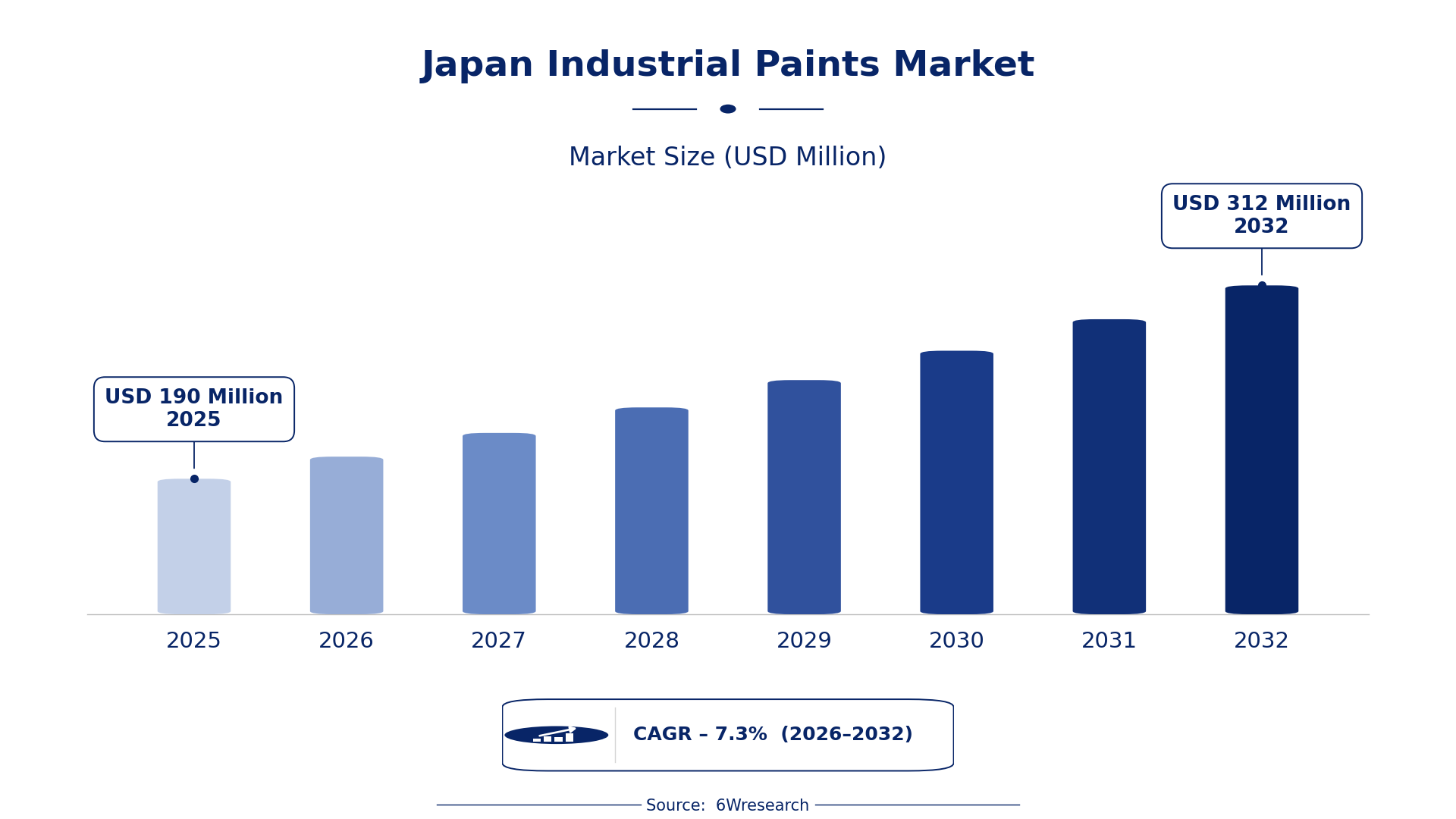
According to 6Wresearch internal database and industry insights, the Japan Industrial Paints Market was valued at USD 190 Million in 2025 and is projected to reach USD 312 Million by 2032, growing at a CAGR of approximately 7.3% during 2026–2032.
Japan Industrial Paints Market Highlights
| Report Metric | Details |
| Report Name | Japan Industrial Paints Market (2026-2032) |
| Market Size 2025 | USD 190 Million |
| Market Size 2032 | USD 312 Million |
| Absolute Growth 2025–2032 | USD 122 Million |
| CAGR 2026–2032 | 7.3% |
| Peak Annual Growth | 8.1% in 2028 |
| Forecast Period | 2026–2032 |
| Historical Data | 2022–2025 |
| Base Year | 2025 |
| Leading Paint Type, 2025 | Epoxy Paints (35% share) |
| Leading Base Type, 2025 | Water-Based (41% share) |
| Leading Coating Technology, 2025 | Spray Coating (38% share) |
| Leading Application, 2025 | Equipment Protection (43% share) |
| Leading End User Industry, 2025 | Automotive (47% share) |
| Fastest-Growing Paint Type | Polyurethane Paints (9.8% CAGR) |
| Fastest-Growing Coating Technology | Electrostatic Coating (10.1% CAGR) |
| Fastest-Growing Application | Surface Finishing (9.4% CAGR) |
| Fastest-Growing End User Industry | Construction (9.0% CAGR) |
| Growing Sector | construction |
| Key End Users | automotive, construction, heavy industry |
Japan Industrial Paints Market Year-wise Growth Rate and Key Drivers (2022–2032)
This graph illustrates the annual growth rates of the market from 2022 to 2032, highlighting a steady upward trajectory and projected market expansion over the forecast period.
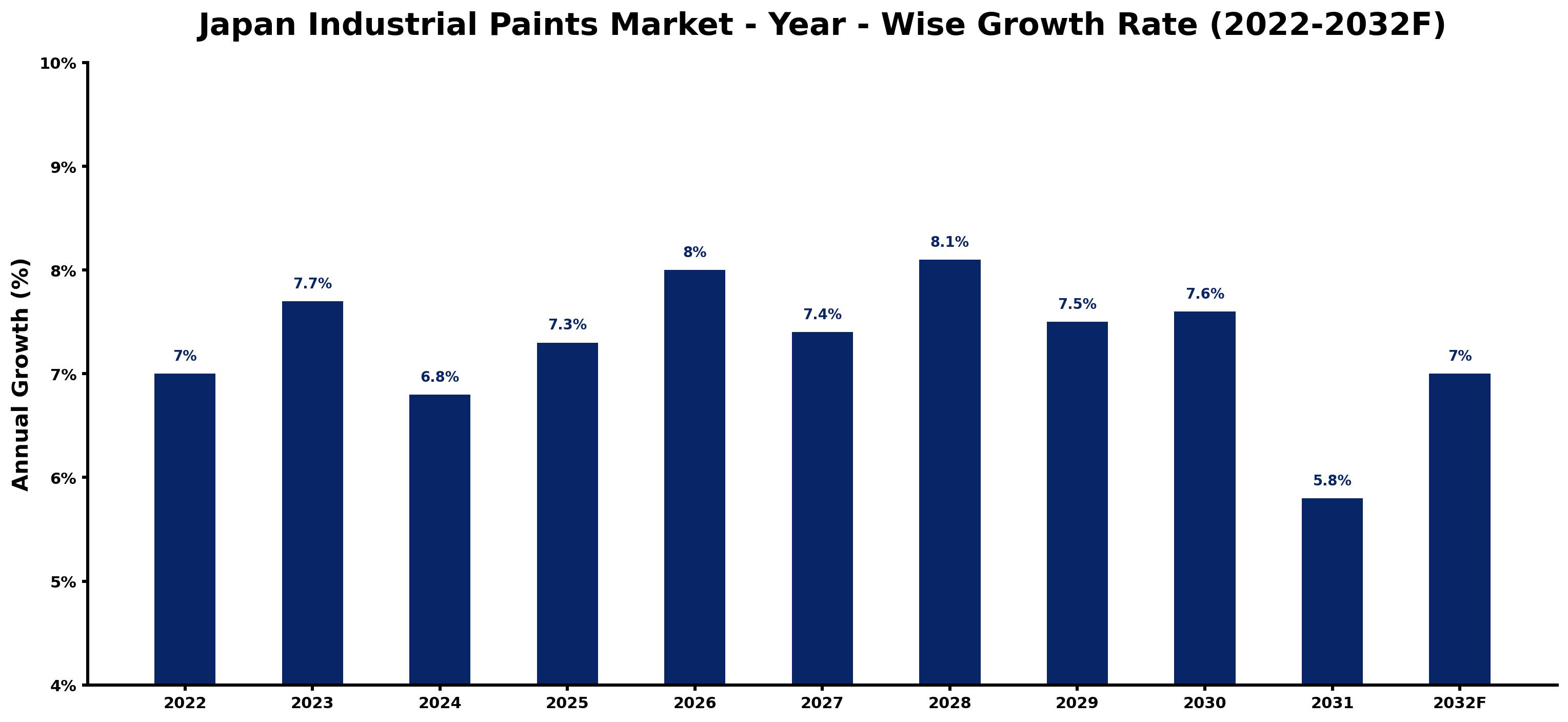
The following figures match every annual growth estimate with the main market development of that year, giving the reasoning behind each rise or slowdown.
| Year | Estimated Annual Growth (%) | Market Rationale |
| 2022 | 7.0 | The automotive sector maintained strong production levels, supporting paint demand. |
| 2023 | 7.7 | Growth accelerated as manufacturing activities expanded, particularly in automotive. |
| 2024 | 6.8 | Demand growth slowed as supply chain issues impacted production rates. |
| 2025 | 7.3 | Manufacturers increased output, responding to rising orders from various sectors. |
| 2026 | 8.0 | The automotive industry is expected to boost paint demand with new models. |
| 2027 | 7.4 | Growth is projected to decelerate as market saturation begins to affect orders. |
| 2028 | 8.1 | A surge in eco-friendly paint adoption will drive demand higher than before. |
| 2029 | 7.5 | Demand growth is expected to moderate as manufacturers adjust to market conditions. |
| 2030 | 7.6 | Increased investment in construction projects is projected to support growth. |
| 2031 | 5.8 | A slowdown is anticipated as the market stabilises after rapid growth. |
| 2032 | 7.0 | Demand is projected to rise as industries increasingly adopt sustainable practices. |
Note: Market size estimations and growth projections presented in this report are based on 6Wresearch's proprietary forecasting methodology, utilizing the latest available industry data, government publications, and primary research inputs.
Japan Industrial Paints Market Synopsis
Industrial paints serve to protect and enhance the durability of surfaces, made from polymers, resins, and pigments. The Japan Industrial Paints Market is expanding due to strong automotive production, with over 8 million vehicles manufactured in 2022. The construction sector is projected to consume approximately 30% of total industrial paint production, while new regulations promote eco-friendly coatings, driving further demand for sustainable products.
Market Dynamics Impact Analysis (2026–2032)
| Factor | Type | Impact | Primary Segment Affected |
| Strong automotive production drives demand for industrial paints. | Driver | High | Epoxy Paints |
| Eco-friendly regulations are increasing the adoption of water-based paints. | Driver | High | Water-Based |
| Rising construction activities present opportunities for protective coatings. | Opportunity | High | Construction |
| Growing demand for sustainable products opens new market avenues. | Opportunity | Medium | Polyurethane Paints |
| Supply chain disruptions can limit paint availability. | Restraint | High | Solvent-Based |
| Environmental regulations may increase production costs for manufacturers. | Restraint | Medium | Powder-Based |
| Competition from alternative coatings may affect market share. | Challenge | High | Acrylic Paints |
| Technological advancements require continuous investment in R&D. | Challenge | Medium | Electrostatic Coating |
Evaluation of Drivers in Japan Industrial Paints Market (2026–2032)
Key forces behind demand, with the segment each one moves most, are listed below.
| Drivers | Primary Segment Affected | Why It Matters (Evidence) |
| The automotive sector's production of over 8 million vehicles in 2022 drives demand for epoxy paints. | Epoxy Paints | This production volume necessitates durable coatings for vehicle protection. |
| JIS standards promoting environmentally friendly products boost water-based paint adoption. | Water-Based | These standards encourage manufacturers to switch to safer, eco-friendly formulations. |
| Growth in the construction sector, projected to consume about 30% of total industrial paint production, fuels demand for polyurethane paints. | Polyurethane Paints | Increased construction activities require high-performance coatings for durability. |
| The Tokyo region, a major manufacturing hub, supports industrial paint production. | Solvent-Based | The concentration of factories improves supply chain efficiency and availability. |
| The push for sustainable practices in industries increases demand for powder coatings. | Powder-Based | These coatings offer durability without solvents, aligning with environmental goals. |
Behind the steady rise in orders sits the automotive sector, which produced over 8 million vehicles in 2022, driving demand for epoxy paints. Growth in the construction sector, projected to consume about 30% of total industrial paint production, is expected to further increase demand for polyurethane paints. JIS standards promoting environmentally friendly products are encouraging a shift towards water-based paints. The growing emphasis on sustainability is leading to increased adoption of powder coatings, which align with eco-friendly practices. The Tokyo region's manufacturing capabilities enhance supply chain efficiency, supporting the overall demand for solvent-based paints.
Evaluation of Restraints in Japan Industrial Paints Market
The main factors holding the market back are set out below.
| Market Restraint | Primary Segment Affected | Why It Matters (Evidence) |
| Supply chain disruptions have limited the availability of solvent-based paints. | Solvent-Based | These disruptions can delay production schedules and affect project timelines. |
| Environmental regulations may increase production costs for powder-based paints. | Powder-Based | Compliance with these regulations often requires investment in new technologies. |
| Competition from alternative coatings can impact market share for acrylic paints. | Acrylic Paints | As alternatives gain popularity, traditional acrylic paints may see reduced demand. |
| Technological advancements necessitate continuous investment in R&D for electrostatic coatings. | Electrostatic Coating | Failure to keep up with technology can lead to obsolescence in the market. |
| Rising raw material costs can constrain profit margins for epoxy paints. | Epoxy Paints | Higher costs may force manufacturers to increase prices, affecting competitiveness. |
Japan Industrial Paints Market Challenges
High raw material prices have raised production costs for suppliers, forcing them to increase prices for buyers in the automotive sector, which produced over 8 million vehicles in 2022. Strict regulations on VOC emissions from the Tokyo Metropolitan Government complicate compliance for producers, leading to potential fines and project delays for buyers. Competition among producers has intensified, resulting in price wars that erode profit margins for suppliers and create uncertainty for buyers. The increasing demand for eco-friendly coatings adds pressure on suppliers, as they must invest in new formulations to meet buyer expectations and regulatory standards, impacting their financial stability.
Trends in the Japan Industrial Paints Market
Buyers and suppliers in the Japan Industrial Paints Market are adjusting to the following trends.
- Shift from Solvent-Based to Water-Based Paints: The transition to water-based paints began in 2023 as environmental regulations tightened. The Tokyo Metropolitan Government's initiative to reduce VOC emissions has accelerated this shift, with water-based paints now accounting for a growing portion of industrial paint production.
- Transition to Eco-Friendly Coatings in Construction: In 2023, the Japanese government launched a program promoting eco-friendly coatings in construction. This initiative aligns with Japan's target of a 46% reduction in greenhouse gas emissions by 2030, encouraging builders to adopt sustainable materials.
- Emergence of Powder Coatings in Automotive Applications: Powder coatings have gained traction in automotive applications since 2022, driven by their sustainability benefits. The automotive sector's shift towards environmentally friendly practices is reflected in the increasing use of powder coatings for vehicle finishes.
- Growing Demand for Electrostatic Coating Technology: Electrostatic coating technology has become increasingly popular since 2023, particularly in automotive and heavy industries. This method improves coating efficiency and reduces waste, aligning with sustainability goals.
Investment Opportunities in the Japan Industrial Paints Market
Below are the investment opportunities with the strongest case in the Japan Industrial Paints Market.
- Supply of Eco-Friendly Water-Based Paints: With a growing emphasis on sustainability, there is a strong opportunity to supply water-based paints. The construction industry, projected to consume about 30% of total industrial paint production, is actively seeking eco-friendly options.
- Investment in Powder Coating Facilities: Investing in powder coating facilities in the Tokyo region can capture the rising demand for sustainable coatings. The automotive sector is increasingly adopting these coatings, presenting a market opportunity.
- Partnerships for Electrostatic Coating Technology: Forming partnerships with manufacturers focusing on electrostatic coating technology can enhance market presence. The automotive industry is a key buyer group that requires efficient coating solutions.
- Development of High-Performance Polyurethane Paints: The automotive sector's demand for high-performance polyurethane paints is increasing. Collaborating with automotive manufacturers can help meet this growing need.
Government Initiatives in the Japan Industrial Paints Market
The GX Promotion Act (2023) establishes a framework for promoting eco-friendly practices in industrial sectors. This law complements existing regulations that mandate energy efficiency improvements, thus supporting the industry's commitment to sustainability. By encouraging eco-friendly coatings, it directly impacts the production and use of industrial paints, fostering a shift towards greener alternatives.
Various government agencies support the GX Promotion Act, encouraging the use of eco-friendly coatings in construction. This initiative aims to reduce greenhouse gas emissions and promote sustainable building practices, impacting the demand for industrial paints. The programme is expected to facilitate investments of around JPY 150 trillion over the next decade, significantly influencing the market.
Future Insight of the Japan Industrial Paints Market
By 2032, buyers in the automotive sector will increasingly demand eco-friendly coatings, driven by government initiatives promoting sustainability. Suppliers will need to innovate product formulations to comply with Japan's target of a 46% reduction in greenhouse-gas emissions by 2030. The Tokyo region will remain a key manufacturing hub, supported by JPY 150 trillion in decarbonisation investments over the next decade. This shift will create opportunities for suppliers to expand their offerings in water-based and powder coatings, aligning with new environmental standards and buyer preferences.
Market Segmentation Analysis
Japan Industrial Paints Market report covers a detailed analysis of the following market segments:
By Paint Type – Epoxy Paints Lead, Polyurethane Paints Expected to Grow Fastest
According to Saurav Kr Singh, Senior Research Analyst at 6Wresearch, the largest paint type category in 2025 was Epoxy Paints, at 35% of revenue. Epoxy paints hold the largest share due to their strong adhesion and chemical resistance, making them essential in various industrial applications. For instance, their widespread use in heavy industries underscores their importance in maintaining equipment durability. The quickest growth will come from Polyurethane Paints, forecast to expand at a CAGR of 9.8% between 2026 and 2032. Polyurethane paints are experiencing rapid growth driven by the increasing demand for high-performance coatings in the automotive sector. The automotive industry, which produced over 8 million vehicles in 2022, is a key market for these durable and flexible finishes. Suppliers should focus on expanding their polyurethane offerings to meet the growing demand in the automotive sector.
By Base Type – Water-Based Leads and Records the Fastest Growth
In 2025, Water-Based led the base type split with a 41% share. Water-based paints dominate Japan's industrial paints market as they comply with environmental regulations, appealing to a wide range of buyers across industries. Their popularity is further supported by the increasing adoption of eco-friendly products, reflecting a significant shift in consumer preferences. Water-Based is also forecast to expand faster than any other category, at a CAGR of 10.2% over 2026–2032. The rapid growth of water-based paints is driven by stringent environmental regulations and a societal push for safer alternatives. This trend is expected to continue as industries increasingly prioritise compliance with these standards. Suppliers must enhance their portfolios of water-based paints to align with regulatory trends and buyer preferences.
By Coating Technology – Spray Coating Leads, Electrostatic Coating Expected to Grow Fastest
With 38% of coating technology revenue in 2025, Spray Coating was the largest category. Spray coating is the leading method due to its effectiveness in achieving uniform application across surfaces, making it essential in industrial environments. This technique is particularly advantageous for large-scale operations where consistent coverage is critical. Electrostatic Coating is projected to grow fastest, at a CAGR of 10.1% during 2026–2032. Electrostatic coating is experiencing rapid growth as it provides an efficient application method, particularly beneficial in automotive and heavy industries. Its ability to minimise waste while maximising coverage makes it increasingly attractive to manufacturers. Suppliers should invest in developing electrostatic coating technologies to meet the rising demand for efficient application methods.
By Application – Equipment Protection Leads, Surface Finishing Expected to Grow Fastest
Equipment Protection took 43% of application revenue in 2025, more than any other category. Equipment protection is the foremost application segment as it is vital for extending the lifespan of industrial machinery, which is crucial for operational efficiency. The focus on safeguarding machinery investments drives the demand for high-quality protective coatings. Surface Finishing is set to record the highest CAGR in this split, 9.4% over 2026–2032. Surface finishing is witnessing swift growth as it plays a key role in enhancing aesthetic appeal across various industries. The increasing emphasis on product presentation and quality is fuelling this rising demand. Buyers will seek advanced surface finishing solutions to improve both the visual and protective qualities of their products.
By End User Industry – Automotive Leads, Construction Expected to Grow Fastest
Automotive accounted for 47% of the market by end user industry in 2025. The automotive industry leads the market for industrial paints, extensively utilising these coatings in vehicle manufacturing to ensure durability and aesthetic appeal. The sector's output, with over 8 million vehicles produced in 2022, underscores its dominant position. The quickest growth will come from Construction, forecast to expand at a CAGR of 9.0% between 2026 and 2032. The construction industry is experiencing the fastest growth due to its increasing need for protective and decorative coatings across various applications. As construction activities expand, the demand for industrial paints in this sector is set to rise significantly. Suppliers should strategically focus on the construction sector to capitalise on the growing demand for coatings in new projects.
Key Attractiveness of the Report
- 10 Years of Market Numbers
- Historical Data Starting from 2022 to 2025
- Base Year 2025
- Forecast Data until 2032
- Key Performance Indicators Impacting the Market
- Major Upcoming Developments and Projects
Key Highlights of the Report:
- Japan Industrial Paints Market Outlook
- Market Size of Japan Industrial Paints Market, 2025
- Forecast of Japan Industrial Paints Market, 2032
- Historical Data and Forecast of Japan Industrial Paints Revenues & Volume for the Period 2022-2032F
- Japan Industrial Paints Market Trend Evolution
- Japan Industrial Paints Market Drivers and Challenges
- Japan Industrial Paints Price Trends
- Japan Industrial Paints Porter's Five Forces
- Japan Industrial Paints Industry Life Cycle
- Historical Data and Forecast of Japan Industrial Paints Market Revenues & Volume By Paint Type for the Period 2022-2032F
- Historical Data and Forecast of Japan Industrial Paints Market Revenues & Volume By Epoxy Paints for the Period 2022-2032F
- Historical Data and Forecast of Japan Industrial Paints Market Revenues & Volume By Polyurethane Paints for the Period 2022-2032F
- Historical Data and Forecast of Japan Industrial Paints Market Revenues & Volume By Acrylic Paints for the Period 2022-2032F
- Historical Data and Forecast of Japan Industrial Paints Market Revenues & Volume By Alkyd Paints for the Period 2022-2032F
- Historical Data and Forecast of Japan Industrial Paints Market Revenues & Volume By Base Type for the Period 2022-2032F
- Historical Data and Forecast of Japan Industrial Paints Market Revenues & Volume By Solvent-Based for the Period 2022-2032F
- Historical Data and Forecast of Japan Industrial Paints Market Revenues & Volume By Water-Based for the Period 2022-2032F
- Historical Data and Forecast of Japan Industrial Paints Market Revenues & Volume By Powder-Based for the Period 2022-2032F
- Historical Data and Forecast of Japan Industrial Paints Market Revenues & Volume By Oil-Based for the Period 2022-2032F
- Historical Data and Forecast of Japan Industrial Paints Market Revenues & Volume By Coating Technology for the Period 2022-2032F
- Historical Data and Forecast of Japan Industrial Paints Market Revenues & Volume By Spray Coating for the Period 2022-2032F
- Historical Data and Forecast of Japan Industrial Paints Market Revenues & Volume By Roller Application for the Period 2022-2032F
- Historical Data and Forecast of Japan Industrial Paints Market Revenues & Volume By Electrostatic Coating for the Period 2022-2032F
- Historical Data and Forecast of Japan Industrial Paints Market Revenues & Volume By Brushing Application for the Period 2022-2032F
- Historical Data and Forecast of Japan Industrial Paints Market Revenues & Volume By Application for the Period 2022-2032F
- Historical Data and Forecast of Japan Industrial Paints Market Revenues & Volume By Equipment Protection for the Period 2022-2032F
- Historical Data and Forecast of Japan Industrial Paints Market Revenues & Volume By Surface Finishing for the Period 2022-2032F
- Historical Data and Forecast of Japan Industrial Paints Market Revenues & Volume By Decorative Finishing for the Period 2022-2032F
- Historical Data and Forecast of Japan Industrial Paints Market Revenues & Volume By Metal Surfaces for the Period 2022-2032F
- Historical Data and Forecast of Japan Industrial Paints Market Revenues & Volume By End User Industry for the Period 2022-2032F
- Historical Data and Forecast of Japan Industrial Paints Market Revenues & Volume By Heavy Industry for the Period 2022-2032F
- Historical Data and Forecast of Japan Industrial Paints Market Revenues & Volume By Automotive for the Period 2022-2032F
- Historical Data and Forecast of Japan Industrial Paints Market Revenues & Volume By Consumer Products for the Period 2022-2032F
- Historical Data and Forecast of Japan Industrial Paints Market Revenues & Volume By Construction for the Period 2022-2032F
- Japan Industrial Paints Import Export Trade Statistics
- Market Opportunity Assessment By Paint Type
- Market Opportunity Assessment By Base Type
- Market Opportunity Assessment By Coating Technology
- Market Opportunity Assessment By Application
- Market Opportunity Assessment By End User Industry
- Japan Industrial Paints Top Companies Market Share
- Japan Industrial Paints Competitive Benchmarking By Technical and Operational Parameters
- Japan Industrial Paints Company Profiles
- Japan Industrial Paints Key Strategic Recommendations
Market Covered
Coverage by segment is as follows.
By Paint Type
- Epoxy Paints
- Polyurethane Paints
- Acrylic Paints
- Alkyd Paints
By Base Type
- Solvent-Based
- Water-Based
- Powder-Based
- Oil-Based
By Coating Technology
- Spray Coating
- Roller Application
- Electrostatic Coating
- Brushing Application
By Application
- Equipment Protection
- Surface Finishing
- Decorative Finishing
- Metal Surfaces
By End User Industry
- Heavy Industry
- Automotive
- Consumer Products
- Construction































