Japan Industrial Particulate Monitor Market Size & Growth Rate
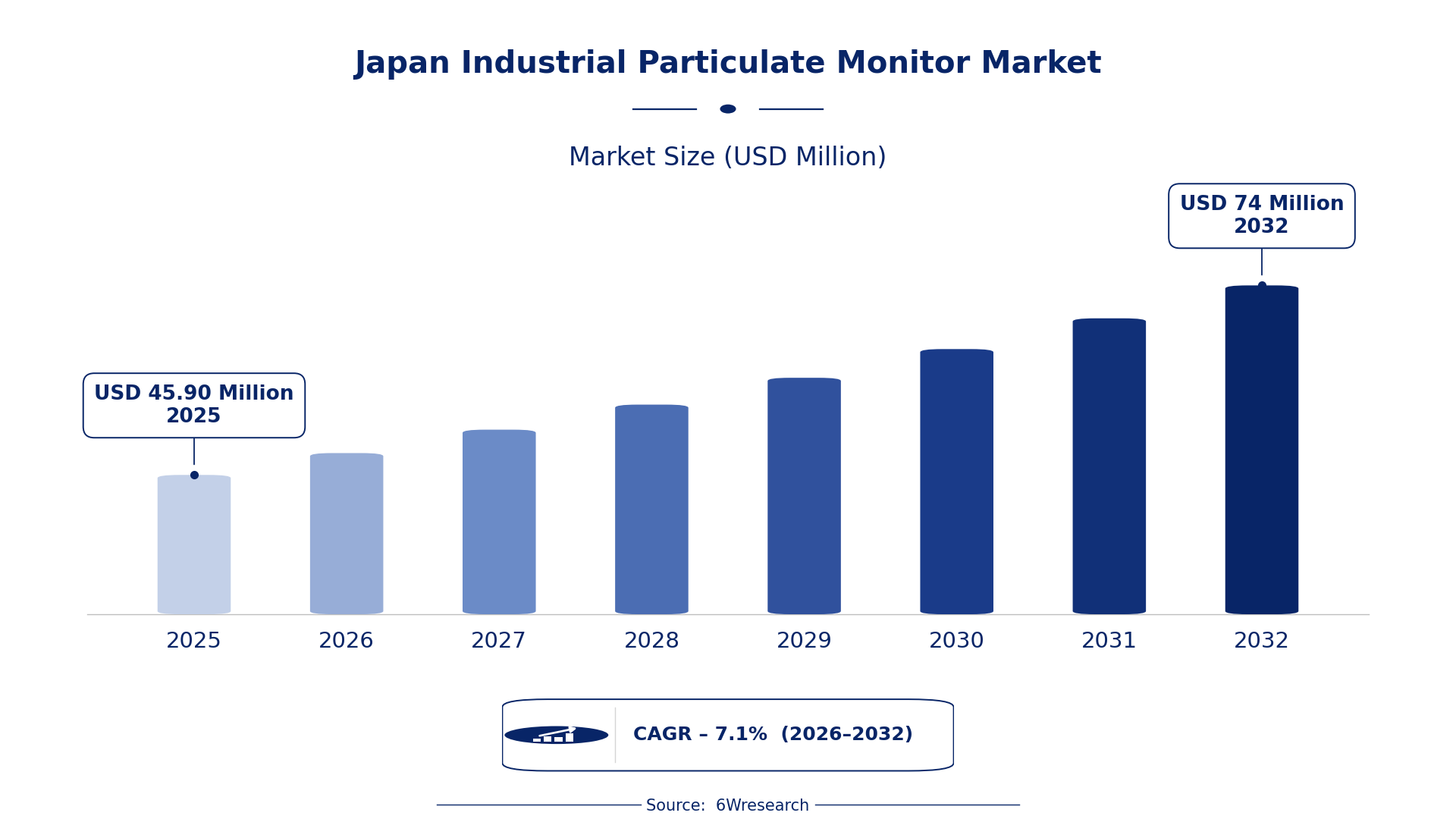
According to 6Wresearch internal database and industry insights, the Japan Industrial Particulate Monitor Market was valued at USD 45.90 Million in 2025 and is projected to reach USD 74 Million by 2032, growing at a CAGR of approximately 7.1% during 2026–2032.
Japan Industrial Particulate Monitor Market Highlights
| Report Metric | Details |
| Report Name | Japan Industrial Particulate Monitor Market (2026-2032) |
| Market Size 2025 | USD 45.90 Million |
| Market Size 2032 | USD 74 Million |
| Absolute Growth 2025–2032 | USD 28.10 Million |
| CAGR 2026–2032 | 7.1% |
| Peak Annual Growth | 7.5% in 2031 |
| Forecast Period | 2026–2032 |
| Historical Data | 2022–2025 |
| Base Year | 2025 |
| Leading Monitor Type, 2025 | Optical Monitors (37% share) |
| Leading Measurement Method, 2025 | Light Scattering (48% share) |
| Leading Sensor Type, 2025 | Infrared Sensors (44% share) |
| Leading Application, 2025 | Emission Monitoring (49% share) |
| Leading End User Industry, 2025 | Semiconductor Facilities (42% share) |
| Fastest-Growing Monitor Type | Gravimetric Monitors (9.8% CAGR) |
| Fastest-Growing Sensor Type | Mechanical Sensors (10.3% CAGR) |
| Fastest-Growing Application | Air Quality Monitoring (9.4% CAGR) |
| Fastest-Growing End User Industry | Chemicals and Materials (10.6% CAGR) |
| Growing Sector | Semiconductor Facilities |
| Key End Users | Semiconductor manufacturers, power generation units, chemical manufacturers, urban planners |
Japan Industrial Particulate Monitor Market Year-wise Growth Rate and Key Drivers (2022–2032)
This graph illustrates the annual growth rates of the market from 2022 to 2032, highlighting a steady upward trajectory and projected market expansion over the forecast period.
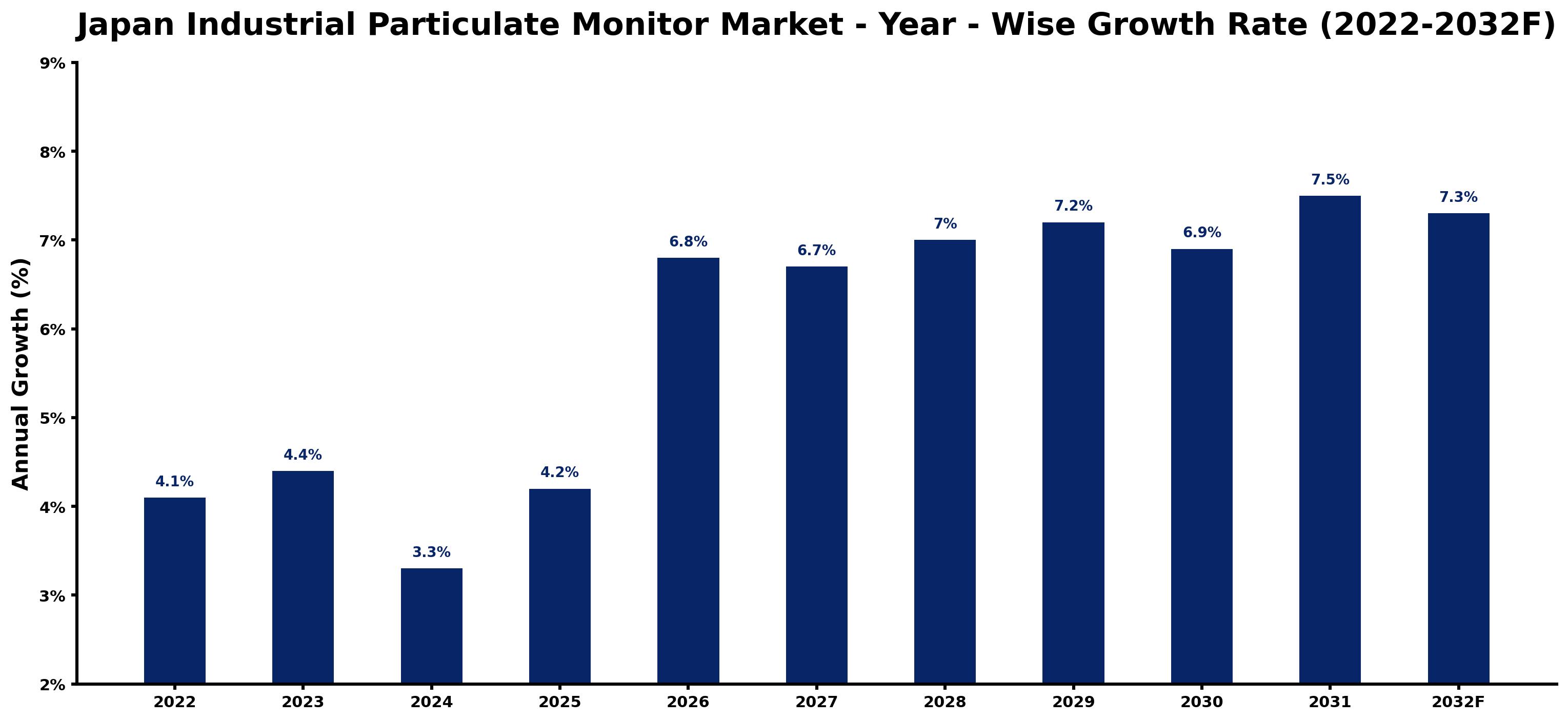
For each year, the table pairs the estimated growth rate with the leading influence on demand, showing how the drivers changed across the period.
| Year | Estimated Annual Growth (%) | Market Rationale |
| 2022 | 4.1 | The market experienced steady growth, reflecting stable demand from semiconductor facilities. |
| 2023 | 4.4 | Growth was driven by increased regulatory focus on air quality monitoring in urban areas. |
| 2024 | 3.3 | A slowdown occurred as companies adjusted to new emission standards and technologies. |
| 2025 | 4.2 | Demand accelerated again due to rising investments in cleanroom monitoring technologies. |
| 2026 | 6.8 | Growth is projected to surge as industries expand operations, particularly in semiconductor manufacturing. |
| 2027 | 6.7 | A slight slowdown is anticipated as market saturation begins in certain segments. |
| 2028 | 7.0 | Growth is expected to resume as air quality concerns prompt further investments in monitoring systems. |
| 2029 | 7.2 | Demand is likely to increase due to ongoing urbanisation and stricter environmental regulations. |
| 2030 | 6.9 | The market is expected to experience a slowdown as companies focus on optimising existing systems. |
| 2031 | 7.5 | Growth is projected to peak as investments in emission monitoring technologies are realised. |
| 2032 | 7.3 | A slight slowdown is expected, yet demand will remain strong due to ongoing regulatory pressures. |
Note: Market size estimations and growth projections presented in this report are based on 6Wresearch's proprietary forecasting methodology, utilizing the latest available industry data, government publications, and primary research inputs.
Japan Industrial Particulate Monitor Market Synopsis
Industrial particulate monitors measure airborne particles using advanced sensor technologies, essential for applications such as emission monitoring and air quality assessment. The Japan Industrial Particulate Monitor Market is expanding due to stringent air quality regulations, particularly in urban areas like Tokyo, and substantial investments in cleanroom technologies. The government's commitment to reducing greenhouse gas emissions by 46% by 2030 further drives demand, leading to increased purchases from industries such as semiconductor manufacturing and power generation.
Market Dynamics Impact Analysis (2026–2032)
| Factor | Type | Impact | Primary Segment Affected |
| Increasing regulatory requirements for air quality monitoring | Driver | High | Emission Monitoring |
| Growing investments in cleanroom technologies | Driver | High | Cleanroom Monitoring |
| Expansion of semiconductor manufacturing facilities | Opportunity | High | Semiconductor Facilities |
| Rising demand for advanced air quality monitoring solutions | Opportunity | High | Air Quality Monitoring |
| High costs of advanced monitoring technologies | Restraint | Medium | Emission Monitoring |
| Limited awareness of particulate monitoring benefits in smaller industries | Restraint | Medium | Workplace Safety |
| Challenges in integrating new technologies into existing systems | Challenge | High | Cleanroom Monitoring |
| Shortage of skilled personnel for operating advanced monitoring systems | Challenge | Medium | Air Quality Monitoring |
Evaluation of Drivers in Japan Industrial Particulate Monitor Market (2026–2032)
These are the developments adding the most demand over the forecast period.
| Drivers | Primary Segment Affected | Why It Matters (Evidence) |
| Stringent air quality regulations | Emission Monitoring | The Tokyo metropolitan area mandates continuous particulate monitoring, increasing demand for compliant devices, with compliance costs averaging 20% of operational budgets. |
| Investment in semiconductor manufacturing | Semiconductor Facilities | The semiconductor sector utilises approximately 80% of particulate monitors, driving higher purchases and compliance investments. |
| Technological advancements in monitoring solutions | Cleanroom Monitoring | ISO 14644 standards encourage adoption of advanced monitoring technologies for compliance, impacting over 70% of cleanroom facilities. |
| Government initiatives for urban air quality improvement | Air Quality Monitoring | In 2023, a program was launched to improve monitoring in urban areas, boosting demand for advanced solutions by 15%. |
| Increasing public awareness of health impacts from air pollution | Workplace Safety | Growing concerns about PM2.5 exposure lead industries to invest in monitoring systems, with demand rising by 10% annually. |
Buyers are adding capacity as Japan targets a 46% cut in greenhouse-gas emissions by 2030, prompting industries to invest in emission monitoring technologies. The semiconductor sector utilises a large share of particulate monitors, driving compliance purchases. Continuous monitoring is mandated in urban areas, resulting in increased demand for advanced solutions. Public awareness of health impacts from air pollution is pushing industries to invest in workplace safety measures, with demand rising annually.
Evaluation of Restraints in Japan Industrial Particulate Monitor Market
These are the pressures that could keep growth below its potential.
| Market Restraint | Primary Segment Affected | Why It Matters (Evidence) |
| High costs associated with advanced monitoring technologies | Emission Monitoring | The initial investment for sophisticated particulate monitors can deter smaller companies from compliance, with costs reaching up to 20% of operational budgets. |
| Limited understanding of particulate monitoring benefits | Workplace Safety | Many smaller industries lack awareness of the advantages of investing in particulate monitors, resulting in lower adoption rates. |
| Integration challenges with existing systems | Cleanroom Monitoring | New technologies may require adjustments to current operational setups, causing delays in adoption by several months. |
| Regulatory compliance complexities | Air Quality Monitoring | Navigating various standards can overwhelm companies, resulting in potential non-compliance and fines. |
| Dependence on skilled personnel for operation | Air Quality Monitoring | A shortage of trained staff can hinder effective operation and maintenance of monitoring systems, impacting efficiency. |
Japan Industrial Particulate Monitor Market Challenges
Japan's industrial sector struggles with a shortage of skilled technicians, causing project delays of up to six months for manufacturers. High operational costs arise from stringent air quality regulations in the Tokyo metropolitan area, increasing expenses by 20% for clinics and hospitals. Intense competition in the semiconductor industry forces suppliers to reduce prices, which tightens profit margins and limits their ability to invest in new technologies. Recent regulatory changes, including the GX Basic Policy, require significant investments in monitoring technologies, straining producers' budgets and delaying projects by up to a year.
Trends in the Japan Industrial Particulate Monitor Market
Several trends are reshaping the Japan Industrial Particulate Monitor Market; the most important are set out below.
- Shift from Basic to Advanced Monitoring Technologies: Semiconductor facilities are increasingly adopting advanced monitoring technologies, with 80% of particulate monitors used in this sector. This shift is driven by stricter compliance requirements and a growing emphasis on air quality standards.
- Transition from Traditional to Real-time Monitoring Solutions: In 2023, the Japanese government initiated a program to improve urban air quality monitoring, resulting in a rise in real-time monitoring solutions. This change reflects the need for immediate data to address air quality issues effectively.
- Emerging Focus on Workplace Safety: As awareness of health impacts from air pollution grows, industries are prioritising workplace safety. This trend is reflected in the increased demand for particulate monitors, particularly in sectors like chemicals and materials.
- Prioritisation of Environmental Compliance: The GX Basic Policy adopted in 2023 emphasises decarbonisation and environmental compliance, prompting industries to invest in advanced monitoring technologies. This policy shift is projected to drive growth in the market.
Investment Opportunities in the Japan Industrial Particulate Monitor Market
Where to invest in the Japan Industrial Particulate Monitor Market: the main openings are set out below.
- Partnerships with local manufacturers: Companies can enter the market through partnerships with local manufacturers in the Kansai region, where chemical manufacturing is prominent. This collaboration can help meet the growing demand for particulate monitoring systems.
- Investment in cleanroom facilities: With a projected growth rate of 9.4% in air quality monitoring, a gap exists in cleanroom technologies. Investing in cleanroom facilities can address the needs of semiconductor manufacturers and other industries.
- Approval for advanced monitoring technologies: The GX Promotion Act provides a pathway for companies to certify new monitoring technologies. This certification can facilitate market entry for advanced solutions, particularly in semiconductor facilities.
- Focus on urban air quality solutions: The government’s 2023 programme to improve urban air quality presents an opportunity for suppliers of advanced particulate monitors. Companies can target urban areas with high pollution levels to comply with regulatory demands.
Government Initiatives in the Japan Industrial Particulate Monitor Market
The Act on the Rational Use of Energy, established in 1979, mandates large energy users to improve efficiency and report energy use. This law has increased demand for monitoring technologies to ensure adherence to energy efficiency standards. The GX Promotion Act, adopted in 2023, supports decarbonisation efforts by facilitating investments in advanced monitoring technologies.
The GX Basic Policy aims for JPY 150 trillion in public-private decarbonisation investment over the next decade, benefiting buyers in the semiconductor industry. The Ministry of the Environment oversees emission monitoring regulations, ensuring that industries comply with standards that improve air quality.
Future Insight of the Japan Industrial Particulate Monitor Market
By 2032, the policy-driven shift towards greenhouse-gas reduction will increase demand for advanced particulate monitors, leading suppliers to innovate. The government's commitment to decarbonisation will result in improved monitoring capabilities across various sectors, benefiting buyers with better data accuracy. New standards will refine monitoring practices, ensuring compliance and safety. Urban air quality initiatives will drive the adoption of sophisticated sensors, creating opportunities for suppliers to expand their product offerings.
Market Segmentation Analysis
Japan Industrial Particulate Monitor Market report covers a detailed analysis of the following market segments:
By Monitor Type – Optical Monitors Lead, Gravimetric Monitors Expected to Grow Fastest
According to Saurav Kr Singh, Senior Research Analyst at 6Wresearch, Optical Monitors held 37% of the Japan Industrial Particulate Monitor Market by monitor type in 2025. Optical monitors hold the largest share due to their critical role in real-time monitoring of airborne particles, particularly in semiconductor manufacturing where precision is paramount. The stringent air quality regulations in Japan necessitate reliable monitoring solutions, further solidifying their market position. Over 2026–2032, Gravimetric Monitors are expected to post the fastest growth, at a CAGR of 9.8%. Gravimetric monitors are experiencing rapid growth because they provide accurate mass measurements of particulates, which are essential for compliance in the power generation sector. The increasing emphasis on emission monitoring regulations is driving this demand, suggesting a trend towards more precise measurement technologies. Suppliers should enhance gravimetric technologies to align with the rising regulatory requirements.
By Measurement Method – Light Scattering Leads and Records the Fastest Growth
The largest measurement method category in 2025 was Light Scattering, at 48% of revenue. Light scattering methods dominate the market as they are widely used for measuring particulate size and concentration, crucial for compliance in various sectors. Their ability to deliver real-time data is vital for Japan's air quality monitoring initiatives, ensuring their leading position. The same category is also set to grow fastest, at a CAGR of 8.2% during 2026–2032. Light scattering methods are also the fastest-growing segment, with their established presence ensuring that technological advancements will further strengthen their market position. The ongoing urban air quality monitoring initiatives are likely to boost their adoption across multiple industries. Buyers should invest in the latest light scattering technologies to maintain compliance with evolving air quality regulations.
By Sensor Type – Infrared Sensors Lead, Mechanical Sensors Expected to Grow Fastest
With 44% of sensor type revenue in 2025, Infrared Sensors was the largest category. Infrared sensors lead the market because they are commonly used alongside other monitoring technologies, enhancing the accuracy of airborne particle measurements. Their integration into various systems, especially in semiconductor facilities, drives their widespread acceptance and usage. The quickest growth will come from Mechanical Sensors, forecast to expand at a CAGR of 10.3% between 2026 and 2032. Mechanical sensors are experiencing rapid growth as they play a supporting role in particulate measurement, particularly in industries focused on quality control. As the demand for precise monitoring escalates, their importance within the measurement framework is expected to increase. Suppliers must prioritise the integration of mechanical sensors with existing technologies to meet the rising demand for accuracy.
By Application – Emission Monitoring Leads, Air Quality Monitoring Expected to Grow Fastest
Emission Monitoring accounted for 49% of the market by application in 2025. Emission monitoring is the leading application due to its critical importance for regulatory compliance across numerous industries, especially in power generation and semiconductor manufacturing. The stringent regulatory environment in Japan necessitates continuous monitoring, driving demand for these systems. Air Quality Monitoring is projected to grow fastest, at a CAGR of 9.4% during 2026–2032. Air quality monitoring is the fastest-growing application as urban areas adopt stricter environmental compliance measures, propelled by government initiatives. The heightened public awareness regarding air quality issues accelerates this trend, indicating a shift towards prioritising environmental health. Suppliers should adapt their offerings to meet the increasing demand for air quality monitoring solutions.
By End User Industry – Semiconductor Facilities Lead, Chemicals and Materials Expected to Grow Fastest
In 2025, Semiconductor Facilities led the end user industry split with a 42% share. Semiconductor facilities dominate the market as they require precise particulate monitoring to maintain air quality standards essential for production processes. The high stakes of contamination control in these facilities ensure a consistent demand for monitoring solutions. Over 2026–2032, Chemicals and Materials are expected to post the fastest growth, at a CAGR of 10.6%. The chemicals and materials sector is experiencing rapid growth in demand for particulate monitors, driven by the need to ensure product quality and compliance with environmental regulations. This trend indicates a broader recognition of the importance of air quality across industries. Suppliers should target the chemicals and materials sector with tailored solutions to capitalise on this growth opportunity.
Key Attractiveness of the Report
- 10 Years of Market Numbers
- Historical Data Starting from 2022 to 2025
- Base Year 2025
- Forecast Data until 2032
- Key Performance Indicators Impacting the Market
- Major Upcoming Developments and Projects
Key Highlights of the Report:
- Japan Industrial Particulate Monitor Market Outlook
- Market Size of Japan Industrial Particulate Monitor Market, 2025
- Forecast of Japan Industrial Particulate Monitor Market, 2032
- Historical Data and Forecast of Japan Industrial Particulate Monitor Revenues & Volume for the Period 2022-2032F
- Japan Industrial Particulate Monitor Market Trend Evolution
- Japan Industrial Particulate Monitor Market Drivers and Challenges
- Japan Industrial Particulate Monitor Price Trends
- Japan Industrial Particulate Monitor Porter's Five Forces
- Japan Industrial Particulate Monitor Industry Life Cycle
- Historical Data and Forecast of Japan Industrial Particulate Monitor Market Revenues & Volume By Monitor Type for the Period 2022-2032F
- Historical Data and Forecast of Japan Industrial Particulate Monitor Market Revenues & Volume By Optical Monitors for the Period 2022-2032F
- Historical Data and Forecast of Japan Industrial Particulate Monitor Market Revenues & Volume By Gravimetric Monitors for the Period 2022-2032F
- Historical Data and Forecast of Japan Industrial Particulate Monitor Market Revenues & Volume By Beta Attenuation for the Period 2022-2032F
- Historical Data and Forecast of Japan Industrial Particulate Monitor Market Revenues & Volume By Electrostatic Monitors for the Period 2022-2032F
- Historical Data and Forecast of Japan Industrial Particulate Monitor Market Revenues & Volume By Measurement Method for the Period 2022-2032F
- Historical Data and Forecast of Japan Industrial Particulate Monitor Market Revenues & Volume By Light Scattering for the Period 2022-2032F
- Historical Data and Forecast of Japan Industrial Particulate Monitor Market Revenues & Volume By Filter Weighing for the Period 2022-2032F
- Historical Data and Forecast of Japan Industrial Particulate Monitor Market Revenues & Volume By Beta Ray Absorption for the Period 2022-2032F
- Historical Data and Forecast of Japan Industrial Particulate Monitor Market Revenues & Volume By Charge Detection for the Period 2022-2032F
- Historical Data and Forecast of Japan Industrial Particulate Monitor Market Revenues & Volume By Sensor Type for the Period 2022-2032F
- Historical Data and Forecast of Japan Industrial Particulate Monitor Market Revenues & Volume By Infrared Sensors for the Period 2022-2032F
- Historical Data and Forecast of Japan Industrial Particulate Monitor Market Revenues & Volume By Mechanical Sensors for the Period 2022-2032F
- Historical Data and Forecast of Japan Industrial Particulate Monitor Market Revenues & Volume By Radiation Sensors for the Period 2022-2032F
- Historical Data and Forecast of Japan Industrial Particulate Monitor Market Revenues & Volume By Electromagnetic Sensors for the Period 2022-2032F
- Historical Data and Forecast of Japan Industrial Particulate Monitor Market Revenues & Volume By Application for the Period 2022-2032F
- Historical Data and Forecast of Japan Industrial Particulate Monitor Market Revenues & Volume By Emission Monitoring for the Period 2022-2032F
- Historical Data and Forecast of Japan Industrial Particulate Monitor Market Revenues & Volume By Workplace Safety for the Period 2022-2032F
- Historical Data and Forecast of Japan Industrial Particulate Monitor Market Revenues & Volume By Air Quality Monitoring for the Period 2022-2032F
- Historical Data and Forecast of Japan Industrial Particulate Monitor Market Revenues & Volume By Cleanroom Monitoring for the Period 2022-2032F
- Historical Data and Forecast of Japan Industrial Particulate Monitor Market Revenues & Volume By End User Industry for the Period 2022-2032F
- Historical Data and Forecast of Japan Industrial Particulate Monitor Market Revenues & Volume By Oil & Gas Plants for the Period 2022-2032F
- Historical Data and Forecast of Japan Industrial Particulate Monitor Market Revenues & Volume By Chemicals and Materials for the Period 2022-2032F
- Historical Data and Forecast of Japan Industrial Particulate Monitor Market Revenues & Volume By Power Generation Units for the Period 2022-2032F
- Historical Data and Forecast of Japan Industrial Particulate Monitor Market Revenues & Volume By Semiconductor Facilities for the Period 2022-2032F
- Japan Industrial Particulate Monitor Import Export Trade Statistics
- Market Opportunity Assessment By Monitor Type
- Market Opportunity Assessment By Measurement Method
- Market Opportunity Assessment By Sensor Type
- Market Opportunity Assessment By Application
- Market Opportunity Assessment By End User Industry
- Japan Industrial Particulate Monitor Top Companies Market Share
- Japan Industrial Particulate Monitor Competitive Benchmarking By Technical and Operational Parameters
- Japan Industrial Particulate Monitor Company Profiles
- Japan Industrial Particulate Monitor Key Strategic Recommendations
Market Covered
The study includes the following segmentation.
By Monitor Type
- Optical Monitors
- Gravimetric Monitors
- Beta Attenuation
- Electrostatic Monitors
By Measurement Method
- Light Scattering
- Filter Weighing
- Beta Ray Absorption
- Charge Detection
By Sensor Type
- Infrared Sensors
- Mechanical Sensors
- Radiation Sensors
- Electromagnetic Sensors
By Application
- Emission Monitoring
- Workplace Safety
- Air Quality Monitoring
- Cleanroom Monitoring
By End User Industry
- Oil & Gas Plants
- Chemicals and Materials
- Power Generation Units
- Semiconductor Facilities































