Japan Industrial Power Quality Market Size & Growth Rate
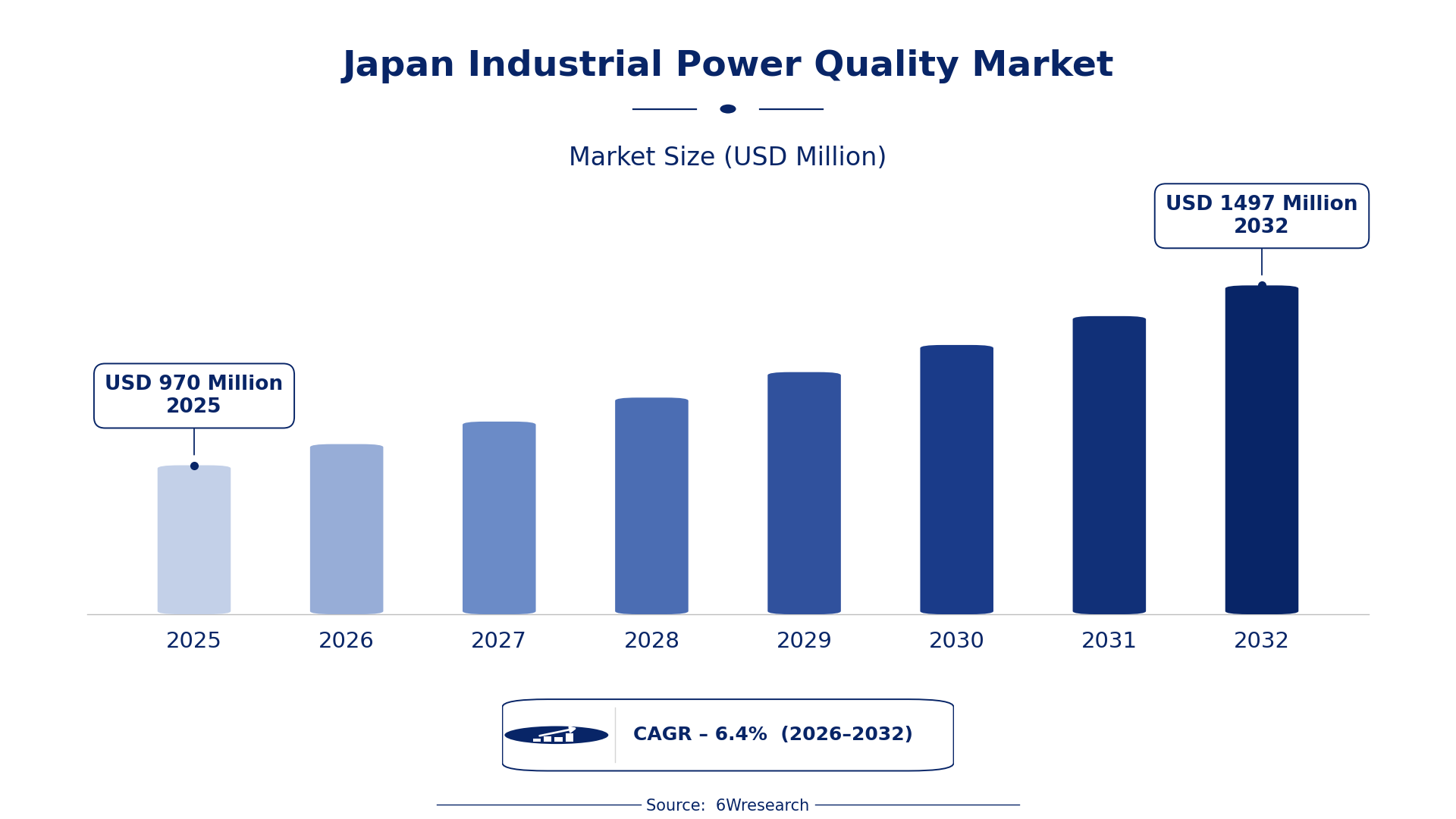
According to 6Wresearch internal database and industry insights, the Japan Industrial Power Quality Market was valued at USD 970 Million in 2025 and is projected to reach USD 1,497 Million by 2032, growing at a CAGR of approximately 6.4% during 2026–2032.
Japan Industrial Power Quality Market Highlights
| Report Metric | Details |
| Report Name | Japan Industrial Power Quality Market (2026-2032) |
| Market Size 2025 | USD 970 Million |
| Market Size 2032 | USD 1,497 Million |
| Absolute Growth 2025–2032 | USD 527 Million |
| CAGR 2026–2032 | 6.4% |
| Peak Annual Growth | 7.4% in 2026 |
| Forecast Period | 2026–2032 |
| Historical Data | 2022–2025 |
| Base Year | 2025 |
| Leading Solution Type, 2025 | UPS Systems (34% share) |
| Leading Issue Addressed, 2025 | Power Interruptions (41% share) |
| Leading Technology Used, 2025 | Battery Inverters (46% share) |
| Leading Deployment Model, 2025 | On-Premise (44% share) |
| Leading End User Industry, 2025 | Manufacturing Plants (43% share) |
| Fastest-Growing Solution Type | Power Conditioners (8.8% CAGR) |
| Fastest-Growing Issue Addressed | Harmonics (8.2% CAGR) |
| Fastest-Growing Deployment Model | Standalone (8.9% CAGR) |
| Fastest-Growing End User Industry | Data Centers (8.5% CAGR) |
| Growing Sector | Manufacturing |
| Key End Users | Manufacturing Plants, Data Centers, Utilities, Oil & Gas Facilities |
Japan Industrial Power Quality Market Year-wise Growth Rate and Key Drivers (2022–2032)
This graph illustrates the annual growth rates of the market from 2022 to 2032, highlighting a steady upward trajectory and projected market expansion over the forecast period.
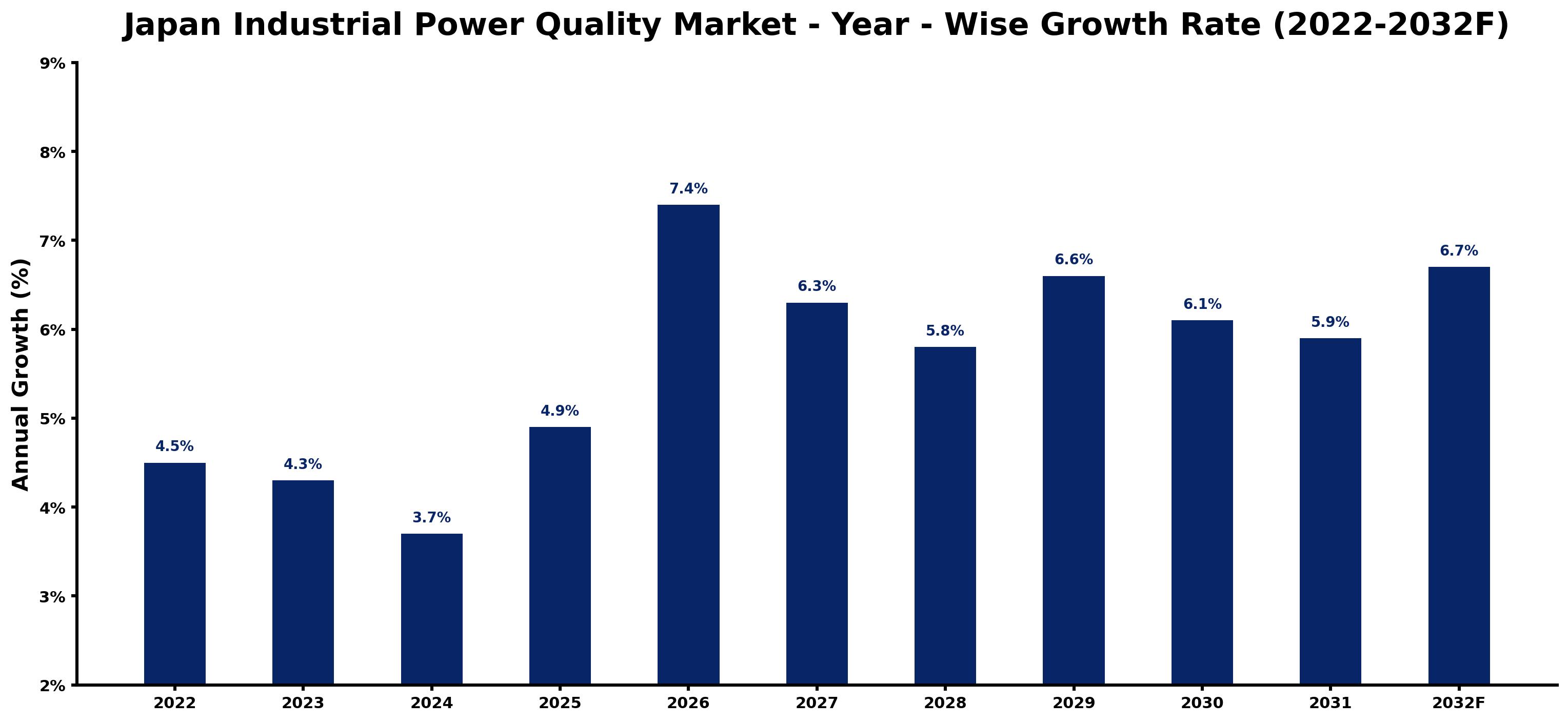
The yearly estimates that follow link every growth rate to its principal driver, so readers can see why the pace changed in each period.
| Year | Estimated Annual Growth (%) | Market Rationale |
| 2022 | 4.5 | The market experienced stable growth due to ongoing industrial activities. |
| 2023 | 4.3 | Growth slowed as energy efficiency initiatives began to take effect. |
| 2024 | 3.7 | Demand continued to rise, albeit at a reduced pace due to market adjustments. |
| 2025 | 4.9 | Growth accelerated as manufacturing plants increased their power quality investments. |
| 2026 | 7.4 | The market peaked, driven by heightened awareness of energy efficiency. |
| 2027 | 6.3 | Growth slowed as investments began to stabilise after the peak. |
| 2028 | 5.8 | Demand is expected to continue growing, supported by ongoing industrial upgrades. |
| 2029 | 6.6 | Growth will pick up again as data centers expand their operations. |
| 2030 | 6.1 | A slight slowdown is expected as market conditions normalise. |
| 2031 | 5.9 | Demand will remain strong, but growth rates are projected to taper off. |
| 2032 | 6.7 | The market is projected to rebound with renewed investments in power quality solutions. |
Note: Market size estimations and growth projections presented in this report are based on 6Wresearch's proprietary forecasting methodology, utilizing the latest available industry data, government publications, and primary research inputs.
Japan Industrial Power Quality Market Synopsis
Industrial Power Quality products ensure the stability and reliability of electrical systems, utilising advanced components like filters and regulators. The Japan Industrial Power Quality Market is growing due to strong demand from manufacturing plants, which account for approximately 30% of total electricity consumption. Key drivers include Japan's ambitious decarbonisation targets, aiming for a 46% reduction in greenhouse gas emissions by 2030, alongside substantial investments in energy-efficient technologies over the next decade.
Market Dynamics Impact Analysis (2026–2032)
| Factor | Type | Impact | Primary Segment Affected |
| Growing demand for energy-efficient solutions | Driver | High | Power Conditioners |
| Increasing investments in manufacturing facilities | Driver | High | UPS Systems |
| Rising need for robust power quality systems | Opportunity | High | Data Centers |
| Expansion of energy efficiency standards | Opportunity | Medium | Voltage Regulators |
| High initial costs of advanced systems | Restraint | High | Surge Protectors |
| Limited awareness of power quality solutions | Restraint | Medium | Power Interruptions |
| Increasing competition from alternative technologies | Challenge | High | Battery Inverters |
| Challenges in integrating new technologies | Challenge | Medium | On-Premise |
Evaluation of Drivers in Japan Industrial Power Quality Market (2026–2032)
Demand rests on the following drivers, each shown with the segment it touches most.
| Drivers | Primary Segment Affected | Why It Matters (Evidence) |
| Demand from manufacturing plants | UPS Systems | Manufacturing plants, employing around 8 million people, increasingly rely on UPS systems to maintain operational continuity. |
| Decarbonisation investments | Power Conditioners | Japan's target of JPY 150 trillion in decarbonisation investments drives demand for power quality improvements. |
| Energy efficiency standards | Voltage Regulators | Energy efficiency standards boost the need for voltage regulators, ensuring compliance with regulations. |
| Data center expansion | Surge Protectors | With over 200 data centers in 2022, the demand for surge protectors has surged to ensure equipment safety. |
| Government incentives for energy-efficient technologies | Battery Inverters | The government's subsidy program for energy-efficient technologies promotes the adoption of battery inverters. |
Purchasing is picking up as manufacturing plants increasingly invest in UPS systems to ensure operational continuity, reflecting a broader trend in the industrial sector. In 2023, decarbonisation investments are projected to reach JPY 150 trillion, driving demand for power conditioners. Energy efficiency standards are boosting the need for voltage regulators, while over 200 data centers in Japan are pushing for surge protectors. Incentives for energy-efficient technologies are facilitating the adoption of battery inverters, further stimulating market growth.
Evaluation of Restraints in Japan Industrial Power Quality Market
These are the pressures that could keep growth below its potential.
| Market Restraint | Primary Segment Affected | Why It Matters (Evidence) |
| High initial costs of advanced systems | Surge Protectors | The high upfront costs of implementing advanced surge protection systems deter some buyers, impacting overall market growth. |
| Limited awareness of power quality solutions | Power Interruptions | Many potential users lack knowledge about the benefits of power quality solutions, hindering wider adoption. |
| Integration challenges with existing systems | Battery Inverters | Integrating new battery inverter technologies with legacy systems can cause delays and increase costs for users. |
| Regulatory compliance complexities | UPS Systems | Navigating the regulatory requirements for UPS systems can be cumbersome, leading to potential project delays. |
| Market competition from alternative technologies | On-Premise | The emergence of alternative technologies creates competitive pressure, challenging the growth of on-premise solutions. |
Japan Industrial Power Quality Market Challenges
In Tokyo, many manufacturers face challenges with outdated power quality systems, leading to increased downtime and production losses. This issue arises from the slow adoption of new technologies, costing these manufacturers approximately JPY 1 trillion annually in lost productivity. Competition among suppliers has intensified, forcing some to compromise on quality to maintain market share, which can result in unreliable solutions for buyers. Skills shortages in advanced power quality technologies hinder firms from implementing effective systems, delaying projects and raising costs for manufacturers by up to 15%. Rising costs of energy-efficient technologies can deter investment, affecting the overall adoption of necessary upgrades in the industrial sector.
Trends in the Japan Industrial Power Quality Market
The trends below show where the Japan Industrial Power Quality Market is heading.
- Shift towards Energy Efficiency: Since 2023, Japan has experienced a shift towards energy-efficient technologies, driven by the GX Basic Policy aiming for a 46% reduction in greenhouse gas emissions by 2030. This has prompted manufacturers to adopt power quality solutions to comply with new standards.
- Transition from Traditional to Advanced Solutions: The move from traditional power quality solutions to advanced systems began in 2023, with new standards introduced. Approximately 1 million UPS systems are now installed, reflecting this transition towards more sophisticated technologies.
- Emerging Demand for Data Centers: In 2022, the demand for power quality solutions surged due to the establishment of over 200 data centers in Japan. This growth highlights the increasing need for reliable power quality systems to ensure operational continuity.
- Prioritisation of Regulatory Compliance: Since 2023, regulatory compliance has become a priority for industrial buyers, particularly under the Act on the Rational Use of Energy. This focus ensures that manufacturers meet energy efficiency standards while optimising their operational costs.
Investment Opportunities in the Japan Industrial Power Quality Market
Investors looking at the Japan Industrial Power Quality Market should consider the following areas.
- Timing for Investment: With Japan's target of JPY 150 trillion in decarbonisation investments over the next decade, there is a strong opportunity for suppliers of energy-efficient technologies in manufacturing facilities to meet new standards.
- Entry through Local Partnerships: Establishing joint ventures with local manufacturers can facilitate entry into the Japanese market, particularly for power quality solutions, allowing for better adaptation to local needs.
- Focus on Data Centers: The growing number of data centers presents a unique opportunity for suppliers of UPS systems and surge protectors, as demand for reliable power quality solutions increases significantly.
- Supply Chain Optimisation: Investing in modular power quality solutions can meet the needs of manufacturers looking to improve energy efficiency and reduce operational costs, particularly in competitive sectors.
Government Initiatives in the Japan Industrial Power Quality Market
The Act on the Rational Use of Energy mandates large energy users to improve energy efficiency and report their energy consumption, influencing the industrial power quality market. This law ensures that manufacturers adopt necessary technologies to comply with energy efficiency standards, improving overall power quality. In 2023, the government set a target to reduce energy losses in utilities by 10% by 2025, which will require significant upgrades in power quality systems.
The GX Promotion Act supports buyers by providing subsidies for energy-efficient technologies. This initiative encourages manufacturing plants to invest in advanced power quality solutions, ensuring compliance with energy standards while reducing operational costs. The government allocated JPY 150 trillion for public and private decarbonisation investments over the next decade, enhancing the market for power quality solutions.
Future Insight of the Japan Industrial Power Quality Market
Japan's investment pipeline for decarbonisation is set to create substantial demand for advanced power quality solutions by 2032. The government's subsidy program for energy-efficient technologies will motivate more firms to upgrade their systems, improving reliability. Widespread adoption of ISO 50001 will drive better energy management practices among manufacturers. The integration of advanced monitoring systems will provide real-time data, enabling better decision-making for energy management. These advancements will create a more resilient power quality market, benefiting both buyers and suppliers.
Market Segmentation Analysis
Japan Industrial Power Quality Market report covers a detailed analysis of the following market segments:
By Solution Type – UPS Systems Lead, Power Conditioners Expected to Grow Fastest
According to Saurav Kr Singh, Senior Research Analyst at 6Wresearch, in 2025, UPS Systems led the solution type split with a 34% share. UPS systems are vital for maintaining power supply during outages, particularly in sectors like manufacturing where operational continuity is crucial. With over 1 million units installed in Japan, their widespread use highlights their importance in various industrial applications. Power Conditioners are projected to grow fastest, at a CAGR of 8.8% during 2026–2032. The rapid growth of power conditioners is driven by the increasing need for improved power quality and reduced disturbances in industrial settings. As facilities adopt energy management standards, the demand for these solutions is expected to rise significantly. Suppliers should focus on enhancing the availability of power conditioners to meet the increasing industrial demand.
By Issue Addressed – Power Interruptions Lead, Harmonics Expected to Grow Fastest
The largest issue addressed category in 2025 was Power Interruptions, at 41% of revenue. Power interruptions are a critical concern for industries, particularly in manufacturing, where downtime can lead to substantial financial losses. The reliance on UPS systems to mitigate these interruptions illustrates their essential role in ensuring operational efficiency. Harmonics are set to record the highest CAGR in this split, 8.2% over 2026–2032. The growing emphasis on managing harmonics is due to the rise of electronic devices that contribute to these disturbances. As industries aim for energy efficiency, the adoption of filtering technologies to address harmonics will accelerate. Buyers need to invest in effective solutions to manage harmonics and comply with energy efficiency standards.
By Technology Used – Battery Inverters Lead and Record the Fastest Growth
With 46% of technology used revenue in 2025, Battery Inverters was the largest category. Battery inverters are crucial components of UPS systems, enabling seamless power supply during outages and optimising energy management. Their integration into various power quality solutions has solidified their position as a leading technology in the market. Battery Inverters are also forecast to expand faster than any other category, at a CAGR of 9.3% over 2026–2032. The demand for battery inverters is expected to grow as they are integral to both UPS systems and power conditioners, ensuring reliable power quality. Their multifunctionality will sustain their leading position and drive further market adoption. Suppliers should prioritise advancements in battery inverter technologies to capitalise on expanding market opportunities.
By Deployment Model – On-Premise Leads, Standalone Expected to Grow Fastest
On-Premise accounted for 44% of the market by deployment model in 2025. On-premise deployment is the preferred choice in facilities that require immediate and reliable power quality solutions, particularly in major industrial hubs like Tokyo and Osaka. This model allows for customised installations that cater to specific operational requirements. The quickest growth will come from Standalone, forecast to expand at a CAGR of 8.9% between 2026 and 2032. Standalone models are gaining popularity due to their flexibility in environments where integrated systems may not be feasible. Their adaptability to various industrial applications is propelling their rapid adoption across multiple sectors. Suppliers should consider expanding their offerings of standalone solutions to meet the diverse deployment needs within the industrial sector.
By End User Industry – Manufacturing Plants Lead, Data Centers Expected to Grow Fastest
Manufacturing Plants held 43% of the Japan Industrial Power Quality Market by end user industry in 2025. Manufacturing plants account for the largest segment of industrial power quality solutions due to their high power demands and the need for reliable operations. The sector's workforce of around 8 million people further drives the demand for power quality technologies. Data Centers are projected to grow fastest, at a CAGR of 8.5% during 2026–2032. Data centers are experiencing rapid growth as they require robust power quality systems to maintain uptime and reliability in a digital world. Their critical role in supporting various industries will lead to increased investment in power quality solutions. Buyers in the data center sector must ensure adequate power quality systems are in place to meet their operational needs.
Key Attractiveness of the Report
- 10 Years of Market Numbers
- Historical Data Starting from 2022 to 2025
- Base Year 2025
- Forecast Data until 2032
- Key Performance Indicators Impacting the Market
- Major Upcoming Developments and Projects
Key Highlights of the Report:
- Japan Industrial Power Quality Market Outlook
- Market Size of Japan Industrial Power Quality Market, 2025
- Forecast of Japan Industrial Power Quality Market, 2032
- Historical Data and Forecast of Japan Industrial Power Quality Revenues & Volume for the Period 2022-2032F
- Japan Industrial Power Quality Market Trend Evolution
- Japan Industrial Power Quality Market Drivers and Challenges
- Japan Industrial Power Quality Price Trends
- Japan Industrial Power Quality Porter's Five Forces
- Japan Industrial Power Quality Industry Life Cycle
- Historical Data and Forecast of Japan Industrial Power Quality Market Revenues & Volume By Solution Type for the Period 2022-2032F
- Historical Data and Forecast of Japan Industrial Power Quality Market Revenues & Volume By Voltage Regulators for the Period 2022-2032F
- Historical Data and Forecast of Japan Industrial Power Quality Market Revenues & Volume By Power Conditioners for the Period 2022-2032F
- Historical Data and Forecast of Japan Industrial Power Quality Market Revenues & Volume By UPS Systems for the Period 2022-2032F
- Historical Data and Forecast of Japan Industrial Power Quality Market Revenues & Volume By Surge Protectors for the Period 2022-2032F
- Historical Data and Forecast of Japan Industrial Power Quality Market Revenues & Volume By Issue Addressed for the Period 2022-2032F
- Historical Data and Forecast of Japan Industrial Power Quality Market Revenues & Volume By Voltage Sags for the Period 2022-2032F
- Historical Data and Forecast of Japan Industrial Power Quality Market Revenues & Volume By Harmonics for the Period 2022-2032F
- Historical Data and Forecast of Japan Industrial Power Quality Market Revenues & Volume By Power Interruptions for the Period 2022-2032F
- Historical Data and Forecast of Japan Industrial Power Quality Market Revenues & Volume By Transients for the Period 2022-2032F
- Historical Data and Forecast of Japan Industrial Power Quality Market Revenues & Volume By Technology Used for the Period 2022-2032F
- Historical Data and Forecast of Japan Industrial Power Quality Market Revenues & Volume By Servo Motors for the Period 2022-2032F
- Historical Data and Forecast of Japan Industrial Power Quality Market Revenues & Volume By Passive Filters for the Period 2022-2032F
- Historical Data and Forecast of Japan Industrial Power Quality Market Revenues & Volume By Battery Inverters for the Period 2022-2032F
- Historical Data and Forecast of Japan Industrial Power Quality Market Revenues & Volume By MOV Devices for the Period 2022-2032F
- Historical Data and Forecast of Japan Industrial Power Quality Market Revenues & Volume By Deployment Model for the Period 2022-2032F
- Historical Data and Forecast of Japan Industrial Power Quality Market Revenues & Volume By On-Premise for the Period 2022-2032F
- Historical Data and Forecast of Japan Industrial Power Quality Market Revenues & Volume By Modular Units for the Period 2022-2032F
- Historical Data and Forecast of Japan Industrial Power Quality Market Revenues & Volume By Standalone for the Period 2022-2032F
- Historical Data and Forecast of Japan Industrial Power Quality Market Revenues & Volume By Plug-In Modules for the Period 2022-2032F
- Historical Data and Forecast of Japan Industrial Power Quality Market Revenues & Volume By End User Industry for the Period 2022-2032F
- Historical Data and Forecast of Japan Industrial Power Quality Market Revenues & Volume By Utilities for the Period 2022-2032F
- Historical Data and Forecast of Japan Industrial Power Quality Market Revenues & Volume By Manufacturing Plants for the Period 2022-2032F
- Historical Data and Forecast of Japan Industrial Power Quality Market Revenues & Volume By Data Centers for the Period 2022-2032F
- Historical Data and Forecast of Japan Industrial Power Quality Market Revenues & Volume By Oil & Gas Facilities for the Period 2022-2032F
- Japan Industrial Power Quality Import Export Trade Statistics
- Market Opportunity Assessment By Solution Type
- Market Opportunity Assessment By Issue Addressed
- Market Opportunity Assessment By Technology Used
- Market Opportunity Assessment By Deployment Model
- Market Opportunity Assessment By End User Industry
- Japan Industrial Power Quality Top Companies Market Share
- Japan Industrial Power Quality Competitive Benchmarking By Technical and Operational Parameters
- Japan Industrial Power Quality Company Profiles
- Japan Industrial Power Quality Key Strategic Recommendations
Market Covered
Segments analysed in this report are listed below.
By Solution Type
- Voltage Regulators
- Power Conditioners
- UPS Systems
- Surge Protectors
By Issue Addressed
- Voltage Sags
- Harmonics
- Power Interruptions
- Transients
By Technology Used
- Servo Motors
- Passive Filters
- Battery Inverters
- MOV Devices
By Deployment Model
- On-Premise
- Modular Units
- Standalone
- Plug-In Modules
By End User Industry
- Utilities
- Manufacturing Plants
- Data Centers
- Oil & Gas Facilities































