Japan Industrial Printing Systems Market Size & Growth Rate
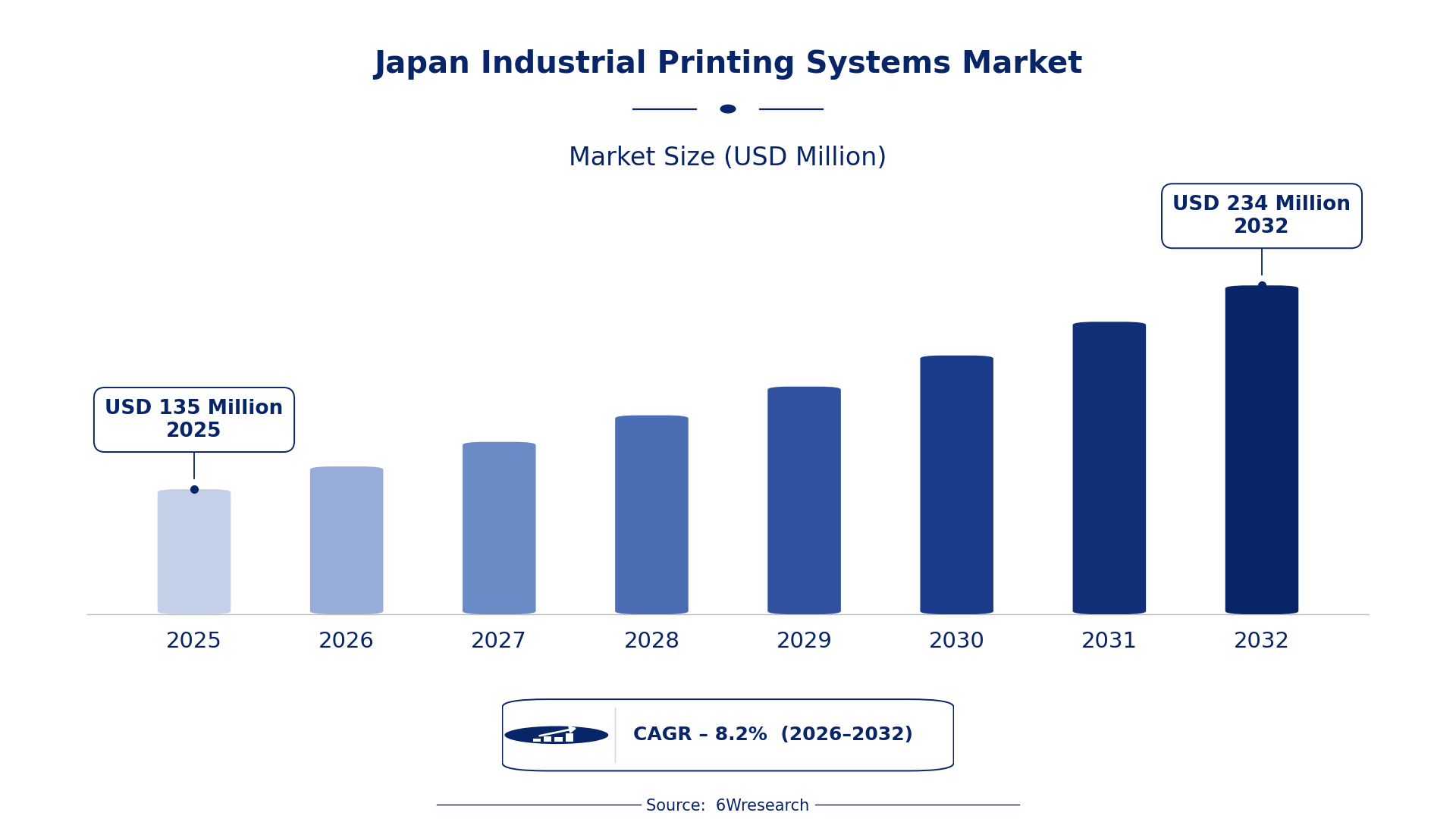
According to 6Wresearch internal database and industry insights, the Japan Industrial Printing Systems Market was valued at USD 135 Million in 2025 and is projected to reach USD 234 Million by 2032, growing at a CAGR of approximately 8.2% during 2026–2032.
Japan Industrial Printing Systems Market Highlights
| Report Metric | Details |
| Report Name | Japan Industrial Printing Systems Market (2026-2032) |
| Market Size 2025 | USD 135 Million |
| Market Size 2032 | USD 234 Million |
| Absolute Growth 2025–2032 | USD 99 Million |
| CAGR 2026–2032 | 8.2% |
| Peak Annual Growth | 9.0% in 2030 |
| Forecast Period | 2026–2032 |
| Historical Data | 2022–2025 |
| Base Year | 2025 |
| Leading Printer Type, 2025 | Inkjet Printers (42% share) |
| Leading Printing Method, 2025 | Non-Contact (43% share) |
| Leading Ink Type, 2025 | Solvent-Based Ink (48% share) |
| Leading Application Area, 2025 | Labeling & Marking (37% share) |
| Leading End User Industry, 2025 | Packaging Industry (36% share) |
| Fastest-Growing Printer Type | 3D Printers (12.0% CAGR) |
| Fastest-Growing Printing Method | Additive Manufacturing (11.4% CAGR) |
| Fastest-Growing Ink Type | Resin/Filament (11.8% CAGR) |
| Fastest-Growing Application Area | Prototype Development (10.0% CAGR) |
| Fastest-Growing End User Industry | Electronics (10.7% CAGR) |
| Growing Sector | Packaging Industry |
| Key End Users | Packaging Industry, Electronics, Retail & Warehousing, Automotive |
Japan Industrial Printing Systems Market Year-wise Growth Rate and Key Drivers (2022–2032)
This graph illustrates the annual growth rates of the market from 2022 to 2032, highlighting a steady upward trajectory and projected market expansion over the forecast period.
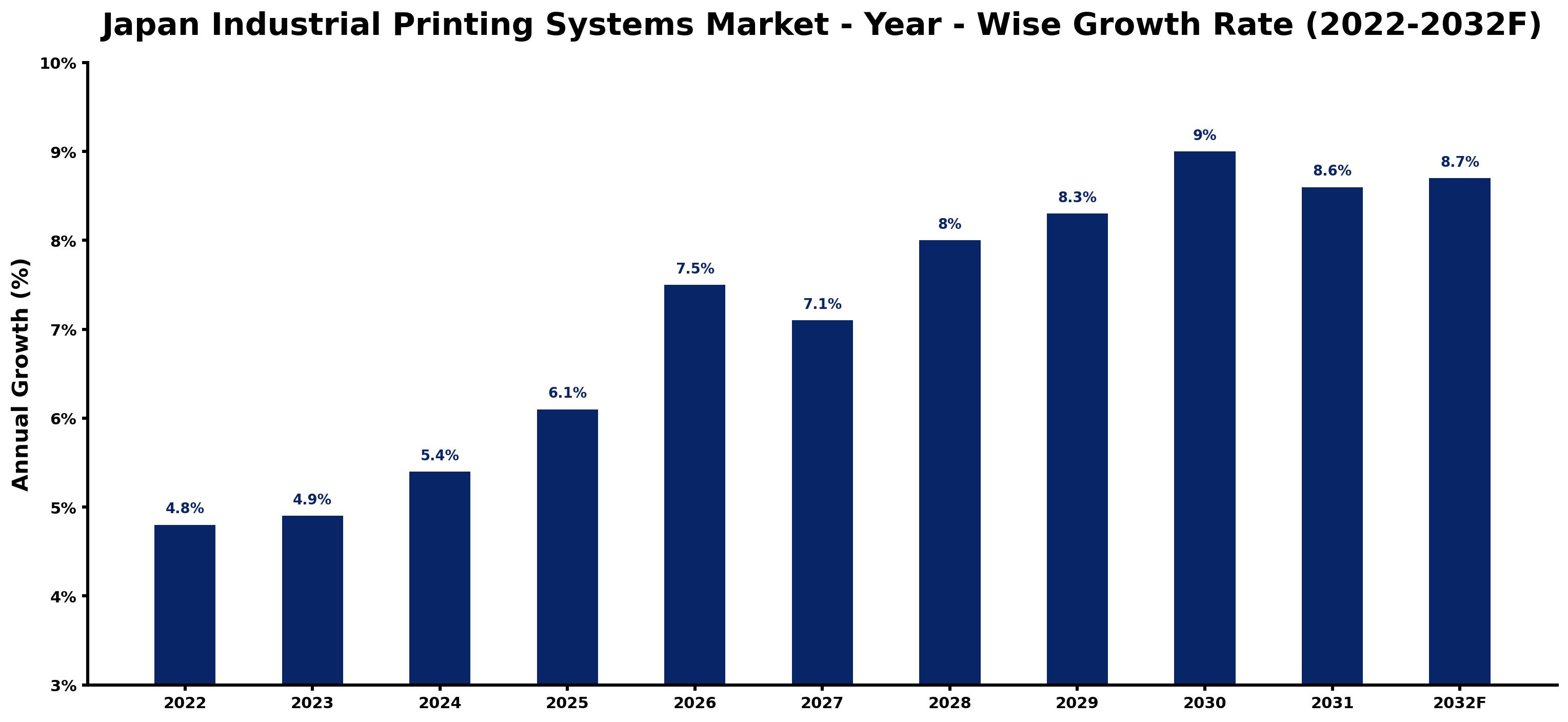
Each row of the following table gives one year's estimated growth and the event or demand shift that explains it.
| Year | Estimated Annual Growth (%) | Market Rationale |
| 2022 | 4.8 | The market showed steady demand, supported by the packaging industry's growth. |
| 2023 | 4.9 | Demand increased due to rising orders from the electronics sector. |
| 2024 | 5.4 | Growth accelerated as manufacturers adopted advanced printing technologies. |
| 2025 | 6.1 | The market peaked with contributions from automotive labeling needs. |
| 2026 | 7.5 | Demand is expected to rise as investments in 3D printing expand. |
| 2027 | 7.1 | Growth slows slightly as the market adjusts to previous peaks. |
| 2028 | 8.0 | Demand is projected to increase with innovations in printing applications. |
| 2029 | 8.3 | The market continues to grow as packaging demands remain strong. |
| 2030 | 9.0 | The peak growth year will see investments in sustainability. |
| 2031 | 8.6 | Growth moderates as the market stabilises after rapid expansion. |
| 2032 | 8.7 | Demand is expected to remain high as new technologies emerge. |
Note: Market size estimations and growth projections presented in this report are based on 6Wresearch's proprietary forecasting methodology, utilizing the latest available industry data, government publications, and primary research inputs.
Japan Industrial Printing Systems Market Synopsis
Industrial printing systems are essential for high-quality printing in various applications, particularly packaging, labeling, and product identification. The Japan Industrial Printing Systems Market is expanding due to strong demand from the packaging and electronics sectors, with the latter generating over 1 trillion yen in revenue in 2022. The government's focus on advanced manufacturing technologies, such as 3D printing, is driving this growth, creating opportunities for suppliers and manufacturers alike.
Market Dynamics Impact Analysis (2026–2032)
| Factor | Type | Impact | Primary Segment Affected |
| Strong demand from the packaging industry drives orders for printing systems. | Driver | High | Packaging Industry |
| Investments in advanced manufacturing technologies are increasing. | Driver | High | 3D Printers |
| Growing need for eco-friendly printing solutions creates market gaps. | Opportunity | High | Solvent-Based Ink |
| Rising demand for customized printing solutions presents new avenues. | Opportunity | Medium | Additive Manufacturing |
| Regulatory standards for ink safety may limit options for producers. | Restraint | High | Solvent-Based Ink |
| High competition among manufacturers can pressure pricing strategies. | Restraint | Medium | Inkjet Printers |
| Limited availability of skilled workforce impacts production efficiency. | Challenge | High | 3D Printers |
| Technological advancements require continuous investment from producers. | Challenge | Medium | Laser Printers |
Evaluation of Drivers in Japan Industrial Printing Systems Market (2026–2032)
The factors lifting demand, and the evidence behind each, are summarised below.
| Drivers | Primary Segment Affected | Why It Matters (Evidence) |
| Increased production in the packaging industry boosts demand for printing systems. | Packaging Industry | The packaging sector accounts for approximately 40% of the total demand for industrial printing systems. |
| The electronics sector's revenue growth drives the need for high-quality printing. | Electronics | Japan's electronics sector generated over 1 trillion yen in revenue in 2022. |
| Government initiatives promote advanced manufacturing technologies. | 3D Printers | A program launched in 2023 supports 3D printing development. |
| The rise in e-commerce increases demand for labeling and marking solutions. | Labeling & Marking | The retail sector has seen a rise in barcode printing applications essential for inventory management. |
| Sustainability trends encourage the use of eco-friendly inks. | Solvent-Based Ink | Regulations under JIS Z 2801 standards impact ink usage in printing applications. |
Behind the steady rise in orders sits the packaging industry's contribution, accounting for about 40% of total demand. In 2022, the electronics sector generated over 1 trillion yen, driving the need for high-quality printing solutions. The growth of e-commerce is increasing demand for labeling solutions, vital for inventory management in retail.
Evaluation of Restraints in Japan Industrial Printing Systems Market
The key brakes on demand, and where they bite hardest, are shown below.
| Market Restraint | Primary Segment Affected | Why It Matters (Evidence) |
| Regulatory standards for ink safety may limit options for producers. | Solvent-Based Ink | Compliance with JIS Z 2801 standards restricts certain ink formulations. |
| High competition among manufacturers can pressure pricing strategies. | Inkjet Printers | Intense rivalry may lead to reduced profit margins for producers. |
| Limited availability of skilled workforce impacts production efficiency. | 3D Printers | A shortage of qualified personnel can delay project timelines. |
| Technological advancements require continuous investment from producers. | Laser Printers | Failure to keep up with technology can lead to obsolescence. |
| Market saturation in certain segments may hinder growth potential. | Thermal Printers | A high number of existing units limits new sales opportunities. |
Japan Industrial Printing Systems Market Challenges
Buyers in the packaging sector face increased operational costs due to outdated printing technology, which can raise expenses by 20% and reduce profit margins. Suppliers struggle with compliance to JIS Z 2801 standards, requiring expensive upgrades to ink formulations that can delay product launches by several months. A lack of skilled workers in advanced printing technologies hampers production efficiency, causing buyers in the automotive sector to miss contracts for over 5 million vehicles annually. Rising prices of eco-friendly materials may lead to a 15% increase in production costs for suppliers, affecting their pricing strategies in competitive markets.
Trends in the Japan Industrial Printing Systems Market
The shifts below are changing how Japan Industrial Printing Systems Market products are bought and supplied.
- Retail Sector Increasing Focus on Barcode Printing: Retailers are embracing advanced barcode printing solutions to enhance inventory management. In Japan, over 10 million labels are printed daily, illustrating this shift towards greater efficiency.
- Shift Towards Eco-Friendly Printing Practices: Japan is prioritising sustainable printing methods as regulations become stricter. The Japan Packaging Institute advocates for eco-friendly solutions, shaping printing technologies across various industries.
- Growth in 3D Printing Applications for Prototyping: The demand for 3D printers is escalating, particularly in prototyping. Government initiatives aimed at supporting innovation are expected to significantly boost this sector by 2025.
- Increase in Customised Printing Solutions: Manufacturers are concentrating on customised printing technologies to cater to diverse client needs. This trend is reflected in the growth of additive manufacturing, which boasts a CAGR of 11.4%.
Investment Opportunities in the Japan Industrial Printing Systems Market
The following opportunities in the Japan Industrial Printing Systems Market pair current demand with a clear way in.
- Packaging Industry Seeking Innovative Solutions: With the packaging sector representing 40% of demand, suppliers have the chance to invest in advanced printing technologies to address evolving needs, especially in the Kanto region.
- Growing Demand for Eco-Friendly Inks: As sustainability gains importance, there exists a notable gap for eco-friendly inks. Initiatives from the Japan Packaging Institute present opportunities for suppliers to innovate.
- Electronics Sector Requires High-Quality Printing: The electronics industry, generating over 1 trillion yen, offers a chance for suppliers to deliver advanced printing solutions, particularly in Tokyo and Kanagawa.
- Rising Need for Customisation in Printing: The trend towards customised printing solutions is on the rise, particularly in the automotive sector. Suppliers can gain entry by collaborating with local manufacturers.
Government Initiatives in the Japan Industrial Printing Systems Market
The Industrial Safety and Health Act of 1972 establishes employer responsibilities regarding hazardous substances and machinery, ensuring safe working environments for printing system producers. The Act on the Rational Use of Energy, enacted in 1979, requires large energy users to enhance energy efficiency, influencing operational practices in printing facilities.
Buyers in the printing sector are benefitting from the GX Promotion Act of 2023, which supports decarbonisation efforts. The government has introduced a subsidy program for small manufacturers adopting advanced printing technologies, improving their competitiveness and sustainability.
Future Insight of the Japan Industrial Printing Systems Market
The rollout of advanced manufacturing technologies will reshape the industrial printing sector by 2032, allowing suppliers to boost efficiency and minimise waste. The adoption of ISO 12647 standards will guarantee consistent quality control, benefiting buyers through reliable product performance. Government initiatives promoting eco-friendly practices will provide buyers with sustainable printing solutions that align with national decarbonisation objectives. The packaging sector, which drives around 40% of demand, will advocate for innovative printing technologies, creating new opportunities for suppliers to address evolving market needs.
Market Segmentation Analysis
Japan Industrial Printing Systems Market report covers a detailed analysis of the following market segments:
By Printer Type – Inkjet Printers Lead, 3D Printers Expected to Grow Fastest
According to Saurav Kr Singh, Senior Research Analyst at 6Wresearch, the largest printer type category in 2025 was Inkjet Printers, at 42% of revenue. Inkjet printers dominate the market due to their high-resolution capabilities and adaptability, widely utilised in packaging and electronics. Their established presence, with over 200,000 units installed, reinforces their leading position in Japan. 3D Printers are projected to grow fastest, at a CAGR of 12.0% during 2026–2032. The demand for 3D printers is driven by the rising need for prototyping and custom manufacturing solutions, particularly within the automotive sector. As industries increasingly adopt advanced manufacturing technologies, this trend is set to continue. Suppliers must focus on enhancing their 3D printing offerings to meet the growing demand across various sectors.
By Printing Method – Non-Contact Leads, Additive Manufacturing Expected to Grow Fastest
Non-Contact held 43% of the Japan Industrial Printing Systems Market by printing method in 2025. Non-contact printing methods are crucial for applications where direct contact with materials is not feasible, making them indispensable in sensitive environments like electronics manufacturing. Their widespread use across various sectors solidifies their leading position. Over 2026–2032, Additive Manufacturing is expected to post the fastest growth, at a CAGR of 11.4%. Additive manufacturing is rapidly gaining popularity as industries seek innovative solutions for prototyping and custom parts production, bolstered by government initiatives. This method's significance is expected to expand as new applications emerge. Buyers should consider integrating additive manufacturing into their operations to improve customisation and operational efficiency.
By Ink Type – Solvent-Based Ink Leads, Resin/Filament Expected to Grow Fastest
Solvent-Based Ink took 48% of ink type revenue in 2025, more than any other category. Solvent-based inks are prevalent in the market due to their durability and suitability for various printing applications, making them a staple in sectors like packaging and labeling. Their established presence and reliability contribute to their leading share. Resin/Filament is set to record the highest CAGR in this split, 11.8% over 2026–2032. The resin and filament segment is experiencing rapid growth as demand for 3D printing increases, particularly for creating durable prototypes in manufacturing. This growth is likely to continue as industries increasingly adopt 3D printing technologies. Suppliers need to invest in resin and filament development to meet the rising demand from the expanding 3D printing market.
By Application Area – Labeling & Marking Leads, Prototype Development Expected to Grow Fastest
With 37% of application area revenue in 2025, Labeling & Marking was the largest category. Labeling and marking applications are essential for product identification and compliance, making them a major user of industrial printing systems. The high volume of products requiring labels across various sectors strengthens this area's leadership. The quickest growth will come from Prototype Development, forecast to expand at a CAGR of 10.0% between 2026 and 2032. Prototype development is expanding quickly as companies prioritise product design and testing, particularly in the electronics sector. This growth is expected to persist as innovation drives the demand for rapid prototyping solutions. Buyers should focus on solutions that improve prototype development capabilities to maintain competitiveness in their industries.
By End User Industry – Packaging Industry Leads, Electronics Expected to Grow Fastest
In 2025, Packaging Industry led the end user industry split with a 36% share. The packaging industry is the largest end-user of industrial printing systems, accounting for around 40% of total demand due to the necessity for high-quality packaging solutions. This substantial market share ensures its leadership position. Electronics is projected to grow fastest, at a CAGR of 10.7% during 2026–2032. The electronics sector is experiencing notable growth as it increasingly employs printing technologies for components and labeling, driven by over 1 trillion yen in revenue generated in 2022. This trend is expected to persist as the sector continues to evolve. Suppliers should tailor their products to meet the specific requirements of the electronics sector to capitalise on its growth.
Key Attractiveness of the Report
- 10 Years of Market Numbers
- Historical Data Starting from 2022 to 2025
- Base Year 2025
- Forecast Data until 2032
- Key Performance Indicators Impacting the Market
- Major Upcoming Developments and Projects
Key Highlights of the Report:
- Japan Industrial Printing Systems Market Outlook
- Market Size of Japan Industrial Printing Systems Market, 2025
- Forecast of Japan Industrial Printing Systems Market, 2032
- Historical Data and Forecast of Japan Industrial Printing Systems Revenues & Volume for the Period 2022-2032F
- Japan Industrial Printing Systems Market Trend Evolution
- Japan Industrial Printing Systems Market Drivers and Challenges
- Japan Industrial Printing Systems Price Trends
- Japan Industrial Printing Systems Porter's Five Forces
- Japan Industrial Printing Systems Industry Life Cycle
- Historical Data and Forecast of Japan Industrial Printing Systems Market Revenues & Volume By Printer Type for the Period 2022-2032F
- Historical Data and Forecast of Japan Industrial Printing Systems Market Revenues & Volume By Inkjet Printers for the Period 2022-2032F
- Historical Data and Forecast of Japan Industrial Printing Systems Market Revenues & Volume By Laser Printers for the Period 2022-2032F
- Historical Data and Forecast of Japan Industrial Printing Systems Market Revenues & Volume By Thermal Printers for the Period 2022-2032F
- Historical Data and Forecast of Japan Industrial Printing Systems Market Revenues & Volume By 3D Printers for the Period 2022-2032F
- Historical Data and Forecast of Japan Industrial Printing Systems Market Revenues & Volume By Printing Method for the Period 2022-2032F
- Historical Data and Forecast of Japan Industrial Printing Systems Market Revenues & Volume By Non-Contact for the Period 2022-2032F
- Historical Data and Forecast of Japan Industrial Printing Systems Market Revenues & Volume By Contactless for the Period 2022-2032F
- Historical Data and Forecast of Japan Industrial Printing Systems Market Revenues & Volume By Heat Transfer for the Period 2022-2032F
- Historical Data and Forecast of Japan Industrial Printing Systems Market Revenues & Volume By Additive Manufacturing for the Period 2022-2032F
- Historical Data and Forecast of Japan Industrial Printing Systems Market Revenues & Volume By Ink Type for the Period 2022-2032F
- Historical Data and Forecast of Japan Industrial Printing Systems Market Revenues & Volume By Solvent-Based Ink for the Period 2022-2032F
- Historical Data and Forecast of Japan Industrial Printing Systems Market Revenues & Volume By Toner for the Period 2022-2032F
- Historical Data and Forecast of Japan Industrial Printing Systems Market Revenues & Volume By Wax/Resin Ribbons for the Period 2022-2032F
- Historical Data and Forecast of Japan Industrial Printing Systems Market Revenues & Volume By Resin/Filament for the Period 2022-2032F
- Historical Data and Forecast of Japan Industrial Printing Systems Market Revenues & Volume By Application Area for the Period 2022-2032F
- Historical Data and Forecast of Japan Industrial Printing Systems Market Revenues & Volume By Labeling & Marking for the Period 2022-2032F
- Historical Data and Forecast of Japan Industrial Printing Systems Market Revenues & Volume By PCB Labeling for the Period 2022-2032F
- Historical Data and Forecast of Japan Industrial Printing Systems Market Revenues & Volume By Barcode Printing for the Period 2022-2032F
- Historical Data and Forecast of Japan Industrial Printing Systems Market Revenues & Volume By Prototype Development for the Period 2022-2032F
- Historical Data and Forecast of Japan Industrial Printing Systems Market Revenues & Volume By End User Industry for the Period 2022-2032F
- Historical Data and Forecast of Japan Industrial Printing Systems Market Revenues & Volume By Packaging Industry for the Period 2022-2032F
- Historical Data and Forecast of Japan Industrial Printing Systems Market Revenues & Volume By Electronics for the Period 2022-2032F
- Historical Data and Forecast of Japan Industrial Printing Systems Market Revenues & Volume By Retail & Warehousing for the Period 2022-2032F
- Historical Data and Forecast of Japan Industrial Printing Systems Market Revenues & Volume By Automotive for the Period 2022-2032F
- Japan Industrial Printing Systems Import Export Trade Statistics
- Market Opportunity Assessment By Printer Type
- Market Opportunity Assessment By Printing Method
- Market Opportunity Assessment By Ink Type
- Market Opportunity Assessment By Application Area
- Market Opportunity Assessment By End User Industry
- Japan Industrial Printing Systems Top Companies Market Share
- Japan Industrial Printing Systems Competitive Benchmarking By Technical and Operational Parameters
- Japan Industrial Printing Systems Company Profiles
- Japan Industrial Printing Systems Key Strategic Recommendations
Market Covered
The report covers the following segments.
By Printer Type
- Inkjet Printers
- Laser Printers
- Thermal Printers
- 3D Printers
By Printing Method
- Non-Contact
- Contactless
- Heat Transfer
- Additive Manufacturing
By Ink Type
- Solvent-Based Ink
- Toner
- Wax/Resin Ribbons
- Resin/Filament
By Application Area
- Labeling & Marking
- PCB Labeling
- Barcode Printing
- Prototype Development
By End User Industry
- Packaging Industry
- Electronics
- Retail & Warehousing
- Automotive































