Japan Industrial Private Network Market Size & Growth Rate
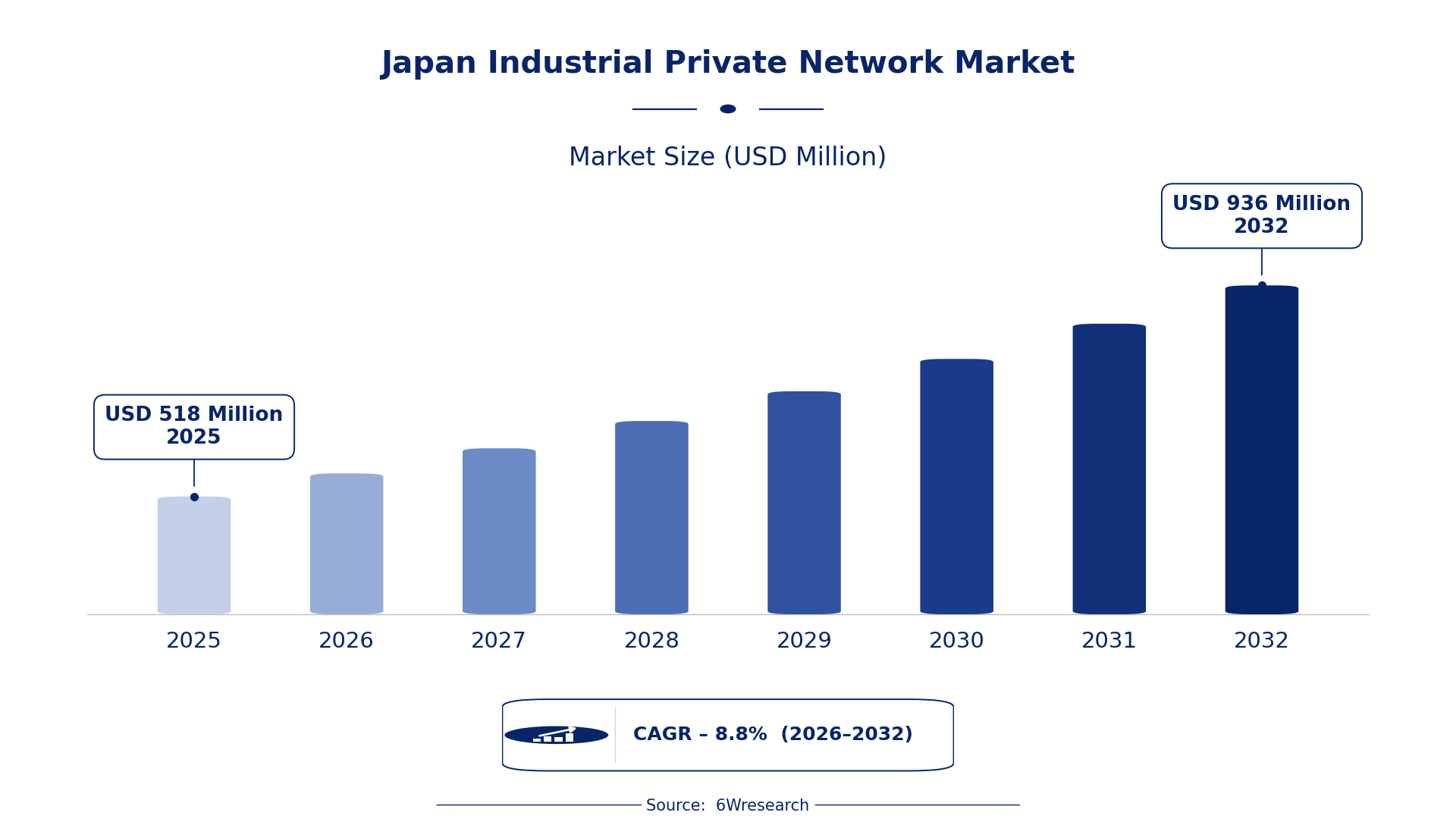
According to 6Wresearch internal database and industry insights, the Japan Industrial Private Network Market was valued at USD 518 Million in 2025 and is projected to reach USD 936 Million by 2032, growing at a CAGR of approximately 8.8% during 2026–2032.
Japan Industrial Private Network Market Highlights
| Report Metric | Details |
| Report Name | Japan Industrial Private Network Market (2026-2032) |
| Market Size 2025 | USD 518 Million |
| Market Size 2032 | USD 936 Million |
| Absolute Growth 2025–2032 | USD 418 Million |
| CAGR 2026–2032 | 8.8% |
| Peak Annual Growth | 10.1% in 2032 |
| Forecast Period | 2026–2032 |
| Historical Data | 2022–2025 |
| Base Year | 2025 |
| Leading Network Type, 2025 | LTE Private Networks (51% share) |
| Leading Connectivity Type, 2025 | Wireless (40% share) |
| Leading Spectrum Band, 2025 | Licensed (42% share) |
| Leading Deployment Mode, 2025 | On-Premise (44% share) |
| Leading End User Industry, 2025 | Smart Manufacturing (39% share) |
| Fastest-Growing Network Type | 5G Private Networks (12.5% CAGR) |
| Fastest-Growing Connectivity Type | Wired/Wireless (12.9% CAGR) |
| Fastest-Growing Spectrum Band | Unlicensed (11.3% CAGR) |
| Fastest-Growing Deployment Mode | Cloud-Based (12.7% CAGR) |
| Fastest-Growing End User Industry | Healthcare Facilities (11.5% CAGR) |
| Growing Sector | Smart Manufacturing |
| Key End Users | Manufacturers, Healthcare Facilities, Utility Services, Oil & Gas Plants |
Japan Industrial Private Network Market Year-wise Growth Rate and Key Drivers (2022–2032)
This graph illustrates the annual growth rates of the market from 2022 to 2032, highlighting a steady upward trajectory and projected market expansion over the forecast period.
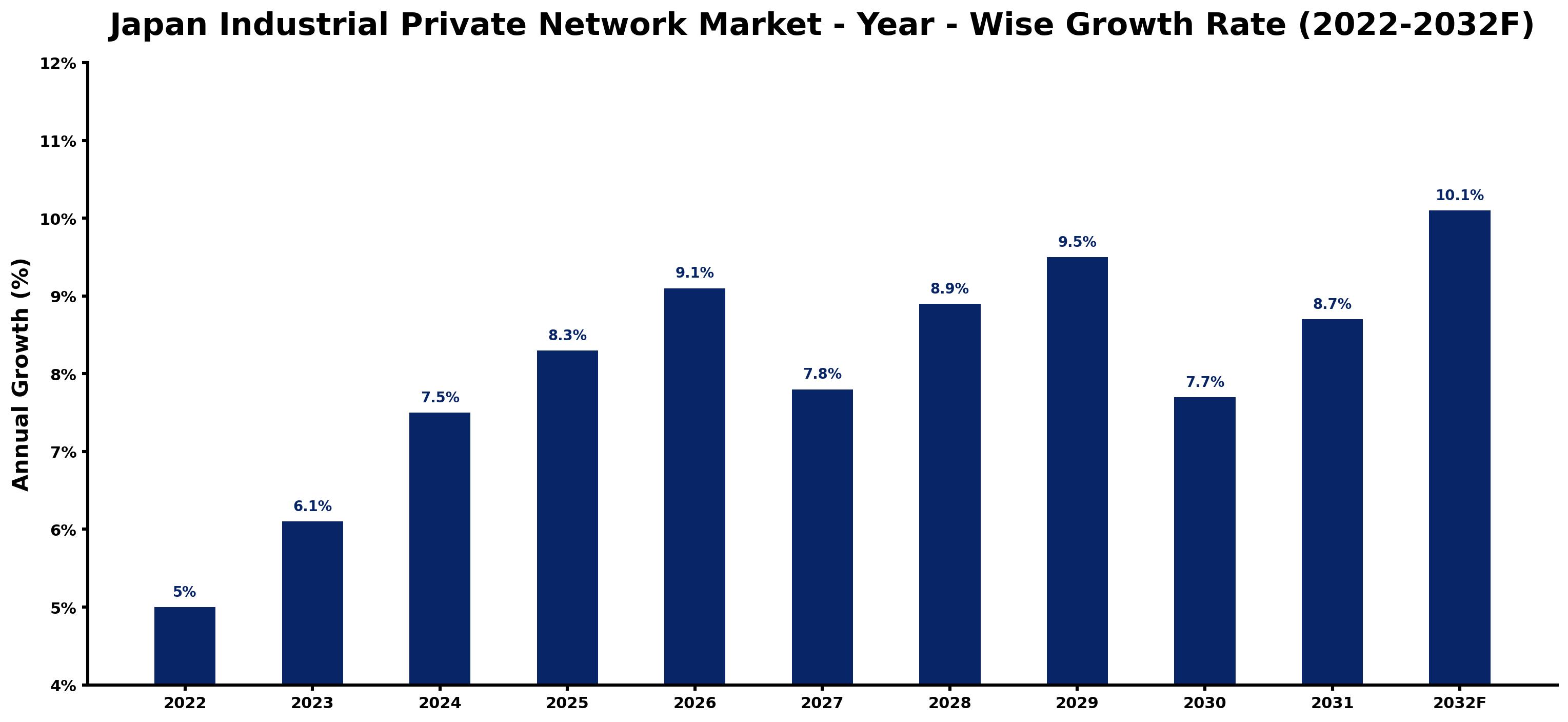
Below, each year's estimated growth is shown next to the factor that most influenced it.
| Year | Estimated Annual Growth (%) | Market Rationale |
| 2022 | 5.0 | The market experienced steady growth as industries began adopting private networks. |
| 2023 | 6.1 | Demand increased due to advancements in LTE technology and its applications. |
| 2024 | 7.5 | Growth accelerated as more sectors recognised the benefits of private networks. |
| 2025 | 8.3 | Investment in smart manufacturing drove higher adoption rates across industries. |
| 2026 | 9.1 | The introduction of 5G technology is expected to further improve network capabilities and demand. |
| 2027 | 7.8 | Growth is projected to slow slightly as the market adjusts to increased competition. |
| 2028 | 8.9 | Demand is expected to rebound as industries seek to improve operational efficiencies. |
| 2029 | 9.5 | The healthcare sector will expand its use of private networks, boosting growth. |
| 2030 | 7.7 | Growth will slow again as market saturation begins to influence new investments. |
| 2031 | 8.7 | Demand is projected to increase as urban areas continue to adopt advanced network solutions. |
| 2032 | 10.1 | The market will peak with significant investments in 5G private networks. |
Note: Market size estimations and growth projections presented in this report are based on 6Wresearch's proprietary forecasting methodology, utilizing the latest available industry data, government publications, and primary research inputs.
Japan Industrial Private Network Market Synopsis
Industrial Private Networks in Japan are sophisticated communication systems tailored for specific industrial applications, utilising LTE and 5G technologies. These networks improve operational efficiency, secure data transmission, and real-time monitoring, primarily benefiting sectors such as smart manufacturing and healthcare. The Japan Industrial Private Network Market is expanding due to substantial investments in digital transformation, particularly in the smart manufacturing sector, which is projected to invest ¥1 trillion by 2025, alongside the healthcare sector, which includes over 8,000 hospitals that can benefit from these networks.
Market Dynamics Impact Analysis (2026–2032)
| Factor | Type | Impact | Primary Segment Affected |
| Growing adoption of 5G technology enhances network capabilities and speeds. | Driver | High | 5G Private Networks |
| Increased investment in smart manufacturing drives demand for secure communications. | Driver | High | Smart Manufacturing |
| Rising need for secure communications in healthcare facilities creates opportunities for network expansion. | Opportunity | High | Healthcare Facilities |
| The Tokyo Metropolitan area is a key region for deploying industrial private networks, presenting investment opportunities. | Opportunity | Medium | LTE Private Networks |
| High costs associated with network implementation can deter smaller businesses from adopting private networks. | Restraint | High | LTE Private Networks |
| Limited awareness of the benefits of private networks among potential users restricts market growth. | Restraint | Medium | 5G Private Networks |
| Competition from alternative communication technologies may hinder market penetration. | Challenge | High | Wireless |
| Technological integration challenges can delay the deployment of private networks in various sectors. | Challenge | Medium | On-Premise |
Evaluation of Drivers in Japan Industrial Private Network Market (2026–2032)
The main growth drivers and the segments they affect most are set out below.
| Drivers | Primary Segment Affected | Why It Matters (Evidence) |
| Investment in smart manufacturing technologies drives demand for private networks. | Smart Manufacturing | Japan's smart manufacturing sector is projected to invest ¥1 trillion in digital transformation by 2025, increasing network adoption. |
| The rollout of 5G technology improves connectivity options for industries. | 5G Private Networks | Japan's 5G rollout will cover 99% of urban areas by 2025, boosting private network capabilities. |
| Healthcare facilities require secure communications for critical operations. | Healthcare Facilities | With over 8,000 hospitals in Japan, the demand for reliable private networks is rising. |
| The need for operational efficiency in utility services encourages network adoption. | Utility Services | Private networks improve management of resources and infrastructure, increasing efficiency. |
| The demand for secure and regulated communication drives the use of licensed spectrum. | Licensed | Licensed spectrum ensures secure communications, making it essential for critical applications. |
Orders keep climbing as Japan's smart manufacturing sector invests ¥1 trillion in digital transformation by 2025, driving demand for private networks. The rollout of 5G technology, expected to cover 99% of urban areas by 2025, improves connectivity options for industries. The utility services sector increasingly requires reliable private networks to manage resources effectively, further boosting demand. The need for secure communication drives the use of licensed spectrum, essential for critical applications, supporting the overall market growth.
Evaluation of Restraints in Japan Industrial Private Network Market
These restraints slow adoption and weigh on supplier margins.
| Market Restraint | Primary Segment Affected | Why It Matters (Evidence) |
| High implementation costs can deter smaller businesses from adopting private networks. | LTE Private Networks | The financial burden of setting up private networks can exceed ¥100 million, limiting access for smaller firms. |
| Limited awareness of private network benefits restricts market growth. | 5G Private Networks | Many potential users remain unaware of the advantages, hindering adoption rates. |
| Technological integration challenges can delay the deployment of private networks. | On-Premise | Complexities in integrating new technologies can lead to project delays and increased costs. |
| Competition from alternative communication technologies may hinder market penetration. | Wireless | Emerging technologies can divert attention and investment away from private networks. |
| Regulatory hurdles can complicate network implementation processes. | Cloud-Based | Compliance with various regulations can slow down the deployment of cloud-based private networks. |
Japan Industrial Private Network Market Challenges
High costs of establishing industrial private networks deter buyers in Japan, with initial investments often exceeding ¥100 million for tailored systems. A lack of skilled workers complicates deployment, as 30% of companies report insufficient personnel for advanced technology integration. Regulatory hurdles arise from spectrum allocation managed by the Ministry of Internal Affairs and Communications, causing project delays of up to 12 months for manufacturers. Existing technological limitations restrict the effectiveness of private networks, affecting operational efficiency for over 8,000 hospitals that could gain from improved connectivity.
Trends in the Japan Industrial Private Network Market
These developments are changing demand patterns in the Japan Industrial Private Network Market.
- Healthcare Facilities Increasingly Adopt Private Networks: Healthcare facilities are enhancing their communication systems, with over 8,000 hospitals in Japan needing private networks. This trend is expected to grow as more facilities recognise the importance of reliable connectivity.
- Transition from LTE to 5G Networks: The shift from LTE to 5G networks is reshaping industrial communications in Japan. With the 5G rollout projected to cover 99% of urban areas by 2025, industries will benefit from improved connectivity for operational efficiency.
- Increased Investment in Smart Manufacturing: Investment in smart manufacturing is driving the adoption of private networks. Japan's smart manufacturing sector is set to invest ¥1 trillion in digital transformation by 2025, creating demand for advanced communication systems.
- Expansion of Private Networks in Urban Areas: The Tokyo Metropolitan area is experiencing a surge in private network deployments, with over 1,000 LTE private networks already established. This trend highlights the urban focus of network expansion, catering to high-density industrial applications.
Investment Opportunities in the Japan Industrial Private Network Market
The openings below show where demand in the Japan Industrial Private Network Market is visible and how suppliers can enter.
- Healthcare Facilities Seeking Secure Communications: Healthcare facilities are aiming to improve their communication systems, with over 8,000 hospitals in Japan needing private networks. This presents a notable opportunity for investment in secure communication solutions.
- Investment in Smart Manufacturing Technologies: Smart manufacturing is set to invest ¥1 trillion in digital transformation by 2025, creating opportunities for suppliers of private network technologies. Collaborating with local manufacturers can facilitate market entry.
- Expansion of Private Networks in Tokyo: The Tokyo Metropolitan area is a key region for deploying industrial private networks, with over 1,000 LTE networks already established. This creates opportunities for local partnerships to expand network offerings.
- Growing Demand for Cloud-Based Solutions: The shift towards cloud-based private networks is driven by the need for scalability and flexibility. With a projected growth rate of 12.7%, suppliers can focus on developing cloud-based solutions for various industries.
Government Initiatives in the Japan Industrial Private Network Market
The Industrial Safety and Health Act (1972) mandates employer responsibilities regarding hazardous substances and machinery, ensuring safe working conditions in industries. This law supports the implementation of private networks by requiring secure communication systems to protect workers and operations. The GX Promotion Act (2023) establishes the legal framework for Japan's decarbonisation strategy, promoting investments in technologies that improve energy efficiency and sustainability, including private networks.
The Ministry of Internal Affairs and Communications oversees spectrum allocation for industrial private networks, ensuring that operators have the necessary resources for deployment. Additionally, the Ministry of Economy, Trade and Industry launched a subsidy program for IoT adoption in manufacturing in 2023, providing financial support for companies looking to implement advanced communication systems.
Future Insight of the Japan Industrial Private Network Market
The introduction of advanced communication technologies will reshape demand for industrial private networks, enabling faster data transmission and real-time monitoring. By 2032, Japan's healthcare sector will undergo substantial digital transformation, with investments projected to reach ¥150 trillion in decarbonisation efforts. New industry standards from the Japan Industrial Standards will simplify network implementations, allowing suppliers to provide customised solutions. Improved urban coverage will support the adoption of private networks across various sectors, enhancing service delivery and operational reliability.
Market Segmentation Analysis
Japan Industrial Private Network Market report covers a detailed analysis of the following market segments:
By Network Type – LTE Private Networks Lead, 5G Private Networks Expected to Grow Fastest
According to Saurav Kr Singh, Senior Research Analyst at 6Wresearch, the largest network type category in 2025 was LTE Private Networks, at 51% of revenue. LTE Private Networks dominate the market as they are crucial for secure communications across various industries. Their established presence, with over 1,000 networks deployed, underlines their importance in enhancing operational efficiency in sectors like smart manufacturing. 5G Private Networks are set to record the highest CAGR in this split, 12.5% over 2026–2032. The rapid growth of 5G Private Networks is attributed to the anticipated coverage of 99% of urban areas by 2025, which will greatly enhance connectivity capabilities. This advancement is essential for industries requiring high-speed data transmission, allowing LTE's lead to expand further. Suppliers should prioritise the development of 5G solutions to meet the increasing demand for advanced connectivity.
By Connectivity Type – Wireless Leads, Wired/Wireless Expected to Grow Fastest
Wireless held 40% of the Japan Industrial Private Network Market by connectivity type in 2025. Wireless connectivity is the market leader because it offers essential flexibility for industrial applications, facilitating seamless communication. This adaptability is vital for industries that require mobility and quick deployment, ensuring efficient operations across various environments. Wired/Wireless is projected to grow fastest, at a CAGR of 12.9% during 2026–2032. The Wired/Wireless segment is rapidly growing due to its unique combination of the reliability of wired connections and the mobility of wireless solutions. This hybrid model is particularly appealing to sectors seeking to enhance operational efficiency, reinforcing the dominance of wireless connectivity. Buyers will increasingly seek solutions that provide both reliability and flexibility, prompting suppliers to innovate in hybrid connectivity offerings.
By Spectrum Band – Licensed Leads, Unlicensed Expected to Grow Fastest
In 2025, Licensed led the spectrum band split with a 42% share. Licensed spectrum holds the largest share as it ensures secure and regulated communication, vital for industries that require stringent compliance and reliability. This is particularly important in sectors like healthcare and manufacturing where data integrity is paramount. Over 2026–2032, Unlicensed is expected to post the fastest growth, at a CAGR of 11.3%. Unlicensed spectrum is growing quickly as it is increasingly adopted in less critical applications, allowing for cost-effective solutions. This trend is likely to attract new users seeking to implement private networks without the constraints of licensing. Suppliers should consider offering unlicensed options to cater to cost-sensitive segments looking for efficient communication solutions.
By Deployment Mode – On-Premise Leads, Cloud-Based Expected to Grow Fastest
With 44% of deployment mode revenue in 2025, On-Premise was the largest category. On-Premise deployment is preferred for its control over network infrastructure, making it ideal for industries that prioritise security and customisation. This is particularly relevant in smart manufacturing where tailored solutions are essential for operational success. The quickest growth will come from Cloud-Based, forecast to expand at a CAGR of 12.7% between 2026 and 2032. Cloud-Based deployment is rapidly gaining traction due to its scalability and flexibility, appealing to industries that require quick adjustments to their network capabilities. This shift reflects a growing trend towards digital transformation in various sectors. Suppliers must adapt to the increasing demand for cloud-based solutions to remain competitive in the evolving market.
By End User Industry – Smart Manufacturing Leads, Healthcare Facilities Expected to Grow Fastest
Smart Manufacturing accounted for 39% of the market by end user industry in 2025. Smart Manufacturing leads the end user market as it is pivotal for driving automation and efficiency, which are essential for competitiveness in Japan's industrial sector. The sector's projected investment of ¥1 trillion in digital transformation by 2025 illustrates its commitment to adopting advanced technologies. Healthcare Facilities are set to record the highest CAGR in this split, 11.5% over 2026–2032. Healthcare Facilities are witnessing the fastest growth due to their pressing need for reliable communication systems that support critical medical operations. With over 8,000 hospitals in Japan, the demand for customised private networks is surging, indicating substantial market potential. Suppliers should focus on developing solutions tailored for healthcare to leverage the sector's rapid growth and specific communication requirements.
Key Attractiveness of the Report
- 10 Years of Market Numbers
- Historical Data Starting from 2022 to 2025
- Base Year 2025
- Forecast Data until 2032
- Key Performance Indicators Impacting the Market
- Major Upcoming Developments and Projects
Key Highlights of the Report:
- Japan Industrial Private Network Market Outlook
- Market Size of Japan Industrial Private Network Market, 2025
- Forecast of Japan Industrial Private Network Market, 2032
- Historical Data and Forecast of Japan Industrial Private Network Revenues & Volume for the Period 2022-2032F
- Japan Industrial Private Network Market Trend Evolution
- Japan Industrial Private Network Market Drivers and Challenges
- Japan Industrial Private Network Price Trends
- Japan Industrial Private Network Porter's Five Forces
- Japan Industrial Private Network Industry Life Cycle
- Historical Data and Forecast of Japan Industrial Private Network Market Revenues & Volume By Network Type for the Period 2022-2032F
- Historical Data and Forecast of Japan Industrial Private Network Market Revenues & Volume By LTE Private Networks for the Period 2022-2032F
- Historical Data and Forecast of Japan Industrial Private Network Market Revenues & Volume By 5G Private Networks for the Period 2022-2032F
- Historical Data and Forecast of Japan Industrial Private Network Market Revenues & Volume By Mesh Networks for the Period 2022-2032F
- Historical Data and Forecast of Japan Industrial Private Network Market Revenues & Volume By LoRaWAN for the Period 2022-2032F
- Historical Data and Forecast of Japan Industrial Private Network Market Revenues & Volume By Connectivity Type for the Period 2022-2032F
- Historical Data and Forecast of Japan Industrial Private Network Market Revenues & Volume By Wireless for the Period 2022-2032F
- Historical Data and Forecast of Japan Industrial Private Network Market Revenues & Volume By Wireless for the Period 2022-2032F
- Historical Data and Forecast of Japan Industrial Private Network Market Revenues & Volume By Wired/Wireless for the Period 2022-2032F
- Historical Data and Forecast of Japan Industrial Private Network Market Revenues & Volume By LPWAN for the Period 2022-2032F
- Historical Data and Forecast of Japan Industrial Private Network Market Revenues & Volume By Spectrum Band for the Period 2022-2032F
- Historical Data and Forecast of Japan Industrial Private Network Market Revenues & Volume By Licensed for the Period 2022-2032F
- Historical Data and Forecast of Japan Industrial Private Network Market Revenues & Volume By Unlicensed for the Period 2022-2032F
- Historical Data and Forecast of Japan Industrial Private Network Market Revenues & Volume By ISM Bands for the Period 2022-2032F
- Historical Data and Forecast of Japan Industrial Private Network Market Revenues & Volume By Sub-GHz for the Period 2022-2032F
- Historical Data and Forecast of Japan Industrial Private Network Market Revenues & Volume By Deployment Mode for the Period 2022-2032F
- Historical Data and Forecast of Japan Industrial Private Network Market Revenues & Volume By On-Premise for the Period 2022-2032F
- Historical Data and Forecast of Japan Industrial Private Network Market Revenues & Volume By Cloud-Based for the Period 2022-2032F
- Historical Data and Forecast of Japan Industrial Private Network Market Revenues & Volume By Hybrid for the Period 2022-2032F
- Historical Data and Forecast of Japan Industrial Private Network Market Revenues & Volume By Remote Areas for the Period 2022-2032F
- Historical Data and Forecast of Japan Industrial Private Network Market Revenues & Volume By End User Industry for the Period 2022-2032F
- Historical Data and Forecast of Japan Industrial Private Network Market Revenues & Volume By Smart Manufacturing for the Period 2022-2032F
- Historical Data and Forecast of Japan Industrial Private Network Market Revenues & Volume By Healthcare Facilities for the Period 2022-2032F
- Historical Data and Forecast of Japan Industrial Private Network Market Revenues & Volume By Oil & Gas Plants for the Period 2022-2032F
- Historical Data and Forecast of Japan Industrial Private Network Market Revenues & Volume By Utility Services for the Period 2022-2032F
- Japan Industrial Private Network Import Export Trade Statistics
- Market Opportunity Assessment By Network Type
- Market Opportunity Assessment By Connectivity Type
- Market Opportunity Assessment By Spectrum Band
- Market Opportunity Assessment By Deployment Mode
- Market Opportunity Assessment By End User Industry
- Japan Industrial Private Network Top Companies Market Share
- Japan Industrial Private Network Competitive Benchmarking By Technical and Operational Parameters
- Japan Industrial Private Network Company Profiles
- Japan Industrial Private Network Key Strategic Recommendations
Market Covered
Coverage by segment is as follows.
By Network Type
- LTE Private Networks
- 5G Private Networks
- Mesh Networks
- LoRaWAN
By Connectivity Type
- Wireless
- Wired/Wireless
- LPWAN
By Spectrum Band
- Licensed
- Unlicensed
- ISM Bands
- Sub-GHz
By Deployment Mode
- On-Premise
- Cloud-Based
- Hybrid
- Remote Areas
By End User Industry
- Smart Manufacturing
- Healthcare Facilities
- Oil & Gas Plants
- Utility Services































