Japan Industrial Process Additives Market Size & Growth Rate
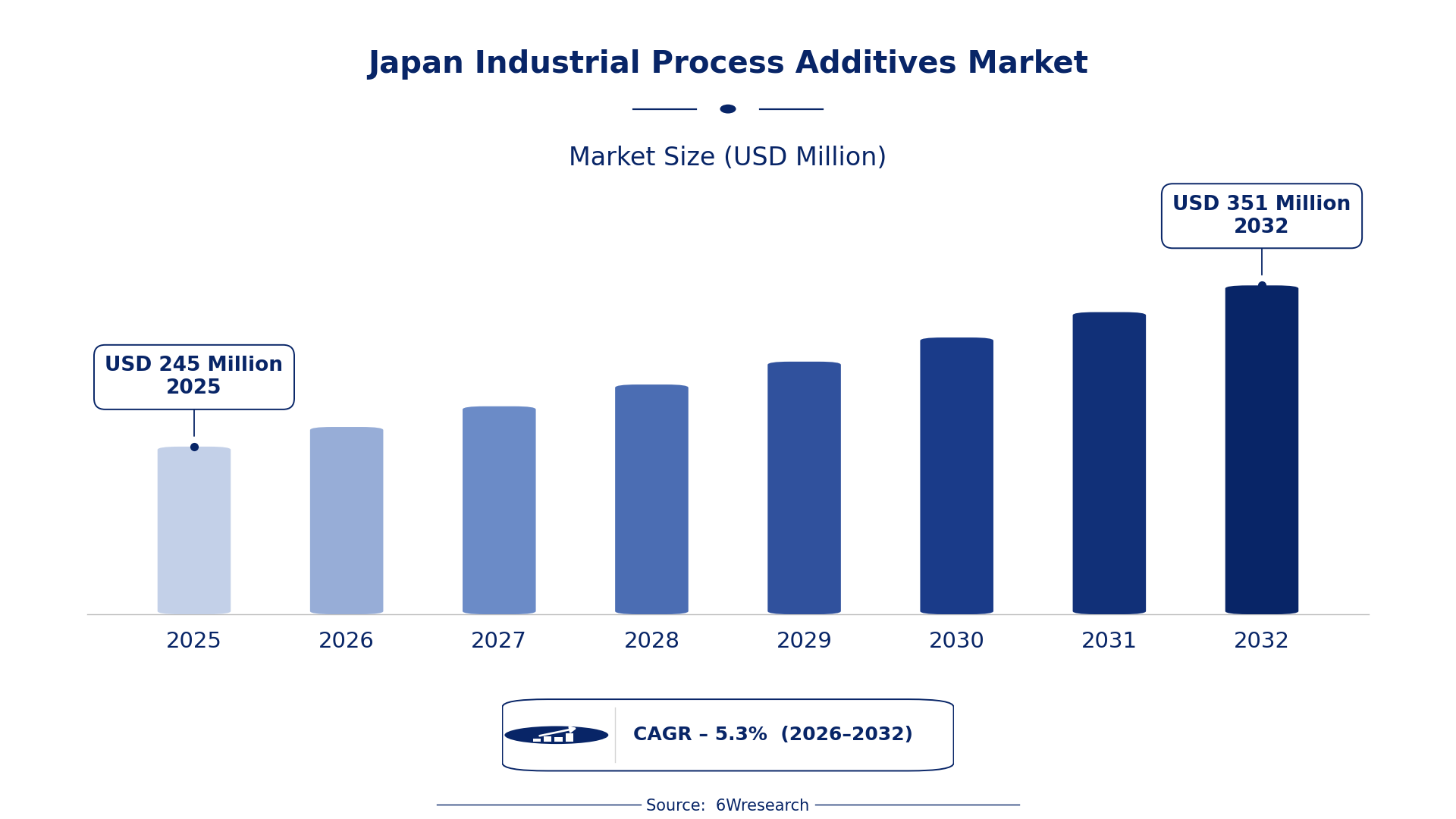
According to 6Wresearch internal database and industry insights, the Japan Industrial Process Additives Market was valued at USD 245 Million in 2025 and is projected to reach USD 351 Million by 2032, growing at a CAGR of approximately 5.3% during 2026–2032.
Japan Industrial Process Additives Market Highlights
| Report Metric | Details |
| Report Name | Japan Industrial Process Additives Market (2026-2032) |
| Market Size 2025 | USD 245 Million |
| Market Size 2032 | USD 351 Million |
| Absolute Growth 2025–2032 | USD 106 Million |
| CAGR 2026–2032 | 5.3% |
| Peak Annual Growth | 6.0% in 2031 |
| Forecast Period | 2026–2032 |
| Historical Data | 2022–2025 |
| Base Year | 2025 |
| Leading Additive Type, 2025 | Defoamers (37% share) |
| Leading Function, 2025 | Foam Suppression (37% share) |
| Leading Physical Form, 2025 | Liquid (56% share) |
| Leading Application, 2025 | Paints & Coatings (40% share) |
| Leading End User Industry, 2025 | Automotive (38% share) |
| Fastest-Growing Additive Type | Dispersing Agents (7.5% CAGR) |
| Fastest-Growing Function | Particle Distribution (7.0% CAGR) |
| Fastest-Growing Physical Form | Powder (8.0% CAGR) |
| Fastest-Growing Application | Water Treatment (7.3% CAGR) |
| Fastest-Growing End User Industry | Manufacturing (6.9% CAGR) |
| Growing Sector | Construction |
| Key End Users | Automotive, Manufacturing, Construction, Water Treatment |
Japan Industrial Process Additives Market Year-wise Growth Rate and Key Drivers (2022–2032)
This graph illustrates the annual growth rates of the market from 2022 to 2032, highlighting a steady upward trajectory and projected market expansion over the forecast period.
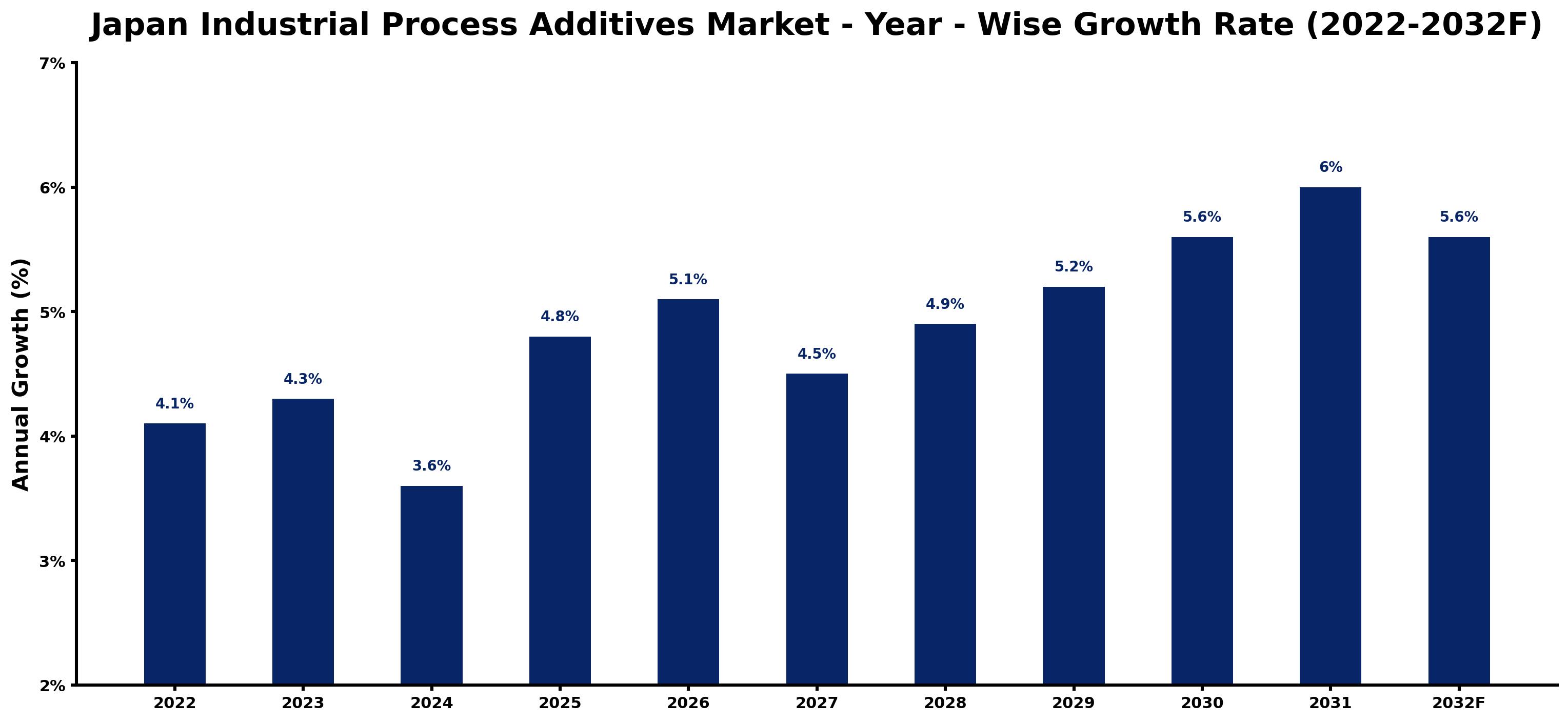
The following figures match every annual growth estimate with the main market development of that year, giving the reasoning behind each rise or slowdown.
| Year | Estimated Annual Growth (%) | Market Rationale |
| 2022 | 4.1 | The market experienced steady growth as demand from the manufacturing sector increased. |
| 2023 | 4.3 | Growth accelerated due to rising automotive production and the adoption of new standards. |
| 2024 | 3.6 | Demand growth slowed as some industries faced temporary production challenges. |
| 2025 | 4.8 | The market rebounded with stronger automotive and construction sector activity. |
| 2026 | 5.1 | Continued investment in manufacturing technologies is expected to drive higher demand for additives. |
| 2027 | 4.5 | Growth is projected to moderate as market conditions adjust to new supply chain realities. |
| 2028 | 4.9 | Demand is expected to increase again as manufacturers seek to improve product quality. |
| 2029 | 5.2 | Rising construction activities will contribute to renewed demand for additives. |
| 2030 | 5.6 | The automotive sector's shift towards sustainability is projected to boost additive requirements. |
| 2031 | 6.0 | Peak growth is expected as decarbonisation efforts intensify across industries. |
| 2032 | 5.6 | Growth is projected to slow slightly as the market stabilises after peak demand. |
Note: Market size estimations and growth projections presented in this report are based on 6Wresearch's proprietary forecasting methodology, utilizing the latest available industry data, government publications, and primary research inputs.
Japan Industrial Process Additives Market Synopsis
Industrial process additives are chemical substances that improve various industrial processes, produced through chemical synthesis and formulation techniques. The Japan Industrial Process Additives Market is driven by key buyer groups, including the automotive and manufacturing sectors, which actively seek these additives to improve product quality and efficiency. Growth is supported by rising automotive production, stringent quality standards, and a commitment to sustainability, with public and private decarbonisation investments projected at JPY 150 trillion over the next decade.
Market Dynamics Impact Analysis (2026–2032)
| Factor | Type | Impact | Primary Segment Affected |
| Increased automotive production drives demand for additives in paints and coatings. | Driver | High | Paints & Coatings |
| Rising construction activities boost the need for additives in various materials. | Driver | High | Construction |
| The push for sustainable additives presents opportunities for innovation in formulations. | Opportunity | High | Defoamers |
| Growing demand for water treatment additives creates a niche market for suppliers. | Opportunity | Medium | Water Treatment |
| Stringent regulations under the Chemical Substances Control Law can limit new product introductions. | Restraint | High | Defoamers |
| High competition among suppliers may lead to pricing pressures in the market. | Restraint | Medium | Defoamers |
| Supply chain disruptions can delay the availability of critical raw materials. | Challenge | High | Defoamers |
| Technological advancements require continuous investment from suppliers to remain competitive. | Challenge | Medium | Defoamers |
Evaluation of Drivers in Japan Industrial Process Additives Market (2026–2032)
The table below links each growth driver to the segment it affects and the evidence for it.
| Drivers | Primary Segment Affected | Why It Matters (Evidence) |
| Increased automotive production leads to higher demand for additives in coatings. | Paints & Coatings | The automotive industry in Japan accounts for 38% of the market. |
| Rising construction activities necessitate the use of additives in various materials. | Construction | The construction industry is projected to grow, increasing demand for additives. |
| The green chemistry initiative promotes the development of sustainable additives. | Defoamers | Japan launched a green chemistry initiative in 2023 to encourage innovation. |
| ISO 9001 standards drive quality improvements in additive manufacturing processes. | Manufacturing | Widespread adoption of ISO 9001 ensures consistent product quality. |
| Increasing investments in water treatment facilities boost demand for specific additives. | Water Treatment | The annual demand for water treatment additives in Japan is estimated at 50,000 tons. |
Spending rises because the automotive sector demands high-quality additives for paints and coatings, which account for a significant market share. The construction industry's growth further fuels demand for these products, with projections indicating increased usage. ISO 9001 standards ensure consistent quality in manufacturing, driving up production. Investments in water treatment facilities create a strong need for specific additives, highlighting their importance in maintaining water quality.
Evaluation of Restraints in Japan Industrial Process Additives Market
The following restraints limit how fast demand can grow.
| Market Restraint | Primary Segment Affected | Why It Matters (Evidence) |
| Stringent regulations can limit the introduction of new additives. | Defoamers | Under the Industrial Safety and Health Act, producers must meet strict compliance standards. |
| High competition may lead to pricing pressures among suppliers. | Defoamers | The annual trade volume of industrial chemicals in Japan exceeds 2 trillion yen. |
| Supply chain disruptions can delay the availability of critical raw materials. | Defoamers | Recent global supply chain issues have affected many industries, including chemicals. |
| Fluctuating raw material costs can impact profitability for manufacturers. | Defoamers | The average costs of chemical inputs have seen volatility in recent years. |
| Market saturation in certain segments may hinder growth opportunities. | Defoamers | With over 500 types of additives available, competition is intensifying. |
Japan Industrial Process Additives Market Challenges
High production costs for industrial process additives arise from expensive raw materials, leading to a 15% price increase for manufacturers. Limited technological advancements in formulation techniques restrict efficiency, causing production delays that can extend lead times for suppliers by up to three weeks. Supply chain disruptions, especially in transportation, create bottlenecks that postpone deliveries to buyers, impacting their ability to meet project deadlines. Stringent regulations under the Chemical Substances Control Law impose additional compliance costs, compelling producers to allocate up to 10% of their budgets to meet these standards, which ultimately raises prices for end-users.
Trends in the Japan Industrial Process Additives Market
Buyers and suppliers in the Japan Industrial Process Additives Market are adjusting to the following trends.
- Shift to Sustainable Additives: In 2023, Japan launched a green chemistry initiative aimed at promoting sustainable additives. This initiative is expected to drive innovation in the industry, with public and private investments projected to reach JPY 150 trillion over the next decade.
- Transition from Traditional to Advanced Coatings: The automotive sector is increasingly adopting advanced coatings that require high-performance additives. In 2022, the automotive industry accounted for 38% of the market, reflecting a shift towards quality and sustainability.
- Emergence of Water Treatment Additives: Water treatment additives are gaining prominence as Japan focuses on maintaining water quality. The annual demand for these additives is estimated at 50,000 tons, highlighting their growing importance in industrial applications.
- Growing Demand for Quality Assurance Standards: The adoption of ISO 9001 standards is becoming more prevalent in additive manufacturing. This trend ensures consistent quality and reliability, important for industries like automotive and construction.
Investment Opportunities in the Japan Industrial Process Additives Market
The opportunities below stand out in the Japan Industrial Process Additives Market for new entrants and existing suppliers.
- Timing for Sustainable Additives: With Japan's commitment to decarbonisation, there is a pressing need for sustainable additives. The green chemistry initiative launched in 2023 supports this shift, creating opportunities for innovation in the sector.
- Entry into Water Treatment Market: Now presents an ideal opportunity to supply water treatment additives, given the estimated annual demand of 50,000 tons. Collaborating with local manufacturers can facilitate market entry.
- Investment in Construction Additives: The projected growth of the construction industry opens avenues for supplying high-quality additives. Engaging with construction firms in the Tokyo region can strengthen market presence.
- Focus on Automotive Coatings: The automotive sector's transition towards advanced coatings offers a significant opportunity. Suppliers can penetrate this market by aligning with automotive manufacturers and meeting quality standards.
Government Initiatives in the Japan Industrial Process Additives Market
The Industrial Safety and Health Act of 1972 mandates employer responsibilities regarding hazardous substances, ensuring safety in chemical manufacturing. This law has shaped the regulatory framework for industrial process additives, requiring producers to adhere to strict safety protocols. The GX Promotion Act of 2023 further supports the industry's transition towards sustainable practices, aiming for a reduction in greenhouse gas emissions by 2030.
The GX Basic Policy promotes decarbonisation investments, benefiting buyers in the automotive and construction sectors. The Ministry of Economy, Trade and Industry oversees initiatives that support innovation in chemical manufacturing, ensuring that producers meet environmental standards. This framework enables buyers to access high-quality, compliant additives that align with sustainability goals.
Future Insight of the Japan Industrial Process Additives Market
New green chemistry initiatives will propel the development of sustainable additives by 2032. The anticipated growth in the construction industry will heighten demand for high-quality additives, particularly in coatings. Investments in cleaner technologies within the power generation sector will reshape additive formulations to meet environmental standards. By 2030, Japan's manufacturing sector, accounting for approximately 20% of GDP, will stimulate innovation in additive production, benefiting both buyers and suppliers through improved product quality and efficiency.
Market Segmentation Analysis
Japan Industrial Process Additives Market report covers a detailed analysis of the following market segments:
By Additive Type – Defoamers Lead, Dispersing Agents Expected to Grow Fastest
According to Saurav Kr Singh, Senior Research Analyst at 6Wresearch, Defoamers took 37% of additive type revenue in 2025, more than any other category. Defoamers maintain the largest share due to their critical role in suppressing foam during industrial processes, especially within the automotive sector where operational efficiency is paramount. Their extensive use across diverse manufacturing environments solidifies their leading position in the market. Dispersing Agents are projected to grow fastest, at a CAGR of 7.5% during 2026–2032. Dispersing Agents are experiencing rapid growth because they ensure uniform particle distribution, which is essential for achieving high-quality production results. The demand for these agents is particularly increasing in sectors that prioritise product consistency and quality. Suppliers should focus on developing dispersing agents to leverage the growth opportunities in this segment.
By Function – Foam Suppression Leads, Particle Distribution Expected to Grow Fastest
Foam Suppression accounted for 37% of the market by function in 2025. Foam Suppression is the leading function because it is essential for maintaining process efficiency across various industrial applications, particularly in the automotive industry. The widespread adoption of this function ensures a stable demand for foam suppression additives. Particle Distribution is set to record the highest CAGR in this split, 7.0% over 2026–2032. Particle Distribution is the fastest-growing function as it is critical for achieving product consistency and quality, especially in high-performance applications. The increasing focus on quality control in manufacturing processes is driving this growth. Buyers should prioritise suppliers that specialise in particle distribution to ensure product quality.
By Physical Form – Liquid Leads, Powder Expected to Grow Fastest
The largest physical form category in 2025 was Liquid, at 56% of revenue. Liquid is the most common form of industrial process additives, primarily due to its versatility in various applications, including paints and coatings. The ease of formulation and application contributes to its leading position in the market. The quickest growth will come from Powder, forecast to expand at a CAGR of 8.0% between 2026 and 2032. Powder is growing rapidly as it is increasingly used in specific formulations that require precise dosing and performance characteristics. The trend towards customised solutions in manufacturing is boosting the demand for powder additives. Suppliers should consider expanding their product lines to include powdered forms to meet evolving customer needs.
By Application – Paints & Coatings Lead, Water Treatment Expected to Grow Fastest
In 2025, Paints & Coatings led the application split with a 40% share. Paints & Coatings represent the largest application area for industrial process additives, largely driven by the automotive industry's demand for high-quality finishes. This application significantly influences overall market trends and shapes industry standards. Over 2026–2032, Water Treatment is expected to post the fastest growth, at a CAGR of 7.3%. Water Treatment is the fastest-growing application, vital for maintaining water quality in light of increasing environmental regulations. The rising need for effective water treatment solutions is a major factor propelling this segment's growth. Buyers in the water treatment sector should prioritise suppliers with comprehensive additive portfolios to ensure compliance with quality and regulatory standards.
By End User Industry – Automotive Leads, Manufacturing Expected to Grow Fastest
With 38% of end user industry revenue in 2025, Automotive was the largest category. The Automotive industry is the primary end-user of industrial process additives, relying on these substances for various applications, including coatings. The sector's substantial size and ongoing innovation drive the demand for additives. Manufacturing is projected to grow fastest, at a CAGR of 6.9% during 2026–2032. Manufacturing is the fastest-growing end-user industry, reflecting the widespread application of additives across multiple sectors and the ongoing push for efficiency. The expansion of manufacturing activities in Japan significantly contributes to this upward trend. Suppliers should concentrate on the manufacturing sector to capitalise on its rapid growth and expand their customer reach.
Key Attractiveness of the Report
- 10 Years of Market Numbers
- Historical Data Starting from 2022 to 2025
- Base Year 2025
- Forecast Data until 2032
- Key Performance Indicators Impacting the Market
- Major Upcoming Developments and Projects
Key Highlights of the Report:
- Japan Industrial Process Additives Market Outlook
- Market Size of Japan Industrial Process Additives Market, 2025
- Forecast of Japan Industrial Process Additives Market, 2032
- Historical Data and Forecast of Japan Industrial Process Additives Revenues & Volume for the Period 2022-2032F
- Japan Industrial Process Additives Market Trend Evolution
- Japan Industrial Process Additives Market Drivers and Challenges
- Japan Industrial Process Additives Price Trends
- Japan Industrial Process Additives Porter's Five Forces
- Japan Industrial Process Additives Industry Life Cycle
- Historical Data and Forecast of Japan Industrial Process Additives Market Revenues & Volume By Additive Type for the Period 2022-2032F
- Historical Data and Forecast of Japan Industrial Process Additives Market Revenues & Volume By Defoamers for the Period 2022-2032F
- Historical Data and Forecast of Japan Industrial Process Additives Market Revenues & Volume By Dispersing Agents for the Period 2022-2032F
- Historical Data and Forecast of Japan Industrial Process Additives Market Revenues & Volume By pH Modifiers for the Period 2022-2032F
- Historical Data and Forecast of Japan Industrial Process Additives Market Revenues & Volume By Viscosity Modifiers for the Period 2022-2032F
- Historical Data and Forecast of Japan Industrial Process Additives Market Revenues & Volume By Function for the Period 2022-2032F
- Historical Data and Forecast of Japan Industrial Process Additives Market Revenues & Volume By Foam Suppression for the Period 2022-2032F
- Historical Data and Forecast of Japan Industrial Process Additives Market Revenues & Volume By Particle Distribution for the Period 2022-2032F
- Historical Data and Forecast of Japan Industrial Process Additives Market Revenues & Volume By Acidity Control for the Period 2022-2032F
- Historical Data and Forecast of Japan Industrial Process Additives Market Revenues & Volume By Flow Control for the Period 2022-2032F
- Historical Data and Forecast of Japan Industrial Process Additives Market Revenues & Volume By Physical Form for the Period 2022-2032F
- Historical Data and Forecast of Japan Industrial Process Additives Market Revenues & Volume By Liquid for the Period 2022-2032F
- Historical Data and Forecast of Japan Industrial Process Additives Market Revenues & Volume By Powder for the Period 2022-2032F
- Historical Data and Forecast of Japan Industrial Process Additives Market Revenues & Volume By Liquid for the Period 2022-2032F
- Historical Data and Forecast of Japan Industrial Process Additives Market Revenues & Volume By Granules for the Period 2022-2032F
- Historical Data and Forecast of Japan Industrial Process Additives Market Revenues & Volume By Application for the Period 2022-2032F
- Historical Data and Forecast of Japan Industrial Process Additives Market Revenues & Volume By Paints & Coatings for the Period 2022-2032F
- Historical Data and Forecast of Japan Industrial Process Additives Market Revenues & Volume By Ceramics for the Period 2022-2032F
- Historical Data and Forecast of Japan Industrial Process Additives Market Revenues & Volume By Water Treatment for the Period 2022-2032F
- Historical Data and Forecast of Japan Industrial Process Additives Market Revenues & Volume By Lubricants for the Period 2022-2032F
- Historical Data and Forecast of Japan Industrial Process Additives Market Revenues & Volume By End User Industry for the Period 2022-2032F
- Historical Data and Forecast of Japan Industrial Process Additives Market Revenues & Volume By Automotive for the Period 2022-2032F
- Historical Data and Forecast of Japan Industrial Process Additives Market Revenues & Volume By Construction for the Period 2022-2032F
- Historical Data and Forecast of Japan Industrial Process Additives Market Revenues & Volume By Power Plants for the Period 2022-2032F
- Historical Data and Forecast of Japan Industrial Process Additives Market Revenues & Volume By Manufacturing for the Period 2022-2032F
- Japan Industrial Process Additives Import Export Trade Statistics
- Market Opportunity Assessment By Additive Type
- Market Opportunity Assessment By Function
- Market Opportunity Assessment By Physical Form
- Market Opportunity Assessment By Application
- Market Opportunity Assessment By End User Industry
- Japan Industrial Process Additives Top Companies Market Share
- Japan Industrial Process Additives Competitive Benchmarking By Technical and Operational Parameters
- Japan Industrial Process Additives Company Profiles
- Japan Industrial Process Additives Key Strategic Recommendations
Market Covered
The report covers the following segments.
By Additive Type
- Defoamers
- Dispersing Agents
- pH Modifiers
- Viscosity Modifiers
By Function
- Foam Suppression
- Particle Distribution
- Acidity Control
- Flow Control
By Physical Form
- Liquid
- Powder
- Granules
By Application
- Paints & Coatings
- Ceramics
- Water Treatment
- Lubricants
By End User Industry
- Automotive
- Construction
- Power Plants
- Manufacturing































