Japan Industrial Process Control Market Size & Growth Rate
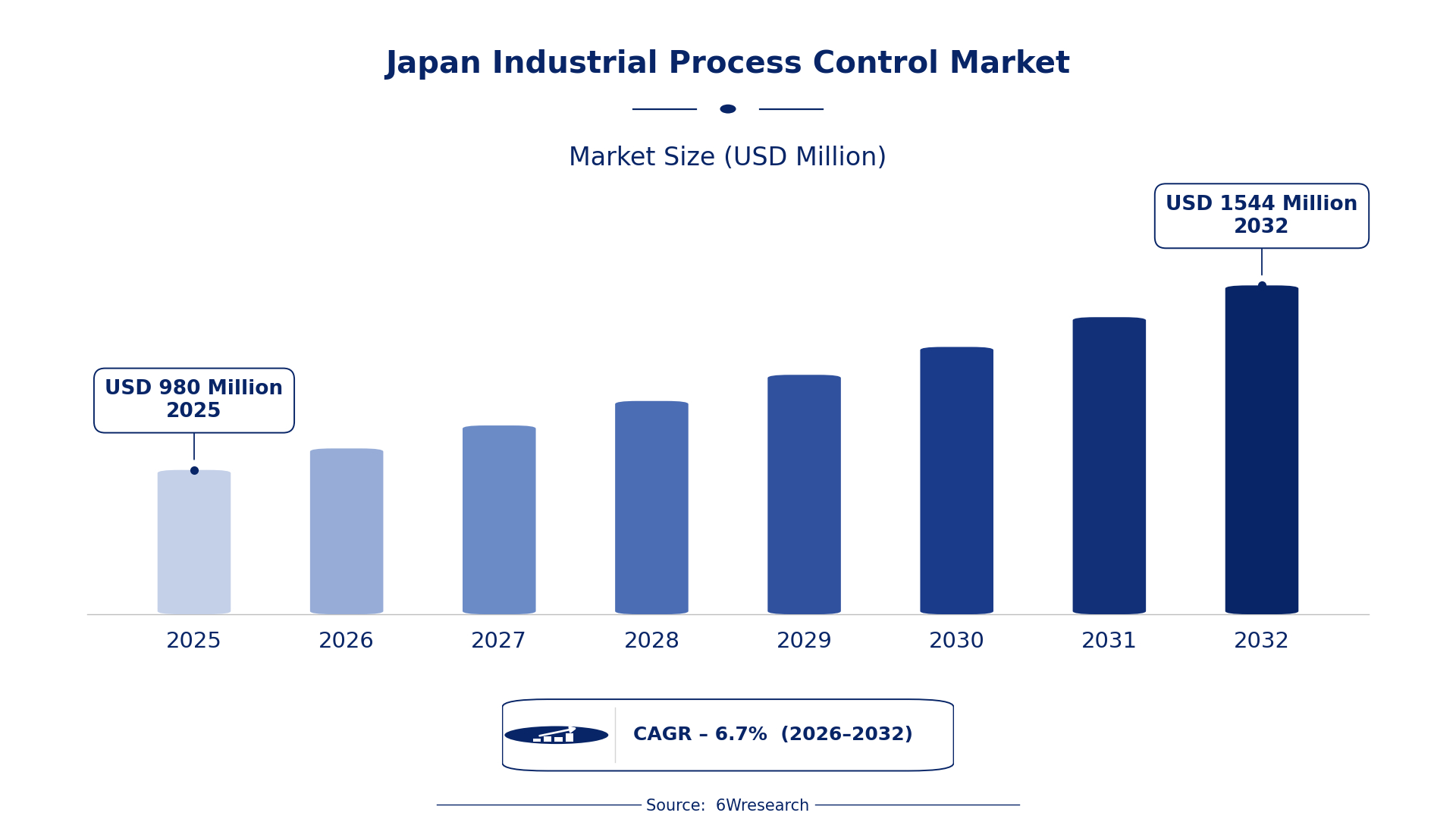
According to 6Wresearch internal database and industry insights, the Japan Industrial Process Control Market was valued at USD 980 Million in 2025 and is projected to reach USD 1,544 Million by 2032, growing at a CAGR of approximately 6.7% during 2026–2032.
Japan Industrial Process Control Market Highlights
| Report Metric | Details |
| Report Name | Japan Industrial Process Control Market (2026-2032) |
| Market Size 2025 | USD 980 Million |
| Market Size 2032 | USD 1,544 Million |
| Absolute Growth 2025–2032 | USD 564 Million |
| CAGR 2026–2032 | 6.7% |
| Peak Annual Growth | 8.2% in 2032 |
| Forecast Period | 2026–2032 |
| Historical Data | 2022–2025 |
| Base Year | 2025 |
| Leading Control Type, 2025 | DCS Systems (39% share) |
| Leading System Type, 2025 | Programmable Logic (35% share) |
| Leading Interface, 2025 | HMI (41% share) |
| Leading Application, 2025 | Automated Production (41% share) |
| Leading End User Industry, 2025 | Automotive (35% share) |
| Fastest-Growing Control Type | SCADA Systems (9.5% CAGR) |
| Fastest-Growing System Type | Distributed (10.1% CAGR) |
| Fastest-Growing Interface | Remote Monitoring (8.8% CAGR) |
| Fastest-Growing Application | Utility Grid Management (9.3% CAGR) |
| Fastest-Growing End User Industry | Chemicals and Materials (8.9% CAGR) |
| Growing Sector | automotive |
| Key End Users | automotive manufacturers, energy providers, chemical producers, utility companies |
Japan Industrial Process Control Market Year-wise Growth Rate and Key Drivers (2022–2032)
This graph illustrates the annual growth rates of the market from 2022 to 2032, highlighting a steady upward trajectory and projected market expansion over the forecast period.
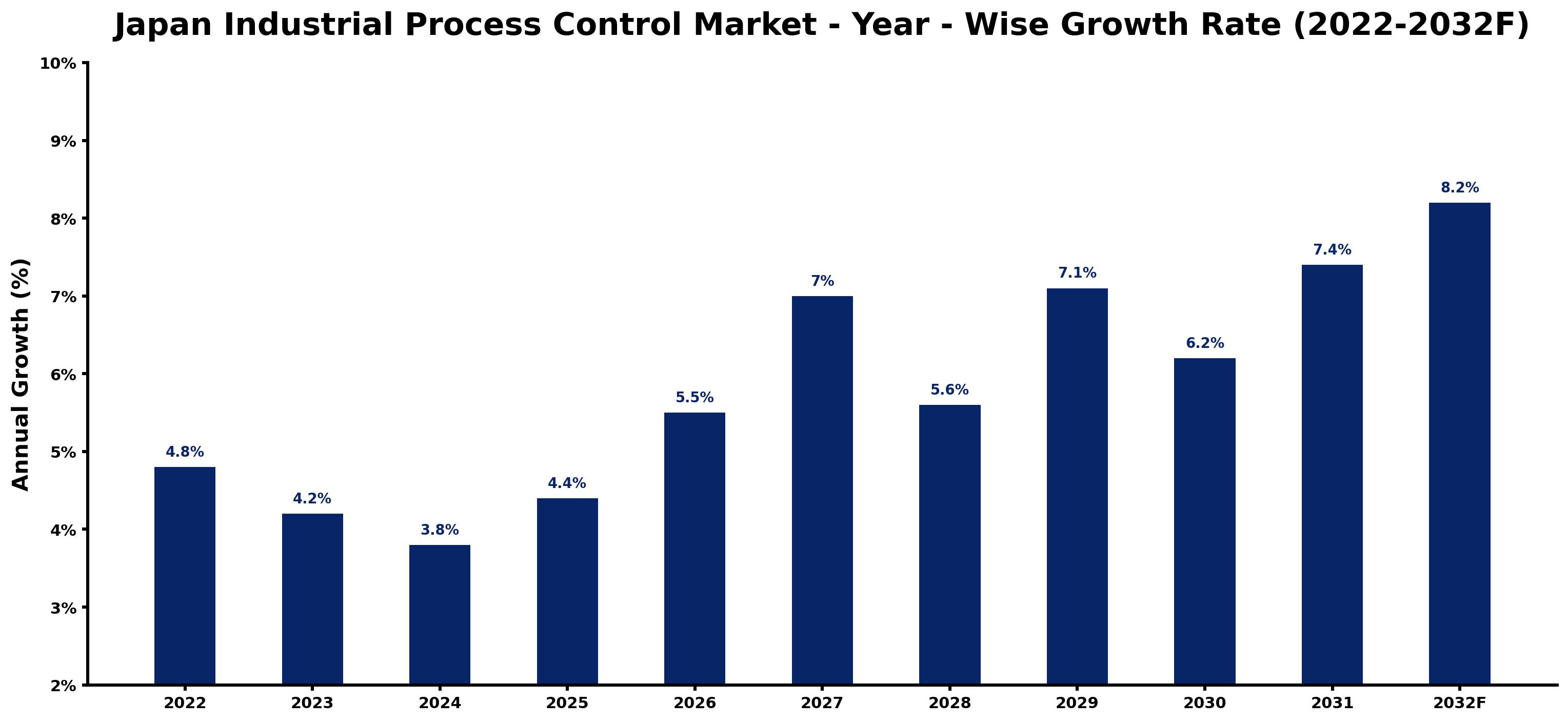
The table below sets out the estimated growth rate for each year and the main factor behind it.
| Year | Estimated Annual Growth (%) | Market Rationale |
| 2022 | 4.8 | The market experienced growth due to strong demand from the automotive sector. |
| 2023 | 4.2 | Growth slowed as the energy sector faced challenges in investment levels. |
| 2024 | 3.8 | The market continued to slow as automation adoption rates stabilised. |
| 2025 | 4.4 | Demand increased as manufacturers sought to improve operational efficiency. |
| 2026 | 5.5 | Growth is expected to accelerate due to rising investments in smart grid technologies. |
| 2027 | 7.0 | The market is projected to expand as the automotive sector increases automation efforts. |
| 2028 | 5.6 | Growth is anticipated to slow as the market adjusts to previous high investment levels. |
| 2029 | 7.1 | Demand is expected to surge as utility companies adopt advanced monitoring systems. |
| 2030 | 6.2 | Growth will slow as the market faces saturation in certain segments. |
| 2031 | 7.4 | Demand is projected to increase due to ongoing investments in energy efficiency technologies. |
| 2032 | 8.2 | The market will peak as automation technologies become standard across industries. |
Note: Market size estimations and growth projections presented in this report are based on 6Wresearch's proprietary forecasting methodology, utilizing the latest available industry data, government publications, and primary research inputs.
Japan Industrial Process Control Market Synopsis
Industrial Process Control includes technologies and systems designed for monitoring and controlling industrial processes, integrating both hardware and software for automation. The automotive sector is a key driver of demand, employing approximately 5 million people and relying heavily on automation. Market growth is underpinned by investments in smart grid technologies, with over ¥1 trillion allocated since 2020, alongside a strong focus on operational efficiency across various industries, particularly in energy and manufacturing. The Tokyo metropolitan area serves as a central hub for the development of industrial automation technologies, further improving market prospects.
Market Dynamics Impact Analysis (2026–2032)
| Factor | Type | Impact | Primary Segment Affected |
| Strong demand from the automotive sector drives the need for automation solutions. | Driver | High | Automated Production |
| Increasing investments in smart grid technologies create opportunities for process control systems. | Opportunity | High | Utility Grid Management |
| Regulatory compliance regarding energy efficiency can limit market growth for certain segments. | Restraint | Medium | DCS Systems |
| High initial investment costs for automation technologies can deter adoption. | Challenge | High | Programmable Logic |
| Adoption of advanced monitoring systems in utilities boosts demand for SCADA systems. | Driver | High | SCADA Systems |
| Growing chemical production necessitates enhanced process control technologies. | Opportunity | Medium | Chemical Processing |
| Market saturation in established sectors can slow growth rates. | Restraint | Medium | Loop Controllers |
| Competition from emerging technologies poses risks to traditional process control systems. | Challenge | Medium | HMI |
Evaluation of Drivers in Japan Industrial Process Control Market (2026–2032)
Below are the drivers that matter most for revenue growth, with supporting evidence.
| Drivers | Primary Segment Affected | Why It Matters (Evidence) |
| Increased automation in the automotive sector boosts demand for PLC systems. | PLC Systems | The automotive sector employs approximately 5 million people, heavily relying on automation. |
| Rising investments in smart grid technologies increase the need for SCADA systems. | SCADA Systems | The energy sector in Japan has invested over ¥1 trillion in smart grid technologies since 2020. |
| The push for energy efficiency drives demand for DCS systems in manufacturing. | DCS Systems | Japan targets a 46% cut in greenhouse-gas emissions from fiscal 2013 levels by fiscal 2030. |
| The need for real-time monitoring in utilities increases demand for Remote Monitoring solutions. | Remote Monitoring | Remote monitoring solutions are projected to increase by 30% in adoption by 2025. |
| The chemical industry’s growth necessitates advanced process control technologies. | Chemical Processing | In 2022, Japan's chemical industry produced over 10 million tons of chemicals using automated processes. |
Buyers are adding capacity as the automotive sector increasingly adopts automation technologies, employing around 5 million people and driving demand for PLC systems. The energy sector's investment in smart grid technologies, exceeding ¥1 trillion since 2020, boosts the need for SCADA systems. Japan's commitment to reducing greenhouse-gas emissions by 46% by fiscal 2030 fuels demand for DCS systems. The projected 30% increase in remote monitoring solutions adoption by 2025 highlights the growing need for real-time monitoring capabilities. The chemical industry's production of over 10 million tons in 2022 further necessitates advanced process control technologies.
Evaluation of Restraints in Japan Industrial Process Control Market
Several factors work against faster growth; the main ones are summarised below.
| Market Restraint | Primary Segment Affected | Why It Matters (Evidence) |
| Regulatory compliance can limit the adoption of DCS systems due to stringent safety standards. | DCS Systems | The Industrial Safety and Health Act mandates strict compliance for hazardous substances and machinery. |
| High initial investment costs deter smaller manufacturers from adopting advanced automation solutions. | Programmable Logic | The average annual energy consumption in Japan is around 1,000 TWh, requiring substantial investments. |
| Market saturation in established sectors can slow growth rates for certain automation technologies. | Loop Controllers | The total installed base of PLC systems in Japan is estimated to be over 1 million units. |
| Limited awareness of advanced process control benefits can hinder market expansion. | HMI | ISO 9001 standards are widely applied, but many firms lack knowledge of automation advantages. |
| Competition from emerging technologies poses risks to traditional process control systems. | SCADA Systems | The Japan Electrical Manufacturers' Association supports innovation, increasing competitive pressure. |
Japan Industrial Process Control Market Challenges
Japan's strict greenhouse gas emission regulations compel producers to invest heavily in compliance technologies, raising operational costs by 20% for manufacturers. As these costs are passed down, buyers may face rising prices, potentially increasing product costs by 15% for end-users. Supply chain challenges arise as producers struggle to source advanced automation components, leading to project delays of up to six months for buyers. A shortage of skilled workers in automation technology restricts producers' ability to implement new systems, resulting in a 10% decline in productivity across affected sectors.
Trends in the Japan Industrial Process Control Market
Four trends stand out in the Japan Industrial Process Control Market.
- Increase in Remote Monitoring Adoption: Remote monitoring solutions are set to increase by 30% in adoption by 2025, particularly within the energy sector. This shift highlights the growing need for operational efficiency and real-time data access, significantly impacting utility companies.
- Shift Towards Smart Grid Technologies: Investment in smart grid technologies is on the rise, with over ¥1 trillion allocated since 2020. This trend is particularly visible in the Tokyo metropolitan area, where advanced automation technologies are being developed to improve energy management.
- Rising Demand for Automation in Chemical Processing: The chemical industry is moving towards greater automation, producing over 10 million tons of chemicals in 2022. This trend is driven by the need for enhanced safety and efficiency in production processes.
- Focus on Energy Efficiency in Manufacturing: Manufacturers are placing a premium on energy efficiency, motivated by Japan's target to reduce greenhouse gas emissions by 46% by fiscal 2030. This focus is especially pertinent in the automotive sector, which employs millions.
Investment Opportunities in the Japan Industrial Process Control Market
Investors looking at the Japan Industrial Process Control Market should consider the following areas.
- Investment in Smart Grid Technologies: Now is an opportune moment for investments in smart grid technologies, with over ¥1 trillion already allocated. Utility companies are actively seeking advanced solutions to improve grid management and efficiency, creating opportunities for suppliers.
- Automation Solutions for the Chemical Industry: The expanding chemical industry, producing over 10 million tons in 2022, generates a demand for advanced automation solutions. Suppliers can penetrate this market through partnerships with local manufacturers.
- Remote Monitoring Solutions for Utilities: With a projected 30% increase in remote monitoring adoption by 2025, utility companies are in search of innovative solutions. Suppliers can engage through collaborations with local technology firms.
- Energy Efficiency Technologies for Manufacturing: The emphasis on energy efficiency in manufacturing presents investment opportunities. Companies in the automotive sector are actively pursuing technologies that align with Japan's emissions reduction targets.
Government Initiatives in the Japan Industrial Process Control Market
The Electrical Appliance and Material Safety Act governs the safety of electrical appliances, ensuring compliance for producers in the industrial process control market. The Industrial Safety and Health Act outlines employer responsibilities regarding hazardous substances and machinery, affecting manufacturers' operational practices. The GX Promotion Act supports decarbonisation efforts, with Japan Climate Transition Bonds facilitating investments in sustainable technologies.
The Ministry of Economy, Trade and Industry supervises the implementation of energy efficiency measures and funds initiatives to promote automation in manufacturing. The GX Promotion Act continues to support decarbonisation efforts, with Japan Climate Transition Bonds aiding investments in sustainable technologies.
Future Insight of the Japan Industrial Process Control Market
By 2032, automation technologies will reshape industrial processes, leading to a marked increase in demand for integrated solutions. The government's initiative to promote AI adoption will streamline operations and lower costs for buyers. Smart grid technologies will improve energy management, aligning with decarbonisation objectives. Standards such as JIS B 3501 will adapt to incorporate new technologies, ensuring compliance and quality for suppliers, while the Tokyo Electric Power Company's advanced DCS systems will further optimise grid management.
Market Segmentation Analysis
Japan Industrial Process Control Market report covers a detailed analysis of the following market segments:
By Control Type – DCS Systems Lead, SCADA Systems Expected to Grow Fastest
According to Saurav Kr Singh, Senior Research Analyst at 6Wresearch, with 39% of control type revenue in 2025, DCS Systems was the largest category. DCS systems hold the largest market share due to their critical role in managing complex processes, particularly in automotive manufacturing facilities. Their importance is highlighted by the extensive installed base of over 1 million units in Japan, ensuring reliability in operations. SCADA Systems are set to record the highest CAGR in this split, 9.5% over 2026–2032. SCADA systems are witnessing rapid growth as they are essential for real-time monitoring of industrial processes, particularly in utility companies. The anticipated 30% increase in remote monitoring solutions by 2025 signifies a strong upward trend for SCADA adoption. Suppliers should enhance SCADA offerings to address the rising demand for remote monitoring capabilities.
By System Type – Programmable Logic Leads, Distributed Expected to Grow Fastest
The largest system type category in 2025 was Programmable Logic, at 35% of revenue. Programmable Logic systems dominate the market as they are fundamental for programmable control across various industries, especially in manufacturing processes. Their reliability and adaptability make them indispensable in sectors such as automotive and chemicals, driving widespread adoption. Over 2026–2032, Distributed is expected to post the fastest growth, at a CAGR of 10.1%. Distributed systems are experiencing the fastest growth due to their efficiency in large-scale industrial applications, which are increasingly necessary for modern manufacturing demands. As industries expand, the reliance on distributed systems will continue to rise. Buyers should consider investing in distributed systems to improve operational efficiency in large-scale applications.
By Interface – HMI Leads, Remote Monitoring Expected to Grow Fastest
HMI held 41% of the Japan Industrial Process Control Market by interface in 2025. HMI interfaces are at the forefront of the market as they are vital for user interaction with control systems, enabling operators to manage processes effectively. Their significance is particularly evident in the automotive sector, where user-friendly interfaces are crucial for operational success. The quickest growth will come from Remote Monitoring, forecast to expand at a CAGR of 8.8% between 2026 and 2032. Remote monitoring interfaces are rapidly growing in importance as they facilitate real-time data access and control, aligning with the shift towards automation in industrial environments. This trend underscores the increasing need for effective remote management solutions. Suppliers need to focus on developing remote monitoring solutions to meet evolving market demands.
By Application – Automated Production Leads, Utility Grid Management Expected to Grow Fastest
Automated Production accounted for 41% of the market by application in 2025. Automated production is the leading application due to its core role in manufacturing processes, particularly in the automotive industry where operational efficiency is paramount. Significant investments in automation technologies further reinforce this dominance in the market. Utility Grid Management is projected to grow fastest, at a CAGR of 9.3% during 2026–2032. Utility grid management is the fastest-growing application as it is essential for effective energy distribution, especially with Japan's focus on smart grid technologies. The government's commitment to decarbonisation accelerates this growth trajectory. Buyers in the energy sector should seek advanced solutions for utility grid management to optimise energy distribution.
By End User Industry – Automotive Leads, Chemicals and Materials Expected to Grow Fastest
In 2025, Automotive led the end user industry split with a 35% share. The automotive industry leads the market as it extensively employs process control technologies for production, supporting approximately 5 million jobs and driving automation demand. This robust growth ensures a strong market for related technologies and solutions. Chemicals and Materials are set to record the highest CAGR in this split, 8.9% over 2026–2032. The chemicals and materials industry is rapidly growing as it increasingly integrates automation for production and safety standards. This trend is vital for maintaining competitiveness and compliance with regulatory requirements. Suppliers should target the chemicals and materials sector to capitalise on the increasing need for automation and process control.
Key Attractiveness of the Report
- 10 Years of Market Numbers
- Historical Data Starting from 2022 to 2025
- Base Year 2025
- Forecast Data until 2032
- Key Performance Indicators Impacting the Market
- Major Upcoming Developments and Projects
Key Highlights of the Report:
- Japan Industrial Process Control Market Outlook
- Market Size of Japan Industrial Process Control Market, 2025
- Forecast of Japan Industrial Process Control Market, 2032
- Historical Data and Forecast of Japan Industrial Process Control Revenues & Volume for the Period 2022-2032F
- Japan Industrial Process Control Market Trend Evolution
- Japan Industrial Process Control Market Drivers and Challenges
- Japan Industrial Process Control Price Trends
- Japan Industrial Process Control Porter's Five Forces
- Japan Industrial Process Control Industry Life Cycle
- Historical Data and Forecast of Japan Industrial Process Control Market Revenues & Volume By Control Type for the Period 2022-2032F
- Historical Data and Forecast of Japan Industrial Process Control Market Revenues & Volume By PLC Systems for the Period 2022-2032F
- Historical Data and Forecast of Japan Industrial Process Control Market Revenues & Volume By SCADA Systems for the Period 2022-2032F
- Historical Data and Forecast of Japan Industrial Process Control Market Revenues & Volume By DCS Systems for the Period 2022-2032F
- Historical Data and Forecast of Japan Industrial Process Control Market Revenues & Volume By Loop Controllers for the Period 2022-2032F
- Historical Data and Forecast of Japan Industrial Process Control Market Revenues & Volume By System Type for the Period 2022-2032F
- Historical Data and Forecast of Japan Industrial Process Control Market Revenues & Volume By Programmable Logic for the Period 2022-2032F
- Historical Data and Forecast of Japan Industrial Process Control Market Revenues & Volume By Supervisory for the Period 2022-2032F
- Historical Data and Forecast of Japan Industrial Process Control Market Revenues & Volume By Distributed for the Period 2022-2032F
- Historical Data and Forecast of Japan Industrial Process Control Market Revenues & Volume By Analog/Digital for the Period 2022-2032F
- Historical Data and Forecast of Japan Industrial Process Control Market Revenues & Volume By Interface for the Period 2022-2032F
- Historical Data and Forecast of Japan Industrial Process Control Market Revenues & Volume By HMI for the Period 2022-2032F
- Historical Data and Forecast of Japan Industrial Process Control Market Revenues & Volume By Remote Monitoring for the Period 2022-2032F
- Historical Data and Forecast of Japan Industrial Process Control Market Revenues & Volume By Centralized Control for the Period 2022-2032F
- Historical Data and Forecast of Japan Industrial Process Control Market Revenues & Volume By PID Interface for the Period 2022-2032F
- Historical Data and Forecast of Japan Industrial Process Control Market Revenues & Volume By Application for the Period 2022-2032F
- Historical Data and Forecast of Japan Industrial Process Control Market Revenues & Volume By Automated Production for the Period 2022-2032F
- Historical Data and Forecast of Japan Industrial Process Control Market Revenues & Volume By Utility Grid Management for the Period 2022-2032F
- Historical Data and Forecast of Japan Industrial Process Control Market Revenues & Volume By Chemical Processing for the Period 2022-2032F
- Historical Data and Forecast of Japan Industrial Process Control Market Revenues & Volume By Temperature/Flow Control for the Period 2022-2032F
- Historical Data and Forecast of Japan Industrial Process Control Market Revenues & Volume By End User Industry for the Period 2022-2032F
- Historical Data and Forecast of Japan Industrial Process Control Market Revenues & Volume By Automotive for the Period 2022-2032F
- Historical Data and Forecast of Japan Industrial Process Control Market Revenues & Volume By Energy Sector for the Period 2022-2032F
- Historical Data and Forecast of Japan Industrial Process Control Market Revenues & Volume By Chemicals and Materials for the Period 2022-2032F
- Historical Data and Forecast of Japan Industrial Process Control Market Revenues & Volume By Metal Industry for the Period 2022-2032F
- Japan Industrial Process Control Import Export Trade Statistics
- Market Opportunity Assessment By Control Type
- Market Opportunity Assessment By System Type
- Market Opportunity Assessment By Interface
- Market Opportunity Assessment By Application
- Market Opportunity Assessment By End User Industry
- Japan Industrial Process Control Top Companies Market Share
- Japan Industrial Process Control Competitive Benchmarking By Technical and Operational Parameters
- Japan Industrial Process Control Company Profiles
- Japan Industrial Process Control Key Strategic Recommendations
Market Covered
This report examines the market across the segments below.
By Control Type
- PLC Systems
- SCADA Systems
- DCS Systems
- Loop Controllers
By System Type
- Programmable Logic
- Supervisory
- Distributed
- Analog/Digital
By Interface
- HMI
- Remote Monitoring
- Centralized Control
- PID Interface
By Application
- Automated Production
- Utility Grid Management
- Chemical Processing
- Temperature/Flow Control
By End User Industry
- Automotive
- Energy Sector
- Chemicals and Materials
- Metal Industry































