Japan Industrial Process Oils Market Size & Growth Rate
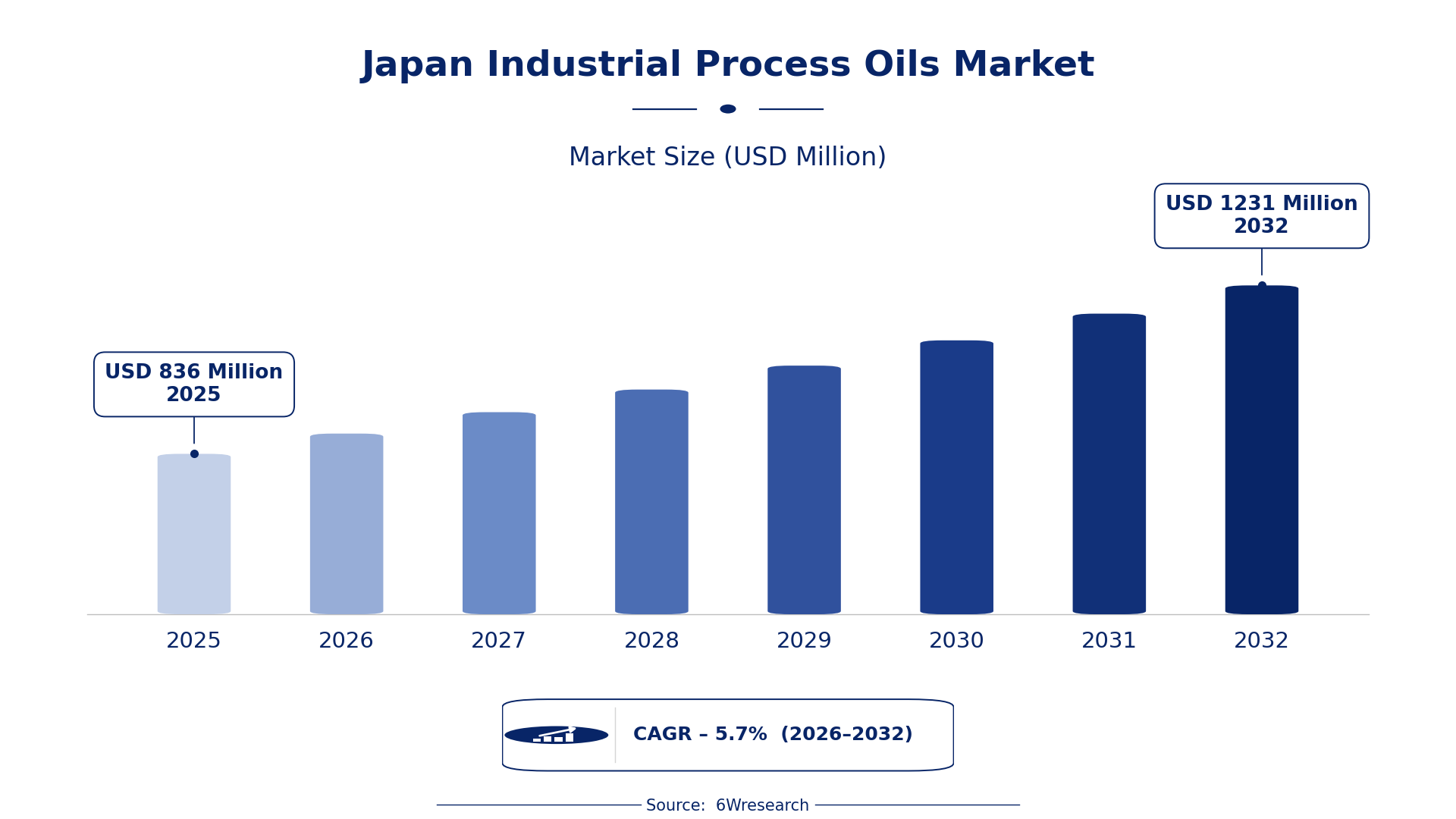
According to 6Wresearch internal database and industry insights, the Japan Industrial Process Oils Market was valued at USD 836 Million in 2025 and is projected to reach USD 1,231 Million by 2032, growing at a CAGR of approximately 5.7% during 2026–2032.
Japan Industrial Process Oils Market Highlights
| Report Metric | Details |
| Report Name | Japan Industrial Process Oils Market (2026-2032) |
| Market Size 2025 | USD 836 Million |
| Market Size 2032 | USD 1,231 Million |
| Absolute Growth 2025–2032 | USD 395 Million |
| CAGR 2026–2032 | 5.7% |
| Peak Annual Growth | 6.5% in 2028 |
| Forecast Period | 2026–2032 |
| Historical Data | 2022–2025 |
| Base Year | 2025 |
| Leading Oil Type, 2025 | Paraffinic Oils (39% share) |
| Leading Source Type, 2025 | Petroleum-Based (40% share) |
| Leading Viscosity Grade, 2025 | Medium (41% share) |
| Leading Application, 2025 | Rubber Processing (38% share) |
| Leading End User Industry, 2025 | Automotive (40% share) |
| Fastest-Growing Oil Type | Bio-Based Oils (8.4% CAGR) |
| Fastest-Growing Source Type | Plant-Based (8.9% CAGR) |
| Fastest-Growing Viscosity Grade | Low (8.0% CAGR) |
| Fastest-Growing Application | Eco-Friendly Additives (7.8% CAGR) |
| Fastest-Growing End User Industry | Chemicals and Materials (7.6% CAGR) |
| Growing Sector | automotive |
| Key End Users | automotive, textile manufacturing, rubber processing, printing and packaging |
Japan Industrial Process Oils Market Year-wise Growth Rate and Key Drivers (2022–2032)
This graph illustrates the annual growth rates of the market from 2022 to 2032, highlighting a steady upward trajectory and projected market expansion over the forecast period.
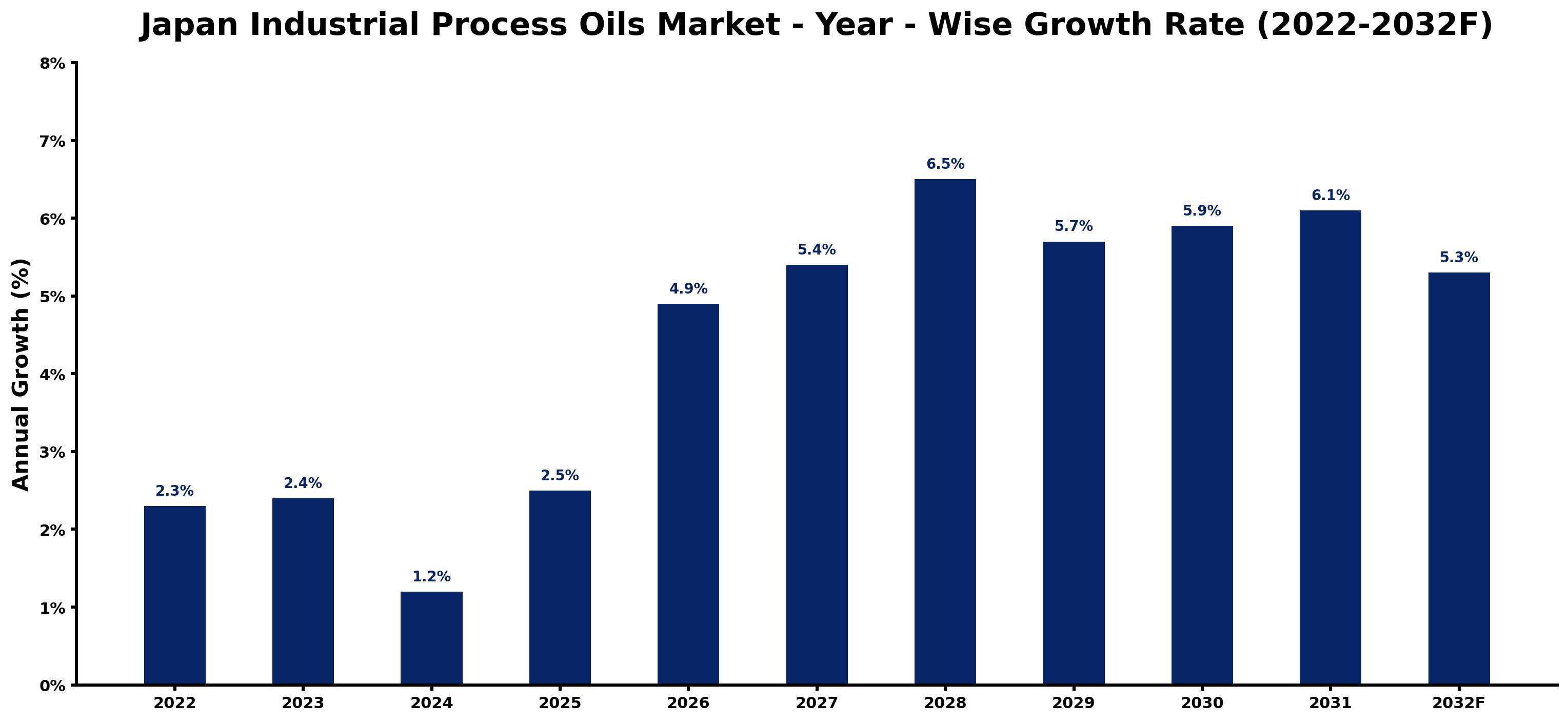
The table below sets out the estimated growth rate for each year and the main factor behind it.
| Year | Estimated Annual Growth (%) | Market Rationale |
| 2022 | 2.3 | The market showed steady growth due to consistent industrial demand for process oils. |
| 2023 | 2.4 | Growth accelerated as automotive production increased, driving higher oil consumption across sectors. |
| 2024 | 1.2 | Growth slowed as supply chain disruptions affected production rates and availability of oils. |
| 2025 | 2.5 | Demand rose again as the automotive sector expanded production capabilities and output. |
| 2026 | 4.9 | The market is expected to grow as investments in eco-friendly oils gain traction. |
| 2027 | 5.4 | Demand will rise further due to technological advancements in oil formulations and applications. |
| 2028 | 6.5 | The peak growth year will see substantial investments in the automotive sector and sustainability initiatives. |
| 2029 | 5.7 | Growth is projected to slow as market saturation begins to occur in certain segments. |
| 2030 | 5.9 | Demand is expected to rise as sustainability initiatives and eco-friendly practices gain traction. |
| 2031 | 6.1 | Growth will continue as the chemical sector increasingly adopts bio-based oils and sustainable practices. |
| 2032 | 5.3 | The market will grow steadily as new applications for industrial process oils emerge. |
Note: Market size estimations and growth projections presented in this report are based on 6Wresearch's proprietary forecasting methodology, utilizing the latest available industry data, government publications, and primary research inputs.
Japan Industrial Process Oils Market Synopsis
Industrial Process Oils are petroleum-derived lubricants and processing aids used primarily in automotive and textile industries. The Japan Industrial Process Oils Market is growing, driven by the automotive sector, which produces millions of vehicles each year, and the textile manufacturing industry, valued at over 1 trillion JPY. The rising adoption of bio-based oils, supported by government initiatives, along with the demand for eco-friendly additives, further propels market expansion, with expectations of reaching USD 1,231 million by 2032.
Market Dynamics Impact Analysis (2026–2032)
| Factor | Type | Impact | Primary Segment Affected |
| Rising automotive production | Driver | High | Petroleum-Based |
| Growing demand for eco-friendly alternatives | Driver | High | Bio-Based Oils |
| Increased investment in sustainable practices | Opportunity | High | Bio-Based Oils |
| Expansion of the textile industry | Opportunity | Medium | Naphthenic Oils |
| Supply chain disruptions affecting availability | Restraint | High | Petroleum-Based |
| High production costs for bio-based oils | Restraint | Medium | Bio-Based Oils |
| Competition from alternative lubricants | Challenge | High | Petroleum-Based |
| Technological barriers in oil formulation | Challenge | Medium | Bio-Based Oils |
Evaluation of Drivers in Japan Industrial Process Oils Market (2026–2032)
Demand rests on the following drivers, each shown with the segment it touches most.
| Drivers | Primary Segment Affected | Why It Matters (Evidence) |
| Increased vehicle production | Petroleum-Based | Japan's automotive sector produces over 5 million vehicles annually, driving demand for industrial process oils. |
| Adoption of eco-friendly oils | Bio-Based Oils | Government initiatives promote sustainable practices, increasing demand for bio-based oils across various applications. |
| Growth in textile manufacturing | Naphthenic Oils | The textile industry, valued at over 1 trillion JPY, relies heavily on industrial process oils for quality production. |
| Expansion of rubber processing | Paraffinic Oils | The rubber processing industry consumes large amounts of paraffinic oils, essential for tire production and related products. |
| Rising demand in printing and packaging | Naphthenic Oils | The growth of the printing and packaging industry contributes to increased consumption of industrial process oils. |
Volumes grow on the back of increased vehicle production, with over 5 million vehicles manufactured annually in Japan, driving demand for petroleum-based oils. The textile manufacturing sector, valued at over 1 trillion JPY, heavily relies on naphthenic oils for quality production. The rubber processing industry is a major consumer of paraffinic oils, essential for tire production. Investments in eco-friendly practices are boosting the adoption of bio-based oils, increasing overall market demand. The printing and packaging sector is also expanding, further contributing to the rising consumption of industrial process oils across applications.
Evaluation of Restraints in Japan Industrial Process Oils Market
Below are the constraints most often cited by buyers and suppliers, with the segment each affects.
| Market Restraint | Primary Segment Affected | Why It Matters (Evidence) |
| Supply chain disruptions | Petroleum-Based | Recent disruptions have affected the availability of petroleum-based oils, impacting production timelines and costs. |
| High production costs | Bio-Based Oils | The production costs for bio-based oils remain high, limiting their widespread adoption in the market and affecting pricing. |
| Competition from synthetic alternatives | Petroleum-Based | Synthetic lubricants are gaining traction, posing a challenge to traditional petroleum-based oils and market share. |
| Regulatory compliance costs | Bio-Based Oils | Compliance with environmental regulations increases operational costs for bio-based oil producers, affecting pricing strategies. |
| Limited supply of raw materials | Paraffinic Oils | The availability of crude oil affects the production capacity of paraffinic oils, leading to potential shortages. |
Japan Industrial Process Oils Market Challenges
Producers encounter intense competition as the automotive sector's demand for industrial process oils rises, compelling them to secure reliable sources. Increased costs arise from stringent environmental regulations, inflating production expenses by 20% for manufacturers, which diminishes their profitability. Distributors face skills shortages as the shift to eco-friendly additives necessitates specialised expertise, delaying product development timelines by six months. Buyers in the textile manufacturing industry experience supply chain disruptions, leading to stock shortages that can affect production schedules for companies dependent on timely deliveries.
Trends in the Japan Industrial Process Oils Market
Below are the shifts with the largest effect on the Japan Industrial Process Oils Market.
- Shift towards Eco-Friendly Additives: The printing and packaging industry is increasingly adopting eco-friendly additives, with a government program launched in 2023 promoting sustainable practices. This shift is expected to improve product quality while reducing environmental impact.
- Transition from Conventional to Bio-Based Oils: The textile manufacturing sector is gradually transitioning to bio-based oils, driven by consumer demand for sustainable products. The sector's value exceeds 1 trillion JPY, highlighting the potential for growth in this area.
- Emergence of Advanced Rubber Processing Techniques: In 2023, the rubber processing industry began adopting advanced techniques that improve the performance of paraffinic oils. This change is important for enhancing tire production efficiency and quality.
- Growth in Automotive Sustainability Initiatives: The automotive sector is prioritising sustainability, with significant investments in eco-friendly oils projected to increase. Japan aims for a 46% cut in greenhouse-gas emissions by 2030, driving demand for greener solutions.
Investment Opportunities in the Japan Industrial Process Oils Market
Where to invest in the Japan Industrial Process Oils Market: the main openings are set out below.
- Automotive Sector's Demand for Eco-Friendly Oils: The automotive industry is increasingly seeking eco-friendly oils, with a projected market growth of 5.7% by 2032. Suppliers can enter this market by partnering with local manufacturers and focusing on bio-based formulations.
- Textile Manufacturing's Need for Quality Enhancements: The textile manufacturing sector, valued at over 1 trillion JPY, requires high-quality oils for production. Suppliers can target this sector by offering tailored naphthenic oils that meet specific performance standards.
- Rubber Processing Industry's Expansion: The rubber processing industry is expanding, creating a demand for paraffinic oils. Suppliers can establish partnerships with local rubber manufacturers to meet this growing need.
- Printing and Packaging Sector's Shift to Sustainability: The printing and packaging industry is increasingly adopting eco-friendly additives, backed by government initiatives. Suppliers should focus on providing sustainable oil solutions to capture this emerging market.
Government Initiatives in the Japan Industrial Process Oils Market
The Industrial Safety and Health Act (1972) mandates employer responsibilities regarding hazardous substances, impacting producers of industrial process oils by requiring compliance with safety standards. This law ensures that manufacturers maintain safe working conditions and product quality, ultimately benefiting buyers through improved safety and reliability. Additionally, the Act requires regular inspections, affecting operational costs for producers.
The Ministry of the Environment oversees the Waste Management and Public Cleansing Act (1970), which regulates the treatment of industrial waste. This agency approves waste management practices, ensuring that producers comply with environmental standards and that buyers can trust the sustainability of the products they use. The Act mandates reporting on waste disposal methods, impacting operational transparency.
Future Insight of the Japan Industrial Process Oils Market
The rollout of new decarbonisation programmes will drive the adoption of bio-based oils in industrial applications by 2032, aligning with Japan's greenhouse gas reduction targets. The textile manufacturing sector will progressively integrate eco-friendly additives, supported by government initiatives promoting sustainability. Standards like ISO 6743-99 will evolve to ensure quality in new formulations, improving performance in industrial process oils. With millions of vehicles produced annually, the automotive industry will maintain its high demand for lubricants, shaping supplier strategies.
Market Segmentation Analysis
Japan Industrial Process Oils Market report covers a detailed analysis of the following market segments:
By Oil Type – Paraffinic Oils Lead, Bio-Based Oils Expected to Grow Fastest
According to Saurav Kr Singh, Senior Research Analyst at 6Wresearch, Paraffinic Oils accounted for 39% of the market by oil type in 2025. Paraffinic oils dominate the market due to their extensive use in rubber processing, where their stability and low volatility are essential. With millions of vehicles produced annually in Japan, the automotive sector heavily relies on these oils for optimal performance. Over 2026–2032, Bio-Based Oils are expected to post the fastest growth, at a CAGR of 8.4%. Bio-based oils are experiencing rapid growth as eco-friendly alternatives, driven by government initiatives promoting sustainable practices. Their adoption is expected to increase as more industries seek to reduce their environmental impact. Suppliers should focus on developing eco-friendly products to meet the growing demand for sustainable solutions.
By Source Type – Petroleum-Based Leads, Plant-Based Expected to Grow Fastest
In 2025, Petroleum-Based led the source type split with a 40% share. Petroleum-based oils are the primary source for industrial process oils, particularly in the automotive and chemicals sectors, where they are essential for lubrication and processing. This dominance is supported by the established infrastructure for petroleum extraction and refining in Japan. Plant-Based is projected to grow fastest, at a CAGR of 8.9% during 2026–2032. Plant-based oils are gaining traction as a sustainable option, with increasing interest from industries looking to adopt greener practices. As regulations tighten around emissions, this segment is likely to see accelerated growth. Buyers may need to consider transitioning to plant-based options to align with environmental regulations and consumer preferences.
By Viscosity Grade – Medium Leads, Low Expected to Grow Fastest
Medium took 41% of viscosity grade revenue in 2025, more than any other category. Medium viscosity oils are essential in numerous industrial applications, striking a balance between performance and versatility. Their widespread use in the automotive sector, which produces millions of vehicles annually, reinforces their dominant market position. Low is set to record the highest CAGR in this split, 8.0% over 2026–2032. Low viscosity oils are gaining traction in sectors that require improved flow characteristics, particularly in high-speed manufacturing processes. This trend is expected to accelerate as industries focus on increasing operational efficiency and productivity. Suppliers must prioritise the development of low viscosity formulations to meet the changing demands of industrial applications.
By Application – Rubber Processing Leads, Eco-Friendly Additives Expected to Grow Fastest
Rubber Processing held 38% of the Japan Industrial Process Oils Market by application in 2025. Rubber processing remains the largest application for industrial process oils, as they are essential for the production of tires and other rubber goods. The industry's reliance on these oils ensures their dominant market position. The quickest growth will come from Eco-Friendly Additives, forecast to expand at a CAGR of 7.8% between 2026 and 2032. Eco-friendly additives are emerging as a fast-growing application, driven by an increasing emphasis on sustainability in industrial processes. Although still limited, their adoption is likely to expand as companies seek greener alternatives. Suppliers need to innovate in eco-friendly formulations to capture the growing interest in sustainable industrial applications.
By End User Industry – Automotive Leads, Chemicals and Materials Expected to Grow Fastest
The largest end user industry category in 2025 was Automotive, at 40% of revenue. The automotive industry is the largest consumer of industrial process oils, utilising them for lubrication and manufacturing processes in vehicle production. This sector's scale and significance in Japan's economy underpin its leading position. Over 2026–2032, Chemicals and Materials are expected to post the fastest growth, at a CAGR of 7.6%. The chemicals and materials sector is projected to grow rapidly as it continues to rely on industrial process oils for various applications. This growth is supported by ongoing advancements in chemical formulations and production techniques. Buyers in the chemicals and materials sector should prepare for increased demand for process oils as their applications expand.
Key Attractiveness of the Report
- 10 Years of Market Numbers
- Historical Data Starting from 2022 to 2025
- Base Year 2025
- Forecast Data until 2032
- Key Performance Indicators Impacting the Market
- Major Upcoming Developments and Projects
Key Highlights of the Report:
- Japan Industrial Process Oils Market Outlook
- Market Size of Japan Industrial Process Oils Market, 2025
- Forecast of Japan Industrial Process Oils Market, 2032
- Historical Data and Forecast of Japan Industrial Process Oils Revenues & Volume for the Period 2022-2032F
- Japan Industrial Process Oils Market Trend Evolution
- Japan Industrial Process Oils Market Drivers and Challenges
- Japan Industrial Process Oils Price Trends
- Japan Industrial Process Oils Porter's Five Forces
- Japan Industrial Process Oils Industry Life Cycle
- Historical Data and Forecast of Japan Industrial Process Oils Market Revenues & Volume By Oil Type for the Period 2022-2032F
- Historical Data and Forecast of Japan Industrial Process Oils Market Revenues & Volume By Paraffinic Oils for the Period 2022-2032F
- Historical Data and Forecast of Japan Industrial Process Oils Market Revenues & Volume By Naphthenic Oils for the Period 2022-2032F
- Historical Data and Forecast of Japan Industrial Process Oils Market Revenues & Volume By Aromatic Oils for the Period 2022-2032F
- Historical Data and Forecast of Japan Industrial Process Oils Market Revenues & Volume By Bio-Based Oils for the Period 2022-2032F
- Historical Data and Forecast of Japan Industrial Process Oils Market Revenues & Volume By Source Type for the Period 2022-2032F
- Historical Data and Forecast of Japan Industrial Process Oils Market Revenues & Volume By Mineral-Based for the Period 2022-2032F
- Historical Data and Forecast of Japan Industrial Process Oils Market Revenues & Volume By Petroleum-Based for the Period 2022-2032F
- Historical Data and Forecast of Japan Industrial Process Oils Market Revenues & Volume By Petroleum-Based for the Period 2022-2032F
- Historical Data and Forecast of Japan Industrial Process Oils Market Revenues & Volume By Plant-Based for the Period 2022-2032F
- Historical Data and Forecast of Japan Industrial Process Oils Market Revenues & Volume By Viscosity Grade for the Period 2022-2032F
- Historical Data and Forecast of Japan Industrial Process Oils Market Revenues & Volume By Medium for the Period 2022-2032F
- Historical Data and Forecast of Japan Industrial Process Oils Market Revenues & Volume By Low for the Period 2022-2032F
- Historical Data and Forecast of Japan Industrial Process Oils Market Revenues & Volume By High for the Period 2022-2032F
- Historical Data and Forecast of Japan Industrial Process Oils Market Revenues & Volume By Variable for the Period 2022-2032F
- Historical Data and Forecast of Japan Industrial Process Oils Market Revenues & Volume By Application for the Period 2022-2032F
- Historical Data and Forecast of Japan Industrial Process Oils Market Revenues & Volume By Rubber Processing for the Period 2022-2032F
- Historical Data and Forecast of Japan Industrial Process Oils Market Revenues & Volume By Textile Manufacturing for the Period 2022-2032F
- Historical Data and Forecast of Japan Industrial Process Oils Market Revenues & Volume By Ink & Adhesive Industry for the Period 2022-2032F
- Historical Data and Forecast of Japan Industrial Process Oils Market Revenues & Volume By Eco-Friendly Additives for the Period 2022-2032F
- Historical Data and Forecast of Japan Industrial Process Oils Market Revenues & Volume By End User Industry for the Period 2022-2032F
- Historical Data and Forecast of Japan Industrial Process Oils Market Revenues & Volume By Automotive for the Period 2022-2032F
- Historical Data and Forecast of Japan Industrial Process Oils Market Revenues & Volume By Consumer Staples for the Period 2022-2032F
- Historical Data and Forecast of Japan Industrial Process Oils Market Revenues & Volume By Printing & Packaging for the Period 2022-2032F
- Historical Data and Forecast of Japan Industrial Process Oils Market Revenues & Volume By Chemicals and Materials for the Period 2022-2032F
- Japan Industrial Process Oils Import Export Trade Statistics
- Market Opportunity Assessment By Oil Type
- Market Opportunity Assessment By Source Type
- Market Opportunity Assessment By Viscosity Grade
- Market Opportunity Assessment By Application
- Market Opportunity Assessment By End User Industry
- Japan Industrial Process Oils Top Companies Market Share
- Japan Industrial Process Oils Competitive Benchmarking By Technical and Operational Parameters
- Japan Industrial Process Oils Company Profiles
- Japan Industrial Process Oils Key Strategic Recommendations
Market Covered
This report examines the market across the segments below.
By Oil Type
- Paraffinic Oils
- Naphthenic Oils
- Aromatic Oils
- Bio-Based Oils
By Source Type
- Mineral-Based
- Petroleum-Based
- Plant-Based
By Viscosity Grade
- Medium
- Low
- High
- Variable
By Application
- Rubber Processing
- Textile Manufacturing
- Ink & Adhesive Industry
- Eco-Friendly Additives
By End User Industry
- Automotive
- Consumer Staples
- Printing & Packaging
- Chemicals and Materials































