Japan Industrial Processing Additives Market Size & Growth Rate
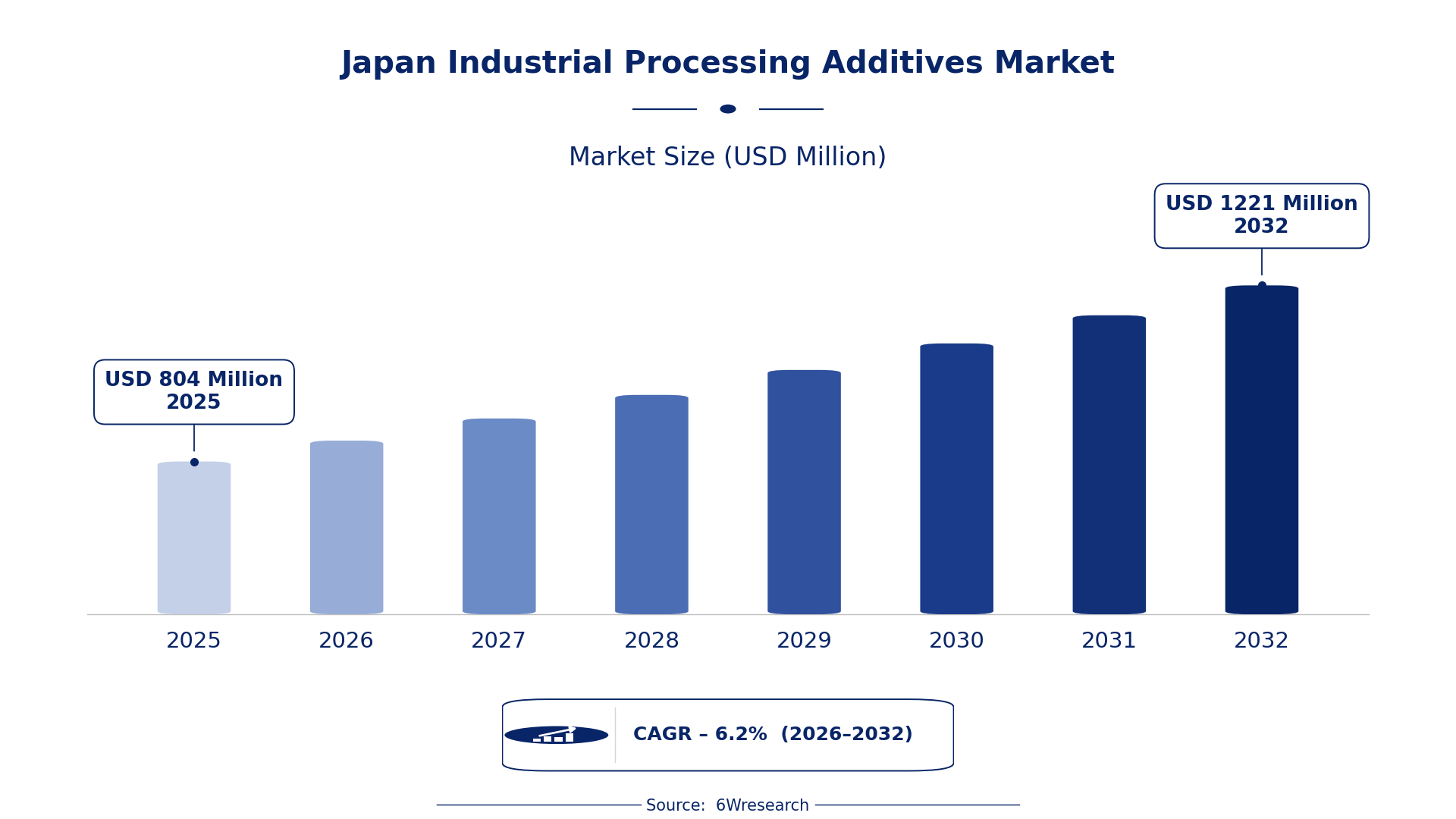
According to 6Wresearch internal database and industry insights, the Japan Industrial Processing Additives Market was valued at USD 804 Million in 2025 and is projected to reach USD 1,221 Million by 2032, growing at a CAGR of approximately 6.2% during 2026–2032.
Japan Industrial Processing Additives Market Highlights
| Report Metric | Details |
| Report Name | Japan Industrial Processing Additives Market (2026-2032) |
| Market Size 2025 | USD 804 Million |
| Market Size 2032 | USD 1,221 Million |
| Absolute Growth 2025–2032 | USD 417 Million |
| CAGR 2026–2032 | 6.2% |
| Peak Annual Growth | 6.9% in 2026 |
| Forecast Period | 2026–2032 |
| Historical Data | 2022–2025 |
| Base Year | 2025 |
| Leading Additive Type, 2025 | Lubricity Additives (39% share) |
| Leading Material Base, 2025 | Synthetic (42% share) |
| Leading Application Process, 2025 | Metal Forming (52% share) |
| Leading Form, 2025 | Liquid (50% share) |
| Leading End User Industry, 2025 | Manufacturing (36% share) |
| Fastest-Growing Additive Type | Anti-Scorch Agents (8.6% CAGR) |
| Fastest-Growing Application Process | Injection Molding (8.2% CAGR) |
| Fastest-Growing Form | Powder (9.0% CAGR) |
| Fastest-Growing End User Industry | Automotive (7.9% CAGR) |
| Growing Sector | Automotive |
| Key End Users | Manufacturers, Automotive, Consumer Goods, Packaging Industry |
Japan Industrial Processing Additives Market Year-wise Growth Rate and Key Drivers (2022–2032)
This graph illustrates the annual growth rates of the market from 2022 to 2032, highlighting a steady upward trajectory and projected market expansion over the forecast period.
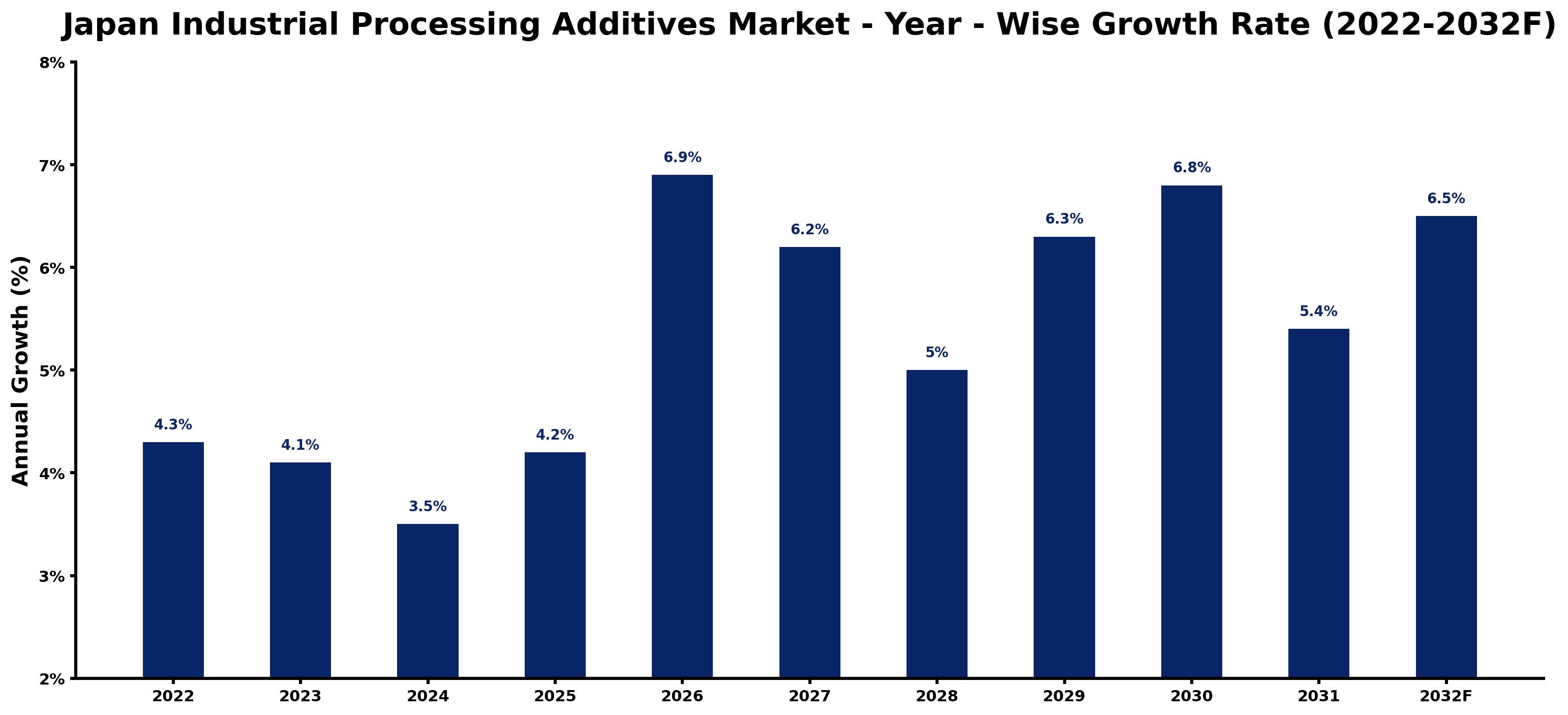
The yearly estimates that follow link every growth rate to its principal driver, so readers can see why the pace changed in each period.
| Year | Estimated Annual Growth (%) | Market Rationale |
| 2022 | 4.3 | The market showed strong activity, driven by demand from the manufacturing sector. |
| 2023 | 4.1 | Growth slowed due to market adjustments, yet demand remained steady from automotive producers. |
| 2024 | 3.5 | The market continued to slow as manufacturers faced supply chain challenges. |
| 2025 | 4.2 | Growth accelerated as manufacturers increased production to meet rising consumer demand. |
| 2026 | 6.9 | The peak growth year reflects heightened investments in sustainable manufacturing practices. |
| 2027 | 6.2 | Growth is expected to slow slightly as the market stabilises after reaching peak levels. |
| 2028 | 5.0 | A further slowdown is expected as manufacturers adjust to changing market conditions. |
| 2029 | 6.3 | Growth is projected to pick up again as the automotive sector expands its use of additives. |
| 2030 | 6.8 | Demand is expected to increase as manufacturers adopt more efficient production methods. |
| 2031 | 5.4 | A slight slowdown is projected as the market begins to mature. |
| 2032 | 6.5 | Growth is expected to resume as investments in decarbonisation initiatives gain momentum. |
Note: Market size estimations and growth projections presented in this report are based on 6Wresearch's proprietary forecasting methodology, utilizing the latest available industry data, government publications, and primary research inputs.
Japan Industrial Processing Additives Market Synopsis
Industrial processing additives are chemical compounds that enhance material performance during manufacturing. Produced through chemical synthesis, these additives play a vital role in applications such as lubrication, mold release, and adhesion. The Japan Industrial Processing Additives Market is expanding due to rising demand from the automotive sector, which contributes approximately 30% of total demand, coupled with ongoing transitions towards sustainable manufacturing practices supported by substantial public and private investments in decarbonisation initiatives.
Market Dynamics Impact Analysis (2026–2032)
| Factor | Type | Impact | Primary Segment Affected |
| Increasing demand for sustainable manufacturing practices | Driver | High | Lubricity Additives |
| Growth in the automotive sector driving additive usage | Driver | High | Anti-Scorch Agents |
| Rising demand for high-performance materials | Opportunity | High | Synthetic |
| Expansion in the packaging industry requiring innovative solutions | Opportunity | Medium | Liquid |
| Regulatory pressures on hazardous substances | Restraint | High | Mold Release Agents |
| Market saturation in certain additive types | Restraint | Medium | Tackifiers |
| Supply chain disruptions affecting production capacity | Challenge | High | Injection Molding |
| Rising costs of raw materials impacting pricing | Challenge | Medium | Rubber Vulcanization |
Evaluation of Drivers in Japan Industrial Processing Additives Market (2026–2032)
The following drivers explain most of the expected growth.
| Drivers | Primary Segment Affected | Why It Matters (Evidence) |
| Investment in sustainable manufacturing technologies | Lubricity Additives | This investment leads to increased demand for lubricity additives, as manufacturers seek to improve efficiency and reduce friction. |
| Expansion of the automotive industry | Anti-Scorch Agents | The automotive sector's growth drives the need for anti-scorch agents to support rubber processing during parts manufacturing. |
| Adoption of ISO 9001 standards by manufacturers | Synthetic | Compliance with these standards increases the demand for synthetic additives, improving product quality and performance. |
| Growth in consumer goods production | Liquid | The rising consumer goods market boosts the need for liquid additives, facilitating efficient manufacturing processes. |
| Technological advancements in additive formulations | Mold Release Agents | Innovations in formulations improve mold release efficiency, driving demand in various manufacturing sectors. |
Most of the extra volume comes from investments in sustainable manufacturing technologies, projected to reach JPY 150 trillion over ten years. The automotive industry, contributing around 30% of total demand, continues to expand, increasing the need for anti-scorch agents. The consumer goods market, valued at approximately $40 billion, boosts the demand for liquid additives to streamline production processes. Advancements in formulations are improving the effectiveness of mold release agents, increasing their usage in manufacturing.
Evaluation of Restraints in Japan Industrial Processing Additives Market
The table below lists the restraints and the evidence behind each.
| Market Restraint | Primary Segment Affected | Why It Matters (Evidence) |
| Regulatory compliance costs for hazardous substances | Mold Release Agents | Manufacturers face increased costs to comply with the Industrial Safety and Health Act, impacting profitability. |
| Market saturation in certain additive categories | Tackifiers | Saturation limits growth potential for tackifiers, as competition intensifies among existing products. |
| Supply chain disruptions affecting raw material availability | Injection Molding | Disruptions lead to delays in production schedules, affecting manufacturers' ability to meet demand. |
| Rising raw material costs impacting pricing strategies | Rubber Vulcanization | Increased costs of raw materials squeeze margins for producers, complicating pricing strategies. |
| Limited awareness of product benefits among manufacturers | Anti-Scorch Agents | A lack of understanding of the advantages of anti-scorch agents restricts their adoption in rubber processing. |
Japan Industrial Processing Additives Market Challenges
Japan produced over 1 million tons of industrial additives in 2022, yet buyers face rising costs due to limited domestic raw material sources, which drives up prices for manufacturers. Compliance with the JIS standard imposes additional costs on suppliers, delaying product launches and affecting market competitiveness. The government’s target for a 46% reduction in greenhouse gas emissions by 2030 requires substantial investment, straining financial resources for both producers and buyers. Frequent natural disasters disrupt supply chains, causing shortages that compel manufacturers to halt production and delay meeting consumer demand.
Trends in the Japan Industrial Processing Additives Market
The trends below show where the Japan Industrial Processing Additives Market is heading.
- Shift towards Sustainable Manufacturing Practices: Tokyo has experienced a shift towards sustainable manufacturing practices since 2023, with over JPY 150 trillion earmarked for investment. This trend encourages manufacturers to adopt eco-friendly additives, enhancing their market appeal.
- Transition from Liquid to Powder Additives: Beginning in 2026, manufacturers are increasingly turning to powder additives due to their efficiency in specific formulations. This shift is reflected in the growing demand for powder additives, projected to grow at 9.0%.
- Emergence of High-Performance Silicone Additives: The use of silicone-based additives has gained popularity in high-performance applications since 2022, driven by increased demand from the automotive sector, improving product capabilities.
- Growth in the Automotive Sector: The automotive sector's expansion has been apparent since 2022, contributing approximately 30% to the overall demand for processing additives. This growth is expected to persist as manufacturers seek effective solutions.
Investment Opportunities in the Japan Industrial Processing Additives Market
Where to invest in the Japan Industrial Processing Additives Market: the main openings are set out below.
- Current Demand for Eco-Friendly Additives: With Japan's aim to reduce greenhouse gas emissions by 46% by 2030, there is a strong need for eco-friendly additives. Manufacturers in the automotive sector are particularly eager to adopt these solutions.
- Investment in High-Performance Additives: The rising demand for high-performance materials presents an opportunity to supply synthetic additives. Collaborating with manufacturers in Tokyo can facilitate market entry.
- Expansion in the Packaging Industry: The packaging industry, valued at approximately $40 billion, is in search of additive solutions. Entering this market through partnerships with local firms can yield substantial returns.
- Growing Need for Efficient Manufacturing Solutions: As manufacturers pursue efficiency, the demand for liquid additives is increasing. Targeting the manufacturing sector in Aichi can provide promising opportunities.
Government Initiatives in the Japan Industrial Processing Additives Market
The GX Promotion Act (2023) is crucial for producers of industrial processing additives, mandating compliance with decarbonisation targets. This law aims for about JPY 150 trillion in public and private investments over the next decade, urging manufacturers to innovate and invest in sustainable practices. The Act on the Rational Use of Energy (1979) requires large energy users to improve energy efficiency, impacting additive producers by necessitating the adoption of energy-saving technologies and reporting their energy consumption, thus affecting operational costs and product pricing.
Buyers in the automotive sector utilise the GX Basic Policy to secure funding for sustainable manufacturing initiatives. This policy promotes investments in eco-friendly materials and processes, enabling manufacturers to meet evolving consumer demands for greener products. The government’s support through Japan Climate Transition Bonds, first auctioned in February 2024, provides financial backing for projects that align with decarbonisation goals, facilitating the adoption of new additives that improve sustainability in production.
Future Insight of the Japan Industrial Processing Additives Market
The policy-driven shift towards decarbonisation will compel suppliers to develop eco-friendly additives, in line with the government's substantial investment in sustainable practices. By 2032, the integration of advanced technologies, such as AI in production processes, will improve efficiency and reduce waste. The growth of the rubber industry will significantly increase demand for anti-scorch agents, creating new opportunities for buyers and suppliers. As the packaging industry, valued at approximately $40 billion, evolves, it will further stimulate innovation in additive applications.
Market Segmentation Analysis
Japan Industrial Processing Additives Market report covers a detailed analysis of the following market segments:
By Additive Type – Lubricity Additives Lead, Anti-Scorch Agents Expected to Grow Fastest
According to Saurav Kr Singh, Senior Research Analyst at 6Wresearch, Lubricity Additives took 39% of additive type revenue in 2025, more than any other category. Lubricity additives are essential in reducing friction during metal forming processes, which are critical in sectors like automotive manufacturing. Their widespread use ensures they maintain a dominant position in the market. The quickest growth will come from Anti-Scorch Agents, forecast to expand at a CAGR of 8.6% between 2026 and 2032. Anti-scorch agents are gaining traction as the rubber industry grows, with a notable increase in demand for solutions that prevent degradation during vulcanization. This trend is expected to continue as high-performance applications proliferate. Suppliers should develop targeted solutions for anti-scorch agents to capitalise on the expanding rubber industry.
By Material Base – Synthetic Leads and Records the Fastest Growth
In 2025, Synthetic led the material base split with a 42% share. Synthetic additives dominate the market due to their versatility and effectiveness in high-performance applications. Their widespread use in sectors such as automotive and electronics ensures a strong and consistent demand. Its lead should widen, with a projected CAGR of 8.8% during 2026–2032, the highest in this split. The synthetic segment is experiencing rapid growth as continuous advancements in chemical formulations enhance their performance characteristics. This trend is likely to further solidify synthetic additives' position as the preferred choice for manufacturers. Suppliers should prioritise synthetic additives to meet the growing demands of performance-driven industries.
By Application Process – Metal Forming Leads, Injection Molding Expected to Grow Fastest
Metal Forming accounted for 52% of the market by application process in 2025. Metal forming is the leading application process for industrial processing additives, essential for shaping metals in production. This method is extensively used in automotive and machinery sectors, driving significant demand. Over 2026–2032, Injection Molding is expected to post the fastest growth, at a CAGR of 8.2%. Injection molding is rapidly gaining traction due to its efficiency in producing plastic components at scale. The increasing demand for lightweight and durable plastic parts across various industries is propelling this growth. Suppliers must adapt their offerings to align with the rising requirements of the injection molding process to capture emerging market opportunities.
By Form – Liquid Leads, Powder Expected to Grow Fastest
The largest form category in 2025 was Liquid, at 50% of revenue. Liquid additives are the most common form in the industry, allowing for straightforward application and integration into various manufacturing processes. Their extensive use across multiple sectors reinforces their dominant market position. Powder is set to record the highest CAGR in this split, 9.0% over 2026–2032. Powder additives are experiencing significant growth, particularly in applications where liquid forms are unsuitable, enabling precise control over material properties. As industries evolve, the demand for powder additives is expected to rise. Manufacturers should consider expanding their product lines to include powder additives to cater to diverse client needs.
By End User Industry – Manufacturing Leads, Automotive Expected to Grow Fastest
With 36% of end user industry revenue in 2025, Manufacturing was the largest category. The manufacturing sector is the largest end-user of processing additives, as it encompasses a vast array of applications requiring these chemical compounds. This extensive usage across industries solidifies its leading position in the market. The quickest growth will come from Automotive, forecast to expand at a CAGR of 7.9% between 2026 and 2032. The automotive industry is the fastest-growing segment, driven by the increasing demand for advanced parts and components that require high-performance additives. As automotive technology evolves, the need for specialised additives will continue to rise. Suppliers should focus on building strong relationships with automotive manufacturers to capitalise on this growing demand.
Key Attractiveness of the Report
- 10 Years of Market Numbers
- Historical Data Starting from 2022 to 2025
- Base Year 2025
- Forecast Data until 2032
- Key Performance Indicators Impacting the Market
- Major Upcoming Developments and Projects
Key Highlights of the Report:
- Japan Industrial Processing Additives Market Outlook
- Market Size of Japan Industrial Processing Additives Market, 2025
- Forecast of Japan Industrial Processing Additives Market, 2032
- Historical Data and Forecast of Japan Industrial Processing Additives Revenues & Volume for the Period 2022-2032F
- Japan Industrial Processing Additives Market Trend Evolution
- Japan Industrial Processing Additives Market Drivers and Challenges
- Japan Industrial Processing Additives Price Trends
- Japan Industrial Processing Additives Porter's Five Forces
- Japan Industrial Processing Additives Industry Life Cycle
- Historical Data and Forecast of Japan Industrial Processing Additives Market Revenues & Volume By Additive Type for the Period 2022-2032F
- Historical Data and Forecast of Japan Industrial Processing Additives Market Revenues & Volume By Lubricity Additives for the Period 2022-2032F
- Historical Data and Forecast of Japan Industrial Processing Additives Market Revenues & Volume By Anti-Scorch Agents for the Period 2022-2032F
- Historical Data and Forecast of Japan Industrial Processing Additives Market Revenues & Volume By Mold Release Agents for the Period 2022-2032F
- Historical Data and Forecast of Japan Industrial Processing Additives Market Revenues & Volume By Tackifiers for the Period 2022-2032F
- Historical Data and Forecast of Japan Industrial Processing Additives Market Revenues & Volume By Material Base for the Period 2022-2032F
- Historical Data and Forecast of Japan Industrial Processing Additives Market Revenues & Volume By Organic for the Period 2022-2032F
- Historical Data and Forecast of Japan Industrial Processing Additives Market Revenues & Volume By Synthetic for the Period 2022-2032F
- Historical Data and Forecast of Japan Industrial Processing Additives Market Revenues & Volume By Silicone for the Period 2022-2032F
- Historical Data and Forecast of Japan Industrial Processing Additives Market Revenues & Volume By Resin-Based for the Period 2022-2032F
- Historical Data and Forecast of Japan Industrial Processing Additives Market Revenues & Volume By Application Process for the Period 2022-2032F
- Historical Data and Forecast of Japan Industrial Processing Additives Market Revenues & Volume By Metal Forming for the Period 2022-2032F
- Historical Data and Forecast of Japan Industrial Processing Additives Market Revenues & Volume By Rubber Vulcanization for the Period 2022-2032F
- Historical Data and Forecast of Japan Industrial Processing Additives Market Revenues & Volume By Injection Molding for the Period 2022-2032F
- Historical Data and Forecast of Japan Industrial Processing Additives Market Revenues & Volume By Adhesive Formulation for the Period 2022-2032F
- Historical Data and Forecast of Japan Industrial Processing Additives Market Revenues & Volume By Form for the Period 2022-2032F
- Historical Data and Forecast of Japan Industrial Processing Additives Market Revenues & Volume By Liquid for the Period 2022-2032F
- Historical Data and Forecast of Japan Industrial Processing Additives Market Revenues & Volume By Powder for the Period 2022-2032F
- Historical Data and Forecast of Japan Industrial Processing Additives Market Revenues & Volume By Aerosol for the Period 2022-2032F
- Historical Data and Forecast of Japan Industrial Processing Additives Market Revenues & Volume By Pellet for the Period 2022-2032F
- Historical Data and Forecast of Japan Industrial Processing Additives Market Revenues & Volume By End User Industry for the Period 2022-2032F
- Historical Data and Forecast of Japan Industrial Processing Additives Market Revenues & Volume By Manufacturing for the Period 2022-2032F
- Historical Data and Forecast of Japan Industrial Processing Additives Market Revenues & Volume By Automotive for the Period 2022-2032F
- Historical Data and Forecast of Japan Industrial Processing Additives Market Revenues & Volume By Consumer Goods for the Period 2022-2032F
- Historical Data and Forecast of Japan Industrial Processing Additives Market Revenues & Volume By Packaging Industry for the Period 2022-2032F
- Japan Industrial Processing Additives Import Export Trade Statistics
- Market Opportunity Assessment By Additive Type
- Market Opportunity Assessment By Material Base
- Market Opportunity Assessment By Application Process
- Market Opportunity Assessment By Form
- Market Opportunity Assessment By End User Industry
- Japan Industrial Processing Additives Top Companies Market Share
- Japan Industrial Processing Additives Competitive Benchmarking By Technical and Operational Parameters
- Japan Industrial Processing Additives Company Profiles
- Japan Industrial Processing Additives Key Strategic Recommendations
Market Covered
Coverage by segment is as follows.
By Additive Type
- Lubricity Additives
- Anti-Scorch Agents
- Mold Release Agents
- Tackifiers
By Material Base
- Organic
- Synthetic
- Silicone
- Resin-Based
By Application Process
- Metal Forming
- Rubber Vulcanization
- Injection Molding
- Adhesive Formulation
By Form
- Liquid
- Powder
- Aerosol
- Pellet
By End User Industry
- Manufacturing
- Automotive
- Consumer Goods
- Packaging Industry































