Japan Industrial Procurement Market Size & Growth Rate
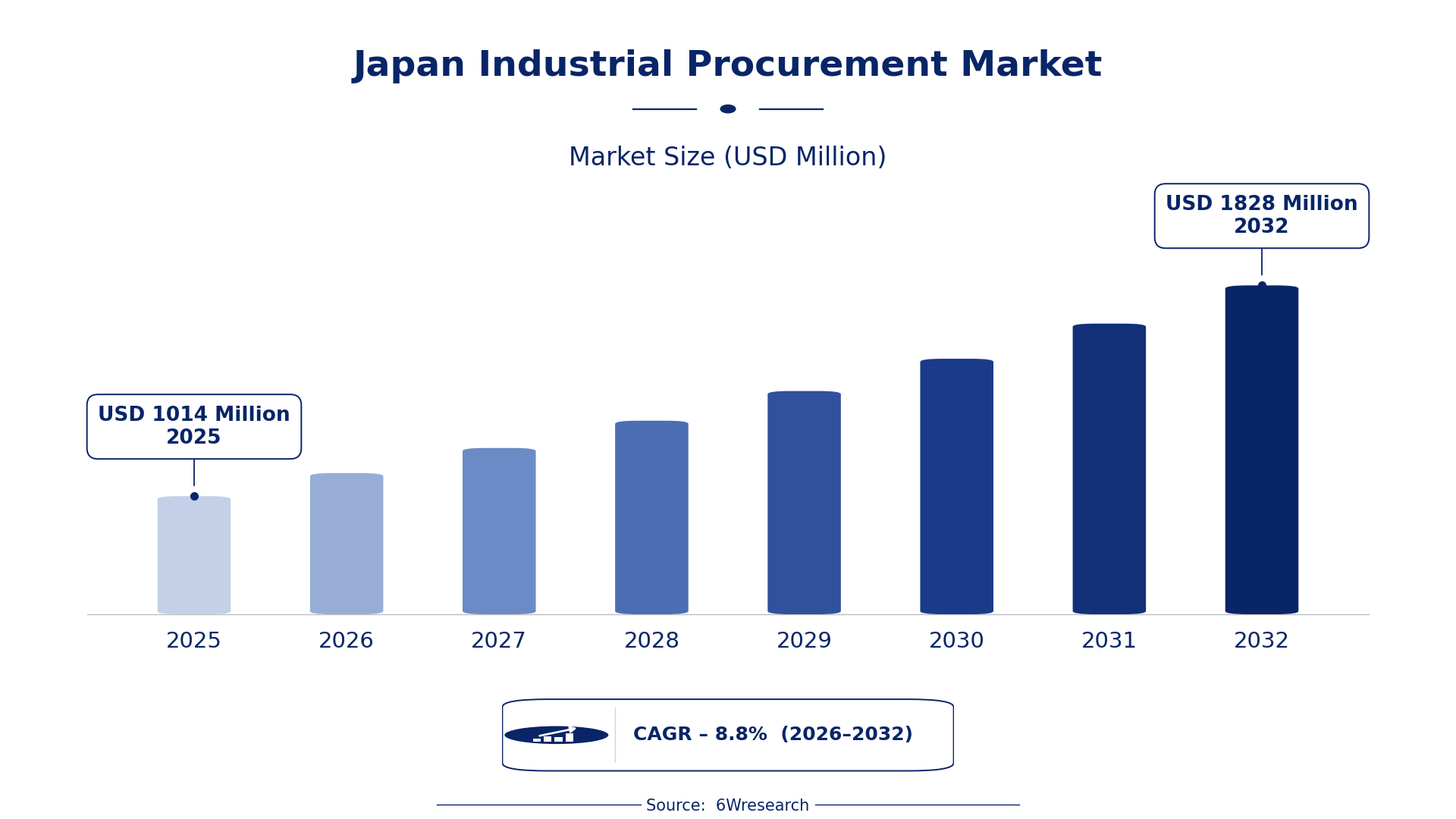
According to 6Wresearch internal database and industry insights, the Japan Industrial Procurement Market was valued at USD 1,014 Million in 2025 and is projected to reach USD 1,828 Million by 2032, growing at a CAGR of approximately 8.8% during 2026–2032.
Japan Industrial Procurement Market Highlights
| Report Metric | Details |
| Report Name | Japan Industrial Procurement Market (2026-2032) |
| Market Size 2025 | USD 1,014 Million |
| Market Size 2032 | USD 1,828 Million |
| Absolute Growth 2025–2032 | USD 814 Million |
| CAGR 2026–2032 | 8.8% |
| Peak Annual Growth | 9.7% in 2029 |
| Forecast Period | 2026–2032 |
| Historical Data | 2022–2025 |
| Base Year | 2025 |
| Leading Procurement Type, 2025 | Direct Procurement (36% share) |
| Leading Mode, 2025 | E-Procurement (45% share) |
| Leading Category Type, 2025 | Raw Materials (39% share) |
| Leading Application, 2025 | Operational Efficiency (40% share) |
| Leading End User Industry, 2025 | Manufacturing (40% share) |
| Fastest-Growing Procurement Type | Service Procurement (12.2% CAGR) |
| Fastest-Growing Category Type | MRO Supplies (12.4% CAGR) |
| Fastest-Growing Application | Production Input (11.7% CAGR) |
| Fastest-Growing End User Industry | Telecom (12.1% CAGR) |
| Growing Sector | Manufacturing |
| Key End Users | Manufacturers, Automotive sector, Heavy Industry, Telecom |
Japan Industrial Procurement Market Year-wise Growth Rate and Key Drivers (2022–2032)
This graph illustrates the annual growth rates of the market from 2022 to 2032, highlighting a steady upward trajectory and projected market expansion over the forecast period.
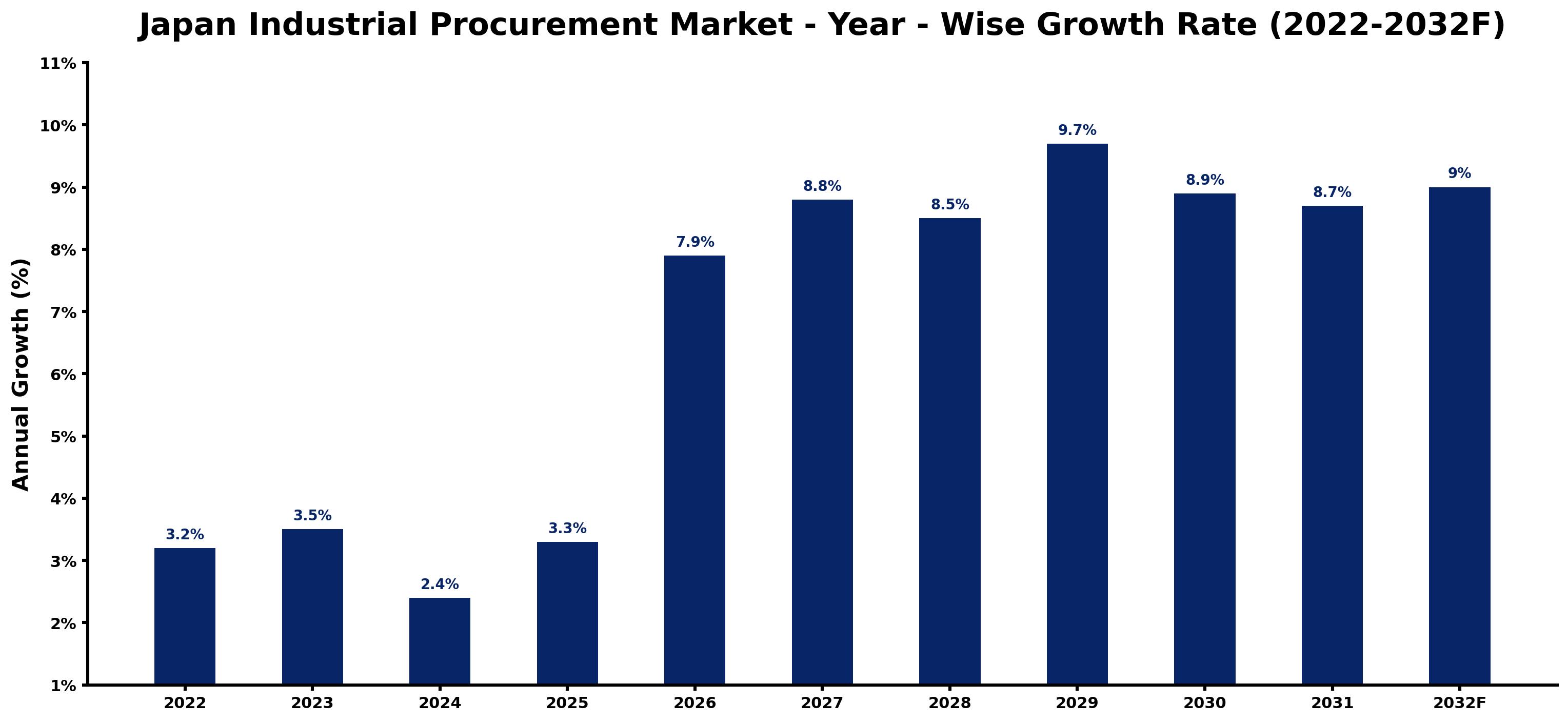
Annual growth estimates for each year appear below with the principal reason behind them, explaining the shifts that set the pace of the market.
| Year | Estimated Annual Growth (%) | Market Rationale |
| 2022 | 3.2 | The market showed steady activity with established procurement practices. |
| 2023 | 3.5 | Growth accelerated due to increased manufacturing output and investments. |
| 2024 | 2.4 | A slowdown occurred as companies adjusted to market conditions. |
| 2025 | 3.3 | Demand rebounded as firms focused on operational efficiency improvements. |
| 2026 | 7.9 | Growth surged as e-procurement adoption expanded across sectors. |
| 2027 | 8.8 | Continued investment in technology drove higher procurement activities. |
| 2028 | 8.5 | A slight slowdown reflected market saturation in some areas. |
| 2029 | 9.7 | Peak growth was achieved with heightened demand for raw materials. |
| 2030 | 8.9 | Growth moderated as firms balanced procurement with sustainability goals. |
| 2031 | 8.7 | A further slowdown occurred as the market stabilised post-peak. |
| 2032 | 9.0 | Growth resumed as new technologies improved procurement efficiency. |
Note: Market size estimations and growth projections presented in this report are based on 6Wresearch's proprietary forecasting methodology, utilizing the latest available industry data, government publications, and primary research inputs.
Japan Industrial Procurement Market Synopsis
Industrial procurement encompasses sourcing goods and services essential for production and operations, including direct and indirect procurement. The Japan Industrial Procurement Market is growing due to rising domestic demand, particularly from the manufacturing and automotive sectors. E-procurement adoption has exceeded 60% among large enterprises, while investments in decarbonisation are driving demand. The government’s emphasis on digital procurement initiatives and standards, such as JIS Q 15001, supports this growth and creates opportunities for improved efficiency in procurement processes.
Market Dynamics Impact Analysis (2026–2032)
| Factor | Type | Impact | Primary Segment Affected |
| Increased adoption of e-procurement technologies | Driver | High | E-Procurement |
| Rising demand for raw materials in manufacturing | Driver | High | Raw Materials |
| Growing focus on sustainability in procurement practices | Opportunity | High | Service Procurement |
| Investment in digital procurement solutions | Opportunity | High | E-Procurement |
| Challenges in supplier relationship management | Restraint | Medium | Direct Procurement |
| High procurement cycle times affecting efficiency | Restraint | Medium | Operational Efficiency |
| Shortage of skilled procurement professionals | Challenge | High | Service Procurement |
| Fluctuations in raw material prices | Challenge | High | Raw Materials |
Evaluation of Drivers in Japan Industrial Procurement Market (2026–2032)
Key forces behind demand, with the segment each one moves most, are listed below.
| Drivers | Primary Segment Affected | Why It Matters (Evidence) |
| E-procurement adoption | E-Procurement | Over 60% of large enterprises in Japan have adopted e-procurement, streamlining purchasing processes and increasing efficiency. |
| Investment in manufacturing capacity | Raw Materials | Japan's manufacturing sector, accounting for approximately 20% of GDP, drives demand for raw materials. |
| Focus on operational efficiency | Operational Efficiency | The average procurement cycle time in Japan is around 30 days, prompting companies to seek efficiency improvements. |
| Government support for digital initiatives | Service Procurement | The government allocated ¥10 billion in 2023 to support industrial procurement digitization. |
| Rising automotive production | Direct Procurement | The automotive industry produced around 8 million vehicles in 2022, increasing demand for components. |
Buyers are adding capacity as e-procurement adoption exceeds 60% among large enterprises, streamlining processes and improving efficiency. The manufacturing sector, contributing approximately 20% of GDP, drives demand for raw materials, prompting suppliers to increase production. With the average procurement cycle time around 30 days, firms are prioritising operational efficiency. Support for digital procurement solutions, including ¥10 billion allocated for digitisation in 2023, encourages investment in these technologies. The automotive sector's output of approximately 8 million vehicles in 2022 fuels demand for components and materials, further driving procurement activities.
Evaluation of Restraints in Japan Industrial Procurement Market
The main factors holding the market back are set out below.
| Market Restraint | Primary Segment Affected | Why It Matters (Evidence) |
| Supplier relationship management challenges | Direct Procurement | Ineffective management can lead to supply disruptions, impacting production schedules and costs. |
| High procurement cycle times | Operational Efficiency | An average cycle time of 30 days can hinder timely project execution and responsiveness. |
| Limited skilled procurement professionals | Service Procurement | A shortage of talent affects the ability to implement efficient strategies, impacting procurement effectiveness. |
| Price volatility of raw materials | Raw Materials | Fluctuations in prices can lead to budget overruns and impact procurement planning. |
| Resistance to adopting new technologies | E-Procurement | Some firms are hesitant to invest in digital solutions, limiting efficiency gains. |
Japan Industrial Procurement Market Challenges
Producers in Japan face a shortage of local raw materials, compelling them to rely on imports and extending production timelines. This situation arises from the country's limited natural resources, resulting in lead times that can stretch by an average of 30 days for manufacturers awaiting shipments. Buyers experience budgetary pressures due to fluctuating prices for imported materials, with the average spend on MRO supplies estimated at ¥1 trillion annually for firms. New regulatory standards, such as the JIS Q 15001, introduce compliance costs that complicate procurement processes for businesses striving to meet these requirements.
Trends in the Japan Industrial Procurement Market
Several trends are reshaping the Japan Industrial Procurement Market; the most important are set out below.
- Shift towards E-Procurement: E-procurement adoption in Japan has surpassed 60% among large enterprises, streamlining purchasing processes. This shift is expected to improve efficiency and reduce costs across sectors.
- Increased focus on sustainability: The GX Basic Policy, adopted in 2023, targets JPY 150 trillion in decarbonisation investments over 10 years, pushing firms to adopt sustainable procurement practices.
- Growth in Service Procurement: Service Procurement is experiencing rapid growth, with a CAGR of 12.2% expected as firms seek to improve operational efficiency and supplier relationships.
- Digital Procurement Initiatives: The GX Promotion Act, launched in 2023, aims to improve efficiency in procurement processes, reflecting a broader trend towards digital solutions.
Investment Opportunities in the Japan Industrial Procurement Market
Several openings in the Japan Industrial Procurement Market merit attention from investors.
- Investment in Digital Solutions: With the government allocating ¥10 billion in 2023 for procurement digitisation, there is a strong opportunity to invest in digital procurement technologies.
- Focus on Sustainable Practices: As companies aim to meet decarbonisation targets, there is a growing demand for sustainable procurement solutions, particularly in manufacturing and automotive sectors.
- Improving Supplier Relationships: Manufacturers are seeking to enhance supplier management, creating opportunities for consultancy services in procurement strategies.
- Expansion of E-Procurement Solutions: With over 60% adoption in large enterprises, there is a pressing need for advanced e-procurement solutions to further streamline processes.
Government Initiatives in the Japan Industrial Procurement Market
The Act on the Rational Use of Energy, established in 1979, requires large energy users to enhance energy efficiency and report consumption. This law influences procurement practices by necessitating energy-efficient sourcing and supplier selection. The GX Basic Policy, adopted in 2023, aims for about JPY 150 trillion in public-private decarbonisation investment over 10 years, promoting sustainable practices in procurement.
The Japan External Trade Organization (JETRO) funds various digital procurement initiatives and supports the GX Promotion Act, which aims to improve efficiency in procurement processes and encourages firms to adopt practical solutions.
Future Insight of the Japan Industrial Procurement Market
Digital procurement technology will reshape demand by 2032, enhancing efficiency for buyers and suppliers. The government's commitment to reducing greenhouse gas emissions will drive significant investments, with around ¥150 trillion allocated for decarbonisation over the next decade. Support for industrial procurement digitisation will lead to more responsive supply chains, while the Smart Manufacturing Strategy aims to improve procurement efficiency by 2025. Advances in 5G technology will further transform procurement practices across various sectors.
Market Segmentation Analysis
Japan Industrial Procurement Market report covers a detailed analysis of the following market segments:
By Procurement Type – Direct Procurement Leads, Service Procurement Expected to Grow Fastest
According to Prakhar Dixit, Senior Research Analyst at 6Wresearch, in 2025, Direct Procurement led the procurement type split with a 36% share. Direct procurement dominates the market as it is crucial for sourcing raw materials and components necessary for manufacturing operations. The manufacturing sector, which constitutes approximately 20% of Japan's GDP, relies heavily on direct procurement to sustain production. Over 2026–2032, Service Procurement is expected to post the fastest growth, at a CAGR of 12.2%. Service procurement is witnessing rapid growth due to increasing operational needs across various sectors, particularly as companies aim to optimise their processes. The launch of the 'Procurement Innovation Program' by the government in 2023 is anticipated to further accelerate this trend. Suppliers should focus on enhancing service procurement offerings to meet the growing demands of businesses.
By Mode – E-Procurement Leads and Records the Fastest Growth
E-Procurement took 45% of mode revenue in 2025, more than any other category. E-procurement leads the market with over 60% adoption among large enterprises in Japan, effectively streamlining purchasing processes. This method facilitates quicker procurement cycles and improves operational efficiency across various sectors. The same category is also set to grow fastest, at a CAGR of 11.3% during 2026–2032. E-procurement is also the fastest-growing mode, as its advantages become increasingly recognised, leading to broader adoption and integration into procurement strategies. Continued government support for digital procurement initiatives will likely sustain this growth. Suppliers must invest in e-procurement solutions to align with the industry's digital transformation.
By Category Type – Raw Materials Lead, MRO Supplies Expected to Grow Fastest
Raw Materials held 39% of the Japan Industrial Procurement Market by category type in 2025. Raw materials dominate the market share as they are fundamental for production processes across various industries, particularly in manufacturing. The average annual spend on raw materials indicates their critical role in maintaining operational continuity. MRO Supplies are set to record the highest CAGR in this split, 12.4% over 2026–2032. MRO supplies are growing rapidly as industries focus on maintaining equipment and ensuring operational reliability. The estimated annual spend of ¥1 trillion on MRO supplies highlights their increasing importance in procurement strategies. Suppliers should prioritise MRO supplies to cater to the rising demand for maintenance and operational support.
By Application – Operational Efficiency Leads, Production Input Expected to Grow Fastest
With 40% of application revenue in 2025, Operational Efficiency was the largest category. Operational efficiency is the leading application as it serves as a primary objective for procurement strategies aimed at reducing costs and enhancing productivity. Companies are increasingly investing in procurement processes that improve operational efficiency to maintain competitiveness. Production Input is projected to grow fastest, at a CAGR of 11.7% during 2026–2032. Production input is the fastest-growing application, driven by the necessity for reliable inputs in manufacturing processes. As production volumes rise, the emphasis on securing quality production inputs will intensify, further propelling this segment's growth. Suppliers need to ensure a steady supply of production inputs to meet the increasing demands of manufacturers.
By End User Industry – Manufacturing Leads, Telecom Expected to Grow Fastest
Manufacturing accounted for 40% of the market by end user industry in 2025. Manufacturing is the leading end user industry, accounting for a substantial portion of procurement activities due to its reliance on various inputs for production. The sector employs around 8 million people, highlighting its significance to the economy and procurement market. Over 2026–2032, Telecom is expected to post the fastest growth, at a CAGR of 12.1%. The telecom industry is experiencing rapid growth in procurement as advancements in 5G technology drive demand for infrastructure and services. This sector's evolving requirements will likely lead to increased procurement activities in the coming years. Suppliers should consider tailored strategies to address the unique procurement needs of the telecom sector.
Key Attractiveness of the Report
- 10 Years of Market Numbers
- Historical Data Starting from 2022 to 2025
- Base Year 2025
- Forecast Data until 2032
- Key Performance Indicators Impacting the Market
- Major Upcoming Developments and Projects
Key Highlights of the Report:
- Japan Industrial Procurement Market Outlook
- Market Size of Japan Industrial Procurement Market, 2025
- Forecast of Japan Industrial Procurement Market, 2032
- Historical Data and Forecast of Japan Industrial Procurement Revenues & Volume for the Period 2022-2032F
- Japan Industrial Procurement Market Trend Evolution
- Japan Industrial Procurement Market Drivers and Challenges
- Japan Industrial Procurement Price Trends
- Japan Industrial Procurement Porter's Five Forces
- Japan Industrial Procurement Industry Life Cycle
- Historical Data and Forecast of Japan Industrial Procurement Market Revenues & Volume By Procurement Type for the Period 2022-2032F
- Historical Data and Forecast of Japan Industrial Procurement Market Revenues & Volume By Indirect Procurement for the Period 2022-2032F
- Historical Data and Forecast of Japan Industrial Procurement Market Revenues & Volume By Direct Procurement for the Period 2022-2032F
- Historical Data and Forecast of Japan Industrial Procurement Market Revenues & Volume By Service Procurement for the Period 2022-2032F
- Historical Data and Forecast of Japan Industrial Procurement Market Revenues & Volume By Spot Buying for the Period 2022-2032F
- Historical Data and Forecast of Japan Industrial Procurement Market Revenues & Volume By Mode for the Period 2022-2032F
- Historical Data and Forecast of Japan Industrial Procurement Market Revenues & Volume By E-Procurement for the Period 2022-2032F
- Historical Data and Forecast of Japan Industrial Procurement Market Revenues & Volume By Strategic Sourcing for the Period 2022-2032F
- Historical Data and Forecast of Japan Industrial Procurement Market Revenues & Volume By Contract-Based for the Period 2022-2032F
- Historical Data and Forecast of Japan Industrial Procurement Market Revenues & Volume By Marketplace for the Period 2022-2032F
- Historical Data and Forecast of Japan Industrial Procurement Market Revenues & Volume By Category Type for the Period 2022-2032F
- Historical Data and Forecast of Japan Industrial Procurement Market Revenues & Volume By MRO Supplies for the Period 2022-2032F
- Historical Data and Forecast of Japan Industrial Procurement Market Revenues & Volume By Raw Materials for the Period 2022-2032F
- Historical Data and Forecast of Japan Industrial Procurement Market Revenues & Volume By Engineering/IT for the Period 2022-2032F
- Historical Data and Forecast of Japan Industrial Procurement Market Revenues & Volume By Spare Parts for the Period 2022-2032F
- Historical Data and Forecast of Japan Industrial Procurement Market Revenues & Volume By Application for the Period 2022-2032F
- Historical Data and Forecast of Japan Industrial Procurement Market Revenues & Volume By Operational Efficiency for the Period 2022-2032F
- Historical Data and Forecast of Japan Industrial Procurement Market Revenues & Volume By Production Input for the Period 2022-2032F
- Historical Data and Forecast of Japan Industrial Procurement Market Revenues & Volume By Project Outsourcing for the Period 2022-2032F
- Historical Data and Forecast of Japan Industrial Procurement Market Revenues & Volume By Emergency Sourcing for the Period 2022-2032F
- Historical Data and Forecast of Japan Industrial Procurement Market Revenues & Volume By End User Industry for the Period 2022-2032F
- Historical Data and Forecast of Japan Industrial Procurement Market Revenues & Volume By Manufacturing for the Period 2022-2032F
- Historical Data and Forecast of Japan Industrial Procurement Market Revenues & Volume By Automotive for the Period 2022-2032F
- Historical Data and Forecast of Japan Industrial Procurement Market Revenues & Volume By Telecom for the Period 2022-2032F
- Historical Data and Forecast of Japan Industrial Procurement Market Revenues & Volume By Heavy Industry for the Period 2022-2032F
- Japan Industrial Procurement Import Export Trade Statistics
- Market Opportunity Assessment By Procurement Type
- Market Opportunity Assessment By Mode
- Market Opportunity Assessment By Category Type
- Market Opportunity Assessment By Application
- Market Opportunity Assessment By End User Industry
- Japan Industrial Procurement Top Companies Market Share
- Japan Industrial Procurement Competitive Benchmarking By Technical and Operational Parameters
- Japan Industrial Procurement Company Profiles
- Japan Industrial Procurement Key Strategic Recommendations
Market Covered
The following segment groups are covered in the report.
By Procurement Type
- Indirect Procurement
- Direct Procurement
- Service Procurement
- Spot Buying
By Mode
- E-Procurement
- Strategic Sourcing
- Contract-Based
- Marketplace
By Category Type
- MRO Supplies
- Raw Materials
- Engineering/IT
- Spare Parts
By Application
- Operational Efficiency
- Production Input
- Project Outsourcing
- Emergency Sourcing
By End User Industry
- Manufacturing
- Automotive
- Telecom
- Heavy Industry































