Japan Industrial Refrigeration Systems Market Size & Growth Rate
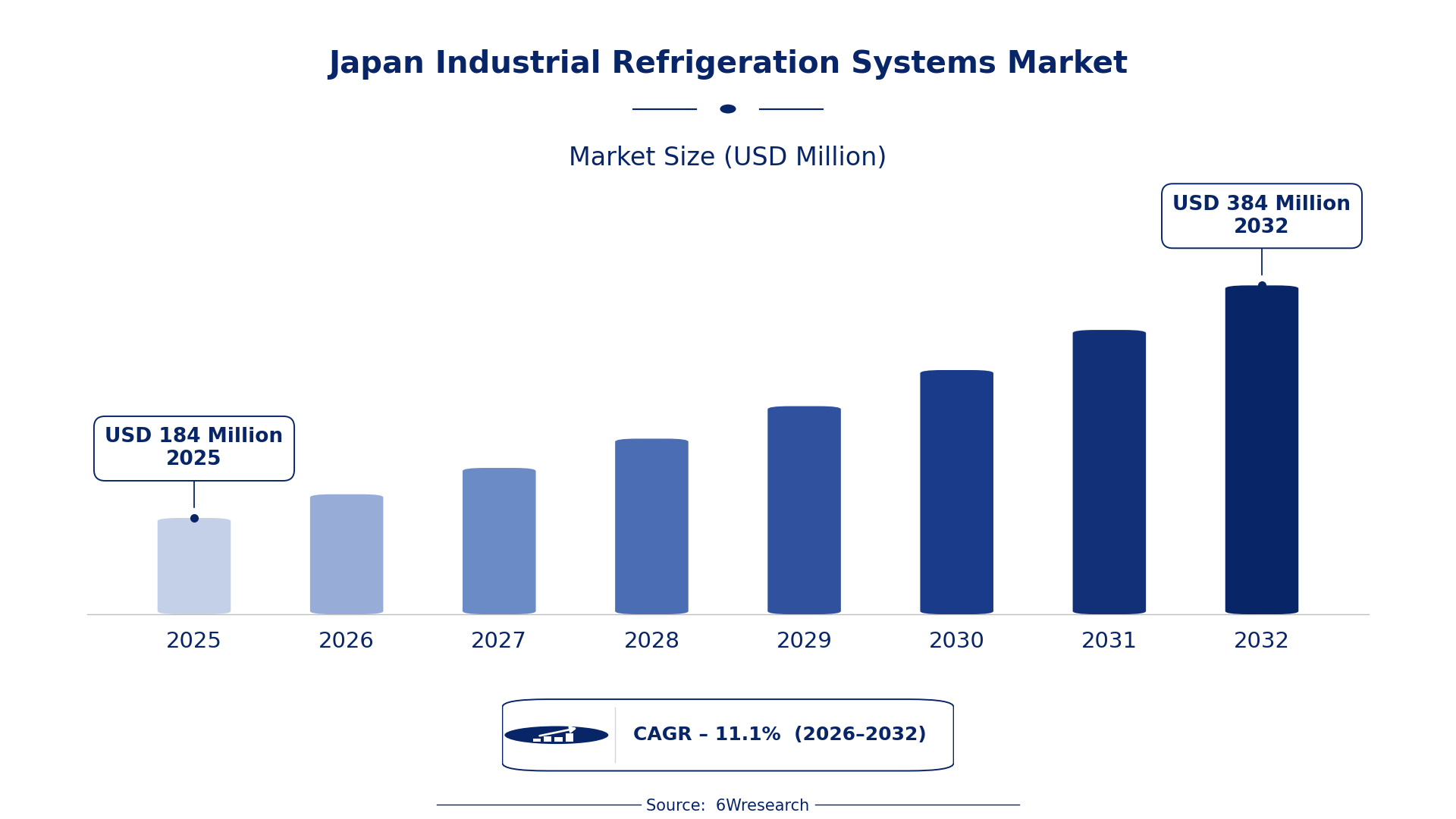
According to 6Wresearch internal database and industry insights, the Japan Industrial Refrigeration Systems Market was valued at USD 184 Million in 2025 and is projected to reach USD 384 Million by 2032, growing at a CAGR of approximately 11.1% during 2026–2032.
Japan Industrial Refrigeration Systems Market Highlights
| Report Metric | Details |
| Report Name | Japan Industrial Refrigeration Systems Market (2026-2032) |
| Market Size 2025 | USD 184 Million |
| Market Size 2032 | USD 384 Million |
| Absolute Growth 2025–2032 | USD 200 Million |
| CAGR 2026–2032 | 11.1% |
| Peak Annual Growth | 12.4% in 2032 |
| Forecast Period | 2026–2032 |
| Historical Data | 2022–2025 |
| Base Year | 2025 |
| Leading Component, 2025 | Compressors (39% share) |
| Leading Capacity, 2025 | Less than 100kW (45% share) |
| Leading Refrigerant, 2025 | Ammonia (37% share) |
| Leading Application, 2025 | Refrigerated Warehouse (39% share) |
| Fastest-Growing Component | Condensers (15.6% CAGR) |
| Fastest-Growing Capacity | 100-500kW (13.6% CAGR) |
| Fastest-Growing Refrigerant | Carbon Dioxide (14.5% CAGR) |
| Fastest-Growing Application | Food & Beverage (15.4% CAGR) |
| Growing Sector | Food and Beverage |
| Key End Users | Food producers, Beverage manufacturers, Logistics companies, Chemical processors |
Japan Industrial Refrigeration Systems Market Year-wise Growth Rate and Key Drivers (2022–2032)
This graph illustrates the annual growth rates of the market from 2022 to 2032, highlighting a steady upward trajectory and projected market expansion over the forecast period.
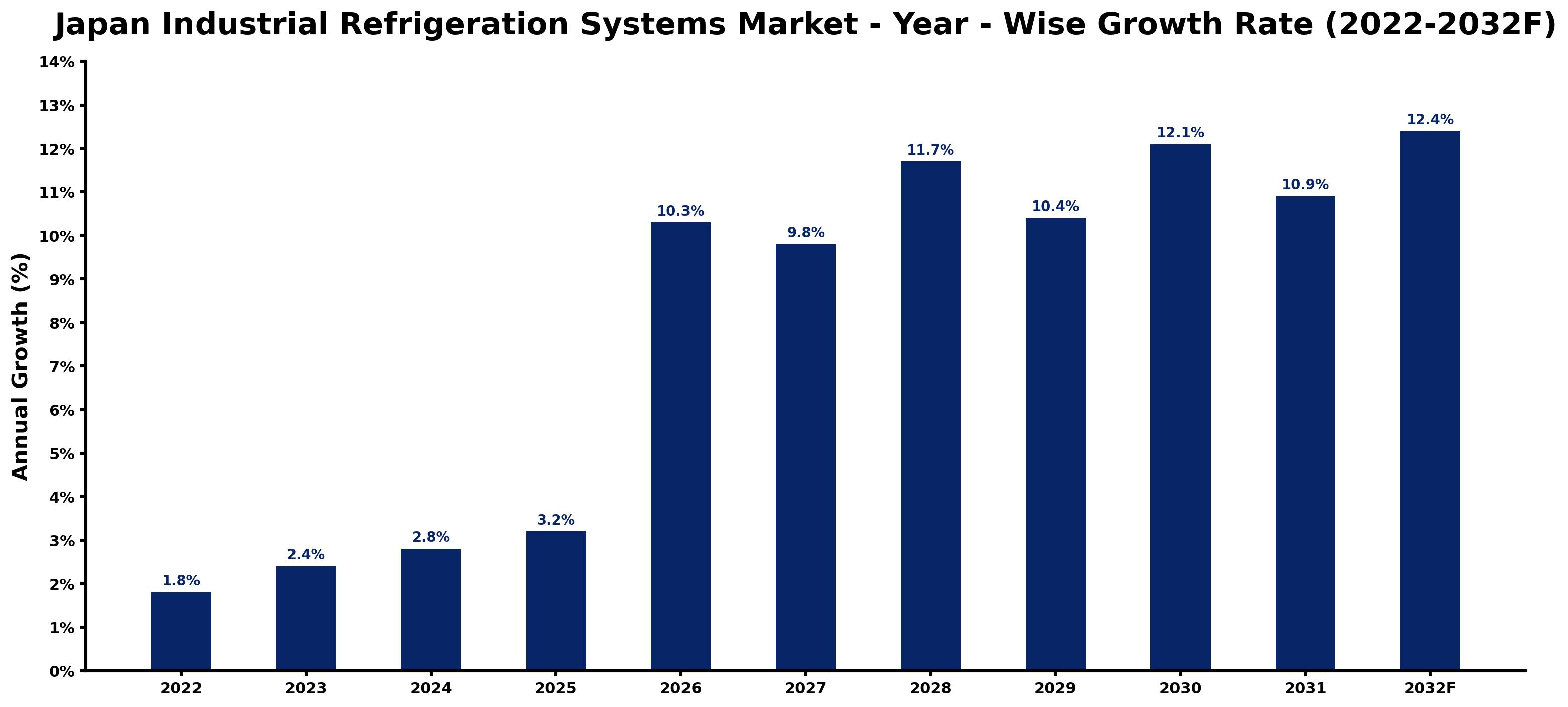
The table below sets out the estimated growth rate for each year and the main factor behind it.
| Year | Estimated Annual Growth (%) | Market Rationale |
| 2022 | 1.8 | The market experienced stable activity, driven by ongoing industrial operations. |
| 2023 | 2.4 | Demand increased due to rising food and beverage sector requirements. |
| 2024 | 2.8 | Growth continued as cold storage capacity expanded across the country. |
| 2025 | 3.2 | The market reached a historical peak due to heightened investments in refrigeration. |
| 2026 | 10.3 | Demand surged as the GX Basic Policy stimulated decarbonisation investments. |
| 2027 | 9.8 | Growth slowed slightly as capacity expansions began to stabilise. |
| 2028 | 11.7 | A rebound in growth occurred, driven by increased food preservation needs. |
| 2029 | 10.4 | Demand growth moderated as the market adjusted to new standards. |
| 2030 | 12.1 | Demand accelerated again, supported by ongoing decarbonisation efforts. |
| 2031 | 10.9 | Growth slowed as the market approached maturity in certain segments. |
| 2032 | 12.4 | The market peaked, driven by substantial investments in large-scale systems. |
Note: Market size estimations and growth projections presented in this report are based on 6Wresearch's proprietary forecasting methodology, utilizing the latest available industry data, government publications, and primary research inputs.
Japan Industrial Refrigeration Systems Market Synopsis
Industrial refrigeration systems are advanced cooling technologies essential for preserving perishable goods. They are primarily used in the food and beverage sector, which accounts for approximately 40% of demand. The Japan Industrial Refrigeration Systems Market is expanding due to increasing investments in cold storage facilities and the need for efficient refrigeration solutions. This growth is driven by Japan's ambitious decarbonisation goals and a growing population requiring food preservation, with over 1,000 refrigerated warehouses supporting this demand.
Market Dynamics Impact Analysis (2026–2032)
| Factor | Type | Impact | Primary Segment Affected |
| Rising demand from the food and beverage sector | Driver | High | Food & Beverage |
| Increased investments in cold storage infrastructure | Driver | High | Refrigerated Warehouse |
| Growing demand for eco-friendly refrigerants | Opportunity | Medium | Carbon Dioxide |
| Expansion of refrigerated transportation services | Opportunity | Medium | Refrigerated Transportation |
| Regulatory pressures on refrigerant emissions | Restraint | High | Ammonia |
| High initial investment costs for advanced systems | Restraint | Medium | Compressors |
| Compliance with stringent safety standards | Challenge | High | Controls |
| Limited availability of skilled technicians | Challenge | Medium | Condensers |
Evaluation of Drivers in Japan Industrial Refrigeration Systems Market (2026–2032)
These are the developments adding the most demand over the forecast period.
| Drivers | Primary Segment Affected | Why It Matters (Evidence) |
| Increased food production and consumption | Food & Beverage | The food and beverage sector accounts for approximately 40% of industrial refrigeration demand, leading to higher purchases of refrigeration systems. |
| Expansion of cold storage facilities | Refrigerated Warehouse | Japan has over 1,000 refrigerated warehouses, driving demand for efficient refrigeration solutions. |
| Investment in energy-efficient technologies | Compressors | Japan's GX Basic Policy targets JPY 150 trillion in decarbonisation investments, boosting demand for modern systems. |
| Rising logistics and transportation needs | Refrigerated Transportation | The growth of e-commerce and food delivery services increases the need for refrigerated transport solutions. |
| Regulatory shifts towards eco-friendly refrigerants | Carbon Dioxide | Japan's government aims to reduce refrigerant emissions by 30% by 2030, promoting the use of eco-friendly options. |
Much of the new demand traces back to the food and beverage sector, which accounts for approximately 40% of industrial refrigeration demand. The Tokyo metropolitan area, with its high concentration of refrigerated facilities, drives investments in cold storage. The rise of e-commerce increases the need for refrigerated transportation solutions, pushing logistics firms to invest in advanced systems.
Evaluation of Restraints in Japan Industrial Refrigeration Systems Market
Below are the constraints most often cited by buyers and suppliers, with the segment each affects.
| Market Restraint | Primary Segment Affected | Why It Matters (Evidence) |
| Regulatory pressures on refrigerant emissions | Ammonia | The government has initiated a program to reduce refrigerant emissions by 30% by 2030, impacting ammonia usage. |
| High initial investment costs for advanced systems | Compressors | The need for advanced refrigeration systems requires substantial capital, limiting adoption among smaller businesses. |
| Compliance with stringent safety standards | Controls | The JIS B 8601 standard governs refrigeration system performance, necessitating compliance costs for producers. |
| Limited availability of skilled technicians | Condensers | The demand for qualified technicians in refrigeration systems is high, affecting service delivery and maintenance. |
| Environmental regulations phasing out certain refrigerants | Hydrofluorocarbon | Phased-out refrigerants due to regulations create challenges for manufacturers using these substances. |
Japan Industrial Refrigeration Systems Market Challenges
Japan's strict regulations on refrigerant emissions require buyers to upgrade systems, potentially delaying implementations by up to six months. The JIS B 8601 standard necessitates extensive testing and certification, raising costs for producers by 15%. Logistical challenges arise from the high concentration of refrigerated facilities in the Tokyo metropolitan area, complicating supply for regions outside this hub. Rising operational costs linked to Japan's decarbonisation targets are expected to increase prices for buyers by approximately 20% over the next few years.
Trends in the Japan Industrial Refrigeration Systems Market
These developments are changing demand patterns in the Japan Industrial Refrigeration Systems Market.
- Shift towards Eco-Friendly Refrigerants: The adoption of carbon dioxide as a refrigerant is on the rise, driven by regulatory pressures. This segment is projected to grow at a CAGR of 14.5% as industries pursue sustainable solutions.
- Transition from Traditional to Advanced Cooling Systems: Food and beverage producers are investing in advanced cooling technologies, with a 5% increase in cold storage capacity reported in 2023, indicating a shift in operational strategies.
- Emergence of Energy-Efficient Refrigeration Solutions: The GX Basic Policy has prompted a focus on energy efficiency, leading to increased investments in modern refrigeration systems, targeting JPY 150 trillion over ten years.
- Growth in Refrigerated Transportation Services: E-commerce growth has resulted in a surge in refrigerated transportation needs, prompting logistics companies to significantly expand their refrigerated fleet.
Investment Opportunities in the Japan Industrial Refrigeration Systems Market
The openings below show where demand in the Japan Industrial Refrigeration Systems Market is visible and how suppliers can enter.
- Food and Beverage Producers Seeking Efficiency: Food and beverage producers are increasingly pursuing energy-efficient refrigeration systems, with a market share of 40% driving demand for advanced solutions.
- Investment in Cold Storage Facilities: With over 1,000 refrigerated warehouses in Japan, there is an urgent need for modern refrigeration systems to support expanding capacity, especially in urban areas.
- Growing Demand for Eco-Friendly Solutions: The push for carbon dioxide as a refrigerant offers a substantial opportunity, appealing to environmentally conscious buyers and supporting a shift in industry standards.
- Timing for Compliance with New Regulations: As regulations tighten, the need for compliant refrigeration systems becomes urgent, prompting suppliers to invest in advanced technologies that meet new standards.
Government Initiatives in the Japan Industrial Refrigeration Systems Market
The GX Promotion Act, adopted in 2023, establishes the legal framework for Japan's decarbonisation strategy, impacting industrial refrigeration systems. This act mandates reductions in greenhouse gas emissions, compelling producers to invest in more efficient technologies and comply with new standards. The act aims for a 46% reduction in emissions by 2030, driving innovation in the sector.
Japan's Ministry of Agriculture has allocated JPY 150 trillion for public and private decarbonisation investments over the next decade. The Ministry oversees compliance with the GX Basic Policy, ensuring that refrigeration systems align with environmental goals. This funding supports projects aimed at improving energy efficiency and reducing emissions in industrial refrigeration.
Future Insight of the Japan Industrial Refrigeration Systems Market
Japan's policy-driven shift towards decarbonisation will drive advancements in industrial refrigeration systems, prompting suppliers to adopt cutting-edge technologies. By 2032, the anticipated investment of JPY 150 trillion will facilitate infrastructure modernisation, improving efficiency for buyers. The implementation of ISO 5149 safety standards will elevate performance benchmarks, boosting buyer confidence. Cold storage capacity is expected to rise by 5% annually, ensuring the food and beverage sector meets its growing demand for reliable preservation solutions.
Market Segmentation Analysis
Japan Industrial Refrigeration Systems Market report covers a detailed analysis of the following market segments:
By Component – Compressors Lead, Condensers Expected to Grow Fastest
According to Vasudha, AM at 6Wresearch, Compressors accounted for 39% of the market by component in 2025. Compressors are essential for the operation of industrial refrigeration systems, making them the most commonly used component in Japan. Their critical role is underscored by the extensive network of over 1,000 refrigerated warehouses, where they ensure the effective preservation of perishable goods. The quickest growth will come from Condensers, forecast to expand at a CAGR of 15.6% between 2026 and 2032. Condensers are experiencing rapid growth due to the increasing emphasis on efficiency in cooling processes. The 5% rise in cold storage capacity in 2023 reflects a heightened demand for effective heat exchange solutions, which will further drive this segment's expansion. Suppliers must focus on advancing condenser technologies to meet the rising efficiency requirements of the industry.
By Capacity – Less than 100kW Leads, 100-500kW Expected to Grow Fastest
In 2025, Less than 100kW led the capacity split with a 45% share. The less than 100kW segment is widely used in small applications, catering to a variety of users across different sectors. This capacity aligns well with the numerous smaller facilities operating within Japan's industrial landscape, ensuring effective refrigeration solutions. 100-500kW is set to record the highest CAGR in this split, 13.6% over 2026–2032. The 100-500kW capacity is rapidly gaining traction as medium-sized facilities adapt to increasing demands in the market. This segment's growth is supported by ongoing investments aimed at enhancing operational efficiency across the industrial sector. Buyers should consider upgrading to the 100-500kW range to align with current market trends and operational efficiencies.
By Refrigerant – Ammonia Leads, Carbon Dioxide Expected to Grow Fastest
Ammonia held 37% of the Japan Industrial Refrigeration Systems Market by refrigerant in 2025. Ammonia is the most widely used refrigerant in Japan, primarily due to its efficiency and effectiveness in large-scale industrial applications. Its dominance is reinforced by the stringent regulations overseen by the Food Safety and Inspection Service, ensuring compliance and safety. Over 2026–2032, Carbon Dioxide is expected to post the fastest growth, at a CAGR of 14.5%. Carbon Dioxide is rapidly gaining popularity as an eco-friendly refrigerant option, driven by government initiatives aimed at reducing refrigerant emissions by 30% by 2030. This shift reflects the industry's commitment to sustainability and environmental responsibility. Suppliers should consider expanding their product lines to include carbon dioxide systems to meet the growing demand for environmentally friendly refrigeration solutions.
By Application – Refrigerated Warehouse Leads, Food & Beverage Expected to Grow Fastest
The largest application category in 2025 was Refrigerated Warehouse, at 39% of revenue. Refrigerated warehouses serve as the primary application area for industrial refrigeration systems, reflecting the high demand for food preservation. The concentration of these facilities in regions like Tokyo highlights their importance in the supply chain for perishable goods. Food & Beverage is projected to grow fastest, at a CAGR of 15.4% during 2026–2032. The food and beverage sector is the fastest-growing application, driven by Japan's large population of approximately 126 million, which fuels the need for effective food preservation solutions. This sector's growth is supported by the overall increase in cold storage capacity reported in 2023. Suppliers should prioritise the food and beverage sector in their marketing strategies to capitalise on the increasing demand for refrigeration solutions.
Key Attractiveness of the Report
- 10 Years of Market Numbers
- Historical Data Starting from 2022 to 2025
- Base Year 2025
- Forecast Data until 2032
- Key Performance Indicators Impacting the Market
- Major Upcoming Developments and Projects
Key Highlights of the Report:
- Japan Industrial Refrigeration Systems Market Outlook
- Market Size of Japan Industrial Refrigeration Systems Market, 2025
- Forecast of Japan Industrial Refrigeration Systems Market, 2032
- Historical Data and Forecast of Japan Industrial Refrigeration Systems Revenues & Volume for the Period 2022-2032
- Japan Industrial Refrigeration Systems Market Trend Evolution
- Japan Industrial Refrigeration Systems Market Drivers and Challenges
- Japan Industrial Refrigeration Systems Price Trends
- Japan Industrial Refrigeration Systems Porter's Five Forces
- Japan Industrial Refrigeration Systems Industry Life Cycle
- Historical Data and Forecast of Japan Industrial Refrigeration Systems Market Revenues & Volume By Component for the Period 2022-2032
- Historical Data and Forecast of Japan Industrial Refrigeration Systems Market Revenues & Volume By Compressors for the Period 2022-2032
- Historical Data and Forecast of Japan Industrial Refrigeration Systems Market Revenues & Volume By Condensers for the Period 2022-2032
- Historical Data and Forecast of Japan Industrial Refrigeration Systems Market Revenues & Volume By Evaporators for the Period 2022-2032
- Historical Data and Forecast of Japan Industrial Refrigeration Systems Market Revenues & Volume By Controls for the Period 2022-2032
- Historical Data and Forecast of Japan Industrial Refrigeration Systems Market Revenues & Volume By Others for the Period 2022-2032
- Historical Data and Forecast of Japan Industrial Refrigeration Systems Market Revenues & Volume By Capacity for the Period 2022-2032
- Historical Data and Forecast of Japan Industrial Refrigeration Systems Market Revenues & Volume By Less than 100kW for the Period 2022-2032
- Historical Data and Forecast of Japan Industrial Refrigeration Systems Market Revenues & Volume By 100-500kW for the Period 2022-2032
- Historical Data and Forecast of Japan Industrial Refrigeration Systems Market Revenues & Volume By 500-1000kW for the Period 2022-2032
- Historical Data and Forecast of Japan Industrial Refrigeration Systems Market Revenues & Volume By 1000-5000kW for the Period 2022-2032
- Historical Data and Forecast of Japan Industrial Refrigeration Systems Market Revenues & Volume By More than 5000kW for the Period 2022-2032
- Historical Data and Forecast of Japan Industrial Refrigeration Systems Market Revenues & Volume By Refrigerant for the Period 2022-2032
- Historical Data and Forecast of Japan Industrial Refrigeration Systems Market Revenues & Volume By Ammonia for the Period 2022-2032
- Historical Data and Forecast of Japan Industrial Refrigeration Systems Market Revenues & Volume By Carbon Dioxide for the Period 2022-2032
- Historical Data and Forecast of Japan Industrial Refrigeration Systems Market Revenues & Volume By Hydrofluorocarbon for the Period 2022-2032
- Historical Data and Forecast of Japan Industrial Refrigeration Systems Market Revenues & Volume By Hydrochlorofluorocarbons for the Period 2022-2032
- Historical Data and Forecast of Japan Industrial Refrigeration Systems Market Revenues & Volume By Others for the Period 2022-2032
- Historical Data and Forecast of Japan Industrial Refrigeration Systems Market Revenues & Volume By Application for the Period 2022-2032
- Historical Data and Forecast of Japan Industrial Refrigeration Systems Market Revenues & Volume By Refrigerated Warehouse for the Period 2022-2032
- Historical Data and Forecast of Japan Industrial Refrigeration Systems Market Revenues & Volume By Food & Beverage for the Period 2022-2032
- Historical Data and Forecast of Japan Industrial Refrigeration Systems Market Revenues & Volume By Chemical Petrochemical & Pharmaceuticals for the Period 2022-2032
- Historical Data and Forecast of Japan Industrial Refrigeration Systems Market Revenues & Volume By Refrigerated Transportation for the Period 2022-2032
- Japan Industrial Refrigeration Systems Import Export Trade Statistics
- Market Opportunity Assessment By Component
- Market Opportunity Assessment By Capacity
- Market Opportunity Assessment By Refrigerant
- Market Opportunity Assessment By Application
- Japan Industrial Refrigeration Systems Top Companies Market Share
- Japan Industrial Refrigeration Systems Competitive Benchmarking By Technical and Operational Parameters
- Japan Industrial Refrigeration Systems Company Profiles
- Japan Industrial Refrigeration Systems Key Strategic Recommendations
Market Covered
The following segment groups are covered in the report.
By Component
- Compressors
- Condensers
- Evaporators
- Controls
- Others
By Capacity
- Less than 100kW
- 100-500kW
- 500-1000kW
- 1000-5000kW
- More than 5000kW
By Refrigerant
- Ammonia
- Carbon Dioxide
- Hydrofluorocarbon
- Hydrochlorofluorocarbons
- Others
By Application
- Refrigerated Warehouse
- Food & Beverage
- Chemical Petrochemical & Pharmaceuticals
- Refrigerated Transportation






































