Japan Industrial Resin Market Size & Growth Rate
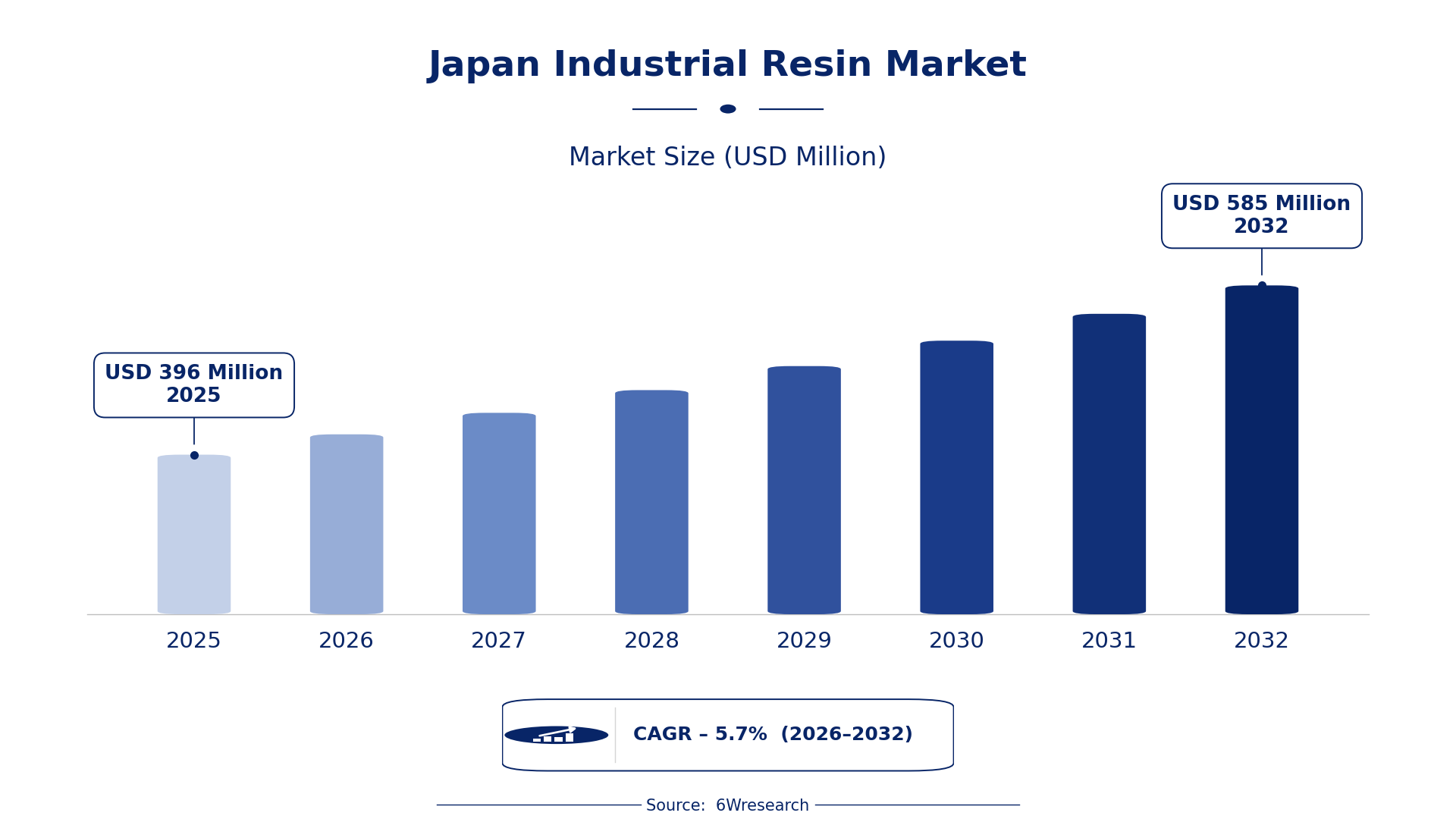
According to 6Wresearch internal database and industry insights, the Japan Industrial Resin Market was valued at USD 396 Million in 2025 and is projected to reach USD 585 Million by 2032, growing at a CAGR of approximately 5.7% during 2026–2032.
Japan Industrial Resin Market Highlights
| Report Metric | Details |
| Report Name | Japan Industrial Resin Market (2026-2032) |
| Market Size 2025 | USD 396 Million |
| Market Size 2032 | USD 585 Million |
| Absolute Growth 2025–2032 | USD 189 Million |
| CAGR 2026–2032 | 5.7% |
| Peak Annual Growth | 6.6% in 2032 |
| Forecast Period | 2026–2032 |
| Historical Data | 2022–2025 |
| Base Year | 2025 |
| Leading Resin Type, 2025 | Epoxy Resin (42% share) |
| Leading Base Material, 2025 | Thermosetting (49% share) |
| Leading Form, 2025 | Liquid (35% share) |
| Leading Application, 2025 | Adhesives & Sealants (37% share) |
| Leading End User Industry, 2025 | Automotive (53% share) |
| Fastest-Growing Resin Type | Polyurethane Resin (7.9% CAGR) |
| Fastest-Growing Base Material | Polyol & Isocyanate (8.0% CAGR) |
| Fastest-Growing Form | Foam (8.3% CAGR) |
| Fastest-Growing Application | Coatings & Insulation (8.4% CAGR) |
| Fastest-Growing End User Industry | Construction (7.5% CAGR) |
| Growing Sector | Construction |
| Key End Users | Automotive, Construction, Marine & Aerospace, Packaging & Printing |
Japan Industrial Resin Market Year-wise Growth Rate and Key Drivers (2022–2032)
This graph illustrates the annual growth rates of the market from 2022 to 2032, highlighting a steady upward trajectory and projected market expansion over the forecast period.
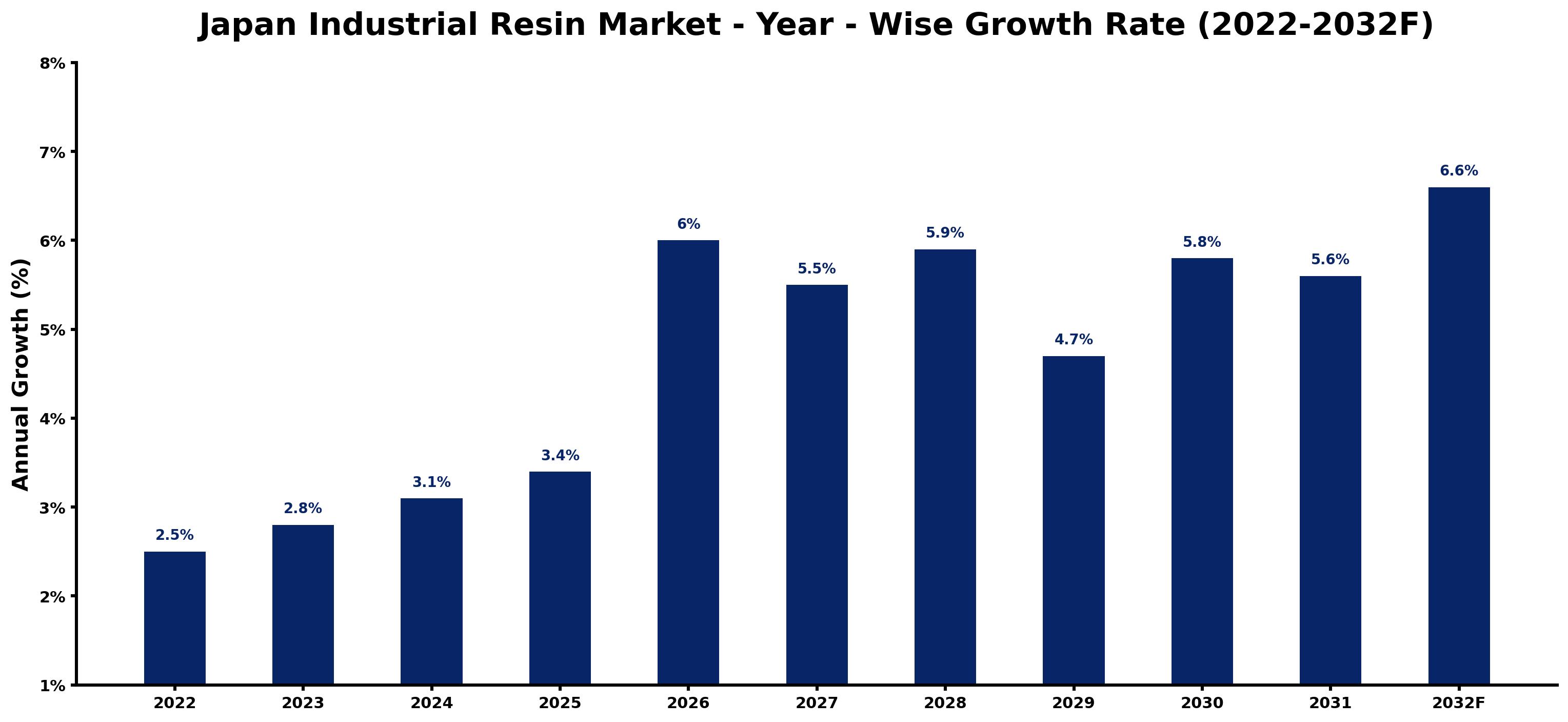
Annual growth estimates for each year appear below with the principal reason behind them, explaining the shifts that set the pace of the market.
| Year | Estimated Annual Growth (%) | Market Rationale |
| 2022 | 2.5 | The market experienced steady growth, reflecting consistent demand from key sectors. |
| 2023 | 2.8 | Demand increased due to rising automotive production and construction activities. |
| 2024 | 3.1 | Growth accelerated as the construction industry ramped up resin usage for projects. |
| 2025 | 3.4 | The market peaked with strong demand from automotive coatings and construction. |
| 2026 | 6.0 | Sustainability initiatives and automotive sector expansion will drive growth higher. |
| 2027 | 5.5 | Growth will slow slightly as the market adjusts to previous high demand levels. |
| 2028 | 5.9 | Demand will rebound as construction projects resume and automotive production increases. |
| 2029 | 4.7 | A slight slowdown will occur as the market stabilises after rapid growth. |
| 2030 | 5.8 | Sustainability trends in construction and automotive will boost demand again. |
| 2031 | 5.6 | Growth will moderate as the market adjusts to evolving production capacities. |
| 2032 | 6.6 | The market is expected to peak with innovations in bio-based materials. |
Note: Market size estimations and growth projections presented in this report are based on 6Wresearch's proprietary forecasting methodology, utilizing the latest available industry data, government publications, and primary research inputs.
Japan Industrial Resin Market Synopsis
Industrial resin is a synthetic polymer extensively employed in adhesives, coatings, and molded components, particularly in construction, automotive manufacturing, and packaging. The Japan Industrial Resin Market is expanding due to a strong automotive sector, which accounts for 30% of resin demand, alongside substantial investments in sustainable materials, such as the JPY 150 trillion target for public and private decarbonisation investment over the next decade. This growth is driven by increasing applications across various industries, broadening overall market potential.
Market Dynamics Impact Analysis (2026–2032)
| Factor | Type | Impact | Primary Segment Affected |
| Strong demand from the automotive sector drives resin consumption. | Driver | High | Epoxy Resin |
| Growing construction projects increase the need for adhesives and coatings. | Driver | High | Polyurethane Resin |
| Investment in sustainable materials presents opportunities for innovation. | Opportunity | High | Polyester Resin |
| Rising demand for eco-friendly products opens new markets. | Opportunity | High | Acrylic Resin |
| Regulatory compliance costs can burden manufacturers and buyers. | Restraint | Medium | Thermosetting |
| Market volatility in resin prices may deter investment decisions. | Restraint | Medium | Polyol & Isocyanate |
| High production costs challenge profitability for resin manufacturers. | Challenge | High | Unsaturated Polyester |
| Technological advancements require continuous investment in R&D. | Challenge | Medium | Acrylic Polymer |
Evaluation of Drivers in Japan Industrial Resin Market (2026–2032)
Key forces behind demand, with the segment each one moves most, are listed below.
| Drivers | Primary Segment Affected | Why It Matters (Evidence) |
| Increasing automotive production drives demand for coatings and adhesives. | Epoxy Resin | The automotive sector accounted for 30% of resin demand, leading to higher purchases of coatings and adhesives. |
| Construction activities require adhesives and sealants for various applications. | Polyurethane Resin | The construction industry is projected to need 1.5 million tons of resin annually by 2025, boosting demand significantly. |
| Sustainability initiatives encourage the use of eco-friendly resins. | Polyester Resin | The Plastic Resource Circulation Act promotes the reduction and recycling of plastics, encouraging sustainable alternatives in resin production. |
| Technological advancements in resin production improve efficiency. | Acrylic Resin | Innovations in bio-based materials are expected to emerge by 2026, enhancing production capabilities. |
| Rising e-commerce boosts demand for packaging materials. | Liquid | The packaging sector is expanding due to increased online shopping, driving demand for resin-based packaging solutions. |
The strongest pull on demand comes from the automotive sector, which accounts for 30% of resin consumption, particularly in coatings. Construction activities are also significant, with projected annual resin needs reaching 1.5 million tons by 2025. Innovations in bio-based materials are expected to emerge by 2026, further stimulating demand. E-commerce growth is increasing the need for packaging materials, prompting manufacturers to adapt their offerings accordingly, particularly in the Tokyo region, a hub for resin production.
Evaluation of Restraints in Japan Industrial Resin Market
These are the pressures that could keep growth below its potential.
| Market Restraint | Primary Segment Affected | Why It Matters (Evidence) |
| Compliance with environmental regulations increases production costs. | Thermosetting | The Plastic Resource Circulation Act requires investments in sustainable practices, raising costs by approximately 15%. |
| Price volatility in raw materials affects profit margins. | Polyol & Isocyanate | Fluctuating prices of petrochemicals can deter investment in resin production, impacting margins by 10%. |
| Limited availability of skilled labour impacts production efficiency. | Unsaturated Polyester | The resin industry faces challenges in attracting and retaining skilled workers, leading to delays of up to six months. |
| Technological advancements require continuous investment in R&D. | Acrylic Polymer | Manufacturers must invest heavily in new technologies, averaging 20% of their annual budget, to remain competitive. |
| Market saturation in certain resin types limits growth potential. | Epoxy Resin | High competition in established segments can restrict new market entrants, limiting growth opportunities. |
Japan Industrial Resin Market Challenges
Buyers in the automotive sector face intense competition, which can reduce profit margins by 15%. Suppliers struggle with skills shortages, as the rapid evolution of resin technologies outpaces the availability of qualified workers, delaying project timelines for manufacturers by an average of six months. Disruptions in the supply chain arise from reliance on specific raw materials, leading to production halts and increasing costs for producers by 20%. Buyers in the construction industry encounter fluctuating prices driven by rising demand for sustainable materials, forcing frequent budget adjustments that complicate project planning.
Trends in the Japan Industrial Resin Market
These developments are changing demand patterns in the Japan Industrial Resin Market.
- Shift Towards Eco-Friendly Resins: Manufacturers are increasingly adopting eco-friendly resins in response to sustainability trends. The Plastic Resource Circulation Act illustrates this shift, with the market expected to grow by 20% as demand for sustainable materials rises.
- Rising Demand for Lightweight Materials: The aerospace and marine sectors are investing in lightweight composite materials, with a focus on resins. Japan's marine sector is particularly active, with investments in composites expected to exceed JPY 10 billion.
- Expansion of E-Commerce Packaging: The packaging sector is rapidly evolving due to the growth of e-commerce, which is expected to increase demand for sustainable packaging solutions by 25%. This shift will drive innovation in resin applications.
- Technological Advancements in Resin Production: Innovations in bio-based materials are emerging as a key trend in resin production. By 2026, these advancements are expected to transform the market, offering new opportunities for manufacturers.
Investment Opportunities in the Japan Industrial Resin Market
The opportunities below stand out in the Japan Industrial Resin Market for new entrants and existing suppliers.
- Investment in Sustainable Material Development: With Japan targeting JPY 150 trillion for decarbonisation investment over the next decade, opportunities exist for developing sustainable resins. The construction sector is a key area for investment, particularly in eco-friendly materials.
- Growth in the Construction Sector: The construction industry is projected to require 1.5 million tons of resin annually by 2025. This demand presents opportunities for suppliers to provide solutions, especially in adhesives and coatings.
- Emerging Markets for Composite Materials: The marine sector's focus on lightweight composites creates opportunities for resin manufacturers. Collaborating with local manufacturers can facilitate entry into this growing market.
- Expansion of Packaging Solutions: The rise of e-commerce is driving demand for sustainable packaging solutions. Suppliers can capitalise on this trend by offering resin products tailored to packaging needs.
Government Initiatives in the Japan Industrial Resin Market
The Chemical Substances Control Law, enacted in 1973, mandates the evaluation and control of chemical substances in production and import, ensuring safety and compliance in resin manufacturing. Additionally, the Plastic Resource Circulation Act, introduced in 2021, promotes the reduction and recycling of plastics, encouraging the use of sustainable alternatives in resin production, directly impacting buyers by ensuring compliance with environmental standards.
The Ministry of the Environment (MoE) and the Ministry of Economy, Trade and Industry (METI) oversee the implementation of various initiatives. They fund projects aimed at improving sustainability in resin production, such as the GX Promotion Act, which supports the transition to eco-friendly materials, benefiting resin producers through financial backing and resources for innovation.
Future Insight of the Japan Industrial Resin Market
By 2032, advancements in bio-based resins will reshape demand, coinciding with the government's goal of a 46% cut in greenhouse-gas emissions by 2030. The packaging sector will expand significantly, driven by e-commerce growth and the need for sustainable solutions. Innovations in lightweight composite materials will be crucial for the aerospace industry, enhancing performance and efficiency. The 'Material Innovation Program' will facilitate research into advanced resin technologies, enabling suppliers to offer improved products that meet evolving market needs.
Market Segmentation Analysis
Japan Industrial Resin Market report covers a detailed analysis of the following market segments:
By Resin Type – Epoxy Resin Leads, Polyurethane Resin Expected to Grow Fastest
According to Saurav Kr Singh, Senior Research Analyst at 6Wresearch, Epoxy Resin took 42% of resin type revenue in 2025, more than any other category. Epoxy resin holds the largest share due to its widespread application in automotive coatings, accounting for 25% of the market. Its strong bonding properties make it a preferred choice among manufacturers in the automotive sector. Polyurethane Resin is set to record the highest CAGR in this split, 7.9% over 2026–2032. Polyurethane resin is experiencing rapid growth driven by increasing demand for flexible and durable materials in various applications. The construction industry is particularly pushing this demand as it requires insulation solutions that polyurethane provides. Suppliers should focus on expanding their polyurethane offerings to capitalise on this growth opportunity.
By Base Material – Thermosetting Leads, Polyol & Isocyanate Expected to Grow Fastest
With 49% of base material revenue in 2025, Thermosetting was the largest category. Thermosetting materials hold the largest share due to their critical role in applications that require heat resistance and structural integrity, particularly in automotive manufacturing. Their reliability in demanding environments, such as high-temperature applications, solidifies their leading position. The quickest growth will come from Polyol & Isocyanate, forecast to expand at a CAGR of 8.0% between 2026 and 2032. The rapid growth of polyol and isocyanate is fuelled by the increasing demand for polyurethane resins, which are essential in various applications, especially in construction. This segment's expansion is expected to continue as industries increasingly seek versatile and efficient materials. Buyers should consider sourcing more polyol and isocyanate to meet the growing demand for polyurethane applications.
By Form – Liquid Leads, Foam Expected to Grow Fastest
The largest form category in 2025 was Liquid, at 35% of revenue. Liquid forms of industrial resin hold the largest share as they are preferred for their ease of application in coatings and adhesives. Their widespread use in sectors such as automotive manufacturing and construction solidifies their position in the market. Over 2026–2032, Foam is expected to post the fastest growth, at a CAGR of 8.3%. Foam forms are witnessing rapid growth due to their critical role in insulation and cushioning materials, which are increasingly required for energy efficiency in construction projects. This trend highlights a shift towards sustainable building practices, ensuring continued demand for foam products. Suppliers should prioritise the development of foam products to capitalise on the increasing need for insulation solutions.
By Application – Adhesives & Sealants Lead, Coatings & Insulation Expected to Grow Fastest
In 2025, Adhesives & Sealants led the application split with a 37% share. Adhesives and sealants dominate the market as they are essential for bonding materials in both the construction and automotive industries. Their critical role in ensuring structural integrity drives their substantial market share. Coatings & Insulation is projected to grow fastest, at a CAGR of 8.4% during 2026–2032. Coatings and insulation are the fastest-growing applications, primarily due to their significance in protecting surfaces and enhancing energy efficiency in construction. This growth signifies a broader movement towards sustainable practices in the building sector. Manufacturers need to focus on advancing coatings and insulation technologies to meet evolving market needs.
By End User Industry – Automotive Leads, Construction Expected to Grow Fastest
Automotive held 53% of the Japan Industrial Resin Market by end user industry in 2025. The automotive sector is the largest consumer of industrial resins, extensively using them for parts and coatings. This high demand is attributed to the industry's focus on lightweight and durable materials that improve vehicle performance. Construction is set to record the highest CAGR in this split, 7.5% over 2026–2032. The construction industry is rapidly increasing its consumption of resins for structural and finishing applications, reflecting a heightened emphasis on energy efficiency and sustainability in building practices. This trend is expected to persist as infrastructure investments grow significantly. Suppliers must enhance their engagement with the construction sector to take advantage of the rising demand for industrial resins.
Key Attractiveness of the Report
- 10 Years of Market Numbers
- Historical Data Starting from 2022 to 2025
- Base Year 2025
- Forecast Data until 2032
- Key Performance Indicators Impacting the Market
- Major Upcoming Developments and Projects
Key Highlights of the Report:
- Japan Industrial Resin Market Outlook
- Market Size of Japan Industrial Resin Market, 2025
- Forecast of Japan Industrial Resin Market, 2032
- Historical Data and Forecast of Japan Industrial Resin Revenues & Volume for the Period 2022-2032F
- Japan Industrial Resin Market Trend Evolution
- Japan Industrial Resin Market Drivers and Challenges
- Japan Industrial Resin Price Trends
- Japan Industrial Resin Porter's Five Forces
- Japan Industrial Resin Industry Life Cycle
- Historical Data and Forecast of Japan Industrial Resin Market Revenues & Volume By Resin Type for the Period 2022-2032F
- Historical Data and Forecast of Japan Industrial Resin Market Revenues & Volume By Epoxy Resin for the Period 2022-2032F
- Historical Data and Forecast of Japan Industrial Resin Market Revenues & Volume By Polyurethane Resin for the Period 2022-2032F
- Historical Data and Forecast of Japan Industrial Resin Market Revenues & Volume By Polyester Resin for the Period 2022-2032F
- Historical Data and Forecast of Japan Industrial Resin Market Revenues & Volume By Acrylic Resin for the Period 2022-2032F
- Historical Data and Forecast of Japan Industrial Resin Market Revenues & Volume By Base Material for the Period 2022-2032F
- Historical Data and Forecast of Japan Industrial Resin Market Revenues & Volume By Thermosetting for the Period 2022-2032F
- Historical Data and Forecast of Japan Industrial Resin Market Revenues & Volume By Polyol & Isocyanate for the Period 2022-2032F
- Historical Data and Forecast of Japan Industrial Resin Market Revenues & Volume By Unsaturated Polyester for the Period 2022-2032F
- Historical Data and Forecast of Japan Industrial Resin Market Revenues & Volume By Acrylic Polymer for the Period 2022-2032F
- Historical Data and Forecast of Japan Industrial Resin Market Revenues & Volume By Form for the Period 2022-2032F
- Historical Data and Forecast of Japan Industrial Resin Market Revenues & Volume By Liquid for the Period 2022-2032F
- Historical Data and Forecast of Japan Industrial Resin Market Revenues & Volume By Foam for the Period 2022-2032F
- Historical Data and Forecast of Japan Industrial Resin Market Revenues & Volume By Gelcoat for the Period 2022-2032F
- Historical Data and Forecast of Japan Industrial Resin Market Revenues & Volume By Emulsion for the Period 2022-2032F
- Historical Data and Forecast of Japan Industrial Resin Market Revenues & Volume By Application for the Period 2022-2032F
- Historical Data and Forecast of Japan Industrial Resin Market Revenues & Volume By Adhesives & Sealants for the Period 2022-2032F
- Historical Data and Forecast of Japan Industrial Resin Market Revenues & Volume By Coatings & Insulation for the Period 2022-2032F
- Historical Data and Forecast of Japan Industrial Resin Market Revenues & Volume By Molded Components for the Period 2022-2032F
- Historical Data and Forecast of Japan Industrial Resin Market Revenues & Volume By Paints & Inks for the Period 2022-2032F
- Historical Data and Forecast of Japan Industrial Resin Market Revenues & Volume By End User Industry for the Period 2022-2032F
- Historical Data and Forecast of Japan Industrial Resin Market Revenues & Volume By Automotive for the Period 2022-2032F
- Historical Data and Forecast of Japan Industrial Resin Market Revenues & Volume By Construction for the Period 2022-2032F
- Historical Data and Forecast of Japan Industrial Resin Market Revenues & Volume By Marine & Aerospace for the Period 2022-2032F
- Historical Data and Forecast of Japan Industrial Resin Market Revenues & Volume By Packaging & Printing for the Period 2022-2032F
- Japan Industrial Resin Import Export Trade Statistics
- Market Opportunity Assessment By Resin Type
- Market Opportunity Assessment By Base Material
- Market Opportunity Assessment By Form
- Market Opportunity Assessment By Application
- Market Opportunity Assessment By End User Industry
- Japan Industrial Resin Top Companies Market Share
- Japan Industrial Resin Competitive Benchmarking By Technical and Operational Parameters
- Japan Industrial Resin Company Profiles
- Japan Industrial Resin Key Strategic Recommendations
Market Covered
Segments analysed in this report are listed below.
By Resin Type
- Epoxy Resin
- Polyurethane Resin
- Polyester Resin
- Acrylic Resin
By Base Material
- Thermosetting
- Polyol & Isocyanate
- Unsaturated Polyester
- Acrylic Polymer
By Form
- Liquid
- Foam
- Gelcoat
- Emulsion
By Application
- Adhesives & Sealants
- Coatings & Insulation
- Molded Components
- Paints & Inks
By End User Industry
- Automotive
- Construction
- Marine & Aerospace
- Packaging & Printing































