Japan Industrial Robot AI Market Size & Growth Rate
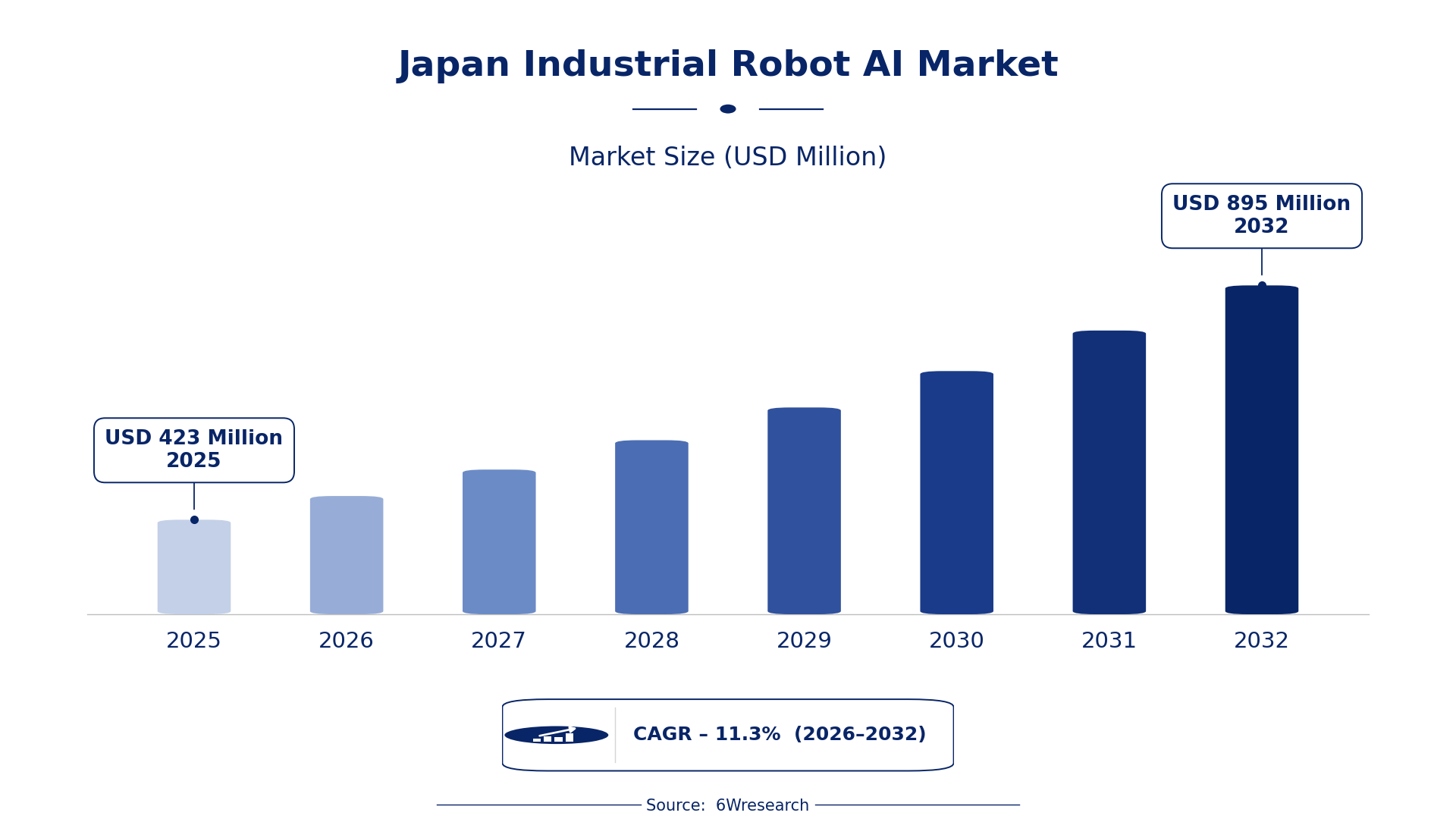
According to 6Wresearch internal database and industry insights, the Japan Industrial Robot AI Market was valued at USD 423 Million in 2025 and is projected to reach USD 895 Million by 2032, growing at a CAGR of approximately 11.3% during 2026–2032.
Japan Industrial Robot AI Market Highlights
| Report Metric | Details |
| Report Name | Japan Industrial Robot AI Market (2026-2032) |
| Market Size 2025 | USD 423 Million |
| Market Size 2032 | USD 895 Million |
| Absolute Growth 2025–2032 | USD 472 Million |
| CAGR 2026–2032 | 11.3% |
| Peak Annual Growth | 14.5% in 2026 |
| Forecast Period | 2026–2032 |
| Historical Data | 2022–2025 |
| Base Year | 2025 |
| Leading Robot Type, 2025 | Articulated Robots (41% share) |
| Leading AI Functionality, 2025 | Vision Recognition (44% share) |
| Leading Control Type, 2025 | Centralized AI Control (43% share) |
| Leading Application Area, 2025 | Assembly Lines (38% share) |
| Leading End User Industry, 2025 | Automotive Manufacturing (53% share) |
| Fastest-Growing Robot Type | Collaborative Robots (15.9% CAGR) |
| Fastest-Growing AI Functionality | Path Optimization (14.0% CAGR) |
| Fastest-Growing Control Type | Edge AI (16.5% CAGR) |
| Fastest-Growing Application Area | Welding/Inspection (13.1% CAGR) |
| Fastest-Growing End User Industry | Electronics (14.1% CAGR) |
| Growing Sector | automotive manufacturing |
| Key End Users | automotive manufacturers, electronics producers, logistics companies, aerospace manufacturers |
Japan Industrial Robot AI Market Year-wise Growth Rate and Key Drivers (2022–2032)
This graph illustrates the annual growth rates of the market from 2022 to 2032, highlighting a steady upward trajectory and projected market expansion over the forecast period.
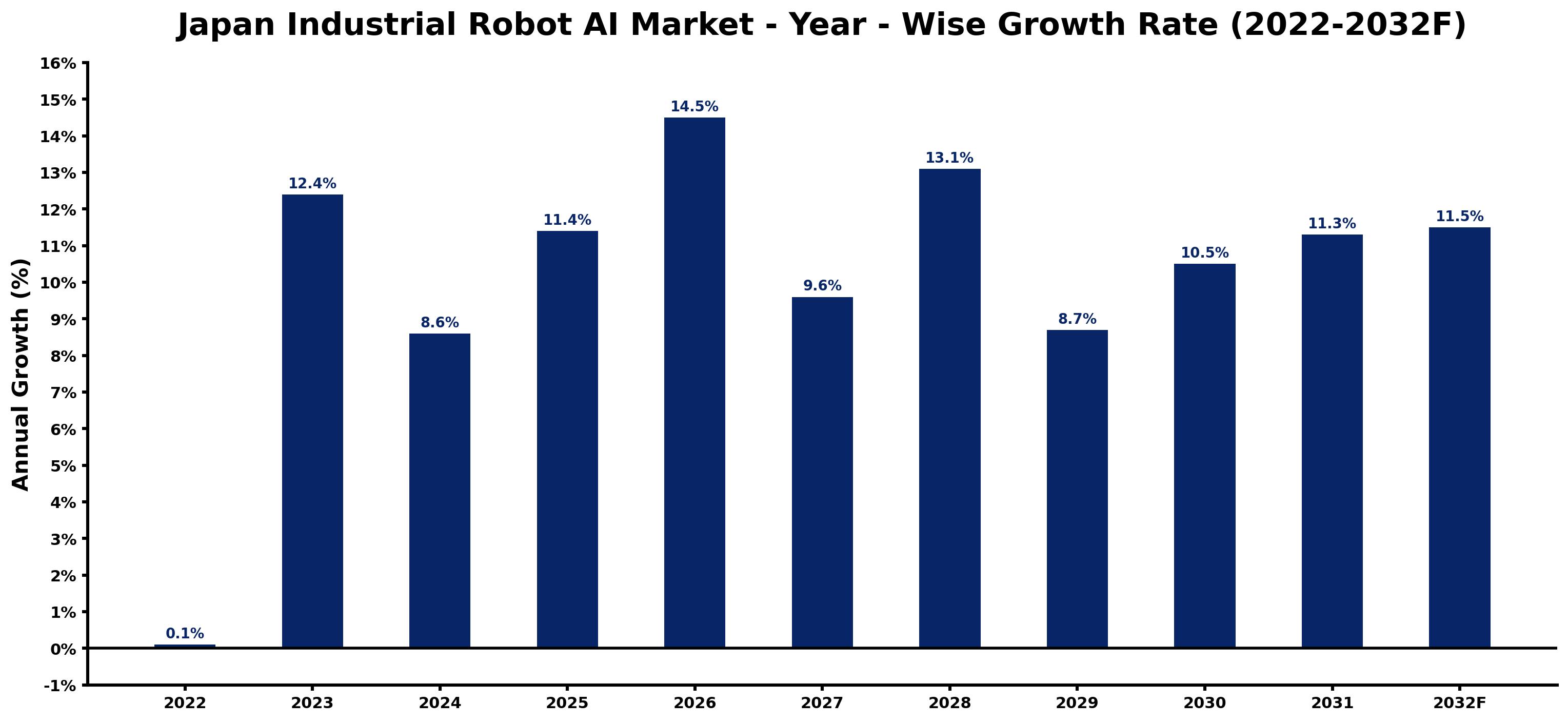
For each year, the table pairs the estimated growth rate with the leading influence on demand, showing how the drivers changed across the period.
| Year | Estimated Annual Growth (%) | Market Rationale |
| 2022 | 0.1 | The market showed minimal growth as businesses began to explore automation options. |
| 2023 | 12.4 | Growth accelerated as industries increasingly adopted advanced robotics for efficiency. |
| 2024 | 8.6 | A slowdown occurred as companies adjusted to new technologies and market conditions. |
| 2025 | 11.4 | Demand rose again as manufacturers invested in automation to boost productivity. |
| 2026 | 14.5 | The market peaked as significant investments in AI integration drove orders higher. |
| 2027 | 9.6 | Growth slowed as companies faced challenges in scaling up production capacity. |
| 2028 | 13.1 | Demand increased again, driven by advancements in AI and robotics technology. |
| 2029 | 8.7 | A slowdown was noted as the market stabilised after rapid growth phases. |
| 2030 | 10.5 | Growth resumed as industries sought to improve operational efficiency with automation. |
| 2031 | 11.3 | Demand continued to rise as technological advancements improved robot capabilities. |
| 2032 | 11.5 | The market maintained a steady growth rate as automation became standard across sectors. |
Note: Market size estimations and growth projections presented in this report are based on 6Wresearch's proprietary forecasting methodology, utilizing the latest available industry data, government publications, and primary research inputs.
Japan Industrial Robot AI Market Synopsis
Industrial Robot AI merges robotics with artificial intelligence to optimise manufacturing processes, enhancing efficiency in tasks like welding and inspection. The Japan Industrial Robot AI Market is growing, driven by the automotive and electronics sectors, which represent a large portion of industrial robot utilisation. Japan's investment of ¥1 trillion in AI and robotics research, along with the rising adoption of automation technologies in manufacturing, is stimulating demand. Collaborative robots are expected to increase by 15% annually, reflecting a trend towards more integrated automation solutions.
Market Dynamics Impact Analysis (2026–2032)
| Factor | Type | Impact | Primary Segment Affected |
| Rising investments in AI and robotics technology | Driver | High | Collaborative Robots |
| Growing demand for automation in manufacturing processes | Driver | High | Articulated Robots |
| Increasing need for efficient production solutions | Opportunity | High | Welding/Inspection |
| Expansion of AI integration in various sectors | Opportunity | Medium | Vision Recognition |
| High initial investment costs for automation technologies | Restraint | High | Centralized AI Control |
| Limited availability of skilled workforce for advanced robotics | Restraint | Medium | Edge AI |
| Supply chain disruptions affecting production capacity | Challenge | High | Assembly Lines |
| Rapid technological changes requiring constant adaptation | Challenge | Medium | Packaging Tasks |
Evaluation of Drivers in Japan Industrial Robot AI Market (2026–2032)
The factors lifting demand, and the evidence behind each, are summarised below.
| Drivers | Primary Segment Affected | Why It Matters (Evidence) |
| Increased automation in manufacturing | Articulated Robots | The automotive sector drives demand for articulated robots to improve production efficiency. |
| Investment in AI technologies | Collaborative Robots | Japan's investment of ¥1 trillion in AI and robotics research boosts demand for collaborative robots in various sectors. |
| Focus on quality control and inspection | Vision Recognition | The electronics industry increases demand for vision recognition technologies to ensure product quality. |
| Need for efficient material handling | Object Sorting | The rise in e-commerce has led to greater demand for object sorting robots in logistics and warehousing. |
| Adoption of safety standards | Centralized AI Control | Compliance with ISO 10218 safety standards encourages investment in centralized AI control systems for industrial robots. |
Behind the steady rise in orders sits increased automation in manufacturing, particularly in the automotive sector, which drives demand for articulated robots. Japan's investment of ¥1 trillion in AI and robotics research supports the growth of collaborative robots, which are increasingly adopted for their efficiency. The rise in e-commerce has led to greater demand for object sorting robots in logistics, while compliance with ISO 10218 safety standards encourages investment in centralized AI control systems. The electronics industry is increasing its demand for vision recognition technologies to ensure product quality, further driving orders in the market.
Evaluation of Restraints in Japan Industrial Robot AI Market
The main factors holding the market back are set out below.
| Market Restraint | Primary Segment Affected | Why It Matters (Evidence) |
| High initial investment costs for automation technologies | Centralized AI Control | The automotive sector's shift to automation requires substantial capital, limiting smaller manufacturers' ability to invest. |
| Limited availability of skilled workforce for advanced robotics | Edge AI | The shortage of skilled workers in robotics hampers the adoption of advanced AI technologies in manufacturing, affecting productivity. |
| Supply chain disruptions affecting production capacity | Assembly Lines | Recent global supply chain issues have delayed the delivery of critical components for industrial robots, impacting production schedules. |
| Rapid technological changes requiring constant adaptation | Packaging Tasks | Manufacturers face challenges in keeping up with rapid advancements in robotics, impacting their competitiveness and market position. |
| Compliance with safety regulations increasing operational costs | Welding/Inspection | Meeting ISO 10218 safety standards raises operational costs for manufacturers, affecting their profit margins. |
Japan Industrial Robot AI Market Challenges
Strict compliance standards in Japan lead to lengthy approval processes, causing delays in product launches for suppliers by up to six months. The rising minimum wage to JPY 1,055 per hour escalates operational costs for buyers, squeezing profit margins in manufacturing. A shortage of skilled technicians in robotics and AI hampers project timelines for producers, with training expenses increasing by 15%. Intense competition from global markets compels local manufacturers to innovate rapidly, straining resources and extending development cycles for clinics and plants.
Trends in the Japan Industrial Robot AI Market
Several trends are reshaping the Japan Industrial Robot AI Market; the most important are set out below.
- Shift towards Collaborative Robotics: The 'Robot Revolution Initiative' is promoting the adoption of collaborative robots, designed to work alongside human operators safely. This trend is reflected in the expected 15% annual growth rate for collaborative robots, indicating a shift in manufacturing practices.
- Transition to AI-Driven Automation: Manufacturers are increasingly adopting AI-driven automation solutions to improve efficiency. The 'GX Promotion Act' aims to boost factory automation by 2025, with a projected investment of ¥150 trillion in decarbonisation and automation technologies.
- Emergence of Edge AI Solutions: Edge AI is gaining traction as manufacturers seek real-time data processing capabilities. The segment is projected to grow at a CAGR of 16.5%, driven by the need for faster decision-making in manufacturing environments.
- Increased Focus on Quality Control: The emphasis on quality control is leading to greater adoption of vision recognition technologies. With the electronics industry projected to utilise 30% of AI robots by 2025, this trend highlights the importance of precision in manufacturing.
Investment Opportunities in the Japan Industrial Robot AI Market
Where to invest in the Japan Industrial Robot AI Market: the main openings are set out below.
- Gap in Automation Solutions: With Japan's industrial robot density at 1,200 units per 10,000 employees, there is a strong opportunity for automation solutions in various sectors. Manufacturers in the automotive sector are particularly in need of advanced robotics to improve production efficiency.
- Growing Demand for Collaborative Robots: The automotive manufacturing sector is increasingly adopting collaborative robots to improve operational efficiency. Investing in collaborative robot technologies can help suppliers meet the rising demand in this sector.
- Entry into Robotics Market: Partnerships with local manufacturers can provide access to Japan's robotics market. The 'Robot Tax Incentive Program' encourages investment in automation technologies, making it an attractive entry point for new suppliers.
- Expansion in Electronics Manufacturing: With the electronics industry projected to utilise 30% of AI robots by 2025, there is a strong demand for advanced robotics solutions. Suppliers can enter this market by collaborating with local electronics manufacturers.
Government Initiatives in the Japan Industrial Robot AI Market
The New Robot Strategy, established in 2015, aims to expand robot use across manufacturing, services, agriculture, and care sectors. This strategy encourages producers to invest in advanced robotics and AI technologies, aligning with Japan's objective of improving productivity and competitiveness in various industries. The initiative has resulted in increased funding for research and development, promoting innovation in robotics.
In 2023, Japan allocated ¥1 trillion for AI and robotics research, administered by the Ministry of Economy, Trade and Industry. This funding supports the development of advanced robotics solutions and encourages collaboration between research institutions and industry players, directly benefiting the Industrial Robot AI sector by promoting technological advancements.
Future Insight of the Japan Industrial Robot AI Market
Technological advancements will reshape demand for industrial robots by 2032, particularly in the automotive sector, which employs 40% of these robots. Japan's projected JPY 150 trillion investment in decarbonisation will stimulate innovation in automation. The 'Smart Manufacturing Strategy' will improve factory automation capabilities, benefiting both buyers and suppliers. The increased adoption of collaborative robots, expected to grow by 15% annually, will further transform operational efficiencies.
Market Segmentation Analysis
Japan Industrial Robot AI Market report covers a detailed analysis of the following market segments:
By Robot Type – Articulated Robots Lead, Collaborative Robots Expected to Grow Fastest
According to Saurav Kr Singh, Senior Research Analyst at 6Wresearch, with 41% of robot type revenue in 2025, Articulated Robots was the largest category. Articulated robots are essential in Japan's automotive sector, where their versatility allows for complex assembly tasks. Their dominance is reflected in the high installed base, particularly in facilities focused on automotive manufacturing. The quickest growth will come from Collaborative Robots, forecast to expand at a CAGR of 15.9% between 2026 and 2032. Collaborative robots are witnessing rapid growth due to their design for safe interaction with human operators, which is increasingly necessary in modern production environments. This trend is likely to accelerate as industries seek to enhance workplace safety. Suppliers should focus on developing collaborative robots to meet the rising demand for safe and efficient automation solutions.
By AI Functionality – Vision Recognition Leads, Path Optimization Expected to Grow Fastest
Vision Recognition held 44% of the Japan Industrial Robot AI Market by ai functionality in 2025. Vision recognition is crucial for quality control in Japan's manufacturing, especially within the automotive and electronics sectors, where precision is paramount. Its widespread implementation in inspection processes reinforces its leading market position. Path Optimization is set to record the highest CAGR in this split, 14.0% over 2026–2032. Path optimization is gaining traction as it significantly enhances operational efficiency in robotic movements, particularly in high-speed production lines. The increasing emphasis on productivity is driving demand for this capability. Buyers should prioritise the integration of path optimization functionalities to boost efficiency and maintain competitive advantage.
By Control Type – Centralized AI Control Leads, Edge AI Expected to Grow Fastest
Centralized AI Control took 43% of control type revenue in 2025, more than any other category. Centralized AI control systems are preferred for their ability to manage multiple robots effectively, which is vital in large-scale manufacturing settings. This capability ensures streamlined operations and optimal resource management across facilities. Edge AI is projected to grow fastest, at a CAGR of 16.5% during 2026–2032. Edge AI is rapidly advancing due to its capacity for real-time data processing on-site, which is critical for making quick decisions in dynamic manufacturing environments. The shift towards smart factories is propelling its adoption. Suppliers must enhance edge AI solutions to cater to the growing need for immediate data processing capabilities.
By Application Area – Assembly Lines Lead, Welding/Inspection Expected to Grow Fastest
The largest application area category in 2025 was Assembly Lines, at 38% of revenue. Assembly lines are fundamental to Japan's mass production, making them the leading application area for industrial robots. Their role in streamlining production processes is vital for maintaining competitiveness in the manufacturing industry. Over 2026–2032, Welding/Inspection is expected to post the fastest growth, at a CAGR of 13.1%. The welding and inspection sector is experiencing significant growth as it is essential for ensuring quality during manufacturing. As industries strive for higher quality standards, the demand for robots in this area is expected to surge. Manufacturers should invest in advanced welding and inspection technologies to enhance product quality and meet evolving market demands.
By End User Industry – Automotive Manufacturing Leads, Electronics Expected to Grow Fastest
In 2025, Automotive Manufacturing led the end user industry split with a 53% share. Automotive manufacturing is the dominant sector utilising industrial robots, accounting for a substantial portion of the market. The industry's reliance on automation for efficiency and precision underscores its leading position. The quickest growth will come from Electronics, forecast to expand at a CAGR of 14.1% between 2026 and 2032. The electronics industry is rapidly adopting robotics for precision tasks, driven by the need for high-quality production in a competitive market. This trend is expected to accelerate as technology advances. Suppliers should tailor their offerings to meet the specific needs of the electronics sector to capitalise on this growth.
Key Attractiveness of the Report
- 10 Years of Market Numbers
- Historical Data Starting from 2022 to 2025
- Base Year 2025
- Forecast Data until 2032
- Key Performance Indicators Impacting the Market
- Major Upcoming Developments and Projects
Key Highlights of the Report:
- Japan Industrial Robot AI Market Outlook
- Market Size of Japan Industrial Robot AI Market, 2025
- Forecast of Japan Industrial Robot AI Market, 2032
- Historical Data and Forecast of Japan Industrial Robot AI Revenues & Volume for the Period 2022-2032F
- Japan Industrial Robot AI Market Trend Evolution
- Japan Industrial Robot AI Market Drivers and Challenges
- Japan Industrial Robot AI Price Trends
- Japan Industrial Robot AI Porter's Five Forces
- Japan Industrial Robot AI Industry Life Cycle
- Historical Data and Forecast of Japan Industrial Robot AI Market Revenues & Volume By Robot Type for the Period 2022-2032F
- Historical Data and Forecast of Japan Industrial Robot AI Market Revenues & Volume By Articulated Robots for the Period 2022-2032F
- Historical Data and Forecast of Japan Industrial Robot AI Market Revenues & Volume By SCARA Robots for the Period 2022-2032F
- Historical Data and Forecast of Japan Industrial Robot AI Market Revenues & Volume By Delta Robots for the Period 2022-2032F
- Historical Data and Forecast of Japan Industrial Robot AI Market Revenues & Volume By Collaborative Robots for the Period 2022-2032F
- Historical Data and Forecast of Japan Industrial Robot AI Market Revenues & Volume By AI Functionality for the Period 2022-2032F
- Historical Data and Forecast of Japan Industrial Robot AI Market Revenues & Volume By Vision Recognition for the Period 2022-2032F
- Historical Data and Forecast of Japan Industrial Robot AI Market Revenues & Volume By Path Optimization for the Period 2022-2032F
- Historical Data and Forecast of Japan Industrial Robot AI Market Revenues & Volume By Object Sorting for the Period 2022-2032F
- Historical Data and Forecast of Japan Industrial Robot AI Market Revenues & Volume By Human Interaction for the Period 2022-2032F
- Historical Data and Forecast of Japan Industrial Robot AI Market Revenues & Volume By Control Type for the Period 2022-2032F
- Historical Data and Forecast of Japan Industrial Robot AI Market Revenues & Volume By Centralized AI Control for the Period 2022-2032F
- Historical Data and Forecast of Japan Industrial Robot AI Market Revenues & Volume By Edge AI for the Period 2022-2032F
- Historical Data and Forecast of Japan Industrial Robot AI Market Revenues & Volume By Cloud-Based AI for the Period 2022-2032F
- Historical Data and Forecast of Japan Industrial Robot AI Market Revenues & Volume By Onboard AI for the Period 2022-2032F
- Historical Data and Forecast of Japan Industrial Robot AI Market Revenues & Volume By Application Area for the Period 2022-2032F
- Historical Data and Forecast of Japan Industrial Robot AI Market Revenues & Volume By Assembly Lines for the Period 2022-2032F
- Historical Data and Forecast of Japan Industrial Robot AI Market Revenues & Volume By PCB Handling for the Period 2022-2032F
- Historical Data and Forecast of Japan Industrial Robot AI Market Revenues & Volume By Packaging Tasks for the Period 2022-2032F
- Historical Data and Forecast of Japan Industrial Robot AI Market Revenues & Volume By Welding/Inspection for the Period 2022-2032F
- Historical Data and Forecast of Japan Industrial Robot AI Market Revenues & Volume By End User Industry for the Period 2022-2032F
- Historical Data and Forecast of Japan Industrial Robot AI Market Revenues & Volume By Automotive Manufacturing for the Period 2022-2032F
- Historical Data and Forecast of Japan Industrial Robot AI Market Revenues & Volume By Electronics for the Period 2022-2032F
- Historical Data and Forecast of Japan Industrial Robot AI Market Revenues & Volume By Consumer Goods for the Period 2022-2032F
- Historical Data and Forecast of Japan Industrial Robot AI Market Revenues & Volume By Aerospace and Defense for the Period 2022-2032F
- Japan Industrial Robot AI Import Export Trade Statistics
- Market Opportunity Assessment By Robot Type
- Market Opportunity Assessment By AI Functionality
- Market Opportunity Assessment By Control Type
- Market Opportunity Assessment By Application Area
- Market Opportunity Assessment By End User Industry
- Japan Industrial Robot AI Top Companies Market Share
- Japan Industrial Robot AI Competitive Benchmarking By Technical and Operational Parameters
- Japan Industrial Robot AI Company Profiles
- Japan Industrial Robot AI Key Strategic Recommendations
Market Covered
This report examines the market across the segments below.
By Robot Type
- Articulated Robots
- SCARA Robots
- Delta Robots
- Collaborative Robots
By AI Functionality
- Vision Recognition
- Path Optimization
- Object Sorting
- Human Interaction
By Control Type
- Centralized AI Control
- Edge AI
- Cloud-Based AI
- Onboard AI
By Application Area
- Assembly Lines
- PCB Handling
- Packaging Tasks
- Welding/Inspection
By End User Industry
- Automotive Manufacturing
- Electronics
- Consumer Goods
- Aerospace and Defense































