Japan Industrial Robotics for Logistics Market Size & Growth Rate
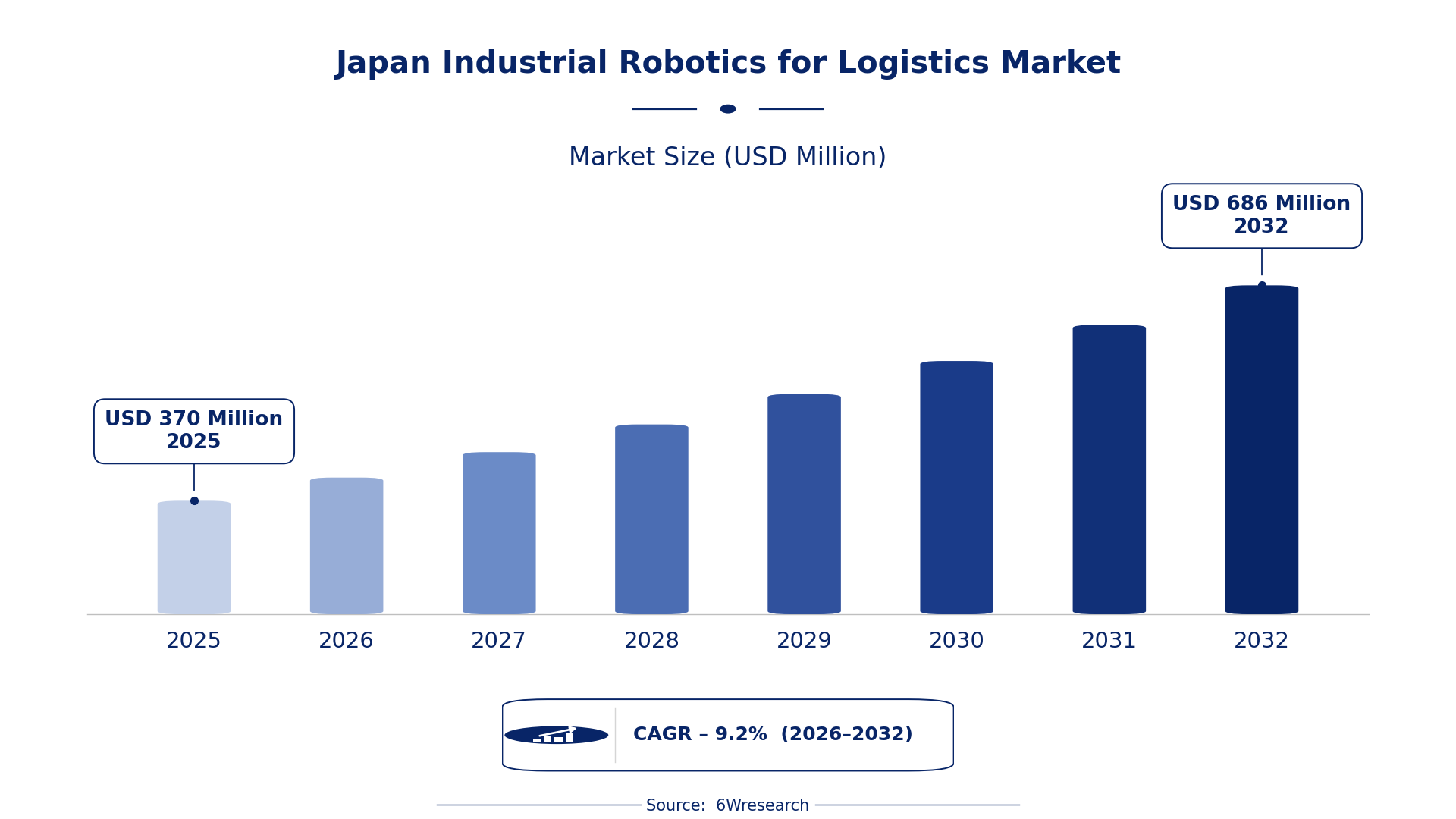
According to 6Wresearch internal database and industry insights, the Japan Industrial Robotics for Logistics Market was valued at USD 370 Million in 2025 and is projected to reach USD 686 Million by 2032, growing at a CAGR of approximately 9.2% during 2026–2032.
Japan Industrial Robotics for Logistics Market Highlights
| Report Metric | Details |
| Report Name | Japan Industrial Robotics for Logistics Market (2026-2032) |
| Market Size 2025 | USD 370 Million |
| Market Size 2032 | USD 686 Million |
| Absolute Growth 2025–2032 | USD 316 Million |
| CAGR 2026–2032 | 9.2% |
| Peak Annual Growth | 10.8% in 2029 |
| Forecast Period | 2026–2032 |
| Historical Data | 2022–2025 |
| Base Year | 2025 |
| Leading Robot Type, 2025 | Automated Guided Vehicles (AGVs) (43% share) |
| Leading Application, 2025 | Order Picking (47% share) |
| Leading End User, 2025 | E-commerce Warehouses (49% share) |
| Leading Distribution Channel, 2025 | Direct Sales (36% share) |
| Fastest-Growing Robot Type | Autonomous Mobile Robots (AMRs) (14.4% CAGR) |
| Fastest-Growing Application | Inventory Management (12.2% CAGR) |
| Fastest-Growing Distribution Channel | Logistics System Providers (12.4% CAGR) |
| Growing Sector | Inventory Management |
| Key End Users | Order Picking, Inventory Management, Palletizing, Last-Mile Delivery |
Japan Industrial Robotics for Logistics Market Year-wise Growth Rate and Key Drivers (2022–2032)
This graph illustrates the annual growth rates of the market from 2022 to 2032, highlighting a steady upward trajectory and projected market expansion over the forecast period.
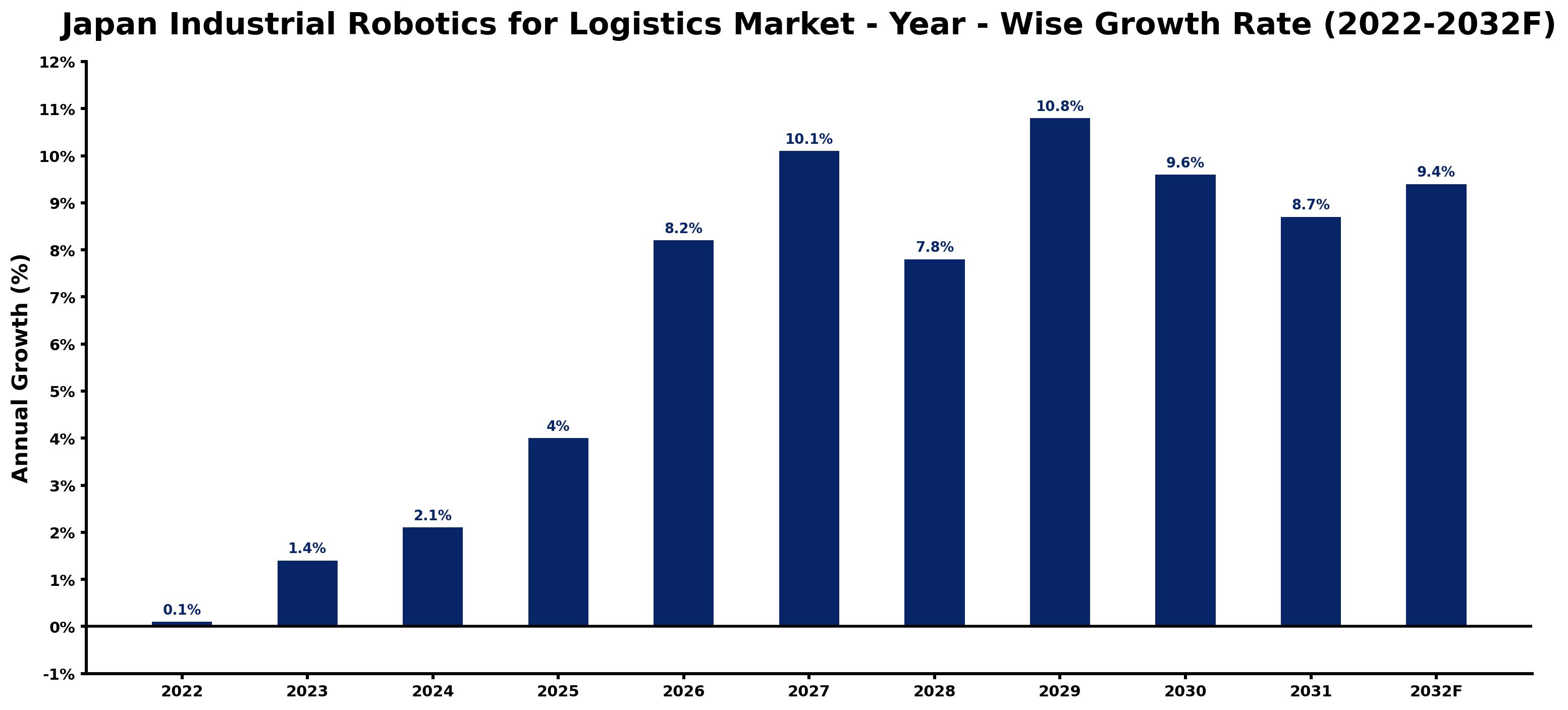
The yearly estimates that follow link every growth rate to its principal driver, so readers can see why the pace changed in each period.
| Year | Estimated Annual Growth (%) | Market Rationale |
| 2022 | 0.1 | The market showed minimal growth as businesses began exploring automation solutions. |
| 2023 | 1.4 | Increased e-commerce activity led to a rise in demand for logistics robotics. |
| 2024 | 2.1 | The introduction of new technologies accelerated market growth further. |
| 2025 | 4.0 | Robotics adoption surged as companies sought efficiency in operations. |
| 2026 | 8.2 | Investment in logistics automation is projected to expand, driving higher demand. |
| 2027 | 10.1 | E-commerce warehouses will increase their reliance on robotics solutions. |
| 2028 | 7.8 | Market growth is expected to slow as saturation in some sectors begins to occur. |
| 2029 | 10.8 | Demand will peak due to heightened investments in automation technologies. |
| 2030 | 9.6 | A slight slowdown in growth is anticipated as the market stabilises. |
| 2031 | 8.7 | Continued investment in logistics robotics will maintain a steady growth rate. |
| 2032 | 9.4 | The market is projected to rebound with renewed interest in advanced robotics solutions. |
Note: Market size estimations and growth projections presented in this report are based on 6Wresearch's proprietary forecasting methodology, utilizing the latest available industry data, government publications, and primary research inputs.
Japan Industrial Robotics for Logistics Market Synopsis
Industrial robotics for logistics involves automated systems designed to improve efficiency in warehousing and distribution. In Japan, demand arises from the booming e-commerce sector, with sales reaching 19 trillion JPY in 2022. Factors driving growth include substantial investments in automation technologies and government initiatives like the New Robot Strategy, which aims to expand robotics use across various industries. The logistics sector, valued at approximately 10 trillion JPY, continues to evolve with increased adoption of these solutions, particularly in e-commerce warehouses and distribution centres.
Market Dynamics Impact Analysis (2026–2032)
| Factor | Type | Impact | Primary Segment Affected |
| Growing e-commerce sales drive demand for efficient logistics solutions. | Driver | High | Order Picking |
| Investment in automation technologies enhances operational efficiency. | Driver | High | Automated Guided Vehicles (AGVs) |
| Rising demand for logistics robotics offers opportunities for suppliers. | Opportunity | High | Autonomous Mobile Robots (AMRs) |
| Increased automation in logistics presents partnership opportunities. | Opportunity | Medium | Logistics System Providers |
| High initial investment costs can deter small businesses from adopting robotics. | Restraint | High | Robotic Arms |
| Limited awareness of robotics benefits constrains market growth. | Restraint | Medium | Drones for Logistics |
| Supply chain disruptions can impact robotics availability. | Challenge | High | Inventory Management |
| Regulatory hurdles may slow down the deployment of logistics robotics. | Challenge | Medium | Last-Mile Delivery |
Evaluation of Drivers in Japan Industrial Robotics for Logistics Market (2026–2032)
The following drivers explain most of the expected growth.
| Drivers | Primary Segment Affected | Why It Matters (Evidence) |
| Increased e-commerce activity drives demand for order fulfillment solutions. | Order Picking | E-commerce sales reached 19 trillion JPY in 2022, leading to more investments in robotics. |
| Investment in automation technologies enhances operational efficiency. | Automated Guided Vehicles (AGVs) | Japan's logistics sector is valued at approximately 10 trillion JPY, prompting automation. |
| The push for sustainability encourages the adoption of robotics. | Autonomous Mobile Robots (AMRs) | Japan targets a 46% cut in greenhouse-gas emissions by 2030, driving robotics demand. |
| Growing competition in logistics necessitates efficiency improvements. | Inventory Management | The installed base of AGVs in Japan is estimated at 20,000 units as of 2023. |
| Technological advancements in robotics increase market potential. | Robotic Arms | Robotic arms are widely used in 60% of automotive logistics operations. |
Most of the extra volume comes from increased e-commerce activity, which has driven demand for order fulfillment solutions, with sales reaching 19 trillion JPY in 2022. Investment in automation technologies boosts operational efficiency, particularly in the logistics sector valued at approximately 10 trillion JPY. The push for sustainability encourages the adoption of robotics, as Japan targets a 46% cut in greenhouse-gas emissions by 2030. Competition in logistics necessitates efficiency improvements, with around 20,000 AGVs installed in Japan. Technological advancements in robotics further increase market potential, especially in automotive logistics where robotic arms are widely used in 60% of operations.
Evaluation of Restraints in Japan Industrial Robotics for Logistics Market
The table below lists the restraints and the evidence behind each.
| Market Restraint | Primary Segment Affected | Why It Matters (Evidence) |
| High initial investment costs deter small businesses from adopting robotics. | Robotic Arms | Small enterprises often lack the capital to invest in advanced robotics solutions, with costs exceeding JPY 10 million for some systems. |
| Limited awareness of robotics benefits constrains market growth. | Drones for Logistics | Many businesses are unaware of how robotics can improve logistics efficiency, with surveys indicating over 40% lack knowledge. |
| Supply chain disruptions can impact robotics availability. | Inventory Management | Global supply chain issues have led to delays in robotics procurement, with lead times extending up to six months. |
| Regulatory hurdles may slow down the deployment of logistics robotics. | Last-Mile Delivery | Strict regulations on drone usage hinder the adoption of last-mile solutions, affecting deployment timelines significantly. |
| Workforce resistance to automation can limit implementation. | Autonomous Mobile Robots (AMRs) | Concerns about job losses lead to pushback against robotics adoption, with 30% of workers expressing opposition. |
Japan Industrial Robotics for Logistics Market Challenges
Producers in Japan encounter fierce competition from global markets, which pressures profit margins and compels significant investments in automation technologies. Distributors face supply chain disruptions due to dependence on foreign components, causing delays in robotics deployment that can last up to six months, thereby affecting operational efficiency. Importers must navigate regulatory challenges associated with JIS B 8400 standards, which can prolong project timelines and lead to revenue losses of around JPY 500 million. Buyers are contending with rising labour costs, as the minimum wage reached JPY 1,055 per hour, prompting a reevaluation of their automation strategies.
Trends in the Japan Industrial Robotics for Logistics Market
Below are the shifts with the largest effect on the Japan Industrial Robotics for Logistics Market.
- Shifts in Automation Practices in Tokyo: Tokyo is experiencing a marked shift towards automation in e-commerce warehouses, with many adopting robotics solutions. E-commerce sales reached 19 trillion JPY in 2022, driving investments in logistics efficiency.
- Integration of Robotics in E-commerce Warehouses: E-commerce warehouses are progressively integrating robotics for inventory management, with a projected CAGR of 12.0% from 2026 to 2032. This trend highlights the need for enhanced efficiency in order fulfillment processes.
- Advocacy for Robotics in Distribution Centers: The Japan Robotics Association is advocating for increased robotics utilisation in distribution centres, anticipating a 10% rise in adoption by 2025. This shift aims to boost operational efficiency in logistics.
- Testing of Last-Mile Delivery Solutions: Since 2023, urban areas like Tokyo have been trialling last-mile delivery solutions using drones. This initiative seeks to meet the rising demand for efficient delivery methods in densely populated regions.
Investment Opportunities in the Japan Industrial Robotics for Logistics Market
Below are the investment opportunities with the strongest case in the Japan Industrial Robotics for Logistics Market.
- Collaborating with Logistics System Providers: Now is the time to collaborate with logistics system providers to supply automation solutions. The logistics sector is valued at approximately 10 trillion JPY, presenting a notable opportunity for growth.
- Investing in Robotics for E-commerce Warehouses: With e-commerce sales reaching 19 trillion JPY in 2022, there is a gap in efficient logistics solutions. Suppliers can target e-commerce warehouses that are rapidly adopting robotics.
- Supplying Autonomous Mobile Robots: The demand for autonomous mobile robots is rising, particularly in urban logistics. Investing in this technology can meet the needs of logistics providers seeking efficiency.
- Entering the Market via Direct Sales: With a 36% share in 2025, direct sales channels are vital for entering the market. Establishing relationships with logistics providers can facilitate access to this growing sector.
Government Initiatives in the Japan Industrial Robotics for Logistics Market
The New Robot Strategy (2015) impacts robotics producers and buyers by aiming to expand robot use across manufacturing, services, and logistics. This strategy encourages investment in automation technologies, improving productivity in various sectors, including logistics, which is essential for Japan's economic growth. The initiative has allocated JPY 100 billion for research and development in robotics, benefiting numerous industries.
In 2023, Japan initiated a program to enhance logistics efficiency with robotics, backed by the Ministry of Economy, Trade and Industry (METI). This initiative allocates substantial funding to promote robotics adoption, aiming to improve operational efficiency and reduce costs in the logistics sector, with an investment target of JPY 50 billion over five years.
Future Insight of the Japan Industrial Robotics for Logistics Market
Japan's transition towards decarbonisation will instigate considerable changes in logistics by 2032, with JPY 150 trillion earmarked for sustainable technology investments. This funding will encourage suppliers to develop robotics solutions tailored for urban logistics challenges. Automation initiatives will streamline operations, benefiting buyers by improving efficiency in their logistics processes. Support from the National Institute of Advanced Industrial Science and Technology will further accelerate advancements, ensuring that robotics integration continues to progress across multiple sectors.
Market Segmentation Analysis
Japan Industrial Robotics for Logistics Market report covers a detailed analysis of the following market segments:
By Robot Type – Automated Guided Vehicles (AGVs) Leads, Autonomous Mobile Robots (AMRs) Expected to Grow Fastest
According to Saurav Kr Singh, Senior Research Analyst at 6Wresearch, the largest robot type category in 2025 was Automated Guided Vehicles (AGVs), at 43% of revenue. Automated Guided Vehicles (AGVs) hold the largest share due to their prevalent use for transporting goods within facilities, particularly in e-commerce warehouses. Their established presence, with an installed base of around 20,000 units, underscores their importance in enhancing operational efficiency. Autonomous Mobile Robots (AMRs) is projected to grow fastest, at a CAGR of 14.4% during 2026–2032. The rapid growth of Autonomous Mobile Robots (AMRs) is attributed to their ability to navigate flexibly within warehouses, meeting the increasing demand for adaptable logistics solutions. As e-commerce sales reached 19 trillion JPY in 2022, AMRs are becoming essential for optimising order fulfilment processes. Suppliers should focus on improving navigation technologies to capitalise on the rising demand for AMRs.
By Application – Order Picking Leads, Inventory Management Expected to Grow Fastest
Order Picking held 47% of the Japan Industrial Robotics for Logistics Market by application in 2025. Order Picking holds the largest share as it is essential for efficient fulfilment processes in logistics operations, especially within e-commerce warehouses. The increasing volume of online orders necessitates reliable and swift order picking solutions to maintain customer satisfaction. The quickest growth will come from Inventory Management, forecast to expand at a CAGR of 12.2% between 2026 and 2032. Inventory Management is experiencing rapid growth due to its critical role in maintaining stock accuracy, which is vital for operational success in logistics. As e-commerce continues to expand, the need for precise inventory control becomes increasingly important. Buyers will need to invest in advanced inventory management solutions to ensure operational efficiency and accuracy.
By End User – E-commerce Warehouses Lead and Record the Fastest Growth
E-commerce Warehouses took 49% of end user revenue in 2025, more than any other category. E-commerce Warehouses dominate the market as they are major users of logistics robotics, leveraging these technologies to enhance efficiency and respond to a growing online consumer base. The e-commerce sector's robust growth, with sales reaching 19 trillion JPY, highlights the essential role of automation in these facilities. E-commerce Warehouses are also forecast to expand faster than any other category, at a CAGR of 12.0% over 2026–2032. E-commerce Warehouses are also the fastest-growing segment, driven by the surge in online shopping that demands greater automation. Their simultaneous leadership and rapid growth indicate a strong trend towards digital transformation in logistics operations. Suppliers must tailor their offerings to meet the specific needs of e-commerce warehouses to remain competitive.
By Distribution Channel – Direct Sales Leads, Logistics System Providers Expected to Grow Fastest
In 2025, Direct Sales led the distribution channel split with a 36% share. Direct Sales is the leading distribution channel, providing a direct method for acquiring robotics solutions that facilitates interaction between suppliers and end users. This approach is particularly effective in logistics where customised solutions are often required to meet specific operational needs. Over 2026–2032, Logistics System Providers are expected to post the fastest growth, at a CAGR of 12.4%. Logistics System Providers are the fastest-growing channel, as they incorporate robotics into comprehensive logistics solutions to address market demands. This shift towards integrated automation strategies reflects the increasing complexity of logistics operations. Suppliers should consider partnerships with logistics system providers to expand their market reach.
Key Attractiveness of the Report
- 10 Years of Market Numbers
- Historical Data Starting from 2022 to 2025
- Base Year 2025
- Forecast Data until 2032
- Key Performance Indicators Impacting the Market
- Major Upcoming Developments and Projects
Key Highlights of the Report:
- Japan Industrial Robotics for Logistics Market Outlook
- Market Size of Japan Industrial Robotics for Logistics Market, 2025
- Forecast of Japan Industrial Robotics for Logistics Market, 2032
- Historical Data and Forecast of Japan Industrial Robotics for Logistics Revenues & Volume for the Period 2022-2032F
- Japan Industrial Robotics for Logistics Market Trend Evolution
- Japan Industrial Robotics for Logistics Market Drivers and Challenges
- Japan Industrial Robotics for Logistics Price Trends
- Japan Industrial Robotics for Logistics Porter's Five Forces
- Japan Industrial Robotics for Logistics Industry Life Cycle
- Historical Data and Forecast of Japan Industrial Robotics for Logistics Market Revenues & Volume By Robot Type for the Period 2022-2032F
- Historical Data and Forecast of Japan Industrial Robotics for Logistics Market Revenues & Volume By Automated Guided Vehicles (AGVs) for the Period 2022-2032F
- Historical Data and Forecast of Japan Industrial Robotics for Logistics Market Revenues & Volume By Autonomous Mobile Robots (AMRs) for the Period 2022-2032F
- Historical Data and Forecast of Japan Industrial Robotics for Logistics Market Revenues & Volume By Robotic Arms for the Period 2022-2032F
- Historical Data and Forecast of Japan Industrial Robotics for Logistics Market Revenues & Volume By Drones for Logistics for the Period 2022-2032F
- Historical Data and Forecast of Japan Industrial Robotics for Logistics Market Revenues & Volume By Application for the Period 2022-2032F
- Historical Data and Forecast of Japan Industrial Robotics for Logistics Market Revenues & Volume By Order Picking for the Period 2022-2032F
- Historical Data and Forecast of Japan Industrial Robotics for Logistics Market Revenues & Volume By Inventory Management for the Period 2022-2032F
- Historical Data and Forecast of Japan Industrial Robotics for Logistics Market Revenues & Volume By Palletizing for the Period 2022-2032F
- Historical Data and Forecast of Japan Industrial Robotics for Logistics Market Revenues & Volume By Last-Mile Delivery for the Period 2022-2032F
- Historical Data and Forecast of Japan Industrial Robotics for Logistics Market Revenues & Volume By End User for the Period 2022-2032F
- Historical Data and Forecast of Japan Industrial Robotics for Logistics Market Revenues & Volume By E-commerce Warehouses for the Period 2022-2032F
- Historical Data and Forecast of Japan Industrial Robotics for Logistics Market Revenues & Volume By Retail Chains for the Period 2022-2032F
- Historical Data and Forecast of Japan Industrial Robotics for Logistics Market Revenues & Volume By Distribution Centers for the Period 2022-2032F
- Historical Data and Forecast of Japan Industrial Robotics for Logistics Market Revenues & Volume By Postal Services for the Period 2022-2032F
- Historical Data and Forecast of Japan Industrial Robotics for Logistics Market Revenues & Volume By Distribution Channel for the Period 2022-2032F
- Historical Data and Forecast of Japan Industrial Robotics for Logistics Market Revenues & Volume By Direct Sales for the Period 2022-2032F
- Historical Data and Forecast of Japan Industrial Robotics for Logistics Market Revenues & Volume By OEM Partnerships for the Period 2022-2032F
- Historical Data and Forecast of Japan Industrial Robotics for Logistics Market Revenues & Volume By Online Distributors for the Period 2022-2032F
- Historical Data and Forecast of Japan Industrial Robotics for Logistics Market Revenues & Volume By Logistics System Providers for the Period 2022-2032F
- Japan Industrial Robotics for Logistics Import Export Trade Statistics
- Market Opportunity Assessment By Robot Type
- Market Opportunity Assessment By Application
- Market Opportunity Assessment By End User
- Market Opportunity Assessment By Distribution Channel
- Japan Industrial Robotics for Logistics Top Companies Market Share
- Japan Industrial Robotics for Logistics Competitive Benchmarking By Technical and Operational Parameters
- Japan Industrial Robotics for Logistics Company Profiles
- Japan Industrial Robotics for Logistics Key Strategic Recommendations
Market Covered
Coverage by segment is as follows.
By Robot Type
- Automated Guided Vehicles (AGVs)
- Autonomous Mobile Robots (AMRs)
- Robotic Arms
- Drones for Logistics
By Application
- Order Picking
- Inventory Management
- Palletizing
- Last-Mile Delivery
By End User
- E-commerce Warehouses
- Retail Chains
- Distribution Centers
- Postal Services
By Distribution Channel
- Direct Sales
- OEM Partnerships
- Online Distributors
- Logistics System Providers































