Japan Industrial Robots Market Size & Growth Rate
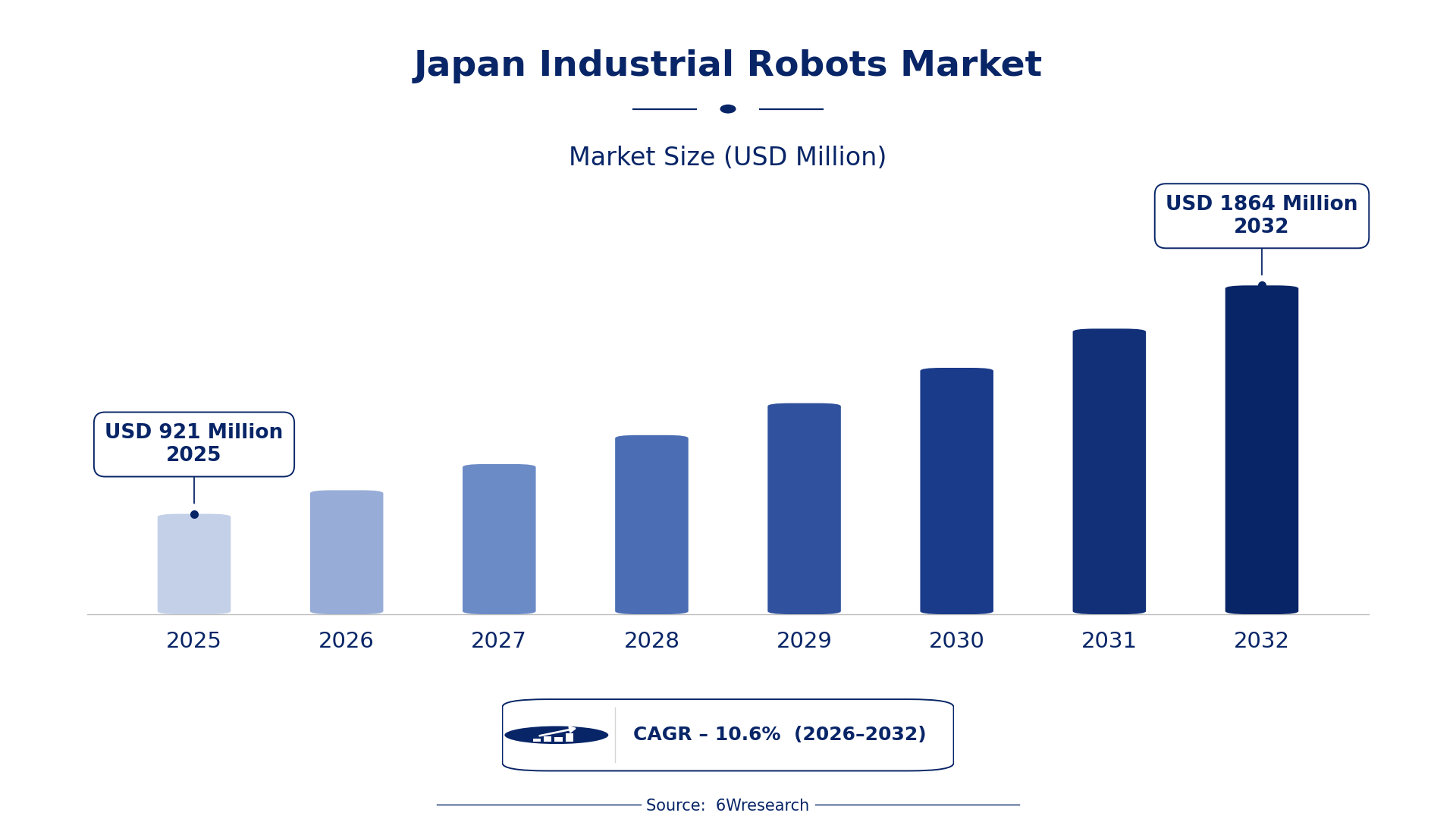
According to 6Wresearch internal database and industry insights, the Japan Industrial Robots Market was valued at USD 921 Million in 2025 and is projected to reach USD 1,864 Million by 2032, growing at a CAGR of approximately 10.6% during 2026–2032.
Japan Industrial Robots Market Highlights
| Report Metric | Details |
| Report Name | Japan Industrial Robots Market (2026-2032) |
| Market Size 2025 | USD 921 Million |
| Market Size 2032 | USD 1,864 Million |
| Absolute Growth 2025–2032 | USD 943 Million |
| CAGR 2026–2032 | 10.6% |
| Peak Annual Growth | 12.2% in 2026 |
| Forecast Period | 2026–2032 |
| Historical Data | 2022–2025 |
| Base Year | 2025 |
| Leading Product Category, 2025 | Articulated (50% share) |
| Leading End-user Vertical, 2025 | Automotive (25% share) |
| Fastest-Growing Product Category | SCARA (15.2% CAGR) |
| Fastest-Growing End-user Vertical | Electronics/Electrical (13.9% CAGR) |
| Growing Sector | Electronics/Electrical |
| Key End Users | Automotive, Electronics/Electrical, Plastic and Chemical, Metal & Machinery |
Japan Industrial Robots Market Year-wise Growth Rate and Key Drivers (2022–2032)
This graph illustrates the annual growth rates of the market from 2022 to 2032, highlighting a steady upward trajectory and projected market expansion over the forecast period.
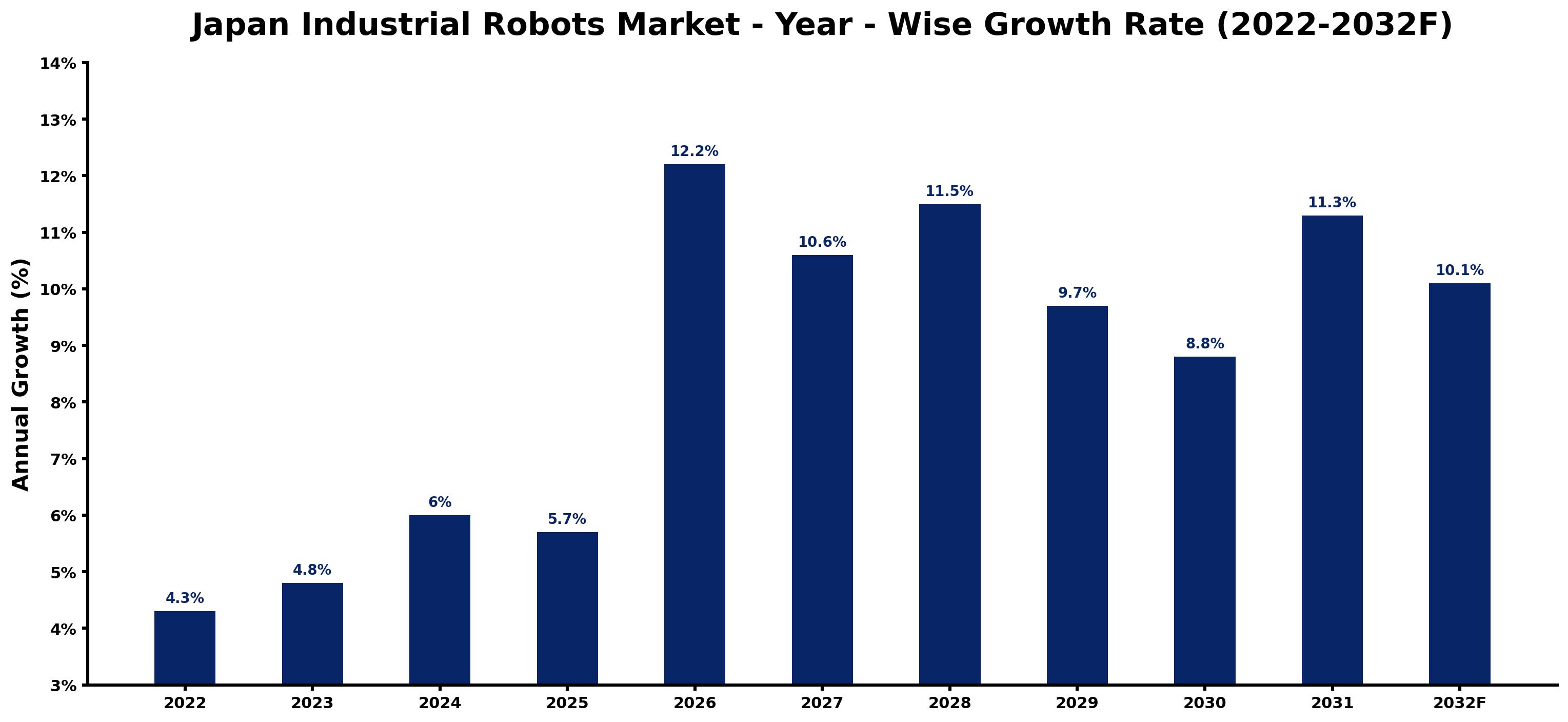
Below, each year's estimated growth is shown next to the factor that most influenced it.
| Year | Estimated Annual Growth (%) | Market Rationale |
| 2022 | 4.3 | The market experienced steady growth driven by strong domestic demand. |
| 2023 | 4.8 | Growth accelerated as manufacturers increased automation to enhance productivity. |
| 2024 | 6.0 | Demand surged due to rising investments in advanced manufacturing technologies. |
| 2025 | 5.7 | Growth slowed as companies adjusted to market saturation in certain sectors. |
| 2026 | 12.2 | Demand spiked as new technologies and applications expanded robot use. |
| 2027 | 10.6 | Growth is expected to decelerate as the market stabilises after rapid expansion. |
| 2028 | 11.5 | Demand will increase due to heightened automation in the electronics sector. |
| 2029 | 9.7 | Growth is projected to moderate as the market faces increased competition and pricing pressures. |
| 2030 | 8.8 | Demand will continue to rise as industries focus on sustainability and efficiency. |
| 2031 | 11.3 | Growth will accelerate again as new applications for robots emerge. |
| 2032 | 10.1 | The market is expected to stabilise as adoption levels reach maturity in key sectors. |
Note: Market size estimations and growth projections presented in this report are based on 6Wresearch's proprietary forecasting methodology, utilizing the latest available industry data, government publications, and primary research inputs.
Japan Industrial Robots Market Synopsis
Industrial robots are automated machines designed for manufacturing tasks, primarily used in assembly, welding, painting, and material handling. The Japan Industrial Robots Market is growing, driven by the automotive sector, which accounted for about 50% of total usage. The electronics industry is expected to increase its robot usage by 15% by 2025, while government measures aim to further boost adoption across various sectors, improving overall productivity and efficiency.
Market Dynamics Impact Analysis (2026–2032)
| Factor | Type | Impact | Primary Segment Affected |
| Increasing automation in manufacturing processes | Driver | High | Automotive |
| Growing demand for precision and efficiency in production | Driver | High | Electronics/Electrical |
| Investment in robotics for decarbonisation efforts | Opportunity | High | Metal & Machinery |
| Rising demand for robots in healthcare applications | Opportunity | Medium | Other Manufacturing Verticals |
| High initial investment costs for robotics integration | Restraint | High | Automotive |
| Limited skilled workforce for advanced robotics operation | Restraint | Medium | Electronics/Electrical |
| Competition from low-cost automation solutions | Challenge | High | Metal & Machinery |
| Technological advancements leading to rapid obsolescence | Challenge | Medium | Other Manufacturing Verticals |
Evaluation of Drivers in Japan Industrial Robots Market (2026–2032)
The following drivers explain most of the expected growth.
| Drivers | Primary Segment Affected | Why It Matters (Evidence) |
| Increased production efficiency through automation | Automotive | The automotive sector accounts for about 50% of total industrial robot usage, driving demand for automation solutions. |
| Expansion of AI integration in robotics | Electronics/Electrical | The electronics sector is projected to grow robot usage by 15% by 2025, improving operational capabilities. |
| Support from government initiatives for robotics | Metal & Machinery | Government measures aim to boost robot adoption, encouraging manufacturers to invest in automation. |
| Rising demand for high-speed packaging solutions | Parallel/Delta | Parallel robots are ideal for high-speed packaging applications, increasing demand in the food and beverage sectors. |
| Focus on sustainability and energy efficiency | Other Manufacturing Verticals | Japan targets a 46% cut in greenhouse-gas emissions by 2030, driving investments in energy-efficient robotics. |
What keeps demand rising is the increasing automation in various sectors, particularly in manufacturing processes. The electronics industry is experiencing a surge in robot usage, projected to grow by 15% by 2025, as firms seek greater precision and efficiency. Japan's commitment to reducing greenhouse-gas emissions by 46% by 2030 fuels demand for energy-efficient robotics, particularly in manufacturing. The robotics industry is also anticipated to support over 1 million jobs by 2025, further stimulating market growth. Investments in advanced robotics technology are on the rise as firms aim to improve operational capabilities, especially in urban manufacturing hubs like Tokyo.
Evaluation of Restraints in Japan Industrial Robots Market
The following restraints limit how fast demand can grow.
| Market Restraint | Primary Segment Affected | Why It Matters (Evidence) |
| High initial investment costs for robotics integration | Automotive | The average cost of an industrial robot in Japan ranges from ¥5 million to ¥20 million, deterring some manufacturers. |
| Limited skilled workforce for advanced robotics operation | Electronics/Electrical | The growing need for skilled technicians to operate advanced robots presents a challenge for manufacturers. |
| Competition from lower-cost automation solutions | Metal & Machinery | Manufacturers may opt for cheaper automation alternatives, impacting the demand for high-end robots. |
| Technological advancements leading to rapid obsolescence | Other Manufacturing Verticals | The fast-paced evolution of robotics technology can render existing systems outdated quickly. |
| Regulatory compliance costs for robotics deployment | Other Manufacturing Verticals | Compliance with standards like JIS B 8432 requires additional investments from manufacturers. |
Japan Industrial Robots Market Challenges
Buyers face high compliance costs due to the JIS B 8432 standard, with investments reaching ¥10 million per robot, which delays deployment timelines. Manufacturers encounter supply chain disruptions as they rely on specific regions for components, leading to production delays that can extend timelines by several months. Clinics struggle with a shortage of skilled workers, limiting the effective operation of over 300,000 robots and resulting in inefficiencies that can cost millions in lost productivity. Technology integration remains a challenge, as the average lifespan of an industrial robot is around 10 years, necessitating costly upgrades that can total ¥20 million for buyers.
Trends in the Japan Industrial Robots Market
Several trends are reshaping the Japan Industrial Robots Market; the most important are set out below.
- Shift towards AI-integrated Robotics: The integration of AI in robotics is transforming automation capabilities. Japan aims for a 46% reduction in greenhouse-gas emissions by 2030, promoting smarter manufacturing solutions.
- Increased Adoption in Electronics Sector: Tokyo is experiencing a surge in robotics adoption within the electronics sector, with an expected 15% growth in robot usage by 2025. This trend reflects the industry's need for precision and efficiency in production.
- Focus on Sustainability in Robotics: The New Robot Strategy aims to improve automation in healthcare by 2025, responding to the growing demand for efficient patient care solutions. This trend highlights the potential for robotics in non-manufacturing sectors.
- Expansion of Robotics in Food and Beverage: The food and beverage sectors are increasingly adopting robotics for packaging processes, driven by the need for efficiency. This trend is clear as manufacturers seek to enhance production capabilities.
Investment Opportunities in the Japan Industrial Robots Market
Where to invest in the Japan Industrial Robots Market: the main openings are set out below.
- Gap in Advanced Robotics Training: With over 300,000 industrial robots installed, a significant gap exists in skilled workforce training. Investing in training programmes for technicians can address this need, particularly in Tokyo and Aichi.
- Partnerships for Robotics Research: The Japanese government allocated ¥10 billion for robotics R&D in 2023, creating opportunities for joint ventures with local institutions to develop innovative solutions.
- Healthcare Robotics Expansion: The healthcare sector is experiencing growth, with government measures targeting enhanced automation. Investing in healthcare robotics can yield substantial returns, especially in urban areas.
- Demand for Sustainable Solutions: As Japan aims for net-zero emissions by 2050, there is a growing need for sustainable robotics solutions. Manufacturers can tap into this opportunity by developing energy-efficient robots.
Government Initiatives in the Japan Industrial Robots Market
The GX Promotion Act (2023) establishes a framework for decarbonisation efforts, directly impacting industrial robot producers and users. This act encourages investments in energy-efficient technologies, aligning with Japan's target for a 46% cut in greenhouse-gas emissions by 2030. Compliance with this act requires manufacturers to adopt sustainable practices in their operations, promoting the use of advanced robotics.
In 2023, the Japanese government allocated ¥10 billion for robotics research and development, administered by the Ministry of Economy, Trade and Industry. This funding supports projects aimed at improving automation across various sectors, benefiting both producers and buyers by driving innovation and improving operational efficiency.
Future Insight of the Japan Industrial Robots Market
By 2032, advancements in AI will reshape the demand for industrial robots, particularly in manufacturing and healthcare sectors. The goal of achieving 1,000 robots per 10,000 workers by 2030 will create new opportunities for suppliers and buyers alike. Investment in robotics is set to rise by 20% by 2025, driving innovation in production processes. The focus on decarbonisation will also push for more efficient robotic solutions, aligning with Japan's environmental targets.
Market Segmentation Analysis
Japan Industrial Robots Market report covers a detailed analysis of the following market segments:
By Product Category – Articulated Leads, SCARA Expected to Grow Fastest
According to Vasudha, AM at 6Wresearch, the largest product category category in 2025 was Articulated, at 50% of revenue. Articulated robots hold the largest share in Japan's industrial robot market because they excel in complex tasks like welding and assembly, which are vital for manufacturing. Their extensive application in the automotive sector, which accounts for about 50% of total usage, underscores their importance. SCARA is projected to grow fastest, at a CAGR of 15.2% during 2026–2032. SCARA robots are experiencing the fastest growth as they are increasingly favoured for pick-and-place tasks in manufacturing environments. The electronics industry, projected to grow its robot usage by 15% by 2025, is a key driver of this trend. Suppliers should focus on enhancing the capabilities of articulated and SCARA robots to meet the growing demands in manufacturing sectors.
By End-user Vertical – Automotive Leads, Electronics/Electrical Expected to Grow Fastest
Automotive took 25% of end-user vertical revenue in 2025, more than any other category. The automotive sector dominates the industrial robot market in Japan, accounting for about 50% of total usage, driven by the need for automation in vehicle production. This strong reliance on robotics for assembly and welding processes solidifies its leading position. Over 2026–2032, Electronics/Electrical is expected to post the fastest growth, at a CAGR of 13.9%. The electronics and electrical sector is the fastest-growing end-user vertical, with a projected 15% increase in robot usage by 2025, primarily due to the rising demand for automation in assembly and testing processes. This growth is indicative of the sector's ongoing transformation towards greater efficiency and productivity. Buyers in the electronics sector should prepare for increased automation solutions to remain competitive in a rapidly evolving market.
Key Attractiveness of the Report
- 10 Years of Market Numbers
- Historical Data Starting from 2022 to 2025
- Base Year 2025
- Forecast Data until 2032
- Key Performance Indicators Impacting the Market
- Major Upcoming Developments and Projects
Key Highlights of the Report:
- Japan Industrial Robots Market Outlook
- Market Size of Japan Industrial Robots Market, 2025
- Forecast of Japan Industrial Robots Market, 2032
- Historical Data and Forecast of Japan Industrial Robots Revenues & Volume for the Period 2022-2032
- Japan Industrial Robots Market Trend Evolution
- Japan Industrial Robots Market Drivers and Challenges
- Japan Industrial Robots Price Trends
- Japan Industrial Robots Porter's Five Forces
- Japan Industrial Robots Industry Life Cycle
- Historical Data and Forecast of Japan Industrial Robots Market Revenues & Volume By Product Category for the Period 2022-2032
- Historical Data and Forecast of Japan Industrial Robots Market Revenues & Volume By Articulated for the Period 2022-2032
- Historical Data and Forecast of Japan Industrial Robots Market Revenues & Volume By SCARA for the Period 2022-2032
- Historical Data and Forecast of Japan Industrial Robots Market Revenues & Volume By Cartesian/Linear/Gantry for the Period 2022-2032
- Historical Data and Forecast of Japan Industrial Robots Market Revenues & Volume By Parallel/Delta for the Period 2022-2032
- Historical Data and Forecast of Japan Industrial Robots Market Revenues & Volume By Other Product Categories (Cylindrical and Spherical) for the Period 2022-2032
- Historical Data and Forecast of Japan Industrial Robots Market Revenues & Volume By End-user Vertical for the Period 2022-2032
- Historical Data and Forecast of Japan Industrial Robots Market Revenues & Volume By Automotive for the Period 2022-2032
- Historical Data and Forecast of Japan Industrial Robots Market Revenues & Volume By Electronics/Electrical for the Period 2022-2032
- Historical Data and Forecast of Japan Industrial Robots Market Revenues & Volume By Plastic and Chemical for the Period 2022-2032
- Historical Data and Forecast of Japan Industrial Robots Market Revenues & Volume By Metal & Machinery for the Period 2022-2032
- Historical Data and Forecast of Japan Industrial Robots Market Revenues & Volume By Food, Beverages, and Tobacco for the Period 2022-2032
- Historical Data and Forecast of Japan Industrial Robots Market Revenues & Volume By Other Manufacturing Verticals for the Period 2022-2032
- Historical Data and Forecast of Japan Industrial Robots Market Revenues & Volume By Other Non-Manufacturing Verticals for the Period 2022-2032
- Japan Industrial Robots Import Export Trade Statistics
- Market Opportunity Assessment By Product Category
- Market Opportunity Assessment By End-user Vertical
- Japan Industrial Robots Top Companies Market Share
- Japan Industrial Robots Competitive Benchmarking By Technical and Operational Parameters
- Japan Industrial Robots Company Profiles
- Japan Industrial Robots Key Strategic Recommendations
Market Covered
The report covers the following segments.
By Product Category
- Articulated
- SCARA
- Cartesian/Linear/Gantry
- Parallel/Delta
- Other Product Categories (Cylindrical and Spherical)
By End-user Vertical
- Automotive
- Electronics/Electrical
- Plastic and Chemical
- Metal & Machinery
- Food
- Beverages
- Tobacco
- Other Manufacturing Verticals
- Other Non-Manufacturing Verticals






































