Japan Industrial Rubber Processing Market Size & Growth Rate
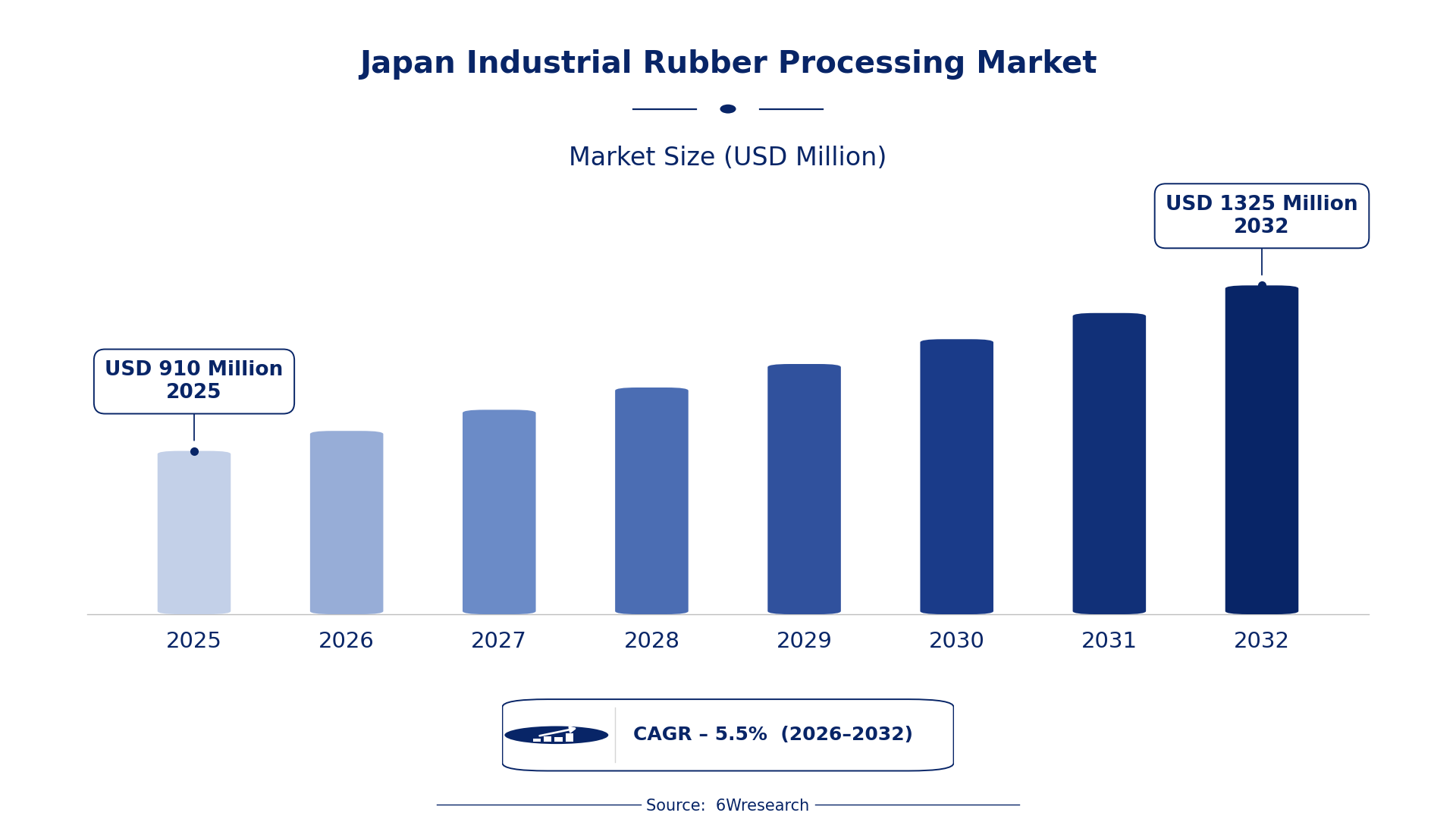
According to 6Wresearch internal database and industry insights, the Japan Industrial Rubber Processing Market was valued at USD 910 Million in 2025 and is projected to reach USD 1,325 Million by 2032, growing at a CAGR of approximately 5.5% during 2026–2032.
Japan Industrial Rubber Processing Market Highlights
| Report Metric | Details |
| Report Name | Japan Industrial Rubber Processing Market (2026-2032) |
| Market Size 2025 | USD 910 Million |
| Market Size 2032 | USD 1,325 Million |
| Absolute Growth 2025–2032 | USD 415 Million |
| CAGR 2026–2032 | 5.5% |
| Peak Annual Growth | 6.2% in 2029 |
| Forecast Period | 2026–2032 |
| Historical Data | 2022–2025 |
| Base Year | 2025 |
| Leading Processing Type, 2025 | Molding (39% share) |
| Leading Material Type, 2025 | Natural Rubber (43% share) |
| Leading End Use Industry, 2025 | Tire Manufacturing (49% share) |
| Leading Distribution Channel, 2025 | Direct Sales (42% share) |
| Fastest-Growing Processing Type | Extrusion (7.7% CAGR) |
| Fastest-Growing Material Type | Synthetic Rubber (7.9% CAGR) |
| Fastest-Growing End Use Industry | Footwear Industry (7.1% CAGR) |
| Fastest-Growing Distribution Channel | Industrial Suppliers (7.2% CAGR) |
| Growing Sector | Tire Manufacturing |
| Key End Users | Automotive Parts Manufacturers, Tire Manufacturers, Footwear Producers, Construction Companies |
Japan Industrial Rubber Processing Market Year-wise Growth Rate and Key Drivers (2022–2032)
This graph illustrates the annual growth rates of the market from 2022 to 2032, highlighting a steady upward trajectory and projected market expansion over the forecast period.
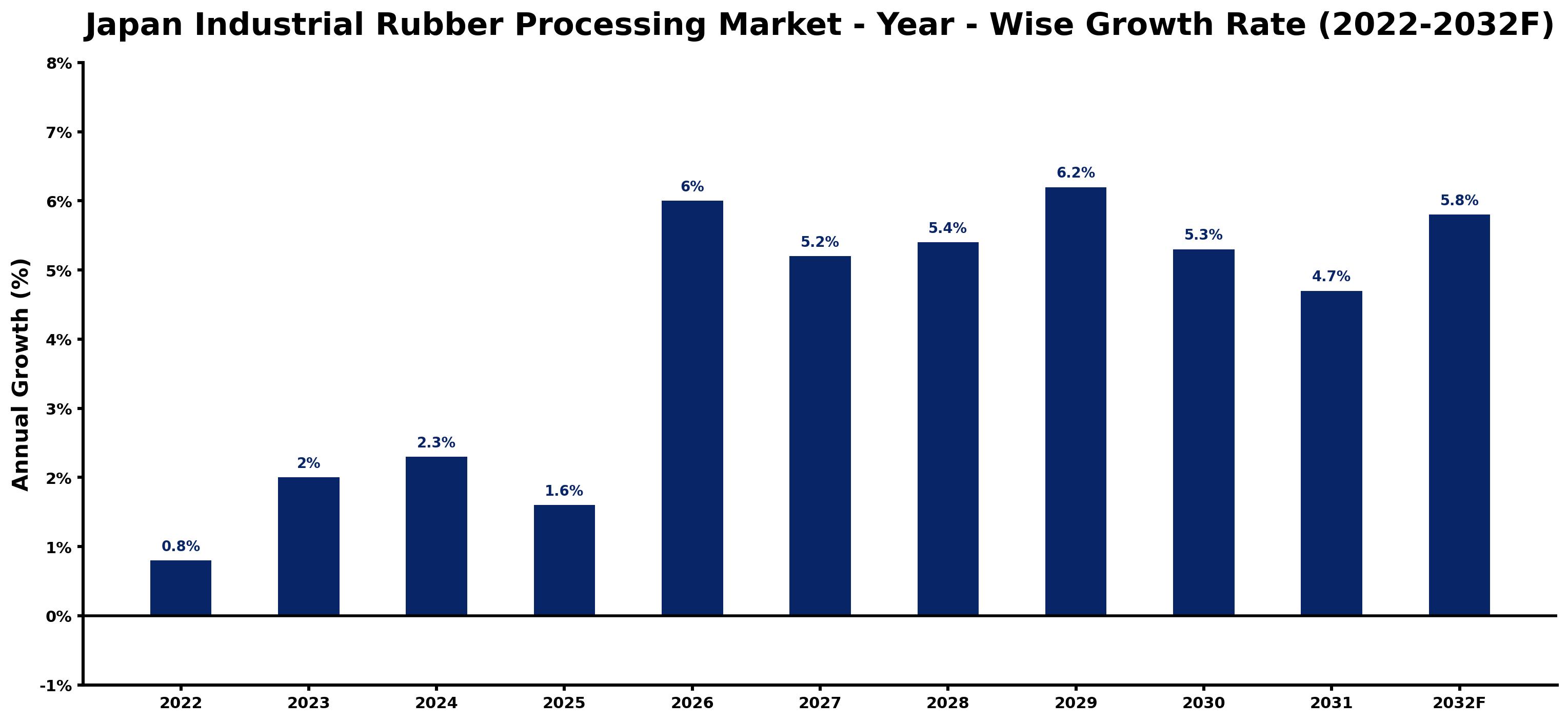
Each row of the following table gives one year's estimated growth and the event or demand shift that explains it.
| Year | Estimated Annual Growth (%) | Market Rationale |
| 2022 | 0.8 | The market experienced steady demand, supported by the automotive sector's needs. |
| 2023 | 2.0 | Growth accelerated due to increased production in the tire manufacturing sector. |
| 2024 | 2.3 | Demand continued to rise as automotive parts manufacturers expanded operations. |
| 2025 | 1.6 | Growth slowed as the market adjusted to previous rapid increases in demand. |
| 2026 | 6.0 | The market is expected to rebound with strong demand from the tire manufacturing sector. |
| 2027 | 5.2 | Growth is projected to decelerate slightly as supply chain challenges emerge. |
| 2028 | 5.4 | Demand is expected to rise again, driven by innovations in rubber processing technologies. |
| 2029 | 6.2 | The peak growth year will see heightened investments in sustainable practices. |
| 2030 | 5.3 | Growth is projected to moderate as the market stabilises after peak demand. |
| 2031 | 4.7 | A further slowdown is expected as the market adjusts to new environmental regulations. |
| 2032 | 5.8 | Demand is expected to rise again as the automotive sector continues to grow. |
Note: Market size estimations and growth projections presented in this report are based on 6Wresearch's proprietary forecasting methodology, utilizing the latest available industry data, government publications, and primary research inputs.
Japan Industrial Rubber Processing Market Synopsis
Industrial rubber processing involves transforming rubber materials into usable products through techniques such as molding, extrusion, and calendering. The Japan Industrial Rubber Processing Market is growing due to rising demand from the tire manufacturing sector, which employs over 40,000 people. Investments targeting JPY 150 trillion over ten years are driving innovation and sustainability in production processes. The automotive industry, valued at over $100 billion, remains a major consumer of processed rubber, fuelling market expansion.
Market Dynamics Impact Analysis (2026–2032)
| Factor | Type | Impact | Primary Segment Affected |
| Increased production of synthetic rubber | Driver | High | Synthetic Rubber |
| Growing demand for sustainable materials | Driver | High | Natural Rubber |
| Emerging demand for recycled rubber products | Opportunity | Medium | Molding |
| Expansion of the automotive sector | Opportunity | High | Automotive Parts |
| High costs of raw materials | Restraint | High | Natural Rubber |
| Strict waste management regulations | Restraint | Medium | EPDM Rubber |
| Capacity constraints in processing facilities | Challenge | High | Calendering |
| Compliance with environmental standards | Challenge | Medium | Mixing |
Evaluation of Drivers in Japan Industrial Rubber Processing Market (2026–2032)
The factors lifting demand, and the evidence behind each, are summarised below.
| Drivers | Primary Segment Affected | Why It Matters (Evidence) |
| Increased production of synthetic rubber | Synthetic Rubber | Japan produced approximately 1.2 million tons of synthetic rubber in 2022, boosting supply for automotive parts. |
| Growing demand for sustainable materials | Natural Rubber | The footwear industry is shifting towards sustainable materials, increasing demand for natural rubber. |
| Expansion of the automotive sector | Automotive Parts | The automotive industry in Japan is valued at over $100 billion, driving higher purchases of rubber components. |
| Technological advancements in processing methods | Molding | ISO 9001 certification is widely adopted, improving quality and efficiency in rubber processing. |
| Rising exports of rubber products | Tire Manufacturing | The tire manufacturing sector remains active, with significant domestic demand and export opportunities. |
The automotive sector, valued at over $100 billion, drives increased purchases of rubber components, particularly in tire manufacturing, where over 40,000 people are employed. Production of synthetic rubber reached approximately 1.2 million tons in 2022, boosting supply for automotive parts. The shift towards sustainable materials in the footwear industry is raising demand for natural rubber. Innovations in processing methods, such as ISO 9001 certification, are improving efficiency and supporting market growth.
Evaluation of Restraints in Japan Industrial Rubber Processing Market
Below are the constraints most often cited by buyers and suppliers, with the segment each affects.
| Market Restraint | Primary Segment Affected | Why It Matters (Evidence) |
| High costs of raw materials | Natural Rubber | Natural rubber imports reached 300,000 tons in 2022, increasing production costs for manufacturers. |
| Strict waste management regulations | EPDM Rubber | Japan has stringent regulations complicating disposal for producers. |
| Limited processing capacity | Calendering | Limited processing capacity affects the ability to meet demand from the automotive sector. |
| Compliance with environmental standards | Mixing | Producers face challenges in meeting the government's target to reduce carbon emissions by 30% by 2030. |
| Fluctuating demand in the construction sector | Construction Sector | The construction sector is expected to grow by only 2% annually until 2025, limiting rubber demand. |
Japan Industrial Rubber Processing Market Challenges
Natural rubber imports to Japan reached 300,000 tons in 2022, causing supply disruptions for domestic manufacturers reliant on consistent input. Rising operational costs due to strict regulations can inflate prices for producers, ultimately burdening buyers with higher expenses. The government’s target to reduce carbon emissions in the rubber industry by 30% by 2030 places financial pressure on suppliers, requiring substantial investments that may delay product availability. Limited adoption of advanced processing technologies can restrict the competitiveness of local firms, hindering their ability to meet the automotive sector's increasing demands.
Trends in the Japan Industrial Rubber Processing Market
The following changes are redrawing the Japan Industrial Rubber Processing Market.
- Shift towards Sustainable Materials in Footwear: The footwear industry is increasingly adopting sustainable materials, with a notable shift observed in 2023. This change is driven by consumer preferences for eco-friendly products, leading to a rise in natural rubber usage.
- Transition from Traditional to Advanced Processing Techniques: In 2023, the rubber processing sector began adopting advanced techniques like calendering and extrusion. This shift improves product quality and efficiency, particularly in the automotive parts segment, which is essential for meeting demand.
- Emergence of Recycling Initiatives in Rubber Processing: Japan launched a program in 2023 to promote recycling in the rubber industry, aiming to reduce waste. This initiative aligns with the country's broader decarbonisation goals, supporting sustainable practices among manufacturers.
- Growth in Direct Sales Channels: Direct sales channels have gained prominence since 2022, reflecting a shift in buyer preferences. This trend is evident in the tire manufacturing sector, where 42% of sales are conducted through direct channels.
Investment Opportunities in the Japan Industrial Rubber Processing Market
The opportunities below stand out in the Japan Industrial Rubber Processing Market for new entrants and existing suppliers.
- Automotive Parts Manufacturers Seeking Sustainable Solutions: With the automotive sector valued at over $100 billion, there is a growing need for sustainable rubber solutions. Investing in eco-friendly materials can capture market share among automotive parts manufacturers.
- Gap in Recycling Capabilities for Rubber Products: Japan's push for recycling in the rubber industry highlights a gap in current capabilities. The government allocated $5 million for research in sustainable rubber processing technologies, presenting an opportunity for investment.
- Timing for Expansion in the Tire Manufacturing Sector: As the tire manufacturing sector remains a major consumer of processed rubber, now is the ideal time for investments in production capacity. Collaborating with local manufacturers can facilitate market entry.
- Entry through Joint Ventures with Local Suppliers: Establishing joint ventures with regional distributors can enhance market access. The Tokyo region is a hub for rubber processing industries, making it a strategic location for partnerships.
Government Initiatives in the Japan Industrial Rubber Processing Market
The GX Promotion Act, adopted in 2023, establishes a legal framework for decarbonisation strategies. This act supports the rubber industry’s transition towards sustainable practices, requiring producers to invest in eco-friendly technologies and processes. The government aims to reduce carbon emissions in the rubber industry by 30% by 2030, necessitating investments in cleaner technologies.
In 2023, the government allocated JPY 150 trillion for public and private decarbonisation investment, administered by the Ministry of the Environment. This funding aims to promote sustainable practices in the rubber industry, encouraging manufacturers to adopt greener technologies.
Future Insight of the Japan Industrial Rubber Processing Market
Innovative recycling technologies will transform the demand for sustainable materials by 2032, enabling suppliers to minimise waste and improve product offerings. New standards, including updated ISO certifications for environmentally friendly practices, will elevate compliance and quality. A government investment of $5 million in sustainable rubber processing technologies will facilitate a shift towards greener production methods, benefiting both buyers and suppliers. The anticipated growth in the construction sector, projected to expand by 2% annually until 2025, will further drive the need for high-quality rubber products.
Market Segmentation Analysis
Japan Industrial Rubber Processing Market report covers a detailed analysis of the following market segments:
By Processing Type – Molding Leads, Extrusion Expected to Grow Fastest
According to Saurav Kr Singh, Senior Research Analyst at 6Wresearch, Molding took 39% of processing type revenue in 2025, more than any other category. Molding holds the largest share due to its essential function in shaping rubber products for various applications. This method is crucial for the production of items like tires, which are in high demand within Japan's automotive sector. Extrusion is set to record the highest CAGR in this split, 7.7% over 2026–2032. Extrusion is rapidly growing because it is increasingly employed for producing continuous rubber shapes, especially in automotive applications. The surge in automotive production and the need for efficient manufacturing processes are key factors propelling this growth. Suppliers should invest in both molding and extrusion technologies to effectively meet the evolving market demands.
By Material Type – Natural Rubber Leads, Synthetic Rubber Expected to Grow Fastest
The largest material type category in 2025 was Natural Rubber, at 43% of revenue. Natural Rubber leads the market as it is extensively used in tire manufacturing, a major application in Japan. The substantial volume of natural rubber imports reinforces its dominant position in the market. Over 2026–2032, Synthetic Rubber is expected to post the fastest growth, at a CAGR of 7.9%. Synthetic Rubber is experiencing rapid growth due to its predominant use in automotive and industrial applications, which are expanding alongside the automotive industry's success. The rising demand for high-performance materials in vehicles significantly drives this segment. Buyers may find advantages in diversifying their material sources to include synthetic options as the demand for high-performance products increases.
By End Use Industry – Tire Manufacturing Leads, Footwear Industry Expected to Grow Fastest
Tire Manufacturing held 49% of the Japan Industrial Rubber Processing Market by end use industry in 2025. Tire Manufacturing is the largest consumer of processed rubber, bolstered by Japan's strong automotive sector and high domestic tire demand. The sector employs a considerable workforce, further solidifying its market position. The quickest growth will come from Footwear Industry, forecast to expand at a CAGR of 7.1% between 2026 and 2032. The Footwear Industry is growing quickly as manufacturers shift towards sustainable materials, reflecting changing consumer preferences. This trend is supported by increasing awareness of environmental issues and the demand for eco-friendly products. Suppliers should consider expanding their product offerings to cater to the rising demand for sustainable materials in the footwear sector.
By Distribution Channel – Direct Sales Leads, Industrial Suppliers Expected to Grow Fastest
Direct Sales accounted for 42% of the market by distribution channel in 2025. Direct Sales is the dominant channel for industrial rubber products, enabling manufacturers to engage directly with customers and streamline operations. This approach ensures better control over pricing and customer relationships. Industrial Suppliers are projected to grow fastest, at a CAGR of 7.2% during 2026–2032. Industrial Suppliers are rapidly expanding their market presence as they serve as key distributors for manufacturers, facilitating access to a broader customer base. The increasing complexity of supply chains in the industrial sector drives this growth. Suppliers should strengthen partnerships with industrial suppliers to improve distribution efficiency and effectively reach more customers.
Key Attractiveness of the Report
- 10 Years of Market Numbers
- Historical Data Starting from 2022 to 2025
- Base Year 2025
- Forecast Data until 2032
- Key Performance Indicators Impacting the Market
- Major Upcoming Developments and Projects
Key Highlights of the Report:
- Japan Industrial Rubber Processing Market Outlook
- Market Size of Japan Industrial Rubber Processing Market, 2025
- Forecast of Japan Industrial Rubber Processing Market, 2032
- Historical Data and Forecast of Japan Industrial Rubber Processing Revenues & Volume for the Period 2022-2032F
- Japan Industrial Rubber Processing Market Trend Evolution
- Japan Industrial Rubber Processing Market Drivers and Challenges
- Japan Industrial Rubber Processing Price Trends
- Japan Industrial Rubber Processing Porter's Five Forces
- Japan Industrial Rubber Processing Industry Life Cycle
- Historical Data and Forecast of Japan Industrial Rubber Processing Market Revenues & Volume By Processing Type for the Period 2022-2032F
- Historical Data and Forecast of Japan Industrial Rubber Processing Market Revenues & Volume By Molding for the Period 2022-2032F
- Historical Data and Forecast of Japan Industrial Rubber Processing Market Revenues & Volume By Extrusion for the Period 2022-2032F
- Historical Data and Forecast of Japan Industrial Rubber Processing Market Revenues & Volume By Calendering for the Period 2022-2032F
- Historical Data and Forecast of Japan Industrial Rubber Processing Market Revenues & Volume By Mixing for the Period 2022-2032F
- Historical Data and Forecast of Japan Industrial Rubber Processing Market Revenues & Volume By Material Type for the Period 2022-2032F
- Historical Data and Forecast of Japan Industrial Rubber Processing Market Revenues & Volume By Natural Rubber for the Period 2022-2032F
- Historical Data and Forecast of Japan Industrial Rubber Processing Market Revenues & Volume By Synthetic Rubber for the Period 2022-2032F
- Historical Data and Forecast of Japan Industrial Rubber Processing Market Revenues & Volume By Butyl Rubber for the Period 2022-2032F
- Historical Data and Forecast of Japan Industrial Rubber Processing Market Revenues & Volume By EPDM Rubber for the Period 2022-2032F
- Historical Data and Forecast of Japan Industrial Rubber Processing Market Revenues & Volume By End Use Industry for the Period 2022-2032F
- Historical Data and Forecast of Japan Industrial Rubber Processing Market Revenues & Volume By Tire Manufacturing for the Period 2022-2032F
- Historical Data and Forecast of Japan Industrial Rubber Processing Market Revenues & Volume By Footwear Industry for the Period 2022-2032F
- Historical Data and Forecast of Japan Industrial Rubber Processing Market Revenues & Volume By Automotive Parts for the Period 2022-2032F
- Historical Data and Forecast of Japan Industrial Rubber Processing Market Revenues & Volume By Construction Sector for the Period 2022-2032F
- Historical Data and Forecast of Japan Industrial Rubber Processing Market Revenues & Volume By Distribution Channel for the Period 2022-2032F
- Historical Data and Forecast of Japan Industrial Rubber Processing Market Revenues & Volume By Direct Sales for the Period 2022-2032F
- Historical Data and Forecast of Japan Industrial Rubber Processing Market Revenues & Volume By Industrial Suppliers for the Period 2022-2032F
- Historical Data and Forecast of Japan Industrial Rubber Processing Market Revenues & Volume By Online Platforms for the Period 2022-2032F
- Historical Data and Forecast of Japan Industrial Rubber Processing Market Revenues & Volume By Regional Distributors for the Period 2022-2032F
- Japan Industrial Rubber Processing Import Export Trade Statistics
- Market Opportunity Assessment By Processing Type
- Market Opportunity Assessment By Material Type
- Market Opportunity Assessment By End Use Industry
- Market Opportunity Assessment By Distribution Channel
- Japan Industrial Rubber Processing Top Companies Market Share
- Japan Industrial Rubber Processing Competitive Benchmarking By Technical and Operational Parameters
- Japan Industrial Rubber Processing Company Profiles
- Japan Industrial Rubber Processing Key Strategic Recommendations
Market Covered
Coverage by segment is as follows.
By Processing Type
- Molding
- Extrusion
- Calendering
- Mixing
By Material Type
- Natural Rubber
- Synthetic Rubber
- Butyl Rubber
- EPDM Rubber
By End Use Industry
- Tire Manufacturing
- Footwear Industry
- Automotive Parts
- Construction Sector
By Distribution Channel
- Direct Sales
- Industrial Suppliers
- Online Platforms
- Regional Distributors































