Japan Industrial Safety Gear Market Size & Growth Rate
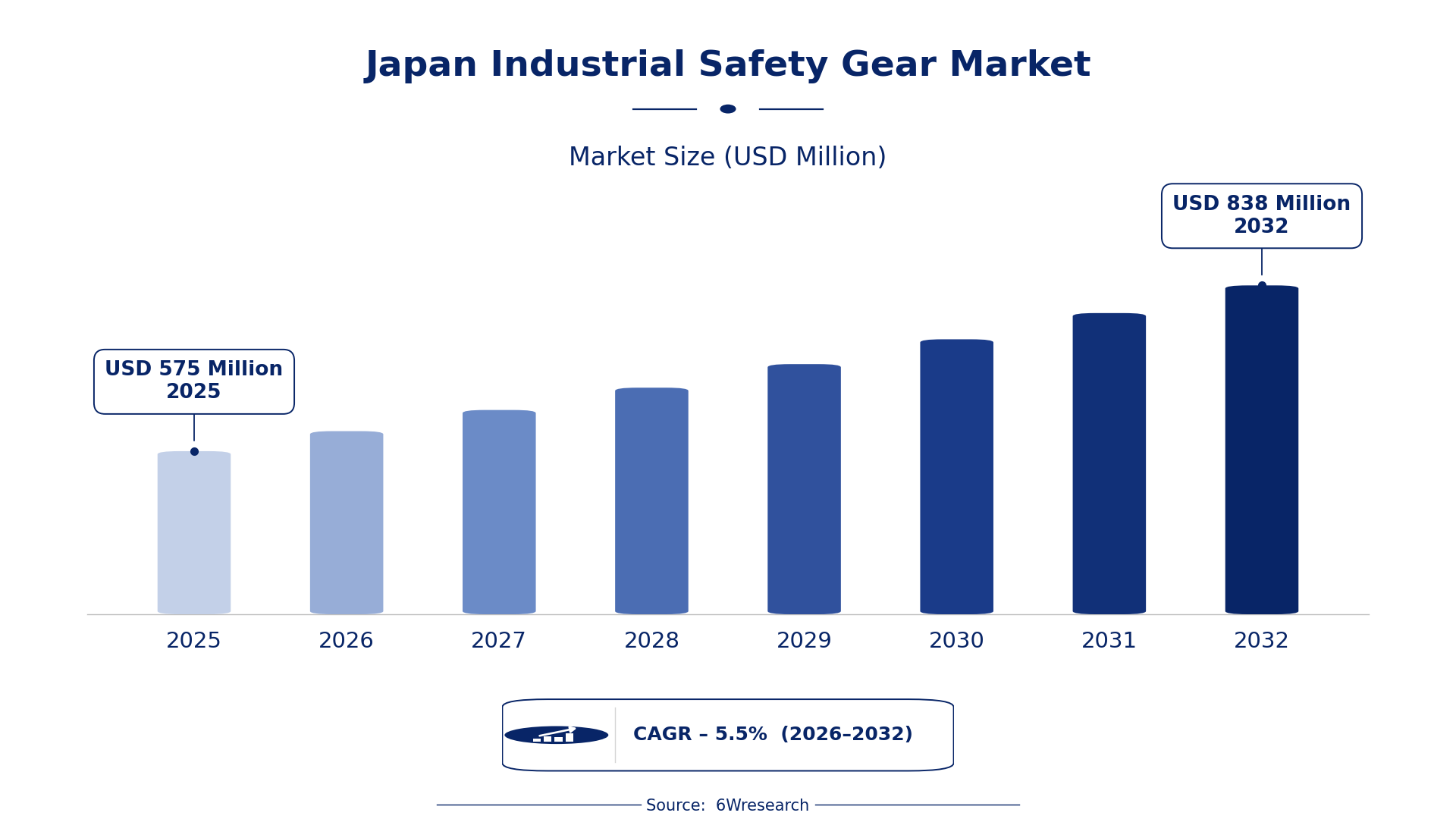
According to 6Wresearch internal database and industry insights, the Japan Industrial Safety Gear Market was valued at USD 575 Million in 2025 and is projected to reach USD 838 Million by 2032, growing at a CAGR of approximately 5.5% during 2026–2032.
Japan Industrial Safety Gear Market Highlights
| Report Metric | Details |
| Report Name | Japan Industrial Safety Gear Market (2026-2032) |
| Market Size 2025 | USD 575 Million |
| Market Size 2032 | USD 838 Million |
| Absolute Growth 2025–2032 | USD 263 Million |
| CAGR 2026–2032 | 5.5% |
| Peak Annual Growth | 6.9% in 2028 |
| Forecast Period | 2026–2032 |
| Historical Data | 2022–2025 |
| Base Year | 2025 |
| Leading Product Type, 2025 | Safety Helmets (49% share) |
| Leading Material Type, 2025 | Polycarbonate (40% share) |
| Leading End User, 2025 | Oil & Gas Industry (44% share) |
| Leading Distribution Channel, 2025 | Industrial Suppliers (50% share) |
| Fastest-Growing Product Type | Safety Gloves (7.6% CAGR) |
| Fastest-Growing Material Type | Nitrile / Latex (8.2% CAGR) |
| Fastest-Growing End User | Chemical Plants (7.1% CAGR) |
| Fastest-Growing Distribution Channel | Online Platforms (7.0% CAGR) |
| Growing Sector | Chemical Plants |
| Key End Users | Oil & Gas Industry, Chemical Plants, Power Utilities, Mining Industry |
Japan Industrial Safety Gear Market Year-wise Growth Rate and Key Drivers (2022–2032)
This graph illustrates the annual growth rates of the market from 2022 to 2032, highlighting a steady upward trajectory and projected market expansion over the forecast period.
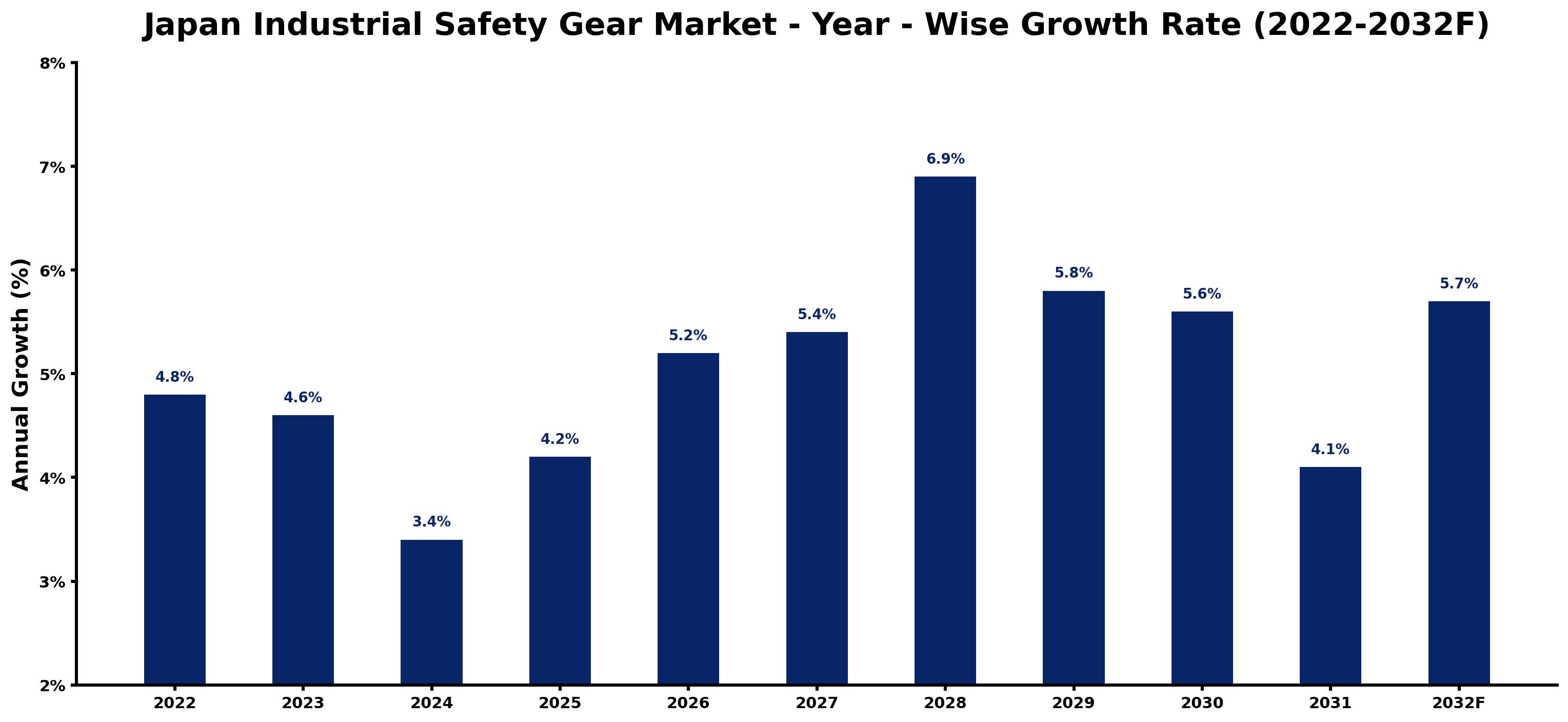
Annual growth estimates for each year appear below with the principal reason behind them, explaining the shifts that set the pace of the market.
| Year | Estimated Annual Growth (%) | Market Rationale |
| 2022 | 4.8 | The market was characterised by steady demand from high-risk industries. |
| 2023 | 4.6 | Growth slowed due to market saturation and increased competition among suppliers. |
| 2024 | 3.4 | Demand continued to slow as buyers adjusted inventory levels. |
| 2025 | 4.2 | An increase in safety regulations led to a rise in gear purchases. |
| 2026 | 5.2 | Demand is expected to surge as companies invest in safety training and compliance. |
| 2027 | 5.4 | Growth will continue as the oil and gas sector expands operations. |
| 2028 | 6.9 | The market is projected to peak due to heightened safety awareness and regulations. |
| 2029 | 5.8 | A slight slowdown is expected as buyers stabilise their safety gear inventories. |
| 2030 | 5.6 | Demand will remain steady as companies maintain safety protocols. |
| 2031 | 4.1 | Growth is projected to slow as the market matures and competition intensifies. |
| 2032 | 5.7 | An increase in workforce numbers in high-risk sectors will boost demand. |
Note: Market size estimations and growth projections presented in this report are based on 6Wresearch's proprietary forecasting methodology, utilizing the latest available industry data, government publications, and primary research inputs.
Japan Industrial Safety Gear Market Synopsis
Industrial safety gear in Japan includes personal protective equipment designed to protect workers from various hazards. The ongoing push for improved workplace safety standards and the government's 'Safety First' initiative are driving demand. The Tokyo region accounts for a substantial share of the market, reflecting concentrated demand in industrial hubs.
Market Dynamics Impact Analysis (2026–2032)
| Factor | Type | Impact | Primary Segment Affected |
| High workforce numbers in hazardous sectors drive demand for safety gear. | Driver | High | Safety Helmets |
| Increased safety regulations require compliance, boosting purchases of protective equipment. | Driver | High | Safety Gloves |
| Growing online sales channels present new opportunities for reaching customers. | Opportunity | Medium | Online Platforms |
| Investment in safety training programs is expanding the market for safety gear. | Opportunity | Medium | Safety Gloves |
| High competition among suppliers may lead to price wars, affecting margins. | Restraint | High | Protective Eyewear |
| Market saturation in certain segments limits growth potential for new entrants. | Restraint | Medium | Flame-Resistant Clothing |
| Rising costs of raw materials can impact pricing strategies for producers. | Challenge | High | Safety Helmets |
| Compliance with evolving safety regulations may strain smaller manufacturers. | Challenge | Medium | Safety Gloves |
Evaluation of Drivers in Japan Industrial Safety Gear Market (2026–2032)
The table below links each growth driver to the segment it affects and the evidence for it.
| Drivers | Primary Segment Affected | Why It Matters (Evidence) |
| High workforce numbers in hazardous sectors drive demand for safety gear. | Safety Helmets | With over 300,000 workers in the oil and gas industry, the need for head protection is critical. |
| Increased safety regulations require compliance, boosting purchases of protective equipment. | Safety Gloves | The implementation of ISO 45001 has heightened the need for compliant safety gear. |
| Investment in safety training programs expands the market for safety gear. | Flame-Resistant Clothing | The government allocated ¥5 billion for safety training in hazardous industries, increasing demand. |
| Rising awareness of workplace safety standards drives gear purchases. | Protective Eyewear | The Chemical Safety Association's initiatives promote the use of protective eyewear in chemical plants. |
| Online sales channels are expanding, reaching new customer bases. | Online Platforms | Online sales of safety gear have increased by 15% year-on-year since 2020. |
Buyers are adding capacity as demand for industrial safety gear rises, particularly in the oil and gas sector, which employs over 300,000 workers. Awareness of workplace safety standards is stimulating purchases of protective eyewear in chemical plants. Online sales channels are expanding, allowing suppliers to reach a broader customer base.
Evaluation of Restraints in Japan Industrial Safety Gear Market
Several factors work against faster growth; the main ones are summarised below.
| Market Restraint | Primary Segment Affected | Why It Matters (Evidence) |
| High competition among suppliers may lead to price wars, affecting margins. | Protective Eyewear | With numerous suppliers in the market, price competition can reduce profit margins. |
| Market saturation in certain segments limits growth potential for new entrants. | Flame-Resistant Clothing | Established brands dominate the flame-resistant clothing market, making entry challenging. |
| Rising costs of raw materials can impact pricing strategies for producers. | Safety Helmets | Increased costs of materials like polycarbonate can lead to higher retail prices. |
| Compliance with evolving safety regulations may strain smaller manufacturers. | Safety Gloves | Smaller manufacturers may struggle to meet the stringent requirements set by regulations. |
| Economic fluctuations can affect overall spending on safety gear. | Protective Eyewear | Economic downturns may lead companies to cut back on safety gear purchases. |
Japan Industrial Safety Gear Market Challenges
High costs for buyers stem from the need for advanced materials in industrial safety gear, pushing prices up by 20%. Suppliers face challenges with outdated production technology, which can delay deliveries by up to three months for buyers needing immediate supplies. Intense competition among suppliers leads to aggressive pricing, reducing profit margins by 15% and limiting their ability to invest in quality improvements. Skills shortages hinder suppliers' compliance with safety standards, jeopardising the protection of over 7 million workers in high-risk industries.
Trends in the Japan Industrial Safety Gear Market
The trends below show where the Japan Industrial Safety Gear Market is heading.
- Shift from Traditional to Online Sales Channels: The industrial safety gear market is shifting towards online sales, particularly in urban areas like Tokyo. Online sales have risen by 15% year-on-year since 2020, enabling suppliers to reach a wider audience and adapt to changing consumer preferences.
- Transition from Basic to Advanced Protective Equipment: In recent years, there has been a transition towards more advanced protective equipment in the oil and gas sector. This shift began in 2021 as companies invested in higher-quality gear to improve worker safety, reflecting a growing commitment to safety standards.
- Emergence of Sustainability in Safety Gear Production: Sustainability is becoming a priority in the production of safety gear, with manufacturers exploring eco-friendly materials. This trend started gaining traction in 2023, influenced by Japan's commitment to reducing greenhouse gas emissions by 46% by 2030.
- Increased Focus on Training and Compliance: The focus on training and compliance has intensified, particularly in hazardous industries. The government's 'Safety First' initiative, launched in 2021, has prompted companies to invest more in safety training programs, improving overall workplace safety.
Investment Opportunities in the Japan Industrial Safety Gear Market
Where to invest in the Japan Industrial Safety Gear Market: the main openings are set out below.
- Partnership with Local Distributors: Forming partnerships with local distributors can help suppliers penetrate the market effectively. Targeting industrial suppliers in regions like Osaka can facilitate access to key buyer groups, especially with the market projected to grow significantly.
- Investment in Online Platforms: The online sales channel, which has grown by 15% year-on-year, presents a timely opportunity. Suppliers can invest in e-commerce platforms to reach a broader audience, particularly in urban areas where demand is increasing.
- Focus on Eco-Friendly Materials: With the growing emphasis on sustainability, investing in eco-friendly materials for safety gear is timely. Buyers in the oil and gas sector are increasingly seeking sustainable options to meet regulatory standards.
- Expansion of Safety Training Programs: The government’s allocation of ¥5 billion for safety training programs creates an opportunity for suppliers to offer training solutions. Collaborating with training facilities can enhance market presence and meet compliance demands.
Government Initiatives in the Japan Industrial Safety Gear Market
The GX Promotion Act (2023) establishes a framework for decarbonisation efforts in Japan, mandating safety gear producers to adopt sustainable practices. This law complements the Industrial Safety and Health Act (1972), which sets employer duties regarding hazardous substances and machinery, ensuring a safer work environment.
The Chemical Safety Association oversees compliance with safety regulations in chemical plants, ensuring that workers are equipped with necessary protective gear. This agency supports safety training initiatives, ensuring that workers in hazardous industries are knowledgeable about safety protocols.
Future Insight of the Japan Industrial Safety Gear Market
Workers in high-risk industries will benefit from improved industrial safety gear by 2032, driven by advancements in materials and manufacturing techniques. New safety standards will enhance compliance and awareness among buyers, promoting a culture of safety. Increased government funding for safety training programs will elevate workforce skills, ensuring effective use of protective equipment. Online sales are expected to reach 1.5 million pairs of safety gloves annually, expanding access to essential gear across various sectors.
Market Segmentation Analysis
Japan Industrial Safety Gear Market report covers a detailed analysis of the following market segments:
By Product Type – Safety Helmets Lead, Safety Gloves Expected to Grow Fastest
According to Saurav Kr Singh, Senior Research Analyst at 6Wresearch, the largest product type category in 2025 was Safety Helmets, at 49% of revenue. Safety helmets are vital for head protection in hazardous environments, making them the largest share in Japan's market. Their significance is highlighted by the over 7 million workers in high-risk industries who rely on them for safety. Safety Gloves are set to record the highest CAGR in this split, 7.6% over 2026–2032. The rapid growth of safety gloves is driven by their essential function in protecting hands against chemicals and abrasions, particularly in the oil and gas sector. In 2022, demand for safety gloves reached approximately 1.5 million pairs annually, showcasing their increasing importance. Suppliers should prioritise expanding their safety glove offerings to meet the increasing market demand.
By Material Type – Polycarbonate Leads, Nitrile / Latex Expected to Grow Fastest
Polycarbonate held 40% of the Japan Industrial Safety Gear Market by material type in 2025. Polycarbonate leads the material segment due to its widespread application for strength and impact resistance, making it ideal for protective eyewear. Its effectiveness is vital for ensuring worker safety in various hazardous environments across Japan. The quickest growth will come from Nitrile / Latex, forecast to expand at a CAGR of 8.2% between 2026 and 2032. Nitrile and latex materials are rapidly growing in popularity as they are favoured for gloves due to their flexibility and durability. Their increasing use in chemical plants is further driving this segment's growth. Buyers should consider sourcing nitrile and latex gloves to align with evolving safety requirements in their industries.
By End User – Oil & Gas Industry Leads, Chemical Plants Expected to Grow Fastest
With 44% of end user revenue in 2025, Oil & Gas Industry was the largest category. The oil and gas industry stands out as the primary end user of safety gear due to the high-risk nature of its operations. With around 300,000 workers needing safety equipment, this sector significantly influences market trends. Over 2026–2032, Chemical Plants are expected to post the fastest growth, at a CAGR of 7.1%. Chemical plants are experiencing the fastest growth as end users, driven by their considerable need for extensive safety equipment to ensure worker protection. The sector's focus on safety compliance is prompting increased investments in protective gear. Suppliers should focus on targeting chemical plants to capitalise on the rising demand for safety equipment in this sector.
By Distribution Channel – Industrial Suppliers Lead, Online Platforms Expected to Grow Fastest
Industrial Suppliers accounted for 50% of the market by distribution channel in 2025. Industrial suppliers serve as the main channel for distributing safety gear, acting as a crucial link to customers in high-risk industries. Their established networks and expertise in safety gear distribution facilitate effective market penetration. Online Platforms are projected to grow fastest, at a CAGR of 7.0% during 2026–2032. Online platforms are rapidly becoming a preferred distribution channel, reflecting a shift in purchasing behaviour among buyers seeking convenience. The 15% year-on-year growth in online sales since 2020 underscores this trend. Suppliers must enhance their online presence to effectively engage with a growing customer base that prefers digital purchasing.
Key Attractiveness of the Report
- 10 Years of Market Numbers
- Historical Data Starting from 2022 to 2025
- Base Year 2025
- Forecast Data until 2032
- Key Performance Indicators Impacting the Market
- Major Upcoming Developments and Projects
Key Highlights of the Report:
- Japan Industrial Safety Gear Market Outlook
- Market Size of Japan Industrial Safety Gear Market, 2025
- Forecast of Japan Industrial Safety Gear Market, 2032
- Historical Data and Forecast of Japan Industrial Safety Gear Revenues & Volume for the Period 2022-2032F
- Japan Industrial Safety Gear Market Trend Evolution
- Japan Industrial Safety Gear Market Drivers and Challenges
- Japan Industrial Safety Gear Price Trends
- Japan Industrial Safety Gear Porter's Five Forces
- Japan Industrial Safety Gear Industry Life Cycle
- Historical Data and Forecast of Japan Industrial Safety Gear Market Revenues & Volume By Product Type for the Period 2022-2032F
- Historical Data and Forecast of Japan Industrial Safety Gear Market Revenues & Volume By Safety Helmets for the Period 2022-2032F
- Historical Data and Forecast of Japan Industrial Safety Gear Market Revenues & Volume By Safety Gloves for the Period 2022-2032F
- Historical Data and Forecast of Japan Industrial Safety Gear Market Revenues & Volume By Protective Eyewear for the Period 2022-2032F
- Historical Data and Forecast of Japan Industrial Safety Gear Market Revenues & Volume By Flame-Resistant Clothing for the Period 2022-2032F
- Historical Data and Forecast of Japan Industrial Safety Gear Market Revenues & Volume By Material Type for the Period 2022-2032F
- Historical Data and Forecast of Japan Industrial Safety Gear Market Revenues & Volume By Polycarbonate for the Period 2022-2032F
- Historical Data and Forecast of Japan Industrial Safety Gear Market Revenues & Volume By Nitrile / Latex for the Period 2022-2032F
- Historical Data and Forecast of Japan Industrial Safety Gear Market Revenues & Volume By Acrylic / Polycarbonate for the Period 2022-2032F
- Historical Data and Forecast of Japan Industrial Safety Gear Market Revenues & Volume By Aramid Fibers for the Period 2022-2032F
- Historical Data and Forecast of Japan Industrial Safety Gear Market Revenues & Volume By End User for the Period 2022-2032F
- Historical Data and Forecast of Japan Industrial Safety Gear Market Revenues & Volume By Oil & Gas Industry for the Period 2022-2032F
- Historical Data and Forecast of Japan Industrial Safety Gear Market Revenues & Volume By Chemical Plants for the Period 2022-2032F
- Historical Data and Forecast of Japan Industrial Safety Gear Market Revenues & Volume By Power Utilities for the Period 2022-2032F
- Historical Data and Forecast of Japan Industrial Safety Gear Market Revenues & Volume By Mining Industry for the Period 2022-2032F
- Historical Data and Forecast of Japan Industrial Safety Gear Market Revenues & Volume By Distribution Channel for the Period 2022-2032F
- Historical Data and Forecast of Japan Industrial Safety Gear Market Revenues & Volume By Industrial Suppliers for the Period 2022-2032F
- Historical Data and Forecast of Japan Industrial Safety Gear Market Revenues & Volume By Online Platforms for the Period 2022-2032F
- Historical Data and Forecast of Japan Industrial Safety Gear Market Revenues & Volume By Safety Gear Retailers for the Period 2022-2032F
- Historical Data and Forecast of Japan Industrial Safety Gear Market Revenues & Volume By Direct Sales for the Period 2022-2032F
- Japan Industrial Safety Gear Import Export Trade Statistics
- Market Opportunity Assessment By Product Type
- Market Opportunity Assessment By Material Type
- Market Opportunity Assessment By End User
- Market Opportunity Assessment By Distribution Channel
- Japan Industrial Safety Gear Top Companies Market Share
- Japan Industrial Safety Gear Competitive Benchmarking By Technical and Operational Parameters
- Japan Industrial Safety Gear Company Profiles
- Japan Industrial Safety Gear Key Strategic Recommendations
Market Covered
Segments analysed in this report are listed below.
By Product Type
- Safety Helmets
- Safety Gloves
- Protective Eyewear
- Flame-Resistant Clothing
By Material Type
- Polycarbonate
- Nitrile / Latex
- Acrylic / Polycarbonate
- Aramid Fibers
By End User
- Oil & Gas Industry
- Chemical Plants
- Power Utilities
- Mining Industry
By Distribution Channel
- Industrial Suppliers
- Online Platforms
- Safety Gear Retailers
- Direct Sales































