Japan Industrial Saw Blades Market Size & Growth Rate
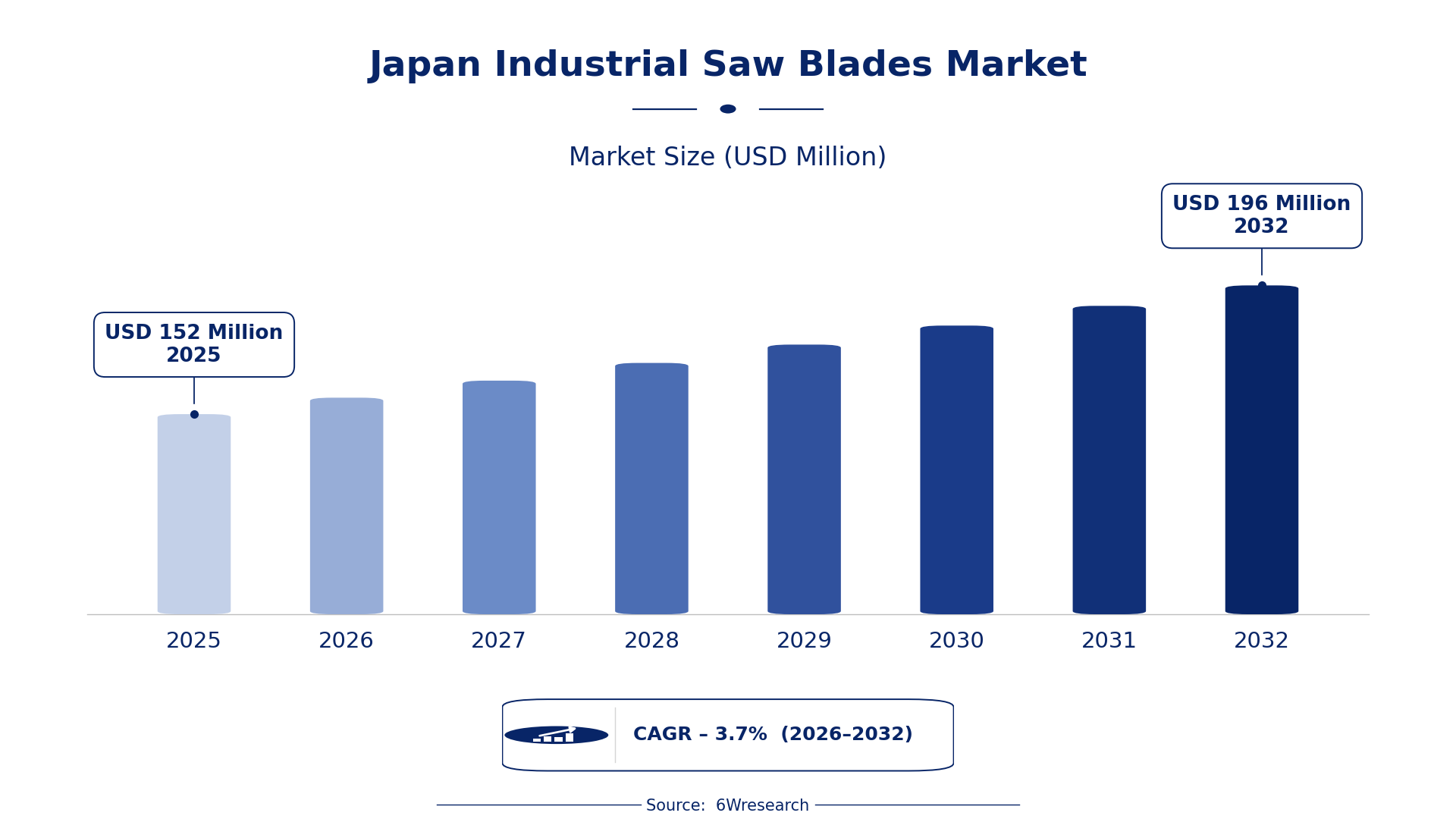
According to 6Wresearch internal database and industry insights, the Japan Industrial Saw Blades Market was valued at USD 152 Million in 2025 and is projected to reach USD 196 Million by 2032, growing at a CAGR of approximately 3.7% during 2026–2032.
Japan Industrial Saw Blades Market Highlights
| Report Metric | Details |
| Report Name | Japan Industrial Saw Blades Market (2026-2032) |
| Market Size 2025 | USD 152 Million |
| Market Size 2032 | USD 196 Million |
| Absolute Growth 2025–2032 | USD 44 Million |
| CAGR 2026–2032 | 3.7% |
| Peak Annual Growth | 4.5% in 2032 |
| Forecast Period | 2026–2032 |
| Historical Data | 2022–2025 |
| Base Year | 2025 |
| Leading Product Type, 2025 | Circular Saw Blades (39% share) |
| Leading Blade Material, 2025 | Tungsten Carbide (36% share) |
| Leading End Use Application, 2025 | Metal Fabrication (46% share) |
| Leading Distribution Channel, 2025 | OEM Distribution (46% share) |
| Fastest-Growing Product Type | Diamond Saw Blades (5.1% CAGR) |
| Fastest-Growing Blade Material | Bi-Metal (5.5% CAGR) |
| Fastest-Growing End Use Application | Stone Cutting (4.7% CAGR) |
| Fastest-Growing Distribution Channel | Online Retailers (4.8% CAGR) |
| Growing Sector | Construction |
| Key End Users | Metal Fabricators, Wood Processors, Construction Companies |
Japan Industrial Saw Blades Market Year-wise Growth Rate and Key Drivers (2022–2032)
This graph illustrates the annual growth rates of the market from 2022 to 2032, highlighting a steady upward trajectory and projected market expansion over the forecast period.
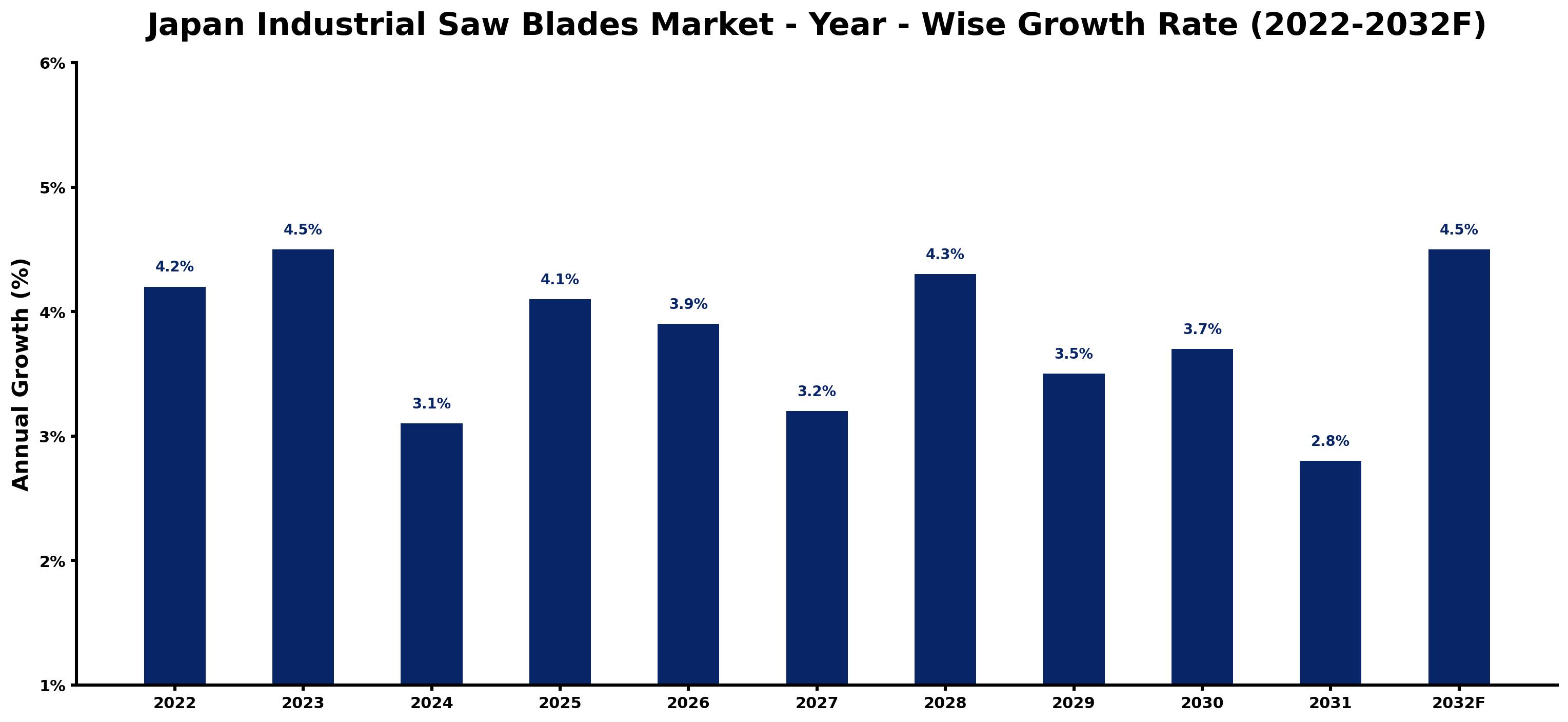
For each year, the table pairs the estimated growth rate with the leading influence on demand, showing how the drivers changed across the period.
| Year | Estimated Annual Growth (%) | Market Rationale |
| 2022 | 4.2 | Demand remained steady, supported by ongoing industrial activities in Japan. |
| 2023 | 4.5 | Growth accelerated due to increased investments in manufacturing technologies. |
| 2024 | 3.1 | A slowdown occurred as market adjustments took place amid changing demand patterns. |
| 2025 | 4.1 | Growth resumed with rising orders from the metal fabrication sector. |
| 2026 | 3.9 | Market growth is projected to slow as manufacturers face supply chain challenges. |
| 2027 | 3.2 | Demand will continue to grow, albeit at a slower pace than previous years. |
| 2028 | 4.3 | Increased construction activities will lead to a rebound in saw blade purchases. |
| 2029 | 3.5 | Growth is expected to decelerate as competition intensifies in the saw blade market. |
| 2030 | 3.7 | Demand will improve with new projects in the construction sector. |
| 2031 | 2.8 | A slowdown in growth is anticipated as market saturation approaches. |
| 2032 | 4.5 | Growth will peak again due to renewed investments in advanced manufacturing. |
Note: Market size estimations and growth projections presented in this report are based on 6Wresearch's proprietary forecasting methodology, utilizing the latest available industry data, government publications, and primary research inputs.
Japan Industrial Saw Blades Market Synopsis
Industrial saw blades are cutting tools used in various manufacturing processes, primarily made from tungsten carbide and high-speed steel. The Japan Industrial Saw Blades Market is expanding, driven by strong demand from metal fabrication and woodworking industries, particularly in the Tokyo and Tohoku regions. Investment in advanced manufacturing technologies is projected to stimulate growth, alongside a notable increase in construction activities, which is boosting demand for diamond saw blades.
Market Dynamics Impact Analysis (2026–2032)
| Factor | Type | Impact | Primary Segment Affected |
| Strong demand from the metal fabrication sector | Driver | High | Metal Fabrication |
| Investment in advanced manufacturing technologies | Driver | High | Diamond Saw Blades |
| Growing urban construction projects | Opportunity | High | Diamond Saw Blades |
| Expansion of online retail channels | Opportunity | Medium | Online Retailers |
| Supply chain disruptions affecting production | Restraint | High | Circular Saw Blades |
| Competition from low-cost imports | Restraint | Medium | Circular Saw Blades |
| Limited domestic production capacity | Challenge | High | Circular Saw Blades |
| Technological advancements requiring constant upgrades | Challenge | Medium | Circular Saw Blades |
Evaluation of Drivers in Japan Industrial Saw Blades Market (2026–2032)
These are the developments adding the most demand over the forecast period.
| Drivers | Primary Segment Affected | Why It Matters (Evidence) |
| Increased orders from the metal fabrication sector | Metal Fabrication | In 2023, this sector accounted for 46% of saw blade applications, driving higher sales. |
| Rising demand for diamond saw blades | Diamond Saw Blades | The urban construction boom led to a notable increase in demand for these blades in 2023. |
| Adoption of advanced manufacturing technologies | Tungsten Carbide | Investment in technology under the Society 5.0 initiative is improving production efficiency. |
| Growing interest in online retail channels | Online Retailers | Online sales are projected to grow annually as consumer preferences shift. |
| Increased focus on energy efficiency | High-Speed Steel | Energy efficiency regulations are prompting manufacturers to adopt more efficient cutting tools. |
Several shifts outside the market lift sales. Demand from the metal fabrication sector remains strong, accounting for 46% of saw blade applications in 2023, which boosts purchases. Urban construction projects have surged, leading to a notable increase in diamond saw blade sales. Investment in advanced manufacturing technologies is improving production efficiency, particularly for tungsten carbide blades. The growing trend towards online retail channels is also noteworthy, reflecting changing consumer preferences.
Evaluation of Restraints in Japan Industrial Saw Blades Market
These are the pressures that could keep growth below its potential.
| Market Restraint | Primary Segment Affected | Why It Matters (Evidence) |
| Supply chain disruptions affecting production timelines | Circular Saw Blades | In 2023, 40% of manufacturers reported delays in sourcing materials. |
| Competition from low-cost imports impacting pricing | Circular Saw Blades | Around 25% of saw blades in Japan are imported, affecting local manufacturers. |
| Limited domestic production capacity due to workforce shortages | Circular Saw Blades | Approximately 15% of saw blade manufacturers reported difficulties in hiring skilled workers. |
| Technological advancements requiring constant upgrades | Circular Saw Blades | Manufacturers must invest in new technologies, raising operational costs. |
| Regulatory compliance costs for quality standards | Circular Saw Blades | Compliance with Japan Industrial Standards (JIS) can increase production costs by 10%. |
Japan Industrial Saw Blades Market Challenges
Producers face challenges due to strict regulations set by the Japan Industrial Standards, which require compliance with quality benchmarks, leading to production delays and increasing costs by 15% for manufacturers. A shortage of skilled workers in advanced manufacturing processes hampers production efficiency, extending lead times for suppliers and resulting in potential revenue losses of approximately JPY 10 billion annually. Intense competition from both domestic and international manufacturers pressures local producers, risking a 20% decline in profitability. Buyers experience fluctuating demand driven by construction cycles, complicating inventory management and potentially raising holding costs by 25%.
Trends in the Japan Industrial Saw Blades Market
Buyers and suppliers in the Japan Industrial Saw Blades Market are adjusting to the following trends.
- Shift from Traditional to Advanced Manufacturing: Manufacturers began adopting advanced technologies in 2023 to improve production efficiency. The Society 5.0 initiative is driving this change, with investments expected to reach JPY 150 trillion over the next decade.
- Transition from Direct Sales to Online Retail: The trend towards online retail channels has gained momentum since 2023, with sales projected to grow annually. This shift allows manufacturers to reach a broader audience and adapt to changing consumer preferences.
- Emergence of Eco-Friendly Cutting Tools: The demand for eco-friendly saw blades is rising, driven by Japan's commitment to reducing greenhouse gas emissions by 46% by 2030. Manufacturers are increasingly focusing on sustainable materials and production processes.
- Prioritisation of Diamond Saw Blades in Construction: The construction boom in urban areas has prioritised diamond saw blades since 2023, with demand increasing significantly. This trend reflects the need for durable tools capable of handling hard materials.
Investment Opportunities in the Japan Industrial Saw Blades Market
Below are the investment opportunities with the strongest case in the Japan Industrial Saw Blades Market.
- Tokyo Region's Construction Boom: The Tokyo region is experiencing a construction boom, with a projected demand increase for diamond saw blades. Suppliers can enter this market by partnering with local distributors.
- Investment in Advanced Manufacturing Technologies: With JPY 150 trillion earmarked for decarbonisation investments, there is an opportunity to supply advanced saw blades. Manufacturers in the metal fabrication sector are particularly well-positioned to benefit.
- Growing Demand for Online Retail Solutions: As online retail channels expand, there is a gap for suppliers to provide saw blades through e-commerce platforms. Collaborating with online retailers can facilitate market entry.
- Tohoku Region's Wood Processing Industry: The Tohoku region has a strong wood processing industry, creating a demand for high-speed steel saw blades. Suppliers should consider local partnerships to tap into this market.
Government Initiatives in the Japan Industrial Saw Blades Market
The GX Promotion Act (2023) sets a framework for energy efficiency improvements, impacting saw blade manufacturers as they must comply with regulations that can raise operational costs. The Industrial Safety and Health Act ensures that manufacturers adhere to safety standards, which can affect production practices. Compliance with these laws is essential for maintaining competitiveness in the market.
The Japan Cutting Tool Manufacturers Association oversees the implementation of quality standards and supports manufacturers through various initiatives. Their funding for technology upgrades has reached JPY 50 billion, benefiting saw blade producers by improving their production capabilities and ensuring compliance with safety and quality standards.
Future Insight of the Japan Industrial Saw Blades Market
Investment in advanced manufacturing technologies will reshape the demand for industrial saw blades by 2032, driven by the need for efficiency. Anticipated public and private decarbonisation investments of JPY 150 trillion will likely increase the need for high-performance cutting tools. New standards from the Japan Cutting Tool Manufacturers Association will enhance product quality, benefiting both buyers and suppliers. As urban construction continues to grow, the demand for precision saw blades will rise, creating new opportunities for producers in the evolving market.
Market Segmentation Analysis
Japan Industrial Saw Blades Market report covers a detailed analysis of the following market segments:
By Product Type – Circular Saw Blades Lead, Diamond Saw Blades Expected to Grow Fastest
According to Saurav Kr Singh, Senior Research Analyst at 6Wresearch, Circular Saw Blades took 39% of product type revenue in 2025, more than any other category. Circular saw blades command the largest share due to their extensive use in wood and metal cutting applications, which are vital for various manufacturing processes. Their reliability is particularly valued in regions like Tokyo, a significant hub for both metal fabrication and woodworking industries. Diamond Saw Blades are set to record the highest CAGR in this split, 5.1% over 2026–2032. The increasing demand for diamond saw blades is propelled by the ongoing construction boom in urban areas, where cutting hard materials like concrete is essential. This trend is reflected in the rising number of construction projects across major cities. Suppliers should focus on expanding their offerings of diamond saw blades to capitalise on the growth within the construction sector.
By Blade Material – Tungsten Carbide Leads, Bi-Metal Expected to Grow Fastest
Tungsten Carbide accounted for 36% of the market by blade material in 2025. Tungsten carbide leads the market as it provides exceptional durability and longevity, making it ideal for heavy-duty applications in various industries. Its widespread use in sectors that require robust cutting tools, such as metal fabrication, reinforces its dominant position. The quickest growth will come from Bi-Metal, forecast to expand at a CAGR of 5.5% between 2026 and 2032. The rapid growth of bi-metal saw blades is attributed to their unique combination of flexibility and strength, which allows for versatile cutting across different materials. This adaptability is increasingly favoured in a competitive manufacturing environment. Manufacturers should consider investing in bi-metal technology to meet the diverse demands of modern cutting applications.
By End Use Application – Metal Fabrication Leads, Stone Cutting Expected to Grow Fastest
With 46% of end use application revenue in 2025, Metal Fabrication was the largest category. Metal fabrication is the foremost application area for industrial saw blades, bolstered by Japan's robust manufacturing sector. This segment consistently requires precision cutting tools across a range of industrial processes, ensuring steady demand. Over 2026–2032, Stone Cutting is expected to post the fastest growth, at a CAGR of 4.7%. The stone cutting segment is expanding rapidly, driven by its essential role in the construction and stone industries, where high-quality cutting tools are crucial. The growth of infrastructure projects further fuels this demand. Suppliers should enhance their product lines to satisfy the increasing requirements of the stone cutting market.
By Distribution Channel – OEM Distribution Leads, Online Retailers Expected to Grow Fastest
The largest distribution channel category in 2025 was OEM Distribution, at 46% of revenue. OEM distribution serves as the primary channel for supplying manufacturers, ensuring the efficient delivery of industrial saw blades to production facilities. This channel is essential for maintaining the supply chain within the manufacturing sector. Online Retailers are projected to grow fastest, at a CAGR of 4.8% during 2026–2032. Online retailers are witnessing the fastest growth as consumers increasingly favour digital platforms for purchasing cutting tools, indicating a shift in buying behaviours. This trend is particularly pronounced among smaller businesses and independent contractors. Companies should strengthen their online presence to capture the growing consumer base that prefers shopping through digital channels.
Key Attractiveness of the Report
- 10 Years of Market Numbers
- Historical Data Starting from 2022 to 2025
- Base Year 2025
- Forecast Data until 2032
- Key Performance Indicators Impacting the Market
- Major Upcoming Developments and Projects
Key Highlights of the Report:
- Japan Industrial Saw Blades Market Outlook
- Market Size of Japan Industrial Saw Blades Market, 2025
- Forecast of Japan Industrial Saw Blades Market, 2032
- Historical Data and Forecast of Japan Industrial Saw Blades Revenues & Volume for the Period 2022-2032F
- Japan Industrial Saw Blades Market Trend Evolution
- Japan Industrial Saw Blades Market Drivers and Challenges
- Japan Industrial Saw Blades Price Trends
- Japan Industrial Saw Blades Porter's Five Forces
- Japan Industrial Saw Blades Industry Life Cycle
- Historical Data and Forecast of Japan Industrial Saw Blades Market Revenues & Volume By Product Type for the Period 2022-2032F
- Historical Data and Forecast of Japan Industrial Saw Blades Market Revenues & Volume By Circular Saw Blades for the Period 2022-2032F
- Historical Data and Forecast of Japan Industrial Saw Blades Market Revenues & Volume By Band Saw Blades for the Period 2022-2032F
- Historical Data and Forecast of Japan Industrial Saw Blades Market Revenues & Volume By Diamond Saw Blades for the Period 2022-2032F
- Historical Data and Forecast of Japan Industrial Saw Blades Market Revenues & Volume By Reciprocating Saw Blades for the Period 2022-2032F
- Historical Data and Forecast of Japan Industrial Saw Blades Market Revenues & Volume By Blade Material for the Period 2022-2032F
- Historical Data and Forecast of Japan Industrial Saw Blades Market Revenues & Volume By Tungsten Carbide for the Period 2022-2032F
- Historical Data and Forecast of Japan Industrial Saw Blades Market Revenues & Volume By High-Speed Steel for the Period 2022-2032F
- Historical Data and Forecast of Japan Industrial Saw Blades Market Revenues & Volume By Industrial Diamond for the Period 2022-2032F
- Historical Data and Forecast of Japan Industrial Saw Blades Market Revenues & Volume By Bi-Metal for the Period 2022-2032F
- Historical Data and Forecast of Japan Industrial Saw Blades Market Revenues & Volume By End Use Application for the Period 2022-2032F
- Historical Data and Forecast of Japan Industrial Saw Blades Market Revenues & Volume By Metal Fabrication for the Period 2022-2032F
- Historical Data and Forecast of Japan Industrial Saw Blades Market Revenues & Volume By Wood Processing for the Period 2022-2032F
- Historical Data and Forecast of Japan Industrial Saw Blades Market Revenues & Volume By Stone Cutting for the Period 2022-2032F
- Historical Data and Forecast of Japan Industrial Saw Blades Market Revenues & Volume By Demolition Operations for the Period 2022-2032F
- Historical Data and Forecast of Japan Industrial Saw Blades Market Revenues & Volume By Distribution Channel for the Period 2022-2032F
- Historical Data and Forecast of Japan Industrial Saw Blades Market Revenues & Volume By OEM Distribution for the Period 2022-2032F
- Historical Data and Forecast of Japan Industrial Saw Blades Market Revenues & Volume By Direct Sales for the Period 2022-2032F
- Historical Data and Forecast of Japan Industrial Saw Blades Market Revenues & Volume By Online Retailers for the Period 2022-2032F
- Historical Data and Forecast of Japan Industrial Saw Blades Market Revenues & Volume By Hardware Distributors for the Period 2022-2032F
- Japan Industrial Saw Blades Import Export Trade Statistics
- Market Opportunity Assessment By Product Type
- Market Opportunity Assessment By Blade Material
- Market Opportunity Assessment By End Use Application
- Market Opportunity Assessment By Distribution Channel
- Japan Industrial Saw Blades Top Companies Market Share
- Japan Industrial Saw Blades Competitive Benchmarking By Technical and Operational Parameters
- Japan Industrial Saw Blades Company Profiles
- Japan Industrial Saw Blades Key Strategic Recommendations
Market Covered
Segments analysed in this report are listed below.
By Product Type
- Circular Saw Blades
- Band Saw Blades
- Diamond Saw Blades
- Reciprocating Saw Blades
By Blade Material
- Tungsten Carbide
- High-Speed Steel
- Industrial Diamond
- Bi-Metal
By End Use Application
- Metal Fabrication
- Wood Processing
- Stone Cutting
- Demolition Operations
By Distribution Channel
- OEM Distribution
- Direct Sales
- Online Retailers
- Hardware Distributors































