Japan Industrial Scrap Recycling Market Size & Growth Rate
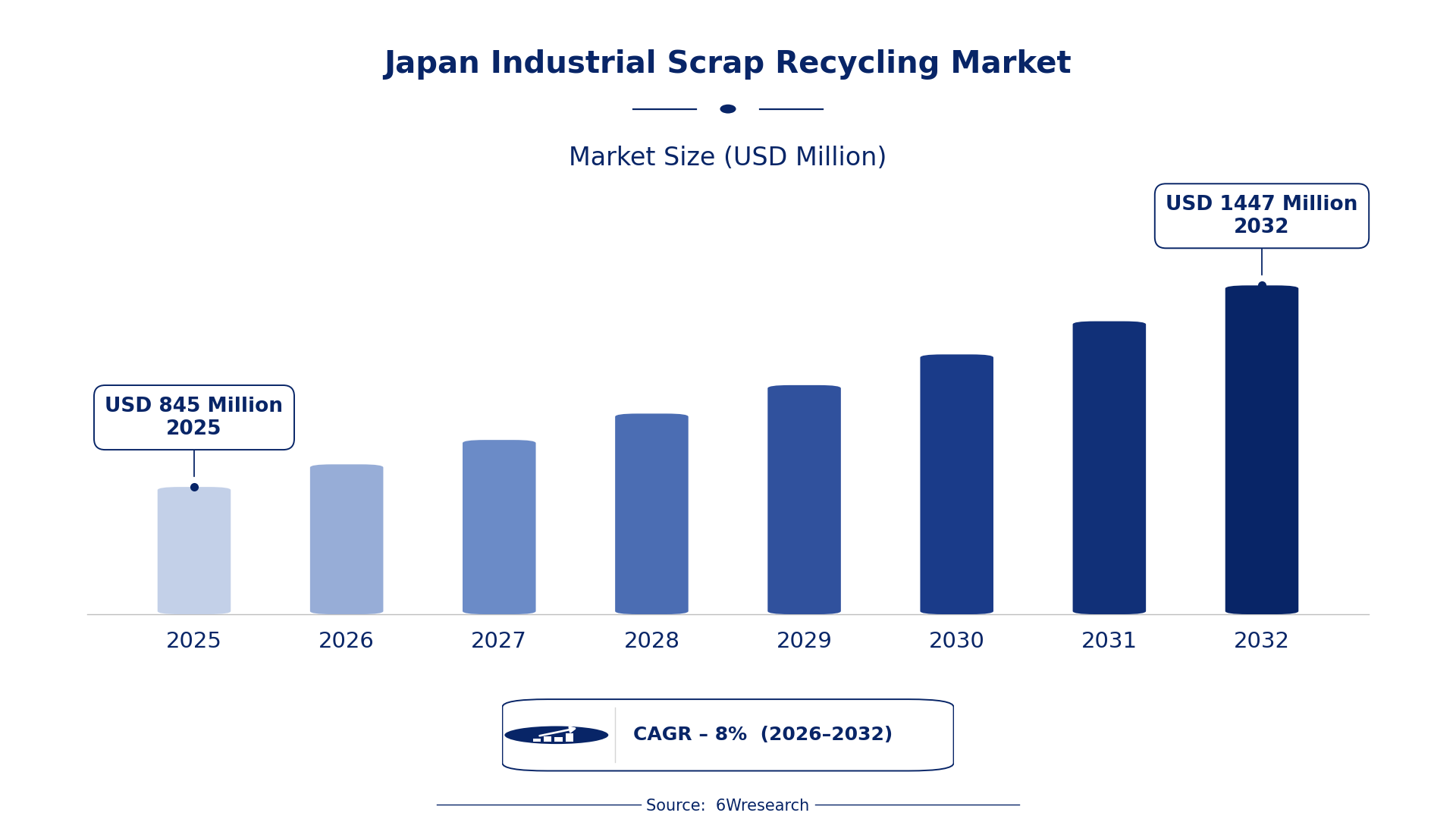
According to 6Wresearch internal database and industry insights, the Japan Industrial Scrap Recycling Market was valued at USD 845 Million in 2025 and is projected to reach USD 1,447 Million by 2032, growing at a CAGR of approximately 8% during 2026–2032.
Japan Industrial Scrap Recycling Market Highlights
| Report Metric | Details |
| Report Name | Japan Industrial Scrap Recycling Market (2026-2032) |
| Market Size 2025 | USD 845 Million |
| Market Size 2032 | USD 1,447 Million |
| Absolute Growth 2025–2032 | USD 602 Million |
| CAGR 2026–2032 | 8% |
| Peak Annual Growth | 8.5% in 2032 |
| Forecast Period | 2026–2032 |
| Historical Data | 2022–2025 |
| Base Year | 2025 |
| Leading Scrap Type, 2025 | Ferrous Scrap (45% share) |
| Leading Process Type, 2025 | Melting & Refining (53% share) |
| Leading End Use Industry, 2025 | Steel Manufacturing (41% share) |
| Leading Distribution Channel, 2025 | Direct Collection (48% share) |
| Fastest-Growing Scrap Type | E-waste (11.1% CAGR) |
| Fastest-Growing Process Type | Shredding (11.3% CAGR) |
| Fastest-Growing End Use Industry | Electronics Recycling (10.7% CAGR) |
| Fastest-Growing Distribution Channel | Specialized Recyclers (10.4% CAGR) |
| Growing Sector | E-waste Recycling |
| Key End Users | Steel Manufacturers, Aluminum Producers, Electronics Recyclers, Specialized Recyclers |
Japan Industrial Scrap Recycling Market Year-wise Growth Rate and Key Drivers (2022–2032)
This graph illustrates the annual growth rates of the market from 2022 to 2032, highlighting a steady upward trajectory and projected market expansion over the forecast period.
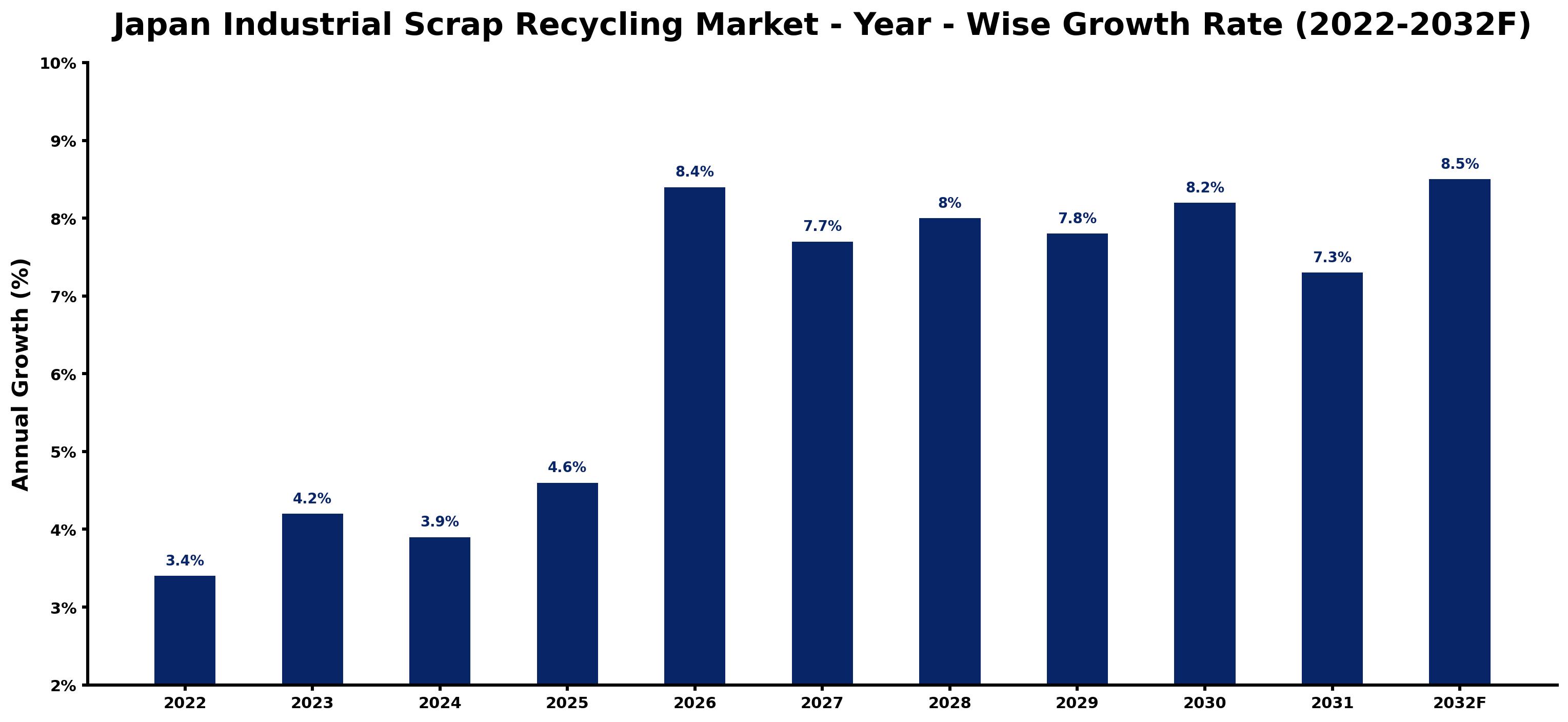
For each year, the table pairs the estimated growth rate with the leading influence on demand, showing how the drivers changed across the period.
| Year | Estimated Annual Growth (%) | Market Rationale |
| 2022 | 3.4 | The market experienced steady growth, driven by strong domestic demand for recycled materials. |
| 2023 | 4.2 | Demand increased as steel manufacturers sought sustainable sourcing for raw materials. |
| 2024 | 3.9 | Growth slowed as market adjustments occurred amid fluctuating raw material prices. |
| 2025 | 4.6 | The market rebounded with increased investments in recycling technologies and infrastructure. |
| 2026 | 8.4 | Demand surged as the steel sector expanded production capabilities and sustainability efforts. |
| 2027 | 7.7 | Growth moderated due to market saturation and increased competition among recyclers. |
| 2028 | 8.0 | The market saw renewed growth as technology advancements improved recycling efficiency. |
| 2029 | 7.8 | Growth decelerated slightly as the market stabilised after a period of rapid expansion. |
| 2030 | 8.2 | Demand rose again as manufacturers focused on achieving decarbonisation targets. |
| 2031 | 7.3 | The market continued to grow, driven by increasing e-waste recycling initiatives. |
| 2032 | 8.5 | The market peaked as investments in recycling technologies reached new heights. |
Note: Market size estimations and growth projections presented in this report are based on 6Wresearch's proprietary forecasting methodology, utilizing the latest available industry data, government publications, and primary research inputs.
Japan Industrial Scrap Recycling Market Synopsis
Industrial scrap recycling involves recovering and processing materials like metals and electronics to create new products. The Japan Industrial Scrap Recycling Market is projected to grow, driven by the steel manufacturing sector's demand for ferrous scrap, which accounted for 83 million tons in 2022. The government's commitment to decarbonisation, targeting JPY 150 trillion in investments over ten years, along with advancements in recycling technologies, will further stimulate market growth.
Market Dynamics Impact Analysis (2026–2032)
| Factor | Type | Impact | Primary Segment Affected |
| Rising demand for recycled materials from steel manufacturers | Driver | High | Ferrous Scrap |
| Technological advancements in recycling processes | Driver | High | Melting & Refining |
| Growing e-waste generation and recycling efforts | Opportunity | High | E-waste |
| Increased investment in recycling infrastructure and facilities | Opportunity | Medium | Specialized Recyclers |
| Fluctuating raw material prices affecting profitability | Restraint | High | Non-Ferrous Scrap |
| Limited applications for rubber scrap in manufacturing | Restraint | Medium | Rubber Scrap |
| High operational costs for recycling facilities | Challenge | High | Shredding |
| Intense competition among recyclers leading to price wars | Challenge | Medium | Direct Collection |
Evaluation of Drivers in Japan Industrial Scrap Recycling Market (2026–2032)
The main growth drivers and the segments they affect most are set out below.
| Drivers | Primary Segment Affected | Why It Matters (Evidence) |
| Increased demand for ferrous scrap from steel manufacturers | Ferrous Scrap | Japan's steel production reached 83 million tons in 2022, driving the need for recycled materials. |
| Technological advancements in recycling processes | Melting & Refining | The average recycling rate for ferrous scrap in Japan is around 90%, improving recovery efficiency. |
| Rising e-waste generation requiring effective recycling solutions | E-waste | Japan generated about 2.4 million tons of e-waste in 2022, necessitating improved recycling practices. |
| Growing focus on sustainability in manufacturing | Non-Ferrous Scrap | Aluminum production in Japan was approximately 1.2 million tons in 2022, relying on non-ferrous scrap. |
| Government initiatives promoting recycling standards | Shredding | The Japan Scrap Recycling Industry Association supports recycling standards to improve operational practices. |
Most of the extra volume comes from the steel manufacturing sector, which consumed 83 million tons of scrap in 2022, driving demand for ferrous scrap. The focus on sustainability has spurred demand for non-ferrous scrap, with aluminium production relying heavily on recycled materials. E-waste generation reached 2.4 million tons in 2022, increasing the need for effective recycling solutions. Industry associations promote best practices across facilities, enhancing operational efficiency and recovery rates.
Evaluation of Restraints in Japan Industrial Scrap Recycling Market
Several factors work against faster growth; the main ones are summarised below.
| Market Restraint | Primary Segment Affected | Why It Matters (Evidence) |
| Fluctuating raw material prices affecting profitability | Non-Ferrous Scrap | Prices for recycled materials vary, impacting margins for recyclers and manufacturers. |
| Limited applications for rubber scrap in manufacturing | Rubber Scrap | Rubber scrap is primarily used as fuel in cement kilns, restricting its market potential. |
| High operational costs for recycling facilities | Shredding | Maintaining advanced recycling technologies strains facility budgets, with costs rising by 15%. |
| Regulatory compliance costs for recycling operations | Melting & Refining | Strict environmental regulations increase operational expenses and require significant investments. |
| Competition from alternative materials in manufacturing | Ferrous Scrap | Manufacturers may opt for cheaper alternatives, reducing demand for recycled ferrous scrap. |
Japan Industrial Scrap Recycling Market Challenges
Buyers struggle with outdated recycling technologies that hinder efficiency, as many facilities still rely on traditional methods, delaying processing times and increasing operational costs by up to 15%. Fluctuating scrap prices create budget uncertainties for buyers, complicating procurement strategies and potentially leading to increased costs. A shortage of skilled workers in recycling facilities persists, as the industry struggles to attract talent, resulting in project delays and raising training costs by 20% for producers. Competition from emerging markets intensifies, as lower-cost alternatives threaten local recyclers, forcing buyers to rethink sourcing strategies and risking supply disruptions.
Trends in the Japan Industrial Scrap Recycling Market
Buyers and suppliers in the Japan Industrial Scrap Recycling Market are adjusting to the following trends.
- Shift from Landfill to Recycling: Japan is prioritising recycling over landfill disposal, as environmental policies push for higher recycling rates. The government aims to reduce landfill waste by 2025, promoting sustainable waste management practices.
- Emergence of Advanced Recycling Technologies: A program launched in 2023 aims to improve recycling technologies, increasing efficiency across facilities. This shift is expected to raise the recycling rate for ferrous scrap, currently at 90%.
- Growing Focus on E-waste Management: The recycling of e-waste has gained prominence, with Japan generating about 2.4 million tons in 2022. Enhanced recycling efforts are critical for recovering precious metals and reducing environmental impact.
- Increase in Direct Collection Methods: Direct Collection has become the leading distribution channel, holding 48% of the market share in 2025. This method streamlines sourcing and improves efficiency for recyclers.
Investment Opportunities in the Japan Industrial Scrap Recycling Market
The openings below show where demand in the Japan Industrial Scrap Recycling Market is visible and how suppliers can enter.
- Investment in E-waste Recycling Facilities: The e-waste recycling sector presents investment opportunities, with Japan generating 2.4 million tons in 2022. Specialized recyclers can benefit from partnerships with local governments to improve processing capabilities.
- Expansion of Ferrous Scrap Processing Capacity: With Japan's steel production reaching 83 million tons, there is a pressing need for increased ferrous scrap processing capacity. Investments in shredding facilities can meet rising demand from manufacturers.
- Development of Advanced Recycling Technologies: The government has allocated funding to improve recycling technologies, creating opportunities for innovation. Facilities focusing on Melting & Refining can utilise these advancements for better efficiency.
- Growth in Specialized Recycling Services: Specialized recyclers are expected to grow, with a projected increase through 2032. Collaborating with industry associations can help these businesses establish best practices and standards.
Government Initiatives in the Japan Industrial Scrap Recycling Market
The Waste Management and Public Cleansing Act (1970) ensures recycling facilities adhere to environmental standards, requiring producers to report and certify their recycling processes. This law promotes accountability in the industry and supports sustainable practices. The GX Promotion Act (2023) provides a framework for green technology development, enabling buyers to access funding for upgrading recycling facilities and improving operational efficiency.
The Ministry of the Environment oversees various recycling initiatives, including the GX Promotion Act (2023). This act supports the development of green technologies, allowing buyers to access funding for upgrading recycling facilities and improving operational efficiency.
Future Insight of the Japan Industrial Scrap Recycling Market
Steel manufacturers will benefit from advanced recycling technologies by 2032, supported by the government's JPY 150 trillion investment in decarbonisation initiatives. The adoption of ISO 14001 across more facilities will standardise practices and improve operational efficiencies for producers. Increased recycling rates for metals and plastics will arise from government programmes, creating a more sustainable supply chain. By 2032, Japan's recycling industry is set to process around 3 million tons of e-waste, expanding the material pool available for manufacturers.
Market Segmentation Analysis
Japan Industrial Scrap Recycling Market report covers a detailed analysis of the following market segments:
By Scrap Type – Ferrous Scrap Leads, E-waste Expected to Grow Fastest
According to Saurav Kr Singh, Senior Research Analyst at 6Wresearch, Ferrous Scrap took 45% of scrap type revenue in 2025, more than any other category. Ferrous scrap holds the largest market share due to its essential role in steel production, with Japan producing 83 million tons in 2022. The high recycling rate of approximately 90% further emphasises its significance in the manufacturing sector. E-waste is projected to grow fastest, at a CAGR of 11.1% during 2026–2032. E-waste is experiencing rapid growth, driven by the generation of around 2.4 million tons in 2022, highlighting the urgent need for effective recycling solutions. The increasing focus on recovering precious metals will further propel this segment's expansion. Suppliers must invest in advanced e-waste recycling technologies to seize the opportunities presented by this growing market.
By Process Type – Melting & Refining Leads, Shredding Expected to Grow Fastest
With 53% of process type revenue in 2025, Melting & Refining was the largest category. Melting and refining processes are essential for effective metal recovery, making them the leading method in the industrial scrap recycling market. These processes are integral to ensuring high-quality output for various manufacturing applications, particularly in metal production. Over 2026–2032, Shredding is expected to post the fastest growth, at a CAGR of 11.3%. Shredding is experiencing rapid growth due to its necessity for size reduction in recycling operations, facilitating easier processing of scrap materials. As the demand for efficient recycling increases, shredding will likely see continued expansion in its application. This indicates that suppliers should invest in advanced shredding technologies to improve operational efficiency and meet market needs.
By End Use Industry – Steel Manufacturing Leads, Electronics Recycling Expected to Grow Fastest
Steel Manufacturing held 41% of the Japan Industrial Scrap Recycling Market by end use industry in 2025. Steel manufacturing is the dominant consumer of ferrous scrap, representing a substantial portion of the overall demand in the market. This reliance underscores the critical importance of ferrous scrap within Japan's manufacturing framework. Electronics Recycling is set to record the highest CAGR in this split, 10.7% over 2026–2032. Electronics recycling is rapidly gaining traction, driven by the rising volume of electronic waste being generated. This growth reflects the pressing need for efficient recycling solutions to manage the increasing disposal of electronic products. Suppliers should focus on developing tailored solutions for the electronics recycling industry to meet its expanding needs.
By Distribution Channel – Direct Collection Leads, Specialized Recyclers Expected to Grow Fastest
In 2025, Direct Collection led the distribution channel split with a 48% share. Direct collection is the primary method for sourcing scrap materials, establishing itself as the leading distribution channel in the market. This method allows for efficient gathering of scrap directly from various sources, ensuring a reliable supply for recycling operations. The quickest growth will come from Specialized Recyclers, forecast to expand at a CAGR of 10.4% between 2026 and 2032. Specialised recyclers are witnessing rapid growth as they cater to specific types of scrap, enhancing recycling efficiency. This trend indicates a shift towards more targeted recycling strategies in response to evolving market demands. Suppliers should explore partnerships with specialised recyclers to optimise their distribution channels and improve market penetration.
Key Attractiveness of the Report
- 10 Years of Market Numbers
- Historical Data Starting from 2022 to 2025
- Base Year 2025
- Forecast Data until 2032
- Key Performance Indicators Impacting the Market
- Major Upcoming Developments and Projects
Key Highlights of the Report:
- Japan Industrial Scrap Recycling Market Outlook
- Market Size of Japan Industrial Scrap Recycling Market, 2025
- Forecast of Japan Industrial Scrap Recycling Market, 2032
- Historical Data and Forecast of Japan Industrial Scrap Recycling Revenues & Volume for the Period 2022-2032F
- Japan Industrial Scrap Recycling Market Trend Evolution
- Japan Industrial Scrap Recycling Market Drivers and Challenges
- Japan Industrial Scrap Recycling Price Trends
- Japan Industrial Scrap Recycling Porter's Five Forces
- Japan Industrial Scrap Recycling Industry Life Cycle
- Historical Data and Forecast of Japan Industrial Scrap Recycling Market Revenues & Volume By Scrap Type for the Period 2022-2032F
- Historical Data and Forecast of Japan Industrial Scrap Recycling Market Revenues & Volume By Ferrous Scrap for the Period 2022-2032F
- Historical Data and Forecast of Japan Industrial Scrap Recycling Market Revenues & Volume By Non-Ferrous Scrap for the Period 2022-2032F
- Historical Data and Forecast of Japan Industrial Scrap Recycling Market Revenues & Volume By E-waste for the Period 2022-2032F
- Historical Data and Forecast of Japan Industrial Scrap Recycling Market Revenues & Volume By Rubber Scrap for the Period 2022-2032F
- Historical Data and Forecast of Japan Industrial Scrap Recycling Market Revenues & Volume By Process Type for the Period 2022-2032F
- Historical Data and Forecast of Japan Industrial Scrap Recycling Market Revenues & Volume By Shredding for the Period 2022-2032F
- Historical Data and Forecast of Japan Industrial Scrap Recycling Market Revenues & Volume By Melting & Refining for the Period 2022-2032F
- Historical Data and Forecast of Japan Industrial Scrap Recycling Market Revenues & Volume By Chemical Recovery for the Period 2022-2032F
- Historical Data and Forecast of Japan Industrial Scrap Recycling Market Revenues & Volume By Pyrolysis for the Period 2022-2032F
- Historical Data and Forecast of Japan Industrial Scrap Recycling Market Revenues & Volume By End Use Industry for the Period 2022-2032F
- Historical Data and Forecast of Japan Industrial Scrap Recycling Market Revenues & Volume By Steel Manufacturing for the Period 2022-2032F
- Historical Data and Forecast of Japan Industrial Scrap Recycling Market Revenues & Volume By Aluminum Products for the Period 2022-2032F
- Historical Data and Forecast of Japan Industrial Scrap Recycling Market Revenues & Volume By Electronics Recycling for the Period 2022-2032F
- Historical Data and Forecast of Japan Industrial Scrap Recycling Market Revenues & Volume By Cement Kilns for the Period 2022-2032F
- Historical Data and Forecast of Japan Industrial Scrap Recycling Market Revenues & Volume By Distribution Channel for the Period 2022-2032F
- Historical Data and Forecast of Japan Industrial Scrap Recycling Market Revenues & Volume By Direct Collection for the Period 2022-2032F
- Historical Data and Forecast of Japan Industrial Scrap Recycling Market Revenues & Volume By Online Aggregators for the Period 2022-2032F
- Historical Data and Forecast of Japan Industrial Scrap Recycling Market Revenues & Volume By Specialized Recyclers for the Period 2022-2032F
- Historical Data and Forecast of Japan Industrial Scrap Recycling Market Revenues & Volume By Industrial Brokers for the Period 2022-2032F
- Japan Industrial Scrap Recycling Import Export Trade Statistics
- Market Opportunity Assessment By Scrap Type
- Market Opportunity Assessment By Process Type
- Market Opportunity Assessment By End Use Industry
- Market Opportunity Assessment By Distribution Channel
- Japan Industrial Scrap Recycling Top Companies Market Share
- Japan Industrial Scrap Recycling Competitive Benchmarking By Technical and Operational Parameters
- Japan Industrial Scrap Recycling Company Profiles
- Japan Industrial Scrap Recycling Key Strategic Recommendations
Market Covered
This report examines the market across the segments below.
By Scrap Type
- Ferrous Scrap
- Non-Ferrous Scrap
- E-waste
- Rubber Scrap
By Process Type
- Shredding
- Melting & Refining
- Chemical Recovery
- Pyrolysis
By End Use Industry
- Steel Manufacturing
- Aluminum Products
- Electronics Recycling
- Cement Kilns
By Distribution Channel
- Direct Collection
- Online Aggregators
- Specialized Recyclers
- Industrial Brokers































