Japan Industrial Sealants Market Size & Growth Rate
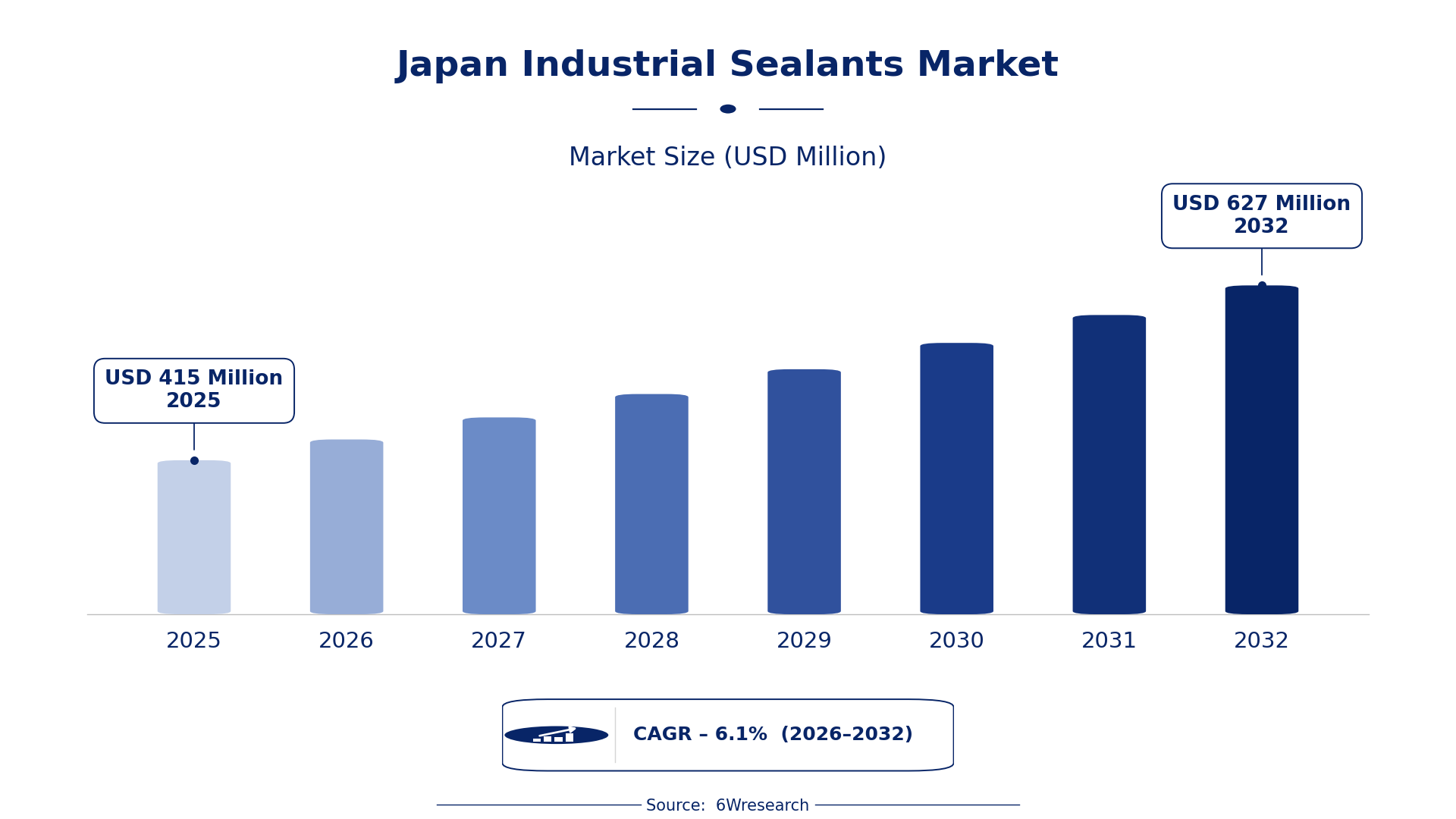
According to 6Wresearch internal database and industry insights, the Japan Industrial Sealants Market was valued at USD 415 Million in 2025 and is projected to reach USD 627 Million by 2032, growing at a CAGR of approximately 6.1% during 2026–2032.
Japan Industrial Sealants Market Highlights
| Report Metric | Details |
| Report Name | Japan Industrial Sealants Market (2026-2032) |
| Market Size 2025 | USD 415 Million |
| Market Size 2032 | USD 627 Million |
| Absolute Growth 2025–2032 | USD 212 Million |
| CAGR 2026–2032 | 6.1% |
| Peak Annual Growth | 8.4% in 2027 |
| Forecast Period | 2026–2032 |
| Historical Data | 2022–2025 |
| Base Year | 2025 |
| Leading Product Type, 2025 | Silicone Sealants (46% share) |
| Leading Chemical Base, 2025 | Silicone (57% share) |
| Leading End User, 2025 | Construction Sector (42% share) |
| Leading Distribution Channel, 2025 | OEM Supply Chains (43% share) |
| Fastest-Growing Product Type | Polyurethane Sealants (8.6% CAGR) |
| Fastest-Growing Chemical Base | Polyurethane (8.0% CAGR) |
| Fastest-Growing End User | HVAC Systems (7.9% CAGR) |
| Fastest-Growing Distribution Channel | Online Sales (8.1% CAGR) |
| Growing Sector | Construction Sector |
| Key End Users | Construction companies, automotive manufacturers, HVAC contractors |
Japan Industrial Sealants Market Year-wise Growth Rate and Key Drivers (2022–2032)
This graph illustrates the annual growth rates of the market from 2022 to 2032, highlighting a steady upward trajectory and projected market expansion over the forecast period.
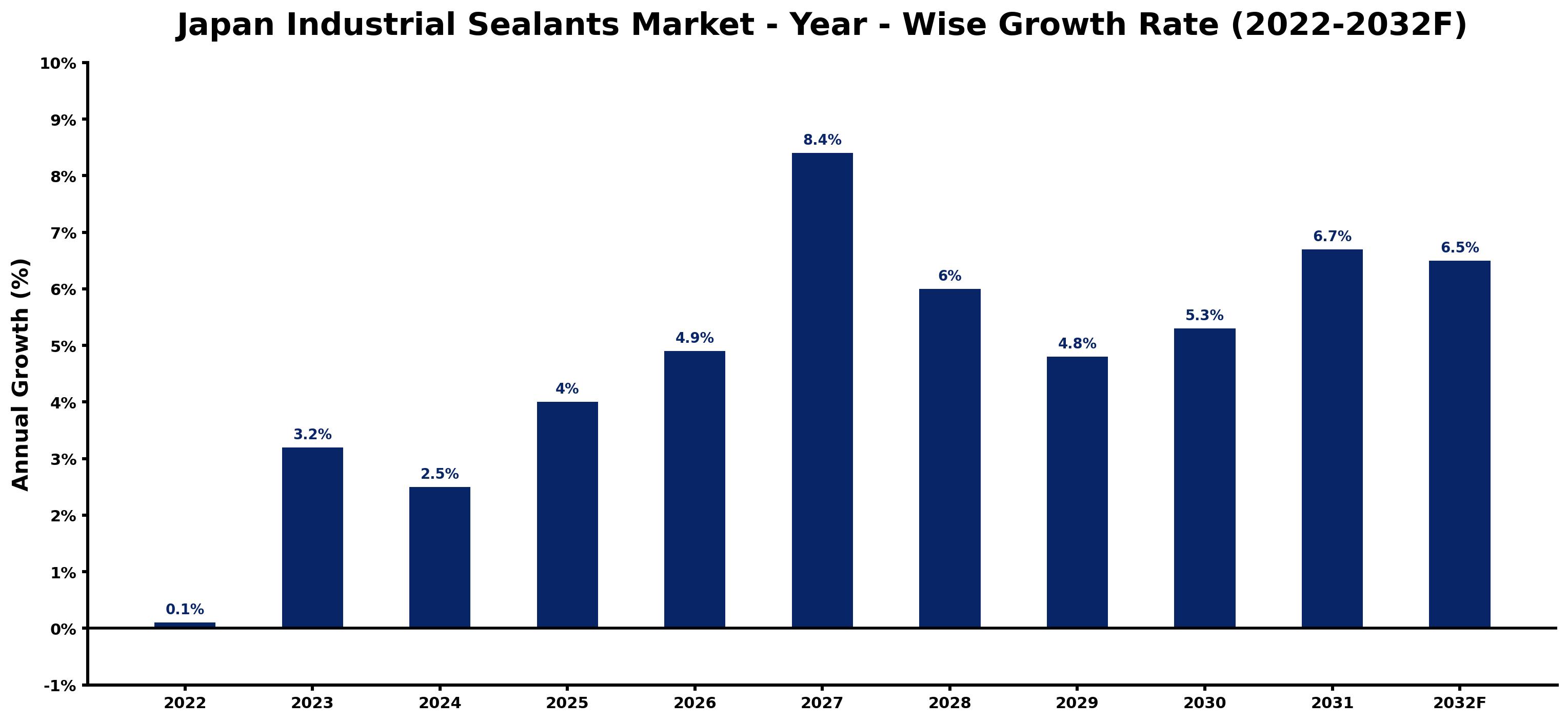
Each row of the following table gives one year's estimated growth and the event or demand shift that explains it.
| Year | Estimated Annual Growth (%) | Market Rationale |
| 2022 | 0.1 | The market showed minimal growth due to recovery from previous disruptions. |
| 2023 | 3.2 | Demand increased as construction activity began to accelerate after previous challenges. |
| 2024 | 2.5 | Growth slowed as the market adjusted to previous high levels of demand. |
| 2025 | 4.0 | A surge in construction projects drove faster growth in sealant consumption. |
| 2026 | 4.9 | Rising investments in infrastructure projects are expected to boost sealant demand further. |
| 2027 | 8.4 | Peak growth will occur as the automotive sector ramps up production. |
| 2028 | 6.0 | Growth is projected to slow as market saturation begins to influence purchasing patterns. |
| 2029 | 4.8 | Demand will continue to slow as the market stabilises after rapid expansion. |
| 2030 | 5.3 | Increased energy efficiency initiatives will lead to higher sealant requirements. |
| 2031 | 6.7 | The market is expected to experience renewed interest from the construction sector. |
| 2032 | 6.5 | Growth will moderate as the market reaches a more mature phase. |
Note: Market size estimations and growth projections presented in this report are based on 6Wresearch's proprietary forecasting methodology, utilizing the latest available industry data, government publications, and primary research inputs.
Japan Industrial Sealants Market Synopsis
Industrial sealants are materials designed to prevent fluid passage through surfaces or joints, primarily used in construction, automotive assembly, and HVAC systems. The Japan Industrial Sealants Market is growing due to robust demand from the construction sector, which is projected to require over 50,000 tons of sealants annually. The automotive industry, producing over 8 million vehicles in 2022, is also driving demand for high-performance sealants, supported by investments in decarbonisation and energy efficiency programmes.
Market Dynamics Impact Analysis (2026–2032)
| Factor | Type | Impact | Primary Segment Affected |
| Strong demand from the construction sector | Driver | High | Silicone Sealants |
| Increasing automotive production rates | Driver | High | Polyurethane Sealants |
| Expansion of online sales channels | Opportunity | Medium | Acrylic Sealants |
| Growing focus on energy-efficient building materials | Opportunity | High | HVAC Systems |
| Market saturation in certain segments | Restraint | Medium | Silicone Sealants |
| Regulatory compliance costs for manufacturers | Restraint | High | Polyurethane Sealants |
| Supply chain disruptions affecting availability | Challenge | High | Acrylic Sealants |
| Fluctuating raw material prices impacting production | Challenge | Medium | Polysulfide Sealants |
Evaluation of Drivers in Japan Industrial Sealants Market (2026–2032)
Below are the drivers that matter most for revenue growth, with supporting evidence.
| Drivers | Primary Segment Affected | Why It Matters (Evidence) |
| Increased infrastructure investment | Silicone Sealants | The construction sector's projected demand of over 50,000 tons annually drives silicone sealant usage. |
| Rising vehicle production | Polyurethane Sealants | The automotive industry produced over 8 million vehicles in 2022, increasing sealant demand. |
| Growing HVAC market | Acrylic Sealants | The HVAC market in Japan, valued at over 1 trillion yen, boosts demand for sealants. |
| Decarbonisation initiatives | Polyurethane Sealants | Japan's target of JPY 150 trillion in decarbonisation investment increases demand for high-performance sealants. |
| Technological advancements in sealant formulations | Silicone Sealants | Innovations in sealant technology improve performance, attracting more buyers in construction. |
The strongest pull on demand comes from increased infrastructure investment, with the construction sector projected to require over 50,000 tons of sealants annually. Vehicle production, with over 8 million vehicles manufactured in 2022, boosts demand for polyurethane sealants. The HVAC market, valued at over 1 trillion yen, drives sealant consumption. Advancements in sealant formulations improve performance, attracting buyers in construction and automotive sectors alike. Furthermore, decarbonisation efforts targeting JPY 150 trillion in investments create further demand for high-performance sealants.
Evaluation of Restraints in Japan Industrial Sealants Market
The table below lists the restraints and the evidence behind each.
| Market Restraint | Primary Segment Affected | Why It Matters (Evidence) |
| Market saturation in the silicone segment | Silicone Sealants | As silicone sealants account for approximately 40% of the market, saturation limits growth potential. |
| High compliance costs for regulatory standards | Polyurethane Sealants | Manufacturers face increased costs to meet stringent standards, impacting pricing strategies. |
| Supply chain disruptions affecting availability | Acrylic Sealants | Ongoing supply chain issues have led to delays in sealant availability, hindering sales. |
| Fluctuating raw material prices impacting production | Polysulfide Sealants | Volatility in raw material costs affects production schedules and pricing for polysulfide sealants. |
| Limited awareness of advanced sealant technologies | Polyurethane Sealants | A lack of knowledge about new formulations restricts adoption in certain sectors. |
Japan Industrial Sealants Market Challenges
Buyers in the construction sector are facing rising input costs due to supply chain disruptions, which may delay project timelines. Competition intensifies as manufacturers strive to meet the annual demand of over 50,000 tons, potentially causing project hold-ups for contractors. Regulatory changes, including the adoption of ISO 11600, impose compliance costs on suppliers, which can inflate prices for end-users. Increasing raw material costs, driven by Japan's decarbonisation goals, threaten to raise production expenses, ultimately impacting buyers who require affordable sealants for their applications.
Trends in the Japan Industrial Sealants Market
Below are the shifts with the largest effect on the Japan Industrial Sealants Market.
- Launch of Energy Efficiency Programmes: The 2023 government initiative to improve energy efficiency in buildings is driving sealant demand, with expectations for growth in the construction sector as a result.
- Shift towards Online Sales Channels: Online sales of sealants have increased by 15% in the last year, reflecting changing buyer preferences and expanding market access for consumers.
- Focus on Sustainable Construction Materials: The push for decarbonisation is driving demand for advanced sealants, with Japan targeting a 46% reduction in greenhouse gas emissions by 2030.
- Growth in Automotive Assembly Innovations: The automotive assembly sector is increasingly adopting advanced sealants, with over 8 million vehicles produced in 2022, improving sealing performance.
Investment Opportunities in the Japan Industrial Sealants Market
Below are the investment opportunities with the strongest case in the Japan Industrial Sealants Market.
- Partnerships for Local Production: With JPY 150 trillion earmarked for decarbonisation, forming joint ventures with local manufacturers can improve market entry and supply chain efficiency.
- Investment in Energy-Efficient Sealants: The HVAC market's value over 1 trillion yen presents an opportunity to supply advanced sealants that meet energy efficiency standards.
- Expansion in Online Distribution Channels: The growing trend of online sales, increasing by 15% last year, offers a chance to reach a broader consumer base effectively.
- Focus on Aerospace Applications: With polysulfide sealants used in specialized aerospace applications, targeting this niche can yield high returns due to limited competition.
Government Initiatives in the Japan Industrial Sealants Market
The Industrial Safety and Health Act (1972) mandates employer responsibilities regarding hazardous substances, ensuring safety in sealant production. The GX Promotion Act (2023) supports the government's decarbonisation strategy, encouraging innovation in sealant technologies to meet environmental standards.
The Ministry of Land, Infrastructure, Transport and Tourism oversees construction standards, approving materials used in building projects. The government funds initiatives aimed at improving energy efficiency, directly impacting sealant demand in the construction sector.
Future Insight of the Japan Industrial Sealants Market
New energy-efficient building initiatives will drive demand for advanced sealants as government funding supports innovative materials. By 2032, the automotive sector will increasingly adopt high-performance sealants to improve vehicle durability and efficiency. The HVAC market will implement updated standards that enhance product reliability and safety. With the construction industry employing over 5 million workers, the need for durable sealants will remain strong, creating opportunities for both buyers and suppliers.
Market Segmentation Analysis
Japan Industrial Sealants Market report covers a detailed analysis of the following market segments:
By Product Type – Silicone Sealants Lead, Polyurethane Sealants Expected to Grow Fastest
According to Saurav Kr Singh, Senior Research Analyst at 6Wresearch, the largest product type category in 2025 was Silicone Sealants, at 46% of revenue. Silicone sealants dominate the market due to their extensive application in construction and automotive sectors, particularly in regions like Tokyo and Osaka. Their durability, with an average lifespan of around 20 years, makes them a reliable choice for long-term projects. Polyurethane Sealants are set to record the highest CAGR in this split, 8.6% over 2026–2032. Polyurethane sealants are rapidly gaining traction, primarily due to their strong adhesion properties which are increasingly sought after in industrial applications. The government's initiatives to promote innovation in construction materials further support their growing adoption. Suppliers should prioritise expanding their polyurethane product lines to address the rising demand in industrial applications.
By Chemical Base – Silicone Leads, Polyurethane Expected to Grow Fastest
Silicone held 57% of the Japan Industrial Sealants Market by chemical base in 2025. Silicone is the predominant chemical base for many sealants due to its flexibility and durability, making it essential in applications such as construction and automotive assembly. Its widespread use is supported by standards like ISO 11600, which governs sealant applications in construction. Over 2026–2032, Polyurethane is expected to post the fastest growth, at a CAGR of 8.0%. Polyurethane is gaining traction as a preferred choice for high-performance sealants, particularly valued for its chemical resistance in demanding environments. This growth is expected to continue as industries increasingly require advanced sealing solutions. Suppliers should consider expanding their product lines to include more polyurethane options to meet the rising demand for high-performance sealants.
By End User – Construction Sector Leads, HVAC Systems Expected to Grow Fastest
In 2025, Construction Sector led the end user split with a 42% share. The construction sector is the leading end-user of sealants, with demand projected to exceed 50,000 tons annually, driven by ongoing projects and a large workforce of over 5 million. This sector's consistent activity ensures a robust market for various types of sealants. HVAC Systems are projected to grow fastest, at a CAGR of 7.9% during 2026–2032. HVAC systems are experiencing rapid growth in sealant usage, particularly for sealing ducts and joints, propelled by a heightened focus on energy efficiency in buildings. Recent government initiatives aimed at improving energy efficiency further enhance this demand. Suppliers should target the HVAC sector to capitalise on the increasing need for effective sealing solutions in energy-efficient buildings.
By Distribution Channel – OEM Supply Chains Lead, Online Sales Expected to Grow Fastest
OEM Supply Chains accounted for 43% of the market by distribution channel in 2025. OEM supply chains are the dominant distribution channel, crucial for manufacturers requiring bulk sealants for their production needs. This direct channel ensures timely access to high-quality products, which is essential for large-scale applications. The quickest growth will come from Online Sales, forecast to expand at a CAGR of 8.1% between 2026 and 2032. Online sales are the fastest-growing distribution channel, having increased by 15% in the last year, indicating a shift in consumer purchasing habits towards convenience and accessibility. This trend suggests a growing preference for online platforms for sealant purchases. Suppliers must strengthen their online sales strategies to capture the expanding market segment of consumers who prefer purchasing sealants online.
Key Attractiveness of the Report
- 10 Years of Market Numbers
- Historical Data Starting from 2022 to 2025
- Base Year 2025
- Forecast Data until 2032
- Key Performance Indicators Impacting the Market
- Major Upcoming Developments and Projects
Key Highlights of the Report:
- Japan Industrial Sealants Market Outlook
- Market Size of Japan Industrial Sealants Market, 2025
- Forecast of Japan Industrial Sealants Market, 2032
- Historical Data and Forecast of Japan Industrial Sealants Revenues & Volume for the Period 2022-2032F
- Japan Industrial Sealants Market Trend Evolution
- Japan Industrial Sealants Market Drivers and Challenges
- Japan Industrial Sealants Price Trends
- Japan Industrial Sealants Porter's Five Forces
- Japan Industrial Sealants Industry Life Cycle
- Historical Data and Forecast of Japan Industrial Sealants Market Revenues & Volume By Product Type for the Period 2022-2032F
- Historical Data and Forecast of Japan Industrial Sealants Market Revenues & Volume By Silicone Sealants for the Period 2022-2032F
- Historical Data and Forecast of Japan Industrial Sealants Market Revenues & Volume By Polyurethane Sealants for the Period 2022-2032F
- Historical Data and Forecast of Japan Industrial Sealants Market Revenues & Volume By Acrylic Sealants for the Period 2022-2032F
- Historical Data and Forecast of Japan Industrial Sealants Market Revenues & Volume By Polysulfide Sealants for the Period 2022-2032F
- Historical Data and Forecast of Japan Industrial Sealants Market Revenues & Volume By Chemical Base for the Period 2022-2032F
- Historical Data and Forecast of Japan Industrial Sealants Market Revenues & Volume By Silicone for the Period 2022-2032F
- Historical Data and Forecast of Japan Industrial Sealants Market Revenues & Volume By Polyurethane for the Period 2022-2032F
- Historical Data and Forecast of Japan Industrial Sealants Market Revenues & Volume By Acrylic Polymer for the Period 2022-2032F
- Historical Data and Forecast of Japan Industrial Sealants Market Revenues & Volume By Polysulfide for the Period 2022-2032F
- Historical Data and Forecast of Japan Industrial Sealants Market Revenues & Volume By End User for the Period 2022-2032F
- Historical Data and Forecast of Japan Industrial Sealants Market Revenues & Volume By Automotive Assembly for the Period 2022-2032F
- Historical Data and Forecast of Japan Industrial Sealants Market Revenues & Volume By Construction Sector for the Period 2022-2032F
- Historical Data and Forecast of Japan Industrial Sealants Market Revenues & Volume By HVAC Systems for the Period 2022-2032F
- Historical Data and Forecast of Japan Industrial Sealants Market Revenues & Volume By Aircraft Maintenance for the Period 2022-2032F
- Historical Data and Forecast of Japan Industrial Sealants Market Revenues & Volume By Distribution Channel for the Period 2022-2032F
- Historical Data and Forecast of Japan Industrial Sealants Market Revenues & Volume By Auto Parts Retailers for the Period 2022-2032F
- Historical Data and Forecast of Japan Industrial Sealants Market Revenues & Volume By Industrial Distributors for the Period 2022-2032F
- Historical Data and Forecast of Japan Industrial Sealants Market Revenues & Volume By Online Sales for the Period 2022-2032F
- Historical Data and Forecast of Japan Industrial Sealants Market Revenues & Volume By OEM Supply Chains for the Period 2022-2032F
- Japan Industrial Sealants Import Export Trade Statistics
- Market Opportunity Assessment By Product Type
- Market Opportunity Assessment By Chemical Base
- Market Opportunity Assessment By End User
- Market Opportunity Assessment By Distribution Channel
- Japan Industrial Sealants Top Companies Market Share
- Japan Industrial Sealants Competitive Benchmarking By Technical and Operational Parameters
- Japan Industrial Sealants Company Profiles
- Japan Industrial Sealants Key Strategic Recommendations
Market Covered
The following segment groups are covered in the report.
By Product Type
- Silicone Sealants
- Polyurethane Sealants
- Acrylic Sealants
- Polysulfide Sealants
By Chemical Base
- Silicone
- Polyurethane
- Acrylic Polymer
- Polysulfide
By End User
- Automotive Assembly
- Construction Sector
- HVAC Systems
- Aircraft Maintenance
By Distribution Channel
- Auto Parts Retailers
- Industrial Distributors
- Online Sales
- OEM Supply Chains































