Japan Industrial Sensor Market Size & Growth Rate
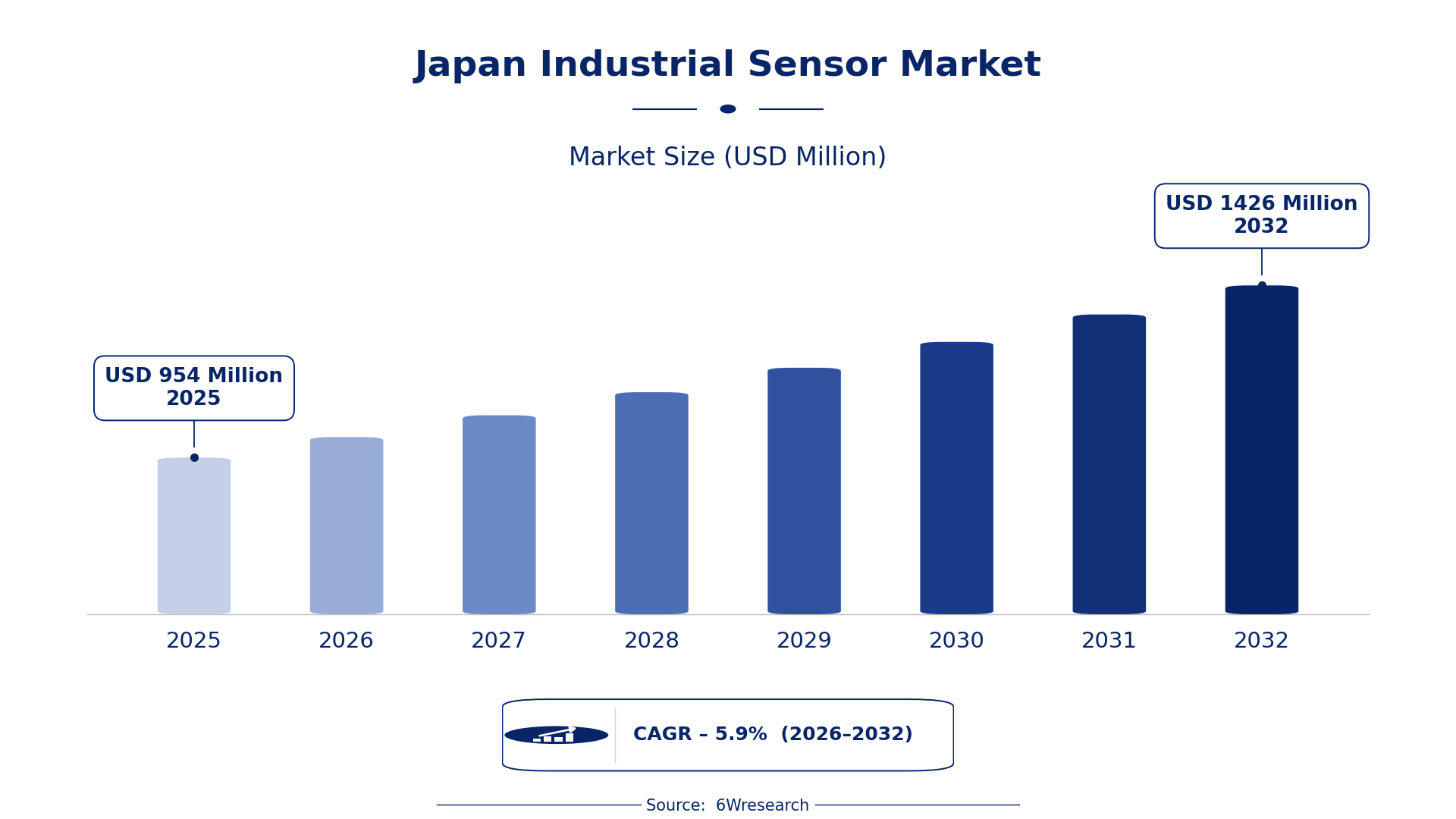
According to 6Wresearch internal database and industry insights, the Japan Industrial Sensor Market was valued at USD 954 Million in 2025 and is projected to reach USD 1,426 Million by 2032, growing at a CAGR of approximately 5.9% during 2026–2032.
Japan Industrial Sensor Market Highlights
| Report Metric | Details |
| Report Name | Japan Industrial Sensor Market (2026-2032) |
| Market Size 2025 | USD 954 Million |
| Market Size 2032 | USD 1,426 Million |
| Absolute Growth 2025–2032 | USD 472 Million |
| CAGR 2026–2032 | 5.9% |
| Peak Annual Growth | 6.8% in 2032 |
| Forecast Period | 2026–2032 |
| Historical Data | 2022–2025 |
| Base Year | 2025 |
| Leading Sensor Type, 2025 | Proximity Sensors (45% share) |
| Leading Application Area, 2025 | Robotics & Automation (43% share) |
| Leading End User, 2025 | Electronics Factories (37% share) |
| Leading Distribution Channel, 2025 | Direct Sales (41% share) |
| Fastest-Growing Sensor Type | Pressure Sensors (8.7% CAGR) |
| Fastest-Growing Application Area | HVAC Systems (7.4% CAGR) |
| Fastest-Growing End User | Semiconductor Plants (7.9% CAGR) |
| Fastest-Growing Distribution Channel | Component Suppliers (7.8% CAGR) |
| Growing Sector | Electronics manufacturing |
| Key End Users | Electronics factories, semiconductor plants, HVAC manufacturers, water treatment facilities |
Japan Industrial Sensor Market Year-wise Growth Rate and Key Drivers (2022–2032)
This graph illustrates the annual growth rates of the market from 2022 to 2032, highlighting a steady upward trajectory and projected market expansion over the forecast period.
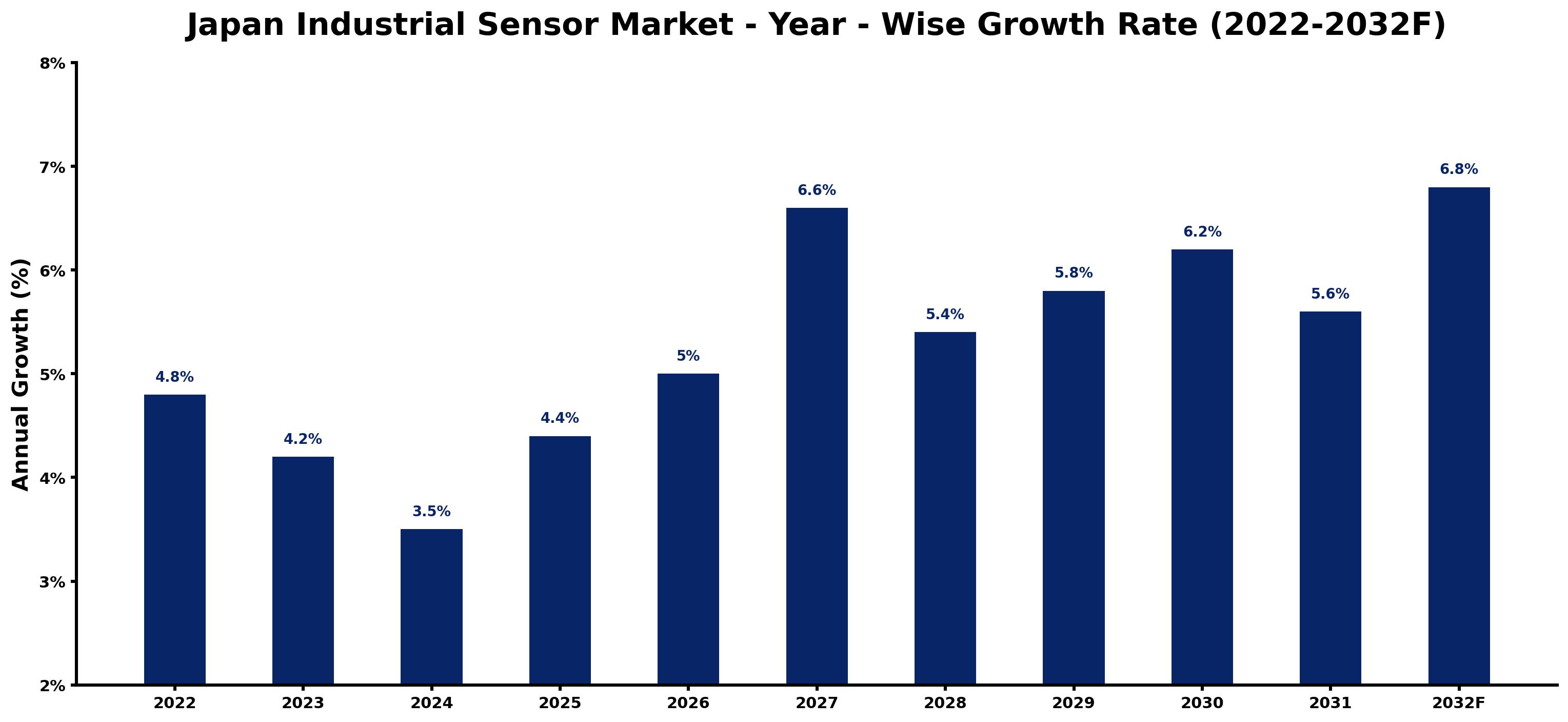
Annual growth estimates for each year appear below with the principal reason behind them, explaining the shifts that set the pace of the market.
| Year | Estimated Annual Growth (%) | Market Rationale |
| 2022 | 4.8 | The market showed strong performance, driven by increased automation in manufacturing. |
| 2023 | 4.2 | Growth slowed as manufacturers adjusted to supply chain disruptions from global events. |
| 2024 | 3.5 | Continued investment in smart manufacturing technologies led to a further slowdown in growth. |
| 2025 | 4.4 | Demand rose as manufacturers expanded operations in response to rising consumer electronics needs. |
| 2026 | 5.0 | Investment in robotics and automation is expected to boost sensor demand. |
| 2027 | 6.6 | Growth is projected to surge as semiconductor plants increase production capacity. |
| 2028 | 5.4 | The market is expected to experience a slowdown as growth stabilises after rapid increases. |
| 2029 | 5.8 | Demand is anticipated to pick up again due to advancements in HVAC systems requiring more sensors. |
| 2030 | 6.2 | A rise in environmental monitoring initiatives will spur further growth in sensor applications. |
| 2031 | 5.6 | Growth is expected to slow slightly as market maturity begins to set in, stabilising demand. |
| 2032 | 6.8 | The market is projected to peak as new technologies in automation drive sensor adoption. |
Note: Market size estimations and growth projections presented in this report are based on 6Wresearch's proprietary forecasting methodology, utilizing the latest available industry data, government publications, and primary research inputs.
Japan Industrial Sensor Market Synopsis
The Japan Industrial Sensor Market is valued at approximately 500 billion yen, driven by strong demand from electronics factories and the semiconductor sector. Growth is propelled by rising automation in manufacturing, investments in smart manufacturing initiatives, and a commitment to decarbonisation, with Japan aiming for a 46% reduction in greenhouse gas emissions by 2030.
Market Dynamics Impact Analysis (2026–2032)
| Factor | Type | Impact | Primary Segment Affected |
| Increased automation in manufacturing processes | Driver | High | Robotics & Automation |
| Growing demand for precision in semiconductor manufacturing | Driver | High | Semiconductor Plants |
| Investment in HVAC systems to improve energy efficiency | Opportunity | Medium | HVAC Systems |
| Rising environmental regulations necessitating advanced monitoring | Opportunity | Medium | Process Monitoring |
| Supply chain disruptions affecting sensor availability | Restraint | High | Proximity Sensors |
| High initial costs of advanced sensor technologies | Restraint | Medium | Proximity Sensors |
| Competition from low-cost sensor manufacturers | Challenge | High | Proximity Sensors |
| Technological advancements requiring continuous upgrades | Challenge | Medium | Proximity Sensors |
Evaluation of Drivers in Japan Industrial Sensor Market (2026–2032)
These are the developments adding the most demand over the forecast period.
| Drivers | Primary Segment Affected | Why It Matters (Evidence) |
| Investment in smart manufacturing technologies | Robotics & Automation | Japan's government has allocated 10 billion yen to support smart manufacturing initiatives, driving sensor demand in automation. |
| Increased production capacity in semiconductor plants | Semiconductor Plants | The semiconductor industry is one of the largest consumers of sensors, with over 1,000 electronics factories in Japan. |
| Growing HVAC market due to energy efficiency regulations | HVAC Systems | Japan's push for energy efficiency has led to increased sensor installations in HVAC systems. |
| Rising environmental monitoring needs | Process Monitoring | Japan targets a 46% reduction in greenhouse gas emissions by 2030, increasing demand for monitoring sensors. |
| Technological advancements in sensor manufacturing | Proximity Sensors | ISO 9001 standards drive quality improvements in sensor production, boosting market competitiveness. |
The semiconductor industry is expanding, leading to increased sensor usage in production processes. Japan's commitment to reducing greenhouse gas emissions by 46% by 2030 is increasing the need for advanced environmental monitoring solutions. These factors stimulate purchasing activity across various sectors, particularly in electronics and manufacturing.
Evaluation of Restraints in Japan Industrial Sensor Market
Below are the constraints most often cited by buyers and suppliers, with the segment each affects.
| Market Restraint | Primary Segment Affected | Why It Matters (Evidence) |
| Supply chain disruptions affecting sensor availability | Proximity Sensors | Recent global events have caused delays in sensor production and distribution, impacting availability for manufacturers. |
| High initial costs of advanced sensor technologies | Proximity Sensors | The investment required for advanced sensor technologies can deter smaller manufacturers from upgrading. |
| Competition from alternative sensor technologies | Proximity Sensors | The presence of cheaper alternatives in the market pressures established manufacturers to lower prices. |
| Technological advancements requiring continuous upgrades | Proximity Sensors | Rapid technological changes necessitate frequent updates, which can strain budgets and resources for buyers. |
| Regulatory compliance costs for manufacturers | Proximity Sensors | Meeting standards like ISO 9001 can increase operational costs for sensor producers. |
Japan Industrial Sensor Market Challenges
Technological advancements in Japan's industrial sensor market are slow, causing buyers to miss out on efficient automation solutions. This stagnation exists due to limited investment in R&D, resulting in an estimated 15% increase in operational costs for manufacturers. Buyers struggle with rising prices as suppliers face strict regulations, which can delay product launches by up to six months, impacting project timelines. Intense competition among suppliers leads to price reductions that compromise quality, forcing manufacturers to settle for less effective sensors, ultimately hindering productivity.
Trends in the Japan Industrial Sensor Market
The following changes are redrawing the Japan Industrial Sensor Market.
- Shift in Focus to Environmental Monitoring: Electronics factories are increasingly adopting advanced sensors for environmental monitoring, reflecting Japan's emission reduction targets. In 2022, 30% of sensor applications were in this area, indicating a growing trend.
- Transition from Traditional to Smart HVAC Systems: HVAC systems are evolving with the integration of smart sensors, improving energy efficiency. The market for these systems is projected to grow, indicating a shift towards more advanced solutions.
- Robotics & Automation Gaining Prominence: Robotics & Automation is becoming a leading application area for industrial sensors, accounting for 30% of applications in 2022. This trend highlights the increasing reliance on automation in manufacturing.
- Emergence of Advanced Pressure Sensors: Pressure sensors are rapidly gaining traction, with a projected CAGR of 8.7% from 2026 to 2032. This growth is driven by the need for precision in various industrial applications.
Investment Opportunities in the Japan Industrial Sensor Market
The following opportunities in the Japan Industrial Sensor Market pair current demand with a clear way in.
- Investment in Smart Manufacturing Technologies: With Japan aiming for a 46% reduction in greenhouse gas emissions by 2030, there is a strong opportunity for investment in smart manufacturing technologies, particularly within electronics factories.
- Growing Demand for HVAC Systems: The HVAC market is projected to expand, creating opportunities for suppliers of advanced sensors. Manufacturers can enter this market by partnering with local HVAC providers.
- Expansion of Environmental Monitoring Solutions: As environmental regulations tighten, the need for advanced monitoring solutions is increasing. Suppliers can target water treatment plants that require enhanced monitoring capabilities.
- Development of Pressure Sensors: The rising demand for precision across various industries presents an opportunity for pressure sensor manufacturers. Collaborating with semiconductor plants can facilitate market entry.
Government Initiatives in the Japan Industrial Sensor Market
The GX Promotion Act (2023) introduces a framework for decarbonisation, building on the Economic Security Promotion Act (2022) which supports supply-chain resilience. These measures encourage manufacturers to adopt advanced sensor technologies to comply with new environmental standards.
Japan's investment of 150 trillion yen over ten years in decarbonisation initiatives is administered by the Ministry of Economy, Trade and Industry. This funding supports the development of sensor technologies that improve energy efficiency and environmental monitoring.
Future Insight of the Japan Industrial Sensor Market
By 2032, buyers in Japan will benefit from enhanced sensor technologies as decarbonisation investments of JPY 150 trillion drive advancements. The emphasis on smart manufacturing will encourage suppliers to create specialised solutions for automation and environmental monitoring needs. Growth in the HVAC market will further stimulate sensor demand, leading to innovative product developments. Robotics applications will remain crucial, with approximately 30% of sensor usage dedicated to improving operational efficiency across various sectors.
Market Segmentation Analysis
Japan Industrial Sensor Market report covers a detailed analysis of the following market segments:
By Sensor Type – Proximity Sensors Lead, Pressure Sensors Expected to Grow Fastest
According to Saurav Kr Singh, Senior Research Analyst at 6Wresearch, Proximity Sensors took 45% of sensor type revenue in 2025, more than any other category. Proximity sensors dominate the market due to their critical function in detecting objects without contact, particularly in electronics factories where precision is vital. Their widespread use in major industrial hubs like Tokyo and Osaka underlines their importance in various applications. Over 2026–2032, Pressure Sensors are expected to post the fastest growth, at a CAGR of 8.7%. Pressure sensors are experiencing rapid growth as they are increasingly integrated into HVAC systems, which are set to expand significantly in the coming years. This trend indicates a heightened demand for reliable pressure monitoring solutions across multiple sectors. Suppliers should prioritise the development of advanced pressure sensor technologies to capitalise on emerging market opportunities.
By Application Area – Robotics & Automation Leads, HVAC Systems Expected to Grow Fastest
Robotics & Automation held 43% of the Japan Industrial Sensor Market by application area in 2025. Robotics and automation lead the market as they are essential for enhancing operational efficiency in manufacturing, especially within electronics factories. Their significant role in streamlining processes in key industrial regions solidifies their dominant position. The quickest growth will come from HVAC Systems, forecast to expand at a CAGR of 7.4% between 2026 and 2032. HVAC systems are the fastest-growing application area, driven by rising investments in smart building technologies and energy efficiency initiatives. This increasing demand for sophisticated sensor solutions in HVAC points to a shift towards more automated climate control systems. Buyers in the HVAC sector should focus on sourcing advanced sensors to meet regulatory and efficiency standards.
By End User – Electronics Factories Lead, Semiconductor Plants Expected to Grow Fastest
Electronics Factories accounted for 37% of the market by end user in 2025. Electronics factories are the largest end user segment, relying heavily on industrial sensors for quality control and automation in production lines. The existence of over 1,000 electronics factories in Japan highlights their substantial demand for sensor technologies. Semiconductor Plants are set to record the highest CAGR in this split, 7.9% over 2026–2032. Semiconductor plants are the fastest-growing end user segment, requiring precise measurements for their manufacturing processes amid the ongoing expansion of the semiconductor industry. This growth is likely to accelerate as technology demands increase. Suppliers must tailor their products to meet the specific requirements of semiconductor plants to leverage this growth.
By Distribution Channel – Direct Sales Leads, Component Suppliers Expected to Grow Fastest
The largest distribution channel category in 2025 was Direct Sales, at 41% of revenue. Direct sales are the primary distribution channel for industrial sensors, allowing manufacturers to establish strong relationships with end users and deliver customised solutions. This approach is particularly effective in the electronics and manufacturing sectors where direct engagement is crucial. Component Suppliers are projected to grow fastest, at a CAGR of 7.8% during 2026–2032. Component suppliers are rapidly gaining traction as they integrate sensors into larger systems, reflecting a trend towards more cohesive solutions in manufacturing. This shift highlights the need for suppliers to collaborate closely with component suppliers to expand their market presence. Suppliers should explore partnerships with component suppliers to improve distribution and enhance market penetration.
Key Attractiveness of the Report
- 10 Years of Market Numbers
- Historical Data Starting from 2022 to 2025
- Base Year 2025
- Forecast Data until 2032
- Key Performance Indicators Impacting the Market
- Major Upcoming Developments and Projects
Key Highlights of the Report:
- Japan Industrial Sensor Market Outlook
- Market Size of Japan Industrial Sensor Market, 2025
- Forecast of Japan Industrial Sensor Market, 2032
- Historical Data and Forecast of Japan Industrial Sensor Revenues & Volume for the Period 2022-2032F
- Japan Industrial Sensor Market Trend Evolution
- Japan Industrial Sensor Market Drivers and Challenges
- Japan Industrial Sensor Price Trends
- Japan Industrial Sensor Porter's Five Forces
- Japan Industrial Sensor Industry Life Cycle
- Historical Data and Forecast of Japan Industrial Sensor Market Revenues & Volume By Sensor Type for the Period 2022-2032F
- Historical Data and Forecast of Japan Industrial Sensor Market Revenues & Volume By Proximity Sensors for the Period 2022-2032F
- Historical Data and Forecast of Japan Industrial Sensor Market Revenues & Volume By Pressure Sensors for the Period 2022-2032F
- Historical Data and Forecast of Japan Industrial Sensor Market Revenues & Volume By Temperature Sensors for the Period 2022-2032F
- Historical Data and Forecast of Japan Industrial Sensor Market Revenues & Volume By Level Sensors for the Period 2022-2032F
- Historical Data and Forecast of Japan Industrial Sensor Market Revenues & Volume By Application Area for the Period 2022-2032F
- Historical Data and Forecast of Japan Industrial Sensor Market Revenues & Volume By Robotics & Automation for the Period 2022-2032F
- Historical Data and Forecast of Japan Industrial Sensor Market Revenues & Volume By HVAC Systems for the Period 2022-2032F
- Historical Data and Forecast of Japan Industrial Sensor Market Revenues & Volume By Process Monitoring for the Period 2022-2032F
- Historical Data and Forecast of Japan Industrial Sensor Market Revenues & Volume By Liquid Measurement for the Period 2022-2032F
- Historical Data and Forecast of Japan Industrial Sensor Market Revenues & Volume By End User for the Period 2022-2032F
- Historical Data and Forecast of Japan Industrial Sensor Market Revenues & Volume By Electronics Factories for the Period 2022-2032F
- Historical Data and Forecast of Japan Industrial Sensor Market Revenues & Volume By Semiconductor Plants for the Period 2022-2032F
- Historical Data and Forecast of Japan Industrial Sensor Market Revenues & Volume By Chemical Industries for the Period 2022-2032F
- Historical Data and Forecast of Japan Industrial Sensor Market Revenues & Volume By Water Treatment Plants for the Period 2022-2032F
- Historical Data and Forecast of Japan Industrial Sensor Market Revenues & Volume By Distribution Channel for the Period 2022-2032F
- Historical Data and Forecast of Japan Industrial Sensor Market Revenues & Volume By Direct Sales for the Period 2022-2032F
- Historical Data and Forecast of Japan Industrial Sensor Market Revenues & Volume By Component Suppliers for the Period 2022-2032F
- Historical Data and Forecast of Japan Industrial Sensor Market Revenues & Volume By Online Marketplaces for the Period 2022-2032F
- Historical Data and Forecast of Japan Industrial Sensor Market Revenues & Volume By Engineering Distributors for the Period 2022-2032F
- Japan Industrial Sensor Import Export Trade Statistics
- Market Opportunity Assessment By Sensor Type
- Market Opportunity Assessment By Application Area
- Market Opportunity Assessment By End User
- Market Opportunity Assessment By Distribution Channel
- Japan Industrial Sensor Top Companies Market Share
- Japan Industrial Sensor Competitive Benchmarking By Technical and Operational Parameters
- Japan Industrial Sensor Company Profiles
- Japan Industrial Sensor Key Strategic Recommendations
Market Covered
The report covers the following segments.
By Sensor Type
- Proximity Sensors
- Pressure Sensors
- Temperature Sensors
- Level Sensors
By Application Area
- Robotics & Automation
- HVAC Systems
- Process Monitoring
- Liquid Measurement
By End User
- Electronics Factories
- Semiconductor Plants
- Chemical Industries
- Water Treatment Plants
By Distribution Channel
- Direct Sales
- Component Suppliers
- Online Marketplaces
- Engineering Distributors































