Japan Industrial Simulation Market Size & Growth Rate
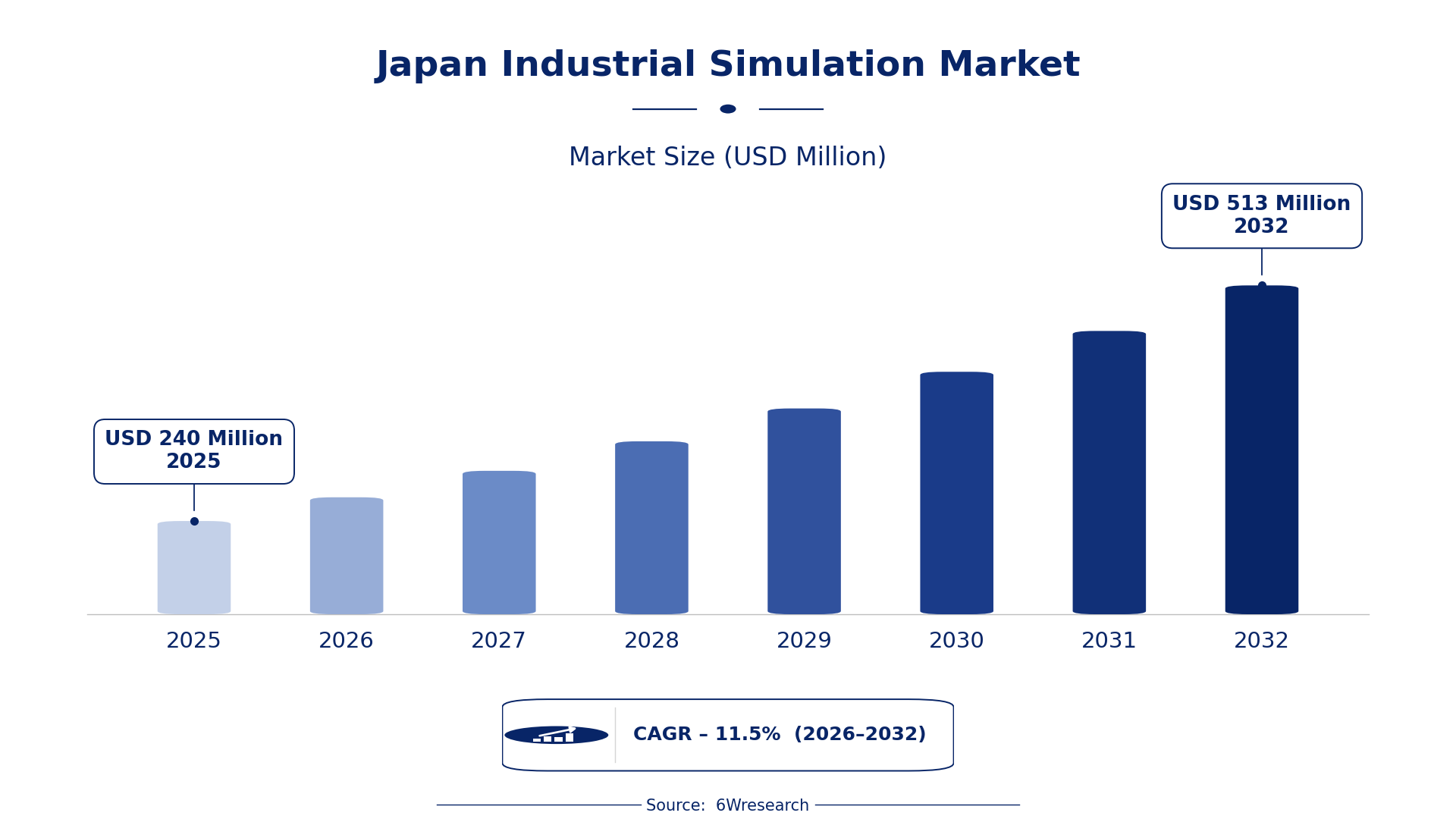
According to 6Wresearch internal database and industry insights, the Japan Industrial Simulation Market was valued at USD 240 Million in 2025 and is projected to reach USD 513 Million by 2032, growing at a CAGR of approximately 11.5% during 2026–2032.
Japan Industrial Simulation Market Highlights
| Report Metric | Details |
| Report Name | Japan Industrial Simulation Market (2026-2032) |
| Market Size 2025 | USD 240 Million |
| Market Size 2032 | USD 513 Million |
| Absolute Growth 2025–2032 | USD 273 Million |
| CAGR 2026–2032 | 11.5% |
| Peak Annual Growth | 12.4% in 2028 |
| Forecast Period | 2026–2032 |
| Historical Data | 2022–2025 |
| Base Year | 2025 |
| Leading Simulation Type, 2025 | Process Simulation (44% share) |
| Leading Application, 2025 | Manufacturing Optimization (46% share) |
| Leading End User, 2025 | Aerospace Manufacturing (44% share) |
| Leading Distribution Channel, 2025 | Direct Software Licenses (41% share) |
| Fastest-Growing Simulation Type | Motion Simulation (15.7% CAGR) |
| Fastest-Growing Application | Robot Design (15.4% CAGR) |
| Fastest-Growing End User | Defense Contractors (14.7% CAGR) |
| Fastest-Growing Distribution Channel | Software Resellers (15.1% CAGR) |
| Growing Sector | Aerospace Manufacturing |
| Key End Users | Aerospace Manufacturers, Defense Contractors, R&D Labs, Engineering Consultants |
Japan Industrial Simulation Market Year-wise Growth Rate and Key Drivers (2022–2032)
This graph illustrates the annual growth rates of the market from 2022 to 2032, highlighting a steady upward trajectory and projected market expansion over the forecast period.
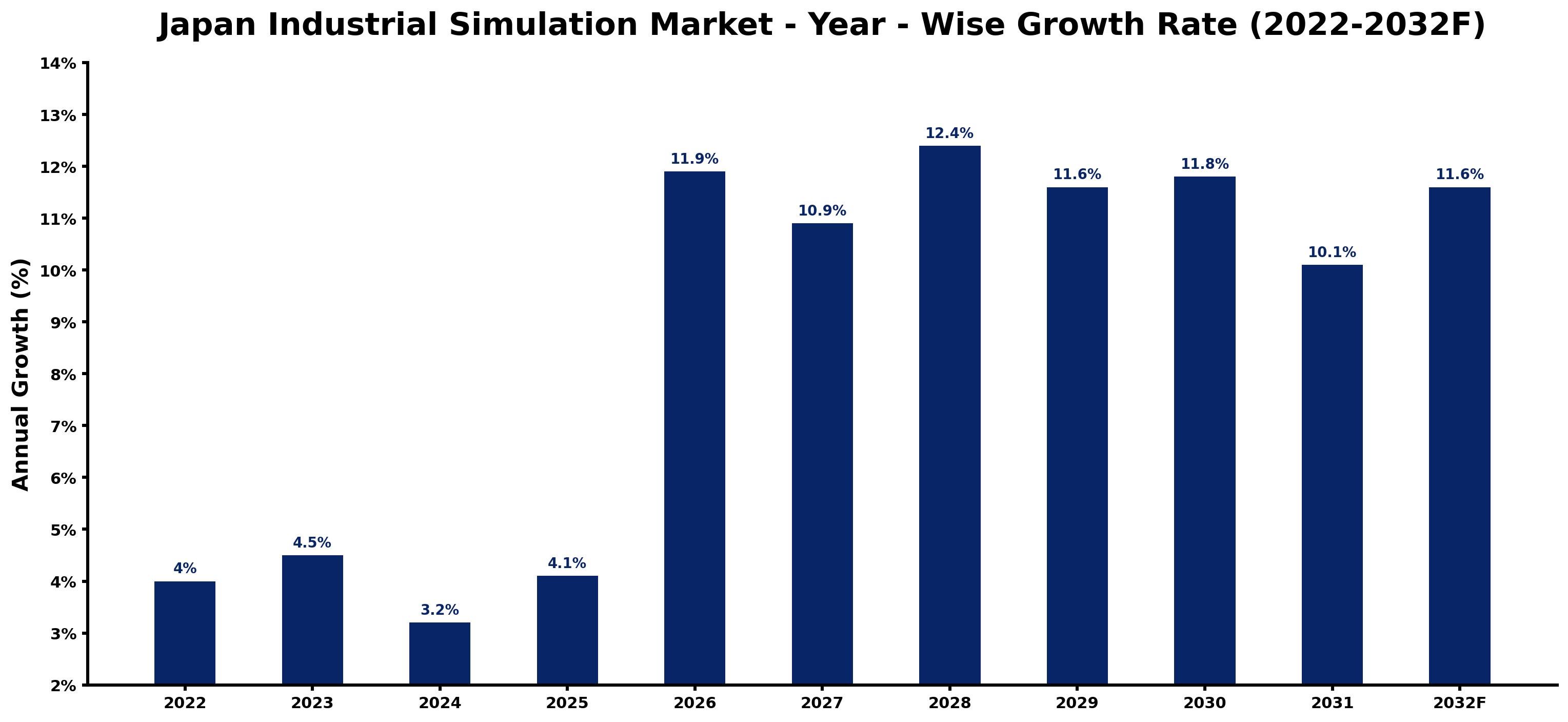
For each year, the table pairs the estimated growth rate with the leading influence on demand, showing how the drivers changed across the period.
| Year | Estimated Annual Growth (%) | Market Rationale |
| 2022 | 4.0 | Demand remained steady as industries continued to adopt simulation technologies. |
| 2023 | 4.5 | Growth accelerated due to increased investments in aerospace and manufacturing sectors. |
| 2024 | 3.2 | Growth slowed as some manufacturers reassessed their technology needs. |
| 2025 | 4.1 | Demand picked up again with new projects in manufacturing optimization. |
| 2026 | 11.9 | Orders keep climbing as aerospace manufacturers invest heavily in simulation tools. |
| 2027 | 10.9 | Growth slowed slightly due to market saturation in some segments. |
| 2028 | 12.4 | Demand surged as advanced simulation technologies gained traction. |
| 2029 | 11.6 | Growth slowed as competition intensified among software providers. |
| 2030 | 11.8 | Demand rose again with increased focus on efficiency in manufacturing processes. |
| 2031 | 10.1 | Growth slowed as the market stabilised after rapid expansion. |
| 2032 | 11.6 | Demand remains strong as industries continue to innovate with simulations. |
Note: Market size estimations and growth projections presented in this report are based on 6Wresearch's proprietary forecasting methodology, utilizing the latest available industry data, government publications, and primary research inputs.
Japan Industrial Simulation Market Synopsis
Industrial simulation uses software to create digital models of physical systems, optimising performance and operations. The Japan Industrial Simulation Market is experiencing significant growth, driven by the aerospace industry's valuation of ¥2 trillion and a strong focus on advanced manufacturing technologies. Factors such as increased investment in aerospace technology, supported by government initiatives, and a growing installed base of over 100,000 simulation software licenses contribute to this upward trend.
Market Dynamics Impact Analysis (2026–2032)
| Factor | Type | Impact | Primary Segment Affected |
| Increased investment in aerospace technology | Driver | High | Aerospace Manufacturing |
| Growing demand for manufacturing optimization | Driver | High | Manufacturing Optimization |
| Expansion of cloud-based simulation platforms | Opportunity | Medium | Cloud-Based Platforms |
| Rising need for robotic design | Opportunity | Medium | Robot Design |
| High competition among software providers | Restraint | High | Direct Software Licenses |
| Market saturation in certain simulation types | Restraint | Medium | Process Simulation |
| Limited awareness of simulation benefits in smaller firms | Challenge | Medium | Manufacturing Optimization |
| Dependence on advanced technology for simulation accuracy | Challenge | High | Aerospace R&D Labs |
Evaluation of Drivers in Japan Industrial Simulation Market (2026–2032)
Below are the drivers that matter most for revenue growth, with supporting evidence.
| Drivers | Primary Segment Affected | Why It Matters (Evidence) |
| Increased aerospace investments | Aerospace Manufacturing | Japan's aerospace industry is valued at ¥2 trillion, driving demand for simulation tools to improve design and testing processes. |
| Focus on manufacturing efficiency | Manufacturing Optimization | Manufacturers are adopting simulation to streamline operations, with over 100,000 licenses in use. |
| Adoption of cloud-based platforms | Cloud-Based Platforms | 40% of manufacturers are increasingly using cloud solutions for simulation access, improving flexibility and cost-effectiveness. |
| Innovation in robotic systems | Robot Design | The growing robotics sector necessitates advanced simulations for design, leading to increased purchases of simulation software. |
| Government support for aerospace technology | Aerospace R&D Labs | The government allocated ¥10 billion for aerospace technology development, boosting demand for simulation applications. |
Orders continue to rise as the aerospace industry, valued at ¥2 trillion, invests heavily in simulation tools to enhance design and testing processes. The adoption of simulation software is increasing as companies pursue operational efficiency. The shift towards cloud-based platforms is apparent, with many manufacturers choosing these solutions to improve access and lower costs. The expanding robotics sector is driving demand for simulation in robotic design. Funding for aerospace technology development further stimulates the market, creating opportunities for simulation providers.
Evaluation of Restraints in Japan Industrial Simulation Market
Below are the constraints most often cited by buyers and suppliers, with the segment each affects.
| Market Restraint | Primary Segment Affected | Why It Matters (Evidence) |
| Intense competition among software providers | Direct Software Licenses | High competition leads to price pressures, affecting profitability for simulation software providers. |
| Market saturation in certain simulation types | Process Simulation | As the market matures, some simulation types face saturation, limiting growth potential. |
| Limited awareness of simulation benefits | Manufacturing Optimization | Smaller firms often lack knowledge about the advantages of simulation, hindering adoption. |
| Dependence on advanced technology | Aerospace R&D Labs | The need for sophisticated technology in simulations can delay implementation for some buyers. |
| Regulatory compliance costs | Robot Design | Compliance with industry standards can increase costs for manufacturers, affecting simulation investments. |
Japan Industrial Simulation Market Challenges
High costs of simulation software hinder adoption across industries. Many firms face initial investments exceeding ¥10 million, delaying project launches and limiting access for smaller manufacturers. Technological advancements lag due to insufficient R&D funding, with only ¥300 billion allocated in 2022, stalling innovation in simulation capabilities. Supply chain disruptions affect software availability, with over 40% of manufacturers reporting delays in procurement, impacting operational efficiency. Regulatory compliance adds complexity, as firms must navigate standards like JIS Q 15001, which can extend project timelines by several months for compliance verification.
Trends in the Japan Industrial Simulation Market
Below are the shifts with the largest effect on the Japan Industrial Simulation Market.
- Shift to Cloud-Based Simulation Platforms: The Tokyo region is experiencing a shift towards cloud-based simulation platforms, with many manufacturers adopting these solutions for improved flexibility. This trend enables easier access to advanced simulation tools, driving efficiency in design processes.
- Increased Focus on Robotic Design: Japan is seeing a growing emphasis on robotic design, with simulation tools becoming essential for developing advanced robotic systems. This shift is reflected in a 15.4% CAGR for the Robot Design segment, indicating strong demand.
- Transition from Traditional to Advanced Simulation Techniques: Since 2023, there has been a notable transition from traditional simulation methods to advanced techniques that utilise real-world data. This change is important for industries like aerospace, where precision is paramount.
- Emergence of Simulation Standards: The introduction of JIS Q 15001 in Japan has established important standards for simulation software, ensuring quality and reliability. This standard supports manufacturers in meeting compliance requirements while improving simulation accuracy.
Investment Opportunities in the Japan Industrial Simulation Market
Below are the investment opportunities with the strongest case in the Japan Industrial Simulation Market.
- Aerospace Manufacturing: Aerospace manufacturers are increasingly investing in simulation technologies, with the sector valued at ¥2 trillion. This creates opportunities for suppliers to provide advanced simulation tools and services.
- Cloud-Based Platforms: With many manufacturers adopting cloud-based solutions, there is an opportunity to supply software that improves accessibility and reduces costs. Partnering with local firms can facilitate market entry.
- Robot Design: The growing focus on robotic systems presents an opportunity to supply advanced simulation software tailored for design and testing. Engaging with engineering consultants can help reach this buyer group effectively.
- Manufacturing Optimization: As companies seek efficiency, there is a demand for simulation tools that optimise manufacturing processes. Suppliers can enter this market by offering tailored solutions that meet specific industry needs.
Government Initiatives in the Japan Industrial Simulation Market
The Industrial Safety and Health Act (1972) mandates employers to ensure safety in machinery and hazardous substances, impacting simulation software providers by requiring compliance with safety standards. The GX Promotion Act (2023) supports decarbonisation efforts, encouraging investments in simulation technologies that improve energy efficiency.
The Japan Aerospace Exploration Agency oversees funding for aerospace innovation programs, allocating ¥10 billion in 2023 for technology development. This funding aids aerospace manufacturers in adopting simulation technologies, ensuring they remain competitive in the global market.
Future Insight of the Japan Industrial Simulation Market
Japan's decarbonisation investment pipeline of ¥150 trillion will create substantial demand for simulation technologies across industries. By 2032, the installed base of simulation software is expected to exceed 150,000 licenses, reflecting a shift towards advanced digital modelling. Collaborations between research institutions and the Japan Aerospace Exploration Agency will enhance simulation capabilities, enabling suppliers to provide more precise solutions. Ongoing government initiatives will ensure that buyers access cutting-edge innovations, particularly within the aerospace sector.
Market Segmentation Analysis
Japan Industrial Simulation Market report covers a detailed analysis of the following market segments:
By Simulation Type – Process Simulation Leads, Motion Simulation Expected to Grow Fastest
According to Saurav Kr Singh, Senior Research Analyst at 6Wresearch, Process Simulation accounted for 44% of the market by simulation type in 2025. Process simulation commands the largest share due to its critical application in optimising manufacturing processes within Japan's extensive industrial landscape. This is evidenced by the high installed base of over 100,000 licenses, indicating strong domestic demand. The quickest growth will come from Motion Simulation, forecast to expand at a CAGR of 15.7% between 2026 and 2032. Motion simulation is witnessing rapid growth as it plays a vital role in the design and testing of robotic movements, essential for modern manufacturing. The Tokyo Metropolitan Government's initiatives to promote advanced manufacturing technologies are propelling this segment forward. Suppliers should concentrate on enhancing process simulation offerings while also capitalising on the growing demand for motion simulation.
By Application – Manufacturing Optimization Leads, Robot Design Expected to Grow Fastest
With 46% of application revenue in 2025, Manufacturing Optimization was the largest category. Manufacturing optimisation leads the market as it is fundamental to improving production efficiency in Japan's manufacturing sector, a cornerstone of the economy. The substantial investments in decarbonisation and advanced technologies further highlight its significance. Robot Design is projected to grow fastest, at a CAGR of 15.4% during 2026–2032. Robot design is the fastest-growing application, driven by the escalating need for automation in manufacturing processes. The increasing workforce in aerospace manufacturing underscores the urgency for advancements in robotic systems. Buyers should focus on solutions that improve manufacturing optimisation while also advancing their robotic design capabilities.
By End User – Aerospace Manufacturing Leads, Defense Contractors Expected to Grow Fastest
Aerospace Manufacturing took 44% of end user revenue in 2025, more than any other category. Aerospace manufacturing is the leading end user, extensively employing simulations for design and development, supported by the industry's valuation of ¥2 trillion. Collaborative efforts between the Japan Aerospace Exploration Agency and R&D labs reinforce its dominant position. Defense Contractors are set to record the highest CAGR in this split, 14.7% over 2026–2032. Defense contractors represent the fastest-growing end users, utilising simulations for equipment development, particularly in light of the Defence Ministry's budget allocation of ¥5 billion. This sector's heightened focus on advanced technologies is expected to sustain growth. Suppliers need to tailor their offerings to meet the specific requirements of aerospace manufacturers while also addressing the increasing demand from defense contractors.
By Distribution Channel – Direct Software Licenses Lead, Software Resellers Expected to Grow Fastest
In 2025, Direct Software Licenses led the distribution channel split with a 41% share. Direct software licenses are the predominant distribution channel, serving as the primary method for software distribution and ensuring users have direct access to the latest simulation technologies. This aligns with the substantial installed base of simulation software in Japan. Over 2026–2032, Software Resellers are expected to post the fastest growth, at a CAGR of 15.1%. Software resellers are the fastest-growing channel, playing a crucial role in supporting sales and expanding market reach. Their increasing engagement in promoting simulation technologies reflects the rising demand within the market. Suppliers should strengthen collaborations with software resellers to enhance market penetration and improve customer access.
Key Attractiveness of the Report
- 10 Years of Market Numbers
- Historical Data Starting from 2022 to 2025
- Base Year 2025
- Forecast Data until 2032
- Key Performance Indicators Impacting the Market
- Major Upcoming Developments and Projects
Key Highlights of the Report:
- Japan Industrial Simulation Market Outlook
- Market Size of Japan Industrial Simulation Market, 2025
- Forecast of Japan Industrial Simulation Market, 2032
- Historical Data and Forecast of Japan Industrial Simulation Revenues & Volume for the Period 2022-2032F
- Japan Industrial Simulation Market Trend Evolution
- Japan Industrial Simulation Market Drivers and Challenges
- Japan Industrial Simulation Price Trends
- Japan Industrial Simulation Porter's Five Forces
- Japan Industrial Simulation Industry Life Cycle
- Historical Data and Forecast of Japan Industrial Simulation Market Revenues & Volume By Simulation Type for the Period 2022-2032F
- Historical Data and Forecast of Japan Industrial Simulation Market Revenues & Volume By Process Simulation for the Period 2022-2032F
- Historical Data and Forecast of Japan Industrial Simulation Market Revenues & Volume By Motion Simulation for the Period 2022-2032F
- Historical Data and Forecast of Japan Industrial Simulation Market Revenues & Volume By Fluid Simulation for the Period 2022-2032F
- Historical Data and Forecast of Japan Industrial Simulation Market Revenues & Volume By Thermal Simulation for the Period 2022-2032F
- Historical Data and Forecast of Japan Industrial Simulation Market Revenues & Volume By Application for the Period 2022-2032F
- Historical Data and Forecast of Japan Industrial Simulation Market Revenues & Volume By Manufacturing Optimization for the Period 2022-2032F
- Historical Data and Forecast of Japan Industrial Simulation Market Revenues & Volume By Robot Design for the Period 2022-2032F
- Historical Data and Forecast of Japan Industrial Simulation Market Revenues & Volume By Aerodynamics for the Period 2022-2032F
- Historical Data and Forecast of Japan Industrial Simulation Market Revenues & Volume By Equipment Design for the Period 2022-2032F
- Historical Data and Forecast of Japan Industrial Simulation Market Revenues & Volume By End User for the Period 2022-2032F
- Historical Data and Forecast of Japan Industrial Simulation Market Revenues & Volume By Aerospace Manufacturing for the Period 2022-2032F
- Historical Data and Forecast of Japan Industrial Simulation Market Revenues & Volume By Defense Contractors for the Period 2022-2032F
- Historical Data and Forecast of Japan Industrial Simulation Market Revenues & Volume By Aerospace R&D Labs for the Period 2022-2032F
- Historical Data and Forecast of Japan Industrial Simulation Market Revenues & Volume By Military Equipment OEMs for the Period 2022-2032F
- Historical Data and Forecast of Japan Industrial Simulation Market Revenues & Volume By Distribution Channel for the Period 2022-2032F
- Historical Data and Forecast of Japan Industrial Simulation Market Revenues & Volume By Direct Software Licenses for the Period 2022-2032F
- Historical Data and Forecast of Japan Industrial Simulation Market Revenues & Volume By Software Resellers for the Period 2022-2032F
- Historical Data and Forecast of Japan Industrial Simulation Market Revenues & Volume By Cloud-Based Platforms for the Period 2022-2032F
- Historical Data and Forecast of Japan Industrial Simulation Market Revenues & Volume By Engineering Consultants for the Period 2022-2032F
- Japan Industrial Simulation Import Export Trade Statistics
- Market Opportunity Assessment By Simulation Type
- Market Opportunity Assessment By Application
- Market Opportunity Assessment By End User
- Market Opportunity Assessment By Distribution Channel
- Japan Industrial Simulation Top Companies Market Share
- Japan Industrial Simulation Competitive Benchmarking By Technical and Operational Parameters
- Japan Industrial Simulation Company Profiles
- Japan Industrial Simulation Key Strategic Recommendations
Market Covered
The study includes the following segmentation.
By Simulation Type
- Process Simulation
- Motion Simulation
- Fluid Simulation
- Thermal Simulation
By Application
- Manufacturing Optimization
- Robot Design
- Aerodynamics
- Equipment Design
By End User
- Aerospace Manufacturing
- Defense Contractors
- Aerospace R&D Labs
- Military Equipment OEMs
By Distribution Channel
- Direct Software Licenses
- Software Resellers
- Cloud-Based Platforms
- Engineering Consultants































