Japan Industrial Storage Systems Market Size & Growth Rate
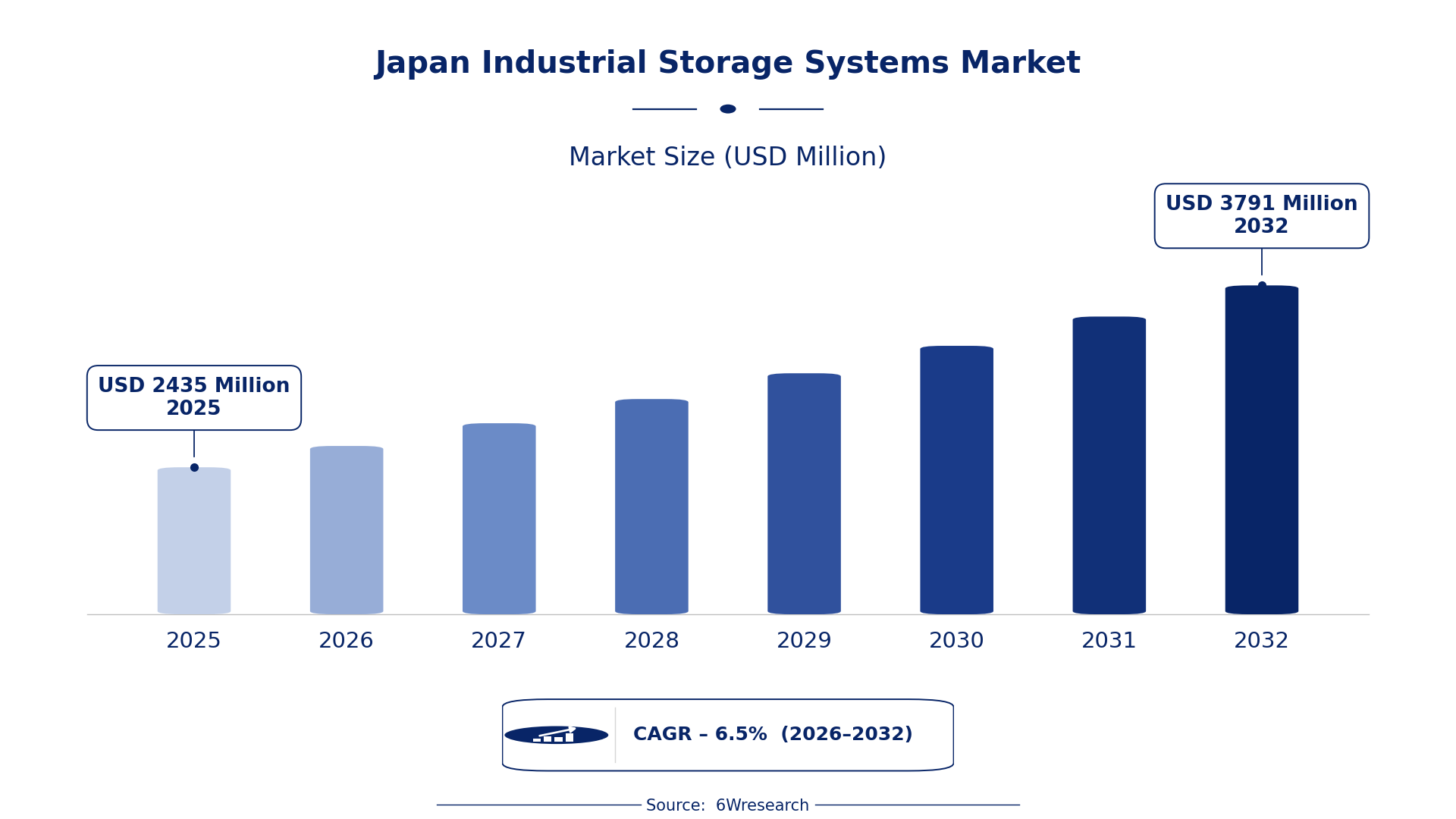
According to 6Wresearch internal database and industry insights, the Japan Industrial Storage Systems Market was valued at USD 2,435 Million in 2025 and is projected to reach USD 3,791 Million by 2032, growing at a CAGR of approximately 6.5% during 2026–2032.
Japan Industrial Storage Systems Market Highlights
| Report Metric | Details |
| Report Name | Japan Industrial Storage Systems Market (2026-2032) |
| Market Size 2025 | USD 2,435 Million |
| Market Size 2032 | USD 3,791 Million |
| Absolute Growth 2025–2032 | USD 1,356 Million |
| CAGR 2026–2032 | 6.5% |
| Peak Annual Growth | 7.7% in 2029 |
| Forecast Period | 2026–2032 |
| Historical Data | 2022–2025 |
| Base Year | 2025 |
| Leading Storage Type, 2025 | Pallet Racking Systems (49% share) |
| Leading Material Type, 2025 | Steel (48% share) |
| Leading Application, 2025 | Warehouse Storage (52% share) |
| Leading Distribution Channel, 2025 | Direct Sales (50% share) |
| Fastest-Growing Storage Type | Shelving Systems (9.6% CAGR) |
| Fastest-Growing Material Type | Aluminum/Plastic (9.8% CAGR) |
| Fastest-Growing Application | Retail Backrooms (8.8% CAGR) |
| Fastest-Growing Distribution Channel | Industrial Suppliers (8.7% CAGR) |
| Growing Sector | Logistics and Warehousing |
| Key End Users | Manufacturers, Retailers, Logistics Providers, Cold Storage Operators |
Japan Industrial Storage Systems Market Year-wise Growth Rate and Key Drivers (2022–2032)
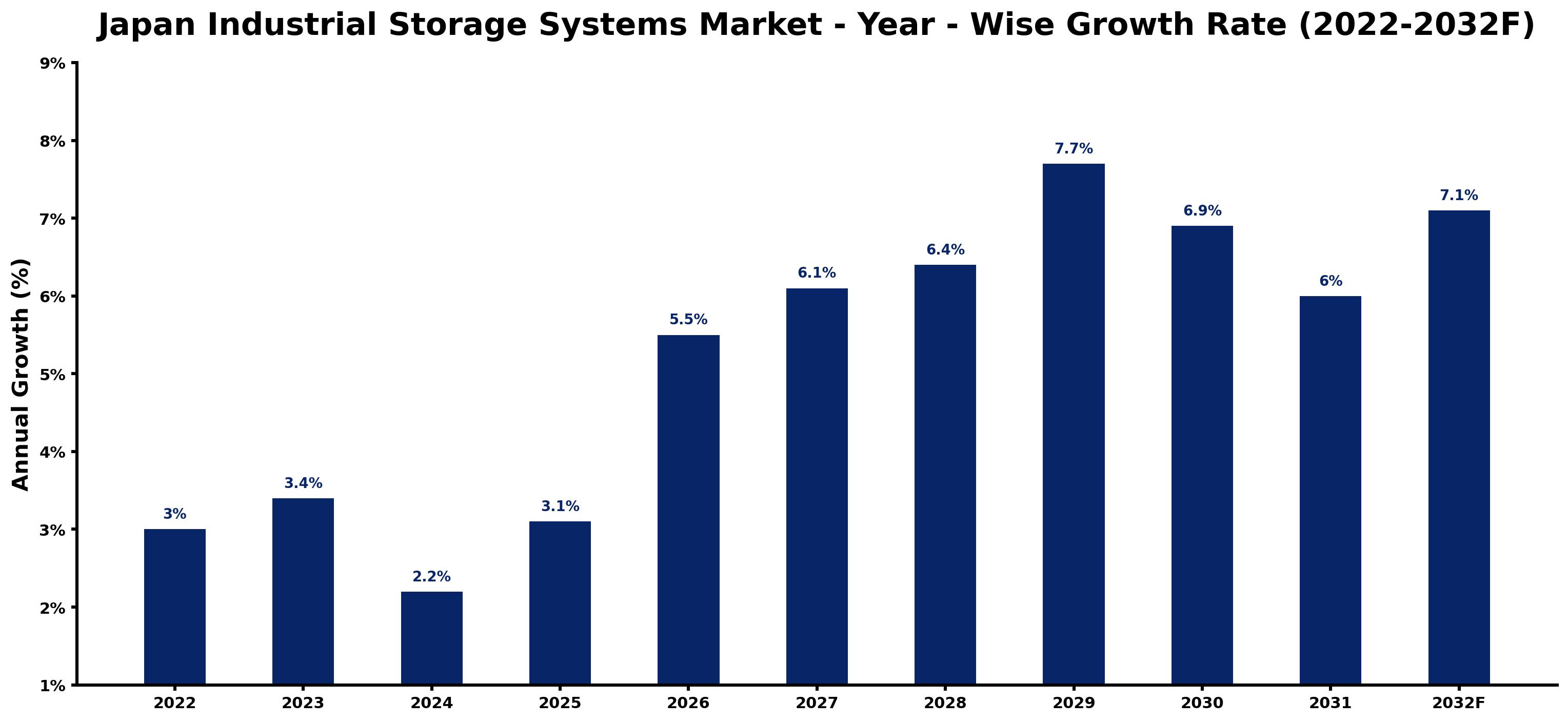
This graph illustrates the annual growth rates of the market from 2022 to 2032, highlighting a steady upward trajectory and projected market expansion over the forecast period.
The yearly estimates that follow link every growth rate to its principal driver, so readers can see why the pace changed in each period.
| Year | Estimated Annual Growth (%) | Market Rationale |
| 2022 | 3.0 | The market experienced steady growth, reflecting ongoing investments in warehouse infrastructure. |
| 2023 | 3.4 | Demand increased due to heightened logistics activity following the Tokyo 2020 Olympics. |
| 2024 | 2.2 | Growth slowed as supply chain adjustments continued to stabilise. |
| 2025 | 3.1 | Renewed investments in automation and efficiency drove faster growth in the market. |
| 2026 | 5.5 | The introduction of new technologies is expected to stimulate further demand for storage solutions. |
| 2027 | 6.1 | Increased focus on sustainability will drive interest in efficient storage systems. |
| 2028 | 6.4 | Rising e-commerce activity will support demand for warehouse storage. |
| 2029 | 7.7 | Peak growth is anticipated as urbanisation drives further investments in logistics. |
| 2030 | 6.9 | Growth is projected to moderate as the market reaches a more mature phase. |
| 2031 | 6.0 | A slight slowdown is expected as competition intensifies among suppliers. |
| 2032 | 7.1 | Demand is expected to rise again as new standards for efficiency are adopted. |
Note: Market size estimations and growth projections presented in this report are based on 6Wresearch's proprietary forecasting methodology, utilizing the latest available industry data, government publications, and primary research inputs.
Japan Industrial Storage Systems Market Synopsis
Industrial storage systems are essential for optimising space in warehouses and manufacturing facilities. These systems, made from materials like steel and aluminum, improve inventory management efficiency. The Japan Industrial Storage Systems Market is expanding due to increased logistics activity, driven by urbanisation and investments in automation. The Tokyo metropolitan area serves as a major hub for these solutions, while the government's focus on decarbonisation is prompting manufacturers to innovate.
Market Dynamics Impact Analysis (2026–2032)
| Factor | Type | Impact | Primary Segment Affected |
| Increased logistics activity due to urbanisation | Driver | High | Warehouse Storage |
| Growing demand for automation in warehouses | Driver | High | Pallet Racking Systems |
| Rising investments in cold storage facilities | Opportunity | High | Cold Storage Facilities |
| Expansion of e-commerce driving storage needs | Opportunity | High | Retail Backrooms |
| Supply chain disruptions affecting availability | Restraint | Medium | Shelving Systems |
| High costs of raw materials impacting pricing | Restraint | Medium | Steel |
| Competition from alternative storage solutions | Challenge | High | Automated Systems |
| Regulatory compliance requirements increasing complexity | Challenge | Medium | Pallet Racking Systems |
Evaluation of Drivers in Japan Industrial Storage Systems Market (2026–2032)
These are the developments adding the most demand over the forecast period.
| Drivers | Primary Segment Affected | Why It Matters (Evidence) |
| Urbanisation increasing logistics activity | Warehouse Storage | The high population density in urban areas drives demand for efficient storage solutions, increasing purchases of warehouse systems. |
| Growing interest in warehouse automation | Pallet Racking Systems | A new government program promotes automation, increasing demand for advanced storage solutions. |
| E-commerce growth boosting storage requirements | Retail Backrooms | As online shopping expands, retailers invest in shelving systems to effectively manage stock levels. |
| Demand for cold storage due to perishables | Cold Storage Facilities | The increasing number of cold storage facilities reflects the need for effective inventory management of perishables. |
| Focus on sustainability driving material innovation | Steel | Japan's decarbonisation goals encourage the use of durable materials like steel in storage solutions. |
Several shifts outside the market are driving sales. In 2023, the introduction of new technologies is anticipated to boost demand for storage solutions, especially in urban regions. E-commerce growth is prompting retailers to invest in efficient shelving systems for backroom stock management. The rise in cold storage facilities indicates a need for effective inventory management of perishables, with steel as the primary material used in these systems. Japan's decarbonisation goals are also pushing for the adoption of durable materials in storage solutions.
Evaluation of Restraints in Japan Industrial Storage Systems Market
Several factors work against faster growth; the main ones are summarised below.
| Market Restraint | Primary Segment Affected | Why It Matters (Evidence) |
| Supply chain disruptions affecting availability of materials | Shelving Systems | Supply chain issues have led to delays in the availability of shelving systems, impacting buyer decisions. |
| High costs of raw materials impacting pricing | Steel | Rising steel prices have increased overall costs for storage systems, affecting profitability for manufacturers. |
| Limited production capacity for automated systems | Automated Systems | The niche market for automated systems faces production constraints, limiting availability for buyers. |
| Regulatory compliance requirements increasing complexity | Pallet Racking Systems | Manufacturers must navigate complex regulations, increasing costs and time for compliance. |
| Competition from alternative storage solutions | Automated Systems | Emerging alternatives to traditional storage systems are capturing market share, challenging established products. |
Japan Industrial Storage Systems Market Challenges
Japan's stringent environmental regulations increase production costs for manufacturers, compelling them to invest heavily in sustainable materials. Many importers face challenges with outdated technology, resulting in a 30% slower processing time for orders, which delays inventory replenishment. Intense competition among distributors drives prices down, eroding profit margins by up to 15%, making it difficult for suppliers to maintain profitability. Buyers are experiencing rising costs due to increased demand for efficient storage solutions, with prices expected to rise by 10% over the next year due to supply constraints.
Trends in the Japan Industrial Storage Systems Market
Buyers and suppliers in the Japan Industrial Storage Systems Market are adjusting to the following trends.
- Shift in Warehouse Automation: The Kansai region is experiencing a transition towards automated storage solutions, with a projected growth of 15% by 2026. This shift reflects the increasing need for efficiency in logistics operations.
- Rising Demand for Cold Storage: In 2023, the number of cold storage facilities in Japan increased, driven by the growing demand for perishable goods. This trend is vital for maintaining supply chain integrity.
- Growing Interest in Modular Steel Systems: Modular steel storage systems are gaining popularity, particularly in manufacturing plants, as they provide flexible solutions for various storage needs. This trend is expected to improve operational efficiency.
- Expansion of Direct Sales Channels: Direct sales accounted for 50% of the distribution channel in 2025, reflecting a strong preference for personal engagement in purchasing storage systems.
Investment Opportunities in the Japan Industrial Storage Systems Market
The openings below show where demand in the Japan Industrial Storage Systems Market is visible and how suppliers can enter.
- Supply of Automated Storage Solutions: Automated storage systems offer a notable opportunity, with projected growth of 15% by 2026. Suppliers can focus on logistics companies in urban areas to meet this demand.
- Investment in Cold Storage Facilities: With the rising demand for perishables, there is a pressing need for more cold storage facilities. The expanding food retail sector in Kansai presents a prime opportunity for investment.
- Expansion of Steel Storage Systems: The demand for durable steel storage systems continues to grow, particularly in manufacturing plants. Suppliers can enter this market by collaborating with local manufacturers.
- Development of Modular Storage Solutions: There is an increasing need for modular storage solutions in warehouses, with a notable gap in supply. Partnering with industrial suppliers in urban areas can facilitate market entry.
Government Initiatives in the Japan Industrial Storage Systems Market
The Industrial Safety and Health Act (1972) requires employers to ensure safety standards for machinery and hazardous substances, affecting storage system manufacturers. Compliance with this law necessitates investment in safety measures, ensuring products meet regulatory standards. This act has resulted in higher compliance costs for manufacturers.
The GX Promotion Act (2023) sets a framework for decarbonisation strategies, influencing how storage system manufacturers design their products. Buyers benefit from this act as it promotes the development of energy-efficient storage solutions, aligning with sustainability goals. The act aims for approximately JPY 150 trillion in public and private investment over ten years.
Future Insight of the Japan Industrial Storage Systems Market
By 2032, warehouse efficiency will improve as government programmes promote automation, benefiting buyers through reduced operational costs. New ISO standards will improve quality and safety in storage systems, providing assurance to both suppliers and buyers. Increased investment in decarbonisation initiatives will lead to the adoption of more sustainable materials in production, aligning with environmental targets. As automated storage solutions are projected to grow, suppliers will find opportunities to innovate and respond to changing market demands.
Market Segmentation Analysis
Japan Industrial Storage Systems Market report covers a detailed analysis of the following market segments:
By Storage Type – Pallet Racking Systems Lead, Shelving Systems Expected to Grow Fastest
According to Saurav Kr Singh, Senior Research Analyst at 6Wresearch, the largest storage type category in 2025 was Pallet Racking Systems, at 49% of revenue. Pallet racking systems dominate the market as they are crucial for maximising vertical space in warehouses, which is essential for efficient inventory management. Their widespread application in the Tokyo metropolitan area, a key logistics hub, reinforces their leading status. Shelving Systems are set to record the highest CAGR in this split, 9.6% over 2026–2032. Shelving systems are experiencing rapid growth driven by the increasing need for effective stock management in retail backrooms, especially in urban environments with limited space. This demand is propelled by retailers striving to optimise their storage to meet rising consumer expectations. Suppliers must focus on creating versatile shelving systems to address the changing needs of the retail industry.
By Material Type – Steel Leads, Aluminum/Plastic Expected to Grow Fastest
Steel took 48% of material type revenue in 2025, more than any other category. Steel is the predominant material in the market, accounting for 70% of storage systems due to its strength and durability, making it suitable for various applications. Its reliability is essential for users seeking long-lasting solutions in warehouses and manufacturing facilities. Over 2026–2032, Aluminum/Plastic is expected to post the fastest growth, at a CAGR of 9.8%. Aluminum and plastic are gaining traction in lighter applications, driven by the demand for flexible and portable storage solutions in specific environments. This trend highlights a shift towards materials that cater to diverse storage requirements across different sectors. Buyers should explore a wider range of materials to improve the efficiency of their storage solutions in various operational scenarios.
By Application – Warehouse Storage Leads, Retail Backrooms Expected to Grow Fastest
Warehouse Storage held 52% of the Japan Industrial Storage Systems Market by application in 2025. Warehouse storage is critical for logistics and supply chain management, making it the largest application segment in the market. The substantial investment in warehouse infrastructure, particularly in the Tokyo area, underscores the importance of this segment. Retail Backrooms are projected to grow fastest, at a CAGR of 8.8% during 2026–2032. Retail backrooms are rapidly growing as they become essential for effective stock management in retail environments, driven by the need for efficient inventory control. This growth is particularly pronounced in urban retail spaces where operational efficiency is paramount. Suppliers should consider tailoring their offerings to meet the specific needs of retail backroom applications.
By Distribution Channel – Direct Sales Leads, Industrial Suppliers Expected to Grow Fastest
Direct Sales accounted for 50% of the market by distribution channel in 2025. Direct sales represent the primary channel for purchasing storage systems, allowing manufacturers to establish strong relationships with buyers. This direct approach is particularly effective in the industrial sector where tailored solutions are often required. The quickest growth will come from Industrial Suppliers, forecast to expand at a CAGR of 8.7% between 2026 and 2032. Industrial suppliers are increasingly becoming the fastest-growing distribution channel, as they play a key role in the distribution of storage solutions to various sectors. Their ability to provide specialised products and services is driving this growth. Buyers may find greater value in sourcing from industrial suppliers who can offer tailored solutions and expert advice.
Key Attractiveness of the Report
- 10 Years of Market Numbers
- Historical Data Starting from 2022 to 2025
- Base Year 2025
- Forecast Data until 2032
- Key Performance Indicators Impacting the Market
- Major Upcoming Developments and Projects
Key Highlights of the Report:
- Japan Industrial Storage Systems Market Outlook
- Market Size of Japan Industrial Storage Systems Market, 2025
- Forecast of Japan Industrial Storage Systems Market, 2032
- Historical Data and Forecast of Japan Industrial Storage Systems Revenues & Volume for the Period 2022-2032F
- Japan Industrial Storage Systems Market Trend Evolution
- Japan Industrial Storage Systems Market Drivers and Challenges
- Japan Industrial Storage Systems Price Trends
- Japan Industrial Storage Systems Porter's Five Forces
- Japan Industrial Storage Systems Industry Life Cycle
- Historical Data and Forecast of Japan Industrial Storage Systems Market Revenues & Volume By Storage Type for the Period 2022-2032F
- Historical Data and Forecast of Japan Industrial Storage Systems Market Revenues & Volume By Pallet Racking Systems for the Period 2022-2032F
- Historical Data and Forecast of Japan Industrial Storage Systems Market Revenues & Volume By Shelving Systems for the Period 2022-2032F
- Historical Data and Forecast of Japan Industrial Storage Systems Market Revenues & Volume By Mezzanine Systems for the Period 2022-2032F
- Historical Data and Forecast of Japan Industrial Storage Systems Market Revenues & Volume By Mobile Racks for the Period 2022-2032F
- Historical Data and Forecast of Japan Industrial Storage Systems Market Revenues & Volume By Material Type for the Period 2022-2032F
- Historical Data and Forecast of Japan Industrial Storage Systems Market Revenues & Volume By Steel for the Period 2022-2032F
- Historical Data and Forecast of Japan Industrial Storage Systems Market Revenues & Volume By Aluminum/Plastic for the Period 2022-2032F
- Historical Data and Forecast of Japan Industrial Storage Systems Market Revenues & Volume By Modular Steel for the Period 2022-2032F
- Historical Data and Forecast of Japan Industrial Storage Systems Market Revenues & Volume By Automated Systems for the Period 2022-2032F
- Historical Data and Forecast of Japan Industrial Storage Systems Market Revenues & Volume By Application for the Period 2022-2032F
- Historical Data and Forecast of Japan Industrial Storage Systems Market Revenues & Volume By Warehouse Storage for the Period 2022-2032F
- Historical Data and Forecast of Japan Industrial Storage Systems Market Revenues & Volume By Retail Backrooms for the Period 2022-2032F
- Historical Data and Forecast of Japan Industrial Storage Systems Market Revenues & Volume By Manufacturing Plants for the Period 2022-2032F
- Historical Data and Forecast of Japan Industrial Storage Systems Market Revenues & Volume By Cold Storage Facilities for the Period 2022-2032F
- Historical Data and Forecast of Japan Industrial Storage Systems Market Revenues & Volume By Distribution Channel for the Period 2022-2032F
- Historical Data and Forecast of Japan Industrial Storage Systems Market Revenues & Volume By Direct Sales for the Period 2022-2032F
- Historical Data and Forecast of Japan Industrial Storage Systems Market Revenues & Volume By Industrial Suppliers for the Period 2022-2032F
- Historical Data and Forecast of Japan Industrial Storage Systems Market Revenues & Volume By Storage Integrators for the Period 2022-2032F
- Historical Data and Forecast of Japan Industrial Storage Systems Market Revenues & Volume By Online Platforms for the Period 2022-2032F
- Japan Industrial Storage Systems Import Export Trade Statistics
- Market Opportunity Assessment By Storage Type
- Market Opportunity Assessment By Material Type
- Market Opportunity Assessment By Application
- Market Opportunity Assessment By Distribution Channel
- Japan Industrial Storage Systems Top Companies Market Share
- Japan Industrial Storage Systems Competitive Benchmarking By Technical and Operational Parameters
- Japan Industrial Storage Systems Company Profiles
- Japan Industrial Storage Systems Key Strategic Recommendations
Market Covered
Coverage by segment is as follows.
By Storage Type
- Pallet Racking Systems
- Shelving Systems
- Mezzanine Systems
- Mobile Racks
By Material Type
- Steel
- Aluminum/Plastic
- Modular Steel
- Automated Systems
By Application
- Warehouse Storage
- Retail Backrooms
- Manufacturing Plants
- Cold Storage Facilities
By Distribution Channel
- Direct Sales
- Industrial Suppliers
- Storage Integrators
- Online Platforms































