Japan Industrial Supply Chain Services Market Size & Growth Rate
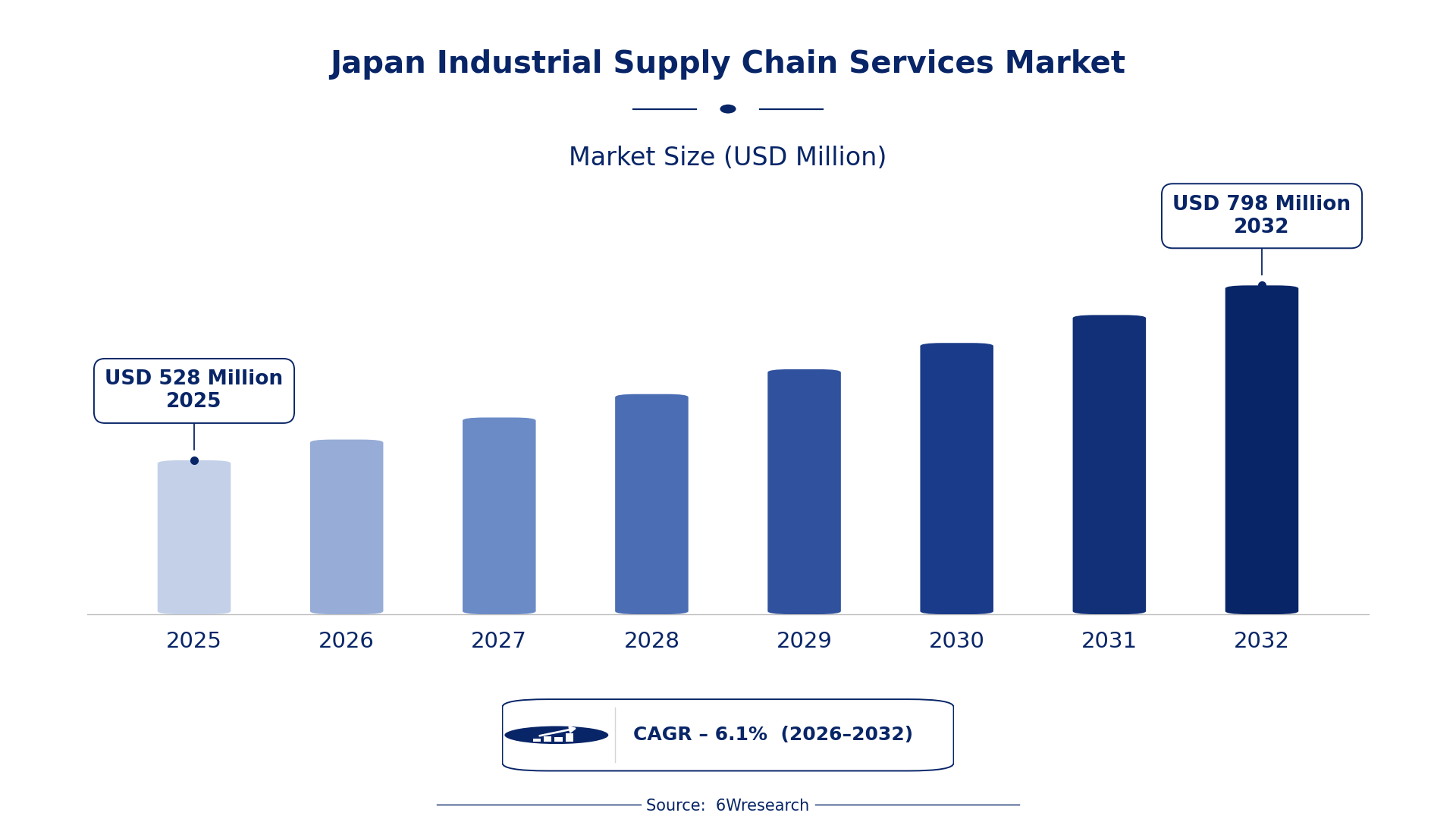
According to 6Wresearch internal database and industry insights, the Japan Industrial Supply Chain Services Market was valued at USD 528 Million in 2025 and is projected to reach USD 798 Million by 2032, growing at a CAGR of approximately 6.1% during 2026–2032.
Japan Industrial Supply Chain Services Market Highlights
| Report Metric | Details |
| Report Name | Japan Industrial Supply Chain Services Market (2026-2032) |
| Market Size 2025 | USD 528 Million |
| Market Size 2032 | USD 798 Million |
| Absolute Growth 2025–2032 | USD 270 Million |
| CAGR 2026–2032 | 6.1% |
| Peak Annual Growth | 6.8% in 2032 |
| Forecast Period | 2026–2032 |
| Historical Data | 2022–2025 |
| Base Year | 2025 |
| Leading Service Type, 2025 | Freight & Logistics (38% share) |
| Leading Technology Support, 2025 | Cloud-Based (41% share) |
| Leading End User, 2025 | Electronics Distributors (34% share) |
| Leading Distribution Channel, 2025 | Direct Contracts (36% share) |
| Fastest-Growing Service Type | Procurement Services (8.4% CAGR) |
| Fastest-Growing End User | Semiconductor Plants (8.5% CAGR) |
| Fastest-Growing Distribution Channel | SaaS Platforms (8.2% CAGR) |
| Growing Sector | Electronics |
| Key End Users | Electronics Distributors, Semiconductor Plants, Telecom Equipment |
Japan Industrial Supply Chain Services Market Year-wise Growth Rate and Key Drivers (2022–2032)
This graph illustrates the annual growth rates of the market from 2022 to 2032, highlighting a steady upward trajectory and projected market expansion over the forecast period.
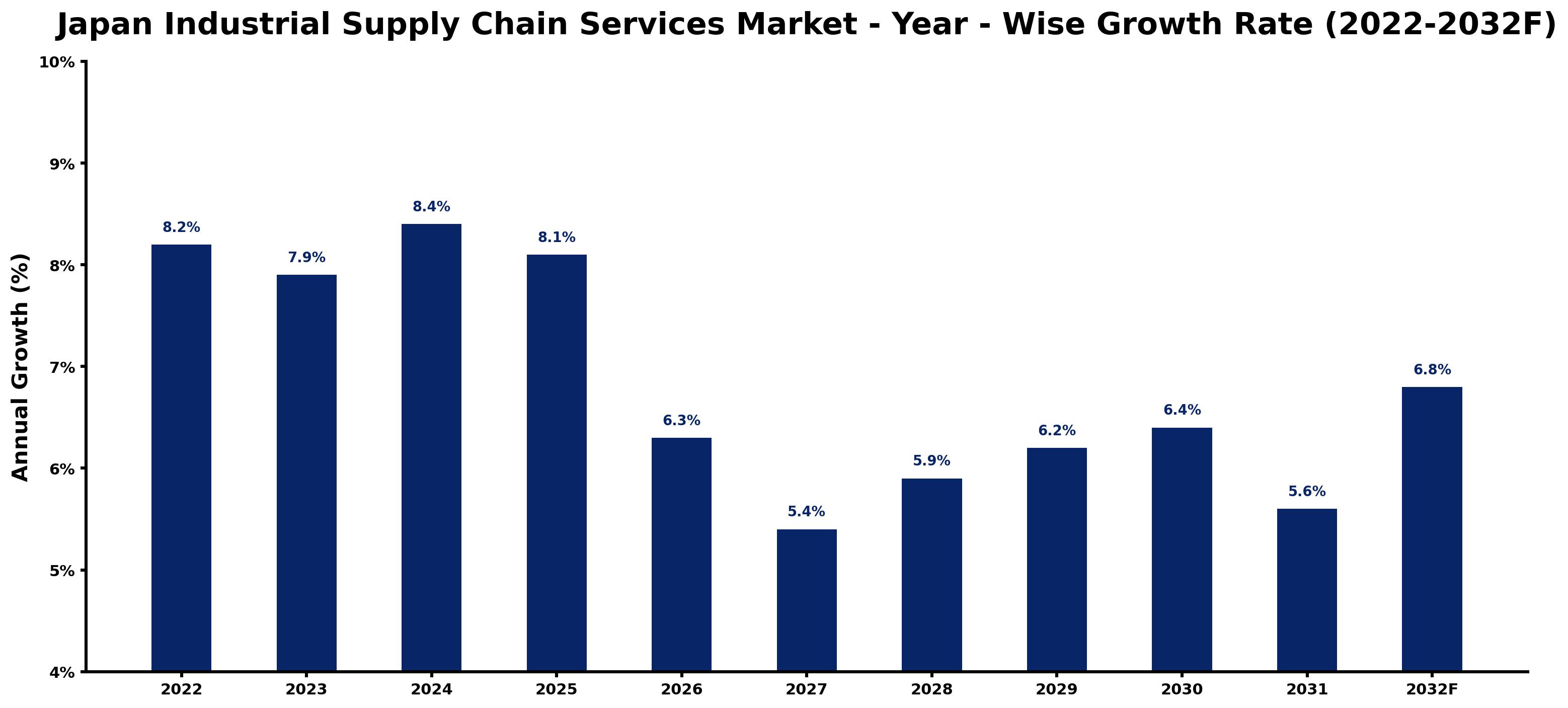
For each year, the table pairs the estimated growth rate with the leading influence on demand, showing how the drivers changed across the period.
| Year | Estimated Annual Growth (%) | Market Rationale |
| 2022 | 8.2 | The market experienced strong demand from the electronics sector, driving growth. |
| 2023 | 7.9 | Growth slowed as businesses adjusted to supply chain challenges from the previous year. |
| 2024 | 8.4 | Increased investments in logistics technology boosted growth rates. |
| 2025 | 8.1 | Growth slowed again as the market stabilised after rapid expansion in prior years. |
| 2026 | 6.3 | Demand for cloud-based solutions is expected to drive growth more consistently. |
| 2027 | 5.4 | The market will continue to grow, albeit at a slower pace as saturation approaches. |
| 2028 | 5.9 | A resurgence in e-commerce will lead to faster growth in logistics services. |
| 2029 | 6.2 | Continued investment in supply chain efficiency is projected to improve market performance. |
| 2030 | 6.4 | Technological advancements in logistics will further support market expansion. |
| 2031 | 5.6 | Growth will slow as the market adjusts to new operational realities. |
| 2032 | 6.8 | The market is expected to peak as demand for sustainable logistics rises. |
Note: Market size estimations and growth projections presented in this report are based on 6Wresearch's proprietary forecasting methodology, utilizing the latest available industry data, government publications, and primary research inputs.
Japan Industrial Supply Chain Services Market Synopsis
Industrial supply chain services encompass logistics and management solutions that optimise the flow of goods and information. These services improve operational efficiency and visibility, particularly in sectors like electronics and telecommunications. The Japan Industrial Supply Chain Services Market is expanding due to rising demand for cloud-based solutions, with 60% of firms adopting these technologies. The government's push for decarbonisation, targeting JPY 150 trillion in investments, drives the need for efficient supply chain services.
Market Dynamics Impact Analysis (2026–2032)
| Factor | Type | Impact | Primary Segment Affected |
| Rising e-commerce demand | Driver | High | Freight & Logistics |
| Increased adoption of cloud-based solutions | Driver | High | Cloud-Based |
| Growing need for efficient logistics in the electronics sector | Opportunity | High | Electronics Distributors |
| Investment in logistics digitisation | Opportunity | Medium | Freight & Logistics |
| High logistics costs impacting profitability | Restraint | High | Warehousing |
| Compliance with ISO 9001 certification requirements | Restraint | Medium | Freight & Logistics |
| Capacity constraints in warehousing | Challenge | High | Warehousing |
| Regulatory compliance costs | Challenge | Medium | Freight & Logistics |
Evaluation of Drivers in Japan Industrial Supply Chain Services Market (2026–2032)
The main growth drivers and the segments they affect most are set out below.
| Drivers | Primary Segment Affected | Why It Matters (Evidence) |
| Increased e-commerce activity | Freight & Logistics | The rise in online shopping has driven demand for efficient logistics solutions, with Japan's e-commerce market growing to approximately JPY 20 trillion. |
| Cloud adoption for supply chain management | Cloud-Based | As 60% of firms adopt cloud solutions, operational efficiency improves, leading to increased service demand. |
| Technological investments in logistics | Freight & Logistics | Investment in logistics technology attracts more users in the electronics sector, improving service capabilities. |
| Government decarbonisation initiatives | Electronics Distributors | Japan's target for a 46% reduction in greenhouse gases by 2030 encourages investment in efficient supply chains. |
| Rising production values in semiconductors | Semiconductor Plants | With a production value of ¥4 trillion in 2022, the semiconductor industry drives demand for supply chain services. |
Buyers are adding capacity as Japan's e-commerce market expands, with online retail sales reaching approximately JPY 20 trillion. The adoption of cloud-based solutions by 60% of firms is prompting logistics vendors to increase service offerings. The semiconductor industry, valued at ¥4 trillion, requires supply chain services to manage complex logistics. Investments in technology are rising, improving capabilities for service providers. As a result, demand for freight and logistics services continues to rise.
Evaluation of Restraints in Japan Industrial Supply Chain Services Market
The main factors holding the market back are set out below.
| Market Restraint | Primary Segment Affected | Why It Matters (Evidence) |
| High logistics costs affecting competitiveness | Warehousing | Logistics costs average around 10% of total sales, impacting profit margins for businesses. |
| ISO 9001 certification compliance | Freight & Logistics | Many service providers must meet ISO standards, increasing operational costs and complexity. |
| Limited warehousing capacity in urban areas | Warehousing | The Tokyo region's logistics hub faces space constraints, limiting service availability. |
| Regulatory compliance costs for logistics providers | Freight & Logistics | Compliance with the Economic Security Promotion Act adds financial burdens on service providers. |
| Dependence on skilled workforce | Freight & Logistics | The logistics sector struggles with talent shortages, affecting service delivery capabilities. |
Japan Industrial Supply Chain Services Market Challenges
Rising logistics costs pose a major challenge for buyers, averaging around 10% of total sales value, which pressures profit margins. Stringent regulations complicate operations for suppliers, as compliance with the Logistics Efficiency Act can delay service implementation and elevate operational costs. Limited technology adoption hinders efficiency, with only 60% of firms using cloud-based solutions, restricting competitive capabilities. Skills shortages are prevalent, particularly in the electronics sector, which employs over 1 million people, creating a talent gap that undermines service quality for providers.
Trends in the Japan Industrial Supply Chain Services Market
The shifts below are changing how Japan Industrial Supply Chain Services Market products are bought and supplied.
- Shift towards Cloud-Based Solutions: Japan is increasingly adopting cloud-based supply chain solutions, with 60% of firms implementing these technologies. This shift improves operational efficiency and visibility, allowing businesses to manage logistics remotely.
- Transition from Traditional to Digital Logistics: In 2023, the government launched a programme to digitize logistics operations across industries, aiming to improve efficiency. This initiative supports the growing demand for digital solutions in supply chain management.
- Electronics Sector Prioritising Supply Chain Efficiency: Electronics distributors are focusing on optimising supply chains, driven by the need for faster delivery. The sector employs over 1 million people, highlighting its significance in the logistics market.
- Emergence of Sustainable Logistics Practices: With Japan targeting net zero emissions by 2050, sustainable logistics practices are gaining traction. The GX Promotion Act encourages businesses to adopt greener supply chain solutions.
Investment Opportunities in the Japan Industrial Supply Chain Services Market
The following opportunities in the Japan Industrial Supply Chain Services Market pair current demand with a clear way in.
- Investing in Cloud-Based Supply Chain Solutions: With 60% of firms adopting cloud technologies, there is a clear opportunity for investment in these solutions. Electronics distributors are particularly interested in enhancing their logistics capabilities.
- Growing Demand for Logistics in E-Commerce: Japan's e-commerce market is projected to reach JPY 20 trillion, creating a demand for efficient logistics services. Investing in freight solutions will cater to this expanding market.
- Enhancing Logistics for Semiconductor Industry: The semiconductor sector, valued at ¥4 trillion, offers opportunities for logistics providers to deliver tailored services. Collaborating with semiconductor plants can enhance service delivery.
- Entering the Market through Direct Contracts: Direct contracts are a prevalent method for engaging logistics services, representing a 36% share. Establishing partnerships with logistics vendors can facilitate market entry.
Government Initiatives in the Japan Industrial Supply Chain Services Market
The GX Promotion Act, introduced in 2023, builds on the framework established by the Economic Security Promotion Act of 2022. This new law focuses on promoting decarbonisation in supply chains, requiring companies to adopt sustainable practices and report on their progress.
Electronics distributors are utilising the Economic Security Promotion Act to strengthen supply chain resilience. By engaging in designated critical products and materials, they can secure their operations against disruptions while complying with regulatory requirements.
Future Insight of the Japan Industrial Supply Chain Services Market
Electronics buyers will experience improved efficiency due to the government's digitization programme, which aims to modernise operations. By 2032, Japan's logistics market will benefit from an estimated JPY 150 trillion investment in decarbonisation, promoting sustainable practices. Advanced technologies such as AI and automation will be integrated, boosting operational capabilities for suppliers. The growth of e-commerce will continue to drive demand for flexible supply chain solutions, ensuring responsiveness to market changes.
Market Segmentation Analysis
Japan Industrial Supply Chain Services Market report covers a detailed analysis of the following market segments:
By Service Type – Freight & Logistics Leads, Procurement Services Expected to Grow Fastest
According to Saurav Kr Singh, Senior Research Analyst at 6Wresearch, Freight & Logistics accounted for 38% of the market by service type in 2025. Freight and logistics services hold the largest market share due to their critical role in transporting products across Japan's diverse regions. The Tokyo region exemplifies this with its extensive warehousing facilities that support these essential operations. Procurement Services are projected to grow fastest, at a CAGR of 8.4% during 2026–2032. Procurement services are witnessing rapid growth as companies aim to streamline sourcing processes amidst rising operational costs. The government's initiative to digitise logistics operations is expected to further accelerate the expansion of this segment. Suppliers should focus on enhancing procurement solutions to meet the increasing demand for efficiency.
By Technology Support – Cloud-Based Leads and Records the Fastest Growth
With 41% of technology support revenue in 2025, Cloud-Based was the largest category. Cloud-based solutions lead the market as they are vital for managing operations remotely, enabling firms to optimise their logistics processes effectively. With 60% of Japanese firms adopting these technologies, the installed base is expanding rapidly. Cloud-Based is also forecast to expand faster than any other category, at a CAGR of 9.2% over 2026–2032. The cloud-based segment is also the fastest-growing, driven by the need for flexibility and real-time data access in supply chain management. As more companies transition to digital platforms, this growth trajectory is likely to continue. Suppliers must invest in cloud technologies to remain competitive in this rapidly evolving market.
By End User – Electronics Distributors Lead, Semiconductor Plants Expected to Grow Fastest
The largest end user category in 2025 was Electronics Distributors, at 34% of revenue. Electronics distributors hold the largest share as they are major users of supply chain services, facilitating the distribution of products throughout Japan. This sector employs over 1 million people, indicating a robust demand for logistics solutions. Over 2026–2032, Semiconductor Plants are expected to post the fastest growth, at a CAGR of 8.5%. Semiconductor plants are the fastest-growing end user, driven by the industry's critical need to manage complex supply chains efficiently. The production value of ¥4 trillion in 2022 highlights the sector's importance and potential for growth. Suppliers should tailor their offerings to meet the specific needs of semiconductor plants to capture this growth opportunity.
By Distribution Channel – Direct Contracts Lead, SaaS Platforms Expected to Grow Fastest
Direct Contracts took 36% of distribution channel revenue in 2025, more than any other category. Direct contracts are the leading distribution channel, as they are a common method for engaging supply chain services directly with providers. This approach allows for tailored solutions that meet specific client needs. The quickest growth will come from SaaS Platforms, forecast to expand at a CAGR of 8.2% between 2026 and 2032. SaaS platforms are emerging as the fastest-growing channel, reflecting the trend towards digital solutions that enhance supply chain management efficiency. The increasing reliance on technology in logistics is driving this shift. Suppliers should consider developing SaaS offerings to align with the market's digital transformation.
Key Attractiveness of the Report
- 10 Years of Market Numbers
- Historical Data Starting from 2022 to 2025
- Base Year 2025
- Forecast Data until 2032
- Key Performance Indicators Impacting the Market
- Major Upcoming Developments and Projects
Key Highlights of the Report:
- Japan Industrial Supply Chain Services Market Outlook
- Market Size of Japan Industrial Supply Chain Services Market, 2025
- Forecast of Japan Industrial Supply Chain Services Market, 2032
- Historical Data and Forecast of Japan Industrial Supply Chain Services Revenues & Volume for the Period 2022-2032F
- Japan Industrial Supply Chain Services Market Trend Evolution
- Japan Industrial Supply Chain Services Market Drivers and Challenges
- Japan Industrial Supply Chain Services Price Trends
- Japan Industrial Supply Chain Services Porter's Five Forces
- Japan Industrial Supply Chain Services Industry Life Cycle
- Historical Data and Forecast of Japan Industrial Supply Chain Services Market Revenues & Volume By Service Type for the Period 2022-2032F
- Historical Data and Forecast of Japan Industrial Supply Chain Services Market Revenues & Volume By Warehousing for the Period 2022-2032F
- Historical Data and Forecast of Japan Industrial Supply Chain Services Market Revenues & Volume By Freight & Logistics for the Period 2022-2032F
- Historical Data and Forecast of Japan Industrial Supply Chain Services Market Revenues & Volume By Procurement Services for the Period 2022-2032F
- Historical Data and Forecast of Japan Industrial Supply Chain Services Market Revenues & Volume By Inventory Management for the Period 2022-2032F
- Historical Data and Forecast of Japan Industrial Supply Chain Services Market Revenues & Volume By Technology Support for the Period 2022-2032F
- Historical Data and Forecast of Japan Industrial Supply Chain Services Market Revenues & Volume By RFID/Barcode for the Period 2022-2032F
- Historical Data and Forecast of Japan Industrial Supply Chain Services Market Revenues & Volume By GPS Fleet Tracking for the Period 2022-2032F
- Historical Data and Forecast of Japan Industrial Supply Chain Services Market Revenues & Volume By EDI Integration for the Period 2022-2032F
- Historical Data and Forecast of Japan Industrial Supply Chain Services Market Revenues & Volume By Cloud-Based for the Period 2022-2032F
- Historical Data and Forecast of Japan Industrial Supply Chain Services Market Revenues & Volume By End User for the Period 2022-2032F
- Historical Data and Forecast of Japan Industrial Supply Chain Services Market Revenues & Volume By Electronics Distributors for the Period 2022-2032F
- Historical Data and Forecast of Japan Industrial Supply Chain Services Market Revenues & Volume By Telecom Equipment for the Period 2022-2032F
- Historical Data and Forecast of Japan Industrial Supply Chain Services Market Revenues & Volume By ICT Sector for the Period 2022-2032F
- Historical Data and Forecast of Japan Industrial Supply Chain Services Market Revenues & Volume By Semiconductor Plants for the Period 2022-2032F
- Historical Data and Forecast of Japan Industrial Supply Chain Services Market Revenues & Volume By Distribution Channel for the Period 2022-2032F
- Historical Data and Forecast of Japan Industrial Supply Chain Services Market Revenues & Volume By Direct Contracts for the Period 2022-2032F
- Historical Data and Forecast of Japan Industrial Supply Chain Services Market Revenues & Volume By Logistics Vendors for the Period 2022-2032F
- Historical Data and Forecast of Japan Industrial Supply Chain Services Market Revenues & Volume By B2B Portals for the Period 2022-2032F
- Historical Data and Forecast of Japan Industrial Supply Chain Services Market Revenues & Volume By SaaS Platforms for the Period 2022-2032F
- Japan Industrial Supply Chain Services Import Export Trade Statistics
- Market Opportunity Assessment By Service Type
- Market Opportunity Assessment By Technology Support
- Market Opportunity Assessment By End User
- Market Opportunity Assessment By Distribution Channel
- Japan Industrial Supply Chain Services Top Companies Market Share
- Japan Industrial Supply Chain Services Competitive Benchmarking By Technical and Operational Parameters
- Japan Industrial Supply Chain Services Company Profiles
- Japan Industrial Supply Chain Services Key Strategic Recommendations
Market Covered
The report covers the following segments.
By Service Type
- Warehousing
- Freight & Logistics
- Procurement Services
- Inventory Management
By Technology Support
- RFID/Barcode
- GPS Fleet Tracking
- EDI Integration
- Cloud-Based
By End User
- Electronics Distributors
- Telecom Equipment
- ICT Sector
- Semiconductor Plants
By Distribution Channel
- Direct Contracts
- Logistics Vendors
- B2B Portals
- SaaS Platforms































