Japan Industrial Surfactants Market Size & Growth Rate
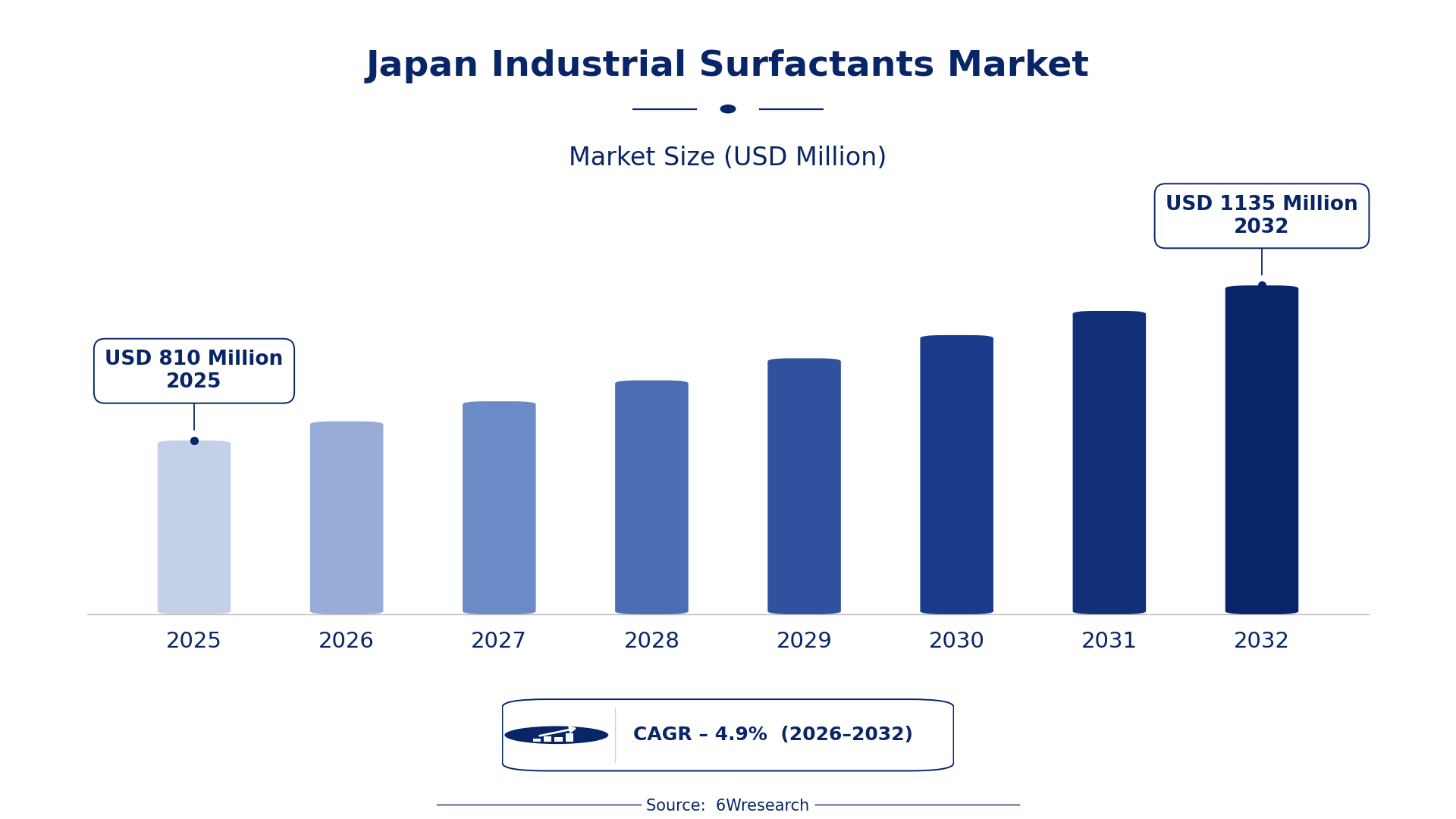
According to 6Wresearch internal database and industry insights, the Japan Industrial Surfactants Market was valued at USD 810 Million in 2025 and is projected to reach USD 1,135 Million by 2032, growing at a CAGR of approximately 4.9% during 2026–2032.
Japan Industrial Surfactants Market Highlights
| Report Metric | Details |
| Report Name | Japan Industrial Surfactants Market (2026-2032) |
| Market Size 2025 | USD 810 Million |
| Market Size 2032 | USD 1,135 Million |
| Absolute Growth 2025–2032 | USD 325 Million |
| CAGR 2026–2032 | 4.9% |
| Peak Annual Growth | 6.3% in 2032 |
| Forecast Period | 2026–2032 |
| Historical Data | 2022–2025 |
| Base Year | 2025 |
| Leading Surfactant Type, 2025 | Anionic Surfactants (40% share) |
| Leading Chemical Structure, 2025 | Sulfonates (49% share) |
| Leading Application, 2025 | Detergents (46% share) |
| Leading Distribution Channel, 2025 | Bulk Chemical Suppliers (48% share) |
| Fastest-Growing Surfactant Type | Nonionic Surfactants (6.9% CAGR) |
| Fastest-Growing Chemical Structure | Ethoxylates (6.4% CAGR) |
| Fastest-Growing Application | Emulsifiers (6.6% CAGR) |
| Fastest-Growing Distribution Channel | Online Chemical Sellers (6.8% CAGR) |
| Growing Sector | Personal Care Products |
| Key End Users | Detergent manufacturers, personal care product producers, food industry suppliers |
Japan Industrial Surfactants Market Year-wise Growth Rate and Key Drivers (2022–2032)
This graph illustrates the annual growth rates of the market from 2022 to 2032, highlighting a steady upward trajectory and projected market expansion over the forecast period.
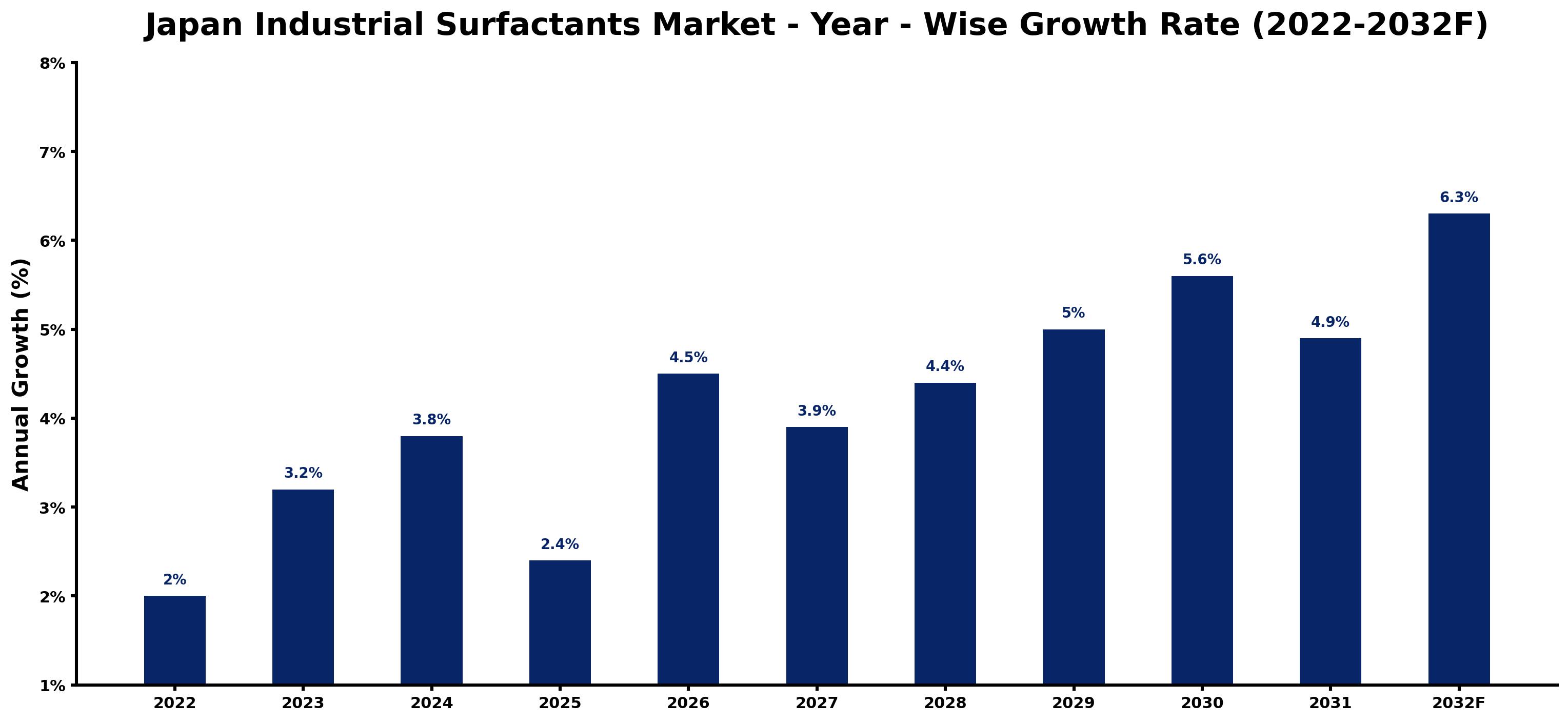
For each year, the table pairs the estimated growth rate with the leading influence on demand, showing how the drivers changed across the period.
| Year | Estimated Annual Growth (%) | Market Rationale |
| 2022 | 2.0 | The market experienced steady growth due to consistent domestic demand. |
| 2023 | 3.2 | Increased investments in personal care products contributed to faster growth. |
| 2024 | 3.8 | The rise in detergent usage further accelerated market expansion. |
| 2025 | 2.4 | Growth slowed as the market adjusted to previous peaks in demand. |
| 2026 | 4.5 | New eco-friendly product lines are expected to drive higher demand for surfactants. |
| 2027 | 3.9 | A slight slowdown is projected as market saturation begins to set in. |
| 2028 | 4.4 | Innovations in emulsifiers are expected to spark renewed interest from manufacturers. |
| 2029 | 5.0 | Demand is projected to surge as consumers shift towards sustainable products. |
| 2030 | 5.6 | Continued investment in green chemistry practices is expected to boost growth. |
| 2031 | 4.9 | A slowdown is anticipated as the market stabilises after rapid growth. |
| 2032 | 6.3 | The peak growth will be driven by heightened environmental awareness. |
Note: Market size estimations and growth projections presented in this report are based on 6Wresearch's proprietary forecasting methodology, utilizing the latest available industry data, government publications, and primary research inputs.
Japan Industrial Surfactants Market Synopsis
Industrial surfactants are chemical compounds that lower surface tension between liquids or solids, produced through processes like sulfonation and ethoxylation. The Japan Industrial Surfactants Market is expanding, driven by rising demand in personal care and cleaning sectors, alongside investments in sustainable practices. Approximately 30% of surfactant demand comes from personal care products, indicating strong growth potential in eco-friendly formulations and diverse applications across industries.
Market Dynamics Impact Analysis (2026–2032)
| Factor | Type | Impact | Primary Segment Affected |
| Growing demand for eco-friendly products | Driver | High | Nonionic Surfactants |
| Rising personal care product consumption | Driver | High | Detergents |
| Increased focus on sustainable formulations | Opportunity | High | Ethoxylates |
| Expansion of online sales channels | Opportunity | Medium | Online Chemical Sellers |
| Stringent regulations on chemical safety | Restraint | High | Cationic Surfactants |
| Market saturation in traditional applications | Restraint | Medium | Anionic Surfactants |
| Limited production capacity for bio-based surfactants | Challenge | High | Sulfonates |
| Competition from alternative formulations | Challenge | Medium | Amphoteric Surfactants |
Evaluation of Drivers in Japan Industrial Surfactants Market (2026–2032)
Below are the drivers that matter most for revenue growth, with supporting evidence.
| Drivers | Primary Segment Affected | Why It Matters (Evidence) |
| Increased consumer focus on sustainability | Nonionic Surfactants | This trend leads manufacturers to invest more in eco-friendly surfactants, with the personal care segment accounting for about 30% of overall demand. |
| Growing production of personal care products | Detergents | The average household uses about 12 liters of detergent per year, driving higher demand for surfactants in this sector. |
| Adoption of bio-based surfactants | Ethoxylates | Japan's surfactant market will adopt more bio-based products by 2025, creating market opportunities. |
| Expansion of e-commerce platforms | Online Chemical Sellers | Online sales of industrial chemicals increased by 15% last year, attracting new buyer segments. |
| Increasing demand in food emulsification | Emulsifiers | Surfactants are essential in the formulation of over 50% of personal care products, expanding their application range. |
What keeps demand rising is the increasing consumer focus on sustainability, with the personal care sector accounting for about 30% of surfactant demand. The average household uses approximately 12 liters of detergent annually, driving higher consumption of surfactants. Japan's surfactant market is expected to adopt more bio-based products by 2025, creating opportunities for manufacturers. The expansion of e-commerce platforms has led to a 15% increase in online sales of industrial chemicals, attracting new buyers. Surfactants are essential in food emulsification, further diversifying their applications in various sectors.
Evaluation of Restraints in Japan Industrial Surfactants Market
Below are the constraints most often cited by buyers and suppliers, with the segment each affects.
| Market Restraint | Primary Segment Affected | Why It Matters (Evidence) |
| Strict regulations on chemical safety | Cationic Surfactants | Japan has stringent regulations that require manufacturers to ensure compliance, which can increase operational costs. |
| Market saturation in traditional surfactant applications | Anionic Surfactants | As the market matures, growth in traditional applications has slowed, limiting new opportunities. |
| Limited production capacity for bio-based surfactants | Sulfonates | The transition to bio-based products requires substantial investment, which can hinder growth for some producers. |
| Competition from alternative formulations | Amphoteric Surfactants | The rise of alternative formulations can divert demand away from traditional surfactants, impacting sales. |
| High production costs for eco-friendly surfactants | Ethoxylates | Investments in sustainable practices can lead to higher production costs, affecting pricing strategies. |
Japan Industrial Surfactants Market Challenges
Buyers face increased sourcing costs as the country shifts towards eco-friendly formulations, leading to a 15% rise in raw material expenses. Distributors struggle with fluctuating demand from the personal care segment, which accounts for 30% of surfactant consumption, resulting in potential stockouts and lost sales opportunities. Producers encounter high compliance costs due to Japan's stringent chemical safety regulations, which can exceed JPY 10 million annually, limiting their ability to invest in new technologies. Regulatory hurdles can delay product launches, impacting market responsiveness and competitiveness for manufacturers.
Trends in the Japan Industrial Surfactants Market
Several trends are reshaping the Japan Industrial Surfactants Market; the most important are set out below.
- Shift towards Eco-Friendly Products: Since 2023, there has been a shift towards eco-friendly surfactants, as consumer demand for sustainable products rises. Approximately 30% of surfactant demand now comes from personal care products, indicating a growing preference for environmentally friendly formulations.
- Transition from Traditional to Bio-Based Surfactants: The introduction of bio-based surfactants is changing market practices, with producers focusing on sustainable alternatives. By 2025, the market is projected to adopt more bio-based products, reflecting a commitment to reducing environmental impact.
- Emergence of Online Sales Channels: In 2022, online sales of industrial chemicals increased by 15%, showcasing a shift in purchasing behaviour. This trend is facilitating access for smaller buyers and diversifying the market.
- Increasing Demand for Emulsifiers in Food Industry: The demand for emulsifiers in the food industry has been on the rise, with surfactants playing an important role in stabilising mixtures. This segment is expected to expand further, reflecting changing consumer preferences.
Investment Opportunities in the Japan Industrial Surfactants Market
The opportunities below stand out in the Japan Industrial Surfactants Market for new entrants and existing suppliers.
- Personal Care Manufacturers: Personal care manufacturers increasingly seek sustainable surfactants, with a growing market reflecting consumer preferences. Collaborating with local suppliers can improve product offerings, with the personal care segment accounting for about 30% of surfactant demand.
- Tokyo Industrial Facilities: Tokyo's industrial facilities are focusing on eco-friendly surfactant production, presenting investment opportunities for suppliers. The region's strong manufacturing base supports growth in sustainable practices, with an estimated 15% increase in eco-friendly production capacity.
- Joint Ventures for Sustainable Production: Investing in joint ventures with local producers can facilitate entry into the eco-friendly surfactant market. This approach allows for shared resources and expertise in sustainable practices, tapping into the growing demand for bio-based products.
- Supply of Bio-Based Surfactants: The demand for bio-based surfactants is rising, driven by consumer preferences for sustainable products. Suppliers can target personal care manufacturers looking to innovate their product lines, with an expected 20% increase in bio-based surfactant demand by 2025.
Government Initiatives in the Japan Industrial Surfactants Market
The Industrial Safety and Health Act (1972) establishes safety standards for hazardous substances and machinery, impacting surfactant producers by enforcing compliance measures. The GX Promotion Act (2023) further supports the industry by promoting decarbonisation efforts, targeting about JPY 150 trillion of public and private investment over the next decade, encouraging innovation in surfactant production.
The Ministry of Economy, Trade and Industry oversees various initiatives that support surfactant innovation programs, ensuring compliance with safety regulations. These initiatives aim to improve the sustainability of surfactants, benefiting manufacturers and buyers alike, with funding of approximately JPY 30 billion allocated for green chemistry projects.
Future Insight of the Japan Industrial Surfactants Market
Japan's policy-driven shift towards sustainability will reshape the surfactant market by 2032, with increased investments in green chemistry initiatives. The anticipated adoption of bio-based products will meet evolving consumer preferences and regulatory standards. Enhanced quality control through ISO 9001 will elevate product reliability for buyers and suppliers. The market is expected to experience a significant transformation, with over 50% of personal care products incorporating eco-friendly surfactants, creating new opportunities for suppliers.
Market Segmentation Analysis
Japan Industrial Surfactants Market report covers a detailed analysis of the following market segments:
By Surfactant Type – Anionic Surfactants Lead, Nonionic Surfactants Expected to Grow Fastest
According to Saurav Kr Singh, Senior Research Analyst at 6Wresearch, the largest surfactant type category in 2025 was Anionic Surfactants, at 40% of revenue. Anionic surfactants hold the largest share due to their widespread use in detergents and cleaning agents, which are essential for both domestic and industrial applications. Their role in formulating over 50% of personal care products underscores their dominant position in the market. Nonionic Surfactants are set to record the highest CAGR in this split, 6.9% over 2026–2032. The rapid growth of nonionic surfactants is attributed to their emulsifying properties, particularly in eco-friendly formulations that are gaining traction. As consumer demand shifts towards sustainable products, the market for nonionic surfactants is expected to expand significantly. Suppliers must focus on increasing the production of nonionic surfactants to meet the rising demand for sustainable solutions.
By Chemical Structure – Sulfonates Lead, Ethoxylates Expected to Grow Fastest
In 2025, Sulfonates led the chemical structure split with a 49% share. Sulfonates lead the market as they are key components in many industrial surfactants, effectively reducing surface tension across various applications. Their essential role in numerous formulations solidifies their leading status in the chemical structure segment. Ethoxylates are projected to grow fastest, at a CAGR of 6.4% during 2026–2032. Ethoxylates are experiencing rapid growth due to their critical emulsifying properties, especially in the food and cosmetics industries. The rising demand for effective emulsifiers is set to drive significant market expansion for ethoxylates in the near future. Buyers should consider increasing their procurement of ethoxylate-based products to enhance formulation effectiveness in their applications.
By Application – Detergents Lead, Emulsifiers Expected to Grow Fastest
With 46% of application revenue in 2025, Detergents was the largest category. Detergents account for the largest application of surfactants, representing a major portion of overall demand in Japan. The typical household's annual usage of around 12 litres of detergent underscores the critical role surfactants play in this application. Over 2026–2032, Emulsifiers are expected to post the fastest growth, at a CAGR of 6.6%. Emulsifiers are the fastest-growing application segment, driven by their essential function in stabilising mixtures for food and cosmetic products. As consumer preferences shift towards emulsified products, this segment is set for rapid growth. Suppliers should consider expanding their product lines to include more emulsifiers to take advantage of this growth opportunity.
By Distribution Channel – Bulk Chemical Suppliers Lead, Online Chemical Sellers Expected to Grow Fastest
Bulk Chemical Suppliers accounted for 48% of the market by distribution channel in 2025. Bulk chemical suppliers are the primary distribution channel, catering mainly to industrial users who require large volumes of surfactants. This established channel efficiently meets the diverse needs of various sectors, ensuring a consistent supply of products. The quickest growth will come from Online Chemical Sellers, forecast to expand at a CAGR of 6.8% between 2026 and 2032. Online chemical sellers are rapidly gaining traction, particularly among small-scale users seeking convenient purchasing options. The 15% increase in online sales of industrial chemicals over the past year highlights a shift towards digital purchasing methods. Suppliers should strengthen their online sales platforms to effectively reach the growing segment of small-scale users.
Key Attractiveness of the Report
- 10 Years of Market Numbers
- Historical Data Starting from 2022 to 2025
- Base Year 2025
- Forecast Data until 2032
- Key Performance Indicators Impacting the Market
- Major Upcoming Developments and Projects
Key Highlights of the Report:
- Japan Industrial Surfactants Market Outlook
- Market Size of Japan Industrial Surfactants Market, 2025
- Forecast of Japan Industrial Surfactants Market, 2032
- Historical Data and Forecast of Japan Industrial Surfactants Revenues & Volume for the Period 2022-2032F
- Japan Industrial Surfactants Market Trend Evolution
- Japan Industrial Surfactants Market Drivers and Challenges
- Japan Industrial Surfactants Price Trends
- Japan Industrial Surfactants Porter's Five Forces
- Japan Industrial Surfactants Industry Life Cycle
- Historical Data and Forecast of Japan Industrial Surfactants Market Revenues & Volume By Surfactant Type for the Period 2022-2032F
- Historical Data and Forecast of Japan Industrial Surfactants Market Revenues & Volume By Anionic Surfactants for the Period 2022-2032F
- Historical Data and Forecast of Japan Industrial Surfactants Market Revenues & Volume By Cationic Surfactants for the Period 2022-2032F
- Historical Data and Forecast of Japan Industrial Surfactants Market Revenues & Volume By Nonionic Surfactants for the Period 2022-2032F
- Historical Data and Forecast of Japan Industrial Surfactants Market Revenues & Volume By Amphoteric Surfactants for the Period 2022-2032F
- Historical Data and Forecast of Japan Industrial Surfactants Market Revenues & Volume By Chemical Structure for the Period 2022-2032F
- Historical Data and Forecast of Japan Industrial Surfactants Market Revenues & Volume By Sulfonates for the Period 2022-2032F
- Historical Data and Forecast of Japan Industrial Surfactants Market Revenues & Volume By Ammonium-Based for the Period 2022-2032F
- Historical Data and Forecast of Japan Industrial Surfactants Market Revenues & Volume By Ethoxylates for the Period 2022-2032F
- Historical Data and Forecast of Japan Industrial Surfactants Market Revenues & Volume By Betaines for the Period 2022-2032F
- Historical Data and Forecast of Japan Industrial Surfactants Market Revenues & Volume By Application for the Period 2022-2032F
- Historical Data and Forecast of Japan Industrial Surfactants Market Revenues & Volume By Detergents for the Period 2022-2032F
- Historical Data and Forecast of Japan Industrial Surfactants Market Revenues & Volume By Fabric Softeners for the Period 2022-2032F
- Historical Data and Forecast of Japan Industrial Surfactants Market Revenues & Volume By Emulsifiers for the Period 2022-2032F
- Historical Data and Forecast of Japan Industrial Surfactants Market Revenues & Volume By Personal Care Products for the Period 2022-2032F
- Historical Data and Forecast of Japan Industrial Surfactants Market Revenues & Volume By Distribution Channel for the Period 2022-2032F
- Historical Data and Forecast of Japan Industrial Surfactants Market Revenues & Volume By Bulk Chemical Suppliers for the Period 2022-2032F
- Historical Data and Forecast of Japan Industrial Surfactants Market Revenues & Volume By Online Chemical Sellers for the Period 2022-2032F
- Historical Data and Forecast of Japan Industrial Surfactants Market Revenues & Volume By Industrial Distributors for the Period 2022-2032F
- Historical Data and Forecast of Japan Industrial Surfactants Market Revenues & Volume By Direct Sales for the Period 2022-2032F
- Japan Industrial Surfactants Import Export Trade Statistics
- Market Opportunity Assessment By Surfactant Type
- Market Opportunity Assessment By Chemical Structure
- Market Opportunity Assessment By Application
- Market Opportunity Assessment By Distribution Channel
- Japan Industrial Surfactants Top Companies Market Share
- Japan Industrial Surfactants Competitive Benchmarking By Technical and Operational Parameters
- Japan Industrial Surfactants Company Profiles
- Japan Industrial Surfactants Key Strategic Recommendations
Market Covered
This report examines the market across the segments below.
By Surfactant Type
- Anionic Surfactants
- Cationic Surfactants
- Nonionic Surfactants
- Amphoteric Surfactants
By Chemical Structure
- Sulfonates
- Ammonium-Based
- Ethoxylates
- Betaines
By Application
- Detergents
- Fabric Softeners
- Emulsifiers
- Personal Care Products
By Distribution Channel
- Bulk Chemical Suppliers
- Online Chemical Sellers
- Industrial Distributors
- Direct Sales































