Japan Industrial Tank Market Size & Growth Rate
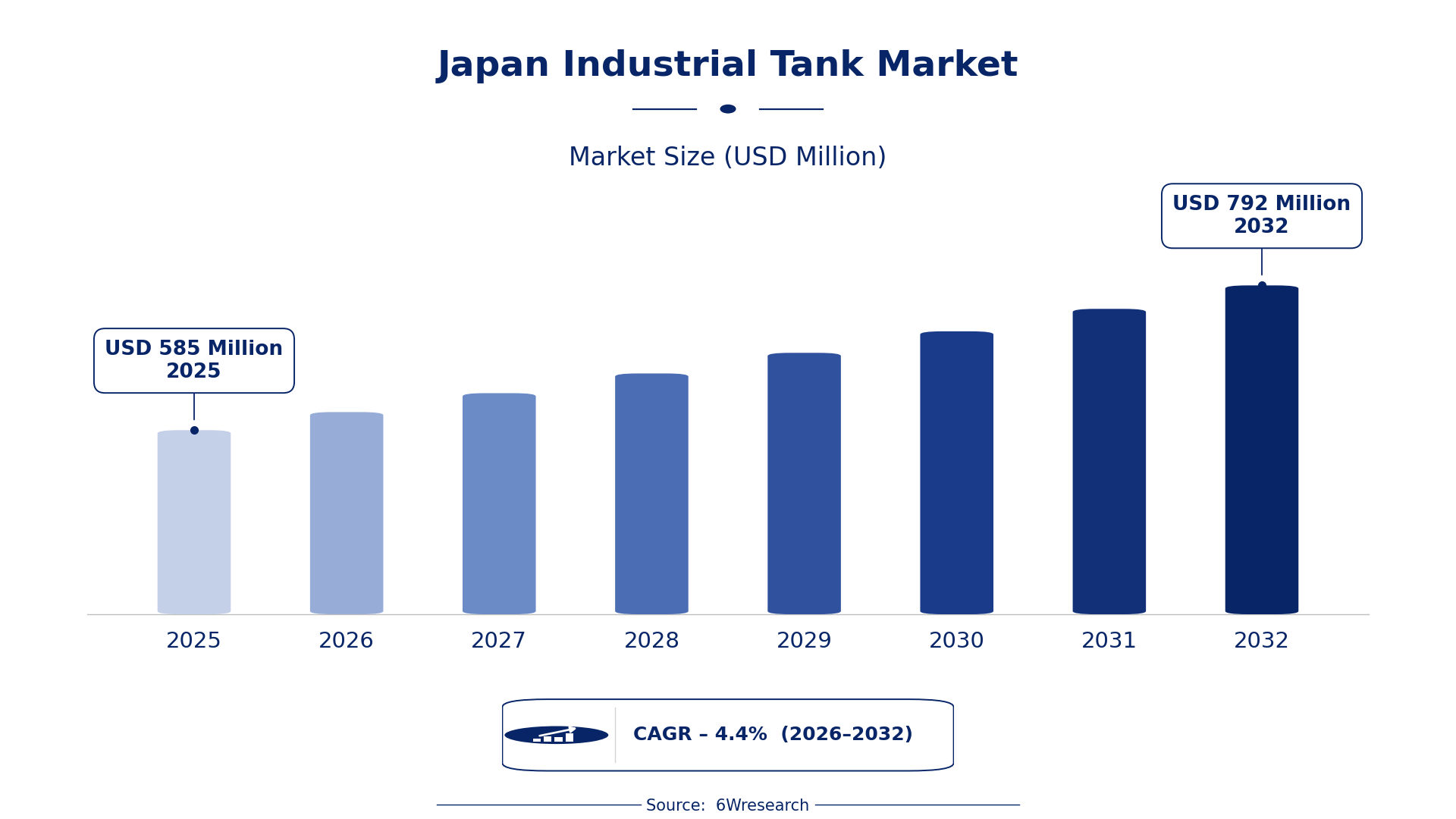
According to 6Wresearch internal database and industry insights, the Japan Industrial Tank Market was valued at USD 585 Million in 2025 and is projected to reach USD 792 Million by 2032, growing at a CAGR of approximately 4.4% during 2026–2032.
Japan Industrial Tank Market Highlights
| Report Metric | Details |
| Report Name | Japan Industrial Tank Market (2026-2032) |
| Market Size 2025 | USD 585 Million |
| Market Size 2032 | USD 792 Million |
| Absolute Growth 2025–2032 | USD 207 Million |
| CAGR 2026–2032 | 4.4% |
| Peak Annual Growth | 5.5% in 2028 |
| Forecast Period | 2026–2032 |
| Historical Data | 2022–2025 |
| Base Year | 2025 |
| Leading Tank Type, 2025 | Storage Tanks (42% share) |
| Leading Material Type, 2025 | Stainless Steel (42% share) |
| Leading Application, 2025 | Oil & Chemical Storage (41% share) |
| Leading Distribution Channel, 2025 | Direct Manufacturer Sales (50% share) |
| Fastest-Growing Tank Type | Mixing Tanks (6.0% CAGR) |
| Fastest-Growing Material Type | Polypropylene (6.5% CAGR) |
| Fastest-Growing Application | Water Treatment Plants (5.9% CAGR) |
| Fastest-Growing Distribution Channel | Engineering Suppliers (5.7% CAGR) |
| Growing Sector | Water Treatment |
| Key End Users | Chemical producers, municipal water authorities, industrial gas suppliers, energy companies |
Japan Industrial Tank Market Year-wise Growth Rate and Key Drivers (2022–2032)
This graph illustrates the annual growth rates of the market from 2022 to 2032, highlighting a steady upward trajectory and projected market expansion over the forecast period.
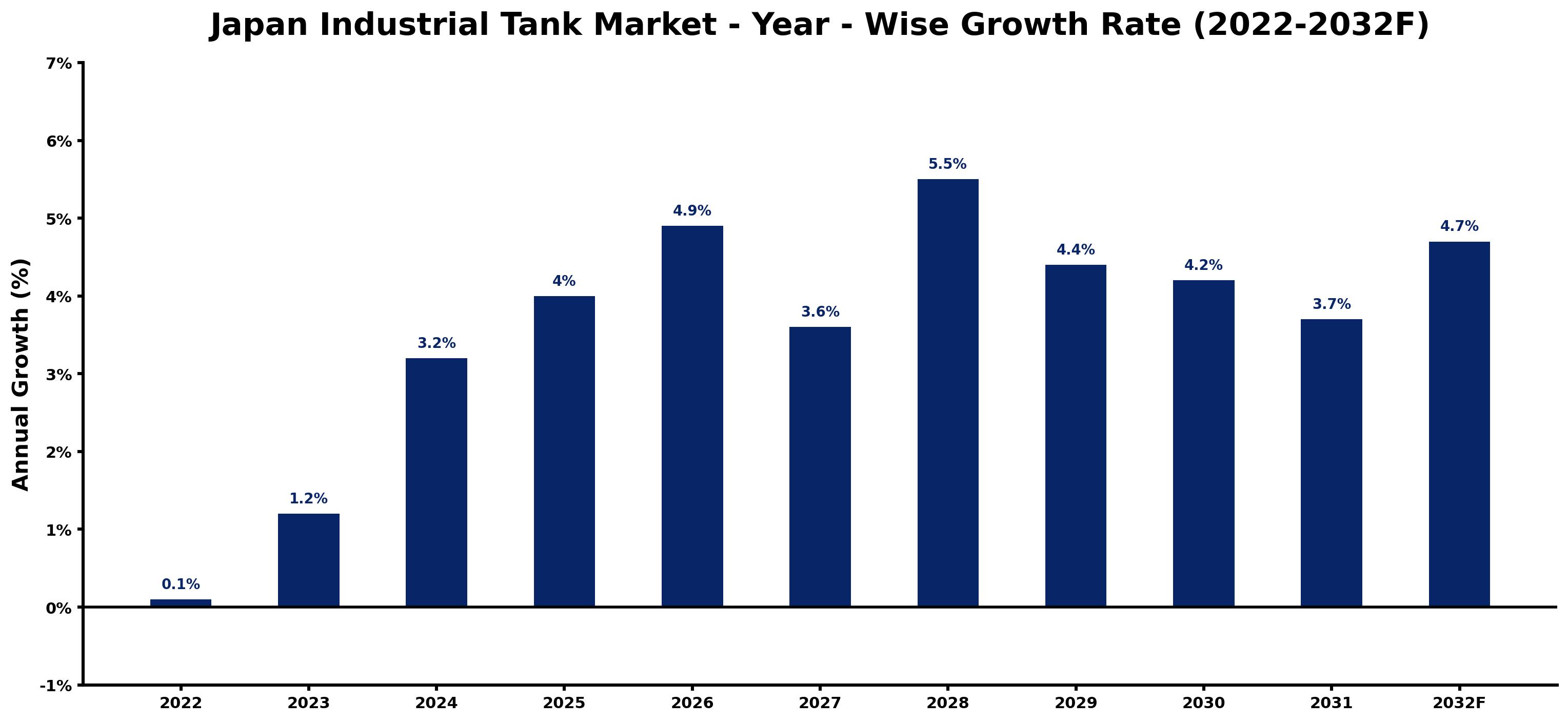
For each year, the table pairs the estimated growth rate with the leading influence on demand, showing how the drivers changed across the period.
| Year | Estimated Annual Growth (%) | Market Rationale |
| 2022 | 0.1 | The market experienced minimal growth due to existing demand levels. |
| 2023 | 1.2 | Growth accelerated as industrial activities resumed post-restrictions. |
| 2024 | 3.2 | Demand increased further, driven by rising chemical production rates. |
| 2025 | 4.0 | The market peaked as investments in infrastructure expanded. |
| 2026 | 4.9 | Growth continued, supported by rising demand for energy-efficient solutions. |
| 2027 | 3.6 | Growth slowed as market saturation began to affect new orders. |
| 2028 | 5.5 | The market peaked again due to heightened investments in LNG facilities. |
| 2029 | 4.4 | Growth slowed as the market stabilised after the peak year. |
| 2030 | 4.2 | Demand remained steady as regulations pushed for greener technologies. |
| 2031 | 3.7 | A further slowdown occurred as competition intensified among suppliers. |
| 2032 | 4.7 | Growth picked up again, driven by new projects in water treatment. |
Note: Market size estimations and growth projections presented in this report are based on 6Wresearch's proprietary forecasting methodology, utilizing the latest available industry data, government publications, and primary research inputs.
Japan Industrial Tank Market Synopsis
Industrial tanks are large containers used for storing liquids and gases, typically made from materials like stainless steel and carbon steel. The Japan Industrial Tank Market is flourishing, driven by the manufacturing and chemical sectors. In 2022, the chemical industry produced approximately 9 million tons of chemicals, while the government aims for JPY 150 trillion in decarbonisation investments over the next decade, boosting demand for storage solutions across various applications.
Market Dynamics Impact Analysis (2026–2032)
| Factor | Type | Impact | Primary Segment Affected |
| Growing chemical production rates | Driver | High | Storage Tanks |
| Increased investment in LNG facilities | Driver | High | Cryogenic Tanks |
| Rising demand for water treatment solutions | Opportunity | High | Water Treatment Plants |
| Expansion of industrial gas storage facilities | Opportunity | Medium | Industrial Gas Storage |
| Regulatory compliance costs | Restraint | High | Pressure Tanks |
| Market saturation in certain segments | Restraint | Medium | Mixing Tanks |
| Intense competition among suppliers | Challenge | High | Storage Tanks |
| Fluctuating raw material prices | Challenge | Medium | Storage Tanks |
Evaluation of Drivers in Japan Industrial Tank Market (2026–2032)
The factors lifting demand, and the evidence behind each, are summarised below.
| Drivers | Primary Segment Affected | Why It Matters (Evidence) |
| Increase in chemical production | Storage Tanks | In 2022, the chemical industry produced approximately 9 million tons, leading to higher demand for storage solutions. |
| Investment in LNG infrastructure | Cryogenic Tanks | The need for LNG handling in ports like Osaka drives demand for cryogenic tanks. |
| Support for water treatment initiatives | Water Treatment Plants | Funding for advanced water treatment technology increases demand for related storage solutions. |
| Growth in industrial gas storage | Industrial Gas Storage | The Tokyo metropolitan area is a major hub, boosting demand for storage facilities. |
| Focus on energy efficiency | Pressure Tanks | The Act on the Rational Use of Energy obliges users to improve efficiency, increasing demand for compliant tanks. |
Spending rises because the chemical industry produced approximately 9 million tons in 2022, which increased the need for storage solutions. Investments in LNG infrastructure at ports like Osaka stimulate demand for cryogenic tanks, as they are essential for handling liquefied natural gas. The push for advanced water treatment technologies promotes investment in water treatment facilities, increasing the need for storage solutions. Rising industrial gas storage requirements in urban areas further drive demand for tanks, reflecting the growing activity in the manufacturing sector.
Evaluation of Restraints in Japan Industrial Tank Market
Several factors work against faster growth; the main ones are summarised below.
| Market Restraint | Primary Segment Affected | Why It Matters (Evidence) |
| High compliance costs for safety standards | Pressure Tanks | The industrial tank market is regulated under JIS standards, increasing operational costs for manufacturers. |
| Market saturation limiting new orders | Mixing Tanks | A mature market has led to fewer new projects, impacting growth potential. |
| Fluctuating prices of raw materials | Storage Tanks | Volatility in steel prices affects production costs and pricing strategies. |
| Intense competition reducing profit margins | Storage Tanks | Numerous suppliers in the market drive prices down, impacting profitability. |
| Regulatory changes affecting production timelines | Cryogenic Tanks | Compliance with new regulations can delay project timelines and increase costs. |
Japan Industrial Tank Market Challenges
Buyers face stringent regulations under JIS standards that necessitate extensive compliance checks, delaying tank production by three months and disrupting delivery schedules for manufacturers. Suppliers encounter fierce competition from low-cost imports, compelling them to lower prices, which can shrink profit margins by 15%. Rising raw material costs, particularly for stainless steel, have increased production expenses by 20%, leading to higher prices for end users. Buyers also experience inconsistent tank availability due to supply chain disruptions, extending procurement timelines by four weeks and complicating project schedules.
Trends in the Japan Industrial Tank Market
Below are the shifts with the largest effect on the Japan Industrial Tank Market.
- Shift Towards Sustainable Storage Solutions: Chemical producers are increasingly adopting eco-friendly storage solutions, prompted by government incentives. In 2023, Japan targets a 46% cut in greenhouse-gas emissions by 2030, driving investments in sustainable tank materials.
- Expansion of Water Treatment Facilities: The number of water treatment plants in Japan has increased, reflecting the rising demand for efficient water management solutions, particularly in urban areas. This growth is supported by government funding initiatives.
- Increased Use of Online Procurement Platforms: Small manufacturers are increasingly using online B2B platforms for tank procurement. This trend is evident as more companies shift towards digital solutions, with a noticeable rise in platform usage among these buyers.
- Growing Demand for Cryogenic Tanks: Cryogenic tanks are becoming essential for LNG handling, particularly in ports like Osaka. The demand is expected to rise, reflecting Japan's focus on expanding its LNG infrastructure.
Investment Opportunities in the Japan Industrial Tank Market
The following opportunities in the Japan Industrial Tank Market pair current demand with a clear way in.
- Partnerships for Decarbonisation Initiatives: With JPY 150 trillion allocated for decarbonisation, partnerships with local firms can facilitate entry into the market. Targeting chemical producers in regions like Aichi can yield substantial returns.
- Investment in Water Treatment Technologies: The need for advanced water treatment solutions presents a gap in the market. Investing in innovative tank designs can cater to municipalities seeking to enhance their facilities.
- Expansion of LNG Infrastructure: The growing LNG sector in ports like Yokohama offers significant opportunities for tank suppliers. Collaborating with local authorities can streamline entry into this expanding market.
- Focus on Energy-Efficient Solutions: The push for energy efficiency creates a demand for compliant tanks. Engaging with industrial users in the Tokyo metropolitan area can lead to fruitful partnerships.
Government Initiatives in the Japan Industrial Tank Market
The GX Promotion Act, adopted in 2023, establishes a framework for decarbonisation efforts, complementing the Industrial Safety and Health Act of 1972. This new legislation mandates improved energy efficiency and safety standards for industrial tanks, ensuring compliance with modern environmental goals.
Local governments utilise the GX Basic Policy to promote sustainable practices among industrial users. For instance, funding is provided for projects that advance water treatment technologies, benefiting municipalities and private sector players.
Future Insight of the Japan Industrial Tank Market
By 2032, Japan's focus on decarbonisation will drive demand for advanced tank solutions, especially in chemical production and waste management sectors. New environmental regulations will necessitate upgrades in industrial facilities, prompting suppliers to develop improved technologies. Government initiatives will enhance water treatment infrastructure, benefiting both producers and end users. The chemical industry is projected to grow, producing approximately 12 million tons of chemicals, thereby increasing the need for efficient storage solutions.
Market Segmentation Analysis
Japan Industrial Tank Market report covers a detailed analysis of the following market segments:
By Tank Type – Storage Tanks Lead, Mixing Tanks Expected to Grow Fastest
According to Saurav Kr Singh, Senior Research Analyst at 6Wresearch, Storage Tanks accounted for 42% of the market by tank type in 2025. Storage tanks are the predominant sub-segment due to their extensive use in various industries for storing liquids and chemicals. Their relevance is particularly highlighted in the Tokyo metropolitan area, which has a robust industrial base requiring reliable storage solutions. The quickest growth will come from Mixing Tanks, forecast to expand at a CAGR of 6.0% between 2026 and 2032. Mixing tanks are experiencing the highest growth rate, attributed to their critical function in blending materials during production processes. This growth is driven by the increasing demand for efficiency in manufacturing practices, which is vital for maintaining competitiveness. Suppliers should focus on enhancing mixing tank technologies to cater to the growing manufacturing sector.
By Material Type – Stainless Steel Leads, Polypropylene Expected to Grow Fastest
In 2025, Stainless Steel led the material type split with a 42% share. Stainless steel is the dominant material type in the market, valued for its corrosion resistance and suitability for various applications, including food and pharmaceuticals. This preference is further reinforced by stringent hygiene standards that drive demand in these sectors. Over 2026–2032, Polypropylene is expected to post the fastest growth, at a CAGR of 6.5%. Polypropylene is the fastest-growing material type, gaining traction in specific applications that require lightweight and chemical resistance. This growth is particularly relevant in sectors aiming to optimise costs while ensuring performance standards. Buyers should evaluate polypropylene as a viable alternative to traditional materials for specific applications.
By Application – Oil & Chemical Storage Leads, Water Treatment Plants Expected to Grow Fastest
Oil & Chemical Storage held 41% of the Japan Industrial Tank Market by application in 2025. Oil and chemical storage leads the application segment, as it is vital for the energy and chemical sectors that form the backbone of Japan's economy. The existing infrastructure and regulatory frameworks ensure a consistent demand for these storage solutions. Water Treatment Plants are set to record the highest CAGR in this split, 5.9% over 2026–2032. Water treatment plants are rapidly expanding, propelled by the rising necessity for effective water management in both municipal and industrial contexts. Government initiatives promoting advanced water treatment technologies further fuel this growth. Suppliers should align their strategies with the increasing focus on water treatment solutions to capitalise on new market opportunities.
By Distribution Channel – Direct Manufacturer Sales Leads, Engineering Suppliers Expected to Grow Fastest
The largest distribution channel category in 2025 was Direct Manufacturer Sales, at 50% of revenue. Direct manufacturer sales are the leading distribution channel, providing a direct link between manufacturers and buyers for tank procurement. This method effectively meets the needs of large industrial clients, ensuring tailored solutions are delivered efficiently. Engineering Suppliers are projected to grow fastest, at a CAGR of 5.7% during 2026–2032. Engineering suppliers are the fastest-growing channel, as they play a crucial role in supplying specialised equipment for complex industrial projects. Their involvement enhances the efficiency of supply chains and project execution across various sectors. Suppliers should consider forming alliances with engineering suppliers to broaden their market reach and improve service delivery.
Key Attractiveness of the Report
- 10 Years of Market Numbers
- Historical Data Starting from 2022 to 2025
- Base Year 2025
- Forecast Data until 2032
- Key Performance Indicators Impacting the Market
- Major Upcoming Developments and Projects
Key Highlights of the Report:
- Japan Industrial Tank Market Outlook
- Market Size of Japan Industrial Tank Market, 2025
- Forecast of Japan Industrial Tank Market, 2032
- Historical Data and Forecast of Japan Industrial Tank Revenues & Volume for the Period 2022-2032F
- Japan Industrial Tank Market Trend Evolution
- Japan Industrial Tank Market Drivers and Challenges
- Japan Industrial Tank Price Trends
- Japan Industrial Tank Porter's Five Forces
- Japan Industrial Tank Industry Life Cycle
- Historical Data and Forecast of Japan Industrial Tank Market Revenues & Volume By Tank Type for the Period 2022-2032F
- Historical Data and Forecast of Japan Industrial Tank Market Revenues & Volume By Storage Tanks for the Period 2022-2032F
- Historical Data and Forecast of Japan Industrial Tank Market Revenues & Volume By Mixing Tanks for the Period 2022-2032F
- Historical Data and Forecast of Japan Industrial Tank Market Revenues & Volume By Pressure Tanks for the Period 2022-2032F
- Historical Data and Forecast of Japan Industrial Tank Market Revenues & Volume By Cryogenic Tanks for the Period 2022-2032F
- Historical Data and Forecast of Japan Industrial Tank Market Revenues & Volume By Material Type for the Period 2022-2032F
- Historical Data and Forecast of Japan Industrial Tank Market Revenues & Volume By Stainless Steel for the Period 2022-2032F
- Historical Data and Forecast of Japan Industrial Tank Market Revenues & Volume By Polypropylene for the Period 2022-2032F
- Historical Data and Forecast of Japan Industrial Tank Market Revenues & Volume By Carbon Steel for the Period 2022-2032F
- Historical Data and Forecast of Japan Industrial Tank Market Revenues & Volume By Insulated Steel for the Period 2022-2032F
- Historical Data and Forecast of Japan Industrial Tank Market Revenues & Volume By Application for the Period 2022-2032F
- Historical Data and Forecast of Japan Industrial Tank Market Revenues & Volume By Oil & Chemical Storage for the Period 2022-2032F
- Historical Data and Forecast of Japan Industrial Tank Market Revenues & Volume By Water Treatment Plants for the Period 2022-2032F
- Historical Data and Forecast of Japan Industrial Tank Market Revenues & Volume By Industrial Gas Storage for the Period 2022-2032F
- Historical Data and Forecast of Japan Industrial Tank Market Revenues & Volume By LNG & Oxygen Handling for the Period 2022-2032F
- Historical Data and Forecast of Japan Industrial Tank Market Revenues & Volume By Distribution Channel for the Period 2022-2032F
- Historical Data and Forecast of Japan Industrial Tank Market Revenues & Volume By Direct Manufacturer Sales for the Period 2022-2032F
- Historical Data and Forecast of Japan Industrial Tank Market Revenues & Volume By Engineering Suppliers for the Period 2022-2032F
- Historical Data and Forecast of Japan Industrial Tank Market Revenues & Volume By Industrial Distributors for the Period 2022-2032F
- Historical Data and Forecast of Japan Industrial Tank Market Revenues & Volume By Online B2B Platforms for the Period 2022-2032F
- Japan Industrial Tank Import Export Trade Statistics
- Market Opportunity Assessment By Tank Type
- Market Opportunity Assessment By Material Type
- Market Opportunity Assessment By Application
- Market Opportunity Assessment By Distribution Channel
- Japan Industrial Tank Top Companies Market Share
- Japan Industrial Tank Competitive Benchmarking By Technical and Operational Parameters
- Japan Industrial Tank Company Profiles
- Japan Industrial Tank Key Strategic Recommendations
Market Covered
Coverage by segment is as follows.
By Tank Type
- Storage Tanks
- Mixing Tanks
- Pressure Tanks
- Cryogenic Tanks
By Material Type
- Stainless Steel
- Polypropylene
- Carbon Steel
- Insulated Steel
By Application
- Oil & Chemical Storage
- Water Treatment Plants
- Industrial Gas Storage
- LNG & Oxygen Handling
By Distribution Channel
- Direct Manufacturer Sales
- Engineering Suppliers
- Industrial Distributors
- Online B2B Platforms































