Japan Industrial Testing Equipment Market Size & Growth Rate
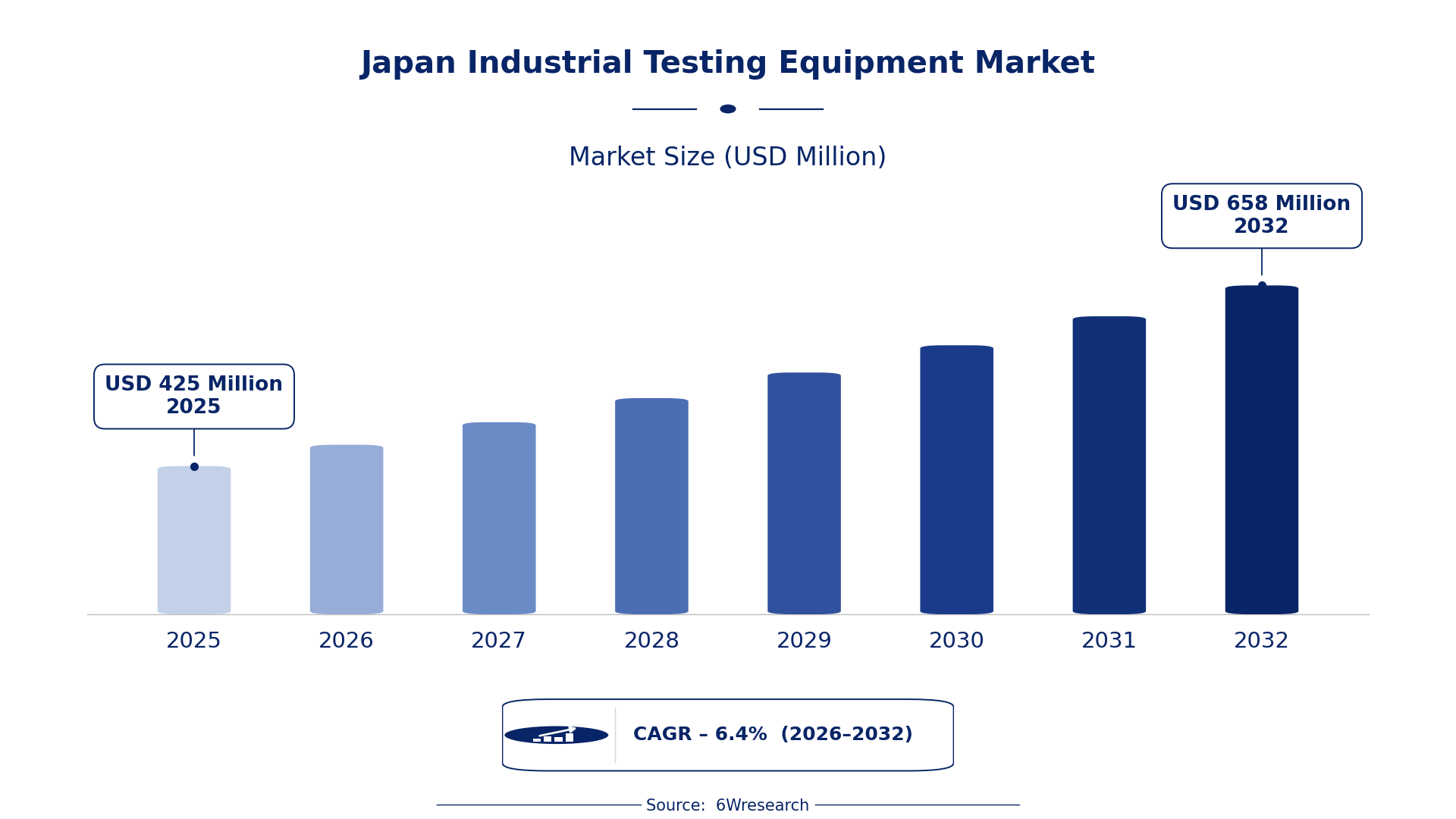
According to 6Wresearch internal database and industry insights, the Japan Industrial Testing Equipment Market was valued at USD 425 Million in 2025 and is projected to reach USD 658 Million by 2032, growing at a CAGR of approximately 6.4% during 2026–2032.
Japan Industrial Testing Equipment Market Highlights
| Report Metric | Details |
| Report Name | Japan Industrial Testing Equipment Market (2026-2032) |
| Market Size 2025 | USD 425 Million |
| Market Size 2032 | USD 658 Million |
| Absolute Growth 2025–2032 | USD 233 Million |
| CAGR 2026–2032 | 6.4% |
| Peak Annual Growth | 7.5% in 2028 |
| Forecast Period | 2026–2032 |
| Historical Data | 2022–2025 |
| Base Year | 2025 |
| Leading Equipment Type, 2025 | Tensile Testers (39% share) |
| Leading Technology, 2025 | Load Cell Sensors (40% share) |
| Leading Application, 2025 | Material Strength Testing (42% share) |
| Leading Distribution Channel, 2025 | Direct Sales (41% share) |
| Fastest-Growing Equipment Type | Hardness Testers (9.0% CAGR) |
| Fastest-Growing Technology | Indentation Technology (9.7% CAGR) |
| Fastest-Growing Application | Component Validation (8.8% CAGR) |
| Fastest-Growing Distribution Channel | OEM Suppliers (8.5% CAGR) |
| Growing Sector | manufacturing |
| Key End Users | manufacturers, research institutions, construction companies, automotive sector |
Japan Industrial Testing Equipment Market Year-wise Growth Rate and Key Drivers (2022–2032)
This graph illustrates the annual growth rates of the market from 2022 to 2032, highlighting a steady upward trajectory and projected market expansion over the forecast period.
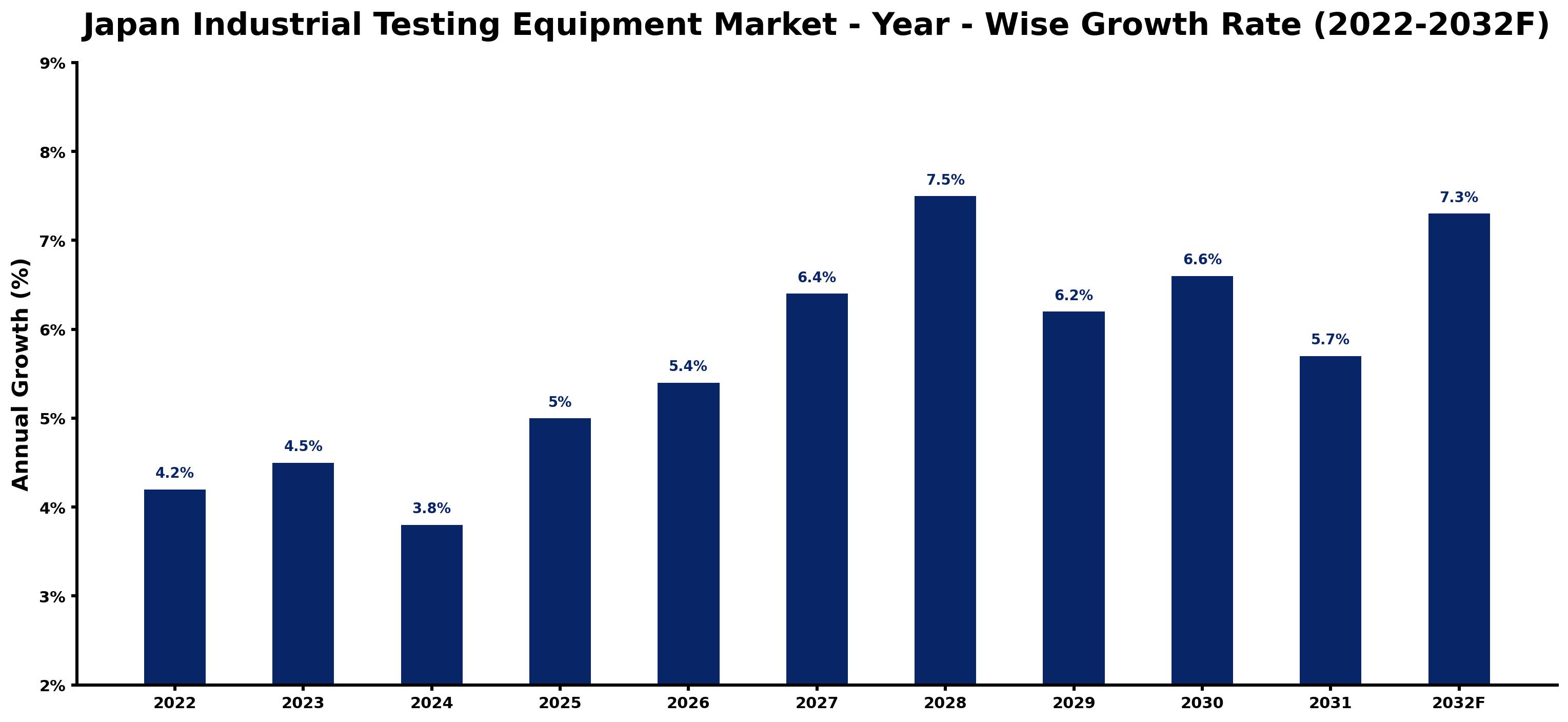
The following figures match every annual growth estimate with the main market development of that year, giving the reasoning behind each rise or slowdown.
| Year | Estimated Annual Growth (%) | Market Rationale |
| 2022 | 4.2 | The market experienced steady demand from various industrial sectors, reflecting ongoing quality assurance needs. |
| 2023 | 4.5 | Increased investments in manufacturing technologies contributed to faster growth than the previous year. |
| 2024 | 3.8 | Growth slowed slightly as manufacturers adjusted to market conditions and demand stabilised. |
| 2025 | 5.0 | The market saw a resurgence in demand, driven by a heightened focus on material quality and compliance. |
| 2026 | 5.4 | Demand is expected to rise as companies adopt advanced testing technologies to meet industry standards. |
| 2027 | 6.4 | Growth is projected to accelerate due to increased investments in research and development across sectors. |
| 2028 | 7.5 | The peak growth year will be driven by advancements in testing methodologies and equipment. |
| 2029 | 6.2 | A slight slowdown is anticipated as the market begins to stabilise after peak growth. |
| 2030 | 6.6 | Demand is expected to rise again as industries push for improved testing capabilities and compliance. |
| 2031 | 5.7 | Growth will slow as the market matures, but demand for quality assurance remains strong. |
| 2032 | 7.3 | The market is projected to grow as new technologies are adopted, improving testing efficiency. |
Note: Market size estimations and growth projections presented in this report are based on 6Wresearch's proprietary forecasting methodology, utilizing the latest available industry data, government publications, and primary research inputs.
Japan Industrial Testing Equipment Market Synopsis
Industrial Testing Equipment includes devices that evaluate the physical properties of materials, ensuring quality and compliance across industries such as manufacturing and aerospace. The Japan Industrial Testing Equipment Market is valued at approximately 200 billion yen, driven by strong demand from domestic manufacturers and research institutions. A focus on quality assurance, advancements in testing technologies, and investments in decarbonisation initiatives are propelling market growth, with the Tokyo region accounting for 30% of demand.
Market Dynamics Impact Analysis (2026–2032)
| Factor | Type | Impact | Primary Segment Affected |
| Growing demand for material certification in the automotive sector | Driver | High | Tensile Testers |
| Rising focus on quality management standards such as ISO 9001 | Driver | High | Hardness Testers |
| Investment in advanced manufacturing technologies | Opportunity | High | NDT Equipment |
| Increasing online sales channels for testing equipment | Opportunity | Medium | Direct Sales |
| High costs associated with advanced testing technologies | Restraint | High | Ultrasonic / X-ray |
| Limited awareness of testing standards among SMEs | Restraint | Medium | Vibration Testers |
| Supply chain disruptions affecting equipment availability | Challenge | High | Load Cell Sensors |
| Competition from alternative testing methods | Challenge | Medium | Indentation Technology |
Evaluation of Drivers in Japan Industrial Testing Equipment Market (2026–2032)
The main growth drivers and the segments they affect most are set out below.
| Drivers | Primary Segment Affected | Why It Matters (Evidence) |
| Increased automotive production requiring tensile testing for material strength | Tensile Testers | The automotive sector's demand for quality assurance drives purchases of tensile testers, with 30% of demand from this industry. |
| Growing electronics manufacturing necessitating hardness testing for components | Hardness Testers | The electronics industry relies on hardness testers to ensure component durability, contributing 25% to market growth. |
| Rising construction activities driving demand for NDT equipment | NDT Equipment | As construction projects expand, the need for non-destructive testing to maintain safety standards increases. |
| Technological advancements improving load cell sensor accuracy | Load Cell Sensors | Improvements in sensor technology lead to higher demand for load cell sensors in various testing setups. |
| Increasing focus on renewable energy driving vibration testing | Vibration Testers | The renewable energy sector's growth necessitates vibration testing for equipment reliability, expanding market opportunities. |
Purchasing is picking up as the automotive sector increases production, necessitating tensile testing for material strength. In 2023, 30% of demand stemmed from this industry, driving purchases of tensile testers. The electronics manufacturing sector also requires hardness testing for components, with contributions from this industry impacting market growth. The construction industry is expanding, leading to a rise in demand for NDT equipment to ensure safety standards. Advancements in load cell sensor technology are improving accuracy, prompting more purchases across various testing setups.
Evaluation of Restraints in Japan Industrial Testing Equipment Market
Several factors work against faster growth; the main ones are summarised below.
| Market Restraint | Primary Segment Affected | Why It Matters (Evidence) |
| High costs associated with implementing advanced testing technologies | Ultrasonic / X-ray | The expenses related to advanced testing methods can deter smaller manufacturers from investing in necessary equipment. |
| Limited awareness of testing standards among SMEs | Vibration Testers | Small and medium enterprises often lack knowledge of essential testing standards, hindering compliance efforts. |
| Supply chain disruptions affecting equipment availability | Load Cell Sensors | Delays in obtaining critical testing equipment impact production timelines due to supply chain disruptions. |
| Competition from alternative testing methods | Indentation Technology | Emerging testing methods may attract buyers away from traditional indentation technology, affecting its market share. |
| Regulatory compliance challenges for manufacturers | NDT Equipment | Navigating complex regulations complicates the procurement process for non-destructive testing equipment. |
Japan Industrial Testing Equipment Market Challenges
In the automotive sector, outdated tensile testing technology hampers manufacturers' compliance with evolving standards, causing delays of up to three months for suppliers. Insufficient investment in advanced equipment limits production efficiency, resulting in increased operational costs. Price competition escalates as new entrants provide lower-cost alternatives, forcing existing producers to cut margins by 15%. Supply chain disruptions stem from the inconsistent availability of essential components, leading to project delays of up to six weeks for clinics and manufacturers, which ultimately impacts their ability to meet deadlines.
Trends in the Japan Industrial Testing Equipment Market
Four trends stand out in the Japan Industrial Testing Equipment Market.
- Shift towards Online Equipment Sales: Sales of industrial testing equipment online reached 15% in 2023, reflecting changing purchasing trends. This shift allows smaller businesses easier access to testing tools, driving market growth.
- Increased Focus on Quality Management Standards: The Aerospace Industry Association of Japan promotes standards for testing in aerospace applications. This focus on quality management is expected to improve compliance and safety across the sector.
- Transition to Advanced Testing Technologies: The Ministry of Economy, Trade and Industry launched a program in 2023 to improve testing capabilities in SMEs. This initiative supports the adoption of advanced technologies, increasing overall testing efficiency.
- Growth in Renewable Energy Testing: Vibration testing is increasingly utilized in the renewable energy sector for equipment reliability. This trend reflects the industry's commitment to ensuring operational safety and performance.
Investment Opportunities in the Japan Industrial Testing Equipment Market
Several openings in the Japan Industrial Testing Equipment Market merit attention from investors.
- Investment in Advanced Manufacturing Technologies: With Japan targeting JPY 150 trillion in decarbonisation investment over ten years, there is an opportunity for suppliers of advanced testing equipment to support this transition.
- Expansion of Online Sales Channels: As 15% of industrial testing equipment sales occurred online in 2023, investing in e-commerce platforms can help suppliers reach a broader market, especially among SMEs.
- Focus on Aerospace Standards: The Aerospace Industry Association of Japan promotes stringent testing standards, creating opportunities for manufacturers of NDT equipment to meet industry compliance needs.
- Collaboration with SMEs for Testing Solutions: The Osaka region, known for its concentration of testing equipment manufacturers, presents opportunities for partnerships with SMEs to improve testing capabilities.
Government Initiatives in the Japan Industrial Testing Equipment Market
The Industrial Safety and Health Act (1972; MHLW) mandates employer responsibilities for hazardous substances and machinery, ensuring safety in industrial environments. The GX Promotion Act (2023) establishes a framework for decarbonisation, encouraging investments in advanced testing technologies to support this transition.
The Ministry of Land, Infrastructure, Transport and Tourism emphasizes testing for infrastructure safety. This agency promotes compliance with safety standards, ensuring that NDT equipment is effectively utilized in maintaining safety across construction projects.
Future Insight of the Japan Industrial Testing Equipment Market
Technological innovations will reshape the industrial testing equipment market as Japan aims for a 46% reduction in greenhouse-gas emissions by 2030. The JPY 150 trillion decarbonisation investment will encourage the adoption of advanced testing methods that align with new regulations. Government initiatives will support the growth of testing capabilities in SMEs, driving sector-wide innovation. With over 300,000 units of equipment currently installed, the market will increasingly integrate automation and digital solutions, improving operational efficiency for suppliers and ensuring rigorous quality assurance for buyers.
Market Segmentation Analysis
Japan Industrial Testing Equipment Market report covers a detailed analysis of the following market segments:
By Equipment Type – Tensile Testers Lead, Hardness Testers Expected to Grow Fastest
According to Saurav Kr Singh, Senior Research Analyst at 6Wresearch, Tensile Testers took 39% of equipment type revenue in 2025, more than any other category. Tensile testers hold the largest share as they are crucial for measuring material strength and ductility, particularly in the automotive sector. Their indispensable role in material certification ensures compliance and safety, making them essential for manufacturers. Hardness Testers are set to record the highest CAGR in this split, 9.0% over 2026–2032. The rapid growth of hardness testers is attributed to their vital application in assessing material hardness and durability, especially in the electronics industry. As manufacturers increasingly focus on component validation, the demand for these testers is expected to rise significantly. Suppliers should enhance the availability of hardness testers to meet the growing demand in the electronics sector.
By Technology – Load Cell Sensors Lead, Indentation Technology Expected to Grow Fastest
The largest technology category in 2025 was Load Cell Sensors, at 40% of revenue. Load cell sensors dominate the market due to their fundamental role in various testing setups, providing accurate measurements essential for quality assurance. Their widespread application across multiple industries sustains a strong demand for these sensors. The quickest growth will come from Indentation Technology, forecast to expand at a CAGR of 9.7% between 2026 and 2032. Indentation technology is experiencing accelerated growth thanks to its specialised applications in material analysis, particularly in sectors requiring precise evaluations. As industries seek advanced testing methods, the adoption of indentation technology is likely to increase. Suppliers may need to invest in R&D to develop advanced load cell sensors and indentation technology to cater to evolving market needs.
By Application – Material Strength Testing Leads, Component Validation Expected to Grow Fastest
In 2025, Material Strength Testing led the application split with a 42% share. Material strength testing is the leading application as it is essential for ensuring material reliability in production processes across diverse industries. The emphasis on quality assurance in manufacturing drives robust demand for testing solutions in this area. Component Validation is projected to grow fastest, at a CAGR of 8.8% during 2026–2032. Component validation is rapidly growing as it is crucial for verifying component integrity in manufacturing processes, particularly in electronics. The heightened focus on quality control in production lines is expected to further boost this application. Suppliers should enhance their offerings in component validation technologies to align with the rising focus on quality assurance in manufacturing.
By Distribution Channel – Direct Sales Leads, OEM Suppliers Expected to Grow Fastest
With 41% of distribution channel revenue in 2025, Direct Sales was the largest category. Direct sales represent the primary distribution channel for industrial testing equipment, establishing a direct connection between manufacturers and end-users. This method ensures that customers receive tailored solutions that effectively meet their specific testing requirements. Over 2026–2032, OEM Suppliers are expected to post the fastest growth, at a CAGR of 8.5%. OEM suppliers are gaining traction as they integrate testing equipment into their products, reflecting a shift towards bundled solutions in the market. This trend indicates a growing preference for comprehensive offerings that simplify procurement for end-users. Suppliers should consider partnerships with OEMs to expand their market reach and provide integrated solutions.
Key Attractiveness of the Report
- 10 Years of Market Numbers
- Historical Data Starting from 2022 to 2025
- Base Year 2025
- Forecast Data until 2032
- Key Performance Indicators Impacting the Market
- Major Upcoming Developments and Projects
Key Highlights of the Report:
- Japan Industrial Testing Equipment Market Outlook
- Market Size of Japan Industrial Testing Equipment Market, 2025
- Forecast of Japan Industrial Testing Equipment Market, 2032
- Historical Data and Forecast of Japan Industrial Testing Equipment Revenues & Volume for the Period 2022-2032F
- Japan Industrial Testing Equipment Market Trend Evolution
- Japan Industrial Testing Equipment Market Drivers and Challenges
- Japan Industrial Testing Equipment Price Trends
- Japan Industrial Testing Equipment Porter's Five Forces
- Japan Industrial Testing Equipment Industry Life Cycle
- Historical Data and Forecast of Japan Industrial Testing Equipment Market Revenues & Volume By Equipment Type for the Period 2022-2032F
- Historical Data and Forecast of Japan Industrial Testing Equipment Market Revenues & Volume By Tensile Testers for the Period 2022-2032F
- Historical Data and Forecast of Japan Industrial Testing Equipment Market Revenues & Volume By Hardness Testers for the Period 2022-2032F
- Historical Data and Forecast of Japan Industrial Testing Equipment Market Revenues & Volume By Vibration Testers for the Period 2022-2032F
- Historical Data and Forecast of Japan Industrial Testing Equipment Market Revenues & Volume By NDT Equipment for the Period 2022-2032F
- Historical Data and Forecast of Japan Industrial Testing Equipment Market Revenues & Volume By Technology for the Period 2022-2032F
- Historical Data and Forecast of Japan Industrial Testing Equipment Market Revenues & Volume By Load Cell Sensors for the Period 2022-2032F
- Historical Data and Forecast of Japan Industrial Testing Equipment Market Revenues & Volume By Indentation Technology for the Period 2022-2032F
- Historical Data and Forecast of Japan Industrial Testing Equipment Market Revenues & Volume By Servo & Electrodynamic for the Period 2022-2032F
- Historical Data and Forecast of Japan Industrial Testing Equipment Market Revenues & Volume By Ultrasonic / X-ray for the Period 2022-2032F
- Historical Data and Forecast of Japan Industrial Testing Equipment Market Revenues & Volume By Application for the Period 2022-2032F
- Historical Data and Forecast of Japan Industrial Testing Equipment Market Revenues & Volume By Material Strength Testing for the Period 2022-2032F
- Historical Data and Forecast of Japan Industrial Testing Equipment Market Revenues & Volume By Component Validation for the Period 2022-2032F
- Historical Data and Forecast of Japan Industrial Testing Equipment Market Revenues & Volume By Aircraft Components for the Period 2022-2032F
- Historical Data and Forecast of Japan Industrial Testing Equipment Market Revenues & Volume By Weld & Defect Testing for the Period 2022-2032F
- Historical Data and Forecast of Japan Industrial Testing Equipment Market Revenues & Volume By Distribution Channel for the Period 2022-2032F
- Historical Data and Forecast of Japan Industrial Testing Equipment Market Revenues & Volume By Direct Sales for the Period 2022-2032F
- Historical Data and Forecast of Japan Industrial Testing Equipment Market Revenues & Volume By OEM Suppliers for the Period 2022-2032F
- Historical Data and Forecast of Japan Industrial Testing Equipment Market Revenues & Volume By Online Equipment Portals for the Period 2022-2032F
- Historical Data and Forecast of Japan Industrial Testing Equipment Market Revenues & Volume By Industrial Dealers for the Period 2022-2032F
- Japan Industrial Testing Equipment Import Export Trade Statistics
- Market Opportunity Assessment By Equipment Type
- Market Opportunity Assessment By Technology
- Market Opportunity Assessment By Application
- Market Opportunity Assessment By Distribution Channel
- Japan Industrial Testing Equipment Top Companies Market Share
- Japan Industrial Testing Equipment Competitive Benchmarking By Technical and Operational Parameters
- Japan Industrial Testing Equipment Company Profiles
- Japan Industrial Testing Equipment Key Strategic Recommendations
Market Covered
Segments analysed in this report are listed below.
By Equipment Type
- Tensile Testers
- Hardness Testers
- Vibration Testers
- NDT Equipment
By Technology
- Load Cell Sensors
- Indentation Technology
- Servo & Electrodynamic
- Ultrasonic / X-ray
By Application
- Material Strength Testing
- Component Validation
- Aircraft Components
- Weld & Defect Testing
By Distribution Channel
- Direct Sales
- OEM Suppliers
- Online Equipment Portals
- Industrial Dealers































