Japan Industrial Tools Distribution Market Size & Growth Rate
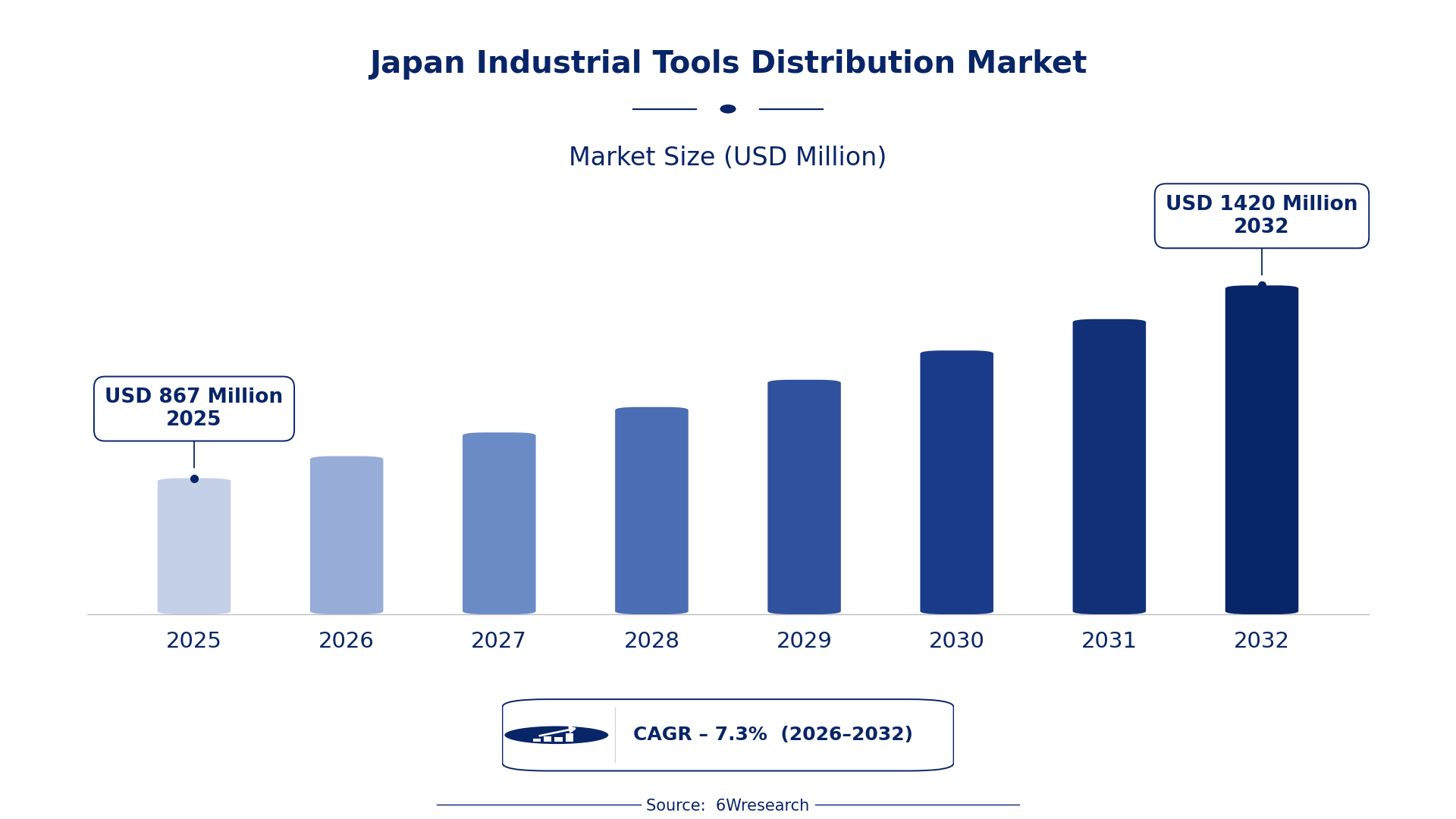
According to 6Wresearch internal database and industry insights, the Japan Industrial Tools Distribution Market was valued at USD 867 Million in 2025 and is projected to reach USD 1,420 Million by 2032, growing at a CAGR of approximately 7.3% during 2026–2032.
Japan Industrial Tools Distribution Market Highlights
| Report Metric | Details |
| Report Name | Japan Industrial Tools Distribution Market (2026-2032) |
| Market Size 2025 | USD 867 Million |
| Market Size 2032 | USD 1,420 Million |
| Absolute Growth 2025–2032 | USD 553 Million |
| CAGR 2026–2032 | 7.3% |
| Peak Annual Growth | 8.1% in 2027 |
| Forecast Period | 2026–2032 |
| Historical Data | 2022–2025 |
| Base Year | 2025 |
| Leading Tool Category, 2025 | Power Tools (35% share) |
| Leading Distribution Method, 2025 | Franchise Dealers (40% share) |
| Leading End User, 2025 | Metalworking Industry (41% share) |
| Leading Channel Strategy, 2025 | Regional Distributors (42% share) |
| Fastest-Growing Tool Category | Hand Tools (9.8% CAGR) |
| Fastest-Growing Distribution Method | Multi-Brand Retail (9.5% CAGR) |
| Fastest-Growing End User | Construction Sector (9.6% CAGR) |
| Fastest-Growing Channel Strategy | Direct Sales (10.0% CAGR) |
| Growing Sector | Construction Sector |
| Key End Users | Metalworking Industry, Construction Sector, Aerospace Workshops, Oil & Gas Plants |
Japan Industrial Tools Distribution Market Year-wise Growth Rate and Key Drivers (2022–2032)
This graph illustrates the annual growth rates of the market from 2022 to 2032, highlighting a steady upward trajectory and projected market expansion over the forecast period.
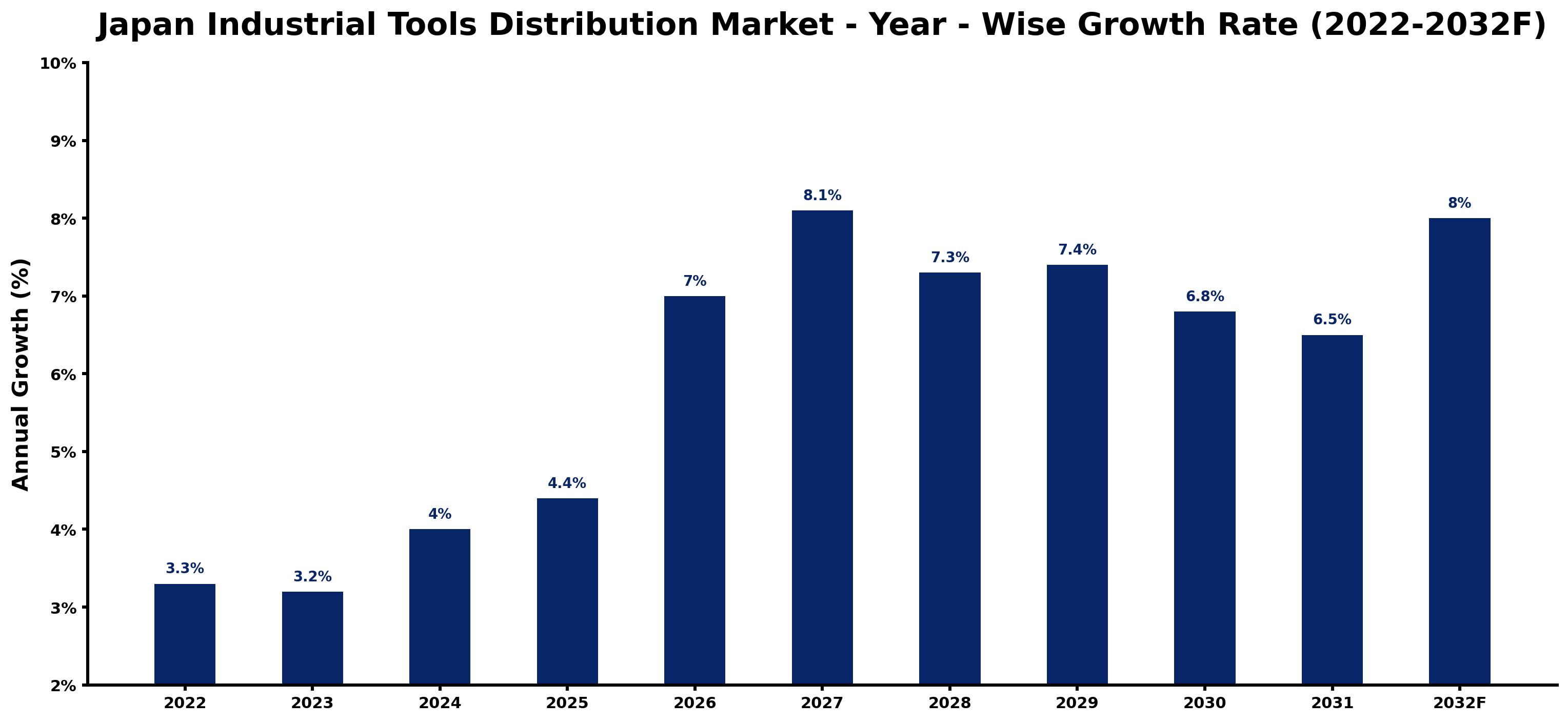
The yearly estimates that follow link every growth rate to its principal driver, so readers can see why the pace changed in each period.
| Year | Estimated Annual Growth (%) | Market Rationale |
| 2022 | 3.3 | The market experienced steady demand from various industrial sectors. |
| 2023 | 3.2 | Growth slowed slightly due to market saturation in urban areas. |
| 2024 | 4.0 | Demand increased as construction projects resumed following delays. |
| 2025 | 4.4 | The market saw faster growth driven by infrastructure investments. |
| 2026 | 7.0 | Demand is expected to surge as the construction sector expands. |
| 2027 | 8.1 | The peak growth year will be fuelled by high urban development activity. |
| 2028 | 7.3 | Growth is projected to slow as the market begins to stabilise after peak levels. |
| 2029 | 7.4 | Demand will increase again as new projects are initiated in key sectors. |
| 2030 | 6.8 | Growth is expected to moderate as market conditions adjust to new realities. |
| 2031 | 6.5 | The market will continue to grow, albeit at a slower rate than before. |
| 2032 | 8.0 | Demand is projected to rise again due to renewed investment in infrastructure. |
Note: Market size estimations and growth projections presented in this report are based on 6Wresearch's proprietary forecasting methodology, utilizing the latest available industry data, government publications, and primary research inputs.
Japan Industrial Tools Distribution Market Synopsis
Industrial Tools Distribution in Japan involves the supply and sale of power tools, hand tools, precision tools, and hydraulic tools used in various sectors such as metalworking and construction. The Japan Industrial Tools Distribution Market is expanding due to substantial investments in infrastructure, with the construction sector projected to grow by 9.6%. The metalworking industry, employing over 1.5 million people, is a major consumer of these tools. Online sales have surged by 20% in the last year, reflecting changing buyer preferences and the shift towards digital purchasing channels, thus driving further market growth.
Market Dynamics Impact Analysis (2026–2032)
| Factor | Type | Impact | Primary Segment Affected |
| Increasing urban development projects drive demand for power tools. | Driver | High | Power Tools |
| The rise of online sales platforms enhances accessibility for buyers. | Driver | Medium | Online Portals |
| The construction sector's growth creates opportunities for tool suppliers. | Opportunity | High | Construction Sector |
| Investment in domestic tool production is becoming a priority. | Opportunity | Medium | Franchise Dealers |
| Market saturation in urban areas limits growth potential. | Restraint | High | Franchise Dealers |
| High competition among distributors can affect pricing strategies. | Restraint | Medium | Regional Distributors |
| Rising costs of raw materials impact tool pricing. | Challenge | High | Power Tools |
| Technological advancements require continuous investment in innovation. | Challenge | Medium | Precision Tools |
Evaluation of Drivers in Japan Industrial Tools Distribution Market (2026–2032)
These are the developments adding the most demand over the forecast period.
| Drivers | Primary Segment Affected | Why It Matters (Evidence) |
| Increased construction activity drives demand for power tools. | Power Tools | The construction sector's projected growth of 9.6% fuels purchases of power tools. |
| Online sales platforms expand market reach for tool distributors. | Online Portals | A 20% increase in online sales reflects changing consumer purchasing habits. |
| The metalworking industry's growth boosts demand for hand tools. | Hand Tools | With over 1.5 million employees, the metalworking industry drives tool sales. |
| Investment in infrastructure projects raises demand for hydraulic tools. | Hydraulic Tools | The construction sector's expansion necessitates hydraulic tools for heavy machinery. |
| Technological advancements in manufacturing increase precision tool sales. | Precision Tools | High-tech manufacturing processes require advanced precision tools for efficiency. |
Volumes grow on the back of increased construction activity and rising urban development. The construction sector is projected to grow by 9.6%, boosting demand for various tools. The metalworking industry, employing over 1.5 million people, continues to be a major consumer of hand tools. Investment in infrastructure projects raises demand for hydraulic tools, as construction expands. Additionally, advancements in manufacturing processes drive the need for precision tools, ensuring efficiency in production. Online sales platforms have gained traction, with a 20% increase in purchases reflecting changing consumer habits.
Evaluation of Restraints in Japan Industrial Tools Distribution Market
The key brakes on demand, and where they bite hardest, are shown below.
| Market Restraint | Primary Segment Affected | Why It Matters (Evidence) |
| Market saturation in urban areas limits growth potential. | Franchise Dealers | High competition in urban markets restricts new customer acquisition. |
| Rising raw material costs affect pricing strategies for distributors. | Power Tools | Increased costs lead to higher prices, potentially deterring buyers. |
| Intense competition among distributors can compress margins. | Regional Distributors | Price wars and aggressive marketing strategies reduce profitability. |
| Technological advancements require continuous investment in R&D. | Precision Tools | Failure to innovate can lead to obsolescence in a competitive market. |
| Regulatory compliance adds to operational costs for manufacturers. | Hydraulic Tools | Manufacturers must invest in certifications to meet industry standards. |
Japan Industrial Tools Distribution Market Challenges
In Japan, local production struggles to meet the rising demand for industrial tools, leading to delays in deliveries for buyers in urban areas. A 20% increase in online sales strains logistics, causing higher costs for consumers who rely on timely access to tools. Many suppliers still use outdated technology, which results in inefficiencies that hinder their competitiveness in the market. Regulatory changes, including the adoption of Japan Industrial Standards, impose compliance costs on producers, complicating market entry for new suppliers and raising prices for end users.
Trends in the Japan Industrial Tools Distribution Market
The following changes are redrawing the Japan Industrial Tools Distribution Market.
- Shift to Online Purchasing: Tokyo is experiencing a notable shift towards online purchasing of industrial tools, with online sales increasing by 20% last year. This trend reflects changing consumer preferences, particularly among younger buyers who value convenience.
- Growth in Construction Sector: The construction sector is expanding, projected to grow by 9.6% as infrastructure projects ramp up. This growth drives demand for various industrial tools, particularly power tools and hydraulic equipment.
- Increased Investment in Domestic Production: A new government initiative aims to boost domestic tool production, targeting JPY 150 trillion in decarbonisation investment over ten years. This initiative supports local manufacturers and strengthens supply chain resilience.
- Rising Focus on Sustainability: Buyers are increasingly prioritising sustainable tools, with the GX Basic Policy promoting eco-friendly practices. This shift is influencing purchasing decisions, particularly among environmentally conscious consumers.
Investment Opportunities in the Japan Industrial Tools Distribution Market
Where to invest in the Japan Industrial Tools Distribution Market: the main openings are set out below.
- Gap in Local Tool Production: Japan's push for domestic production creates a gap for suppliers to fill, with JPY 150 trillion earmarked for decarbonisation investments. Local manufacturers in the construction sector can benefit from this initiative.
- Demand from the Construction Sector: The construction sector's projected growth presents opportunities for suppliers of power tools and hydraulic equipment. Regional distributors can tap into this demand by expanding their product offerings.
- Investment in Digital Marketplaces: With online sales increasing by 20%, now is the time for suppliers to invest in digital marketplaces. Younger consumers are driving this trend, making it essential for distributors to adapt.
- Enhanced Local Warehousing Solutions: Improving local warehousing solutions can streamline distribution efficiency, particularly in urban areas like Tokyo and Osaka. This investment can help meet the growing demand for industrial tools.
Government Initiatives in the Japan Industrial Tools Distribution Market
The Industrial Safety and Health Act (1972) mandates employer responsibilities for hazardous substances and machinery, ensuring safety standards in tool production. The GX Promotion Act (2023) supports decarbonisation efforts, requiring manufacturers to adopt sustainable practices and improve energy efficiency.
Japan's GX Basic Policy, adopted in 2023, targets approximately JPY 150 trillion in public-private investment over ten years. The Ministry of Economy, Trade and Industry oversees this initiative, promoting innovation and sustainability in the industrial tools sector.
Future Insight of the Japan Industrial Tools Distribution Market
The expansion of specialized aerospace workshops will drive demand for advanced tools by 2032, benefiting suppliers. Increased government funding for infrastructure projects will enhance the construction sector, creating opportunities for buyers seeking reliable tools. Investments in local warehousing solutions will streamline distribution processes, reducing lead times for consumers. The push for decarbonisation will also encourage innovation in tool manufacturing, aligning with buyers' sustainability goals.
Market Segmentation Analysis
Japan Industrial Tools Distribution Market report covers a detailed analysis of the following market segments:
By Tool Category – Power Tools Lead, Hand Tools Expected to Grow Fastest
According to Saurav Kr Singh, Senior Research Analyst at 6Wresearch, the largest tool category category in 2025 was Power Tools, at 35% of revenue. Power tools dominate the market due to their extensive use in construction and manufacturing, which are critical sectors for Japan's economy. Urban development projects in cities like Tokyo and Osaka significantly drive the demand for these tools. The quickest growth will come from Hand Tools, forecast to expand at a CAGR of 9.8% between 2026 and 2032. Hand tools are seeing rapid growth as they are essential for various trades, particularly with the increase in small-scale construction projects. The ongoing urban infrastructure initiatives further boost the need for these versatile tools. Suppliers should focus on expanding their hand tool product lines to take advantage of this growing segment.
By Distribution Method – Franchise Dealers Lead, Multi-Brand Retail Expected to Grow Fastest
In 2025, Franchise Dealers led the distribution method split with a 40% share. Franchise dealers lead the distribution method as they provide localized access to tools, making them a preferred choice for consumers in urban areas. Their established networks in cities like Tokyo and Osaka facilitate effective distribution. Multi-Brand Retail is projected to grow fastest, at a CAGR of 9.5% during 2026–2032. Multi-brand retail is growing quickly as it offers a variety of brands and tools under one roof, appealing to consumers seeking convenience and choice. The trend towards one-stop shopping experiences is propelling this segment's growth. Suppliers must consider partnerships with multi-brand retailers to reach a broader customer base.
By End User – Metalworking Industry Leads, Construction Sector Expected to Grow Fastest
Metalworking Industry took 41% of end user revenue in 2025, more than any other category. The metalworking industry is the largest end user of industrial tools, employing over 1.5 million people and heavily relying on these tools for efficient operations. This sector's strong demand reinforces its leading position in the market. Construction Sector is set to record the highest CAGR in this split, 9.6% over 2026–2032. The construction sector is experiencing the fastest growth due to significant government investment in infrastructure projects, which directly increases the demand for various tools. This growth trend is expected to continue as urban development progresses. Suppliers should adapt their offerings to meet the rising demand from the construction sector.
By Channel Strategy – Regional Distributors Lead, Direct Sales Expected to Grow Fastest
With 42% of channel strategy revenue in 2025, Regional Distributors was the largest category. Regional distributors are crucial in local markets, providing tailored solutions and support to customers, which ensures effective distribution. Their established networks across regions improve customer service and accessibility to products. Over 2026–2032, Direct Sales is expected to post the fastest growth, at a CAGR of 10.0%. Direct sales are increasingly important as they facilitate securing large contracts, especially in sectors requiring bulk tool purchases. The shift towards direct engagement with customers enhances the attractiveness of this sales channel. Suppliers should enhance their direct sales strategies to better cater to large clients.
Key Attractiveness of the Report
- 10 Years of Market Numbers
- Historical Data Starting from 2022 to 2025
- Base Year 2025
- Forecast Data until 2032
- Key Performance Indicators Impacting the Market
- Major Upcoming Developments and Projects
Key Highlights of the Report:
- Japan Industrial Tools Distribution Market Outlook
- Market Size of Japan Industrial Tools Distribution Market, 2025
- Forecast of Japan Industrial Tools Distribution Market, 2032
- Historical Data and Forecast of Japan Industrial Tools Distribution Revenues & Volume for the Period 2022-2032F
- Japan Industrial Tools Distribution Market Trend Evolution
- Japan Industrial Tools Distribution Market Drivers and Challenges
- Japan Industrial Tools Distribution Price Trends
- Japan Industrial Tools Distribution Porter's Five Forces
- Japan Industrial Tools Distribution Industry Life Cycle
- Historical Data and Forecast of Japan Industrial Tools Distribution Market Revenues & Volume By Tool Category for the Period 2022-2032F
- Historical Data and Forecast of Japan Industrial Tools Distribution Market Revenues & Volume By Power Tools for the Period 2022-2032F
- Historical Data and Forecast of Japan Industrial Tools Distribution Market Revenues & Volume By Hand Tools for the Period 2022-2032F
- Historical Data and Forecast of Japan Industrial Tools Distribution Market Revenues & Volume By Precision Tools for the Period 2022-2032F
- Historical Data and Forecast of Japan Industrial Tools Distribution Market Revenues & Volume By Hydraulic Tools for the Period 2022-2032F
- Historical Data and Forecast of Japan Industrial Tools Distribution Market Revenues & Volume By Distribution Method for the Period 2022-2032F
- Historical Data and Forecast of Japan Industrial Tools Distribution Market Revenues & Volume By Franchise Dealers for the Period 2022-2032F
- Historical Data and Forecast of Japan Industrial Tools Distribution Market Revenues & Volume By Multi-Brand Retail for the Period 2022-2032F
- Historical Data and Forecast of Japan Industrial Tools Distribution Market Revenues & Volume By Online Portals for the Period 2022-2032F
- Historical Data and Forecast of Japan Industrial Tools Distribution Market Revenues & Volume By Local Warehousing for the Period 2022-2032F
- Historical Data and Forecast of Japan Industrial Tools Distribution Market Revenues & Volume By End User for the Period 2022-2032F
- Historical Data and Forecast of Japan Industrial Tools Distribution Market Revenues & Volume By Metalworking Industry for the Period 2022-2032F
- Historical Data and Forecast of Japan Industrial Tools Distribution Market Revenues & Volume By Construction Sector for the Period 2022-2032F
- Historical Data and Forecast of Japan Industrial Tools Distribution Market Revenues & Volume By Aerospace Workshops for the Period 2022-2032F
- Historical Data and Forecast of Japan Industrial Tools Distribution Market Revenues & Volume By Oil & Gas Plants for the Period 2022-2032F
- Historical Data and Forecast of Japan Industrial Tools Distribution Market Revenues & Volume By Channel Strategy for the Period 2022-2032F
- Historical Data and Forecast of Japan Industrial Tools Distribution Market Revenues & Volume By Regional Distributors for the Period 2022-2032F
- Historical Data and Forecast of Japan Industrial Tools Distribution Market Revenues & Volume By Direct Sales for the Period 2022-2032F
- Historical Data and Forecast of Japan Industrial Tools Distribution Market Revenues & Volume By Digital Marketplaces for the Period 2022-2032F
- Historical Data and Forecast of Japan Industrial Tools Distribution Market Revenues & Volume By OEM Tie-ups for the Period 2022-2032F
- Japan Industrial Tools Distribution Import Export Trade Statistics
- Market Opportunity Assessment By Tool Category
- Market Opportunity Assessment By Distribution Method
- Market Opportunity Assessment By End User
- Market Opportunity Assessment By Channel Strategy
- Japan Industrial Tools Distribution Top Companies Market Share
- Japan Industrial Tools Distribution Competitive Benchmarking By Technical and Operational Parameters
- Japan Industrial Tools Distribution Company Profiles
- Japan Industrial Tools Distribution Key Strategic Recommendations
Market Covered
The following segment groups are covered in the report.
By Tool Category
- Power Tools
- Hand Tools
- Precision Tools
- Hydraulic Tools
By Distribution Method
- Franchise Dealers
- Multi-Brand Retail
- Online Portals
- Local Warehousing
By End User
- Metalworking Industry
- Construction Sector
- Aerospace Workshops
- Oil & Gas Plants
By Channel Strategy
- Regional Distributors
- Direct Sales
- Digital Marketplaces
- OEM Tie-ups































