Japan Industrial Visual Inspection AI Market Size & Growth Rate
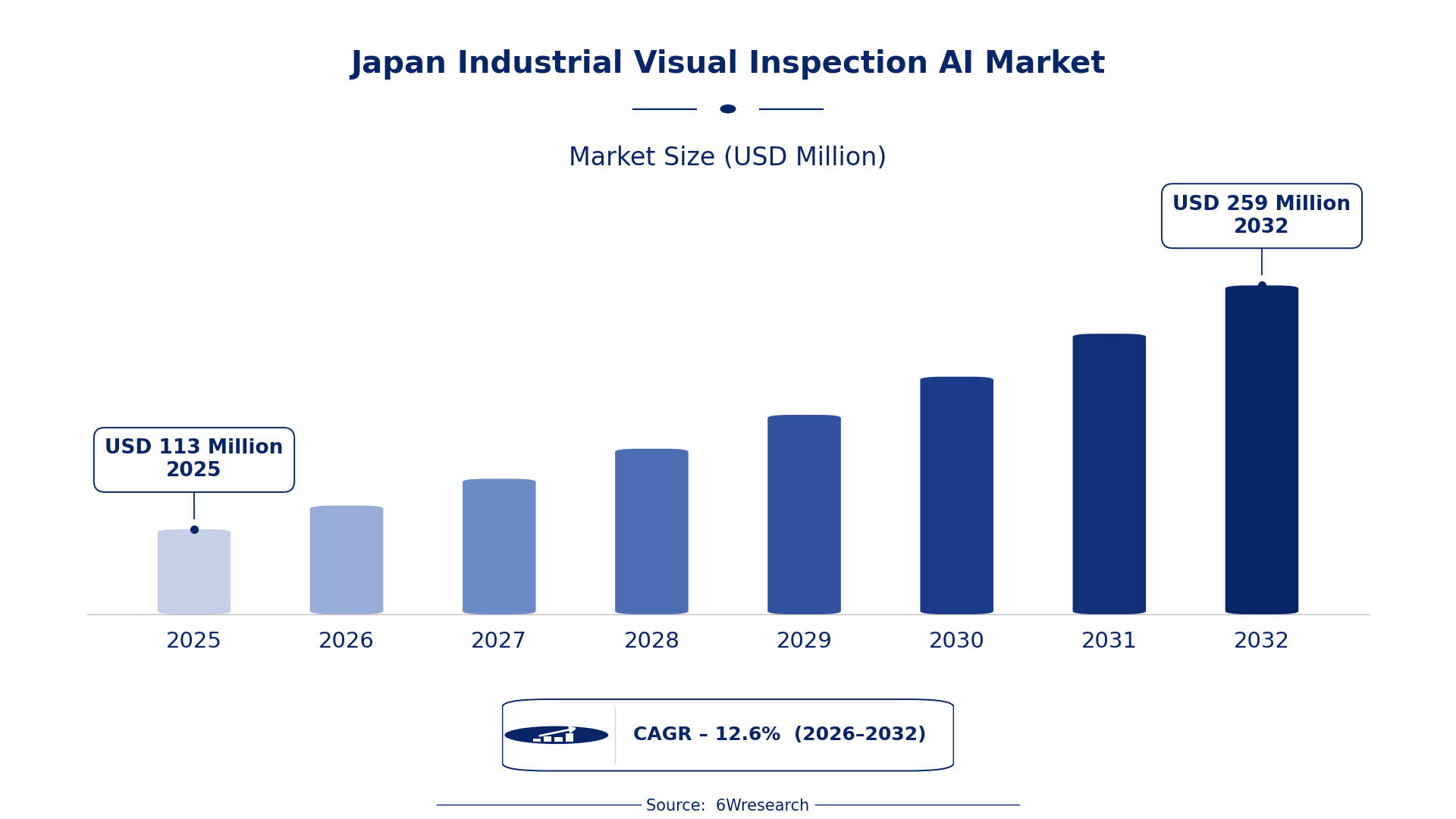
According to 6Wresearch internal database and industry insights, the Japan Industrial Visual Inspection AI Market was valued at USD 113 Million in 2025 and is projected to reach USD 259 Million by 2032, growing at a CAGR of approximately 12.6% during 2026–2032.
Japan Industrial Visual Inspection AI Market Highlights
| Report Metric | Details |
| Report Name | Japan Industrial Visual Inspection AI Market (2026-2032) |
| Market Size 2025 | USD 113 Million |
| Market Size 2032 | USD 259 Million |
| Absolute Growth 2025–2032 | USD 146 Million |
| CAGR 2026–2032 | 12.6% |
| Peak Annual Growth | 14.4% in 2028 |
| Forecast Period | 2026–2032 |
| Historical Data | 2022–2025 |
| Base Year | 2025 |
| Leading Solution Type, 2025 | Surface Defect Detection (44% share) |
| Leading AI Capability, 2025 | Deep Learning Vision (45% share) |
| Leading Application, 2025 | PCB Assembly (51% share) |
| Leading Distribution Channel, 2025 | AI Software Vendors (47% share) |
| Fastest-Growing Solution Type | Assembly Line Inspection (17.7% CAGR) |
| Fastest-Growing AI Capability | Real-time Imaging AI (17.8% CAGR) |
| Fastest-Growing Application | Electronic Devices (17.4% CAGR) |
| Fastest-Growing Distribution Channel | System Integrators (17.2% CAGR) |
| Growing Sector | Electronic Devices |
| Key End Users | PCB Assembly, Electronic Devices, Semiconductor Fabrication, Packaging QA |
Japan Industrial Visual Inspection AI Market Year-wise Growth Rate and Key Drivers (2022–2032)
This graph illustrates the annual growth rates of the market from 2022 to 2032, highlighting a steady upward trajectory and projected market expansion over the forecast period.
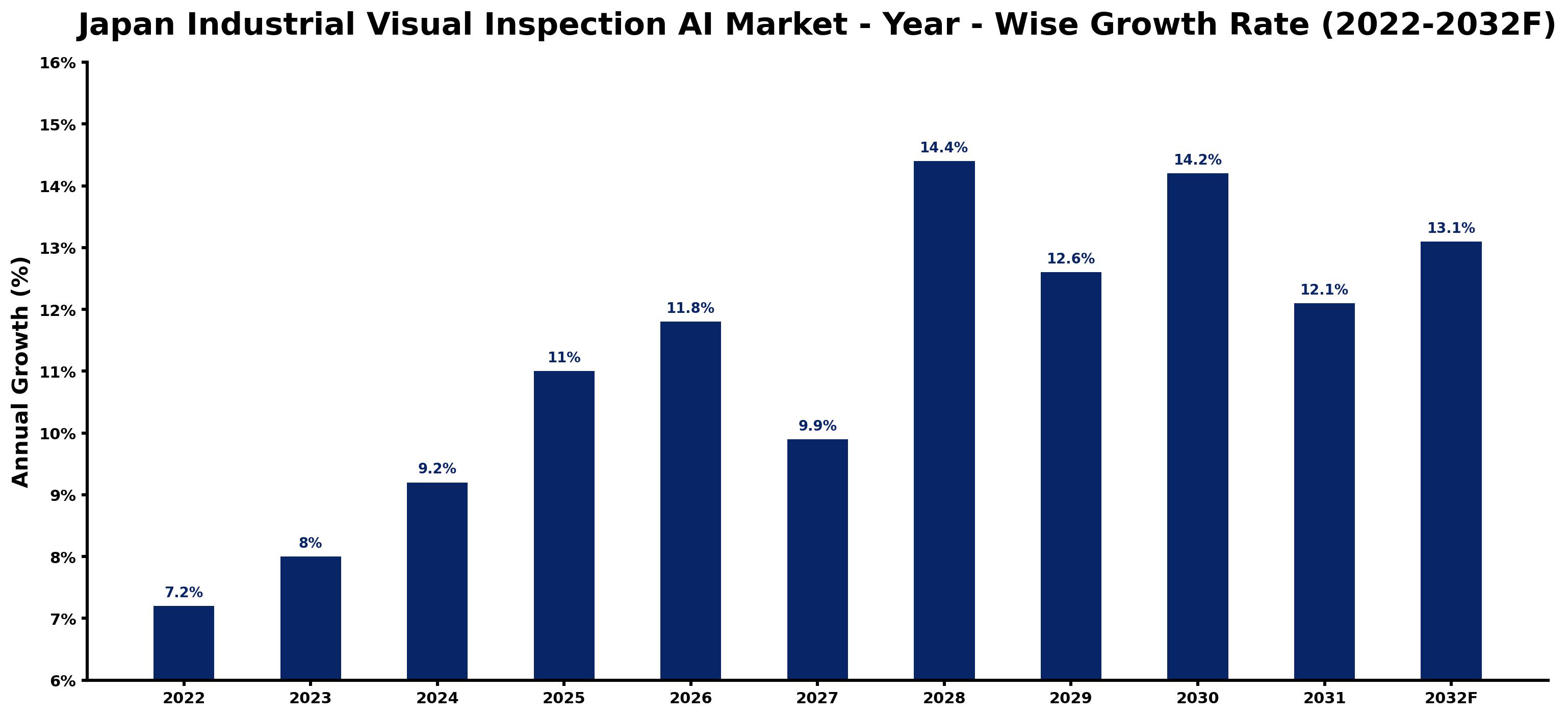
The following figures match every annual growth estimate with the main market development of that year, giving the reasoning behind each rise or slowdown.
| Year | Estimated Annual Growth (%) | Market Rationale |
| 2022 | 7.2 | The market experienced steady growth, driven by increased automation in manufacturing processes. |
| 2023 | 8.0 | Demand accelerated as manufacturers adopted AI technologies to improve quality control. |
| 2024 | 9.2 | The introduction of advanced visual inspection systems further boosted market growth. |
| 2025 | 11.0 | A surge in semiconductor production led to higher demand for inspection solutions. |
| 2026 | 11.8 | Growth continued as manufacturers sought to improve efficiency and reduce defects. |
| 2027 | 9.9 | The market growth slowed slightly as companies adjusted to new technologies. |
| 2028 | 14.4 | A significant increase in AI adoption is expected to propel the market to its peak growth. |
| 2029 | 12.6 | Growth is projected to decelerate as the market begins to stabilise after rapid expansion. |
| 2030 | 14.2 | Demand is expected to surge again as manufacturers focus on quality assurance and compliance. |
| 2031 | 12.1 | The market growth rate is projected to slow as saturation in some sectors begins to occur. |
| 2032 | 13.1 | Continued investments in AI technologies are expected to drive demand further. |
Note: Market size estimations and growth projections presented in this report are based on 6Wresearch's proprietary forecasting methodology, utilizing the latest available industry data, government publications, and primary research inputs.
Japan Industrial Visual Inspection AI Market Synopsis
Industrial Visual Inspection AI employs advanced algorithms and machine learning to analyse visual data for quality control in manufacturing processes. This technology plays a crucial role in detecting defects, ensuring accuracy, and reading labels across various sectors. The Japan Industrial Visual Inspection AI Market is growing, propelled by strong demand from the electronics and semiconductor industries, which are heavily investing in automation and quality assurance. The GX Basic Policy and the Manufacturing Innovation 2025 programme are pivotal in this growth, encouraging greater AI integration in production processes.
Market Dynamics Impact Analysis (2026–2032)
| Factor | Type | Impact | Primary Segment Affected |
| Rising demand for quality assurance in manufacturing processes | Driver | High | Surface Defect Detection |
| Increased automation in manufacturing | Driver | High | Assembly Line Inspection |
| Growing need for precision in manufacturing | Opportunity | High | Dimensional Accuracy |
| Expansion of the electronics sector | Opportunity | High | Electronic Devices |
| High initial investment costs for AI systems | Restraint | Medium | Machine Vision AI |
| Limited awareness of AI capabilities among smaller manufacturers | Restraint | Medium | AI Software Vendors |
| Competition from traditional inspection methods | Challenge | Medium | Surface Defect Detection |
| Challenges in integrating AI with existing systems | Challenge | Medium | System Integrators |
Evaluation of Drivers in Japan Industrial Visual Inspection AI Market (2026–2032)
The following drivers explain most of the expected growth.
| Drivers | Primary Segment Affected | Why It Matters (Evidence) |
| Increased semiconductor production | Surface Defect Detection | Japan's semiconductor market, valued at approximately 4 trillion yen, drives demand for quality control solutions. |
| Adoption of the GX Basic Policy | Assembly Line Inspection | This policy promotes AI integration, leading to higher demand for inspection technologies. |
| Focus on precision in manufacturing | Dimensional Accuracy | The need for compliance with various standards drives investments in accurate inspection systems. |
| Growing electronic devices sector | Electronic Devices | The sector employs around 1.2 million people, increasing the need for quality assurance solutions. |
| Expansion of AI capabilities in manufacturing | Machine Vision AI | The installed base of AI visual inspection systems exceeds 10,000 units, indicating strong market growth. |
The strongest pull on demand comes from increased semiconductor production, valued at approximately 4 trillion yen, which requires stringent quality control measures. The growing electronic devices sector, employing around 1.2 million people, increases the need for quality assurance solutions. Furthermore, the installed base of AI visual inspection systems in Japan exceeds 10,000 units, reflecting the growing adoption of machine vision systems.
Evaluation of Restraints in Japan Industrial Visual Inspection AI Market
The table below lists the restraints and the evidence behind each.
| Market Restraint | Primary Segment Affected | Why It Matters (Evidence) |
| High initial investment costs for AI systems | Machine Vision AI | The substantial upfront costs deter smaller manufacturers from adopting advanced inspection technologies. |
| Limited awareness of AI capabilities among smaller manufacturers | AI Software Vendors | Many smaller firms lack knowledge about the benefits of AI, hindering market penetration. |
| Competition from traditional inspection methods | Surface Defect Detection | Established inspection techniques remain prevalent, making it difficult for AI solutions to gain traction. |
| Integration challenges with existing systems | System Integrators | Many manufacturers face difficulties in merging AI solutions with their legacy systems. |
| Regulatory compliance complexities | Dimensional Accuracy | Navigating compliance with various standards complicates the adoption of new technologies. |
Japan Industrial Visual Inspection AI Market Challenges
Buyers in Japan's manufacturing sector face challenges with outdated technology, as many facilities still rely on traditional inspection methods, which can lead to a 20% increase in defect rates. Suppliers encounter difficulties in sourcing advanced AI components due to limited domestic production, resulting in delays of up to six months for new system implementations. Regulatory compliance with JIS B 0020 standards imposes additional costs on producers, with about 15% of budgets dedicated to meeting these requirements. Skills shortages in AI and machine learning hinder suppliers' ability to innovate, causing a 30% slowdown in project timelines for new installations.
Trends in the Japan Industrial Visual Inspection AI Market
Below are the shifts with the largest effect on the Japan Industrial Visual Inspection AI Market.
- Launch of the GX Basic Policy: The GX Basic Policy, introduced in 2023, aims to promote AI adoption in manufacturing. This initiative is anticipated to boost the use of AI visual inspection technologies, with investments expected to reach JPY 150 trillion over the next ten years.
- Shift towards Real-time Imaging AI: Real-time Imaging AI is gaining popularity in Japan's manufacturing sector, offering immediate feedback during production. This trend is illustrated by the increasing number of installations, with over 10,000 AI visual inspection systems currently operational.
- Focus on Quality Assurance in Electronics: The electronics sector is prioritising quality assurance, especially in PCB assembly. This emphasis is reflected in the sector's projected growth, which employs around 1.2 million people and is crucial for maintaining high manufacturing standards.
- Transition to AI-driven Dimensional Accuracy: The demand for dimensional accuracy is shifting towards AI-driven solutions, influenced by compliance with various standards. This transition is apparent in the rising investments in precision inspection technologies across multiple manufacturing sectors.
Investment Opportunities in the Japan Industrial Visual Inspection AI Market
Where to invest in the Japan Industrial Visual Inspection AI Market: the main openings are set out below.
- Growing Demand for AI Solutions: With Japan's semiconductor market valued at approximately 4 trillion yen, there is a chance to supply advanced AI visual inspection systems. Manufacturers in the Tokyo region are particularly interested in these solutions to improve quality control.
- Investment in Precision Technologies: The increasing emphasis on precision in manufacturing presents an opportunity to provide dimensional accuracy solutions. Companies in the electronics sector are investing heavily in these technologies to adhere to rigorous quality standards.
- Expansion of AI Capabilities: As the installed base of AI visual inspection systems exceeds 10,000 units, there is a rising demand for suppliers of machine vision technologies. Partnering with system integrators in Japan can facilitate market entry.
- Rising Quality Assurance Standards: The drive for higher quality assurance standards in manufacturing creates an opportunity to supply AI-driven inspection solutions. The packaging industry is expected to grow, highlighting the need for compliance and quality.
Government Initiatives in the Japan Industrial Visual Inspection AI Market
The GX Promotion Act, enacted in 2023, serves as the legal foundation for Japan's decarbonisation strategy, targeting a 46% reduction in greenhouse gas emissions by fiscal 2030. This act stimulates investment in advanced technologies, including AI solutions for manufacturing, ensuring adherence to environmental standards.
The Ministry of Economy, Trade and Industry (METI) manages funding programmes that support AI technology development. METI's initiatives include financial backing for projects that incorporate AI into manufacturing processes, promoting innovation and efficiency throughout the sector.
Future Insight of the Japan Industrial Visual Inspection AI Market
Investment in decarbonisation, projected at JPY 150 trillion over the next ten years, will drive demand for advanced AI technologies in manufacturing. Integrating AI in factories will streamline quality assurance processes, benefiting buyers by lowering defect rates. Research collaborations, such as those with the Tokyo Institute of Technology, will improve AI applications, ensuring competitiveness in the global market. The Manufacturing Innovation 2025 programme will further encourage AI adoption, leading to enhancements in operational efficiency.
Market Segmentation Analysis
Japan Industrial Visual Inspection AI Market report covers a detailed analysis of the following market segments:
By Solution Type – Surface Defect Detection Leads, Assembly Line Inspection Expected to Grow Fastest
According to Saurav Kr Singh, Senior Research Analyst at 6Wresearch, in 2025, Surface Defect Detection led the solution type split with a 44% share. Surface defect detection holds the largest share as it is essential for quality assurance in manufacturing processes. Its significance is evident in the installed base of over 10,000 visual inspection systems utilised across Japan's manufacturing sector. Assembly Line Inspection is set to record the highest CAGR in this split, 17.7% over 2026–2032. Assembly line inspection is experiencing rapid growth as manufacturers focus on maintaining production efficiency and quality standards. The government's 'Smart Manufacturing Initiative' significantly promotes the adoption of advanced inspection technologies in production lines, further accelerating this trend. This indicates that suppliers should enhance their offerings for assembly line inspection to cater to the increasing demand.
By AI Capability – Deep Learning Vision Leads, Real-time Imaging AI Expected to Grow Fastest
The largest ai capability category in 2025 was Deep Learning Vision, at 45% of revenue. Deep learning vision leads the market as it is fundamental for improving inspection accuracy and speed in visual inspection applications. The backing from the Ministry of Economy, Trade and Industry for AI technology development underscores its critical role in the sector. The quickest growth will come from Real-time Imaging AI, forecast to expand at a CAGR of 17.8% between 2026 and 2032. Real-time imaging AI is growing quickly due to its importance in providing immediate feedback during production processes. This capability is increasingly sought after as manufacturers aim to improve their operational efficiency and response times. Suppliers must invest in real-time imaging technologies to take advantage of the increasing demand for immediate feedback solutions.
By Application – PCB Assembly Leads, Electronic Devices Expected to Grow Fastest
PCB Assembly accounted for 51% of the market by application in 2025. PCB assembly dominates the application segment as it is critical for ensuring quality in the electronic manufacturing sector. The reliance on these inspection solutions is highlighted by the employment of around 1.2 million people in the electronic devices sector. Over 2026–2032, Electronic Devices are expected to post the fastest growth, at a CAGR of 17.4%. Electronic devices are witnessing the fastest growth due to their widespread use for quality assurance in device production. This surge is driven by the increasing demand for high-quality electronic products in Japan's robust market. Suppliers should focus on developing solutions tailored for electronic device inspections to capitalise on this growth opportunity.
By Distribution Channel – AI Software Vendors Lead, System Integrators Expected to Grow Fastest
AI Software Vendors took 47% of distribution channel revenue in 2025, more than any other category. AI software vendors lead the distribution channel as they provide essential tools for implementing inspection solutions in various manufacturing settings. Their established presence ensures widespread access to advanced technologies that enhance quality control processes. System Integrators are projected to grow fastest, at a CAGR of 17.2% during 2026–2032. System integrators are rapidly gaining traction as they play a crucial role in integrating inspection solutions into existing manufacturing systems. This trend is fuelled by the increasing complexity of manufacturing processes that necessitate seamless integration of new technologies. Suppliers should consider partnerships with system integrators to improve their market reach and effectiveness.
Key Attractiveness of the Report
- 10 Years of Market Numbers
- Historical Data Starting from 2022 to 2025
- Base Year 2025
- Forecast Data until 2032
- Key Performance Indicators Impacting the Market
- Major Upcoming Developments and Projects
Key Highlights of the Report:
- Japan Industrial Visual Inspection AI Market Outlook
- Market Size of Japan Industrial Visual Inspection AI Market, 2025
- Forecast of Japan Industrial Visual Inspection AI Market, 2032
- Historical Data and Forecast of Japan Industrial Visual Inspection AI Revenues & Volume for the Period 2022-2032F
- Japan Industrial Visual Inspection AI Market Trend Evolution
- Japan Industrial Visual Inspection AI Market Drivers and Challenges
- Japan Industrial Visual Inspection AI Price Trends
- Japan Industrial Visual Inspection AI Porter's Five Forces
- Japan Industrial Visual Inspection AI Industry Life Cycle
- Historical Data and Forecast of Japan Industrial Visual Inspection AI Market Revenues & Volume By Solution Type for the Period 2022-2032F
- Historical Data and Forecast of Japan Industrial Visual Inspection AI Market Revenues & Volume By Surface Defect Detection for the Period 2022-2032F
- Historical Data and Forecast of Japan Industrial Visual Inspection AI Market Revenues & Volume By Assembly Line Inspection for the Period 2022-2032F
- Historical Data and Forecast of Japan Industrial Visual Inspection AI Market Revenues & Volume By Dimensional Accuracy for the Period 2022-2032F
- Historical Data and Forecast of Japan Industrial Visual Inspection AI Market Revenues & Volume By OCR & Label Reading for the Period 2022-2032F
- Historical Data and Forecast of Japan Industrial Visual Inspection AI Market Revenues & Volume By AI Capability for the Period 2022-2032F
- Historical Data and Forecast of Japan Industrial Visual Inspection AI Market Revenues & Volume By Deep Learning Vision for the Period 2022-2032F
- Historical Data and Forecast of Japan Industrial Visual Inspection AI Market Revenues & Volume By Real-time Imaging AI for the Period 2022-2032F
- Historical Data and Forecast of Japan Industrial Visual Inspection AI Market Revenues & Volume By 3D AI Vision for the Period 2022-2032F
- Historical Data and Forecast of Japan Industrial Visual Inspection AI Market Revenues & Volume By Machine Vision AI for the Period 2022-2032F
- Historical Data and Forecast of Japan Industrial Visual Inspection AI Market Revenues & Volume By Application for the Period 2022-2032F
- Historical Data and Forecast of Japan Industrial Visual Inspection AI Market Revenues & Volume By PCB Assembly for the Period 2022-2032F
- Historical Data and Forecast of Japan Industrial Visual Inspection AI Market Revenues & Volume By Electronic Devices for the Period 2022-2032F
- Historical Data and Forecast of Japan Industrial Visual Inspection AI Market Revenues & Volume By Semiconductor Fabrication for the Period 2022-2032F
- Historical Data and Forecast of Japan Industrial Visual Inspection AI Market Revenues & Volume By Packaging QA for the Period 2022-2032F
- Historical Data and Forecast of Japan Industrial Visual Inspection AI Market Revenues & Volume By Distribution Channel for the Period 2022-2032F
- Historical Data and Forecast of Japan Industrial Visual Inspection AI Market Revenues & Volume By AI Software Vendors for the Period 2022-2032F
- Historical Data and Forecast of Japan Industrial Visual Inspection AI Market Revenues & Volume By System Integrators for the Period 2022-2032F
- Historical Data and Forecast of Japan Industrial Visual Inspection AI Market Revenues & Volume By Cloud-based SaaS for the Period 2022-2032F
- Historical Data and Forecast of Japan Industrial Visual Inspection AI Market Revenues & Volume By OEM Integrators for the Period 2022-2032F
- Japan Industrial Visual Inspection AI Import Export Trade Statistics
- Market Opportunity Assessment By Solution Type
- Market Opportunity Assessment By AI Capability
- Market Opportunity Assessment By Application
- Market Opportunity Assessment By Distribution Channel
- Japan Industrial Visual Inspection AI Top Companies Market Share
- Japan Industrial Visual Inspection AI Competitive Benchmarking By Technical and Operational Parameters
- Japan Industrial Visual Inspection AI Company Profiles
- Japan Industrial Visual Inspection AI Key Strategic Recommendations
Market Covered
The following segment groups are covered in the report.
By Solution Type
- Surface Defect Detection
- Assembly Line Inspection
- Dimensional Accuracy
- OCR & Label Reading
By AI Capability
- Deep Learning Vision
- Real-time Imaging AI
- 3D AI Vision
- Machine Vision AI
By Application
- PCB Assembly
- Electronic Devices
- Semiconductor Fabrication
- Packaging QA
By Distribution Channel
- AI Software Vendors
- System Integrators
- Cloud-based SaaS
- OEM Integrators































