Japan Industrial Water Solutions Market Size & Growth Rate
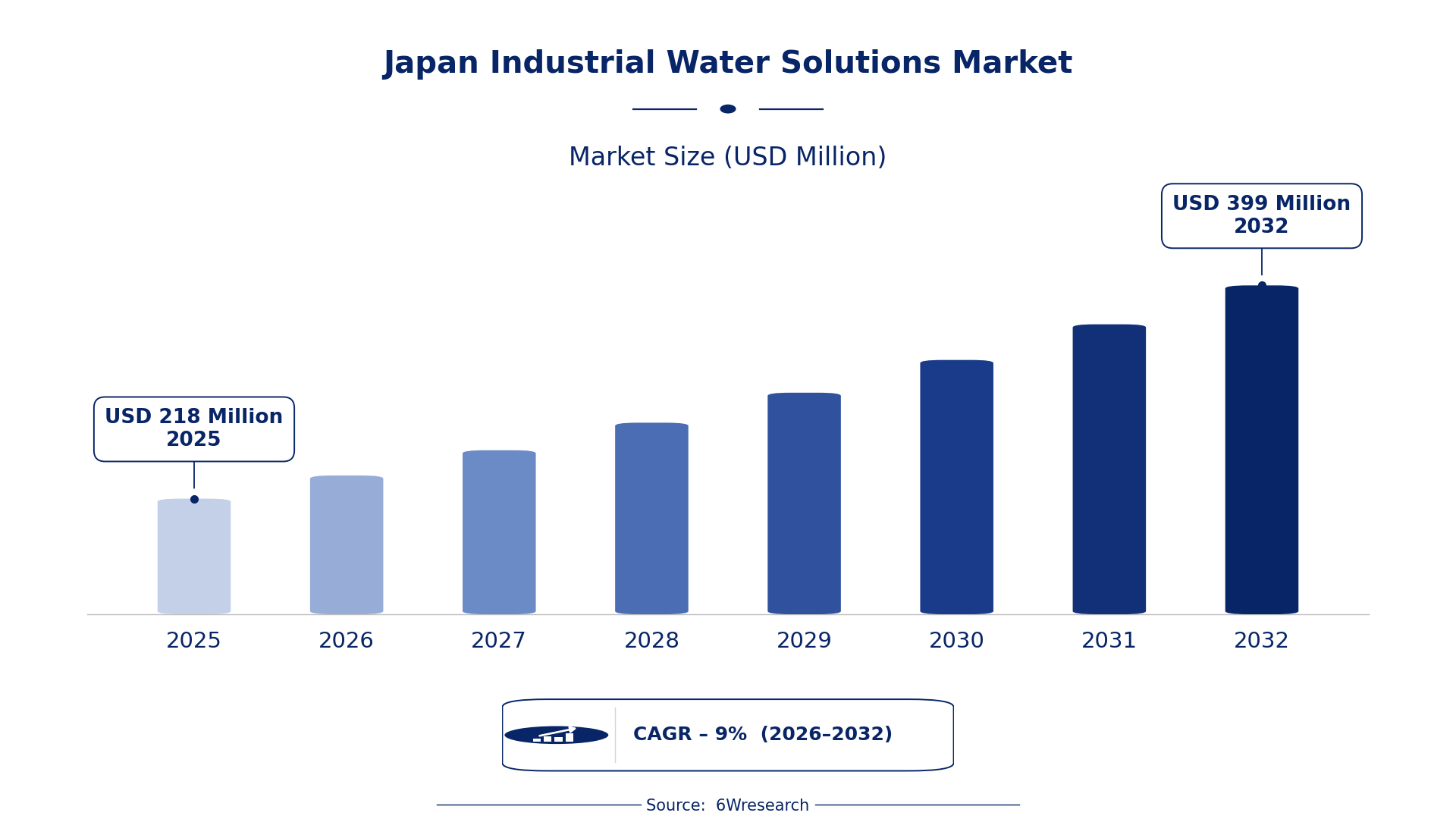
According to 6Wresearch internal database and industry insights, the Japan Industrial Water Solutions Market was valued at USD 218 Million in 2025 and is projected to reach USD 399 Million by 2032, growing at a CAGR of approximately 9% during 2026–2032.
Japan Industrial Water Solutions Market Highlights
| Report Metric | Details |
| Report Name | Japan Industrial Water Solutions Market (2026-2032) |
| Market Size 2025 | USD 218 Million |
| Market Size 2032 | USD 399 Million |
| Absolute Growth 2025–2032 | USD 181 Million |
| CAGR 2026–2032 | 9% |
| Peak Annual Growth | 9.5% in 2032 |
| Forecast Period | 2026–2032 |
| Historical Data | 2022–2025 |
| Base Year | 2025 |
| Leading Industrial Water Solutions, 2025 | Water Recycling Systems (37% share) |
| Leading Solution Type, 2025 | Zero Liquid Discharge (43% share) |
| Leading Treatment Process, 2025 | Filtration & Evaporation (50% share) |
| Leading Technology Used, 2025 | RO Desalination (35% share) |
| Leading End User Application, 2025 | Chemical Plants (41% share) |
| Fastest-Growing Industrial Water Solutions | Desalination Systems (11.8% CAGR) |
| Fastest-Growing Treatment Process | Chemical Dosing (12.7% CAGR) |
| Fastest-Growing Technology Used | Membrane Bioreactor (13.2% CAGR) |
| Fastest-Growing End User Application | Fertilizer Manufacturing (11.7% CAGR) |
| Growing Sector | Chemical Manufacturing |
| Key End Users | Chemical Plants, Petrochemical Refineries, Fertilizer Manufacturing, Paper & Pulp Industry |
Japan Industrial Water Solutions Market Year-wise Growth Rate and Key Drivers (2022–2032)
This graph illustrates the annual growth rates of the market from 2022 to 2032, highlighting a steady upward trajectory and projected market expansion over the forecast period.
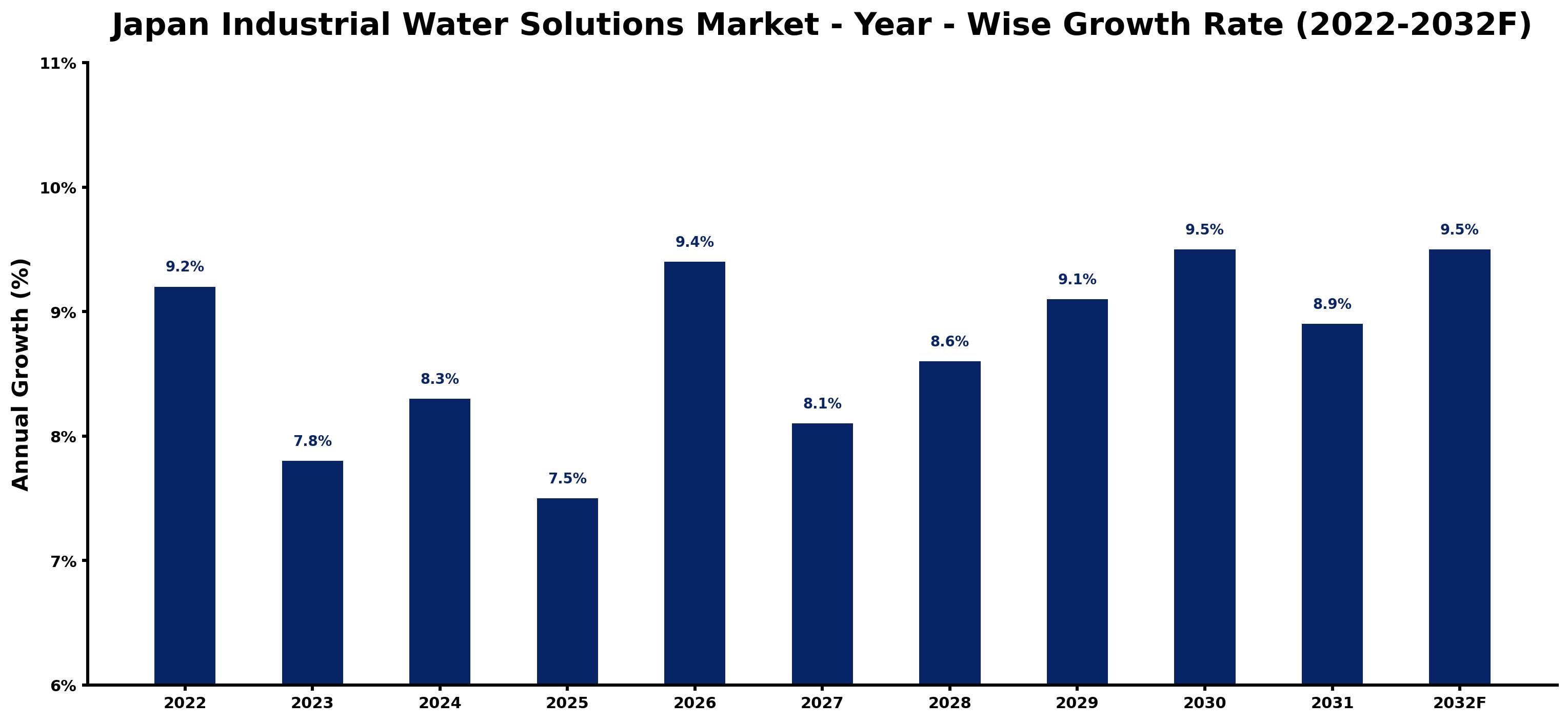
Annual growth estimates for each year appear below with the principal reason behind them, explaining the shifts that set the pace of the market.
| Year | Estimated Annual Growth (%) | Market Rationale |
| 2022 | 9.2 | The market experienced strong demand from industrial sectors, particularly chemical manufacturing. |
| 2023 | 7.8 | Growth slowed due to market saturation in certain regions and sectors. |
| 2024 | 8.3 | Increased investments in water treatment technologies spurred higher growth rates. |
| 2025 | 7.5 | Growth slowed again as the market adjusted to previous expansions in capacity. |
| 2026 | 9.4 | Demand is expected to surge with new desalination projects coming online in coastal areas. |
| 2027 | 8.1 | Growth is projected to slow as competition intensifies among existing solution providers. |
| 2028 | 8.6 | Rising environmental regulations will prompt increased investments in water recycling. |
| 2029 | 9.1 | Demand is expected to accelerate as industrial users seek to comply with stricter sustainability targets. |
| 2030 | 9.5 | Growth is projected to peak as major investments in zero liquid discharge technologies materialise. |
| 2031 | 8.9 | A slight slowdown is anticipated as market maturity sets in across various sectors. |
| 2032 | 9.5 | Demand is expected to rise again with advancements in treatment technologies. |
Note: Market size estimations and growth projections presented in this report are based on 6Wresearch's proprietary forecasting methodology, utilizing the latest available industry data, government publications, and primary research inputs.
Japan Industrial Water Solutions Market Synopsis
Industrial Water Solutions encompass advanced technologies for treating and recycling water in industrial applications, including water recycling, desalination, and treatment for boiler systems. The Japan Industrial Water Solutions Market is growing due to investments in decarbonisation, driven by over 50 major chemical plants and initiatives from the Ministry of the Environment. A heightened focus on sustainability influences the market, with Japan aiming for a 30% reduction in industrial water usage by 2030, which promotes operational efficiency and compliance among industrial users.
Market Dynamics Impact Analysis (2026–2032)
| Factor | Type | Impact | Primary Segment Affected |
| Increasing investments in water treatment technologies | Driver | High | Water Recycling Systems |
| Rising environmental regulations promoting sustainable practices | Driver | High | Desalination Systems |
| Growing demand for advanced cooling water treatment solutions | Opportunity | High | Cooling Water Treatment |
| Expansion of desalination projects in coastal regions | Opportunity | High | Desalination Systems |
| High initial investment costs for advanced technologies | Restraint | Medium | Zero Liquid Discharge |
| Limited awareness of new treatment technologies among smaller firms | Restraint | Medium | Boiler Water Treatment |
| Competition from alternative water sourcing methods | Challenge | High | Water Recycling Systems |
| Supply chain disruptions affecting technology availability | Challenge | Medium | Desalination Systems |
Evaluation of Drivers in Japan Industrial Water Solutions Market (2026–2032)
The table below links each growth driver to the segment it affects and the evidence for it.
| Drivers | Primary Segment Affected | Why It Matters (Evidence) |
| Significant investments in decarbonisation initiatives | Water Recycling Systems | Japan's GX Basic Policy targets JPY 150 trillion in decarbonisation investment over 10 years. |
| Increased focus on sustainability in industrial processes | Desalination Systems | The fertilizer manufacturing sector consumes around 15% of industrial water supply annually. |
| Growing urban population driving water demand | Cooling Water Treatment | Japan's population of approximately 125 million creates substantial industrial water demand. |
| Technological advancements in water treatment solutions | Boiler Water Treatment | The average installed capacity for boiler water treatment systems is approximately 1,000 cubic meters per day. |
| Government initiatives promoting water conservation | Zero Liquid Discharge | In 2022, the Japanese government allocated ¥10 billion for water conservation projects. |
Volumes increase due to substantial investments in decarbonisation, with Japan targeting JPY 150 trillion for these efforts over the next decade. The urban population of approximately 125 million fuels water demand, particularly in industrial sectors. Technological advancements have resulted in an average installed capacity for boiler water treatment systems of 1,000 cubic meters per day, encouraging more purchases. The fertilizer manufacturing sector, which consumes around 15% of industrial water supply, is increasingly adopting new treatment technologies to improve efficiency.
Evaluation of Restraints in Japan Industrial Water Solutions Market
The following restraints limit how fast demand can grow.
| Market Restraint | Primary Segment Affected | Why It Matters (Evidence) |
| High initial investment costs for advanced technologies | Zero Liquid Discharge | The implementation of zero liquid discharge systems requires substantial capital investment, limiting adoption among smaller firms. |
| Limited awareness of new treatment technologies among smaller firms | Boiler Water Treatment | Many smaller companies lack knowledge of advanced treatment solutions, hindering their ability to invest. |
| Competition from alternative water sourcing methods | Water Recycling Systems | Alternative methods, such as rainwater harvesting, may divert attention from industrial water solutions. |
| Supply chain disruptions affecting technology availability | Desalination Systems | Global supply chain issues have delayed the procurement of essential components for desalination projects. |
| Regulatory hurdles in implementing new technologies | Cooling Water Treatment | Compliance with stringent regulations can slow the adoption of new cooling solutions. |
Japan Industrial Water Solutions Market Challenges
Chemical plants in Japan encounter a shortage of skilled technicians for advanced water treatment systems, which delays project timelines and raises operational costs for producers. Buyers find it challenging to secure reliable suppliers of industrial water solutions, leading to inconsistent supply and potential production halts in manufacturing. Rising expenses for water treatment technologies, projected to reach ¥5 billion in investments by 2025, strain budgets for industrial users, particularly in the chemical sector. Strict regulatory requirements, such as the ISO 14046 standard, complicate operations and elevate costs for suppliers, hindering their ability to innovate and meet market demands.
Trends in the Japan Industrial Water Solutions Market
Below are the shifts with the largest effect on the Japan Industrial Water Solutions Market.
- Shift towards Zero Liquid Discharge Technologies: In 2023, the Japanese government launched a new initiative to promote zero liquid discharge technologies in manufacturing, aiming for a 30% reduction in wastewater discharge. This trend is expected to drive demand for advanced treatment systems.
- Increased Adoption of Membrane Bioreactors: The use of membrane bioreactors has increased by 20% in wastewater treatment facilities since 2020, reflecting a shift towards more efficient treatment processes. This change is important for industries aiming to improve their sustainability efforts.
- Expansion of Desalination Projects in Coastal Areas: The Tokyo Bay area has seen several desalination plants operational since 2021, addressing fresh water shortages in urban regions. This expansion is vital for supporting industrial water needs in densely populated areas.
- Growing Focus on Water Recycling Initiatives: The Ministry of the Environment promotes water recycling initiatives, targeting a 30% reduction in industrial water usage by 2030. This focus is reshaping the market towards sustainable practices.
Investment Opportunities in the Japan Industrial Water Solutions Market
The following areas offer the clearest openings for investors and suppliers in the Japan Industrial Water Solutions Market.
- Rising Demand for Advanced Cooling Solutions: With Japan's population density, there is a pressing need for advanced cooling water treatment solutions. The Chubu region, a hub for petrochemical refineries, presents an opportunity for suppliers to enter through local partnerships.
- Investment in Zero Liquid Discharge Technologies: Now is the time to invest in zero liquid discharge technologies as the government promotes their adoption. Chemical plants, which are significant water users, represent a prime buyer group for these solutions.
- Expansion of Water Recycling Systems: The average water recycling rate in Japanese industrial sectors is estimated at 50%, indicating a need for improved systems. Collaborating with local firms can facilitate entry into this growing segment.
- Development of Innovative Desalination Methods: As coastal regions expand, innovative desalination methods are increasingly necessary. Engaging with regional authorities can help suppliers navigate the approval pathways for new technologies.
Government Initiatives in the Japan Industrial Water Solutions Market
The GX Promotion Act, launched in 2023, establishes a legal framework for decarbonisation strategies. This act supports initiatives aimed at reducing greenhouse gas emissions, aligning with Japan's target for net zero by 2050, and directly impacts the adoption of Industrial Water Solutions.
The Japan Water Works Association oversees the implementation of the Water Supply Act and the Sewerage Act, ensuring compliance with water quality standards. These regulations guide industrial users in maintaining treatment systems, promoting sustainability in operations.
Future Insight of the Japan Industrial Water Solutions Market
Membrane bioreactor technology will drive demand for efficient water recycling solutions in industrial sectors by 2032, as facilities aim for a 30% reduction in water usage. Advanced disinfection systems will reshape treatment practices, promoting sustainability in manufacturing. By 2030, urban industrial areas will likely see an increase in desalination projects, particularly in the Tokyo Bay area, enhancing water availability. The Japanese government allocated ¥10 billion for water conservation projects in industrial zones, indicating strong support for innovation in water management.
Market Segmentation Analysis
Japan Industrial Water Solutions Market report covers a detailed analysis of the following market segments:
By Industrial Water Solutions – Water Recycling Systems Lead, Desalination Systems Expected to Grow Fastest
According to Saurav Kr Singh, Senior Research Analyst at 6Wresearch, in 2025, Water Recycling Systems led the industrial water solutions split with a 37% share. Water recycling systems dominate the market due to their critical role in reducing water waste in industries. The average water recycling rate in Japanese industrial sectors is estimated at 50%, indicating extensive implementation in facilities like chemical manufacturing. Desalination Systems are set to record the highest CAGR in this split, 11.8% over 2026–2032. Desalination systems are witnessing rapid growth, particularly in the Tokyo Bay area where several plants have been operational since 2021. This trend is expected to accelerate as urban areas expand, further solidifying the lead of water recycling systems. Suppliers must prioritise advancements in water recycling and desalination technologies to satisfy the increasing industrial demand.
By Solution Type – Zero Liquid Discharge Leads and Records the Fastest Growth
Zero Liquid Discharge took 43% of solution type revenue in 2025, more than any other category. Zero liquid discharge technologies lead the market as they are essential for minimising wastewater discharge, aligning with Japan's environmental objectives. The government's substantial investments to support these initiatives highlight their significance in industrial applications. The same category is also set to grow fastest, at a CAGR of 12.5% during 2026–2032. Zero liquid discharge technologies are also the fastest-growing segment, spurred by the government's commitment to sustainable industrial practices. This dual role will likely enhance their market position and ensure ongoing relevance. Buyers will increasingly seek suppliers capable of providing comprehensive zero liquid discharge solutions to adhere to regulatory standards.
By Treatment Process – Filtration & Evaporation Leads, Chemical Dosing Expected to Grow Fastest
Filtration & Evaporation held 50% of the Japan Industrial Water Solutions Market by treatment process in 2025. Filtration and evaporation processes are at the forefront of the market as they are utilised in specific applications requiring effective separation. Their consistent demand across various industrial sectors ensures their leading position in the market. Chemical Dosing is projected to grow fastest, at a CAGR of 12.7% during 2026–2032. Chemical dosing processes are experiencing rapid growth due to their ability to improve treatment efficacy across multiple applications. This trend is anticipated to continue as industries aim to enhance their water treatment outcomes and operational efficiency. Suppliers should focus on developing advanced chemical dosing solutions to meet the rising demand for effective water treatment processes.
By Technology Used – RO Desalination Leads, Membrane Bioreactor Expected to Grow Fastest
With 35% of technology used revenue in 2025, RO Desalination was the largest category. RO desalination technology holds the largest share as it is widely used for fresh water production, especially in regions with limited water resources. Its established presence in the market ensures a steady demand from various sectors, particularly in urban areas. Over 2026–2032, Membrane Bioreactor is expected to post the fastest growth, at a CAGR of 13.2%. Membrane bioreactor technology is growing quickly, being integral for wastewater treatment in numerous facilities. As industries focus on improving their wastewater management, this technology's relevance will only increase, further solidifying its market position. Buyers will benefit from exploring advanced RO desalination and membrane bioreactor technologies to optimise their water management strategies.
By End User Application – Chemical Plants Lead, Fertilizer Manufacturing Expected to Grow Fastest
The largest end user application category in 2025 was Chemical Plants, at 41% of revenue. Chemical plants are the primary end users of industrial water solutions, employing various water treatment technologies to fulfil their operational requirements. This sector's significant water consumption reinforces its leading position in the market, especially in regions with high industrial activity. Fertilizer Manufacturing is set to record the highest CAGR in this split, 11.7% over 2026–2032. Fertilizer manufacturing is the fastest-growing application, necessitating substantial water treatment solutions to support its production processes. As this sector expands, its demand for effective water management will correspondingly increase, creating opportunities for suppliers. Suppliers should customise their offerings to address the specific needs of chemical plants and fertilizer manufacturers to seize growth opportunities.
Key Attractiveness of the Report
- 10 Years of Market Numbers
- Historical Data Starting from 2022 to 2025
- Base Year 2025
- Forecast Data until 2032
- Key Performance Indicators Impacting the Market
- Major Upcoming Developments and Projects
Key Highlights of the Report:
- Japan Industrial Water Solutions Market Outlook
- Market Size of Japan Industrial Water Solutions Market, 2025
- Forecast of Japan Industrial Water Solutions Market, 2032
- Historical Data and Forecast of Japan Industrial Water Solutions Revenues & Volume for the Period 2022-2032F
- Japan Industrial Water Solutions Market Trend Evolution
- Japan Industrial Water Solutions Market Drivers and Challenges
- Japan Industrial Water Solutions Price Trends
- Japan Industrial Water Solutions Porter's Five Forces
- Japan Industrial Water Solutions Industry Life Cycle
- Historical Data and Forecast of Japan Industrial Water Solutions Market Revenues & Volume By Industrial Water Solutions for the Period 2022-2032F
- Historical Data and Forecast of Japan Industrial Water Solutions Market Revenues & Volume By Water Recycling Systems for the Period 2022-2032F
- Historical Data and Forecast of Japan Industrial Water Solutions Market Revenues & Volume By Desalination Systems for the Period 2022-2032F
- Historical Data and Forecast of Japan Industrial Water Solutions Market Revenues & Volume By Boiler Water Treatment for the Period 2022-2032F
- Historical Data and Forecast of Japan Industrial Water Solutions Market Revenues & Volume By Cooling Water Treatment for the Period 2022-2032F
- Historical Data and Forecast of Japan Industrial Water Solutions Market Revenues & Volume By Solution Type for the Period 2022-2032F
- Historical Data and Forecast of Japan Industrial Water Solutions Market Revenues & Volume By Zero Liquid Discharge for the Period 2022-2032F
- Historical Data and Forecast of Japan Industrial Water Solutions Market Revenues & Volume By Brine Treatment for the Period 2022-2032F
- Historical Data and Forecast of Japan Industrial Water Solutions Market Revenues & Volume By Scale Prevention for the Period 2022-2032F
- Historical Data and Forecast of Japan Industrial Water Solutions Market Revenues & Volume By Corrosion Control for the Period 2022-2032F
- Historical Data and Forecast of Japan Industrial Water Solutions Market Revenues & Volume By Treatment Process for the Period 2022-2032F
- Historical Data and Forecast of Japan Industrial Water Solutions Market Revenues & Volume By Filtration & Evaporation for the Period 2022-2032F
- Historical Data and Forecast of Japan Industrial Water Solutions Market Revenues & Volume By Ion Exchange for the Period 2022-2032F
- Historical Data and Forecast of Japan Industrial Water Solutions Market Revenues & Volume By Chemical Dosing for the Period 2022-2032F
- Historical Data and Forecast of Japan Industrial Water Solutions Market Revenues & Volume By UV Disinfection for the Period 2022-2032F
- Historical Data and Forecast of Japan Industrial Water Solutions Market Revenues & Volume By Technology Used for the Period 2022-2032F
- Historical Data and Forecast of Japan Industrial Water Solutions Market Revenues & Volume By Membrane Bioreactor for the Period 2022-2032F
- Historical Data and Forecast of Japan Industrial Water Solutions Market Revenues & Volume By RO Desalination for the Period 2022-2032F
- Historical Data and Forecast of Japan Industrial Water Solutions Market Revenues & Volume By Thermal Deaeration for the Period 2022-2032F
- Historical Data and Forecast of Japan Industrial Water Solutions Market Revenues & Volume By Ozonation for the Period 2022-2032F
- Historical Data and Forecast of Japan Industrial Water Solutions Market Revenues & Volume By End User Application for the Period 2022-2032F
- Historical Data and Forecast of Japan Industrial Water Solutions Market Revenues & Volume By Fertilizer Manufacturing for the Period 2022-2032F
- Historical Data and Forecast of Japan Industrial Water Solutions Market Revenues & Volume By Paper & Pulp Industry for the Period 2022-2032F
- Historical Data and Forecast of Japan Industrial Water Solutions Market Revenues & Volume By Chemical Plants for the Period 2022-2032F
- Historical Data and Forecast of Japan Industrial Water Solutions Market Revenues & Volume By Petrochemical Refineries for the Period 2022-2032F
- Japan Industrial Water Solutions Import Export Trade Statistics
- Market Opportunity Assessment By Industrial Water Solutions
- Market Opportunity Assessment By Solution Type
- Market Opportunity Assessment By Treatment Process
- Market Opportunity Assessment By Technology Used
- Market Opportunity Assessment By End User Application
- Japan Industrial Water Solutions Top Companies Market Share
- Japan Industrial Water Solutions Competitive Benchmarking By Technical and Operational Parameters
- Japan Industrial Water Solutions Company Profiles
- Japan Industrial Water Solutions Key Strategic Recommendations
Market Covered
The report covers the following segments.
By Industrial Water Solutions
- Water Recycling Systems
- Desalination Systems
- Boiler Water Treatment
- Cooling Water Treatment
By Solution Type
- Zero Liquid Discharge
- Brine Treatment
- Scale Prevention
- Corrosion Control
By Treatment Process
- Filtration & Evaporation
- Ion Exchange
- Chemical Dosing
- UV Disinfection
By Technology Used
- Membrane Bioreactor
- RO Desalination
- Thermal Deaeration
- Ozonation
By End User Application
- Fertilizer Manufacturing
- Paper & Pulp Industry
- Chemical Plants
- Petrochemical Refineries































