Japan Industrial Webbing Market Size & Growth Rate
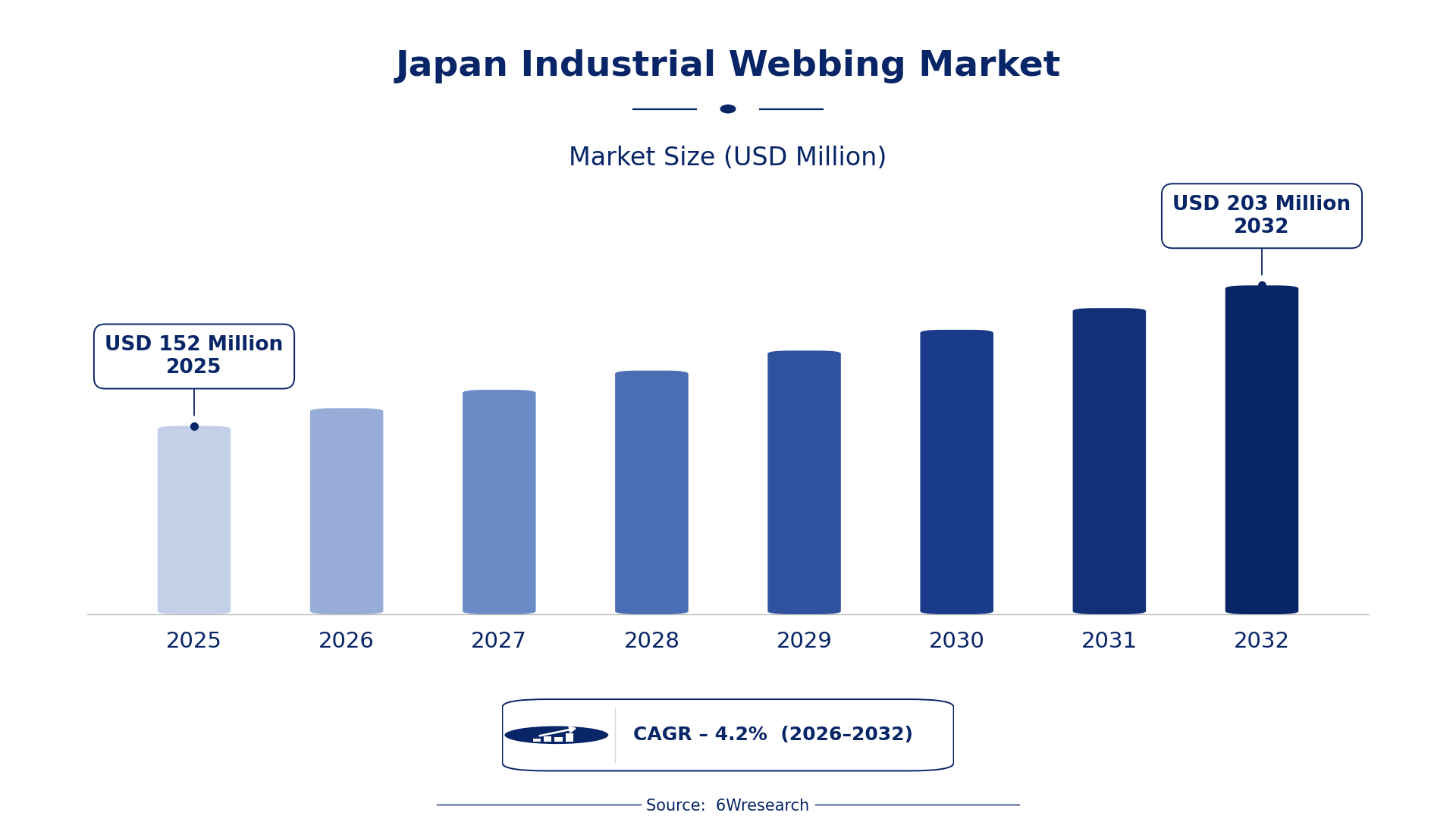
According to 6Wresearch internal database and industry insights, the Japan Industrial Webbing Market was valued at USD 152 Million in 2025 and is projected to reach USD 203 Million by 2032, growing at a CAGR of approximately 4.2% during 2026–2032.
Japan Industrial Webbing Market Highlights
| Report Metric | Details |
| Report Name | Japan Industrial Webbing Market (2026-2032) |
| Market Size 2025 | USD 152 Million |
| Market Size 2032 | USD 203 Million |
| Absolute Growth 2025–2032 | USD 51 Million |
| CAGR 2026–2032 | 4.2% |
| Peak Annual Growth | 5.6% in 2032 |
| Forecast Period | 2026–2032 |
| Historical Data | 2022–2025 |
| Base Year | 2025 |
| Leading Industrial Webbing, 2025 | Polyester Webbing (41% share) |
| Leading Material Type, 2025 | Polyester (48% share) |
| Leading Weaving Pattern, 2025 | Plain Weave (47% share) |
| Leading End Use Product, 2025 | Seat Belts (34% share) |
| Leading Distribution Channel, 2025 | OEM Supplies (43% share) |
| Fastest-Growing Industrial Webbing | Nylon Webbing (5.5% CAGR) |
| Fastest-Growing Material Type | Nylon (6.2% CAGR) |
| Fastest-Growing Weaving Pattern | Twill Weave (5.7% CAGR) |
| Fastest-Growing End Use Product | Harnesses (5.6% CAGR) |
| Fastest-Growing Distribution Channel | Industrial Distributors (6.0% CAGR) |
| Growing Sector | Safety Equipment |
| Key End Users | Automotive manufacturers, construction companies, military agencies, industrial suppliers |
Japan Industrial Webbing Market Year-wise Growth Rate and Key Drivers (2022–2032)
This graph illustrates the annual growth rates of the market from 2022 to 2032, highlighting a steady upward trajectory and projected market expansion over the forecast period.
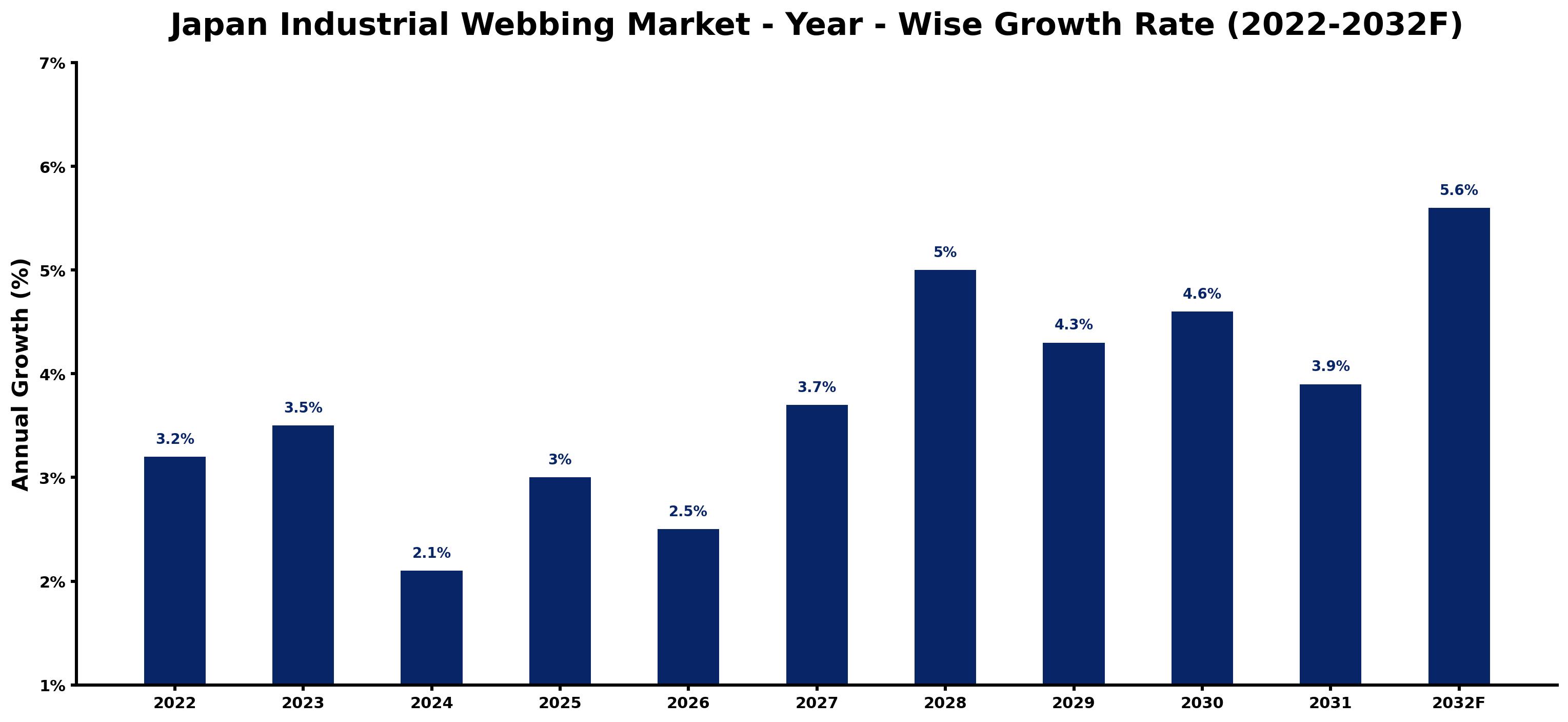
Below, each year's estimated growth is shown next to the factor that most influenced it.
| Year | Estimated Annual Growth (%) | Market Rationale |
| 2022 | 3.2 | The market was characterised by moderate growth as demand from the automotive sector remained steady. |
| 2023 | 3.5 | Growth accelerated due to increased safety regulations in the automotive industry, boosting webbing demand. |
| 2024 | 2.1 | A slowdown occurred as manufacturers faced supply chain disruptions affecting production rates. |
| 2025 | 3.0 | Demand rebounded as manufacturers adapted to supply challenges and automotive production increased. |
| 2026 | 2.5 | Growth is expected to slow again as manufacturers adjust to market saturation in certain segments. |
| 2027 | 3.7 | The market is projected to experience renewed growth driven by rising defence spending and military applications. |
| 2028 | 5.0 | Demand is anticipated to surge as safety standards in construction increase, leading to higher webbing purchases. |
| 2029 | 4.3 | Growth is expected to decelerate as the market begins to stabilise after a period of rapid expansion. |
| 2030 | 4.6 | A rise in demand is projected as investments in decarbonisation initiatives begin to take effect. |
| 2031 | 3.9 | The market is expected to see slower growth as companies focus on efficiency improvements in production. |
| 2032 | 5.6 | Demand is projected to peak as new safety regulations and military contracts drive substantial purchases. |
Note: Market size estimations and growth projections presented in this report are based on 6Wresearch's proprietary forecasting methodology, utilizing the latest available industry data, government publications, and primary research inputs.
Japan Industrial Webbing Market Synopsis
Industrial webbing is a durable woven fabric made from synthetic fibres like polyester and nylon, primarily used in safety harnesses, seat belts, and military applications. The Japan Industrial Webbing Market is growing due to heightened safety regulations in the automotive and construction sectors, alongside increased defence spending. In 2022, the automotive industry accounted for a large share of webbing demand, while government initiatives are promoting the use of domestic materials, further driving market expansion.
Market Dynamics Impact Analysis (2026–2032)
| Factor | Type | Impact | Primary Segment Affected |
| Increased safety regulations in the automotive sector drive demand for webbing materials. | Driver | High | Polyester Webbing |
| Rising defence spending enhances the need for military straps and related products. | Driver | High | Military Straps |
| Growing construction projects create a demand for safety harnesses and related webbing products. | Opportunity | High | Harnesses |
| The shift towards sustainable materials opens avenues for new product development in webbing. | Opportunity | Medium | Polyester Webbing |
| Supply chain disruptions have impacted the availability of raw materials for webbing production. | Restraint | High | Nylon Webbing |
| Market saturation in certain segments limits growth potential for existing manufacturers. | Restraint | Medium | Polyester Webbing |
| High production costs affect profit margins for manufacturers in the webbing industry. | Challenge | High | Nylon Webbing |
| Technological advancements require continuous investment, straining smaller manufacturers financially. | Challenge | Medium | Polyester Webbing |
Evaluation of Drivers in Japan Industrial Webbing Market (2026–2032)
Demand rests on the following drivers, each shown with the segment it touches most.
| Drivers | Primary Segment Affected | Why It Matters (Evidence) |
| Increased automotive safety standards require higher-quality webbing materials. | Polyester Webbing | In 2022, the automotive industry accounted for a large portion of webbing demand, pushing manufacturers to improve quality. |
| Rising military expenditures drive demand for durable webbing applications. | Military Straps | In 2022, military applications drove a substantial portion of webbing demand, reflecting the growing focus on defence capabilities. |
| Growing construction safety regulations necessitate the use of safety harnesses. | Harnesses | The construction industry has seen a rise in safety regulations, leading to increased purchases of webbing for harnesses. |
| Technological advancements in manufacturing improve production efficiency. | Nylon Webbing | Investments in new weaving technologies have enhanced production capabilities, allowing for faster output. |
| Government initiatives promote the use of domestic materials, boosting local production. | Polyester Webbing | Government support for local manufacturers has increased the demand for domestically produced webbing. |
What keeps demand rising is the increased focus on safety standards in the automotive industry, which accounted for a large share of webbing demand in 2022. Rising military expenditures have resulted in a notable increase in procurement of military straps, reflecting the growing emphasis on defence capabilities. Investments in advanced weaving technologies have improved production efficiency, enabling manufacturers to respond to increasing demand more effectively.
Evaluation of Restraints in Japan Industrial Webbing Market
Below are the constraints most often cited by buyers and suppliers, with the segment each affects.
| Market Restraint | Primary Segment Affected | Why It Matters (Evidence) |
| Supply chain disruptions have led to delays in raw material availability. | Nylon Webbing | In 2022, disruptions affected the timely procurement of nylon, impacting production schedules. |
| Market saturation in certain segments limits growth opportunities for existing players. | Polyester Webbing | As the market matures, competition has intensified, restricting growth for established manufacturers. |
| High production costs strain profit margins for manufacturers. | Nylon Webbing | Increased costs of raw materials have pressured manufacturers, affecting pricing strategies. |
| Technological advancements require continuous investment in production processes. | Polyester Webbing | Manufacturers must invest in new technologies to remain competitive, impacting financial resources. |
| Fluctuating demand in the automotive sector can lead to unpredictable sales. | Military Straps | Changes in automotive production rates can directly affect webbing demand, creating volatility. |
Japan Industrial Webbing Market Challenges
Producers struggle with outdated weaving technology, which slows production and delays deliveries to buyers in the automotive sector. Buyers face rising costs as safety standards require more expensive materials, increasing expenses for end-users in construction by up to 15%. Importers encounter sourcing difficulties for raw materials, causing supply chain disruptions that can postpone production schedules for manufacturers by weeks. Cost pressures mount as government initiatives encourage local sourcing, forcing producers to invest in domestic materials, inflating operational costs by up to 20% for smaller manufacturers.
Trends in the Japan Industrial Webbing Market
Buyers and suppliers in the Japan Industrial Webbing Market are adjusting to the following trends.
- Shift towards Sustainable Materials: A growing trend is the shift towards sustainable materials in industrial webbing. The GX Basic Policy adopted in 2023 aims for JPY 150 trillion in decarbonisation investments, prompting manufacturers to explore eco-friendly alternatives.
- Increased Focus on Safety Standards: Stricter safety regulations for seat belts have been implemented by the Ministry of Land, Infrastructure, Transport and Tourism. This change has led to a notable increase in demand for high-quality webbing products, reflecting the emphasis on safety.
- Rising Military Applications: The demand for military straps has surged due to increased defence spending. In 2022, military applications accounted for a substantial share of webbing sales, indicating the growing focus on defence capabilities.
- Expansion of Online Distribution Channels: The rise of online B2B platforms is changing how webbing products are distributed. In 2023, online sales channels accounted for a growing share of total sales, enhancing market accessibility for buyers.
Investment Opportunities in the Japan Industrial Webbing Market
Several openings in the Japan Industrial Webbing Market merit attention from investors.
- Growing Demand for Safety Harnesses: The construction sector's focus on safety creates a timely opportunity for webbing suppliers. In 2023, safety harnesses accounted for a notable share of webbing sales, indicating strong demand for high-quality products.
- Military Contracts Present New Avenues: With rising defence budgets, there is a clear opportunity for manufacturers to supply military straps. In 2022, military applications drove a substantial portion of webbing demand, reflecting the need for durable materials.
- Investment in Eco-Friendly Materials: The push for sustainability in manufacturing offers a chance to develop new webbing products. The GX Basic Policy aims for about JPY 150 trillion in investments, encouraging innovation in materials and production processes.
- Expansion in Online Sales Channels: The increasing use of online B2B platforms provides a timely opportunity for suppliers. In 2023, the online distribution of webbing products saw substantial growth, indicating a shift in purchasing behaviour.
Government Initiatives in the Japan Industrial Webbing Market
The Industrial Safety and Health Act of 1972 mandates employer responsibilities regarding hazardous substances and machinery, impacting producers of industrial webbing. Compliance with this law requires manufacturers to implement safety measures in their production processes, ensuring worker safety and product reliability. The Act on the Rational Use of Energy, established in 1979, obliges large energy users to improve energy efficiency, affecting the operational costs of webbing manufacturers.
In 2023, the GX Basic Policy set a target of JPY 150 trillion for public and private decarbonisation investments over the next decade. The Ministry of Economy, Trade and Industry oversees these initiatives, promoting sustainable practices among webbing producers. This policy encourages manufacturers to adopt eco-friendly materials and processes, aligning with national sustainability goals.
Future Insight of the Japan Industrial Webbing Market
A shift towards aggressive decarbonisation will drive innovation in sustainable materials, prompting suppliers to develop eco-friendly webbing solutions. By 2032, advancements in weaving technology will enhance production efficiency, enabling buyers to receive products faster and at lower costs. Support for local manufacturers through subsidies in the Tokyo region will strengthen the domestic supply chain, benefiting both producers and buyers. Increased defence spending will elevate demand for industrial webbing, particularly in military applications, creating new growth opportunities.
Market Segmentation Analysis
Japan Industrial Webbing Market report covers a detailed analysis of the following market segments:
By Industrial Webbing – Polyester Webbing Leads, Nylon Webbing Expected to Grow Fastest
According to Saurav Kr Singh, Senior Research Analyst at 6Wresearch, Polyester Webbing held 41% of the Japan Industrial Webbing Market by industrial webbing in 2025. Polyester webbing holds the largest share in Japan due to its critical role in safety applications like seat belts and safety harnesses. The automotive industry significantly relies on polyester for its strength and durability, creating a strong demand base. Nylon Webbing is set to record the highest CAGR in this split, 5.5% over 2026–2032. Nylon webbing is witnessing rapid growth, particularly for high-strength applications in sectors such as construction and safety equipment. The increasing emphasis on safety standards is propelling its adoption, ensuring its market share continues to expand. Suppliers should focus on increasing their nylon product offerings to cater to the growing demand for high-strength webbing solutions.
By Material Type – Polyester Leads, Nylon Expected to Grow Fastest
With 48% of material type revenue in 2025, Polyester was the largest category. Polyester is the dominant material type in the industrial webbing market, largely due to its extensive use in producing durable webbing products. Its properties make it particularly suitable for applications in the automotive sector, driving consistent demand. Nylon is projected to grow fastest, at a CAGR of 6.2% during 2026–2032. Nylon is experiencing the fastest growth as it is increasingly valued for its strength and durability, making it ideal for demanding applications. This trend is reinforced by the growing focus on safety in product design across various industries. Buyers should consider incorporating nylon options to improve the performance and safety of their products.
By Weaving Pattern – Plain Weave Leads, Twill Weave Expected to Grow Fastest
Plain Weave took 47% of weaving pattern revenue in 2025, more than any other category. Plain weave is the leading pattern due to its standardisation in the production of industrial webbing, ensuring reliability and consistency. This pattern is widely adopted across various applications, particularly in safety equipment. Over 2026–2032, Twill Weave is expected to post the fastest growth, at a CAGR of 5.7%. Twill weave is growing quickly as it offers added strength, making it suitable for more demanding applications. The increasing focus on safety and performance is driving the shift towards this weaving pattern. Suppliers should consider expanding their twill weave offerings to meet the rising demand for stronger webbing solutions.
By End Use Product – Seat Belts Lead, Harnesses Expected to Grow Fastest
Seat Belts accounted for 34% of the market by end use product in 2025. Seat belts are the leading end-use product segment, primarily due to their essential role in vehicle safety and adherence to regulatory standards. The integration of polyester webbing in these safety features ensures a strong market presence. The quickest growth will come from Harnesses, forecast to expand at a CAGR of 5.6% between 2026 and 2032. Harnesses are rapidly gaining traction, especially in safety and industrial applications, driven by stricter safety regulations. The construction industry plays a significant role in this increasing demand, highlighting the need for reliable safety equipment. Manufacturers should increase harness production to meet the growing safety requirements across various sectors.
By Distribution Channel – OEM Supplies Lead, Industrial Distributors Expected to Grow Fastest
The largest distribution channel category in 2025 was OEM Supplies, at 43% of revenue. OEM supplies are the leading distribution channel, providing manufacturers with essential materials directly and ensuring a steady demand for industrial webbing. This channel is crucial for maintaining high quality and reliability in production processes. Industrial Distributors are set to record the highest CAGR in this split, 6.0% over 2026–2032. Industrial distributors are experiencing the fastest growth, acting as vital links in the supply chain for various industries. Their expansion is further encouraged by the growth of the manufacturing sector, improving access to webbing products. Suppliers should strengthen partnerships with industrial distributors to enhance market penetration and responsiveness.
Key Attractiveness of the Report
- 10 Years of Market Numbers
- Historical Data Starting from 2022 to 2025
- Base Year 2025
- Forecast Data until 2032
- Key Performance Indicators Impacting the Market
- Major Upcoming Developments and Projects
Key Highlights of the Report:
- Japan Industrial Webbing Market Outlook
- Market Size of Japan Industrial Webbing Market, 2025
- Forecast of Japan Industrial Webbing Market, 2032
- Historical Data and Forecast of Japan Industrial Webbing Revenues & Volume for the Period 2022-2032F
- Japan Industrial Webbing Market Trend Evolution
- Japan Industrial Webbing Market Drivers and Challenges
- Japan Industrial Webbing Price Trends
- Japan Industrial Webbing Porter's Five Forces
- Japan Industrial Webbing Industry Life Cycle
- Historical Data and Forecast of Japan Industrial Webbing Market Revenues & Volume By Industrial Webbing for the Period 2022-2032F
- Historical Data and Forecast of Japan Industrial Webbing Market Revenues & Volume By Polyester Webbing for the Period 2022-2032F
- Historical Data and Forecast of Japan Industrial Webbing Market Revenues & Volume By Nylon Webbing for the Period 2022-2032F
- Historical Data and Forecast of Japan Industrial Webbing Market Revenues & Volume By Kevlar Webbing for the Period 2022-2032F
- Historical Data and Forecast of Japan Industrial Webbing Market Revenues & Volume By Polypropylene Webbing for the Period 2022-2032F
- Historical Data and Forecast of Japan Industrial Webbing Market Revenues & Volume By Material Type for the Period 2022-2032F
- Historical Data and Forecast of Japan Industrial Webbing Market Revenues & Volume By Polyester for the Period 2022-2032F
- Historical Data and Forecast of Japan Industrial Webbing Market Revenues & Volume By Nylon for the Period 2022-2032F
- Historical Data and Forecast of Japan Industrial Webbing Market Revenues & Volume By Aramid Fiber for the Period 2022-2032F
- Historical Data and Forecast of Japan Industrial Webbing Market Revenues & Volume By Polypropylene for the Period 2022-2032F
- Historical Data and Forecast of Japan Industrial Webbing Market Revenues & Volume By Weaving Pattern for the Period 2022-2032F
- Historical Data and Forecast of Japan Industrial Webbing Market Revenues & Volume By Plain Weave for the Period 2022-2032F
- Historical Data and Forecast of Japan Industrial Webbing Market Revenues & Volume By Twill Weave for the Period 2022-2032F
- Historical Data and Forecast of Japan Industrial Webbing Market Revenues & Volume By Basket Weave for the Period 2022-2032F
- Historical Data and Forecast of Japan Industrial Webbing Market Revenues & Volume By Satin Weave for the Period 2022-2032F
- Historical Data and Forecast of Japan Industrial Webbing Market Revenues & Volume By End Use Product for the Period 2022-2032F
- Historical Data and Forecast of Japan Industrial Webbing Market Revenues & Volume By Seat Belts for the Period 2022-2032F
- Historical Data and Forecast of Japan Industrial Webbing Market Revenues & Volume By Harnesses for the Period 2022-2032F
- Historical Data and Forecast of Japan Industrial Webbing Market Revenues & Volume By Military Straps for the Period 2022-2032F
- Historical Data and Forecast of Japan Industrial Webbing Market Revenues & Volume By Luggage Belts for the Period 2022-2032F
- Historical Data and Forecast of Japan Industrial Webbing Market Revenues & Volume By Distribution Channel for the Period 2022-2032F
- Historical Data and Forecast of Japan Industrial Webbing Market Revenues & Volume By OEM Supplies for the Period 2022-2032F
- Historical Data and Forecast of Japan Industrial Webbing Market Revenues & Volume By Industrial Distributors for the Period 2022-2032F
- Historical Data and Forecast of Japan Industrial Webbing Market Revenues & Volume By Government Tenders for the Period 2022-2032F
- Historical Data and Forecast of Japan Industrial Webbing Market Revenues & Volume By Online B2B Platforms for the Period 2022-2032F
- Japan Industrial Webbing Import Export Trade Statistics
- Market Opportunity Assessment By Industrial Webbing
- Market Opportunity Assessment By Material Type
- Market Opportunity Assessment By Weaving Pattern
- Market Opportunity Assessment By End Use Product
- Market Opportunity Assessment By Distribution Channel
- Japan Industrial Webbing Top Companies Market Share
- Japan Industrial Webbing Competitive Benchmarking By Technical and Operational Parameters
- Japan Industrial Webbing Company Profiles
- Japan Industrial Webbing Key Strategic Recommendations
Market Covered
The study includes the following segmentation.
By Industrial Webbing
- Polyester Webbing
- Nylon Webbing
- Kevlar Webbing
- Polypropylene Webbing
By Material Type
- Polyester
- Nylon
- Aramid Fiber
- Polypropylene
By Weaving Pattern
- Plain Weave
- Twill Weave
- Basket Weave
- Satin Weave
By End Use Product
- Seat Belts
- Harnesses
- Military Straps
- Luggage Belts
By Distribution Channel
- OEM Supplies
- Industrial Distributors
- Government Tenders
- Online B2B Platforms































