Japan Industrial Welding Market Size & Growth Rate
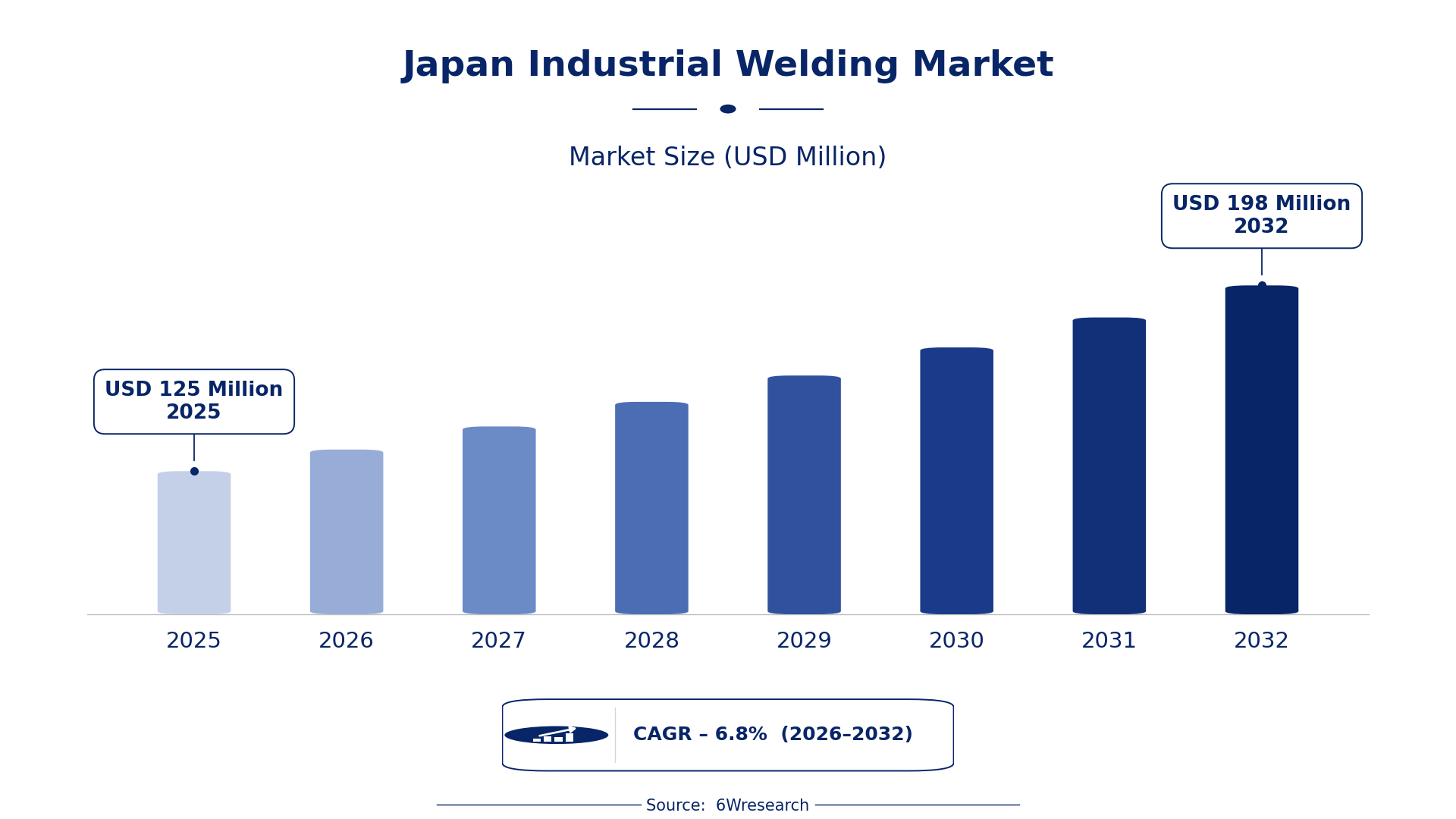
According to 6Wresearch internal database and industry insights, the Japan Industrial Welding Market was valued at USD 125 Million in 2025 and is projected to reach USD 198 Million by 2032, growing at a CAGR of approximately 6.8% during 2026–2032.
Japan Industrial Welding Market Highlights
| Report Metric | Details |
| Report Name | Japan Industrial Welding Market (2026-2032) |
| Market Size 2025 | USD 125 Million |
| Market Size 2032 | USD 198 Million |
| Absolute Growth 2025–2032 | USD 73 Million |
| CAGR 2026–2032 | 6.8% |
| Peak Annual Growth | 7.6% in 2028 |
| Forecast Period | 2026–2032 |
| Historical Data | 2022–2025 |
| Base Year | 2025 |
| Leading Industrial Welding, 2025 | Arc Welding (44% share) |
| Leading Welding Type, 2025 | Gas Metal Arc (36% share) |
| Leading Equipment Type, 2025 | Semi-Automatic Welder (37% share) |
| Leading Application Area, 2025 | Automotive Assemblies (44% share) |
| Leading End User Industry, 2025 | Construction Sector (50% share) |
| Fastest-Growing Industrial Welding | Laser Welding (8.7% CAGR) |
| Fastest-Growing Welding Type | Gas Tungsten Arc (9.4% CAGR) |
| Fastest-Growing Equipment Type | CNC Laser Welder (9.8% CAGR) |
| Fastest-Growing Application Area | Micro-Welding Jobs (8.1% CAGR) |
| Fastest-Growing End User Industry | Fabrication Workshops (9.1% CAGR) |
| Growing Sector | Construction Sector |
| Key End Users | Automotive manufacturers, construction companies, aerospace firms, fabrication workshops |
Japan Industrial Welding Market Year-wise Growth Rate and Key Drivers (2022–2032)
This graph illustrates the annual growth rates of the market from 2022 to 2032, highlighting a steady upward trajectory and projected market expansion over the forecast period.
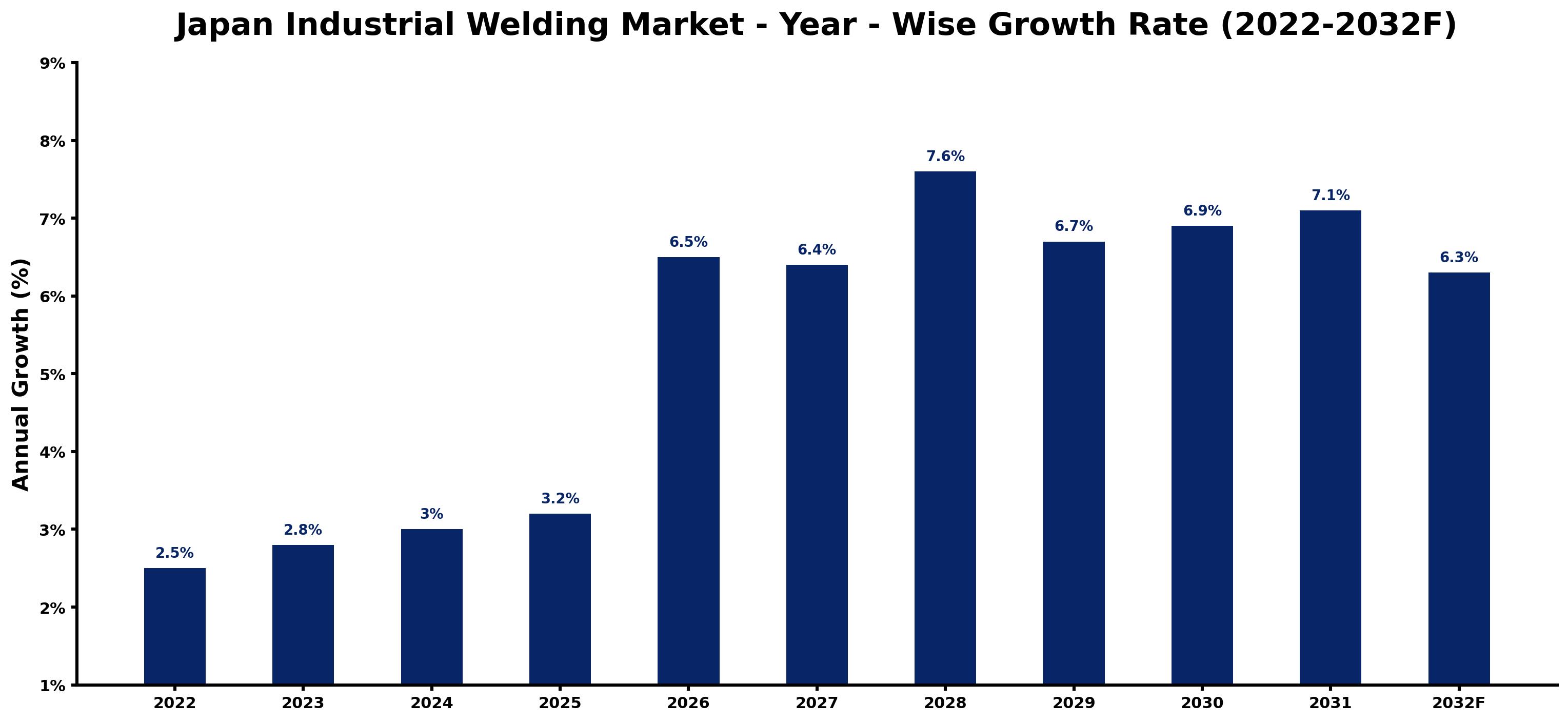
The yearly estimates that follow link every growth rate to its principal driver, so readers can see why the pace changed in each period.
| Year | Estimated Annual Growth (%) | Market Rationale |
| 2022 | 2.5 | The market showed steady growth due to ongoing industrial activities and demand. |
| 2023 | 2.8 | Growth accelerated as construction projects increased, boosting welding needs. |
| 2024 | 3.0 | The rise in automotive production further stimulated demand for welding equipment. |
| 2025 | 3.2 | Demand peaked as infrastructure investments reached high levels. |
| 2026 | 6.5 | Growth surged with advancements in automation and robotics in welding. |
| 2027 | 6.4 | Growth slowed slightly as the market adjusted to previous peaks. |
| 2028 | 7.6 | The market experienced a strong rebound driven by new technology adoption. |
| 2029 | 6.7 | Growth decelerated as the market stabilised after rapid advancements. |
| 2030 | 6.9 | Demand increased again as infrastructure investments continued to rise. |
| 2031 | 7.1 | The market grew steadily with ongoing investments in manufacturing sectors. |
| 2032 | 6.3 | Growth slowed as the market matured, reflecting stabilised demand. |
Note: Market size estimations and growth projections presented in this report are based on 6Wresearch's proprietary forecasting methodology, utilizing the latest available industry data, government publications, and primary research inputs.
Japan Industrial Welding Market Synopsis
The Japan Industrial Welding Market, valued at approximately 300 billion JPY, is growing due to the automotive sector, which accounts for 40% of welding equipment usage. Infrastructure investments, projected at 10 trillion JPY by 2025, along with advancements in automation, are driving market expansion and creating new opportunities for suppliers.
Market Dynamics Impact Analysis (2026–2032)
| Factor | Type | Impact | Primary Segment Affected |
| Increasing demand for automation in manufacturing processes | Driver | High | Semi-Automatic Welder |
| Growth in the automotive sector driving welding technology advancements | Driver | High | Automotive Assemblies |
| Rising infrastructure investments creating demand for welding services | Opportunity | High | Construction Sector |
| Expansion of the aerospace industry increasing precision welding needs | Opportunity | Medium | Aerospace Components |
| High operational costs affecting small welding workshops | Restraint | High | Fabrication Workshops |
| Strict regulations on welding safety and quality standards | Restraint | Medium | Arc Welding |
| Shortage of skilled welders impacting production capabilities | Challenge | High | Arc Welding |
| Rising material costs affecting profitability for manufacturers | Challenge | Medium | Arc Welding |
Evaluation of Drivers in Japan Industrial Welding Market (2026–2032)
These are the developments adding the most demand over the forecast period.
| Drivers | Primary Segment Affected | Why It Matters (Evidence) |
| Advancements in automation and robotics | CNC Laser Welder | This technology improves efficiency, resulting in increased purchases from manufacturing sectors. |
| Growing automotive production | MIG Welding | The expansion of the automotive sector drives demand for efficient welding solutions. |
| Infrastructure investments | Construction Sector | The projected 10 trillion JPY investment boosts demand for welding services. |
| Increased precision requirements in aerospace | TIG Welding | The growth of the aerospace industry necessitates high-quality welding solutions. |
| Rising demand for energy-efficient solutions | Laser Welding | The shift towards energy-efficient technologies boosts the adoption of laser welding. |
The strongest pull on demand comes from advancements in automation and robotics, particularly in CNC Laser Welding, which improves efficiency and productivity. The automotive sector's expansion boosts demand for MIG Welding as production increases. Infrastructure investments, projected at 10 trillion JPY by 2025, create a surge in demand for welding services in construction. Increased precision requirements in aerospace drive the need for TIG Welding, as the industry seeks high-quality solutions. The shift towards energy-efficient technologies supports the adoption of laser welding, stimulating market growth.
Evaluation of Restraints in Japan Industrial Welding Market
Several factors work against faster growth; the main ones are summarised below.
| Market Restraint | Primary Segment Affected | Why It Matters (Evidence) |
| High operational costs for small welding workshops | Fabrication Workshops | Operational costs limit the ability of small workshops to invest in advanced equipment. |
| Strict regulations on welding safety and quality standards | Arc Welding | Compliance with regulations increases operational costs for manufacturers. |
| Shortage of skilled welders | Arc Welding | The lack of skilled labour affects production capabilities and quality standards. |
| Rising material costs | Arc Welding | Increased costs of raw materials impact profitability for manufacturers. |
| Limited access to advanced training programs | Fabrication Workshops | Insufficient training opportunities hinder the development of skilled workers. |
Japan Industrial Welding Market Challenges
Japan's welding workshops contend with fierce competition, which compresses profit margins for producers and ignites price wars. A saturated market with over 1,000 registered workshops makes differentiation challenging for individual firms. Supply chain disruptions stem from strict regulations on welding materials, causing delays for construction firms and inflating project costs by up to 15%. Technology adoption is slow, limiting efficiency for suppliers who struggle to meet the automotive sector's demands, which represent 40% of equipment usage. Rising operational costs due to stringent safety standards pressure budgets for buyers in the shipbuilding industry, employing over 100,000 workers.
Trends in the Japan Industrial Welding Market
Four trends stand out in the Japan Industrial Welding Market.
- Shift towards Automated Welding Solutions: Fabrication workshops are increasingly adopting automated welding solutions to improve efficiency, with a reported 20% increase in automation adoption in 2023.
- Growing Demand for Precision Welding in Aerospace: The aerospace sector is experiencing a notable shift towards precision welding, with a projected increase in demand for TIG Welding by 2025.
- Expansion of Infrastructure Projects: Japan's construction sector is experiencing a surge in infrastructure projects, with an estimated investment of 10 trillion JPY by 2025, driving welding demand.
- Increased Focus on Energy Efficiency: The shift towards energy-efficient welding technologies is clear, with a reported increase in laser welding applications in the automotive industry.
Investment Opportunities in the Japan Industrial Welding Market
Investors looking at the Japan Industrial Welding Market should consider the following areas.
- Investment in Advanced Welding Technologies: The automotive sector is seeking advanced welding solutions, with a projected investment of 40 billion JPY in new technologies by 2025, creating opportunities for suppliers.
- Expansion in the Aerospace Industry: The aerospace sector in Japan is expected to grow, increasing demand for precision welding, with a forecasted investment of 5 trillion JPY by 2025.
- Development of Training Programs for Welders: With a growing need for skilled welders, training programs are being expanded, supported by government initiatives, to bridge the skills gap.
- Partnerships in Research and Development: Collaboration between educational institutions and welding technology firms is essential, with a focus on innovation to meet industry demands.
Government Initiatives in the Japan Industrial Welding Market
The Industrial Safety and Health Act mandates employers to ensure safe working conditions in welding environments, impacting producers and buyers by enforcing strict safety standards. Compliance with these regulations requires investment in safety equipment and training, ensuring a safer workplace for welders and reducing workplace incidents by 20%.
The GX Promotion Act aims for about JPY 150 trillion in public-private decarbonisation investment over ten years, overseen by the Ministry of Economy, Trade and Industry. This funding supports the development of energy-efficient welding technologies, benefiting manufacturers and buyers alike by promoting sustainable practices.
Future Insight of the Japan Industrial Welding Market
Advancements in automation and robotics will reshape demand for welding by 2032, enabling suppliers to enhance productivity and cut costs. The construction sector's projected investment of 10 trillion JPY in infrastructure by 2025 will drive increased welding applications. New quality standards like ISO 3834 will elevate industry benchmarks, benefiting both buyers and suppliers. Government initiatives focused on welding training programs will develop a skilled workforce, ensuring the industry adapts to future technological advancements.
Market Segmentation Analysis
Japan Industrial Welding Market report covers a detailed analysis of the following market segments:
By Industrial Welding – Arc Welding Leads, Laser Welding Expected to Grow Fastest
According to Saurav Kr Singh, Senior Research Analyst at 6Wresearch, Arc Welding held 44% of the Japan Industrial Welding Market by industrial welding in 2025. Arc welding holds the largest share due to its prevalent use in heavy-duty applications across construction and manufacturing sectors. The shipbuilding industry, employing over 100,000 workers in welding roles, exemplifies the reliance on this method for creating durable structures. Over 2026–2032, Laser Welding is expected to post the fastest growth, at a CAGR of 8.7%. Laser welding is rapidly growing because of its precision, particularly in automotive and electronics manufacturing. The increasing need for high-quality welds in these sectors is accelerating its adoption and expanding its market presence. Suppliers should enhance their laser welding offerings to meet the rising precision demands in manufacturing.
By Welding Type – Gas Metal Arc Leads, Gas Tungsten Arc Expected to Grow Fastest
The largest welding type category in 2025 was Gas Metal Arc, at 36% of revenue. Gas metal arc welding dominates the market thanks to its versatility and speed, making it a preferred choice in manufacturing environments. Its adaptability allows for efficient production across various applications. Gas Tungsten Arc is projected to grow fastest, at a CAGR of 9.4% during 2026–2032. Gas tungsten arc welding is growing quickly due to its ability to produce high-quality welds, especially in aerospace and thin-walled applications. The increasing complexity of aerospace components is driving this demand. Buyers in aerospace should consider investing in gas tungsten arc welding technology to ensure high-quality production standards.
By Equipment Type – Semi-Automatic Welder Leads, CNC Laser Welder Expected to Grow Fastest
Semi-Automatic Welder took 37% of equipment type revenue in 2025, more than any other category. Semi-automatic welders lead the market as they are extensively used in production lines, significantly boosting efficiency across various welding tasks. Their ability to streamline operations makes them indispensable in numerous manufacturing environments. The quickest growth will come from CNC Laser Welder, forecast to expand at a CAGR of 9.8% between 2026 and 2032. CNC laser welders are witnessing rapid growth as manufacturers seek automated solutions for precise welding applications. The trend towards automation in production processes is driving this segment's expansion and market relevance. Suppliers must focus on advancing CNC laser welding technologies to meet the increasing automation requirements in the industry.
By Application Area – Automotive Assemblies Lead, Micro-Welding Jobs Expected to Grow Fastest
Automotive Assemblies accounted for 44% of the market by application area in 2025. Automotive assemblies represent the largest application area for welding, propelling significant advancements in welding technology. The automotive sector's reliance on welding for assembly processes highlights its critical role in driving industry standards. Micro-Welding Jobs are set to record the highest CAGR in this split, 8.1% over 2026–2032. Micro-welding jobs are gaining traction due to their essential role in electronics and small component manufacturing. The rising demand for compact and intricate electronic devices is propelling this segment's growth and importance. Manufacturers should invest in micro-welding solutions to capitalise on the expanding electronics market.
By End User Industry – Construction Sector Leads, Fabrication Workshops Expected to Grow Fastest
In 2025, Construction Sector led the end user industry split with a 50% share. The construction sector is the primary end user of welding services, particularly for infrastructure projects that require robust welding solutions. Its substantial investments in infrastructure development ensure a steady demand for welding services across the industry. Over 2026–2032, Fabrication Workshops are expected to post the fastest growth, at a CAGR of 9.1%. Fabrication workshops are rapidly expanding as they adopt various welding techniques for diverse applications. The increasing complexity of projects within these workshops is driving notable growth in this segment. Suppliers should target fabrication workshops to align with the rising demand for diverse welding capabilities.
Key Attractiveness of the Report
- 10 Years of Market Numbers
- Historical Data Starting from 2022 to 2025
- Base Year 2025
- Forecast Data until 2032
- Key Performance Indicators Impacting the Market
- Major Upcoming Developments and Projects
Key Highlights of the Report:
- Japan Industrial Welding Market Outlook
- Market Size of Japan Industrial Welding Market, 2025
- Forecast of Japan Industrial Welding Market, 2032
- Historical Data and Forecast of Japan Industrial Welding Revenues & Volume for the Period 2022-2032F
- Japan Industrial Welding Market Trend Evolution
- Japan Industrial Welding Market Drivers and Challenges
- Japan Industrial Welding Price Trends
- Japan Industrial Welding Porter's Five Forces
- Japan Industrial Welding Industry Life Cycle
- Historical Data and Forecast of Japan Industrial Welding Market Revenues & Volume By Industrial Welding for the Period 2022-2032F
- Historical Data and Forecast of Japan Industrial Welding Market Revenues & Volume By Arc Welding for the Period 2022-2032F
- Historical Data and Forecast of Japan Industrial Welding Market Revenues & Volume By MIG Welding for the Period 2022-2032F
- Historical Data and Forecast of Japan Industrial Welding Market Revenues & Volume By TIG Welding for the Period 2022-2032F
- Historical Data and Forecast of Japan Industrial Welding Market Revenues & Volume By Laser Welding for the Period 2022-2032F
- Historical Data and Forecast of Japan Industrial Welding Market Revenues & Volume By Welding Type for the Period 2022-2032F
- Historical Data and Forecast of Japan Industrial Welding Market Revenues & Volume By Shielded Arc for the Period 2022-2032F
- Historical Data and Forecast of Japan Industrial Welding Market Revenues & Volume By Gas Metal Arc for the Period 2022-2032F
- Historical Data and Forecast of Japan Industrial Welding Market Revenues & Volume By Gas Tungsten Arc for the Period 2022-2032F
- Historical Data and Forecast of Japan Industrial Welding Market Revenues & Volume By Fusion Welding for the Period 2022-2032F
- Historical Data and Forecast of Japan Industrial Welding Market Revenues & Volume By Equipment Type for the Period 2022-2032F
- Historical Data and Forecast of Japan Industrial Welding Market Revenues & Volume By Manual Welding Machine for the Period 2022-2032F
- Historical Data and Forecast of Japan Industrial Welding Market Revenues & Volume By Semi-Automatic Welder for the Period 2022-2032F
- Historical Data and Forecast of Japan Industrial Welding Market Revenues & Volume By Precision Welding Unit for the Period 2022-2032F
- Historical Data and Forecast of Japan Industrial Welding Market Revenues & Volume By CNC Laser Welder for the Period 2022-2032F
- Historical Data and Forecast of Japan Industrial Welding Market Revenues & Volume By Application Area for the Period 2022-2032F
- Historical Data and Forecast of Japan Industrial Welding Market Revenues & Volume By Steel Structures for the Period 2022-2032F
- Historical Data and Forecast of Japan Industrial Welding Market Revenues & Volume By Automotive Assemblies for the Period 2022-2032F
- Historical Data and Forecast of Japan Industrial Welding Market Revenues & Volume By Aerospace Components for the Period 2022-2032F
- Historical Data and Forecast of Japan Industrial Welding Market Revenues & Volume By Micro-Welding Jobs for the Period 2022-2032F
- Historical Data and Forecast of Japan Industrial Welding Market Revenues & Volume By End User Industry for the Period 2022-2032F
- Historical Data and Forecast of Japan Industrial Welding Market Revenues & Volume By Shipbuilding Industry for the Period 2022-2032F
- Historical Data and Forecast of Japan Industrial Welding Market Revenues & Volume By Construction Sector for the Period 2022-2032F
- Historical Data and Forecast of Japan Industrial Welding Market Revenues & Volume By Machinery Manufacturers for the Period 2022-2032F
- Historical Data and Forecast of Japan Industrial Welding Market Revenues & Volume By Fabrication Workshops for the Period 2022-2032F
- Japan Industrial Welding Import Export Trade Statistics
- Market Opportunity Assessment By Industrial Welding
- Market Opportunity Assessment By Welding Type
- Market Opportunity Assessment By Equipment Type
- Market Opportunity Assessment By Application Area
- Market Opportunity Assessment By End User Industry
- Japan Industrial Welding Top Companies Market Share
- Japan Industrial Welding Competitive Benchmarking By Technical and Operational Parameters
- Japan Industrial Welding Company Profiles
- Japan Industrial Welding Key Strategic Recommendations
Market Covered
Coverage by segment is as follows.
By Industrial Welding
- Arc Welding
- MIG Welding
- TIG Welding
- Laser Welding
By Welding Type
- Shielded Arc
- Gas Metal Arc
- Gas Tungsten Arc
- Fusion Welding
By Equipment Type
- Manual Welding Machine
- Semi-Automatic Welder
- Precision Welding Unit
- CNC Laser Welder
By Application Area
- Steel Structures
- Automotive Assemblies
- Aerospace Components
- Micro-Welding Jobs
By End User Industry
- Shipbuilding Industry
- Construction Sector
- Machinery Manufacturers
- Fabrication Workshops































