Japan Infant Care Equipment Market Size & Growth Rate
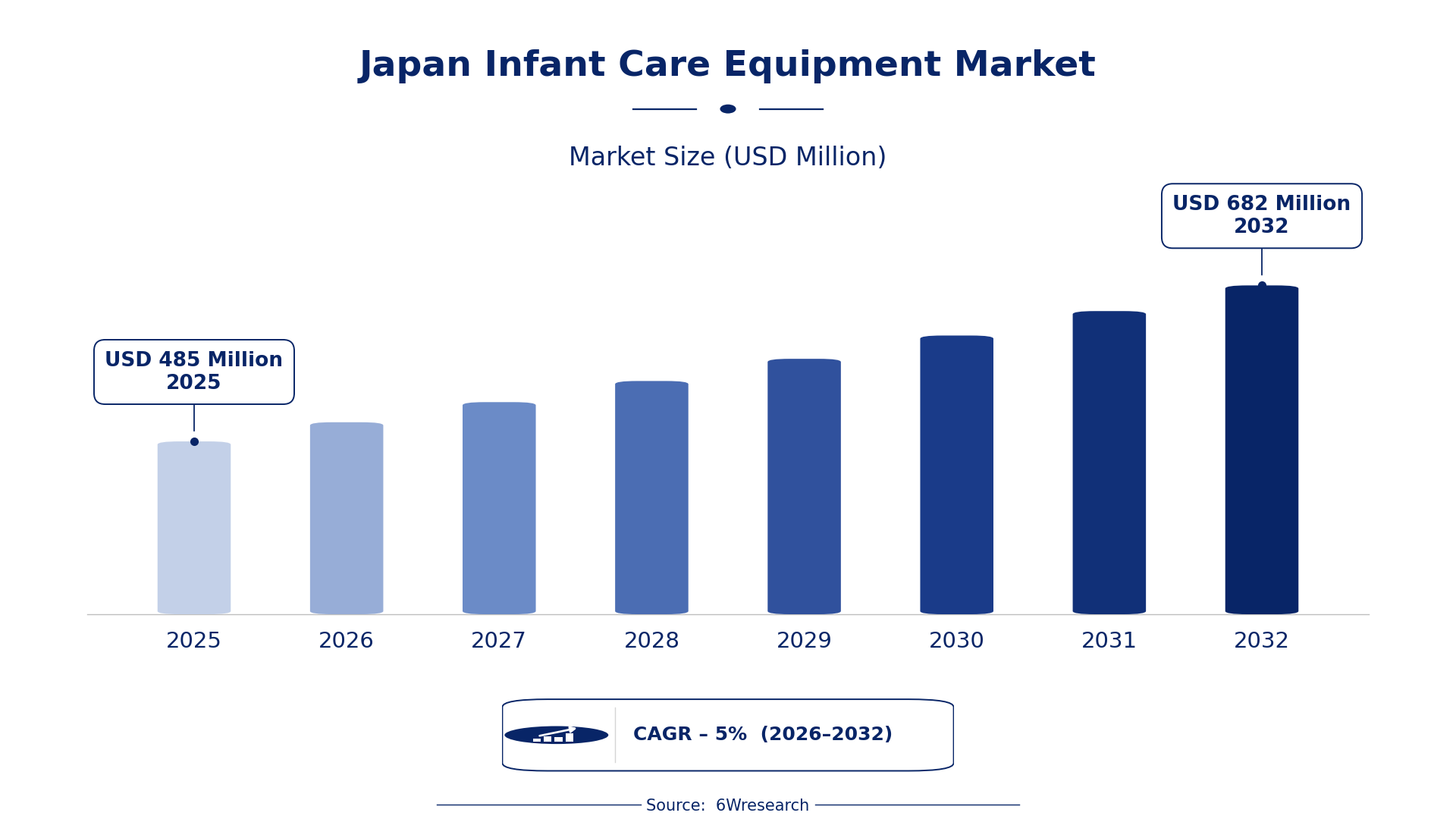
According to 6Wresearch internal database and industry insights, the Japan Infant Care Equipment Market was valued at USD 485 Million in 2025 and is projected to reach USD 682 Million by 2032, growing at a CAGR of approximately 5% during 2026–2032.
Japan Infant Care Equipment Market Highlights
| Report Metric | Details |
| Report Name | Japan Infant Care Equipment Market (2026-2032) |
| Market Size 2025 | USD 485 Million |
| Market Size 2032 | USD 682 Million |
| Absolute Growth 2025–2032 | USD 197 Million |
| CAGR 2026–2032 | 5% |
| Peak Annual Growth | 6.4% in 2026 |
| Forecast Period | 2026–2032 |
| Historical Data | 2022–2025 |
| Base Year | 2025 |
| Leading Equipment Type, 2025 | Incubators (42% share) |
| Leading Application Area, 2025 | Premature Infant Care (44% share) |
| Leading End User, 2025 | Neonatal ICUs (43% share) |
| Leading Distribution Channel, 2025 | Hospital Equipment Dealers (49% share) |
| Fastest-Growing Equipment Type | Phototherapy Units (6.7% CAGR) |
| Fastest-Growing Application Area | Mobile Infant Support (6.0% CAGR) |
| Fastest-Growing End User | Maternity Clinics (6.1% CAGR) |
| Fastest-Growing Distribution Channel | Online Medical Platforms (6.3% CAGR) |
| Growing Sector | Neonatal care services |
| Key End Users | Hospitals, Pediatric Clinics, Maternity Clinics, Emergency Services |
Japan Infant Care Equipment Market Year-wise Growth Rate and Key Drivers (2022–2032)
This graph illustrates the annual growth rates of the market from 2022 to 2032, highlighting a steady upward trajectory and projected market expansion over the forecast period.
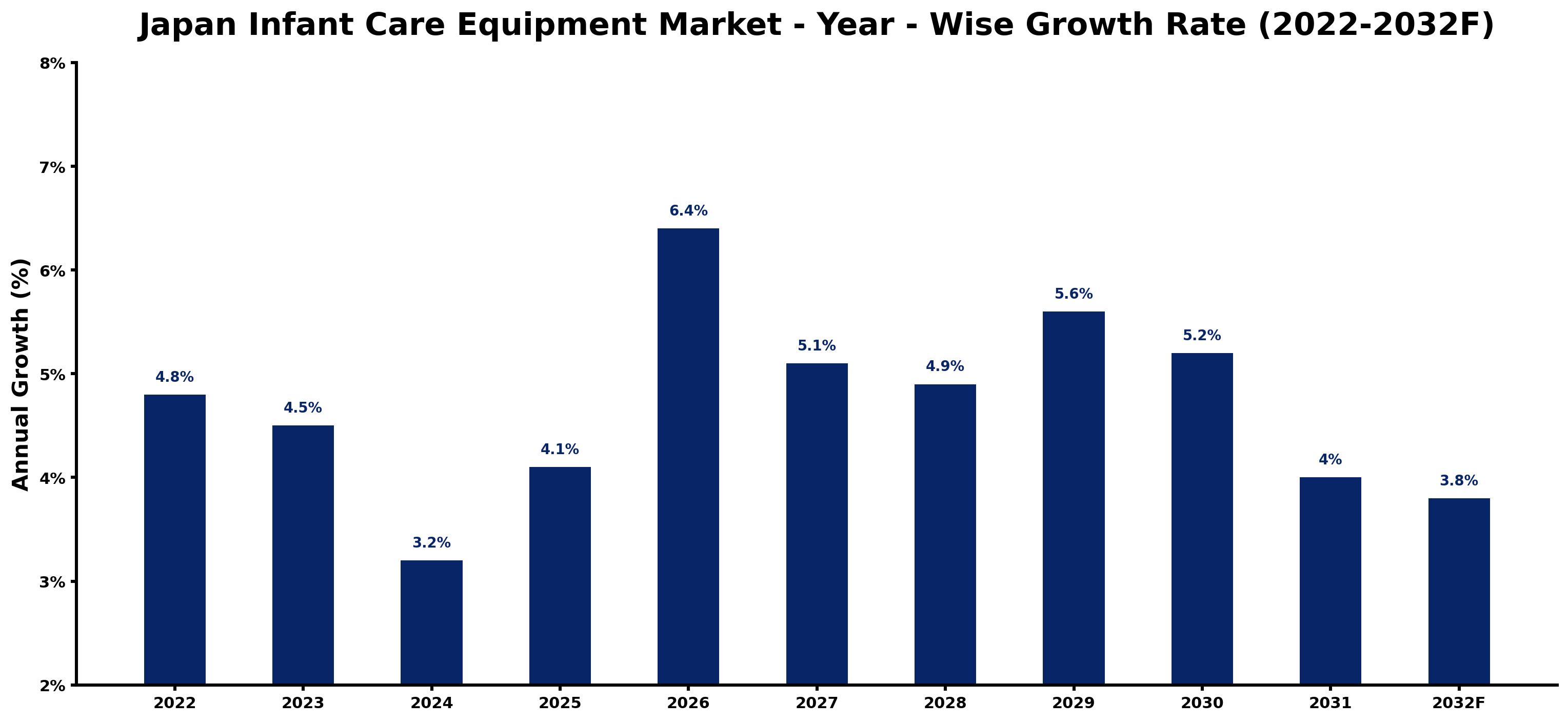
For each year, the table pairs the estimated growth rate with the leading influence on demand, showing how the drivers changed across the period.
| Year | Estimated Annual Growth (%) | Market Rationale |
| 2022 | 4.8 | The market experienced steady growth, driven by increasing healthcare investments. |
| 2023 | 4.5 | Growth slowed due to market saturation and limited new technology introductions. |
| 2024 | 3.2 | A further slowdown occurred as hospitals focused on cost management strategies. |
| 2025 | 4.1 | Demand increased as hospitals upgraded their neonatal care equipment. |
| 2026 | 6.4 | Growth accelerated with the introduction of advanced phototherapy units. |
| 2027 | 5.1 | A slight slowdown was observed as competition intensified among suppliers. |
| 2028 | 4.9 | Demand remained stable as hospitals continued to invest in infant care. |
| 2029 | 5.6 | Growth picked up again as neonatal care standards were revised. |
| 2030 | 5.2 | The market saw a slowdown as buyers became more selective in purchases. |
| 2031 | 4.0 | A further slowdown took place as economic conditions tightened. |
| 2032 | 3.8 | Growth is projected to slow as the market matures and competition rises. |
Note: Market size estimations and growth projections presented in this report are based on 6Wresearch's proprietary forecasting methodology, utilizing the latest available industry data, government publications, and primary research inputs.
Japan Infant Care Equipment Market Synopsis
Infant care equipment encompasses vital devices such as incubators, warmers, and phototherapy units that support the health of newborns, particularly in neonatal care. The Japan Infant Care Equipment Market is growing due to rising healthcare spending, technological advancements, and an emphasis on improving neonatal outcomes. With around 800,000 births each year and over 500 neonatal intensive care units, hospitals and clinics are propelling demand for superior infant care solutions.
Market Dynamics Impact Analysis (2026–2032)
| Factor | Type | Impact | Primary Segment Affected |
| Increasing birth rates and healthcare spending | Driver | High | Neonatal ICUs |
| Technological advancements in medical equipment | Driver | High | Phototherapy Units |
| Growing demand for advanced neonatal care solutions | Opportunity | High | Pediatric Hospitals |
| Expansion of online medical platforms for equipment sales | Opportunity | Medium | Hospital Equipment Dealers |
| High costs of advanced equipment maintenance | Restraint | High | Incubators |
| Stringent regulatory compliance requirements | Restraint | Medium | Transport Incubators |
| Limited access to funding for smaller healthcare facilities | Challenge | High | Maternity Clinics |
| Competition from low-cost alternatives | Challenge | Medium | Direct Sales |
Evaluation of Drivers in Japan Infant Care Equipment Market (2026–2032)
The factors lifting demand, and the evidence behind each, are summarised below.
| Drivers | Primary Segment Affected | Why It Matters (Evidence) |
| Rising birth rates | Neonatal ICUs | With approximately 800,000 births annually, hospitals are increasing their capacity to care for newborns. |
| Technological advancements | Phototherapy Units | Recent innovations have improved treatment efficacy, leading hospitals to purchase more units for jaundice treatment. |
| Increased healthcare expenditure | Pediatric Hospitals | Japan's medical care expenditure reached JPY 46.7 trillion in 2022, enabling hospitals to invest in better equipment. |
| Focus on neonatal care standards | Incubators | Updated guidelines from the Japan Society of Neonatology encourage hospitals to upgrade their incubators to meet new standards. |
| Growth of online medical platforms | Hospital Equipment Dealers | A 15% increase in online platform adoption in 2023 has expanded purchasing options for hospitals. |
Purchasing is picking up as Japan's healthcare expenditure reached JPY 46.7 trillion in 2022, prompting hospitals to invest in advanced neonatal care solutions. The annual average of 800,000 births drives demand for neonatal ICUs, leading to increased purchases of incubators and phototherapy units. Technological advancements have improved treatment efficacy, encouraging healthcare facilities to upgrade their equipment. Updated guidelines from the Japan Society of Neonatology further support this trend, as hospitals seek compliance with new standards. The rise of online medical platforms has expanded purchasing options, making it easier for healthcare facilities to acquire necessary equipment.
Evaluation of Restraints in Japan Infant Care Equipment Market
The main factors holding the market back are set out below.
| Market Restraint | Primary Segment Affected | Why It Matters (Evidence) |
| High maintenance costs for advanced equipment | Incubators | Ongoing maintenance expenses can deter smaller hospitals from investing in new incubators, restricting their ability to upgrade. |
| Regulatory compliance challenges | Transport Incubators | Stringent regulations require extensive testing and certification, raising costs for manufacturers and affecting pricing. |
| Limited funding access for smaller facilities | Maternity Clinics | Smaller clinics often struggle to secure financing for necessary upgrades in infant care equipment, impacting their operations. |
| Competition from low-cost alternatives | Direct Sales | The presence of cheaper options pressures established suppliers to lower prices, affecting profitability and market stability. |
| Market saturation in urban areas | Hospital Equipment Dealers | In urban regions, many hospitals have already upgraded their equipment, limiting new sales opportunities for suppliers. |
Japan Infant Care Equipment Market Challenges
High costs of neonatal care equipment constrain hospital budgets, limiting purchasing power for clinics. This challenge stems from Japan's national medical care expenditure, which reached approximately JPY 46.7 trillion in fiscal 2022, restricting funds for new technologies. Intense competition among over 500 neonatal intensive care units creates contract acquisition challenges for suppliers, ultimately squeezing profit margins. A shortage of skilled healthcare professionals delays patient care, raising training costs for hospitals. Rapid technological advancements pressure suppliers to innovate, risking obsolescence and impacting their market position.
Trends in the Japan Infant Care Equipment Market
Several trends are reshaping the Japan Infant Care Equipment Market; the most important are set out below.
- Shift towards Online Medical Platforms: Hospital Equipment Dealers are increasingly adopting online platforms for equipment sales, with a 15% increase in usage in 2023. This shift allows for greater accessibility and convenience, enabling hospitals to make faster purchasing decisions.
- Growing Focus on Neonatal Care Standards: The Japan Society of Neonatology has revised guidelines for neonatal care, promoting the adoption of advanced technologies. This change is expected to drive demand for equipment that meets updated standards, improving patient outcomes.
- Expansion of Pediatric Hospitals: Pediatric Hospitals are expanding their services to accommodate rising birth rates, which reached approximately 800,000 annually. This expansion necessitates increased investment in infant care equipment to support growing patient numbers.
- Increase in Mobile Infant Support Systems: Mobile Infant Support systems are gaining traction, particularly in rural areas, as they facilitate safe transport of infants. This trend is driven by the need for improved neonatal care access in less populated regions.
Investment Opportunities in the Japan Infant Care Equipment Market
Several openings in the Japan Infant Care Equipment Market merit attention from investors.
- Timing for Investment in Neonatal Care: With Japan's annual budget for neonatal health initiatives at approximately ¥10 billion, there is a strong opportunity to invest in advanced infant care technologies. Hospitals are actively seeking solutions to enhance care.
- Supply of Advanced Phototherapy Units: As phototherapy units are essential for treating over 50% of jaundice cases, suppliers can focus on providing these units to hospitals. The increasing adoption of these units presents a lucrative opportunity for manufacturers.
- Growing Demand from Pediatric Hospitals: Pediatric Hospitals are expanding their services, creating a demand for advanced infant care equipment. Suppliers can enter this market by forming partnerships with healthcare facilities to provide tailored solutions.
- Entry through Online Medical Platforms: With the rise of online medical platforms, there is an opportunity to supply infant care equipment directly to healthcare providers. Establishing a presence on these platforms can enhance market reach.
Government Initiatives in the Japan Infant Care Equipment Market
The 2023 initiative to enhance neonatal care technologies builds on the existing Medical Care Act of 1948, which sets standards for hospitals and clinics. This new measure increases funding for advanced equipment, ensuring compliance with updated protocols and improving patient outcomes.
Approximately ¥10 billion is allocated annually for neonatal health initiatives, overseen by the Ministry of Health, Labour and Welfare. This funding supports the development and approval of new technologies, ensuring that healthcare facilities have access to the latest advancements in infant care equipment.
Future Insight of the Japan Infant Care Equipment Market
A government programme to improve neonatal care technologies will introduce advanced equipment standards by 2032, benefiting hospitals and clinics. Increased adoption of online medical platforms for equipment sales will streamline procurement processes. The initiative to train healthcare professionals will elevate skill levels, ensuring better utilisation of advanced equipment. By 2032, the average stay for premature infants in NICUs is expected to decrease to around 50 days, reflecting improved practices and technologies in neonatal care.
Market Segmentation Analysis
Japan Infant Care Equipment Market report covers a detailed analysis of the following market segments:
By Equipment Type – Incubators Lead, Phototherapy Units Expected to Grow Fastest
According to Saurav Kr Singh, Senior Research Analyst at 6Wresearch, Incubators held 42% of the Japan Infant Care Equipment Market by equipment type in 2025. Incubators dominate the equipment type segment because they are crucial for maintaining a stable environment for premature infants. With over 500 neonatal intensive care units across Japan, the reliance on these devices is substantial. Over 2026–2032, Phototherapy Units are expected to post the fastest growth, at a CAGR of 6.7%. Phototherapy units are witnessing the highest growth due to their critical function in treating jaundice, which affects a significant proportion of newborns. A 10% increase in their usage within pediatric hospitals underscores the rising demand for this technology. Manufacturers should focus on enhancing the availability of phototherapy units to meet the growing healthcare needs.
By Application Area – Premature Infant Care Leads, Mobile Infant Support Expected to Grow Fastest
Premature Infant Care accounted for 44% of the market by application area in 2025. Premature infant care is the leading application area as it is vital for the survival and health of preterm infants, who represent a considerable portion of births in Japan. The average NICU stay of around 60 days illustrates the ongoing necessity for specialised equipment in this sector. Mobile Infant Support is set to record the highest CAGR in this split, 6.0% over 2026–2032. Mobile infant support is the fastest-growing application area, particularly in rural areas where access to healthcare is often limited. The trend towards adopting these systems reflects an increasing need for flexible care solutions during infant transport. Providers should consider expanding mobile infant support solutions to cater to the needs of rural healthcare facilities.
By End User – Neonatal ICUs Leads, Maternity Clinics Expected to Grow Fastest
With 43% of end user revenue in 2025, Neonatal ICUs was the largest category. Neonatal ICUs are the primary end-user segment as they provide intensive care for vulnerable newborns, necessitating a steady demand for essential equipment. The high admission rates in these units contribute to their dominant position in the market. The quickest growth will come from Maternity Clinics, forecast to expand at a CAGR of 6.1% between 2026 and 2032. Maternity clinics are experiencing notable growth, with their numbers reaching approximately 1,200, indicating an expanding role in supporting infant care. This trend highlights the increasing emphasis on comprehensive prenatal and postnatal services. Suppliers should target maternity clinics to enhance their market presence and support integrated infant care initiatives.
By Distribution Channel – Hospital Equipment Dealers Lead, Online Medical Platforms Expected to Grow Fastest
The largest distribution channel category in 2025 was Hospital Equipment Dealers, at 49% of revenue. Hospital equipment dealers lead the distribution channel as they supply essential devices to healthcare facilities, ensuring timely access to necessary equipment for neonatal care. Their established networks play a crucial role in facilitating the distribution of these critical products. Online Medical Platforms are projected to grow fastest, at a CAGR of 6.3% during 2026–2032. Online medical platforms are rapidly emerging as the fastest-growing channel, with a 15% increase in adoption for equipment sales, reflecting a shift towards digital purchasing solutions. This trend indicates the rising importance of convenience and accessibility in the procurement process. Vendors must strengthen their online sales strategies to capitalise on the growing preference for digital channels.
Key Attractiveness of the Report
- 10 Years of Market Numbers
- Historical Data Starting from 2022 to 2025
- Base Year 2025
- Forecast Data until 2032
- Key Performance Indicators Impacting the Market
- Major Upcoming Developments and Projects
Key Highlights of the Report:
- Japan Infant Care Equipment Market Outlook
- Market Size of Japan Infant Care Equipment Market, 2025
- Forecast of Japan Infant Care Equipment Market, 2032
- Historical Data and Forecast of Japan Infant Care Equipment Revenues & Volume for the Period 2022-2032F
- Japan Infant Care Equipment Market Trend Evolution
- Japan Infant Care Equipment Market Drivers and Challenges
- Japan Infant Care Equipment Price Trends
- Japan Infant Care Equipment Porter's Five Forces
- Japan Infant Care Equipment Industry Life Cycle
- Historical Data and Forecast of Japan Infant Care Equipment Market Revenues & Volume By Equipment Type for the Period 2022-2032F
- Historical Data and Forecast of Japan Infant Care Equipment Market Revenues & Volume By Infant Warmers for the Period 2022-2032F
- Historical Data and Forecast of Japan Infant Care Equipment Market Revenues & Volume By Phototherapy Units for the Period 2022-2032F
- Historical Data and Forecast of Japan Infant Care Equipment Market Revenues & Volume By Incubators for the Period 2022-2032F
- Historical Data and Forecast of Japan Infant Care Equipment Market Revenues & Volume By Transport Incubators for the Period 2022-2032F
- Historical Data and Forecast of Japan Infant Care Equipment Market Revenues & Volume By Application Area for the Period 2022-2032F
- Historical Data and Forecast of Japan Infant Care Equipment Market Revenues & Volume By Temperature Regulation for the Period 2022-2032F
- Historical Data and Forecast of Japan Infant Care Equipment Market Revenues & Volume By Jaundice Treatment for the Period 2022-2032F
- Historical Data and Forecast of Japan Infant Care Equipment Market Revenues & Volume By Premature Infant Care for the Period 2022-2032F
- Historical Data and Forecast of Japan Infant Care Equipment Market Revenues & Volume By Mobile Infant Support for the Period 2022-2032F
- Historical Data and Forecast of Japan Infant Care Equipment Market Revenues & Volume By End User for the Period 2022-2032F
- Historical Data and Forecast of Japan Infant Care Equipment Market Revenues & Volume By Neonatal ICUs for the Period 2022-2032F
- Historical Data and Forecast of Japan Infant Care Equipment Market Revenues & Volume By Pediatric Hospitals for the Period 2022-2032F
- Historical Data and Forecast of Japan Infant Care Equipment Market Revenues & Volume By Maternity Clinics for the Period 2022-2032F
- Historical Data and Forecast of Japan Infant Care Equipment Market Revenues & Volume By Emergency Services for the Period 2022-2032F
- Historical Data and Forecast of Japan Infant Care Equipment Market Revenues & Volume By Distribution Channel for the Period 2022-2032F
- Historical Data and Forecast of Japan Infant Care Equipment Market Revenues & Volume By Hospital Equipment Dealers for the Period 2022-2032F
- Historical Data and Forecast of Japan Infant Care Equipment Market Revenues & Volume By Direct Sales for the Period 2022-2032F
- Historical Data and Forecast of Japan Infant Care Equipment Market Revenues & Volume By Online Medical Platforms for the Period 2022-2032F
- Historical Data and Forecast of Japan Infant Care Equipment Market Revenues & Volume By OEM Supply Chains for the Period 2022-2032F
- Japan Infant Care Equipment Import Export Trade Statistics
- Market Opportunity Assessment By Equipment Type
- Market Opportunity Assessment By Application Area
- Market Opportunity Assessment By End User
- Market Opportunity Assessment By Distribution Channel
- Japan Infant Care Equipment Top Companies Market Share
- Japan Infant Care Equipment Competitive Benchmarking By Technical and Operational Parameters
- Japan Infant Care Equipment Company Profiles
- Japan Infant Care Equipment Key Strategic Recommendations
Market Covered
The following segment groups are covered in the report.
By Equipment Type
- Infant Warmers
- Phototherapy Units
- Incubators
- Transport Incubators
By Application Area
- Temperature Regulation
- Jaundice Treatment
- Premature Infant Care
- Mobile Infant Support
By End User
- Neonatal ICUs
- Pediatric Hospitals
- Maternity Clinics
- Emergency Services
By Distribution Channel
- Hospital Equipment Dealers
- Direct Sales
- Online Medical Platforms
- OEM Supply Chains































