Japan Infant Feeding Equipment Market Size & Growth Rate
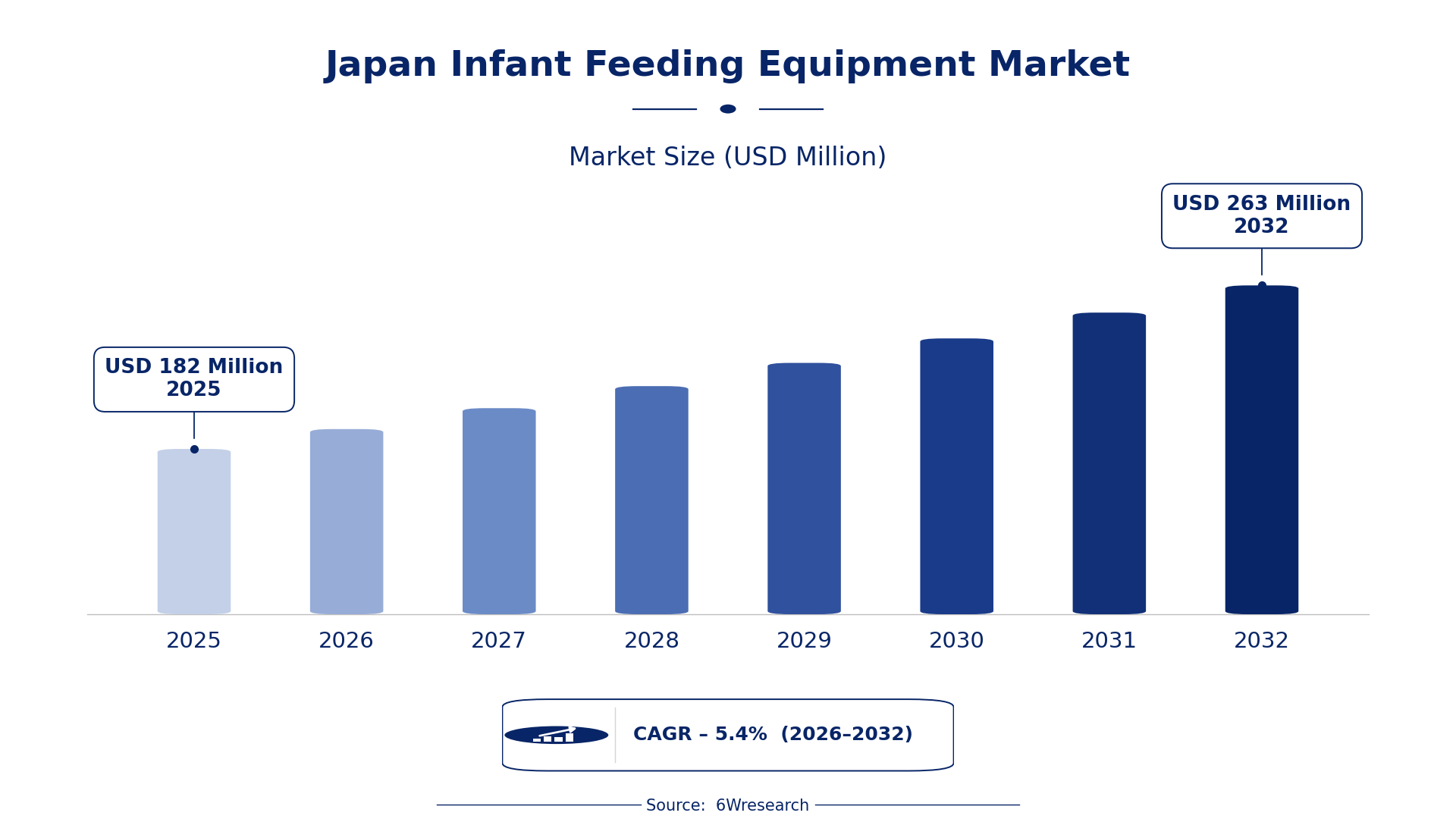
According to 6Wresearch internal database and industry insights, the Japan Infant Feeding Equipment Market was valued at USD 182 Million in 2025 and is projected to reach USD 263 Million by 2032, growing at a CAGR of approximately 5.4% during 2026–2032.
Japan Infant Feeding Equipment Market Highlights
| Report Metric | Details |
| Report Name | Japan Infant Feeding Equipment Market (2026-2032) |
| Market Size 2025 | USD 182 Million |
| Market Size 2032 | USD 263 Million |
| Absolute Growth 2025–2032 | USD 81 Million |
| CAGR 2026–2032 | 5.4% |
| Peak Annual Growth | 6.3% in 2028 |
| Forecast Period | 2026–2032 |
| Historical Data | 2022–2025 |
| Base Year | 2025 |
| Leading Equipment Type, 2025 | Baby Bottles (45% share) |
| Leading Material Type, 2025 | BPA-Free Plastic/Glass (40% share) |
| Leading Feeding Stage, 2025 | Bottle-Feeding (36% share) |
| Leading Distribution Channel, 2025 | Pharmacies (47% share) |
| Fastest-Growing Equipment Type | Sterilizers (7.4% CAGR) |
| Fastest-Growing Material Type | Steam / UV (8.2% CAGR) |
| Fastest-Growing Feeding Stage | All Feeding Ages (7.6% CAGR) |
| Fastest-Growing Distribution Channel | Electronics Stores (6.9% CAGR) |
| Growing Sector | Electronics Stores |
| Key End Users | Pharmacies, Electronics Stores, Online Platforms, Medical Supply Stores |
Japan Infant Feeding Equipment Market Year-wise Growth Rate and Key Drivers (2022–2032)
This graph illustrates the annual growth rates of the market from 2022 to 2032, highlighting a steady upward trajectory and projected market expansion over the forecast period.
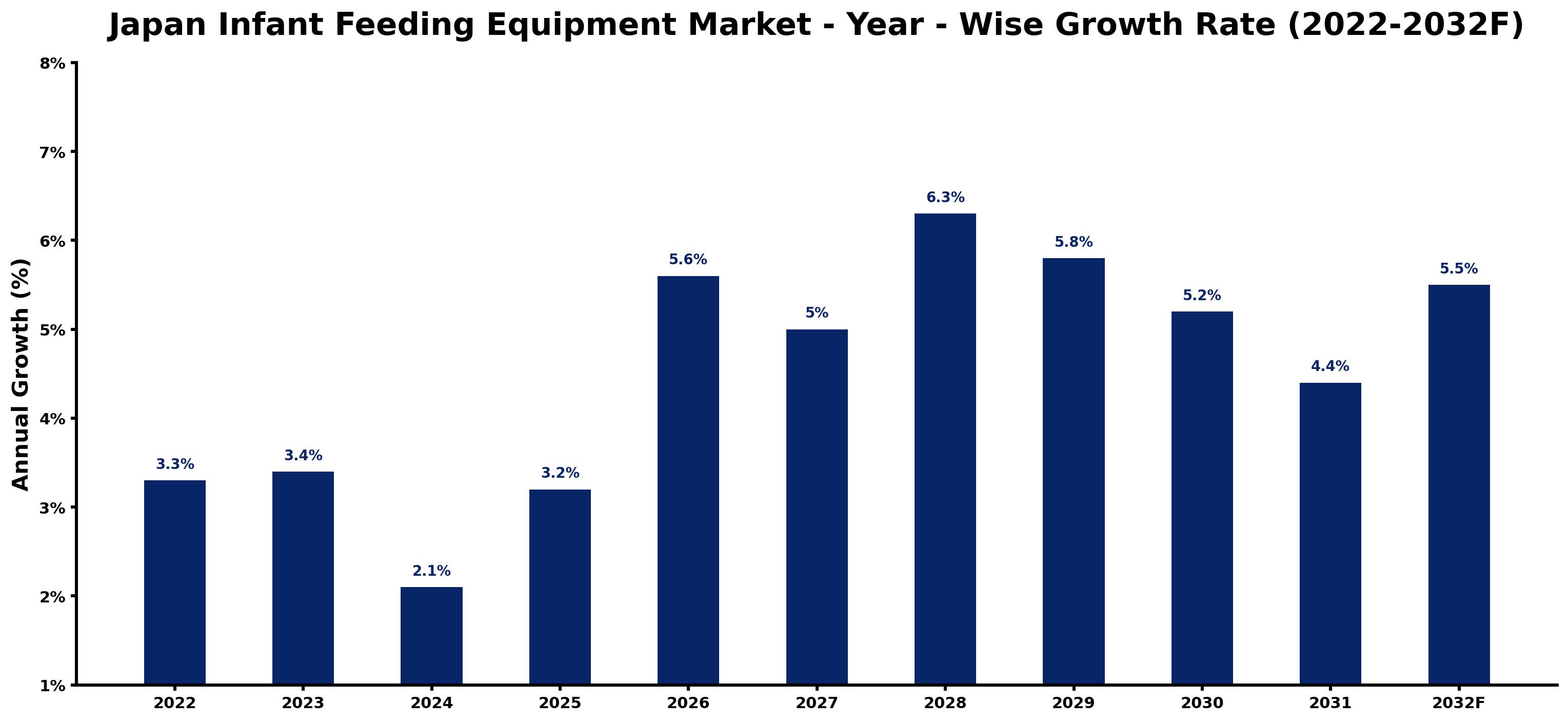
Annual growth estimates for each year appear below with the principal reason behind them, explaining the shifts that set the pace of the market.
| Year | Estimated Annual Growth (%) | Market Rationale |
| 2022 | 3.3 | The market experienced steady growth supported by a stable birth rate. |
| 2023 | 3.4 | Demand increased as more parents sought safe feeding solutions for infants. |
| 2024 | 2.1 | Growth slowed due to market saturation and cautious consumer spending. |
| 2025 | 3.2 | Sales improved as online platforms expanded their offerings for new parents. |
| 2026 | 5.6 | The introduction of new products is expected to drive higher consumer interest. |
| 2027 | 5.0 | Growth is projected to slow as competition intensifies among various brands and products. |
| 2028 | 6.3 | Demand is expected to surge with the introduction of new sterilization technologies. |
| 2029 | 5.8 | Growth is projected to slow as market maturity begins to set in for established products. |
| 2030 | 5.2 | Demand is expected to continue slowing as consumer preferences shift towards convenience. |
| 2031 | 4.4 | Growth is projected to decelerate due to increased price sensitivity among buyers. |
| 2032 | 5.5 | Sales are expected to accelerate as new parents seek advanced feeding solutions. |
Note: Market size estimations and growth projections presented in this report are based on 6Wresearch's proprietary forecasting methodology, utilizing the latest available industry data, government publications, and primary research inputs.
Japan Infant Feeding Equipment Market Synopsis
Infant feeding equipment includes essential items such as baby bottles, sterilizers, bottle warmers, and breast pumps, primarily made from BPA-free materials. The Japan Infant Feeding Equipment Market is expanding due to rising birth rates and increasing awareness of hygiene among parents. The average household spends approximately ¥15,000 annually on these products, while online sales surged by 15% in 2023, reflecting a shift towards digital purchasing channels. Government initiatives promoting breastfeeding also contribute to market growth.
Market Dynamics Impact Analysis (2026–2032)
| Factor | Type | Impact | Primary Segment Affected |
| Rising birth rates create a larger consumer base for infant feeding products. | Driver | High | Baby Bottles |
| Increased online sales channels enhance product accessibility for consumers. | Driver | High | Sterilizers |
| The growing trend of eco-friendly products boosts demand for BPA-free materials. | Opportunity | High | BPA-Free Plastic/Glass |
| The increasing number of first-time parents drives demand for convenient feeding solutions. | Opportunity | High | Bottle Warmers |
| Market saturation limits growth potential for established products. | Restraint | Medium | Breast Pumps |
| Price sensitivity among consumers affects purchasing decisions. | Restraint | Medium | Sterilizers |
| Intense competition among brands leads to price wars, impacting margins. | Challenge | High | Baby Bottles |
| Technological advancements require continuous investment from manufacturers. | Challenge | Medium | Bottle Warmers |
Evaluation of Drivers in Japan Infant Feeding Equipment Market (2026–2032)
Below are the drivers that matter most for revenue growth, with supporting evidence.
| Drivers | Primary Segment Affected | Why It Matters (Evidence) |
| Increased birth rates lead to higher demand for infant feeding products. | Baby Bottles | Japan's birth rate was approximately 840,000 in 2022, prompting more purchases. |
| Online sales channels are expanding rapidly, making products more accessible. | Sterilizers | The number of online platforms selling baby products has doubled since 2020. |
| Growing awareness of hygiene drives the use of sterilizers in households. | Sterilizers | Sterilizers are commonly used in 70% of households with infants. |
| Rising disposable incomes enable families to invest in high-quality feeding equipment. | Breast Pumps | The average household spends ¥15,000 annually on infant feeding products. |
| Government initiatives promoting breastfeeding increase demand for breast pumps. | Breast Pumps | The Japan Pediatric Society endorses the use of breast pumps for nursing mothers. |
What keeps demand rising is the increasing birth rate, with approximately 840,000 births in 2022 leading to heightened interest in infant feeding products. The number of online platforms selling baby products has doubled since 2020, improving accessibility for parents. Households are willing to invest in quality, as evidenced by their annual spending on essential items. The growing focus on hygiene in infant care is also influencing purchasing decisions, driving sales of sterilizers.
Evaluation of Restraints in Japan Infant Feeding Equipment Market
The key brakes on demand, and where they bite hardest, are shown below.
| Market Restraint | Primary Segment Affected | Why It Matters (Evidence) |
| Market saturation limits growth opportunities for established products. | Breast Pumps | With many brands available, differentiation becomes challenging for manufacturers due to the average household spending ¥15,000 annually on infant feeding products. |
| Price sensitivity among consumers affects purchasing decisions. | Sterilizers | Increased living costs lead to cautious spending on non-essential items, impacting overall sales. |
| Intense competition among brands results in price wars, impacting profit margins. | Baby Bottles | As brands compete, prices drop, affecting profitability for manufacturers, with margins shrinking by approximately 15%. |
| Technological advancements require continuous investment from manufacturers. | Bottle Warmers | Keeping up with innovations demands substantial financial resources, affecting smaller players. |
| Changing consumer preferences may shift demand away from traditional products. | Sterilizers | Parents increasingly seek multifunctional devices that consolidate tasks, impacting sales of standalone products. |
Japan Infant Feeding Equipment Market Challenges
Manufacturers face increased costs due to intense competition, which reduces profit margins by approximately 15% for smaller producers. Supply chain disruptions have delayed the availability of essential components, extending lead times for infant feeding equipment by 20%. Many producers experience challenges with technology adoption, as only 30% employ modern manufacturing techniques, resulting in decreased production efficiency. Regulatory compliance adds complexity to operations, increasing production costs by around ¥1,000 per unit for manufacturers, which ultimately affects pricing for buyers.
Trends in the Japan Infant Feeding Equipment Market
Buyers and suppliers in the Japan Infant Feeding Equipment Market are adjusting to the following trends.
- Shift Towards Online Purchasing: Parents are increasingly opting for online platforms to purchase infant feeding equipment, with online sales growing by 15% in 2023. This trend provides convenience for buyers, allowing them to access a wider range of products.
- Rise of Multifunctional Devices: The demand for multifunctional sterilizers is increasing, driven by parents seeking efficiency in infant care. The market for these devices is projected to grow as they simplify the feeding process, appealing to busy families.
- Growing Preference for BPA-Free Materials: There is a rising preference for BPA-free materials in infant feeding products, reflecting heightened safety awareness among parents. This trend is supported by regulations mandating BPA-free materials for baby products, ensuring consumer confidence.
- Increased Focus on Hygiene: Parents are prioritising hygiene in infant care, leading to higher sales of sterilizers. The usage of sterilizers is recommended by pediatricians, further driving this trend as families seek to protect their infants.
Investment Opportunities in the Japan Infant Feeding Equipment Market
Investors looking at the Japan Infant Feeding Equipment Market should consider the following areas.
- Supply BPA-Free Infant Feeding Products: With the increasing demand for BPA-free products, manufacturers should focus on supplying BPA-free infant feeding items. The market potential is strong, with infant feeding equipment exports from Japan reaching ¥5 billion in 2022.
- Target Online Sales Channels: As online sales channels are expanding, suppliers should invest in e-commerce platforms to reach more consumers. The number of online platforms selling baby products has doubled since 2020, creating opportunities for growth.
- Develop Multifunctional Sterilizers: There is an opportunity to develop multifunctional sterilizers that cater to the needs of modern parents. The rising focus on hygiene and convenience makes this a timely investment, with sterilizers used in 70% of households.
- Invest in Breastfeeding Support Equipment: With government initiatives promoting breastfeeding, there is a growing market for breast pumps. Suppliers should consider partnerships with healthcare providers to improve product visibility and access, tapping into the increasing awareness.
Government Initiatives in the Japan Infant Feeding Equipment Market
The Industrial Safety and Health Act of 1972 ensures manufacturers of infant feeding equipment maintain safety standards, protecting both workers and consumers. Compliance with this law is essential for producers to uphold product quality and safety, which is vital for consumer trust. Additionally, the Act on the Rational Use of Energy mandates energy efficiency improvements, indirectly affecting production costs for manufacturers in the infant feeding equipment sector.
The Japan Consumer Affairs Agency oversees safety regulations for infant items, ensuring manufacturers adhere to strict standards. This agency monitors compliance with laws that prohibit misleading labelling and advertising, protecting consumers and maintaining market integrity.
Future Insight of the Japan Infant Feeding Equipment Market
Innovative sterilisation technologies will reshape demand by 2032, appealing to health-conscious parents focused on hygiene. Government initiatives will provide educational resources, empowering new parents to make informed choices. Urban areas will see a surge in electric bottle warmers, meeting the convenience needs of busy families. By 2032, average household spending on infant feeding products will reach ¥15,000 annually, reflecting a trend towards higher quality and safety standards.
Market Segmentation Analysis
Japan Infant Feeding Equipment Market report covers a detailed analysis of the following market segments:
By Equipment Type – Baby Bottles Lead, Sterilizers Expected to Grow Fastest
According to Prakhar Dixit, Senior Research Analyst at 6Wresearch, Baby Bottles took 45% of equipment type revenue in 2025, more than any other category. Baby bottles hold the largest share in the market as they are essential for feeding infants, with a strong presence among new parents. The high birth rate in Japan, approximately 840,000 annually, guarantees sustained demand for these products. The quickest growth will come from Sterilizers, forecast to expand at a CAGR of 7.4% between 2026 and 2032. Sterilizers are growing rapidly due to increased awareness of hygiene, with recommendations from pediatricians and a usage rate of 70% in households with infants. This trend is likely to continue as parents increasingly prioritise health and safety in infant care. Suppliers should consider expanding their sterilizer product lines to align with the rising demand for hygiene-focused infant feeding solutions.
By Material Type – BPA-Free Plastic/Glass Leads, Steam / UV Expected to Grow Fastest
BPA-Free Plastic/Glass held 40% of the Japan Infant Feeding Equipment Market by material type in 2025. BPA-free plastic and glass dominate the market as parents prioritise safety and compliance with regulations mandating these materials for baby products. This preference is driven by concerns over health risks associated with harmful substances. Over 2026–2032, Steam / UV is expected to post the fastest growth, at a CAGR of 8.2%. Steam and UV sterilisation methods are gaining traction due to their effectiveness in ensuring hygiene, appealing to health-conscious parents. The increasing awareness of sterilisation benefits is expected to further boost this segment's growth. Manufacturers should invest in developing and marketing steam and UV sterilisation products to capture the interest of safety-focused consumers.
By Feeding Stage – Bottle-Feeding Leads, All Feeding Ages Expected to Grow Fastest
The largest feeding stage category in 2025 was Bottle-Feeding, at 36% of revenue. Bottle-feeding remains the primary method for infant nutrition, reflecting its established role in early childhood feeding practices. This segment benefits from consistent demand driven by new births and parental preferences for traditional feeding methods. All Feeding Ages are set to record the highest CAGR in this split, 7.6% over 2026–2032. The all feeding ages category is growing as it includes products suitable for older children, tapping into a broader market. As parents seek versatile solutions that accommodate various feeding stages, this segment is set for notable expansion. Suppliers should consider diversifying their product lines to cater to the needs of families with children at various feeding stages.
By Distribution Channel – Pharmacies Lead, Electronics Stores Expected to Grow Fastest
In 2025, Pharmacies led the distribution channel split with a 47% share. Pharmacies are the leading distribution channel for infant feeding equipment, offering convenient access for parents seeking essential products. Their widespread presence in urban areas, particularly in regions like Tokyo, solidifies their dominant market position. Electronics Stores are projected to grow fastest, at a CAGR of 6.9% during 2026–2032. Electronics stores are experiencing rapid growth, appealing to tech-savvy parents looking for modern feeding solutions, despite having a limited selection. This channel's popularity is expected to increase as more innovative products enter the market. Retailers should enhance their presence in electronics stores to attract parents interested in advanced infant feeding solutions.
Key Attractiveness of the Report
- 10 Years of Market Numbers
- Historical Data Starting from 2022 to 2025
- Base Year 2025
- Forecast Data until 2032
- Key Performance Indicators Impacting the Market
- Major Upcoming Developments and Projects
Key Highlights of the Report:
- Japan Infant Feeding Equipment Market Outlook
- Market Size of Japan Infant Feeding Equipment Market, 2025
- Forecast of Japan Infant Feeding Equipment Market, 2032
- Historical Data and Forecast of Japan Infant Feeding Equipment Revenues & Volume for the Period 2022-2032F
- Japan Infant Feeding Equipment Market Trend Evolution
- Japan Infant Feeding Equipment Market Drivers and Challenges
- Japan Infant Feeding Equipment Price Trends
- Japan Infant Feeding Equipment Porter's Five Forces
- Japan Infant Feeding Equipment Industry Life Cycle
- Historical Data and Forecast of Japan Infant Feeding Equipment Market Revenues & Volume By Equipment Type for the Period 2022-2032F
- Historical Data and Forecast of Japan Infant Feeding Equipment Market Revenues & Volume By Baby Bottles for the Period 2022-2032F
- Historical Data and Forecast of Japan Infant Feeding Equipment Market Revenues & Volume By Sterilizers for the Period 2022-2032F
- Historical Data and Forecast of Japan Infant Feeding Equipment Market Revenues & Volume By Bottle Warmers for the Period 2022-2032F
- Historical Data and Forecast of Japan Infant Feeding Equipment Market Revenues & Volume By Breast Pumps for the Period 2022-2032F
- Historical Data and Forecast of Japan Infant Feeding Equipment Market Revenues & Volume By Material Type for the Period 2022-2032F
- Historical Data and Forecast of Japan Infant Feeding Equipment Market Revenues & Volume By BPA-Free Plastic/Glass for the Period 2022-2032F
- Historical Data and Forecast of Japan Infant Feeding Equipment Market Revenues & Volume By Steam / UV for the Period 2022-2032F
- Historical Data and Forecast of Japan Infant Feeding Equipment Market Revenues & Volume By Electric / Portable for the Period 2022-2032F
- Historical Data and Forecast of Japan Infant Feeding Equipment Market Revenues & Volume By Manual / Electric for the Period 2022-2032F
- Historical Data and Forecast of Japan Infant Feeding Equipment Market Revenues & Volume By Feeding Stage for the Period 2022-2032F
- Historical Data and Forecast of Japan Infant Feeding Equipment Market Revenues & Volume By Bottle-Feeding for the Period 2022-2032F
- Historical Data and Forecast of Japan Infant Feeding Equipment Market Revenues & Volume By All Feeding Ages for the Period 2022-2032F
- Historical Data and Forecast of Japan Infant Feeding Equipment Market Revenues & Volume By Infants <12 Months for the Period 2022-2032F
- Historical Data and Forecast of Japan Infant Feeding Equipment Market Revenues & Volume By Newborns for the Period 2022-2032F
- Historical Data and Forecast of Japan Infant Feeding Equipment Market Revenues & Volume By Distribution Channel for the Period 2022-2032F
- Historical Data and Forecast of Japan Infant Feeding Equipment Market Revenues & Volume By Pharmacies for the Period 2022-2032F
- Historical Data and Forecast of Japan Infant Feeding Equipment Market Revenues & Volume By Electronics Stores for the Period 2022-2032F
- Historical Data and Forecast of Japan Infant Feeding Equipment Market Revenues & Volume By Online Platforms for the Period 2022-2032F
- Historical Data and Forecast of Japan Infant Feeding Equipment Market Revenues & Volume By Medical Supply Stores for the Period 2022-2032F
- Japan Infant Feeding Equipment Import Export Trade Statistics
- Market Opportunity Assessment By Equipment Type
- Market Opportunity Assessment By Material Type
- Market Opportunity Assessment By Feeding Stage
- Market Opportunity Assessment By Distribution Channel
- Japan Infant Feeding Equipment Top Companies Market Share
- Japan Infant Feeding Equipment Competitive Benchmarking By Technical and Operational Parameters
- Japan Infant Feeding Equipment Company Profiles
- Japan Infant Feeding Equipment Key Strategic Recommendations
Market Covered
The study includes the following segmentation.
By Equipment Type
- Baby Bottles
- Sterilizers
- Bottle Warmers
- Breast Pumps
By Material Type
- BPA-Free Plastic/Glass
- Steam / UV
- Electric / Portable
- Manual / Electric
By Feeding Stage
- Bottle-Feeding
- All Feeding Ages
- Infants <12 Months
- Newborns
By Distribution Channel
- Pharmacies
- Electronics Stores
- Online Platforms
- Medical Supply Stores































