Japan Infant Food Jar Market Size & Growth Rate
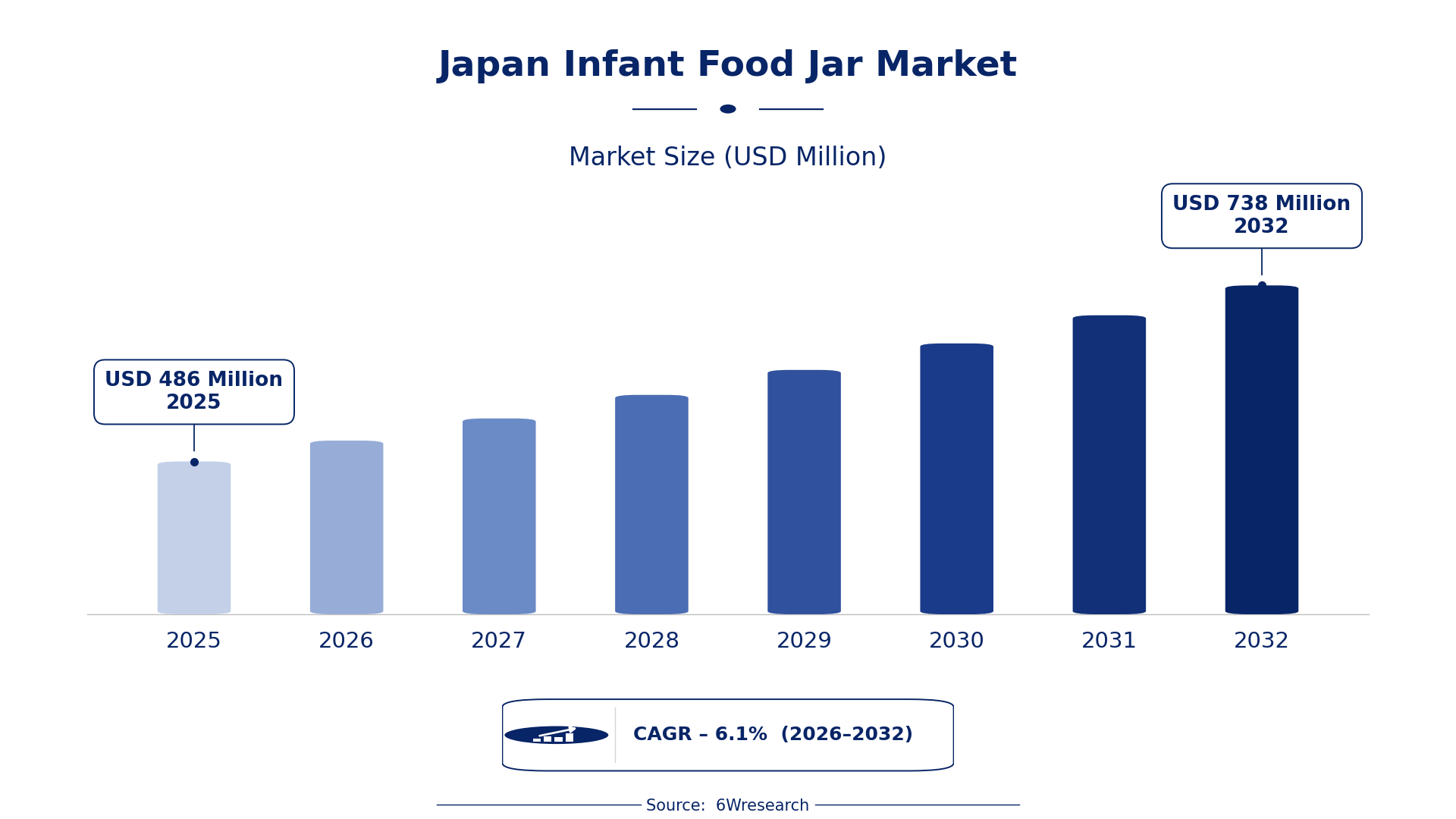
According to 6Wresearch internal database and industry insights, the Japan Infant Food Jar Market was valued at USD 486 Million in 2025 and is projected to reach USD 738 Million by 2032, growing at a CAGR of approximately 6.1% during 2026–2032.
Japan Infant Food Jar Market Highlights
| Report Metric | Details |
| Report Name | Japan Infant Food Jar Market (2026-2032) |
| Market Size 2025 | USD 486 Million |
| Market Size 2032 | USD 738 Million |
| Absolute Growth 2025–2032 | USD 252 Million |
| CAGR 2026–2032 | 6.1% |
| Peak Annual Growth | 7.0% in 2028 |
| Forecast Period | 2026–2032 |
| Historical Data | 2022–2025 |
| Base Year | 2025 |
| Leading Jar Type, 2025 | Glass Jars (46% share) |
| Leading Packaging Material, 2025 | Tempered Glass (44% share) |
| Leading Food Type, 2025 | Organic Purees (50% share) |
| Leading Distribution Channel, 2025 | Supermarkets (53% share) |
| Fastest-Growing Jar Type | Recyclable Packaging (8.9% CAGR) |
| Fastest-Growing Packaging Material | Eco-Friendly (8.5% CAGR) |
| Fastest-Growing Distribution Channel | E-commerce Channels (8.1% CAGR) |
| Growing Sector | Infant Nutrition |
| Key End Users | Health-conscious parents, supermarkets, e-commerce platforms, baby food brands |
Japan Infant Food Jar Market Year-wise Growth Rate and Key Drivers (2022–2032)
This graph illustrates the annual growth rates of the market from 2022 to 2032, highlighting a steady upward trajectory and projected market expansion over the forecast period.
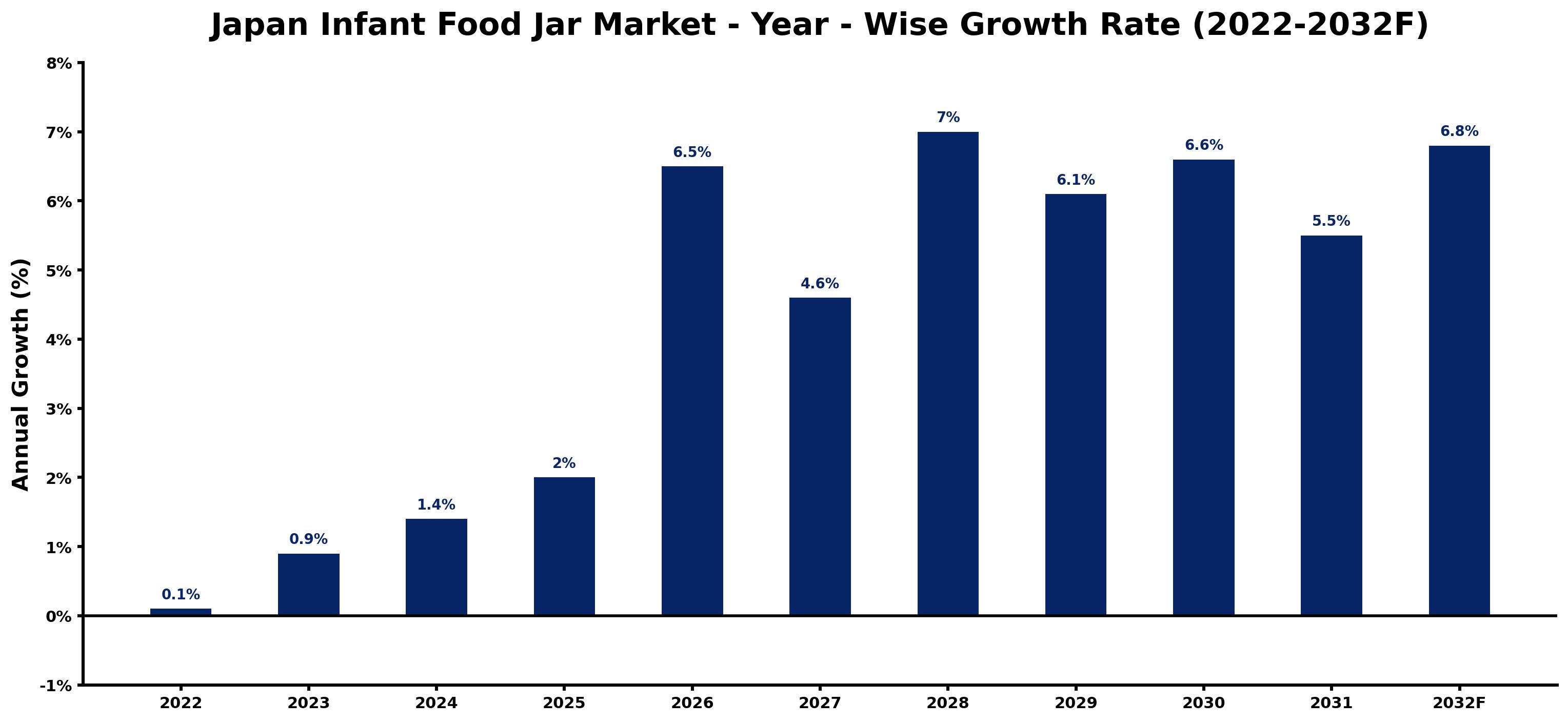
The table below sets out the estimated growth rate for each year and the main factor behind it.
| Year | Estimated Annual Growth (%) | Market Rationale |
| 2022 | 0.1 | The infant population was approximately 1.2 million, indicating steady demand. |
| 2023 | 0.9 | Growth accelerated as health-conscious parents sought convenient feeding solutions. |
| 2024 | 1.4 | Increased awareness of organic options contributed to rising demand for baby food jars. |
| 2025 | 2.0 | The market saw growth driven by the popularity of complete meals for infants. |
| 2026 | 6.5 | Investment in eco-friendly packaging initiatives is projected to boost market growth. |
| 2027 | 4.6 | Growth slows slightly as the market adjusts to previous rapid expansions. |
| 2028 | 7.0 | Demand peaks as new packaging solutions attract more health-conscious buyers. |
| 2029 | 6.1 | The market experiences a slowdown as competition intensifies among suppliers. |
| 2030 | 6.6 | Growth resumes with renewed focus on organic purees and convenience products. |
| 2031 | 5.5 | A slight slowdown in growth reflects market saturation in certain segments. |
| 2032 | 6.8 | Sustained demand for premium products drives growth back up. |
Note: Market size estimations and growth projections presented in this report are based on 6Wresearch's proprietary forecasting methodology, utilizing the latest available industry data, government publications, and primary research inputs.
Japan Infant Food Jar Market Synopsis
Infant food jars are essential containers for storing and preserving baby food, typically made from glass or plastic. The Japan Infant Food Jar Market is expanding due to rising health awareness and demand from health-conscious parents. With approximately 1.2 million infants in 2022, organic purees account for 30% of the market share, while e-commerce channels are growing rapidly. The government's campaign to promote healthy infant nutrition further boosts demand.
Market Dynamics Impact Analysis (2026–2032)
| Factor | Type | Impact | Primary Segment Affected |
| Increasing health awareness among parents | Driver | High | Organic Purees |
| Investment in eco-friendly packaging | Driver | High | Recyclable Packaging |
| Rising demand for organic options | Opportunity | High | Organic Purees |
| Growth of e-commerce channels | Opportunity | Medium | E-commerce Channels |
| Strict regulations on packaging safety | Restraint | High | BPA-Free |
| Market saturation in certain segments | Restraint | Medium | Glass Jars |
| High production costs for premium packaging | Challenge | High | Tempered Glass |
| Compliance with evolving health standards | Challenge | Medium | Plastic Jars |
Evaluation of Drivers in Japan Infant Food Jar Market (2026–2032)
Below are the drivers that matter most for revenue growth, with supporting evidence.
| Drivers | Primary Segment Affected | Why It Matters (Evidence) |
| Growing health consciousness among parents | Organic Purees | This trend drives demand for organic baby food, with organic purees capturing 30% of the market share. |
| Investment in sustainable packaging solutions | Recyclable Packaging | Investment in eco-friendly packaging is projected to attract environmentally conscious consumers. |
| Increase in e-commerce sales | E-commerce Channels | E-commerce sales of infant food have surged by 25%, improving convenience for busy parents. |
| Rising popularity of complete meals | Complete Meals | Complete meals for infants are gaining traction, reflecting changing consumer preferences for convenience. |
| Preference for BPA-free products | BPA-Free | Health regulations mandate BPA-free packaging, encouraging parents to choose safer options. |
A wider customer base explains much of the growth, as health-conscious parents increasingly prefer organic options for their infants. Approximately 1.2 million infants in Japan create a substantial market for baby food jars. E-commerce sales have surged by 25%, driven by the convenience of online shopping. Investment in sustainable packaging solutions is attracting environmentally conscious consumers, while the rising popularity of complete meals reflects changing consumer preferences.
Evaluation of Restraints in Japan Infant Food Jar Market
Several factors work against faster growth; the main ones are summarised below.
| Market Restraint | Primary Segment Affected | Why It Matters (Evidence) |
| High production costs for premium packaging materials | Tempered Glass | Producers face increased costs due to the demand for high-quality tempered glass, impacting pricing. |
| Strict regulations on packaging safety | BPA-Free | Compliance with stringent safety standards can increase operational costs for manufacturers. |
| Market saturation in certain segments | Glass Jars | Intense competition in the glass jar segment limits growth opportunities for existing players. |
| Limited consumer awareness of eco-friendly options | Recyclable Packaging | Despite initiatives, many consumers remain unaware of the benefits of recyclable packaging. |
| Challenges in sourcing sustainable materials | Eco-Friendly | Producers often struggle to find reliable suppliers for sustainable packaging materials. |
Japan Infant Food Jar Market Challenges
Health-conscious parents encounter higher costs as the average price of a glass jar for baby food hovers around 300 yen, limiting their ability to purchase adequate quantities. Producers face production delays because compliance with stringent JIS standards for food packaging safety can prolong lead times, resulting in stock shortages for retailers. Suppliers grapple with meeting the surging demand for organic purees, which constitute 30% of the market share, leading to increased operational costs that may influence pricing. The need for BPA-free packaging requires investments in new materials, which can elevate retail prices for consumers seeking safe feeding solutions.
Trends in the Japan Infant Food Jar Market
The shifts below are changing how Japan Infant Food Jar Market products are bought and supplied.
- Launch of Eco-Friendly Packaging Initiative: In 2023, the government launched an eco-friendly packaging initiative, promoting sustainable materials in baby food jars. This initiative aims to reduce plastic waste, aligning with consumer preferences for environmentally responsible products.
- Shift Towards Organic Baby Food: The appetite for organic baby food has risen, with organic purees making up 30% of the market share. This trend mirrors a growing awareness among parents regarding healthy infant nutrition.
- Rise of E-commerce Channels: E-commerce channels have gained popularity for purchasing infant food jars, with sales increasing by 25% in the past year. This shift provides convenience and variety for health-conscious parents.
- Growing Preference for Single-Serve Packs: Single-serve packs are becoming more popular among parents seeking convenience for on-the-go feeding. This trend is apparent as busy lifestyles drive the demand for easy-to-use packaging solutions.
Investment Opportunities in the Japan Infant Food Jar Market
Where to invest in the Japan Infant Food Jar Market: the main openings are set out below.
- Gap in Eco-Friendly Packaging: With a rising demand for sustainable solutions, the eco-friendly packaging segment is projected to grow at 8.5%. Health food retailers are searching for packaging options to satisfy consumer preferences.
- Expansion of E-commerce Channels: E-commerce channels are expected to expand at 8.1%, offering opportunities for suppliers to connect with health-conscious parents. Collaborating with local e-commerce platforms can ease market entry.
- Demand for Organic Purees: The organic purees segment is anticipated to grow at 8.7%, driven by health-conscious parents. Suppliers can capitalise on this demand by emphasising organic certifications and quality assurance.
- Investment in BPA-Free Packaging: The market for BPA-free packaging is on the rise, with growing consumer awareness of health issues. Partnering with health food retailers can assist suppliers in entering this expanding market.
Government Initiatives in the Japan Infant Food Jar Market
The Food Sanitation Act amendment of 2018 established a positive list system for synthetic resins used in food packaging, ensuring that only safe materials are utilised. This measure requires compliance from producers, boosting consumer confidence in baby food safety.
The Ministry of Health, Labour and Welfare supervises the enforcement of health regulations, ensuring that manufacturers comply with safety standards. This includes approving new packaging materials and promoting healthy infant nutrition initiatives.
Future Insight of the Japan Infant Food Jar Market
By 2032, investment in advanced sterilisation technologies will streamline production processes, enabling suppliers to respond more effectively to market needs. A government initiative promoting organic baby food will expand the variety of nutritious options available for parents. E-commerce sales are projected to continue growing, improving distribution channels and access for buyers. The introduction of new packaging standards will resonate with consumer preferences for sustainability, driving innovation in the infant food jar sector.
Market Segmentation Analysis
Japan Infant Food Jar Market report covers a detailed analysis of the following market segments:
By Jar Type – Glass Jars Lead, Recyclable Packaging Expected to Grow Fastest
According to Saurav Kr Singh, Senior Research Analyst at 6Wresearch, with 46% of jar type revenue in 2025, Glass Jars was the largest category. Glass jars hold the largest share due to their widespread use for premium baby food packaging, appealing to health-conscious parents. For instance, the average price of a glass jar is around 300 yen, reflecting its perceived value and quality. Recyclable Packaging is projected to grow fastest, at a CAGR of 8.9% during 2026–2032. Recyclable packaging is experiencing rapid growth as sustainability becomes a priority for consumers, with recent initiatives promoting eco-friendly options. The government's introduction of a new eco-friendly packaging initiative in 2023 has further accelerated this trend. Suppliers should focus on developing sustainable packaging solutions to meet the rising demand for environmentally friendly products.
By Packaging Material – Tempered Glass Leads, Eco-Friendly Expected to Grow Fastest
Tempered Glass held 44% of the Japan Infant Food Jar Market by packaging material in 2025. Tempered glass is the leading material due to its durability and safety, making it a preferred choice for parents concerned about their infants' health. This preference is reinforced by Japan's strict JIS standards for food packaging safety, ensuring high-quality products. Over 2026–2032, Eco-Friendly is expected to post the fastest growth, at a CAGR of 8.5%. Eco-friendly packaging is gaining traction as consumers increasingly seek sustainable options, aligning with the government's recent campaign to reduce plastic waste. This shift indicates a growing market segment that prioritises environmental considerations in their purchasing decisions. Manufacturers must adapt to the demand for eco-friendly materials to remain competitive in the evolving market.
By Food Type – Organic Purees Lead and Record the Fastest Growth
Organic Purees accounted for 50% of the market by food type in 2025. Organic purees dominate the market as they are highly sought after by health-conscious parents who prioritise nutritious options for their infants. This segment's appeal is underscored by its 30% market share, reflecting a strong consumer preference for organic food. The same category are also set to grow fastest, at a CAGR of 8.7% during 2026–2032. The surge in organic purees is fuelled by increasing health awareness and government campaigns advocating for healthy infant nutrition. This consistent interest in organic products suggests that the segment's growth will continue to expand. Suppliers should focus on organic products to align with the rising demand for health-oriented infant food.
By Distribution Channel – Supermarkets Lead, E-commerce Channels Expected to Grow Fastest
In 2025, Supermarkets led the distribution channel split with a 53% share. Supermarkets are the primary distribution channel for infant food jars, responsible for 60% of sales, offering essential convenience and accessibility for consumers. Their established presence plays a vital role in effectively reaching health-conscious parents. E-commerce Channels are set to record the highest CAGR in this split, 8.1% over 2026–2032. E-commerce channels are rapidly gaining traction, evidenced by a 25% increase in sales over the past year, as parents increasingly favour the convenience and variety available online. This shift in purchasing behaviour may significantly impact future distribution strategies. Retailers need to enhance their online presence to effectively respond to the growing demand for e-commerce in the infant food market.
Key Attractiveness of the Report
- 10 Years of Market Numbers
- Historical Data Starting from 2022 to 2025
- Base Year 2025
- Forecast Data until 2032
- Key Performance Indicators Impacting the Market
- Major Upcoming Developments and Projects
Key Highlights of the Report:
- Japan Infant Food Jar Market Outlook
- Market Size of Japan Infant Food Jar Market, 2025
- Forecast of Japan Infant Food Jar Market, 2032
- Historical Data and Forecast of Japan Infant Food Jar Revenues & Volume for the Period 2022-2032F
- Japan Infant Food Jar Market Trend Evolution
- Japan Infant Food Jar Market Drivers and Challenges
- Japan Infant Food Jar Price Trends
- Japan Infant Food Jar Porter's Five Forces
- Japan Infant Food Jar Industry Life Cycle
- Historical Data and Forecast of Japan Infant Food Jar Market Revenues & Volume By Jar Type for the Period 2022-2032F
- Historical Data and Forecast of Japan Infant Food Jar Market Revenues & Volume By Glass Jars for the Period 2022-2032F
- Historical Data and Forecast of Japan Infant Food Jar Market Revenues & Volume By Plastic Jars for the Period 2022-2032F
- Historical Data and Forecast of Japan Infant Food Jar Market Revenues & Volume By Recyclable Packaging for the Period 2022-2032F
- Historical Data and Forecast of Japan Infant Food Jar Market Revenues & Volume By Single-Serve Packs for the Period 2022-2032F
- Historical Data and Forecast of Japan Infant Food Jar Market Revenues & Volume By Packaging Material for the Period 2022-2032F
- Historical Data and Forecast of Japan Infant Food Jar Market Revenues & Volume By Tempered Glass for the Period 2022-2032F
- Historical Data and Forecast of Japan Infant Food Jar Market Revenues & Volume By BPA-Free for the Period 2022-2032F
- Historical Data and Forecast of Japan Infant Food Jar Market Revenues & Volume By Eco-Friendly for the Period 2022-2032F
- Historical Data and Forecast of Japan Infant Food Jar Market Revenues & Volume By Convenience Focused for the Period 2022-2032F
- Historical Data and Forecast of Japan Infant Food Jar Market Revenues & Volume By Food Type for the Period 2022-2032F
- Historical Data and Forecast of Japan Infant Food Jar Market Revenues & Volume By Organic Purees for the Period 2022-2032F
- Historical Data and Forecast of Japan Infant Food Jar Market Revenues & Volume By Fruit Blends for the Period 2022-2032F
- Historical Data and Forecast of Japan Infant Food Jar Market Revenues & Volume By Vegetable Mixes for the Period 2022-2032F
- Historical Data and Forecast of Japan Infant Food Jar Market Revenues & Volume By Complete Meals for the Period 2022-2032F
- Historical Data and Forecast of Japan Infant Food Jar Market Revenues & Volume By Distribution Channel for the Period 2022-2032F
- Historical Data and Forecast of Japan Infant Food Jar Market Revenues & Volume By Supermarkets for the Period 2022-2032F
- Historical Data and Forecast of Japan Infant Food Jar Market Revenues & Volume By Baby Food Brands for the Period 2022-2032F
- Historical Data and Forecast of Japan Infant Food Jar Market Revenues & Volume By Health Food Retailers for the Period 2022-2032F
- Historical Data and Forecast of Japan Infant Food Jar Market Revenues & Volume By E-commerce Channels for the Period 2022-2032F
- Japan Infant Food Jar Import Export Trade Statistics
- Market Opportunity Assessment By Jar Type
- Market Opportunity Assessment By Packaging Material
- Market Opportunity Assessment By Food Type
- Market Opportunity Assessment By Distribution Channel
- Japan Infant Food Jar Top Companies Market Share
- Japan Infant Food Jar Competitive Benchmarking By Technical and Operational Parameters
- Japan Infant Food Jar Company Profiles
- Japan Infant Food Jar Key Strategic Recommendations
Market Covered
This report examines the market across the segments below.
By Jar Type
- Glass Jars
- Plastic Jars
- Recyclable Packaging
- Single-Serve Packs
By Packaging Material
- Tempered Glass
- BPA-Free
- Eco-Friendly
- Convenience Focused
By Food Type
- Organic Purees
- Fruit Blends
- Vegetable Mixes
- Complete Meals
By Distribution Channel
- Supermarkets
- Baby Food Brands
- Health Food Retailers
- E-commerce Channels































