Japan Infant Health Monitoring Market Size & Growth Rate
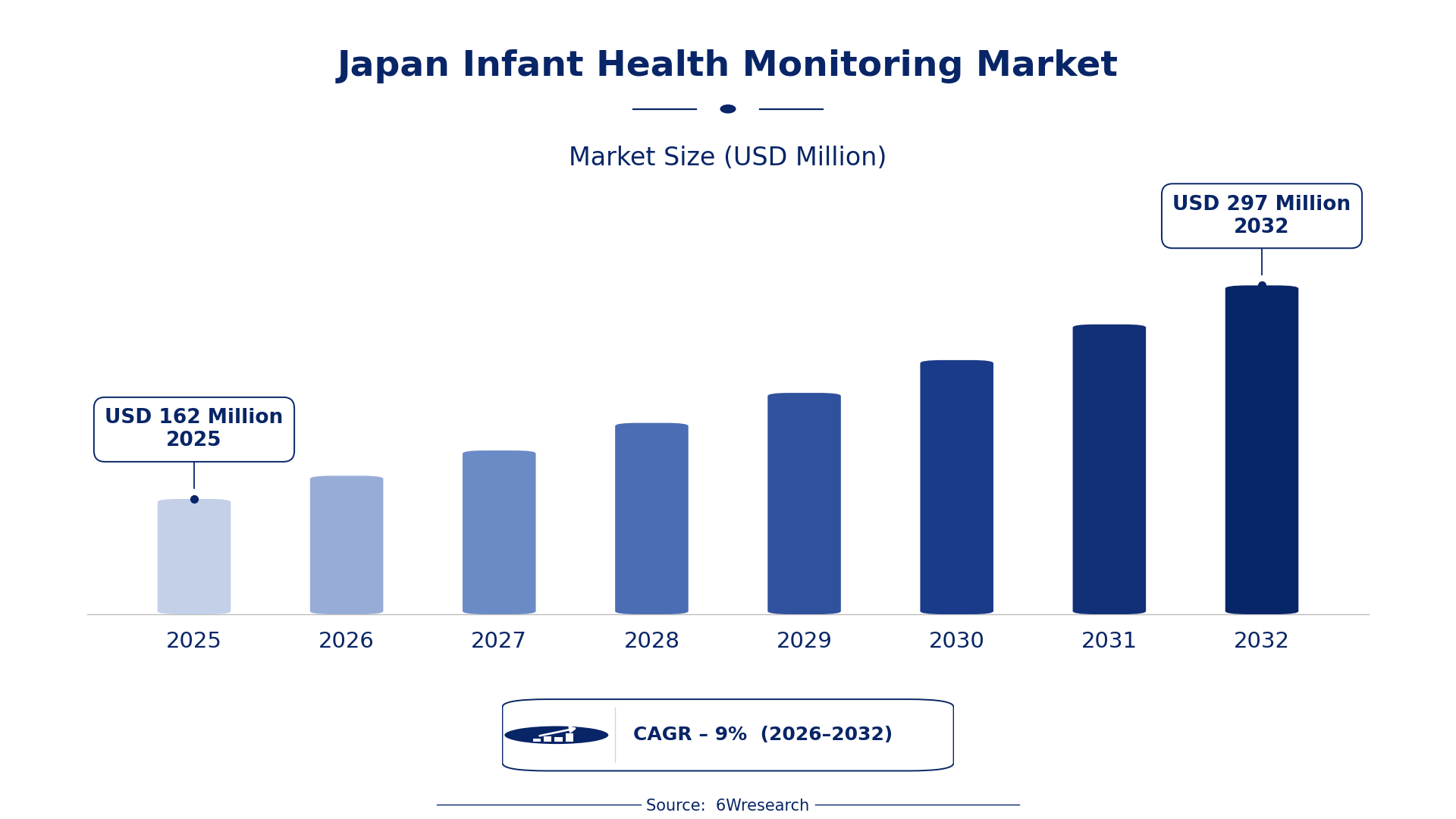
According to 6Wresearch internal database and industry insights, the Japan Infant Health Monitoring Market was valued at USD 162 Million in 2025 and is projected to reach USD 297 Million by 2032, growing at a CAGR of approximately 9% during 2026–2032.
Japan Infant Health Monitoring Market Highlights
| Report Metric | Details |
| Report Name | Japan Infant Health Monitoring Market (2026-2032) |
| Market Size 2025 | USD 162 Million |
| Market Size 2032 | USD 297 Million |
| Absolute Growth 2025–2032 | USD 135 Million |
| CAGR 2026–2032 | 9% |
| Peak Annual Growth | 10.2% in 2030 |
| Forecast Period | 2026–2032 |
| Historical Data | 2022–2025 |
| Base Year | 2025 |
| Leading Monitoring System, 2025 | Smart Monitors (50% share) |
| Leading Sensor Technology, 2025 | Wearable Sensors (38% share) |
| Leading Application, 2025 | Sleep / Heart Rate (42% share) |
| Leading Distribution Channel, 2025 | Online Retailers (51% share) |
| Fastest-Growing Monitoring System | Integrated Apps (12.6% CAGR) |
| Fastest-Growing Application | Health Insights (12.0% CAGR) |
| Fastest-Growing Distribution Channel | Mobile App Stores (11.7% CAGR) |
| Growing Sector | infant health monitoring |
| Key End Users | parents, caregivers, healthcare providers, child health organisations |
Japan Infant Health Monitoring Market Year-wise Growth Rate and Key Drivers (2022–2032)
This graph illustrates the annual growth rates of the market from 2022 to 2032, highlighting a steady upward trajectory and projected market expansion over the forecast period.
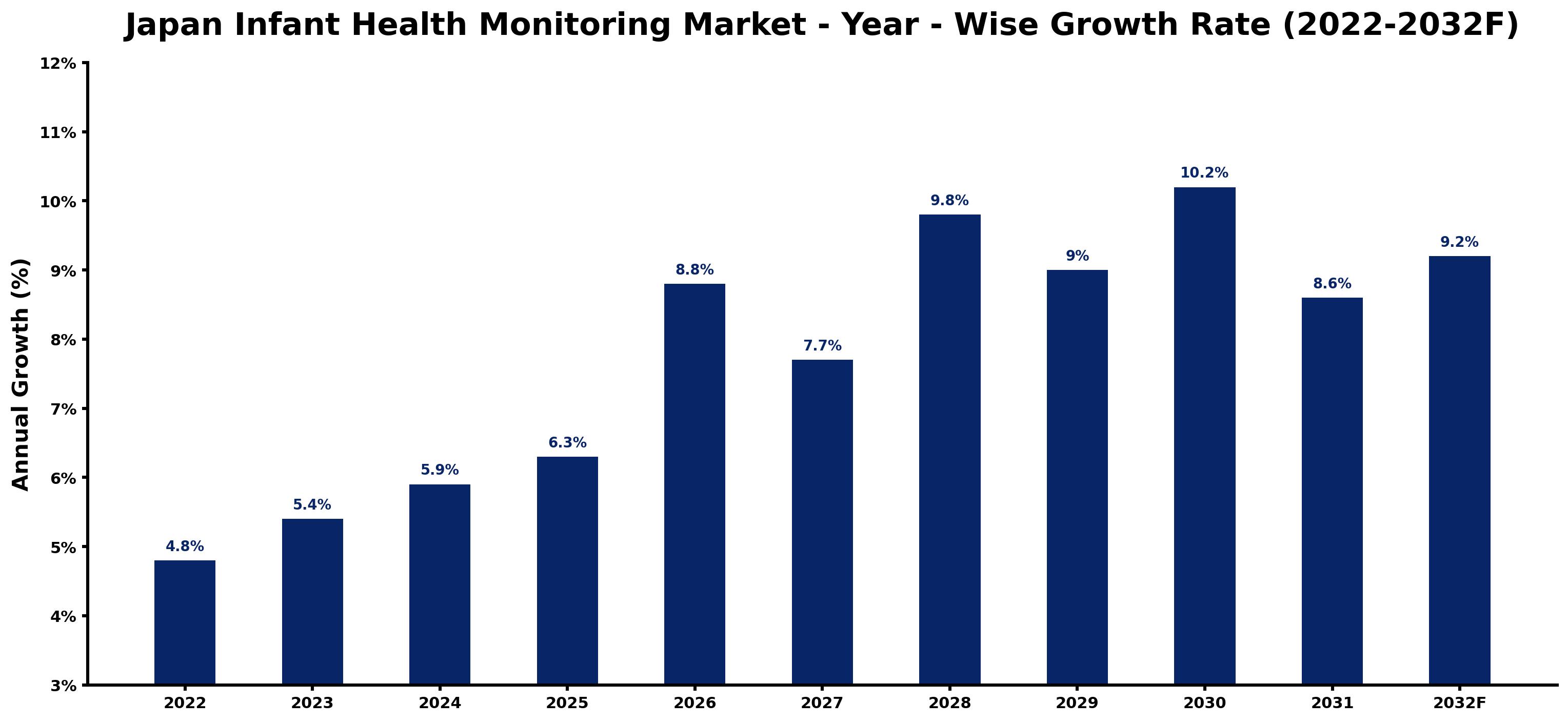
The following figures match every annual growth estimate with the main market development of that year, giving the reasoning behind each rise or slowdown.
| Year | Estimated Annual Growth (%) | Market Rationale |
| 2022 | 4.8 | The market experienced steady growth due to increased awareness of infant health. |
| 2023 | 5.4 | Demand rose as parents sought better monitoring solutions for their infants. |
| 2024 | 5.9 | Technological advancements in monitoring devices contributed to faster growth. |
| 2025 | 6.3 | The introduction of new products enhanced market dynamics and consumer interest. |
| 2026 | 8.8 | Consumer adoption of integrated apps for health tracking increased significantly. |
| 2027 | 7.7 | Growth slowed as market saturation began to impact new device sales. |
| 2028 | 9.8 | Urban areas saw a surge in remote surveillance systems for infants. |
| 2029 | 9.0 | A slight slowdown occurred as competition intensified among product offerings. |
| 2030 | 10.2 | Innovations in smart monitoring technology drove peak growth this year. |
| 2031 | 8.6 | Growth decelerated as the market began to stabilise after rapid expansion. |
| 2032 | 9.2 | Continued advancements in health insights applications will sustain demand. |
Note: Market size estimations and growth projections presented in this report are based on 6Wresearch's proprietary forecasting methodology, utilizing the latest available industry data, government publications, and primary research inputs.
Japan Infant Health Monitoring Market Synopsis
Infant health monitoring products track and analyse health parameters of infants, ensuring their well-being. In Japan, the demand for these products stems from parents and caregivers, with approximately 1.2 million infants in 2022. Market growth is propelled by technological advancements, a rising number of first-time parents averaging 30.7 years, and government initiatives that promote child health monitoring. The installed base of smart monitors is estimated at over 500,000 units, indicating a robust market for these solutions.
Market Dynamics Impact Analysis (2026–2032)
| Factor | Type | Impact | Primary Segment Affected |
| Increasing adoption of smart monitors among parents boosts demand. | Driver | High | Smart Monitors |
| Technological advancements in integrated applications enhance monitoring capabilities. | Driver | High | Integrated Apps |
| Growing urban population creates demand for remote surveillance systems. | Opportunity | High | Remote Surveillance |
| Rising health awareness among parents drives investment in monitoring solutions. | Opportunity | High | Health Insights |
| High costs of advanced monitoring devices may limit accessibility for some families. | Restraint | Medium | Smart Monitors |
| Limited awareness of available products can hinder market growth. | Restraint | Medium | Integrated Apps |
| Competition among brands may lead to price wars affecting margins. | Challenge | High | Smart Monitors |
| Technological integration challenges can delay product development. | Challenge | Medium | Integrated Apps |
Evaluation of Drivers in Japan Infant Health Monitoring Market (2026–2032)
Demand rests on the following drivers, each shown with the segment it touches most.
| Drivers | Primary Segment Affected | Why It Matters (Evidence) |
| Awareness of infant health monitoring benefits drives purchases. | Smart Monitors | In 2022, approximately 1.2 million infants in Japan increased demand for effective monitoring solutions. |
| Technological advancements in monitoring devices improve user experience. | Integrated Apps | Health insights applications experienced a 20% increase in downloads, reflecting strong consumer interest. |
| Urbanisation leads to higher adoption of remote surveillance systems. | Remote Surveillance | Urban areas with higher infant populations are increasingly adopting these systems. |
| Growing number of first-time parents increases demand for monitoring solutions. | Health Insights | The average age of first-time parents in Japan is 30.7 years, driving demand for effective health monitoring. |
| Government initiatives promote child health monitoring technologies. | Smart Monitors | The Japanese government supports various initiatives to advance child health, boosting market growth. |
Several shifts outside the market lift sales. Increased awareness of the benefits of infant health monitoring drives purchases, as approximately 1.2 million infants in Japan create strong demand for effective solutions. The average age of first-time parents is 30.7 years, leading to heightened interest in monitoring solutions. Urban areas are seeing a rise in remote surveillance systems, particularly in regions with larger infant populations. Health insights applications experienced a 20% increase in downloads, reflecting consumer interest in integrated health tracking.
Evaluation of Restraints in Japan Infant Health Monitoring Market
The main factors holding the market back are set out below.
| Market Restraint | Primary Segment Affected | Why It Matters (Evidence) |
| High costs of advanced monitoring devices limit accessibility for families. | Smart Monitors | The average cost of a smart monitor ranges from 15,000 to 30,000 JPY, affecting purchase decisions. |
| Limited awareness of available products can hinder market growth. | Integrated Apps | Many parents may not be fully informed about the benefits of integrated applications for monitoring. |
| Regulatory hurdles can delay product approvals and market entry. | Remote Surveillance | Compliance with JIS standards is essential for product safety and quality, impacting time to market. |
| Competition among brands may lead to price wars affecting margins. | Health Insights | Aggressive pricing strategies from new entrants may impact profitability for established brands. |
| Technological integration challenges can delay product development. | Integrated Apps | Complexities in integrating various health metrics can slow down the launch of new applications. |
Japan Infant Health Monitoring Market Challenges
In regions like Tokyo, parents frequently face intense competition for infant health monitoring products, which can drive prices up to 30,000 JPY per unit. Limited access to advanced monitoring solutions prevents buyers from ensuring their infants' safety, resulting in heightened anxiety among caregivers. Suppliers encounter challenges in sourcing components due to stringent regulations from the Ministry of Health, Labour and Welfare, causing product launch delays of up to six months. Technological integration issues complicate the development of user-friendly platforms, frustrating parents and caregivers who seek effective monitoring solutions.
Trends in the Japan Infant Health Monitoring Market
The trends below show where the Japan Infant Health Monitoring Market is heading.
- Shift from Traditional Monitors to Integrated Apps: Parents are increasingly favouring integrated applications for monitoring infant health, particularly in Tokyo, where health insights applications saw a 20% increase in downloads last year. This shift allows for consolidated health data management, improving user convenience.
- Transition from Basic Monitoring to Remote Surveillance: Urban caregivers are adopting remote surveillance systems for infants, especially in Osaka, where adoption rates have surged. This trend reflects a growing preference for real-time monitoring capabilities, ensuring better safety for infants.
- Emergence of Wearable Sensors in Infant Monitoring: Wearable sensors are gaining traction among tech-savvy parents, particularly in metropolitan areas. This segment accounted for 38% of the sensor technology market in 2025, indicating a shift towards more practical monitoring solutions.
- Rising Trend of Cloud-Connected Devices: There is a shift towards cloud connectivity in infant health monitoring devices, particularly in urban regions. This trend supports data storage and analysis, allowing caregivers to access health insights remotely.
Investment Opportunities in the Japan Infant Health Monitoring Market
The opportunities below stand out in the Japan Infant Health Monitoring Market for new entrants and existing suppliers.
- Parents seeking advanced monitoring solutions: With approximately 1.2 million infants in Japan, there is a significant need for advanced monitoring solutions. Urban parents are particularly interested in integrated apps that provide comprehensive health data.
- Gap in affordable monitoring solutions: The average cost of smart monitors ranges from 15,000 to 30,000 JPY, indicating a market gap for affordable options. Targeting budget-conscious parents in urban areas could be a viable strategy.
- Investment in health insights applications: Health insights applications are experiencing a surge in demand, with a 20% increase in downloads. Developers can focus on creating user-friendly apps that consolidate health metrics for parents.
- Entry through partnerships with local distributors: Collaborating with online retailers can facilitate market entry for new monitoring devices. This approach allows for better visibility and access to the growing consumer base.
Government Initiatives in the Japan Infant Health Monitoring Market
The regulation of infant health monitoring products is influenced by the PMD Act, which ensures the safety and quality of medical devices. Compliance with JIS standards is mandatory for manufacturers, ensuring that products meet rigorous safety criteria. Additionally, the Next-Generation Medical Infrastructure Act promotes the use of advanced technologies in healthcare, facilitating innovation in infant monitoring solutions.
In 2023, a government program was launched to support technological advancements in infant care, with funding of JPY 10 billion allocated for research and development. The Ministry of Health, Labour and Welfare oversees these initiatives, ensuring that products align with national health objectives.
Future Insight of the Japan Infant Health Monitoring Market
A new initiative aimed at advancing infant care technology will reshape product offerings by 2032. The introduction of integrated health monitoring systems will streamline data collection, allowing parents to track multiple health metrics seamlessly. By 2030, the installed base of smart monitors is expected to exceed 1 million units, reflecting increased adoption among urban families. Updated JIS standards will enhance product safety and quality, benefiting both buyers and suppliers in the infant health monitoring market.
Market Segmentation Analysis
Japan Infant Health Monitoring Market report covers a detailed analysis of the following market segments:
By Monitoring System – Smart Monitors Lead, Integrated Apps Expected to Grow Fastest
According to Saurav Kr Singh, Senior Research Analyst at 6Wresearch, in 2025, Smart Monitors led the monitoring system split with a 50% share. Smart monitors are preferred by parents due to their ability to provide real-time tracking of infant health metrics. With an installed base of over 500,000 units, these devices are integral to ensuring infants' well-being in households. Integrated Apps are set to record the highest CAGR in this split, 12.6% over 2026–2032. Integrated apps are experiencing rapid growth as they simplify health data access and analysis, highlighted by a 20% increase in downloads last year. This trend suggests a movement towards comprehensive health management solutions for infants, further supporting the dominance of smart monitors. Suppliers should prioritise the development of app functionalities to align with the growing demand for integrated health monitoring solutions.
By Sensor Technology – Wearable Sensors Lead and Record the Fastest Growth
With 38% of sensor technology revenue in 2025, Wearable Sensors was the largest category. Wearable sensors lead the market as they offer a convenient method for continuous monitoring of infants' health parameters. Their widespread use in urban areas highlights the need for reliable health tracking solutions among parents. Wearable Sensors are also forecast to expand faster than any other category, at a CAGR of 13.3% over 2026–2032. The growth of wearable sensors is propelled by their effectiveness in providing continuous health monitoring, aligning with the rising demand for real-time data. As they remain the primary method for infant monitoring, their lead will likely expand further. Suppliers must invest in the development of advanced wearable technologies to maintain competitiveness in this growing segment.
By Application – Sleep / Heart Rate Leads, Health Insights Expected to Grow Fastest
Sleep / Heart Rate took 42% of application revenue in 2025, more than any other category. Applications focused on sleep and heart rate monitoring are essential for assessing infant health, making them the leading choice among caregivers. These parameters are vital for ensuring infants' overall well-being, driving their widespread adoption. Health Insights are projected to grow fastest, at a CAGR of 12.0% during 2026–2032. Health insights applications are becoming increasingly popular as they deliver valuable data for managing infants' health, reflecting a growing emphasis on data-driven care. This trend indicates that demand for such applications will continue to rise. Suppliers should prioritise the development of health insights features to cater to the changing needs of parents and caregivers.
By Distribution Channel – Online Retailers Lead, Mobile App Stores Expected to Grow Fastest
The largest distribution channel category in 2025 was Online Retailers, at 51% of revenue. Online retailers serve as the primary channel for consumer access to infant health monitoring products, offering convenience for parents. The increasing trend of e-commerce in Japan reinforces the importance of this distribution method. The quickest growth will come from Mobile App Stores, forecast to expand at a CAGR of 11.7% between 2026 and 2032. Mobile app stores are emerging as the fastest-growing distribution channel, providing easy access to health monitoring applications for caregivers. This trend indicates a shift towards digital solutions for managing infant health effectively. Suppliers should enhance their online presence and app store strategies to capitalise on the rising demand for digital health monitoring solutions.
Key Attractiveness of the Report
- 10 Years of Market Numbers
- Historical Data Starting from 2022 to 2025
- Base Year 2025
- Forecast Data until 2032
- Key Performance Indicators Impacting the Market
- Major Upcoming Developments and Projects
Key Highlights of the Report:
- Japan Infant Health Monitoring Market Outlook
- Market Size of Japan Infant Health Monitoring Market, 2025
- Forecast of Japan Infant Health Monitoring Market, 2032
- Historical Data and Forecast of Japan Infant Health Monitoring Revenues & Volume for the Period 2022-2032F
- Japan Infant Health Monitoring Market Trend Evolution
- Japan Infant Health Monitoring Market Drivers and Challenges
- Japan Infant Health Monitoring Price Trends
- Japan Infant Health Monitoring Porter's Five Forces
- Japan Infant Health Monitoring Industry Life Cycle
- Historical Data and Forecast of Japan Infant Health Monitoring Market Revenues & Volume By Monitoring System for the Period 2022-2032F
- Historical Data and Forecast of Japan Infant Health Monitoring Market Revenues & Volume By Smart Monitors for the Period 2022-2032F
- Historical Data and Forecast of Japan Infant Health Monitoring Market Revenues & Volume By Camera-Based Systems for the Period 2022-2032F
- Historical Data and Forecast of Japan Infant Health Monitoring Market Revenues & Volume By Contactless Trackers for the Period 2022-2032F
- Historical Data and Forecast of Japan Infant Health Monitoring Market Revenues & Volume By Integrated Apps for the Period 2022-2032F
- Historical Data and Forecast of Japan Infant Health Monitoring Market Revenues & Volume By Sensor Technology for the Period 2022-2032F
- Historical Data and Forecast of Japan Infant Health Monitoring Market Revenues & Volume By Wearable Sensors for the Period 2022-2032F
- Historical Data and Forecast of Japan Infant Health Monitoring Market Revenues & Volume By Motion Detection for the Period 2022-2032F
- Historical Data and Forecast of Japan Infant Health Monitoring Market Revenues & Volume By Radar / Thermal Sensing for the Period 2022-2032F
- Historical Data and Forecast of Japan Infant Health Monitoring Market Revenues & Volume By Cloud Connectivity for the Period 2022-2032F
- Historical Data and Forecast of Japan Infant Health Monitoring Market Revenues & Volume By Application for the Period 2022-2032F
- Historical Data and Forecast of Japan Infant Health Monitoring Market Revenues & Volume By Sleep / Heart Rate for the Period 2022-2032F
- Historical Data and Forecast of Japan Infant Health Monitoring Market Revenues & Volume By Remote Surveillance for the Period 2022-2032F
- Historical Data and Forecast of Japan Infant Health Monitoring Market Revenues & Volume By Breathing Rate for the Period 2022-2032F
- Historical Data and Forecast of Japan Infant Health Monitoring Market Revenues & Volume By Health Insights for the Period 2022-2032F
- Historical Data and Forecast of Japan Infant Health Monitoring Market Revenues & Volume By Distribution Channel for the Period 2022-2032F
- Historical Data and Forecast of Japan Infant Health Monitoring Market Revenues & Volume By Online Retailers for the Period 2022-2032F
- Historical Data and Forecast of Japan Infant Health Monitoring Market Revenues & Volume By Electronics Retailers for the Period 2022-2032F
- Historical Data and Forecast of Japan Infant Health Monitoring Market Revenues & Volume By Baby Monitor Brands for the Period 2022-2032F
- Historical Data and Forecast of Japan Infant Health Monitoring Market Revenues & Volume By Mobile App Stores for the Period 2022-2032F
- Japan Infant Health Monitoring Import Export Trade Statistics
- Market Opportunity Assessment By Monitoring System
- Market Opportunity Assessment By Sensor Technology
- Market Opportunity Assessment By Application
- Market Opportunity Assessment By Distribution Channel
- Japan Infant Health Monitoring Top Companies Market Share
- Japan Infant Health Monitoring Competitive Benchmarking By Technical and Operational Parameters
- Japan Infant Health Monitoring Company Profiles
- Japan Infant Health Monitoring Key Strategic Recommendations
Market Covered
Segments analysed in this report are listed below.
By Monitoring System
- Smart Monitors
- Camera-Based Systems
- Contactless Trackers
- Integrated Apps
By Sensor Technology
- Wearable Sensors
- Motion Detection
- Radar / Thermal Sensing
- Cloud Connectivity
By Application
- Sleep / Heart Rate
- Remote Surveillance
- Breathing Rate
- Health Insights
By Distribution Channel
- Online Retailers
- Electronics Retailers
- Baby Monitor Brands
- Mobile App Stores































