Japan Infant Hygiene Equipment Market Size & Growth Rate
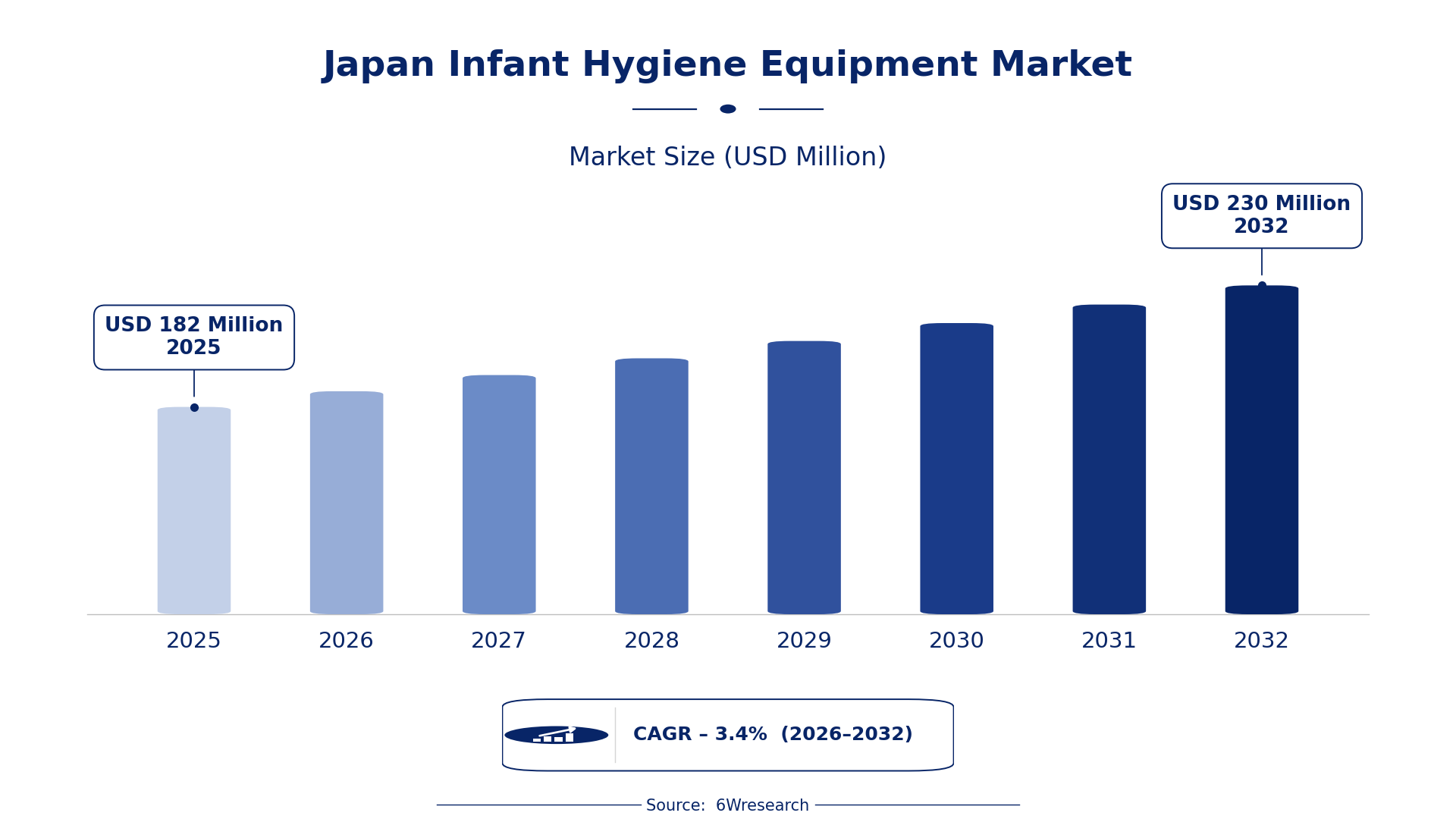
According to 6Wresearch internal database and industry insights, the Japan Infant Hygiene Equipment Market was valued at USD 182 Million in 2025 and is projected to reach USD 230 Million by 2032, growing at a CAGR of approximately 3.4% during 2026–2032.
Japan Infant Hygiene Equipment Market Highlights
| Report Metric | Details |
| Report Name | Japan Infant Hygiene Equipment Market (2026-2032) |
| Market Size 2025 | USD 182 Million |
| Market Size 2032 | USD 230 Million |
| Absolute Growth 2025–2032 | USD 48 Million |
| CAGR 2026–2032 | 3.4% |
| Peak Annual Growth | 4.3% in 2028 |
| Forecast Period | 2026–2032 |
| Historical Data | 2022–2025 |
| Base Year | 2025 |
| Leading Equipment Type, 2025 | Diaper Changing Stations (41% share) |
| Leading Hygiene Use, 2025 | Public Hygiene (45% share) |
| Leading End User, 2025 | Parents (41% share) |
| Leading Distribution Channel, 2025 | Online Stores (46% share) |
| Fastest-Growing Equipment Type | Diaper Disposal Units (4.8% CAGR) |
| Fastest-Growing Hygiene Use | Home Bathing (4.4% CAGR) |
| Fastest-Growing End User | Daycare / Hospitals (4.5% CAGR) |
| Growing Sector | Public Hygiene |
| Key End Users | Parents, Daycare Centers, Urban Families, Equipment Retailers |
Japan Infant Hygiene Equipment Market Year-wise Growth Rate and Key Drivers (2022–2032)
This graph illustrates the annual growth rates of the market from 2022 to 2032, highlighting a steady upward trajectory and projected market expansion over the forecast period.
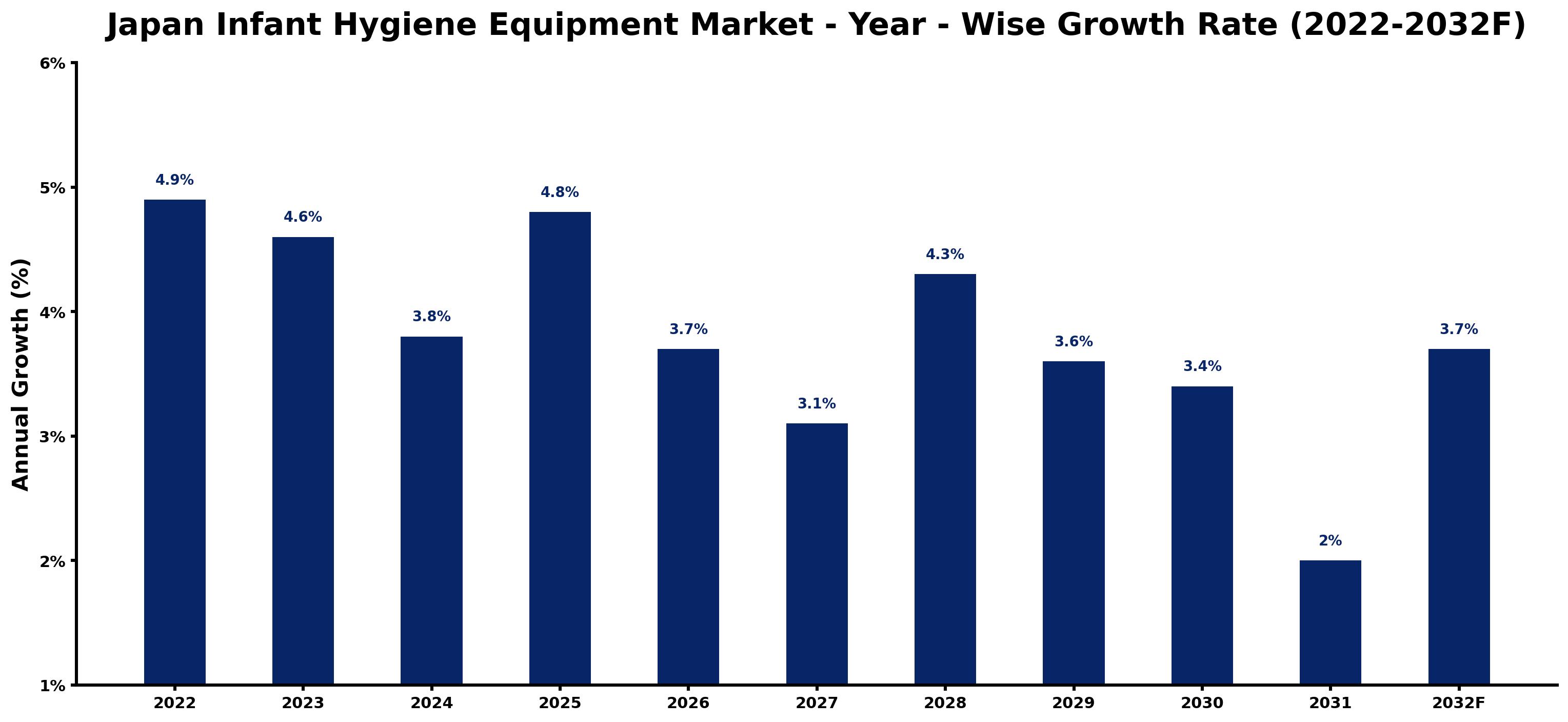
Below, each year's estimated growth is shown next to the factor that most influenced it.
| Year | Estimated Annual Growth (%) | Market Rationale |
| 2022 | 4.9 | The market experienced strong demand from families and childcare facilities. |
| 2023 | 4.6 | Growth slowed due to a slight decrease in consumer spending on infant products. |
| 2024 | 3.8 | Market expansion continued but at a reduced rate as competition intensified. |
| 2025 | 4.8 | Demand increased as urban families sought more convenient hygiene solutions. |
| 2026 | 3.7 | Growth is expected to slow as market maturity begins to set in for certain product types. |
| 2027 | 3.1 | A further slowdown is projected as buyers become more selective in purchases. |
| 2028 | 4.3 | Demand is expected to accelerate again due to rising awareness of hygiene standards. |
| 2029 | 3.6 | Growth is projected to slow as the market stabilises after the previous surge. |
| 2030 | 3.4 | A continued slowdown is expected to reflect a more cautious consumer approach. |
| 2031 | 2.0 | The market growth rate is projected to drop as competition heightens among suppliers. |
| 2032 | 3.7 | Demand is expected to increase again as new product innovations enter the market. |
Note: Market size estimations and growth projections presented in this report are based on 6Wresearch's proprietary forecasting methodology, utilizing the latest available industry data, government publications, and primary research inputs.
Japan Infant Hygiene Equipment Market Synopsis
Infant hygiene equipment includes products designed to ensure cleanliness and comfort for infants, such as diaper changing stations and portable bathtubs. The Japan Infant Hygiene Equipment Market is expanding due to a growing urban family population and increased awareness of hygiene standards. The average age of first-time parents is around 30 years, contributing to a demand for convenient and safe products. Public hygiene initiatives in major cities are also driving purchases, particularly in daycare facilities and urban households.
Market Dynamics Impact Analysis (2026–2032)
| Factor | Type | Impact | Primary Segment Affected |
| Rising urban family populations | Driver | High | Public Hygiene |
| Increased focus on hygiene standards | Driver | High | Home Bathing |
| Growing demand for portable solutions | Opportunity | High | Portable Bathtubs |
| Expansion of online retail channels | Opportunity | High | Online Stores |
| Intense competition among suppliers | Restraint | Medium | Diaper Changing Stations |
| High consumer expectations for product quality | Restraint | High | Diaper Disposal Units |
| Rising costs of raw materials | Challenge | High | Diaper Changing Stations |
| Regulatory compliance requirements | Challenge | Medium | Portable Bathtubs |
Evaluation of Drivers in Japan Infant Hygiene Equipment Market (2026–2032)
The main growth drivers and the segments they affect most are set out below.
| Drivers | Primary Segment Affected | Why It Matters (Evidence) |
| Increased urbanisation | Portable Bathtubs | Urbanisation drives demand for space-efficient bathing solutions, resulting in higher purchases in cities. |
| Government hygiene initiatives | Public Hygiene | Programs by the Ministry of Health, Labour and Welfare promote hygiene in daycare centers, boosting demand for hygiene equipment. |
| Growing awareness of infant health | Home Bathing | Parents prioritise safe bathing solutions, increasing sales of portable bathtubs for home use. |
| Rise of e-commerce | Online Stores | Online sales of baby products grew by 15% in 2023, prompting more parents to shop online. |
| Increasing disposable incomes | Diaper Disposal Units | Higher disposable incomes among urban families enable more purchases of premium hygiene products. |
The population of infants in Japan was approximately 1.2 million in 2022, driving demand for hygiene products. Urbanisation is increasing the need for portable bathtubs, particularly in densely populated areas. Online sales of baby products grew by 15% in 2023, encouraging parents to purchase hygiene items online. Higher disposable incomes allow families to invest in premium diaper disposal units, supporting overall market growth.
Evaluation of Restraints in Japan Infant Hygiene Equipment Market
These are the pressures that could keep growth below its potential.
| Market Restraint | Primary Segment Affected | Why It Matters (Evidence) |
| Intense competition among suppliers | Diaper Changing Stations | With numerous brands in the market, price wars are common, affecting profit margins and leading to lower quality. |
| High consumer expectations for product quality | Diaper Disposal Units | Parents demand high-quality, safe products, which can increase production costs and limit supplier options. |
| Rising costs of raw materials | Portable Bathtubs | Fluctuations in material prices can lead to increased product costs for manufacturers, impacting retail prices. |
| Regulatory compliance requirements | Diaper Changing Stations | Manufacturers must adhere to strict standards, increasing operational complexities and costs for compliance. |
| Limited awareness of niche products | Wipe Warmers | Occasional use of wipe warmers means lower sales volumes, impacting market growth and supplier investment. |
Japan Infant Hygiene Equipment Market Challenges
High demand for infant hygiene products creates supply chain pressures, causing delays for retailers in urban areas. Tokyo and Osaka experience shortages due to increased population density and limited local production capabilities, leading to a 20% increase in delivery times for stores. Fierce competition among suppliers results in price reductions, compelling some to cut corners on quality, which can compromise safety for caregivers. Rising material costs, linked to Japan's national minimum wage reaching JPY 1,055 per hour, squeeze producers, leading to higher prices for buyers. A lack of skilled workers in manufacturing hinders efficiency, delaying product availability for consumers and impacting market responsiveness.
Trends in the Japan Infant Hygiene Equipment Market
Several trends are reshaping the Japan Infant Hygiene Equipment Market; the most important are set out below.
- Shift towards Portable Solutions: The trend towards portable bathing solutions began in 2023, driven by urban families needing space-efficient products. Portable bathtubs are increasingly popular in cities like Tokyo, where space is limited.
- Online Retail Gaining Ground: In 2023, online sales of baby products grew by 15%, reflecting a shift in purchasing behaviour. This trend is reshaping how parents buy infant hygiene equipment, favouring convenience.
- Increased Focus on Hygiene Standards: Since 2023, public hygiene initiatives have gained traction, particularly in daycare facilities. These efforts are pushing demand for high-quality hygiene equipment across Japan.
- Rising Popularity of Odor Control Products: In 2023, urban households with infants increasingly sought odor control solutions. This trend highlights a growing awareness of hygiene and comfort among parents.
Investment Opportunities in the Japan Infant Hygiene Equipment Market
The openings below show where demand in the Japan Infant Hygiene Equipment Market is visible and how suppliers can enter.
- Timing for New Product Development: With the average age of first-time parents around 30, there is a demand for new hygiene solutions. Suppliers can target urban families looking for convenience in products like portable bathtubs.
- Urban Families Seeking Convenience: Urban families are increasingly in need of space-saving hygiene equipment, particularly portable bathtubs. Suppliers can enter the market through partnerships with local retailers to meet this demand.
- Expansion of Online Sales Channels: The growth of online stores presents an opportunity for suppliers to reach a wider audience. Investing in e-commerce platforms can help capture the growing market segment of tech-savvy parents.
- Focus on Public Hygiene Initiatives: Government campaigns promoting safe infant care practices create demand for hygiene products. Suppliers can align with these initiatives to enhance their market presence and credibility.
Government Initiatives in the Japan Infant Hygiene Equipment Market
The Industrial Standardization Act governs the safety standards for infant hygiene equipment, ensuring products meet quality benchmarks. This law complements existing regulations, increasing consumer confidence in product safety and reliability in the market.
The Consumer Affairs Agency oversees funding for programs that promote infant care education. This agency plays a significant role in approving initiatives that improve hygiene practices in childcare facilities, directly impacting product demand.
Future Insight of the Japan Infant Hygiene Equipment Market
By 2032, a shift towards eco-friendly infant hygiene products will occur as government initiatives promote safe care practices. Online sales of baby products are projected to grow by 15% annually, improving accessibility for families. The introduction of advanced hygiene standards will raise product quality, benefiting suppliers who adapt quickly. Urban initiatives will enhance public facilities, ensuring families in major cities have better access to essential infant care products.
Market Segmentation Analysis
Japan Infant Hygiene Equipment Market report covers a detailed analysis of the following market segments:
By Equipment Type – Diaper Changing Stations Lead, Diaper Disposal Units Expected to Grow Fastest
According to Saurav Kr Singh, Senior Research Analyst at 6Wresearch, Diaper Changing Stations took 41% of equipment type revenue in 2025, more than any other category. Diaper changing stations are essential in public restrooms and daycare facilities, providing convenience and maintaining hygiene for caregivers. Their prevalence in these high-traffic areas demonstrates the strong demand for reliable infant hygiene solutions. Over 2026–2032, Diaper Disposal Units are expected to post the fastest growth, at a CAGR of 4.8%. Diaper disposal units are increasingly recognised as crucial for hygienic diaper disposal in both residential and public settings. The growing emphasis on cleanliness, particularly in urban areas, is driving their rapid adoption. Suppliers should focus on enhancing the availability of diaper disposal units to cater to the increasing consumer emphasis on hygiene.
By Hygiene Use – Public Hygiene Leads, Home Bathing Expected to Grow Fastest
Public Hygiene held 45% of the Japan Infant Hygiene Equipment Market by hygiene use in 2025. Public hygiene is essential for cleanliness in facilities like daycare centres, where high foot traffic necessitates strict hygiene protocols. Regulatory requirements further reinforce the importance of this segment in maintaining safety standards. The quickest growth will come from Home Bathing, forecast to expand at a CAGR of 4.4% between 2026 and 2032. Home bathing has gained prominence as parents seek to establish safe and effective bathing routines for their infants. The increasing number of first-time parents is driving this trend as they prioritise hygiene at home. Manufacturers should develop products tailored to the growing emphasis on home bathing to seize this expanding opportunity.
By End User – Parents Lead, Daycare / Hospitals Expected to Grow Fastest
Parents accounted for 41% of the market by end user in 2025. Parents are the primary buyers of infant hygiene products, reflecting their prioritisation of quality and safety in caring for their children. Their purchasing behaviour significantly shapes market trends and influences product offerings. Daycare / Hospitals are set to record the highest CAGR in this split, 4.5% over 2026–2032. Daycare centres and hospitals are witnessing a surge in the utilisation of hygiene equipment, motivated by stringent health regulations and standards. This trend is likely to persist as facilities enhance their hygiene protocols. Suppliers should consider targeting daycare centres and hospitals to address the growing demand for hygiene equipment in these settings.
By Distribution Channel – Online Stores Lead and Record the Fastest Growth
With 46% of distribution channel revenue in 2025, Online Stores was the largest category. Online stores have established themselves as the dominant channel for purchasing hygiene products, driven by consumer preferences for convenience and ease of access. This shift is particularly notable as parents increasingly turn to digital platforms for their shopping needs. Online Stores are also forecast to expand faster than any other category, at a CAGR of 5.2% over 2026–2032. Online stores are not only leading the market but are also experiencing significant growth, reflecting a broader trend towards e-commerce. The 15% rise in online sales of baby products in 2023 underscores this momentum. Retailers must enhance their online strategies to capitalise on the growing consumer preference for e-commerce in the infant hygiene market.
Key Attractiveness of the Report
- 10 Years of Market Numbers
- Historical Data Starting from 2022 to 2025
- Base Year 2025
- Forecast Data until 2032
- Key Performance Indicators Impacting the Market
- Major Upcoming Developments and Projects
Key Highlights of the Report:
- Japan Infant Hygiene Equipment Market Outlook
- Market Size of Japan Infant Hygiene Equipment Market, 2025
- Forecast of Japan Infant Hygiene Equipment Market, 2032
- Historical Data and Forecast of Japan Infant Hygiene Equipment Revenues & Volume for the Period 2022-2032F
- Japan Infant Hygiene Equipment Market Trend Evolution
- Japan Infant Hygiene Equipment Market Drivers and Challenges
- Japan Infant Hygiene Equipment Price Trends
- Japan Infant Hygiene Equipment Porter's Five Forces
- Japan Infant Hygiene Equipment Industry Life Cycle
- Historical Data and Forecast of Japan Infant Hygiene Equipment Market Revenues & Volume By Equipment Type for the Period 2022-2032F
- Historical Data and Forecast of Japan Infant Hygiene Equipment Market Revenues & Volume By Diaper Changing Stations for the Period 2022-2032F
- Historical Data and Forecast of Japan Infant Hygiene Equipment Market Revenues & Volume By Portable Bathtubs for the Period 2022-2032F
- Historical Data and Forecast of Japan Infant Hygiene Equipment Market Revenues & Volume By Diaper Disposal Units for the Period 2022-2032F
- Historical Data and Forecast of Japan Infant Hygiene Equipment Market Revenues & Volume By Wipe Warmers for the Period 2022-2032F
- Historical Data and Forecast of Japan Infant Hygiene Equipment Market Revenues & Volume By Hygiene Use for the Period 2022-2032F
- Historical Data and Forecast of Japan Infant Hygiene Equipment Market Revenues & Volume By Public Hygiene for the Period 2022-2032F
- Historical Data and Forecast of Japan Infant Hygiene Equipment Market Revenues & Volume By Home Bathing for the Period 2022-2032F
- Historical Data and Forecast of Japan Infant Hygiene Equipment Market Revenues & Volume By Odor Control for the Period 2022-2032F
- Historical Data and Forecast of Japan Infant Hygiene Equipment Market Revenues & Volume By Skin Comfort for the Period 2022-2032F
- Historical Data and Forecast of Japan Infant Hygiene Equipment Market Revenues & Volume By End User for the Period 2022-2032F
- Historical Data and Forecast of Japan Infant Hygiene Equipment Market Revenues & Volume By Daycare / Hospitals for the Period 2022-2032F
- Historical Data and Forecast of Japan Infant Hygiene Equipment Market Revenues & Volume By Parents for the Period 2022-2032F
- Historical Data and Forecast of Japan Infant Hygiene Equipment Market Revenues & Volume By Urban Families for the Period 2022-2032F
- Historical Data and Forecast of Japan Infant Hygiene Equipment Market Revenues & Volume By Infants for the Period 2022-2032F
- Historical Data and Forecast of Japan Infant Hygiene Equipment Market Revenues & Volume By Distribution Channel for the Period 2022-2032F
- Historical Data and Forecast of Japan Infant Hygiene Equipment Market Revenues & Volume By Equipment Retailers for the Period 2022-2032F
- Historical Data and Forecast of Japan Infant Hygiene Equipment Market Revenues & Volume By Baby Gear Stores for the Period 2022-2032F
- Historical Data and Forecast of Japan Infant Hygiene Equipment Market Revenues & Volume By Online Stores for the Period 2022-2032F
- Historical Data and Forecast of Japan Infant Hygiene Equipment Market Revenues & Volume By Specialty Shops for the Period 2022-2032F
- Japan Infant Hygiene Equipment Import Export Trade Statistics
- Market Opportunity Assessment By Equipment Type
- Market Opportunity Assessment By Hygiene Use
- Market Opportunity Assessment By End User
- Market Opportunity Assessment By Distribution Channel
- Japan Infant Hygiene Equipment Top Companies Market Share
- Japan Infant Hygiene Equipment Competitive Benchmarking By Technical and Operational Parameters
- Japan Infant Hygiene Equipment Company Profiles
- Japan Infant Hygiene Equipment Key Strategic Recommendations
Market Covered
This report examines the market across the segments below.
By Equipment Type
- Diaper Changing Stations
- Portable Bathtubs
- Diaper Disposal Units
- Wipe Warmers
By Hygiene Use
- Public Hygiene
- Home Bathing
- Odor Control
- Skin Comfort
By End User
- Daycare / Hospitals
- Parents
- Urban Families
- Infants
By Distribution Channel
- Equipment Retailers
- Baby Gear Stores
- Online Stores
- Specialty Shops































