Japan Infant Mobility Products Market Size & Growth Rate
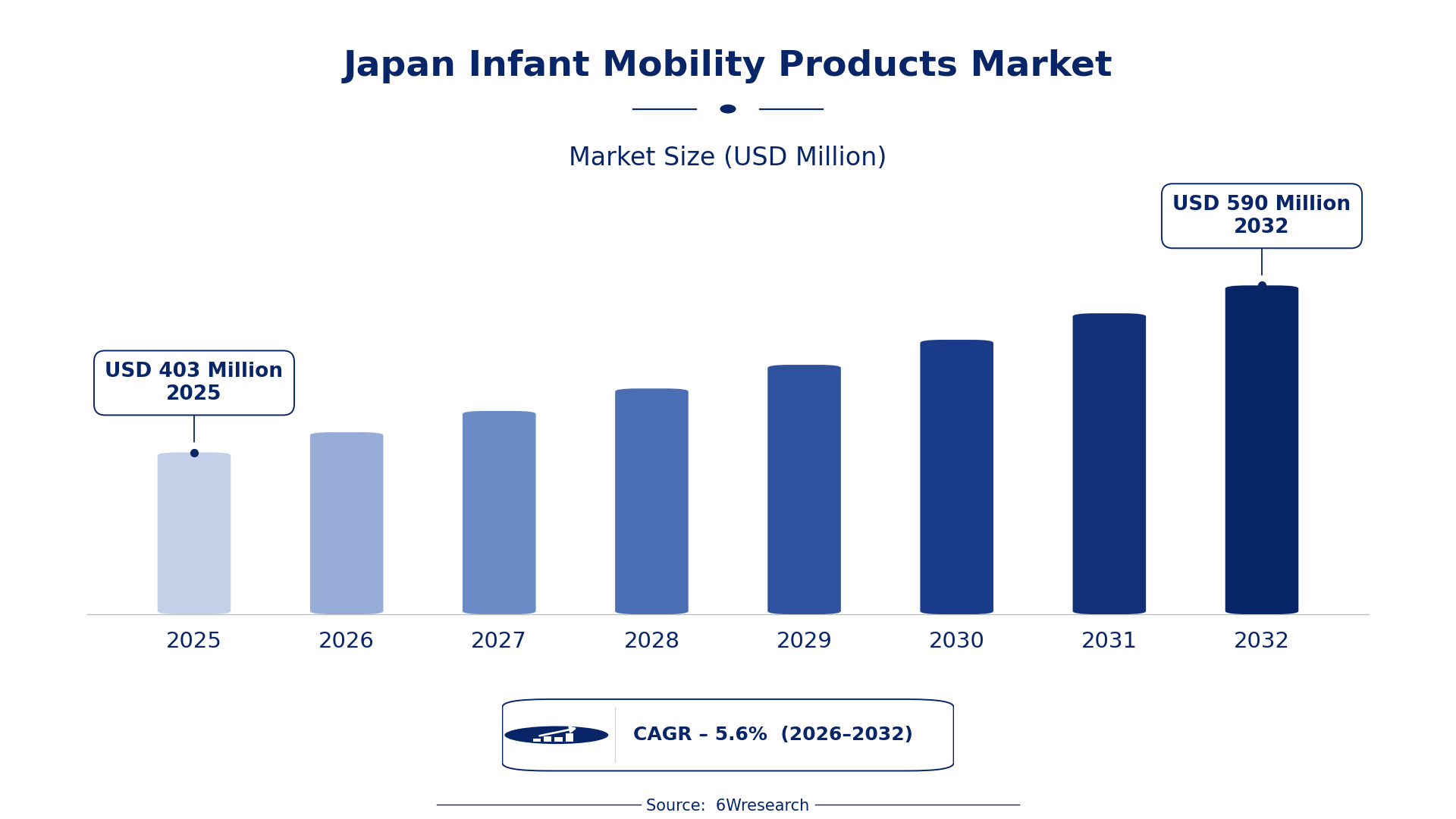
According to 6Wresearch internal database and industry insights, the Japan Infant Mobility Products Market was valued at USD 403 Million in 2025 and is projected to reach USD 590 Million by 2032, growing at a CAGR of approximately 5.6% during 2026–2032.
Japan Infant Mobility Products Market Highlights
| Report Metric | Details |
| Report Name | Japan Infant Mobility Products Market (2026-2032) |
| Market Size 2025 | USD 403 Million |
| Market Size 2032 | USD 590 Million |
| Absolute Growth 2025–2032 | USD 187 Million |
| CAGR 2026–2032 | 5.6% |
| Peak Annual Growth | 6.6% in 2029 |
| Forecast Period | 2026–2032 |
| Historical Data | 2022–2025 |
| Base Year | 2025 |
| Leading Infant Mobility Products, 2025 | Strollers (50% share) |
| Leading Product Type, 2025 | Convertible (34% share) |
| Leading Mechanism Type, 2025 | Push & Recline (46% share) |
| Leading Sales Channel, 2025 | Specialty Stores (45% share) |
| Leading End User, 2025 | New Parents (53% share) |
| Fastest-Growing Infant Mobility Products | Carriers (7.9% CAGR) |
| Fastest-Growing Product Type | Sling/Wrap (8.0% CAGR) |
| Fastest-Growing Sales Channel | Online Retailers (7.3% CAGR) |
| Fastest-Growing End User | Infant Travelers (7.4% CAGR) |
| Growing Sector | Infant Travelers |
| Key End Users | New Parents, Urban Households, Middle-Class Families, Infant Travelers |
Japan Infant Mobility Products Market Year-wise Growth Rate and Key Drivers (2022–2032)
This graph illustrates the annual growth rates of the market from 2022 to 2032, highlighting a steady upward trajectory and projected market expansion over the forecast period.
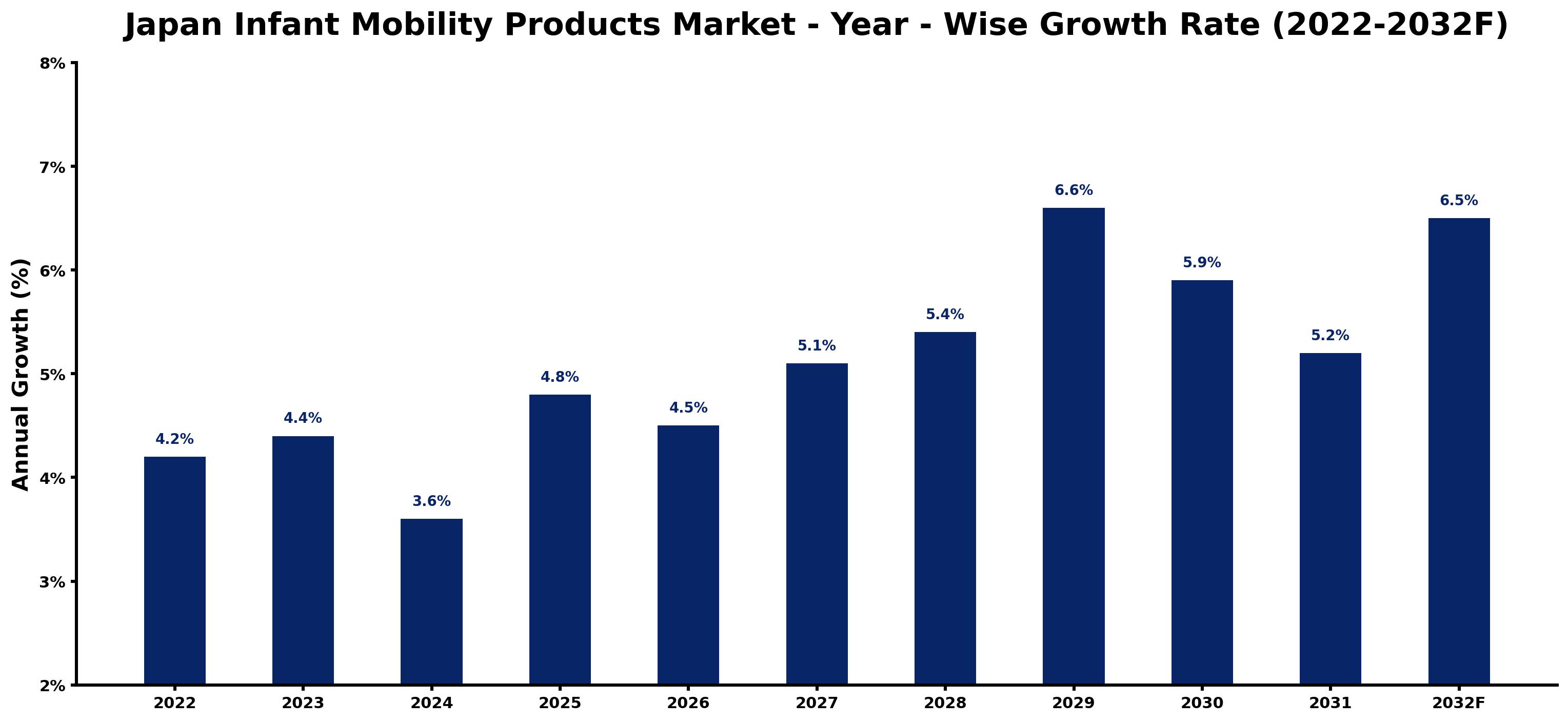
Year by year, the estimates below pair each growth rate with the development that shaped it.
| Year | Estimated Annual Growth (%) | Market Rationale |
| 2022 | 4.2 | The market recorded steady growth due to a large number of new parents in urban areas. |
| 2023 | 4.4 | Growth accelerated as urban households increasingly sought convenient mobility solutions for infants. |
| 2024 | 3.6 | Growth slowed slightly, reflecting market adjustments to evolving consumer preferences and demands. |
| 2025 | 4.8 | The market experienced a peak in growth, driven by rising demand for enhanced safety features in products. |
| 2026 | 4.5 | Growth is expected to moderate as consumers become more selective regarding product features and pricing. |
| 2027 | 5.1 | Demand is projected to increase as new parents prioritise multifunctional mobility products for added convenience. |
| 2028 | 5.4 | Growth is anticipated to continue as urbanisation leads to higher sales of compact mobility solutions for families. |
| 2029 | 6.6 | The market is expected to peak with heightened interest in advanced safety technologies for infants and toddlers. |
| 2030 | 5.9 | Growth is projected to slow as market saturation begins to impact new product introductions and consumer choices. |
| 2031 | 5.2 | Demand will remain strong but growth is expected to decelerate as competition intensifies in the sector. |
| 2032 | 6.5 | The market is expected to grow as technological advancements enhance product offerings and safety standards. |
Note: Market size estimations and growth projections presented in this report are based on 6Wresearch's proprietary forecasting methodology, utilizing the latest available industry data, government publications, and primary research inputs.
Japan Infant Mobility Products Market Synopsis
Infant mobility products include strollers, carriers, and car seats designed for safe infant transport in various environments. In 2022, Japan had approximately 800,000 registered newborns, driving demand for these products. Key factors include rising online retail sales, which increased by 15% year-on-year, and government initiatives promoting child safety regulations, particularly in urban areas.
Market Dynamics Impact Analysis (2026–2032)
| Factor | Type | Impact | Primary Segment Affected |
| Rising urban population | Driver | High | Strollers |
| Increased safety awareness among parents | Driver | High | Baby Car Seats |
| Growing demand for eco-friendly products | Opportunity | Medium | Carriers |
| Expansion of online retail channels | Opportunity | High | Online Retailers |
| High competition among brands | Restraint | Medium | Strollers |
| Regulatory compliance costs for manufacturers | Restraint | High | Strollers |
| High production costs for quality materials | Challenge | High | Strollers |
| Limited availability of innovative designs | Challenge | Medium | Carriers |
Evaluation of Drivers in Japan Infant Mobility Products Market (2026–2032)
The table below links each growth driver to the segment it affects and the evidence for it.
| Drivers | Primary Segment Affected | Why It Matters (Evidence) |
| Urban population growth | Strollers | The expanding urban population in the Tokyo metropolitan area drives demand for strollers, with sales increasing as parents seek convenient transport solutions for their infants. |
| Mandatory car seat regulations | Baby Car Seats | The Japanese government's enforcement of mandatory car seat use has led to increased purchases, as parents comply with safety regulations for their vehicles. |
| Rising online retail sales | Carriers | The 15% year-on-year growth in online retail sales facilitates easier access to carriers, prompting parents to purchase these convenient mobility solutions. |
| Popularity of multifunctional products | Convertible | The demand for convertible car seats is rising due to their long-term usability, appealing to parents seeking versatile options for different stages of their child's growth. |
| Safety awareness campaigns | Prams | Government campaigns promoting safe infant transport practices have heightened awareness, leading to increased demand for prams in urban areas. |
Orders keep climbing as the urban population expands, particularly in the Tokyo metropolitan area, where stroller sales thrive. In 2022, the number of registered newborns was approximately 800,000, prompting parents to seek safe transport solutions. The push for mandatory car seat use has further stimulated demand, with baby car seats becoming essential purchases. The increasing popularity of multifunctional carriers, such as sling carriers, meets the needs of parents looking for convenience and bonding opportunities. Additionally, the rise in online retail sales has made it easier for parents to access these products conveniently.
Evaluation of Restraints in Japan Infant Mobility Products Market
The table below lists the restraints and the evidence behind each.
| Market Restraint | Primary Segment Affected | Why It Matters (Evidence) |
| Skills gap in product development | Strollers | The average age of first-time parents is around 30 years, limiting the availability of young talent needed for innovation in product development. |
| Supply chain delays from compliance | Baby Car Seats | Stringent safety compliance regulations can delay product market entry by six months, complicating supply chain management for importers. |
| Higher production costs | Carriers | Producers hesitant to adopt new manufacturing technologies face production costs that can be 20% higher than competitors using modern techniques. |
| Frequent regulatory updates | Strollers | Regulatory changes necessitate regular updates to safety standards, increasing operational costs for suppliers who must adapt their offerings. |
| Limited selection in supermarkets | Prams | Supermarkets offer a limited selection of infant mobility products, restricting choices for consumers compared to specialty stores. |
Japan Infant Mobility Products Market Challenges
Producers struggle with a skills gap, as the average age of first-time parents in Japan is around 30 years, limiting the availability of young talent needed for product development. Importers face supply chain delays due to stringent safety compliance regulations, which can extend the time to market for new products by six months. Many producers are hesitant to adopt new manufacturing technologies, resulting in production costs that can be 20% higher than competitors using modern techniques. Regulatory changes require frequent updates to safety standards, placing a burden on suppliers to adapt their offerings, which can increase operational costs significantly.
Trends in the Japan Infant Mobility Products Market
The following changes are redrawing the Japan Infant Mobility Products Market.
- Shift to Eco-Friendly Mobility Solutions: In 2023, baby product chains expanded their offerings to include eco-friendly infant mobility products. Approximately 20% of new parents now prefer sustainable options, reflecting a growing environmental consciousness.
- Rise of Online Retail Channels: Since 2022, online retail has transformed the purchasing experience for infant mobility products. Online sales have surged by 15% year-on-year, indicating a shift towards convenience for busy parents.
- Increased Focus on Safety Features: The 2023 campaign by the Ministry of Health, Labour and Welfare highlighted the importance of safety in infant transport. This initiative has led to a 25% increase in the adoption of safety-compliant products.
- Growth of Multifunctional Products: The trend towards multifunctional carriers began in 2022, with sling carriers gaining popularity among new parents. This segment is projected to grow at a CAGR of 8.0%, driven by demand for convenience.
Investment Opportunities in the Japan Infant Mobility Products Market
The following areas offer the clearest openings for investors and suppliers in the Japan Infant Mobility Products Market.
- Partnership with local retailers: With online retail sales projected to increase by 15%, partnering with local retailers can enhance distribution. Specialty stores in urban areas are ideal for introducing new infant mobility products.
- Targeting urban households: The growing population of new parents in urban areas presents a significant opportunity, with approximately 800,000 registered newborns in 2022. Focusing on innovative products can cater to this demographic's needs.
- Investment in eco-friendly solutions: With rising consumer awareness, investing in eco-friendly infant mobility products can capture market share. Baby product chains are expanding their offerings to include sustainable options, appealing to environmentally conscious parents.
- Certification for safety standards: Obtaining certification for compliance with JIS standards can open doors to new markets. The Japan Toy Association oversees these standards, ensuring products meet safety requirements.
Government Initiatives in the Japan Infant Mobility Products Market
The Digital Agency, established in September 2021, enhances government digital transformation and sets common system standards. This agency's initiatives support the development of digital platforms for infant mobility products, improving accessibility for consumers.
The Consumer Affairs Agency administers the Act against Unjustifiable Premiums and Misleading Representations, ensuring that infant mobility products are accurately represented. This regulation protects buyers from misleading claims, fostering trust in product safety and quality.
Future Insight of the Japan Infant Mobility Products Market
By 2032, advancements in technology will reshape demand for infant mobility products, with features like built-in safety sensors becoming standard. Government initiatives will drive consumer awareness and expectations for product safety, compelling suppliers to innovate consistently. Subsidies for eco-friendly solutions will promote sustainable options among families. Online sales are projected to increase by 15%, as digital platforms become the primary purchasing method for infant mobility items.
Market Segmentation Analysis
Japan Infant Mobility Products Market report covers a detailed analysis of the following market segments:
By Infant Mobility Products – Strollers Lead, Carriers Expected to Grow Fastest
According to Saurav Kr Singh, Senior Research Analyst at 6Wresearch, Strollers held 50% of the Japan Infant Mobility Products Market by infant mobility products in 2025. Strollers dominate the market because they are crucial for safely transporting infants, especially in urban areas like Tokyo. The approximately 800,000 registered newborns in Japan in 2022 highlights the strong demand for these essential products. Over 2026–2032, Carriers are expected to post the fastest growth, at a CAGR of 7.9%. Carriers are rapidly gaining popularity as new parents prefer hands-free options that promote bonding and ease of use. The increasing trend towards sling carriers showcases a shift in consumer preference towards products that facilitate parent-infant interaction. Suppliers should focus on enhancing the convenience and safety features of their products to align with the preferences of modern parents.
By Product Type – Convertible Leads, Sling/Wrap Expected to Grow Fastest
In 2025, Convertible led the product type split with a 34% share. Convertible products lead the segment as they provide versatility for different stages of an infant's growth, appealing to cost-conscious parents. Their long-term usability aligns with the needs of families looking for durable solutions. Sling/Wrap is set to record the highest CAGR in this split, 8.0% over 2026–2032. Sling and wrap carriers are gaining traction due to their popularity among parents who value close bonding with their infants. This trend indicates a shift towards more intimate and practical mobility solutions. Manufacturers should consider expanding their offerings to include more versatile and bonding-focused products.
By Mechanism Type – Push & Recline Leads and Records the Fastest Growth
With 46% of mechanism type revenue in 2025, Push & Recline was the largest category. Push and recline mechanisms are preferred as they provide comfort for infants during travel, making them a top choice among parents. This feature is particularly valued in densely populated urban areas where travel can be frequent. Its lead should widen, with a projected CAGR of 8.2% during 2026–2032, the highest in this split. The push and recline mechanism's ability to cater to both comfort and ease of use ensures its continued growth in the market. As consumer preferences evolve, this mechanism's adaptability will likely maintain its lead. Suppliers should prioritise innovation in push and recline mechanisms to meet evolving consumer expectations.
By Sales Channel – Specialty Stores Lead, Online Retailers Expected to Grow Fastest
Specialty Stores took 45% of sales channel revenue in 2025, more than any other category. Specialty stores are the leading sales channel since they offer a curated selection of quality infant mobility products, appealing to safety-conscious parents. Their expertise and focus on customer service resonate well with Japanese consumers seeking reliable options. Online Retailers are projected to grow fastest, at a CAGR of 7.3% during 2026–2032. Online retailers are rapidly expanding as they provide convenience and accessibility, particularly for busy parents. The 15% year-on-year growth in online sales indicates a significant shift in consumer purchasing behaviour. Retailers must enhance their online presence to effectively meet the growing demand for convenient shopping experiences.
By End User – New Parents Lead, Infant Travelers Expected to Grow Fastest
New Parents accounted for 53% of the market by end user in 2025. New parents represent the largest user segment, driven by the increasing number of newborns and their specific needs for mobility solutions. Their focus on safety and comfort directly influences product preferences in the market. Over 2026–2032, Infant Travelers are expected to post the fastest growth, at a CAGR of 7.4%. Infant travelers are a growing user group, as families increasingly seek mobility solutions for outings and travel. This trend points to a rising demand for products that cater to active lifestyles. Suppliers should tailor their marketing strategies to address the unique needs of both new parents and infant travelers.
Key Attractiveness of the Report
- 10 Years of Market Numbers
- Historical Data Starting from 2022 to 2025
- Base Year 2025
- Forecast Data until 2032
- Key Performance Indicators Impacting the Market
- Major Upcoming Developments and Projects
Key Highlights of the Report:
- Japan Infant Mobility Products Market Outlook
- Market Size of Japan Infant Mobility Products Market, 2025
- Forecast of Japan Infant Mobility Products Market, 2032
- Historical Data and Forecast of Japan Infant Mobility Products Revenues & Volume for the Period 2022-2032F
- Japan Infant Mobility Products Market Trend Evolution
- Japan Infant Mobility Products Market Drivers and Challenges
- Japan Infant Mobility Products Price Trends
- Japan Infant Mobility Products Porter's Five Forces
- Japan Infant Mobility Products Industry Life Cycle
- Historical Data and Forecast of Japan Infant Mobility Products Market Revenues & Volume By Infant Mobility Products for the Period 2022-2032F
- Historical Data and Forecast of Japan Infant Mobility Products Market Revenues & Volume By Strollers for the Period 2022-2032F
- Historical Data and Forecast of Japan Infant Mobility Products Market Revenues & Volume By Prams for the Period 2022-2032F
- Historical Data and Forecast of Japan Infant Mobility Products Market Revenues & Volume By Carriers for the Period 2022-2032F
- Historical Data and Forecast of Japan Infant Mobility Products Market Revenues & Volume By Baby Car Seats for the Period 2022-2032F
- Historical Data and Forecast of Japan Infant Mobility Products Market Revenues & Volume By Product Type for the Period 2022-2032F
- Historical Data and Forecast of Japan Infant Mobility Products Market Revenues & Volume By Lightweight for the Period 2022-2032F
- Historical Data and Forecast of Japan Infant Mobility Products Market Revenues & Volume By Convertible for the Period 2022-2032F
- Historical Data and Forecast of Japan Infant Mobility Products Market Revenues & Volume By Sling/Wrap for the Period 2022-2032F
- Historical Data and Forecast of Japan Infant Mobility Products Market Revenues & Volume By Rear-facing for the Period 2022-2032F
- Historical Data and Forecast of Japan Infant Mobility Products Market Revenues & Volume By Mechanism Type for the Period 2022-2032F
- Historical Data and Forecast of Japan Infant Mobility Products Market Revenues & Volume By Manual Push for the Period 2022-2032F
- Historical Data and Forecast of Japan Infant Mobility Products Market Revenues & Volume By Push & Recline for the Period 2022-2032F
- Historical Data and Forecast of Japan Infant Mobility Products Market Revenues & Volume By Manual for the Period 2022-2032F
- Historical Data and Forecast of Japan Infant Mobility Products Market Revenues & Volume By Lock Mechanism for the Period 2022-2032F
- Historical Data and Forecast of Japan Infant Mobility Products Market Revenues & Volume By Sales Channel for the Period 2022-2032F
- Historical Data and Forecast of Japan Infant Mobility Products Market Revenues & Volume By Specialty Stores for the Period 2022-2032F
- Historical Data and Forecast of Japan Infant Mobility Products Market Revenues & Volume By Online Retailers for the Period 2022-2032F
- Historical Data and Forecast of Japan Infant Mobility Products Market Revenues & Volume By Supermarkets for the Period 2022-2032F
- Historical Data and Forecast of Japan Infant Mobility Products Market Revenues & Volume By Baby Product Chains for the Period 2022-2032F
- Historical Data and Forecast of Japan Infant Mobility Products Market Revenues & Volume By End User for the Period 2022-2032F
- Historical Data and Forecast of Japan Infant Mobility Products Market Revenues & Volume By Urban Households for the Period 2022-2032F
- Historical Data and Forecast of Japan Infant Mobility Products Market Revenues & Volume By Middle-Class Families for the Period 2022-2032F
- Historical Data and Forecast of Japan Infant Mobility Products Market Revenues & Volume By New Parents for the Period 2022-2032F
- Historical Data and Forecast of Japan Infant Mobility Products Market Revenues & Volume By Infant Travelers for the Period 2022-2032F
- Japan Infant Mobility Products Import Export Trade Statistics
- Market Opportunity Assessment By Infant Mobility Products
- Market Opportunity Assessment By Product Type
- Market Opportunity Assessment By Mechanism Type
- Market Opportunity Assessment By Sales Channel
- Market Opportunity Assessment By End User
- Japan Infant Mobility Products Top Companies Market Share
- Japan Infant Mobility Products Competitive Benchmarking By Technical and Operational Parameters
- Japan Infant Mobility Products Company Profiles
- Japan Infant Mobility Products Key Strategic Recommendations
Market Covered
This report examines the market across the segments below.
By Infant Mobility Products
- Strollers
- Prams
- Carriers
- Baby Car Seats
By Product Type
- Lightweight
- Convertible
- Sling/Wrap
- Rear-facing
By Mechanism Type
- Manual Push
- Push & Recline
- Manual
- Lock Mechanism
By Sales Channel
- Specialty Stores
- Online Retailers
- Supermarkets
- Baby Product Chains
By End User
- Urban Households
- Middle-Class Families
- New Parents
- Infant Travelers































