Japan Infant Nutraceuticals Market Size & Growth Rate
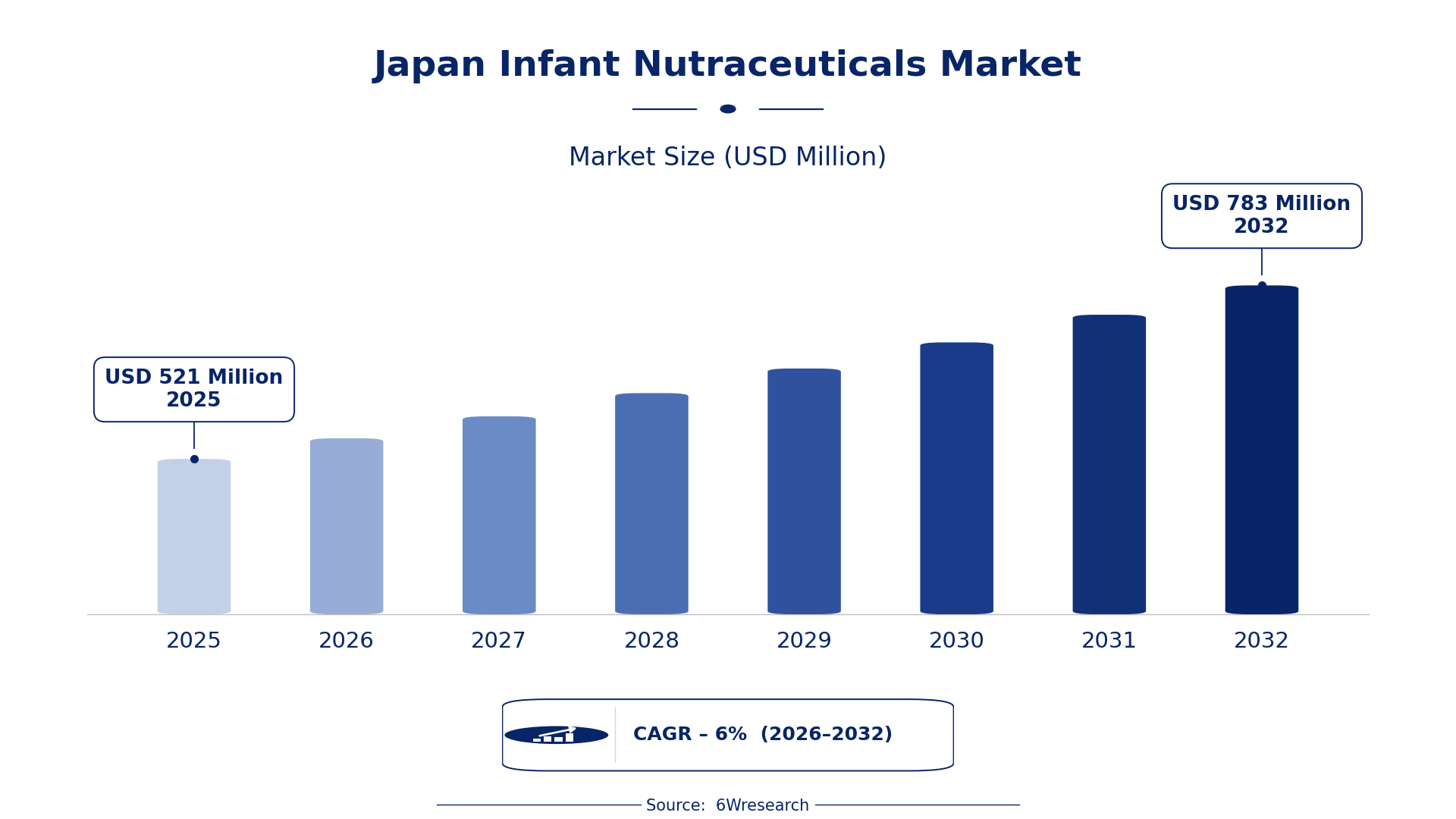
According to 6Wresearch internal database and industry insights, the Japan Infant Nutraceuticals Market was valued at USD 521 Million in 2025 and is projected to reach USD 783 Million by 2032, growing at a CAGR of approximately 6% during 2026–2032.
Japan Infant Nutraceuticals Market Highlights
| Report Metric | Details |
| Report Name | Japan Infant Nutraceuticals Market (2026-2032) |
| Market Size 2025 | USD 521 Million |
| Market Size 2032 | USD 783 Million |
| Absolute Growth 2025–2032 | USD 262 Million |
| CAGR 2026–2032 | 6% |
| Peak Annual Growth | 6.7% in 2028 |
| Forecast Period | 2026–2032 |
| Historical Data | 2022–2025 |
| Base Year | 2025 |
| Leading Infant Nutraceuticals, 2025 | DHA Supplements (37% share) |
| Leading Product Type, 2025 | Omega Fatty Acids (47% share) |
| Leading Ingredient Type, 2025 | Bifidobacteria (43% share) |
| Leading Delivery Format, 2025 | Liquid Dropper (51% share) |
| Leading Sales Channel, 2025 | Pediatric Clinics (43% share) |
| Fastest-Growing Infant Nutraceuticals | Probiotic Formulas (7.9% CAGR) |
| Fastest-Growing Product Type | Probiotic Strains (8.5% CAGR) |
| Fastest-Growing Delivery Format | Oral Drop (8.2% CAGR) |
| Fastest-Growing Sales Channel | Online Retailers (7.7% CAGR) |
| Growing Sector | Infant health and nutrition |
| Key End Users | Parents, pediatric healthcare providers, pharmacies |
Japan Infant Nutraceuticals Market Year-wise Growth Rate and Key Drivers (2022–2032)
This graph illustrates the annual growth rates of the market from 2022 to 2032, highlighting a steady upward trajectory and projected market expansion over the forecast period.
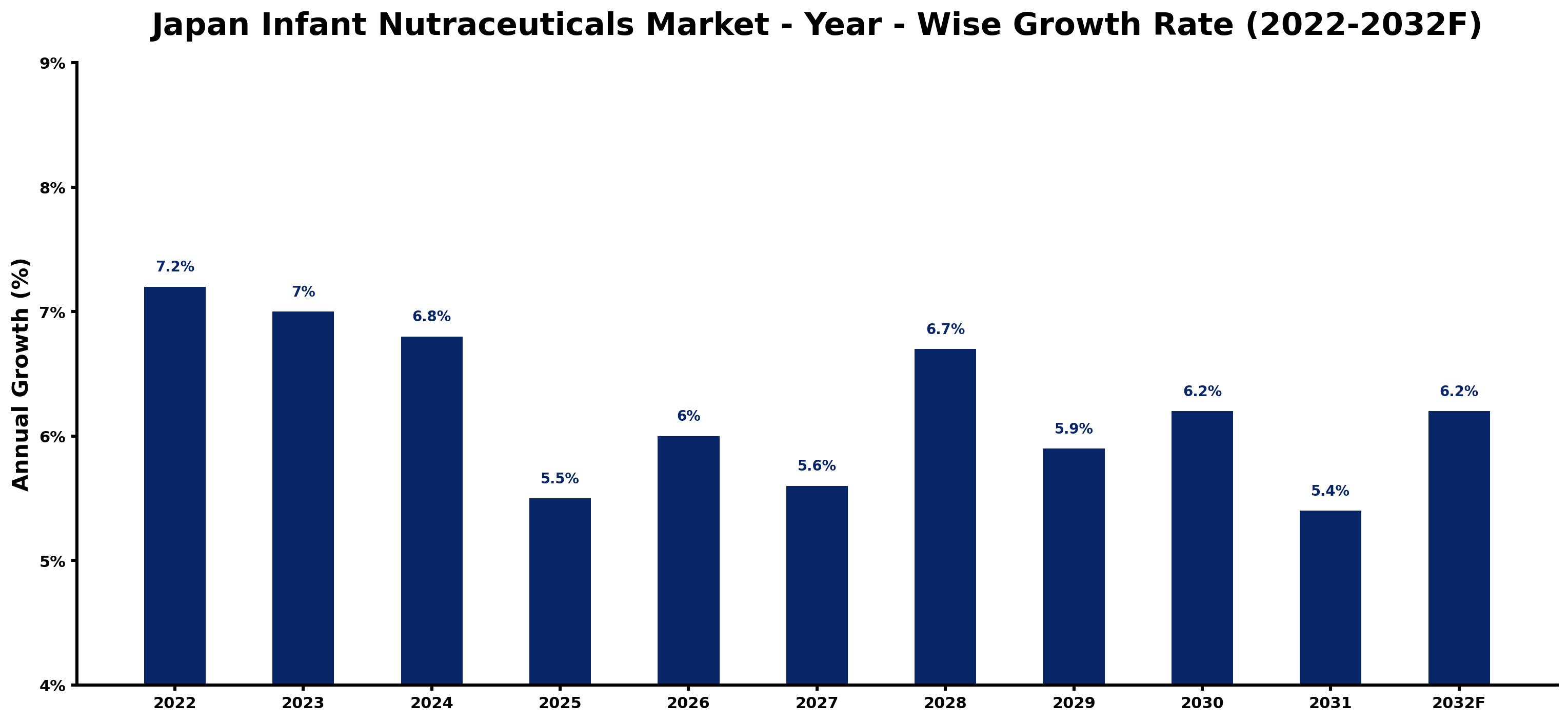
Each row of the following table gives one year's estimated growth and the event or demand shift that explains it.
| Year | Estimated Annual Growth (%) | Market Rationale |
| 2022 | 7.2 | The market experienced strong demand due to high birth rates and health awareness among parents. |
| 2023 | 7.0 | Growth slowed slightly as the market adjusted to increased competition and consumer preferences. |
| 2024 | 6.8 | The market continued to grow, driven by consistent recommendations from pediatricians for nutraceuticals. |
| 2025 | 5.5 | Demand stabilised as parents became more selective about infant health products. |
| 2026 | 6.0 | Growth is expected to accelerate as new product launches and health initiatives gain traction among consumers. |
| 2027 | 5.6 | The market will see a slight slowdown as some products face saturation in the pediatric segment. |
| 2028 | 6.7 | Demand is projected to surge again, driven by new product formulations and health campaigns. |
| 2029 | 5.9 | Growth is anticipated to slow as consumer preferences shift towards more natural ingredients and transparency. |
| 2030 | 6.2 | The market is expected to rebound with a renewed focus on cognitive development products for infants. |
| 2031 | 5.4 | Growth will decelerate as competition intensifies among existing brands and new entrants. |
| 2032 | 6.2 | The market is projected to grow steadily as health trends continue to influence purchasing decisions. |
Note: Market size estimations and growth projections presented in this report are based on 6Wresearch's proprietary forecasting methodology, utilizing the latest available industry data, government publications, and primary research inputs.
Japan Infant Nutraceuticals Market Synopsis
Infant nutraceuticals are dietary supplements designed to support the health and development of infants, made from natural ingredients such as vitamins, minerals, and probiotics. The Japan Infant Nutraceuticals Market is experiencing growth due to rising awareness among parents and strong recommendations from pediatric healthcare providers. Over 60% of parents report using DHA supplements, while 75% of pediatricians endorse probiotic formulas. A government initiative launched in 2023 aims to improve infant health through better nutrition, further driving demand for these products.
Market Dynamics Impact Analysis (2026–2032)
| Factor | Type | Impact | Primary Segment Affected |
| Increasing awareness of infant health benefits from nutraceuticals | Driver | High | DHA Supplements |
| Rising recommendations from pediatricians for specific formulations | Driver | High | Probiotic Formulas |
| Emerging demand for natural and organic ingredients in products | Opportunity | Medium | Vitamin Drops |
| Growing online retail channels for easy access to products | Opportunity | Medium | Online Retailers |
| High competition leading to price wars among brands | Restraint | High | Mineral Powders |
| Consumer skepticism regarding product efficacy and safety | Restraint | Medium | Omega Fatty Acids |
| Rising costs of raw materials affecting pricing strategies | Challenge | High | Probiotic Formulas |
| Regulatory hurdles in product approvals delaying market entry | Challenge | Medium | Vitamin Drops |
Evaluation of Drivers in Japan Infant Nutraceuticals Market (2026–2032)
The factors lifting demand, and the evidence behind each, are summarised below.
| Drivers | Primary Segment Affected | Why It Matters (Evidence) |
| High birth rates increasing demand for infant products | DHA Supplements | Japan's birth rate was approximately 840,000 in 2022, prompting higher purchases of infant nutraceuticals. |
| Pediatric recommendations for specific health benefits | Probiotic Formulas | 75% of pediatricians in Japan recommend probiotic formulas, driving sales among health-conscious parents. |
| Growing health consciousness among parents | Vitamin Drops | Parents are becoming more aware of the importance of vitamins, resulting in higher sales of vitamin drops. |
| Advancements in product formulation | Mineral Powders | New developments in mineral powders improve bioavailability, attracting more parents to these products. |
| Expansion of online retail channels | Online Retailers | The convenience of online shopping is increasing access to infant nutraceuticals, boosting overall sales. |
What keeps demand rising is the high birth rate in Japan, which was approximately 840,000 in 2022, prompting increased purchases of infant nutraceuticals. Pediatricians recommend specific health benefits, which drives sales among health-conscious parents. Growing health consciousness among parents fuels demand for vitamin drops, as they seek to ensure their infants receive essential nutrients. New developments in product formulation improve the bioavailability of mineral powders, making them more appealing. The expansion of online retail channels provides convenient access to a variety of infant nutraceuticals, contributing to overall market growth.
Evaluation of Restraints in Japan Infant Nutraceuticals Market
The following restraints limit how fast demand can grow.
| Market Restraint | Primary Segment Affected | Why It Matters (Evidence) |
| Intense competition resulting in price wars | Mineral Powders | High competition among brands has resulted in aggressive pricing strategies, impacting profit margins. |
| Skepticism regarding product efficacy and safety | Omega Fatty Acids | Consumer doubts about the effectiveness of omega fatty acids may hinder purchasing decisions. |
| Rising costs of raw materials | Probiotic Formulas | Increased raw material costs are affecting pricing strategies, making products less affordable for some parents. |
| Regulatory hurdles in product approvals | Vitamin Drops | Strict regulations can delay the introduction of new vitamin products, limiting market growth. |
| Limited awareness of certain nutraceutical benefits | DHA Supplements | Some parents may not fully understand the benefits of DHA supplements, which can affect sales. |
Japan Infant Nutraceuticals Market Challenges
Parents often struggle with the stringent regulations governing infant nutraceuticals, which can delay product launches by up to six months. In Japan, the Ministry of Health, Labour and Welfare imposes strict guidelines that complicate the approval process for producers, frustrating buyers who need timely access to vital supplements. Many manufacturers lack the technological skills to leverage modern formulation techniques, leading to a gap; 75% of pediatricians endorse specific probiotic strains that some producers fail to include. Workforce shortages in specialised roles hinder innovation, causing delays in product development and limiting options for parents seeking effective solutions.
Trends in the Japan Infant Nutraceuticals Market
Four trends stand out in the Japan Infant Nutraceuticals Market.
- Shift towards Natural Ingredients: Since 2023, there has been a notable shift towards natural ingredients in infant nutraceuticals. Parents are prioritising products that contain organic components, reflecting a broader health trend. This shift is illustrated by the rising popularity of DHA supplements made from algae-based oils.
- Increasing Online Sales Channels: The growing trend of online shopping has impacted how parents purchase infant nutraceuticals. In 2023, online retailers accounted for a substantial share of sales, making it easier for parents to access a variety of products conveniently.
- Rise of Probiotic Formulations: Beginning in 2023, probiotic formulations have gained prominence among parents seeking to improve their infants' digestive health. This trend is supported by endorsements from pediatricians, with 75% recommending these products for their benefits.
- Growth of Pediatric Clinics as Key Sales Channels: In 2023, pediatric clinics emerged as primary sales channels for infant nutraceuticals, capturing a significant share of the market. With a 43% share in 2025, these clinics play a vital role in guiding parents' purchasing decisions.
Investment Opportunities in the Japan Infant Nutraceuticals Market
The following opportunities in the Japan Infant Nutraceuticals Market pair current demand with a clear way in.
- Timing for Natural Ingredient Products: With increasing consumer demand for natural ingredients, now is the ideal time to invest in organic infant nutraceuticals. The Tokyo region, with its high concentration of pediatric clinics, represents a prime market for these products.
- Supply of Probiotic Formulations: The growing endorsement of probiotics by pediatricians creates a strong opportunity for suppliers to focus on these formulations. The average price of probiotic products is around 1,500 JPY, making it a promising segment for investment.
- Expansion of Online Retail Presence: With over 90% of pharmacies stocking infant nutraceuticals, there is a gap in online sales channels. Investing in e-commerce platforms can help capture this growing market segment.
- Partnerships with Pediatric Clinics: Establishing partnerships with pediatric clinics can facilitate product introductions and recommendations. This strategy can enhance brand visibility and credibility among parents seeking trusted infant nutraceuticals.
Government Initiatives in the Japan Infant Nutraceuticals Market
The Economic Security Promotion Act, enacted in 2022, supports supply-chain resilience for critical products, including infant nutraceuticals. This measure adds to the existing framework established by the PRTR Law, which mandates businesses to report chemical substances, ensuring safety and compliance in product offerings. The act aims to improve the availability of safe and effective nutraceuticals for infants, boosting consumer confidence.
The Ministry of Health, Labour and Welfare oversees the implementation of infant health initiatives, funding programs that promote nutritional education for parents. This agency also approves clinical trials for new nutraceutical products, ensuring they meet safety and efficacy standards, thus facilitating timely access to essential supplements for families.
Future Insight of the Japan Infant Nutraceuticals Market
Clinics will increasingly adopt advanced infant nutraceuticals by 2032, driven by heightened health consciousness among parents. The integration of ISO 22000 standards will improve safety and quality, benefiting both buyers and suppliers. Government initiatives focused on enhancing infant nutrition will prompt healthcare providers to broaden their nutraceutical offerings. As the average age of first-time parents rises to 31 years, there will be a greater emphasis on scientifically validated products, leading to increased demand for formulations that promote cognitive and digestive health.
Market Segmentation Analysis
Japan Infant Nutraceuticals Market report covers a detailed analysis of the following market segments:
By Infant Nutraceuticals – DHA Supplements Lead, Probiotic Formulas Expected to Grow Fastest
According to Saurav Kr Singh, Senior Research Analyst at 6Wresearch, with 37% of infant nutraceuticals revenue in 2025, DHA Supplements was the largest category. DHA supplements are widely used by parents in Japan, particularly for their role in brain development in infants. With over 60% of parents reporting their use, this sub-segment has established a strong foothold in the market. The quickest growth will come from Probiotic Formulas, forecast to expand at a CAGR of 7.9% between 2026 and 2032. Probiotic formulas are gaining traction due to their endorsement by 75% of pediatricians in Japan, highlighting their importance in supporting digestive health. This recommendation is likely to drive increased adoption among parents seeking optimal nutrition for their infants. Suppliers should focus on promoting the benefits of probiotic formulas to capitalise on the growing demand.
By Product Type – Omega Fatty Acids Lead, Probiotic Strains Expected to Grow Fastest
Omega Fatty Acids accounted for 47% of the market by product type in 2025. Omega fatty acids are recognised for their critical role in supporting cognitive function, making them a preferred choice among parents. Their established reputation in the market contributes to their leading position in the product type segment. Probiotic Strains are set to record the highest CAGR in this split, 8.5% over 2026–2032. Probiotic strains are rapidly gaining popularity as more parents become aware of their benefits in promoting gut health. This increasing awareness is expected to accelerate their growth in the market. Buyers should consider prioritising products containing probiotic strains to meet the evolving preferences of health-conscious parents.
By Ingredient Type – Bifidobacteria Leads and Records the Fastest Growth
In 2025, Bifidobacteria led the ingredient type split with a 43% share. Bifidobacteria is a key ingredient in probiotic formulas, which are recommended by 75% of pediatricians in Japan. This widespread endorsement highlights its importance in supporting infant health, solidifying its position as the leading ingredient type. The same category is also set to grow fastest, at a CAGR of 8.8% during 2026–2032. The increasing awareness of Bifidobacteria's benefits for immune and digestive health is propelling its growth in the market. As more parents seek these advantages for their infants, demand for products containing this ingredient is expected to rise. Suppliers must ensure a consistent supply of bifidobacteria to meet the growing needs of manufacturers.
By Delivery Format – Liquid Dropper Leads, Oral Drop Expected to Grow Fastest
Liquid Dropper held 51% of the Japan Infant Nutraceuticals Market by delivery format in 2025. Liquid droppers are the most common delivery format for infant nutraceuticals, providing ease of administration for parents. Their popularity stems from the convenience they offer, making them the preferred choice for caregivers in Japan. Over 2026–2032, Oral Drop is expected to post the fastest growth, at a CAGR of 8.2%. Oral drops are gaining popularity due to their practicality and ease of use, appealing to parents who want efficient ways to give supplements to their infants. This trend is likely to drive significant growth in this delivery format. Manufacturers should focus on developing oral drop formats to align with the rising consumer demand for convenient delivery options.
By Sales Channel – Pediatric Clinics Lead, Online Retailers Expected to Grow Fastest
The largest sales channel category in 2025 was Pediatric Clinics, at 43% of revenue. Pediatric clinics serve as the primary source for prescriptions of infant nutraceuticals, fostering trust with parents seeking professional guidance. Their essential role in healthcare solidifies their leading position in the sales channel. The quickest growth will come from Online Retailers, forecast to expand at a CAGR of 7.7% between 2026 and 2032. Online retailers are quickly becoming a preferred sales channel, catering to parents' desire for convenient purchasing options. This shift towards e-commerce is expected to accelerate their growth in the market. Suppliers should enhance their online strategies to take advantage of the increasing trend towards e-commerce in the infant nutraceuticals sector.
Key Attractiveness of the Report
- 10 Years of Market Numbers
- Historical Data Starting from 2022 to 2025
- Base Year 2025
- Forecast Data until 2032
- Key Performance Indicators Impacting the Market
- Major Upcoming Developments and Projects
Key Highlights of the Report:
- Japan Infant Nutraceuticals Market Outlook
- Market Size of Japan Infant Nutraceuticals Market, 2025
- Forecast of Japan Infant Nutraceuticals Market, 2032
- Historical Data and Forecast of Japan Infant Nutraceuticals Revenues & Volume for the Period 2022-2032F
- Japan Infant Nutraceuticals Market Trend Evolution
- Japan Infant Nutraceuticals Market Drivers and Challenges
- Japan Infant Nutraceuticals Price Trends
- Japan Infant Nutraceuticals Porter's Five Forces
- Japan Infant Nutraceuticals Industry Life Cycle
- Historical Data and Forecast of Japan Infant Nutraceuticals Market Revenues & Volume By Infant Nutraceuticals for the Period 2022-2032F
- Historical Data and Forecast of Japan Infant Nutraceuticals Market Revenues & Volume By DHA Supplements for the Period 2022-2032F
- Historical Data and Forecast of Japan Infant Nutraceuticals Market Revenues & Volume By Probiotic Formulas for the Period 2022-2032F
- Historical Data and Forecast of Japan Infant Nutraceuticals Market Revenues & Volume By Vitamin Drops for the Period 2022-2032F
- Historical Data and Forecast of Japan Infant Nutraceuticals Market Revenues & Volume By Mineral Powders for the Period 2022-2032F
- Historical Data and Forecast of Japan Infant Nutraceuticals Market Revenues & Volume By Product Type for the Period 2022-2032F
- Historical Data and Forecast of Japan Infant Nutraceuticals Market Revenues & Volume By Omega Fatty Acids for the Period 2022-2032F
- Historical Data and Forecast of Japan Infant Nutraceuticals Market Revenues & Volume By Probiotic Strains for the Period 2022-2032F
- Historical Data and Forecast of Japan Infant Nutraceuticals Market Revenues & Volume By Multivitamins for the Period 2022-2032F
- Historical Data and Forecast of Japan Infant Nutraceuticals Market Revenues & Volume By Iron, Zinc for the Period 2022-2032F
- Historical Data and Forecast of Japan Infant Nutraceuticals Market Revenues & Volume By Ingredient Type for the Period 2022-2032F
- Historical Data and Forecast of Japan Infant Nutraceuticals Market Revenues & Volume By Algae-Based Oil for the Period 2022-2032F
- Historical Data and Forecast of Japan Infant Nutraceuticals Market Revenues & Volume By Bifidobacteria for the Period 2022-2032F
- Historical Data and Forecast of Japan Infant Nutraceuticals Market Revenues & Volume By Organic Extracts for the Period 2022-2032F
- Historical Data and Forecast of Japan Infant Nutraceuticals Market Revenues & Volume By Natural Minerals for the Period 2022-2032F
- Historical Data and Forecast of Japan Infant Nutraceuticals Market Revenues & Volume By Delivery Format for the Period 2022-2032F
- Historical Data and Forecast of Japan Infant Nutraceuticals Market Revenues & Volume By Liquid Dropper for the Period 2022-2032F
- Historical Data and Forecast of Japan Infant Nutraceuticals Market Revenues & Volume By Sachets for the Period 2022-2032F
- Historical Data and Forecast of Japan Infant Nutraceuticals Market Revenues & Volume By Oral Drop for the Period 2022-2032F
- Historical Data and Forecast of Japan Infant Nutraceuticals Market Revenues & Volume By Powder Sachet for the Period 2022-2032F
- Historical Data and Forecast of Japan Infant Nutraceuticals Market Revenues & Volume By Sales Channel for the Period 2022-2032F
- Historical Data and Forecast of Japan Infant Nutraceuticals Market Revenues & Volume By Pharmacies for the Period 2022-2032F
- Historical Data and Forecast of Japan Infant Nutraceuticals Market Revenues & Volume By Pediatric Clinics for the Period 2022-2032F
- Historical Data and Forecast of Japan Infant Nutraceuticals Market Revenues & Volume By Online Retailers for the Period 2022-2032F
- Historical Data and Forecast of Japan Infant Nutraceuticals Market Revenues & Volume By Grocery Chains for the Period 2022-2032F
- Japan Infant Nutraceuticals Import Export Trade Statistics
- Market Opportunity Assessment By Infant Nutraceuticals
- Market Opportunity Assessment By Product Type
- Market Opportunity Assessment By Ingredient Type
- Market Opportunity Assessment By Delivery Format
- Market Opportunity Assessment By Sales Channel
- Japan Infant Nutraceuticals Top Companies Market Share
- Japan Infant Nutraceuticals Competitive Benchmarking By Technical and Operational Parameters
- Japan Infant Nutraceuticals Company Profiles
- Japan Infant Nutraceuticals Key Strategic Recommendations
Market Covered
The study includes the following segmentation.
By Infant Nutraceuticals
- DHA Supplements
- Probiotic Formulas
- Vitamin Drops
- Mineral Powders
By Product Type
- Omega Fatty Acids
- Probiotic Strains
- Multivitamins
- Iron
- Zinc
By Ingredient Type
- Algae-Based Oil
- Bifidobacteria
- Organic Extracts
- Natural Minerals
By Delivery Format
- Liquid Dropper
- Sachets
- Oral Drop
- Powder Sachet
By Sales Channel
- Pharmacies
- Pediatric Clinics
- Online Retailers
- Grocery Chains































