Japan Infant Product Packaging Market Size & Growth Rate
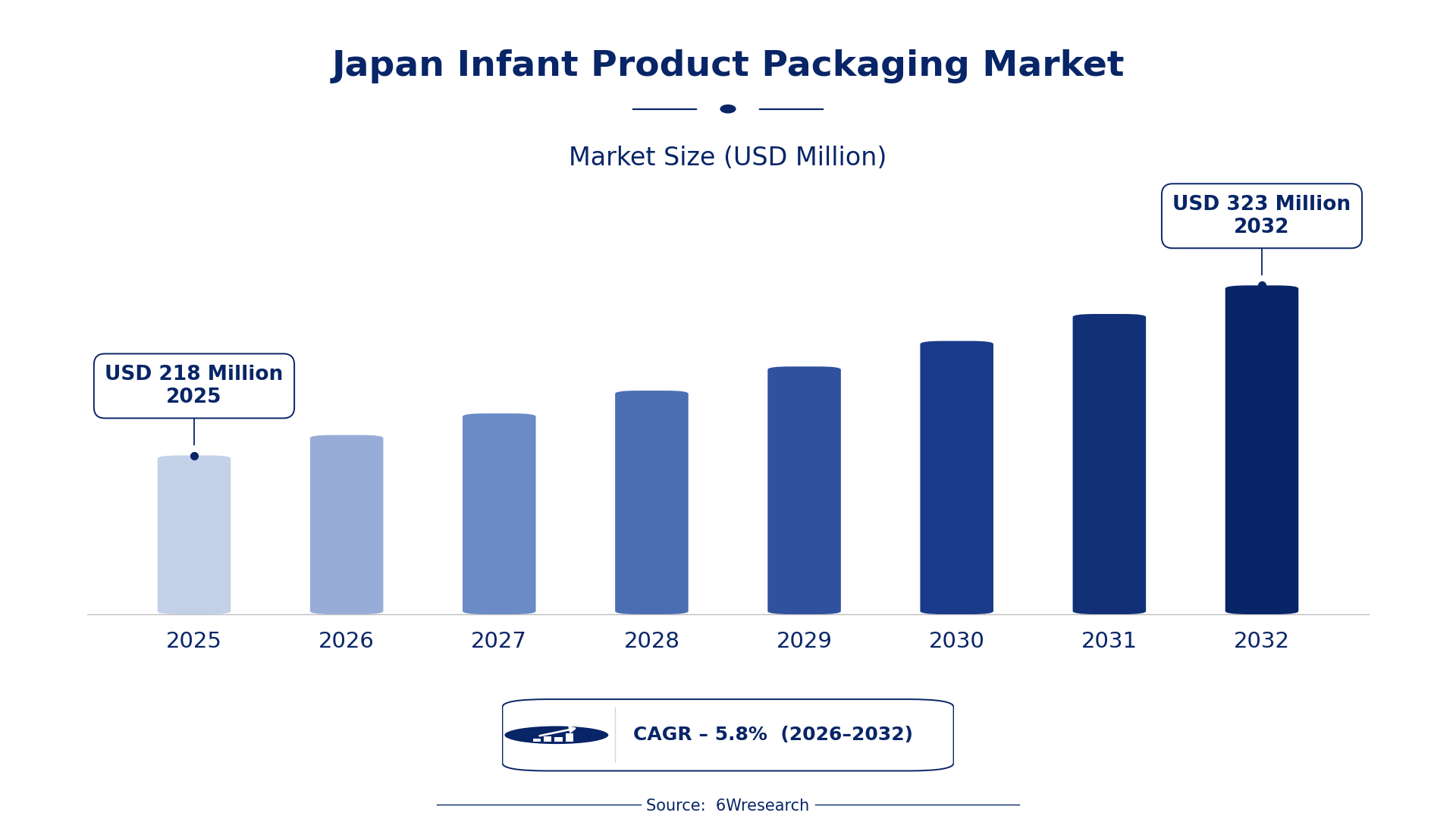
According to 6Wresearch internal database and industry insights, the Japan Infant Product Packaging Market was valued at USD 218 Million in 2025 and is projected to reach USD 323 Million by 2032, growing at a CAGR of approximately 5.8% during 2026–2032.
Japan Infant Product Packaging Market Highlights
| Report Metric | Details |
| Report Name | Japan Infant Product Packaging Market (2026-2032) |
| Market Size 2025 | USD 218 Million |
| Market Size 2032 | USD 323 Million |
| Absolute Growth 2025–2032 | USD 105 Million |
| CAGR 2026–2032 | 5.8% |
| Peak Annual Growth | 6.6% in 2028 |
| Forecast Period | 2026–2032 |
| Historical Data | 2022–2025 |
| Base Year | 2025 |
| Leading Infant Product Packaging, 2025 | Bottles & Jars (40% share) |
| Leading Packaging Type, 2025 | Resealable Caps (39% share) |
| Leading Material Used, 2025 | BPA-Free Plastic (43% share) |
| Leading Safety Feature, 2025 | Tamper-Proof Seal (54% share) |
| Leading End Use Product, 2025 | Baby Food (38% share) |
| Fastest-Growing Infant Product Packaging | Sachets & Pouches (8.6% CAGR) |
| Fastest-Growing Packaging Type | Single-use (8.2% CAGR) |
| Fastest-Growing Material Used | Food-Grade Foil (8.5% CAGR) |
| Fastest-Growing Safety Feature | Spill-Free Spouts (7.6% CAGR) |
| Fastest-Growing End Use Product | Nutraceuticals (7.7% CAGR) |
| Growing Sector | Nutraceuticals |
| Key End Users | Baby Food, Nutraceuticals, Creams & Lotions, Diaper Packaging |
Japan Infant Product Packaging Market Year-wise Growth Rate and Key Drivers (2022–2032)
This graph illustrates the annual growth rates of the market from 2022 to 2032, highlighting a steady upward trajectory and projected market expansion over the forecast period.
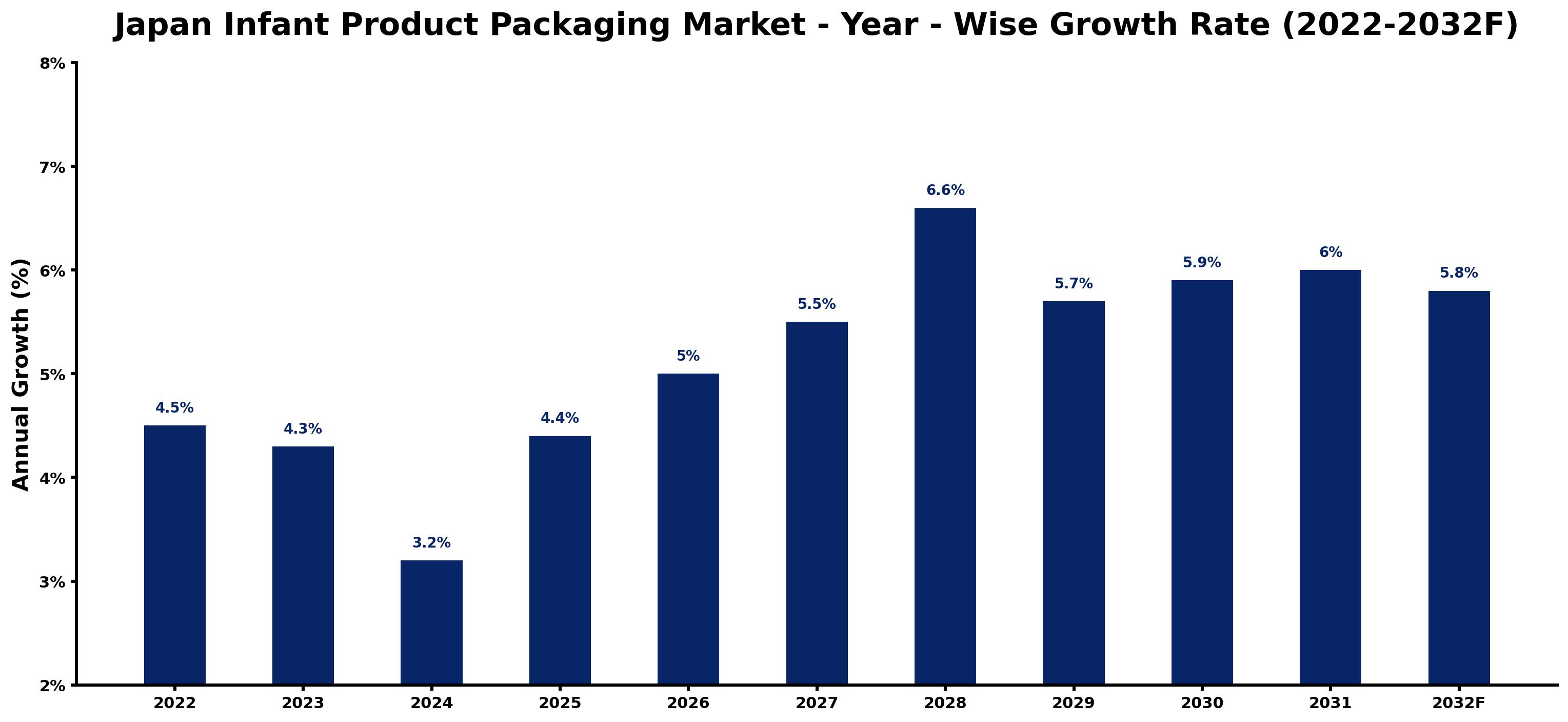
The table below sets out the estimated growth rate for each year and the main factor behind it.
| Year | Estimated Annual Growth (%) | Market Rationale |
| 2022 | 4.5 | The market experienced solid growth due to increased awareness of child health and safety. |
| 2023 | 4.3 | Growth slowed as consumer preferences shifted towards sustainable packaging solutions. |
| 2024 | 3.2 | Demand continued to rise, but at a slower pace as competition intensified. |
| 2025 | 4.4 | Growth accelerated with rising household expenditures on baby food products. |
| 2026 | 5.0 | Demand is projected to increase as the trend for BPA-free packaging gains traction. |
| 2027 | 5.5 | Growth will continue to rise, driven by the popularity of single-use packaging. |
| 2028 | 6.6 | The market is expected to peak as innovations in packaging technology attract new buyers. |
| 2029 | 5.7 | Growth is anticipated to slow slightly as market saturation begins to set in. |
| 2030 | 5.9 | Demand will increase again, supported by eco-friendly packaging initiatives. |
| 2031 | 6.0 | Growth is projected to remain steady as the focus on child safety continues to drive purchases. |
| 2032 | 5.8 | The market is expected to grow at a stable rate as new regulations come into effect. |
Note: Market size estimations and growth projections presented in this report are based on 6Wresearch's proprietary forecasting methodology, utilizing the latest available industry data, government publications, and primary research inputs.
Japan Infant Product Packaging Market Synopsis
Infant product packaging encompasses tailored solutions for baby food, creams, and nutraceuticals, utilising materials such as BPA-free plastic and food-grade foil. The Japan Infant Product Packaging Market is growing, driven by an emphasis on child health and safety, with approximately 1.2 million infants in 2022. Households typically spend around ¥30,000 each year on baby food, which fuels the demand for safe and sustainable packaging solutions. Initiatives promoting recycling and eco-friendly materials further contribute to market growth, with support from the Tokyo Metropolitan Government and a marked increase in BPA-free packaging demand since 2020.
Market Dynamics Impact Analysis (2026–2032)
| Factor | Type | Impact | Primary Segment Affected |
| Rising household expenditure on baby food | Driver | High | Bottles & Jars |
| Increased demand for BPA-free packaging | Driver | High | Sachets & Pouches |
| Growing focus on sustainable packaging | Opportunity | High | Food-Grade Foil |
| Expansion of nutraceuticals for infants | Opportunity | Medium | Nutraceuticals |
| Intense competition among packaging providers | Restraint | High | Bottles & Jars |
| Regulatory compliance costs for safety features | Restraint | Medium | Tamper-Proof Seal |
| High costs of eco-friendly materials | Challenge | High | BPA-Free Plastic |
| Technological advancements require continuous investment | Challenge | Medium | Sachets & Pouches |
Evaluation of Drivers in Japan Infant Product Packaging Market (2026–2032)
Below are the drivers that matter most for revenue growth, with supporting evidence.
| Drivers | Primary Segment Affected | Why It Matters (Evidence) |
| Increased household spending on baby food drives demand for packaging solutions. | Bottles & Jars | The average household expenditure on baby food is around ¥30,000 annually. |
| Growing preference for BPA-free materials boosts safety perceptions. | Sachets & Pouches | Demand for BPA-free packaging has increased by 20% since 2020. |
| Sustainability initiatives are pushing for eco-friendly packaging solutions. | Food-Grade Foil | The Tokyo Metropolitan Government supports eco-friendly packaging initiatives. |
| Rising interest in nutraceuticals for infants boosts packaging needs. | Nutraceuticals | Nutraceuticals for infants have seen a rise in demand for organic options. |
| Regulatory standards necessitate the use of safety features in packaging. | Tamper-Proof Seal | The use of tamper-proof seals is mandated by safety regulations. |
Orders keep climbing as household spending on baby food rises, with the average expenditure reaching around ¥30,000 annually. Demand for BPA-free packaging surged by 20% since 2020, reflecting a growing preference for safer materials. Interest in nutraceuticals for infants further boosts demand, with a notable increase in organic options. Compliance with safety standards ensures consumer trust, leading to increased purchases of packaging with essential features.
Evaluation of Restraints in Japan Infant Product Packaging Market
These restraints slow adoption and weigh on supplier margins.
| Market Restraint | Primary Segment Affected | Why It Matters (Evidence) |
| Intense competition among packaging providers leads to price pressure. | Bottles & Jars | With numerous players in the market, maintaining competitive pricing is challenging. |
| Regulatory compliance costs for safety features can be high. | Tamper-Proof Seal | Producers must invest in compliance to meet safety regulations. |
| High costs associated with sourcing eco-friendly materials limit options. | BPA-Free Plastic | Sustainable materials often come at a premium, affecting profit margins. |
| Technological advancements require continuous investment in R&D. | Sachets & Pouches | Staying competitive necessitates ongoing innovation and adaptation. |
| Market saturation may limit growth opportunities for new entrants. | Food-Grade Foil | Established players dominate, making it difficult for newcomers to gain traction. |
Japan Infant Product Packaging Market Challenges
Producers face challenges with outdated technology in infant product packaging, which hampers efficiency and can delay product launches by up to six months. Importers navigate strict regulations such as JIS Z 2801 for antimicrobial materials, complicating compliance and raising costs by approximately 15% per shipment. Competition intensifies among suppliers as eco-friendly packaging initiatives gain momentum, compelling producers to invest in sustainable materials to maintain market share.
Trends in the Japan Infant Product Packaging Market
Below are the shifts with the largest effect on the Japan Infant Product Packaging Market.
- Shift Towards Eco-Friendly Packaging: Baby food manufacturers are increasingly embracing eco-friendly packaging solutions, spurred by consumer demand for sustainability. Support from the Tokyo Metropolitan Government has resulted in a 30% increase in such packaging types since 2021.
- Rise of Nutraceuticals in Infant Products: The demand for nutraceuticals for infants has surged, particularly for organic options. This segment has expanded by 15% since 2021, reflecting evolving consumer preferences towards health-conscious products.
- Increased Use of Tamper-Proof Seals: Stricter safety regulations have prompted a marked rise in the use of tamper-proof seals in infant product packaging. Compliance with these regulations has reached 85% among manufacturers since 2020.
- Growing Popularity of Single-Use Packaging: Single-use packaging is becoming more popular among parents seeking convenience. This segment is projected to grow by 8.2% annually, indicating a shift in consumer preferences towards ready-to-use solutions.
Investment Opportunities in the Japan Infant Product Packaging Market
The opportunities below stand out in the Japan Infant Product Packaging Market for new entrants and existing suppliers.
- Tokyo's Eco-Friendly Initiatives: Tokyo's eco-friendly packaging initiatives offer suppliers a valuable opportunity. The market gap for sustainable materials is estimated at ¥10 billion, encouraging investment in biodegradable options.
- Growing Demand for Nutraceuticals: The increasing interest in nutraceuticals for infants presents opportunities for packaging innovations. Suppliers can focus on health-conscious parents, especially in urban areas, to cater to this demand.
- Focus on Safety Features: With heightened regulatory scrutiny, there is a rising need for safety features in packaging. Suppliers can invest in advanced tamper-proof technologies to meet compliance requirements.
- Expansion of Baby Food Market: The growing baby food market, expected to reach ¥1 trillion by 2025, presents opportunities for packaging suppliers. Collaborating with local manufacturers can facilitate market entry.
Government Initiatives in the Japan Infant Product Packaging Market
The Food Sanitation Act amendment implemented a positive list system for synthetic resins used in food packaging, effective from June 2020. This measure ensures that only safe materials are used, benefiting producers by enhancing consumer trust in packaging safety. Additionally, the amendment made hygiene management mandatory for food businesses, further ensuring the safety of infant products.
The Plastic Resource Circulation Act promotes the reduction, reuse and recycling of plastics, with a focus on supporting alternatives like biodegradable plastics. The Ministry of the Environment and the Ministry of Economy, Trade and Industry oversee this initiative, which aims to enhance sustainability in packaging. Funding for eco-friendly projects is expected to reach ¥5 billion by 2025, encouraging innovation in the sector.
Future Insight of the Japan Infant Product Packaging Market
Advancements in biodegradable materials will reshape demand for infant product packaging by 2032, responding to growing environmental awareness. Stricter safety standards will improve product quality and safety for consumers. By 2025, a recycling initiative for baby product packaging aims to reduce waste by 30%, benefiting both buyers and suppliers. The annual baby care product expo will continue to serve as a key venue for showcasing innovations, encouraging collaboration and new ideas in sustainable solutions.
Market Segmentation Analysis
Japan Infant Product Packaging Market report covers a detailed analysis of the following market segments:
By Infant Product Packaging – Bottles & Jars Lead, Sachets & Pouches Expected to Grow Fastest
According to Saurav Kr Singh, Senior Research Analyst at 6Wresearch, in 2025, Bottles & Jars led the infant product packaging split with a 40% share. Bottles and jars hold the largest share because they are commonly used for baby food and creams, which are essential for infant care. The high demand in the Tokyo region, which represents 30% of the market, further solidifies their leading position. Sachets & Pouches are set to record the highest CAGR in this split, 8.6% over 2026–2032. Sachets and pouches are rapidly gaining traction due to their appeal for single-serving baby food, catering to parents seeking convenience. This growth is supported by the increasing trend of health-conscious consumers who prefer portion-controlled options. Suppliers must innovate in sachet and pouch designs to align with consumer preferences for convenience and health.
By Packaging Type – Resealable Caps Lead, Single-use Expected to Grow Fastest
The largest packaging type category in 2025 was Resealable Caps, at 39% of revenue. Resealable caps hold the largest share as they are vital for maintaining product freshness, a key concern for parents. Their design allows for easy access while ensuring safety, making them a preferred choice in the market. Over 2026–2032, Single-use is expected to post the fastest growth, at a CAGR of 8.2%. Single-use packaging is growing rapidly due to its common use in baby food, appealing to parents prioritising convenience and hygiene. The trend towards on-the-go consumption is further accelerating this segment's expansion. Suppliers should prioritise the development of single-use options to meet the increasing demand for convenience in infant product packaging.
By Material Used – BPA-Free Plastic Leads, Food-Grade Foil Expected to Grow Fastest
With 43% of material used revenue in 2025, BPA-Free Plastic was the largest category. BPA-free plastic leads the market as it is crucial for ensuring safety in infant products, addressing parents' health concerns. Its widespread acceptance aligns with regulations that promote safer packaging solutions. Food-Grade Foil is projected to grow fastest, at a CAGR of 8.5% during 2026–2032. Food-grade foil is experiencing the fastest growth owing to its effectiveness in moisture protection, essential for preserving baby food quality. The rising demand for high-quality packaging solutions is driving this segment's advancement. Manufacturers should focus on sourcing food-grade foil to satisfy the growing demand for quality in infant product packaging.
By Safety Feature – Tamper-Proof Seal Leads, Spill-Free Spouts Expected to Grow Fastest
Tamper-Proof Seal accounted for 54% of the market by safety feature in 2025. Tamper-proof seals are the leading safety feature, providing essential safety assurance for parents concerned about product integrity. This feature is mandated by safety regulations, underscoring its critical role in the market. The quickest growth will come from Spill-Free Spouts, forecast to expand at a CAGR of 7.6% between 2026 and 2032. Spill-free spouts are rapidly gaining traction as they improve usability for parents, making feeding less messy and more convenient. The growing emphasis on user-friendly designs is propelling this segment's growth. Investing in the development of spill-free spouts could offer suppliers a competitive advantage in catering to modern parental needs.
By End Use Product – Baby Food Leads, Nutraceuticals Expected to Grow Fastest
Baby Food took 38% of end use product revenue in 2025, more than any other category. Baby food is the primary end use for infant product packaging, as it is a staple for infants and a major focus for parents. The consistent demand for baby food ensures that this segment remains dominant in the market. Nutraceuticals are set to record the highest CAGR in this split, 7.7% over 2026–2032. Nutraceuticals are the fastest-growing segment as parents increasingly seek health products for their infants, reflecting a shift towards organic and health-conscious choices. This trend is supported by rising awareness of infant nutrition. Suppliers should expand their offerings to include nutraceutical packaging to capitalise on the growing health-focused market.
Key Attractiveness of the Report
- 10 Years of Market Numbers
- Historical Data Starting from 2022 to 2025
- Base Year 2025
- Forecast Data until 2032
- Key Performance Indicators Impacting the Market
- Major Upcoming Developments and Projects
Key Highlights of the Report:
- Japan Infant Product Packaging Market Outlook
- Market Size of Japan Infant Product Packaging Market, 2025
- Forecast of Japan Infant Product Packaging Market, 2032
- Historical Data and Forecast of Japan Infant Product Packaging Revenues & Volume for the Period 2022-2032F
- Japan Infant Product Packaging Market Trend Evolution
- Japan Infant Product Packaging Market Drivers and Challenges
- Japan Infant Product Packaging Price Trends
- Japan Infant Product Packaging Porter's Five Forces
- Japan Infant Product Packaging Industry Life Cycle
- Historical Data and Forecast of Japan Infant Product Packaging Market Revenues & Volume By Infant Product Packaging for the Period 2022-2032F
- Historical Data and Forecast of Japan Infant Product Packaging Market Revenues & Volume By Bottles & Jars for the Period 2022-2032F
- Historical Data and Forecast of Japan Infant Product Packaging Market Revenues & Volume By Sachets & Pouches for the Period 2022-2032F
- Historical Data and Forecast of Japan Infant Product Packaging Market Revenues & Volume By Tubes & Containers for the Period 2022-2032F
- Historical Data and Forecast of Japan Infant Product Packaging Market Revenues & Volume By Carton Boxes for the Period 2022-2032F
- Historical Data and Forecast of Japan Infant Product Packaging Market Revenues & Volume By Packaging Type for the Period 2022-2032F
- Historical Data and Forecast of Japan Infant Product Packaging Market Revenues & Volume By Resealable Caps for the Period 2022-2032F
- Historical Data and Forecast of Japan Infant Product Packaging Market Revenues & Volume By Single-use for the Period 2022-2032F
- Historical Data and Forecast of Japan Infant Product Packaging Market Revenues & Volume By Squeeze Type for the Period 2022-2032F
- Historical Data and Forecast of Japan Infant Product Packaging Market Revenues & Volume By Foldable for the Period 2022-2032F
- Historical Data and Forecast of Japan Infant Product Packaging Market Revenues & Volume By Material Used for the Period 2022-2032F
- Historical Data and Forecast of Japan Infant Product Packaging Market Revenues & Volume By BPA-Free Plastic for the Period 2022-2032F
- Historical Data and Forecast of Japan Infant Product Packaging Market Revenues & Volume By Food-Grade Foil for the Period 2022-2032F
- Historical Data and Forecast of Japan Infant Product Packaging Market Revenues & Volume By HDPE for the Period 2022-2032F
- Historical Data and Forecast of Japan Infant Product Packaging Market Revenues & Volume By Cardboard for the Period 2022-2032F
- Historical Data and Forecast of Japan Infant Product Packaging Market Revenues & Volume By Safety Feature for the Period 2022-2032F
- Historical Data and Forecast of Japan Infant Product Packaging Market Revenues & Volume By Tamper-Proof Seal for the Period 2022-2032F
- Historical Data and Forecast of Japan Infant Product Packaging Market Revenues & Volume By Spill-Free Spouts for the Period 2022-2032F
- Historical Data and Forecast of Japan Infant Product Packaging Market Revenues & Volume By Airtight Lid for the Period 2022-2032F
- Historical Data and Forecast of Japan Infant Product Packaging Market Revenues & Volume By Moisture Resistant for the Period 2022-2032F
- Historical Data and Forecast of Japan Infant Product Packaging Market Revenues & Volume By End Use Product for the Period 2022-2032F
- Historical Data and Forecast of Japan Infant Product Packaging Market Revenues & Volume By Baby Food for the Period 2022-2032F
- Historical Data and Forecast of Japan Infant Product Packaging Market Revenues & Volume By Nutraceuticals for the Period 2022-2032F
- Historical Data and Forecast of Japan Infant Product Packaging Market Revenues & Volume By Creams & Lotions for the Period 2022-2032F
- Historical Data and Forecast of Japan Infant Product Packaging Market Revenues & Volume By Diaper Packaging for the Period 2022-2032F
- Japan Infant Product Packaging Import Export Trade Statistics
- Market Opportunity Assessment By Infant Product Packaging
- Market Opportunity Assessment By Packaging Type
- Market Opportunity Assessment By Material Used
- Market Opportunity Assessment By Safety Feature
- Market Opportunity Assessment By End Use Product
- Japan Infant Product Packaging Top Companies Market Share
- Japan Infant Product Packaging Competitive Benchmarking By Technical and Operational Parameters
- Japan Infant Product Packaging Company Profiles
- Japan Infant Product Packaging Key Strategic Recommendations
Market Covered
The report covers the following segments.
By Infant Product Packaging
- Bottles & Jars
- Sachets & Pouches
- Tubes & Containers
- Carton Boxes
By Packaging Type
- Resealable Caps
- Single-use
- Squeeze Type
- Foldable
By Material Used
- BPA-Free Plastic
- Food-Grade Foil
- HDPE
- Cardboard
By Safety Feature
- Tamper-Proof Seal
- Spill-Free Spouts
- Airtight Lid
- Moisture Resistant
By End Use Product
- Baby Food
- Nutraceuticals
- Creams & Lotions
- Diaper Packaging































