Japan Infant Respiratory Treatment Market Size & Growth Rate
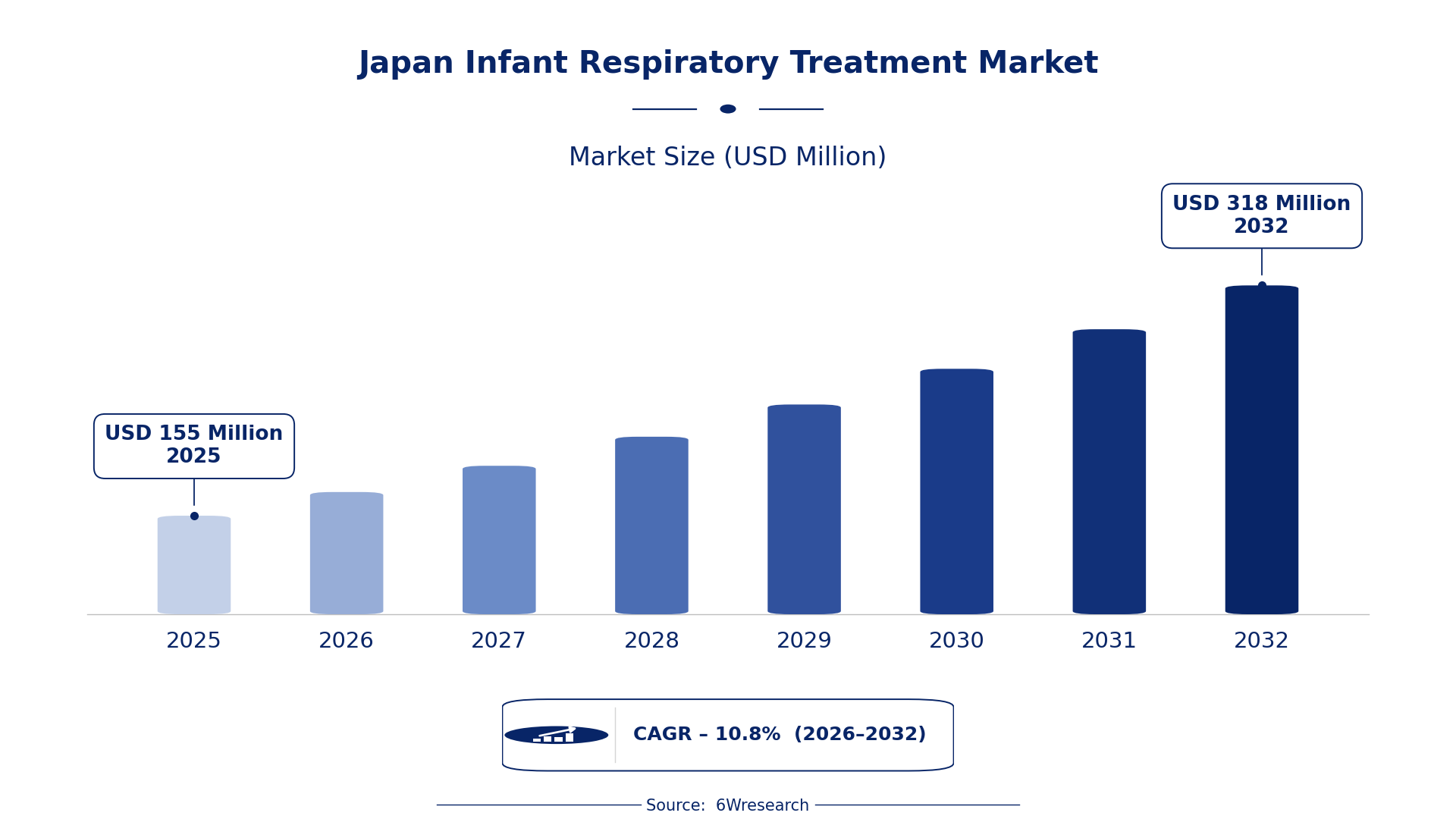
According to 6Wresearch internal database and industry insights, the Japan Infant Respiratory Treatment Market was valued at USD 155 Million in 2025 and is projected to reach USD 318 Million by 2032, growing at a CAGR of approximately 10.8% during 2026–2032.
Japan Infant Respiratory Treatment Market Highlights
| Report Metric | Details |
| Report Name | Japan Infant Respiratory Treatment Market (2026-2032) |
| Market Size 2025 | USD 155 Million |
| Market Size 2032 | USD 318 Million |
| Absolute Growth 2025–2032 | USD 163 Million |
| CAGR 2026–2032 | 10.8% |
| Peak Annual Growth | 12.5% in 2026 |
| Forecast Period | 2026–2032 |
| Historical Data | 2022–2025 |
| Base Year | 2025 |
| Leading Infant Respiratory Treatment, 2025 | Nebulization Therapy (41% share) |
| Leading Treatment Type, 2025 | Saline/Bronchodilators (38% share) |
| Leading Delivery Method, 2025 | Ultrasonic Nebulizer (43% share) |
| Leading Device Used, 2025 | Homecare Kits (40% share) |
| Leading Application Area, 2025 | Asthma/Cold Management (43% share) |
| Fastest-Growing Infant Respiratory Treatment | Inhalers (13.5% CAGR) |
| Fastest-Growing Delivery Method | Vaporizers (15.0% CAGR) |
| Fastest-Growing Device Used | Portable Humidifiers (13.9% CAGR) |
| Fastest-Growing Application Area | Dry Cough Relief (12.7% CAGR) |
| Growing Sector | Pediatric Healthcare |
| Key End Users | Hospitals, Pediatric Care Facilities, Pharmacies, Parents |
Japan Infant Respiratory Treatment Market Year-wise Growth Rate and Key Drivers (2022–2032)
This graph illustrates the annual growth rates of the market from 2022 to 2032, highlighting a steady upward trajectory and projected market expansion over the forecast period.
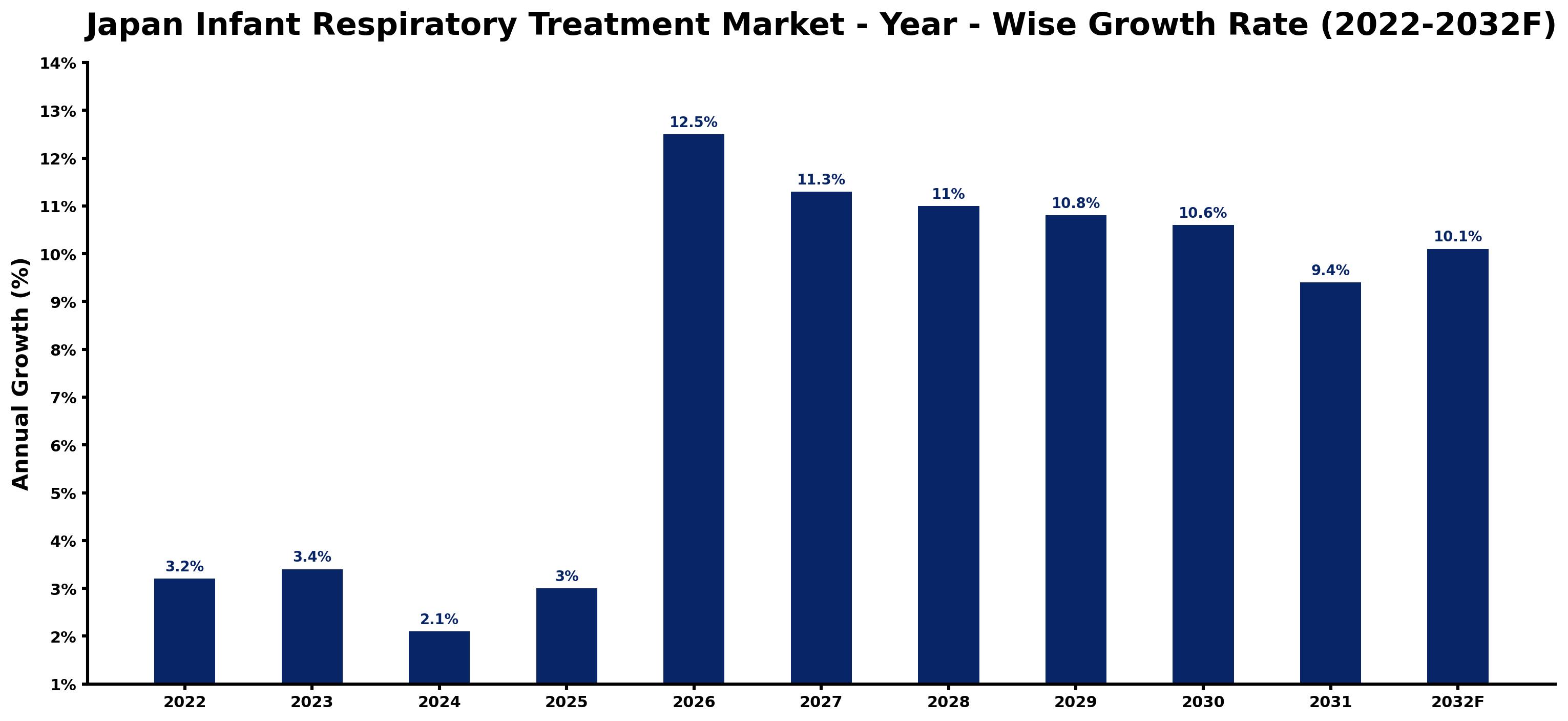
Annual growth estimates for each year appear below with the principal reason behind them, explaining the shifts that set the pace of the market.
| Year | Estimated Annual Growth (%) | Market Rationale |
| 2022 | 3.2 | The market experienced steady growth as hospitals treated a high number of infants for respiratory issues. |
| 2023 | 3.4 | Demand for treatments increased as asthma cases among children rose in Japan. |
| 2024 | 2.1 | Growth slowed as hospitals faced challenges in managing resources and patient care effectively. |
| 2025 | 3.0 | The market saw a resurgence in growth driven by improved awareness of respiratory treatments. |
| 2026 | 12.5 | Rapid growth is anticipated as new guidelines for inhaler use in infants are published, boosting prescriptions. |
| 2027 | 11.3 | Demand growth is projected to slow slightly as the market adjusts to the previous year's surge in treatment adoption. |
| 2028 | 11.0 | Growth is expected to continue slowing as hospitals focus on optimizing existing treatment protocols. |
| 2029 | 10.8 | The market will maintain positive growth as homecare kits become more widely available in pharmacies. |
| 2030 | 10.6 | Growth is expected to decelerate as competition increases among treatment providers and product offerings expand. |
| 2031 | 9.4 | The market will continue to grow at a slower pace as new research on respiratory diseases emerges. |
| 2032 | 10.1 | Demand is projected to rise as technological advancements in nebulization therapy improve treatment efficacy. |
Note: Market size estimations and growth projections presented in this report are based on 6Wresearch's proprietary forecasting methodology, utilizing the latest available industry data, government publications, and primary research inputs.
Japan Infant Respiratory Treatment Market Synopsis
Infant Respiratory Treatment products are crucial medical devices and therapies aimed at alleviating respiratory issues in infants, including asthma and nasal congestion. The Japan Infant Respiratory Treatment Market is growing due to the increasing prevalence of asthma among children, with around 1.2 million infants treated for respiratory issues in 2022. New guidelines from the Japan Pediatric Society and the Ministry of Health's initiative to improve care are propelling demand for these treatments.
Market Dynamics Impact Analysis (2026–2032)
| Factor | Type | Impact | Primary Segment Affected |
| Increasing asthma prevalence among children | Driver | High | Nebulization Therapy |
| Expansion of pediatric care facilities | Driver | High | Homecare Kits |
| Growing awareness of respiratory treatments | Opportunity | High | Inhalers |
| Rising demand for homecare solutions | Opportunity | High | Portable Humidifiers |
| Limited access to advanced treatments in rural areas | Restraint | High | Nasal Sprays |
| High costs associated with advanced respiratory devices | Restraint | Medium | Ultrasonic Nebulizer |
| Competition from alternative therapies | Challenge | Medium | Humidifier Therapy |
| Regulatory compliance challenges for new products | Challenge | High | Saline/Bronchodilators |
Evaluation of Drivers in Japan Infant Respiratory Treatment Market (2026–2032)
The following drivers explain most of the expected growth.
| Drivers | Primary Segment Affected | Why It Matters (Evidence) |
| Rising asthma cases among infants | Nebulization Therapy | Approximately 10% of children in Japan are affected by asthma, increasing the need for effective treatments. |
| Increased funding for pediatric healthcare | Homecare Kits | In 2023, the government allocated funds for research on infant respiratory diseases, improving care options. |
| Growing adoption of inhalers in treatment plans | Inhalers | The average age of first asthma diagnosis is around 2 years, leading to higher inhaler prescriptions. |
| Awareness campaigns by health organizations | Nasal Sprays | The Japan Respiratory Society has initiated campaigns to educate parents about respiratory treatments. |
| Technological advancements in treatment devices | Ultrasonic Nebulizer | Standards for nebulizers regulated under JIS T 9201 ensure high-quality devices are available. |
Much of the new demand traces back to the approximately 1.2 million infants treated for respiratory issues in 2022. The rising prevalence of asthma, affecting about 10% of children, drives the need for effective treatments like nebulization therapy. Awareness campaigns by health organisations have increased knowledge about treatment options, resulting in more prescriptions of inhalers. Technological advancements in nebulization devices ensure that high-quality products are accessible to healthcare providers and parents alike.
Evaluation of Restraints in Japan Infant Respiratory Treatment Market
The main factors holding the market back are set out below.
| Market Restraint | Primary Segment Affected | Why It Matters (Evidence) |
| Limited access to advanced respiratory treatments in rural areas | Nasal Sprays | Many rural facilities lack the necessary equipment, hindering treatment availability for infants. |
| High costs of advanced respiratory devices | Ultrasonic Nebulizer | The expense of these devices can limit their adoption in smaller healthcare settings. |
| Regulatory compliance challenges for new products | Saline/Bronchodilators | Manufacturers face stringent regulations that can delay product launches and increase costs. |
| Competition from alternative therapies | Humidifier Therapy | As other therapies gain popularity, market share for traditional treatments may diminish. |
| Limited awareness among parents regarding treatment options | Inhalers | Parents may not fully understand the benefits of inhalers, affecting their usage rates. |
Japan Infant Respiratory Treatment Market Challenges
Producers face intense market competition, which forces them to reduce prices and can shrink profit margins by 20%. This price pressure leads to compromised product quality, negatively impacting hospitals that depend on effective devices for infant care. A lack of skilled paediatric respiratory care professionals results in longer hospital stays, raising treatment costs by 15% for families. Supply chain disruptions for nebulization devices delay product availability, affecting timely treatment for over 300,000 infants annually who need urgent respiratory care.
Trends in the Japan Infant Respiratory Treatment Market
The shifts below are changing how Japan Infant Respiratory Treatment Market products are bought and supplied.
- Surge in Homecare Solutions: The market is experiencing a surge in homecare solutions for infant respiratory treatment. In 2025, homecare kits are expected to hold a 40% share in pharmacies, allowing parents to manage their infants' conditions more effectively.
- Increase in Nebulization Therapy Usage: The use of nebulization therapy has surged, particularly in paediatric emergency departments. In 2023, the Japan Pediatric Society reported that nebulizers are now a key focus for treating respiratory issues in infants, reflecting a growing reliance on this method.
- Rising Demand for Portable Humidifiers: Portable humidifiers are becoming increasingly popular in paediatric care facilities, with over 70% adoption reported in 2023. This trend highlights the importance of maintaining optimal humidity levels for infants' respiratory health.
- Growing Awareness of Asthma Management: Awareness campaigns initiated by the Japan Respiratory Society have led to increased knowledge about asthma management in children. This has resulted in a notable rise in inhaler prescriptions, with new guidelines published in 2023.
Investment Opportunities in the Japan Infant Respiratory Treatment Market
Below are the investment opportunities with the strongest case in the Japan Infant Respiratory Treatment Market.
- Investment in Pediatric Care Facilities: The Tokyo metropolitan area is seeing increased investment in paediatric care facilities, with plans for expansion in 2023. This presents opportunities for suppliers of respiratory treatment products to meet rising demand.
- Market for Homecare Kits: Parents are increasingly seeking homecare kits for respiratory treatment, particularly in urban areas. Suppliers can enter this market by partnering with local pharmacies to improve distribution.
- Research on Respiratory Diseases: The government has allocated funds for research on infant respiratory diseases, creating opportunities for collaboration with research institutions to develop effective treatments.
- Development of Advanced Nebulization Devices: There is a rising demand for advanced nebulization devices that comply with JIS T 9201 standards. Manufacturers can capitalise on this trend by focusing on product innovation and quality.
Government Initiatives in the Japan Infant Respiratory Treatment Market
The Water Supply Act (1957) and the Sewerage Act (1958) set essential standards for healthcare facilities, ensuring safe water supply and sanitation in hospitals. These regulations are critical for maintaining hygiene in paediatric care environments, directly impacting the quality of infant respiratory treatments.
The Long-Term Care Insurance Act (1997) funds nursing care services, indirectly supporting infant respiratory treatment by ensuring that paediatric care facilities have the necessary resources to provide high-quality services. In 2023, the Ministry of Health allocated funds for improving respiratory care, benefiting numerous paediatric facilities across the country.
Future Insight of the Japan Infant Respiratory Treatment Market
Advancements in nebulization technology will reshape demand for treatment options by 2032. The introduction of integrated monitoring systems in humidifiers will enhance respiratory care in hospitals and clinics. New guidelines from the Japan Pediatric Society will standardise treatment protocols, ensuring consistency across facilities. Government research funding will support innovative therapies, potentially reducing the average hospital visit duration for respiratory issues by 10%.
Market Segmentation Analysis
Japan Infant Respiratory Treatment Market report covers a detailed analysis of the following market segments:
By Infant Respiratory Treatment – Nebulization Therapy Leads, Inhalers Expected to Grow Fastest
According to Saurav Kr Singh, Senior Research Analyst at 6Wresearch, the largest infant respiratory treatment category in 2025 was Nebulization Therapy, at 41% of revenue. Nebulization therapy is the most utilised method in paediatric emergency departments, providing effective medication delivery directly to the lungs. The treatment's prevalence is underscored by the approximately 1.2 million infants treated for respiratory issues in Japan in 2022. The quickest growth will come from Inhalers, forecast to expand at a CAGR of 13.5% between 2026 and 2032. Inhalers are rapidly gaining traction as they are increasingly incorporated into asthma management plans for infants, catering to the needs of the 10% of children diagnosed with asthma. This trend suggests a shift towards more convenient and effective treatment solutions for respiratory conditions. Suppliers should prioritise the availability and training on inhalers to align with the rising demand.
By Treatment Type – Saline/Bronchodilators Lead and Record the Fastest Growth
With 38% of treatment type revenue in 2025, Saline/Bronchodilators was the largest category. Saline and bronchodilators dominate the market as they are commonly used for treating a range of respiratory conditions, making them essential in paediatric hospitals. The Japan Pediatric Society promotes guidelines that reinforce the use of these treatments. Saline/Bronchodilators are also forecast to expand faster than any other category, at a CAGR of 14.8% over 2026–2032. The same saline and bronchodilators segment is also the fastest-growing, as they are integral to effective asthma management and respiratory care strategies. This dual role ensures that their relevance in treatment protocols will continue to expand. Buyers will benefit from a broader range of saline and bronchodilator products as suppliers respond to increasing demand.
By Delivery Method – Ultrasonic Nebulizer Leads, Vaporizers Expected to Grow Fastest
Ultrasonic Nebulizer accounted for 43% of the market by delivery method in 2025. Ultrasonic nebulizers hold the largest share due to their effectiveness in delivering medication in a fine mist, which is particularly beneficial for infants facing respiratory difficulties. Their widespread use in paediatric hospitals across Japan reinforces their established presence in the market. Vaporizers are projected to grow fastest, at a CAGR of 15.0% during 2026–2032. Vaporizers are experiencing rapid growth as their role in creating humidity becomes increasingly recognised, essential for supporting infant respiratory health. The government's recent initiatives to improve respiratory care highlight the importance of maintaining optimal environmental conditions for treatment. Suppliers should consider integrating vaporizers into their product lines to align with the growing emphasis on humidity management in infant care.
By Device Used – Homecare Kits Lead, Portable Humidifiers Expected to Grow Fastest
Homecare Kits held 40% of the Japan Infant Respiratory Treatment Market by device used in 2025. Homecare kits are the leading device type as they provide essential tools for parents to manage their infants' respiratory conditions effectively at home. The high frequency of around 300,000 hospital visits annually for respiratory issues underscores the need for reliable at-home solutions. Over 2026–2032, Portable Humidifiers are expected to post the fastest growth, at a CAGR of 13.9%. Portable humidifiers are rapidly gaining traction as they are crucial for maintaining humidity levels in infant care environments, which is vital for respiratory health. Their presence in over 70% of paediatric care facilities indicates a shift towards more adaptable care options. Suppliers must ensure the availability of portable humidifiers to meet the rising demand for effective home respiratory care solutions.
By Application Area – Asthma/Cold Management Leads, Dry Cough Relief Expected to Grow Fastest
Asthma/Cold Management took 43% of application area revenue in 2025, more than any other category. Asthma and cold management is the leading application area as it addresses critical respiratory issues faced by infants, particularly in urban centres like Tokyo. The Japan Respiratory Society's campaigns highlight the urgency of addressing these conditions, solidifying this segment's importance. The quickest growth will come from Dry Cough Relief, forecast to expand at a CAGR of 12.7% between 2026 and 2032. Dry cough relief is the fastest-growing application area, with treatments increasingly targeting this condition in paediatric settings. This trend reflects a growing awareness of the need for comprehensive respiratory treatment approaches among healthcare providers. Buyers can expect more specialised treatment options for dry cough as suppliers respond to the increasing demand in this area.
Key Attractiveness of the Report
- 10 Years of Market Numbers
- Historical Data Starting from 2022 to 2025
- Base Year 2025
- Forecast Data until 2032
- Key Performance Indicators Impacting the Market
- Major Upcoming Developments and Projects
Key Highlights of the Report:
- Japan Infant Respiratory Treatment Market Outlook
- Market Size of Japan Infant Respiratory Treatment Market, 2025
- Forecast of Japan Infant Respiratory Treatment Market, 2032
- Historical Data and Forecast of Japan Infant Respiratory Treatment Revenues & Volume for the Period 2022-2032F
- Japan Infant Respiratory Treatment Market Trend Evolution
- Japan Infant Respiratory Treatment Market Drivers and Challenges
- Japan Infant Respiratory Treatment Price Trends
- Japan Infant Respiratory Treatment Porter's Five Forces
- Japan Infant Respiratory Treatment Industry Life Cycle
- Historical Data and Forecast of Japan Infant Respiratory Treatment Market Revenues & Volume By Infant Respiratory Treatment for the Period 2022-2032F
- Historical Data and Forecast of Japan Infant Respiratory Treatment Market Revenues & Volume By Nebulization Therapy for the Period 2022-2032F
- Historical Data and Forecast of Japan Infant Respiratory Treatment Market Revenues & Volume By Humidifier Therapy for the Period 2022-2032F
- Historical Data and Forecast of Japan Infant Respiratory Treatment Market Revenues & Volume By Inhalers for the Period 2022-2032F
- Historical Data and Forecast of Japan Infant Respiratory Treatment Market Revenues & Volume By Nasal Sprays for the Period 2022-2032F
- Historical Data and Forecast of Japan Infant Respiratory Treatment Market Revenues & Volume By Treatment Type for the Period 2022-2032F
- Historical Data and Forecast of Japan Infant Respiratory Treatment Market Revenues & Volume By Saline/Bronchodilators for the Period 2022-2032F
- Historical Data and Forecast of Japan Infant Respiratory Treatment Market Revenues & Volume By Moisture Control for the Period 2022-2032F
- Historical Data and Forecast of Japan Infant Respiratory Treatment Market Revenues & Volume By Steroid Based for the Period 2022-2032F
- Historical Data and Forecast of Japan Infant Respiratory Treatment Market Revenues & Volume By Saline Solution for the Period 2022-2032F
- Historical Data and Forecast of Japan Infant Respiratory Treatment Market Revenues & Volume By Delivery Method for the Period 2022-2032F
- Historical Data and Forecast of Japan Infant Respiratory Treatment Market Revenues & Volume By Ultrasonic Nebulizer for the Period 2022-2032F
- Historical Data and Forecast of Japan Infant Respiratory Treatment Market Revenues & Volume By Vaporizers for the Period 2022-2032F
- Historical Data and Forecast of Japan Infant Respiratory Treatment Market Revenues & Volume By Spacer-Based Inhalers for the Period 2022-2032F
- Historical Data and Forecast of Japan Infant Respiratory Treatment Market Revenues & Volume By Spray Bottles for the Period 2022-2032F
- Historical Data and Forecast of Japan Infant Respiratory Treatment Market Revenues & Volume By Device Used for the Period 2022-2032F
- Historical Data and Forecast of Japan Infant Respiratory Treatment Market Revenues & Volume By Homecare Kits for the Period 2022-2032F
- Historical Data and Forecast of Japan Infant Respiratory Treatment Market Revenues & Volume By Portable Humidifiers for the Period 2022-2032F
- Historical Data and Forecast of Japan Infant Respiratory Treatment Market Revenues & Volume By Baby Masks for the Period 2022-2032F
- Historical Data and Forecast of Japan Infant Respiratory Treatment Market Revenues & Volume By Soft Tip Bottles for the Period 2022-2032F
- Historical Data and Forecast of Japan Infant Respiratory Treatment Market Revenues & Volume By Application Area for the Period 2022-2032F
- Historical Data and Forecast of Japan Infant Respiratory Treatment Market Revenues & Volume By Asthma/Cold Management for the Period 2022-2032F
- Historical Data and Forecast of Japan Infant Respiratory Treatment Market Revenues & Volume By Dry Cough Relief for the Period 2022-2032F
- Historical Data and Forecast of Japan Infant Respiratory Treatment Market Revenues & Volume By Wheezing Control for the Period 2022-2032F
- Historical Data and Forecast of Japan Infant Respiratory Treatment Market Revenues & Volume By Nasal Congestion for the Period 2022-2032F
- Japan Infant Respiratory Treatment Import Export Trade Statistics
- Market Opportunity Assessment By Infant Respiratory Treatment
- Market Opportunity Assessment By Treatment Type
- Market Opportunity Assessment By Delivery Method
- Market Opportunity Assessment By Device Used
- Market Opportunity Assessment By Application Area
- Japan Infant Respiratory Treatment Top Companies Market Share
- Japan Infant Respiratory Treatment Competitive Benchmarking By Technical and Operational Parameters
- Japan Infant Respiratory Treatment Company Profiles
- Japan Infant Respiratory Treatment Key Strategic Recommendations
Market Covered
The following segment groups are covered in the report.
By Infant Respiratory Treatment
- Nebulization Therapy
- Humidifier Therapy
- Inhalers
- Nasal Sprays
By Treatment Type
- Saline/Bronchodilators
- Moisture Control
- Steroid Based
- Saline Solution
By Delivery Method
- Ultrasonic Nebulizer
- Vaporizers
- Spacer-Based Inhalers
- Spray Bottles
By Device Used
- Homecare Kits
- Portable Humidifiers
- Baby Masks
- Soft Tip Bottles
By Application Area
- Asthma/Cold Management
- Dry Cough Relief
- Wheezing Control
- Nasal Congestion































