Japan Infant Toiletries Market Size & Growth Rate
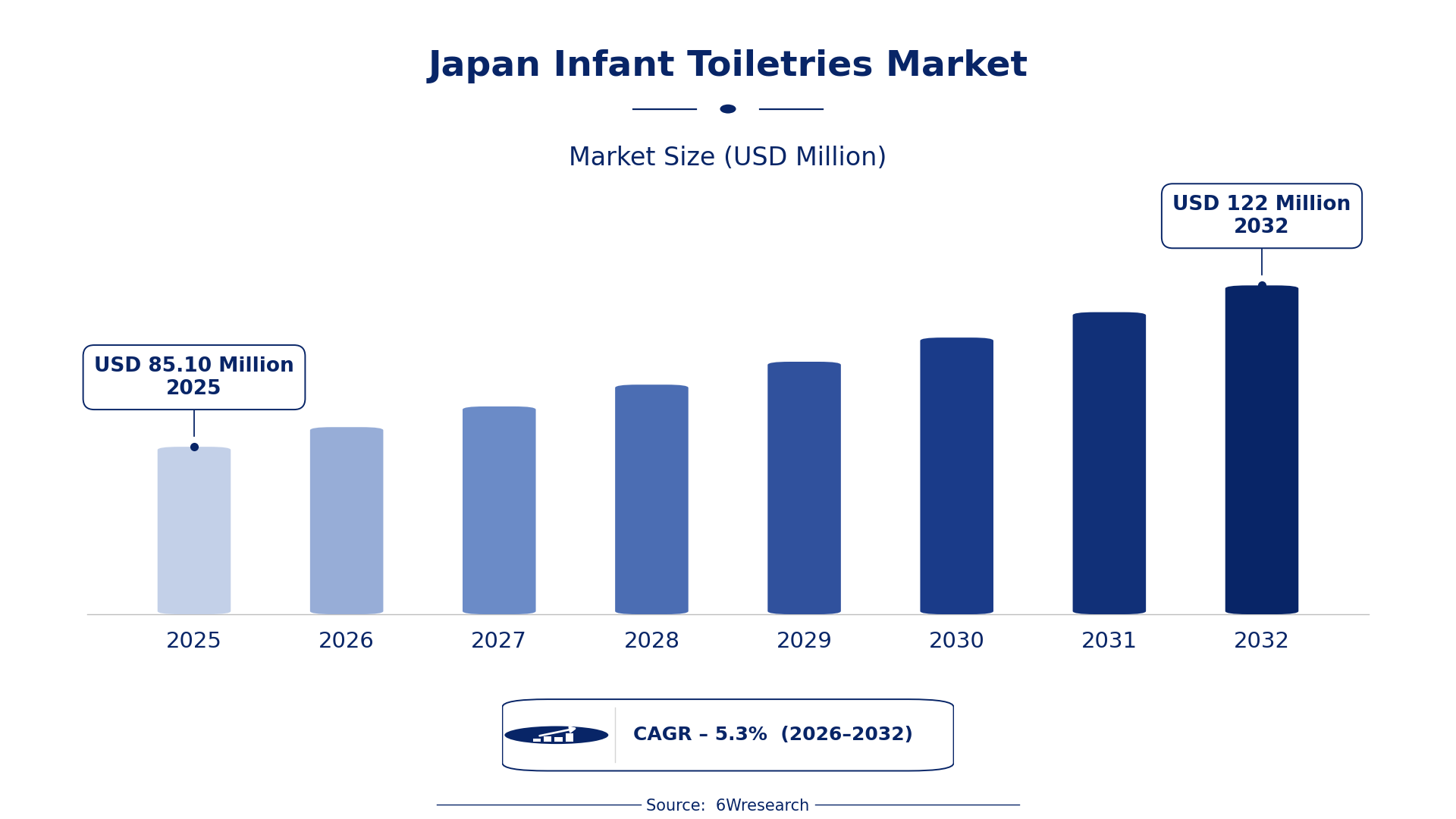
According to 6Wresearch internal database and industry insights, the Japan Infant Toiletries Market was valued at USD 85.10 Million in 2025 and is projected to reach USD 122 Million by 2032, growing at a CAGR of approximately 5.3% during 2026–2032.
Japan Infant Toiletries Market Highlights
| Report Metric | Details |
| Report Name | Japan Infant Toiletries Market (2026-2032) |
| Market Size 2025 | USD 85.10 Million |
| Market Size 2032 | USD 122 Million |
| Absolute Growth 2025–2032 | USD 36.90 Million |
| CAGR 2026–2032 | 5.3% |
| Peak Annual Growth | 6.3% in 2032 |
| Forecast Period | 2026–2032 |
| Historical Data | 2022–2025 |
| Base Year | 2025 |
| Leading Infant Toiletries, 2025 | Baby Shampoos (40% share) |
| Leading Product Type, 2025 | Tear-Free Formula (45% share) |
| Leading Formula Type, 2025 | pH Balanced (48% share) |
| Leading Packaging Style, 2025 | Flip Cap Bottles (44% share) |
| Leading Distribution Channel, 2025 | Pharmacies (44% share) |
| Fastest-Growing Infant Toiletries | Diaper Rash Creams (6.7% CAGR) |
| Fastest-Growing Product Type | Ayurvedic/Herbal (7.3% CAGR) |
| Fastest-Growing Formula Type | Hypoallergenic (7.2% CAGR) |
| Fastest-Growing Distribution Channel | Online Retail (6.8% CAGR) |
| Growing Sector | Infant Care |
| Key End Users | Parents, caregivers, health-conscious consumers |
Japan Infant Toiletries Market Year-wise Growth Rate and Key Drivers (2022–2032)
This graph illustrates the annual growth rates of the market from 2022 to 2032, highlighting a steady upward trajectory and projected market expansion over the forecast period.
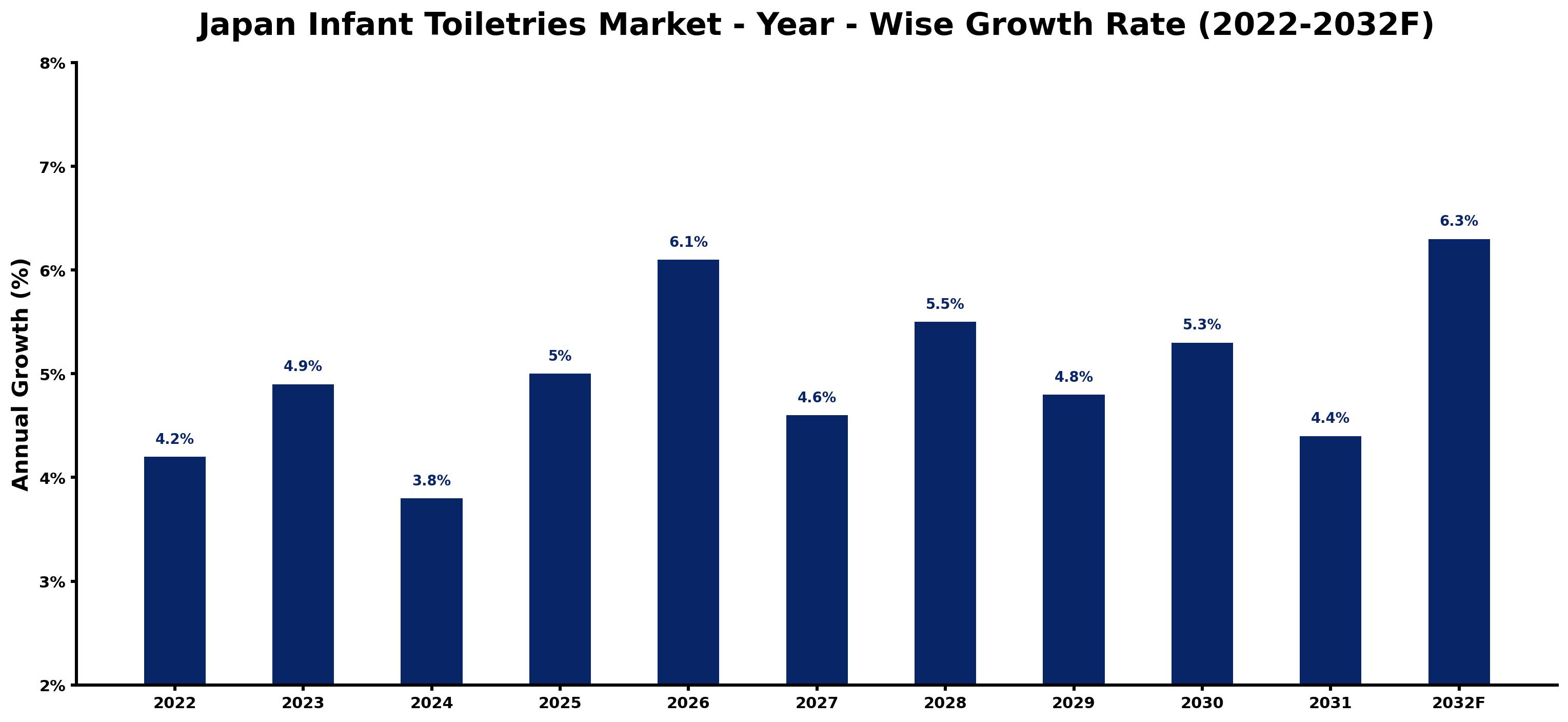
The following figures match every annual growth estimate with the main market development of that year, giving the reasoning behind each rise or slowdown.
| Year | Estimated Annual Growth (%) | Market Rationale |
| 2022 | 4.2 | The market showed steady growth, reflecting consistent demand for infant toiletries. |
| 2023 | 4.9 | Growth accelerated due to heightened consumer awareness of hypoallergenic products. |
| 2024 | 3.8 | Growth slowed slightly as the market adjusted to previous high demand levels. |
| 2025 | 5.0 | The market experienced a peak as families increasingly prioritised infant hygiene. |
| 2026 | 6.1 | A surge in demand for pH-balanced products is expected to drive faster growth rates. |
| 2027 | 4.6 | Growth is projected to slow as market saturation begins to affect purchasing patterns. |
| 2028 | 5.5 | The market is expected to rebound with renewed interest in natural and organic products. |
| 2029 | 4.8 | Growth will decelerate as consumers become more selective in their choices. |
| 2030 | 5.3 | An increase in eco-friendly product awareness is expected to spur demand again. |
| 2031 | 4.4 | Competition among brands will intensify, leading to slower growth rates. |
| 2032 | 6.3 | The market is projected to peak as new product innovations capture consumer interest. |
Note: Market size estimations and growth projections presented in this report are based on 6Wresearch's proprietary forecasting methodology, utilizing the latest available industry data, government publications, and primary research inputs.
Japan Infant Toiletries Market Synopsis
Infant toiletries encompass a range of personal care products designed specifically for babies, including shampoos, creams, oils, and soaps. The Japan Infant Toiletries Market is growing due to rising demand from families, particularly in urban areas like Tokyo and Osaka, where awareness of hypoallergenic and pH-balanced products is increasing. In 2023, the government launched a campaign promoting safe infant care products, creating opportunities for suppliers to meet evolving consumer preferences and strengthen market presence.
Market Dynamics Impact Analysis (2026–2032)
| Factor | Type | Impact | Primary Segment Affected |
| Rising awareness of hypoallergenic products | Driver | High | Diaper Rash Creams |
| Increased demand for natural ingredients | Driver | High | Ayurvedic/Herbal |
| Growth in online retail channels | Opportunity | High | Online Retail |
| Expansion of retail chains offering baby products | Opportunity | Medium | Retail Chains |
| High competition among brands | Restraint | High | Baby Shampoos |
| Saturation in urban markets | Restraint | Medium | Diaper Rash Creams |
| Rising ingredient costs | Challenge | High | Baby Oils |
| Compliance with stringent safety standards | Challenge | Medium | Baby Soaps |
Evaluation of Drivers in Japan Infant Toiletries Market (2026–2032)
Below are the drivers that matter most for revenue growth, with supporting evidence.
| Drivers | Primary Segment Affected | Why It Matters (Evidence) |
| Increased consumer focus on hypoallergenic products | Diaper Rash Creams | The Japanese Pediatric Association recommends using mild products, leading to higher purchases among health-conscious parents. |
| Growing popularity of Ayurvedic formulations | Ayurvedic/Herbal | Health-conscious parents are increasingly seeking natural alternatives, boosting demand for herbal baby products. |
| Rising online retail sales | Online Retail | Online sales of infant toiletries increased by 20% in the last year, attracting tech-savvy parents. |
| Expansion of retail chains | Retail Chains | Retail chains are increasing their baby care product lines to meet consumer demand, improving accessibility. |
| Government campaigns promoting safe products | Baby Soaps | The 2023 campaign encourages the use of hypoallergenic products, driving sales across various channels. |
A wider customer base explains much of the growth, as the demand for hypoallergenic products rises, with 40% of distribution through pharmacies. In 2023, online retail sales of infant toiletries increased by 20%, attracting tech-savvy parents. Retail chains are expanding their baby care product lines to meet consumer demand, improving accessibility. The popularity of Ayurvedic formulations is growing among health-conscious parents, with a projected increase in sales.
Evaluation of Restraints in Japan Infant Toiletries Market
These are the pressures that could keep growth below its potential.
| Market Restraint | Primary Segment Affected | Why It Matters (Evidence) |
| Intense competition among established brands | Baby Shampoos | High competition limits pricing flexibility, impacting profit margins for manufacturers. |
| Market saturation in urban areas | Diaper Rash Creams | Saturation leads to slower growth as consumers become more selective in their choices. |
| Rising costs of natural ingredients | Baby Oils | Increased ingredient costs can squeeze margins and affect pricing strategies. |
| Compliance with safety regulations | Baby Soaps | Strict regulations require significant investment in testing and certification, affecting smaller players. |
| Changing consumer preferences | Diaper Rash Creams | Shifts towards natural products may lead to decreased demand for traditional formulations. |
Japan Infant Toiletries Market Challenges
Families face rising costs for infant toiletries, with baby shampoo priced at approximately 1,200 yen, straining household budgets. Suppliers encounter difficulties in recruiting skilled workers, resulting in production delays that create stock shortages in pharmacies, which account for 40% of distribution. Many manufacturers lack advanced technology, leading to outdated product lines that do not align with the growing demand for eco-friendly options. New guidelines from the Ministry of Health necessitate compliance changes, complicating manufacturing processes and delaying product launches for producers.
Trends in the Japan Infant Toiletries Market
The following changes are redrawing the Japan Infant Toiletries Market.
- Shift towards Eco-Friendly Packaging: Since 2023, there has been a notable shift towards eco-friendly packaging initiatives for baby products, driven by consumer demand for sustainability. This trend is particularly evident in major urban areas like Tokyo, where awareness of environmental issues is high.
- Transition to Online Retail: The rise of online retail channels has transformed how parents purchase infant toiletries, with a 20% increase in online sales last year. This shift is particularly prominent among tech-savvy parents in metropolitan regions.
- Emergence of Ayurvedic Baby Products: Ayurvedic and herbal formulations are gaining traction among health-conscious parents, with a projected growth rate of 7.3%. This trend reflects a broader consumer preference for natural alternatives in urban centres.
- Growing Demand for Hypoallergenic Products: The 2023 government campaign promoting hypoallergenic baby products has significantly influenced consumer choices, leading to increased sales in major cities. This initiative aligns with rising awareness of allergies among parents.
Investment Opportunities in the Japan Infant Toiletries Market
The opportunities below stand out in the Japan Infant Toiletries Market for new entrants and existing suppliers.
- Tokyo as a Key Market: Tokyo's large population presents a notable opportunity for suppliers of infant toiletries, with a projected market size of USD 85.10 million by 2025. Collaborating with local retailers can facilitate market entry.
- Timing for Eco-Friendly Products: With Japan targeting a 46% cut in greenhouse-gas emissions by 2030, there is a timely opportunity for suppliers of eco-friendly baby products. Engaging in partnerships with local manufacturers can facilitate market entry.
- Entry through Online Platforms: The growing online retail sector offers an opportunity for suppliers to reach tech-savvy parents effectively. Establishing partnerships with e-commerce platforms can enhance visibility and sales.
- Focus on Natural Ingredients: The increasing demand for natural ingredients in infant toiletries presents an opportunity for suppliers to innovate. Targeting health-conscious parents in urban areas can drive growth.
Government Initiatives in the Japan Infant Toiletries Market
The Waste Management and Public Cleansing Act (1970) regulates the treatment and disposal of waste, ensuring that manufacturers of infant toiletries adhere to environmental standards. The Industrial Standardization Act (1949), amended in 2019, governs product safety and quality standards, including those for baby care products, ensuring compliance with the JIS standard.
The Consumer Affairs Agency monitors compliance with regulations that prevent misleading advertising of infant toiletries. This oversight protects consumers and ensures that manufacturers provide accurate information about product safety and efficacy.
Future Insight of the Japan Infant Toiletries Market
A shift towards eco-friendly packaging will transform the market, encouraging suppliers to adopt sustainable materials by 2032. The focus on natural formulations will lead to enhanced products that address the needs of sensitive infants, offering parents safer choices. Retail channels will evolve, providing easier access to a wider range of infant toiletries. Health-conscious trends will drive the growth of natural product lines, aligning with changing consumer preferences.
Market Segmentation Analysis
Japan Infant Toiletries Market report covers a detailed analysis of the following market segments:
By Infant Toiletries – Baby Shampoos Lead, Diaper Rash Creams Expected to Grow Fastest
According to Saurav Kr Singh, Senior Research Analyst at 6Wresearch, Baby Shampoos took 40% of infant toiletries revenue in 2025, more than any other category. Baby shampoos are essential for maintaining hygiene in infants, making them a staple in many households across Japan. The high concentration of families in urban areas like Tokyo drives their widespread use and preference among parents. Diaper Rash Creams are set to record the highest CAGR in this split, 6.7% over 2026–2032. Diaper rash creams are experiencing rapid growth as awareness of skin protection for infants rises among parents. The guidance from the Japanese Pediatric Association has heightened the focus on these crucial products, ensuring their continued demand. Suppliers should focus on expanding their offerings of diaper rash creams to meet the increasing consumer demand.
By Product Type – Tear-Free Formula Leads, Ayurvedic/Herbal Expected to Grow Fastest
Tear-Free Formula accounted for 45% of the market by product type in 2025. Tear-free formulas are preferred by parents for their importance in ensuring comfort during bathing, making them a popular choice. This preference is reflected in the high sales volume across various retail channels. The quickest growth will come from Ayurvedic/Herbal, forecast to expand at a CAGR of 7.3% between 2026 and 2032. Ayurvedic and herbal formulations are gaining traction as health-conscious parents seek natural alternatives for their infants. The projected growth indicates a shift towards more organic product options in the market. Manufacturers should consider expanding their product lines to include Ayurvedic options to meet changing consumer preferences.
By Formula Type – pH Balanced Leads, Hypoallergenic Expected to Grow Fastest
pH Balanced held 48% of the Japan Infant Toiletries Market by formula type in 2025. pH balanced products are essential for ensuring compatibility with the delicate skin of infants, leading to their widespread acceptance among caregivers. This formulation is supported by health authority guidelines, solidifying their market dominance. Hypoallergenic is projected to grow fastest, at a CAGR of 7.2% during 2026–2032. Hypoallergenic products are gaining traction as parents increasingly seek safe options for their infants, particularly in light of rising allergy concerns. This heightened focus on safety is likely to propel further growth in this segment. Manufacturers must ensure compliance with hypoallergenic standards to attract the growing demographic of safety-conscious parents.
By Packaging Style – Flip Cap Bottles Lead and Record the Fastest Growth
In 2025, Flip Cap Bottles led the packaging style split with a 44% share. Flip cap bottles are a common packaging style favoured for their convenience and ease of use, making them popular among parents. This packaging style aligns well with the practical needs of caregivers during diaper changes and bath times. Its lead should widen, with a projected CAGR of 6.9% during 2026–2032, the highest in this split. Flip cap bottles are also the fastest-growing packaging style due to their user-friendly design, which appeals to busy parents. The convenience offered by this packaging is likely to sustain its growth momentum. Suppliers should continue to invest in flip cap bottle designs to maintain competitive advantage in the market.
By Distribution Channel – Pharmacies Lead, Online Retail Expected to Grow Fastest
With 44% of distribution channel revenue in 2025, Pharmacies was the largest category. Pharmacies serve as the main distribution channel for infant toiletries, ensuring that parents have easy access to necessary products. Their established presence in communities makes them a trusted source for caregivers seeking reliable options. Online Retail is set to record the highest CAGR in this split, 6.8% over 2026–2032. Online retail is quickly becoming a dominant distribution channel, driven by the rise in e-commerce among consumers. A notable 20% increase in online sales indicates a shift in shopping habits that suppliers must acknowledge. Retailers need to strengthen their online presence to cater to the growing number of consumers choosing to shop online.
Key Attractiveness of the Report
- 10 Years of Market Numbers
- Historical Data Starting from 2022 to 2025
- Base Year 2025
- Forecast Data until 2032
- Key Performance Indicators Impacting the Market
- Major Upcoming Developments and Projects
Key Highlights of the Report:
- Japan Infant Toiletries Market Outlook
- Market Size of Japan Infant Toiletries Market, 2025
- Forecast of Japan Infant Toiletries Market, 2032
- Historical Data and Forecast of Japan Infant Toiletries Revenues & Volume for the Period 2022-2032F
- Japan Infant Toiletries Market Trend Evolution
- Japan Infant Toiletries Market Drivers and Challenges
- Japan Infant Toiletries Price Trends
- Japan Infant Toiletries Porter's Five Forces
- Japan Infant Toiletries Industry Life Cycle
- Historical Data and Forecast of Japan Infant Toiletries Market Revenues & Volume By Infant Toiletries for the Period 2022-2032F
- Historical Data and Forecast of Japan Infant Toiletries Market Revenues & Volume By Baby Shampoos for the Period 2022-2032F
- Historical Data and Forecast of Japan Infant Toiletries Market Revenues & Volume By Diaper Rash Creams for the Period 2022-2032F
- Historical Data and Forecast of Japan Infant Toiletries Market Revenues & Volume By Baby Oils for the Period 2022-2032F
- Historical Data and Forecast of Japan Infant Toiletries Market Revenues & Volume By Baby Soaps for the Period 2022-2032F
- Historical Data and Forecast of Japan Infant Toiletries Market Revenues & Volume By Product Type for the Period 2022-2032F
- Historical Data and Forecast of Japan Infant Toiletries Market Revenues & Volume By Tear-Free Formula for the Period 2022-2032F
- Historical Data and Forecast of Japan Infant Toiletries Market Revenues & Volume By Zinc Oxide Based for the Period 2022-2032F
- Historical Data and Forecast of Japan Infant Toiletries Market Revenues & Volume By Ayurvedic/Herbal for the Period 2022-2032F
- Historical Data and Forecast of Japan Infant Toiletries Market Revenues & Volume By Glycerin Base for the Period 2022-2032F
- Historical Data and Forecast of Japan Infant Toiletries Market Revenues & Volume By Formula Type for the Period 2022-2032F
- Historical Data and Forecast of Japan Infant Toiletries Market Revenues & Volume By pH Balanced for the Period 2022-2032F
- Historical Data and Forecast of Japan Infant Toiletries Market Revenues & Volume By Hypoallergenic for the Period 2022-2032F
- Historical Data and Forecast of Japan Infant Toiletries Market Revenues & Volume By Fragrance-Free for the Period 2022-2032F
- Historical Data and Forecast of Japan Infant Toiletries Market Revenues & Volume By Moisturizing for the Period 2022-2032F
- Historical Data and Forecast of Japan Infant Toiletries Market Revenues & Volume By Packaging Style for the Period 2022-2032F
- Historical Data and Forecast of Japan Infant Toiletries Market Revenues & Volume By Flip Cap Bottles for the Period 2022-2032F
- Historical Data and Forecast of Japan Infant Toiletries Market Revenues & Volume By Tubes for the Period 2022-2032F
- Historical Data and Forecast of Japan Infant Toiletries Market Revenues & Volume By Plastic Bottles for the Period 2022-2032F
- Historical Data and Forecast of Japan Infant Toiletries Market Revenues & Volume By Paper Wrapped for the Period 2022-2032F
- Historical Data and Forecast of Japan Infant Toiletries Market Revenues & Volume By Distribution Channel for the Period 2022-2032F
- Historical Data and Forecast of Japan Infant Toiletries Market Revenues & Volume By Pharmacies for the Period 2022-2032F
- Historical Data and Forecast of Japan Infant Toiletries Market Revenues & Volume By Retail Chains for the Period 2022-2032F
- Historical Data and Forecast of Japan Infant Toiletries Market Revenues & Volume By Online Retail for the Period 2022-2032F
- Historical Data and Forecast of Japan Infant Toiletries Market Revenues & Volume By General Stores for the Period 2022-2032F
- Japan Infant Toiletries Import Export Trade Statistics
- Market Opportunity Assessment By Infant Toiletries
- Market Opportunity Assessment By Product Type
- Market Opportunity Assessment By Formula Type
- Market Opportunity Assessment By Packaging Style
- Market Opportunity Assessment By Distribution Channel
- Japan Infant Toiletries Top Companies Market Share
- Japan Infant Toiletries Competitive Benchmarking By Technical and Operational Parameters
- Japan Infant Toiletries Company Profiles
- Japan Infant Toiletries Key Strategic Recommendations
Market Covered
The report covers the following segments.
By Infant Toiletries
- Baby Shampoos
- Diaper Rash Creams
- Baby Oils
- Baby Soaps
By Product Type
- Tear-Free Formula
- Zinc Oxide Based
- Ayurvedic/Herbal
- Glycerin Base
By Formula Type
- pH Balanced
- Hypoallergenic
- Fragrance-Free
- Moisturizing
By Packaging Style
- Flip Cap Bottles
- Tubes
- Plastic Bottles
- Paper Wrapped
By Distribution Channel
- Pharmacies
- Retail Chains
- Online Retail
- General Stores































