Japan Infantry Weapon Systems Market Size & Growth Rate
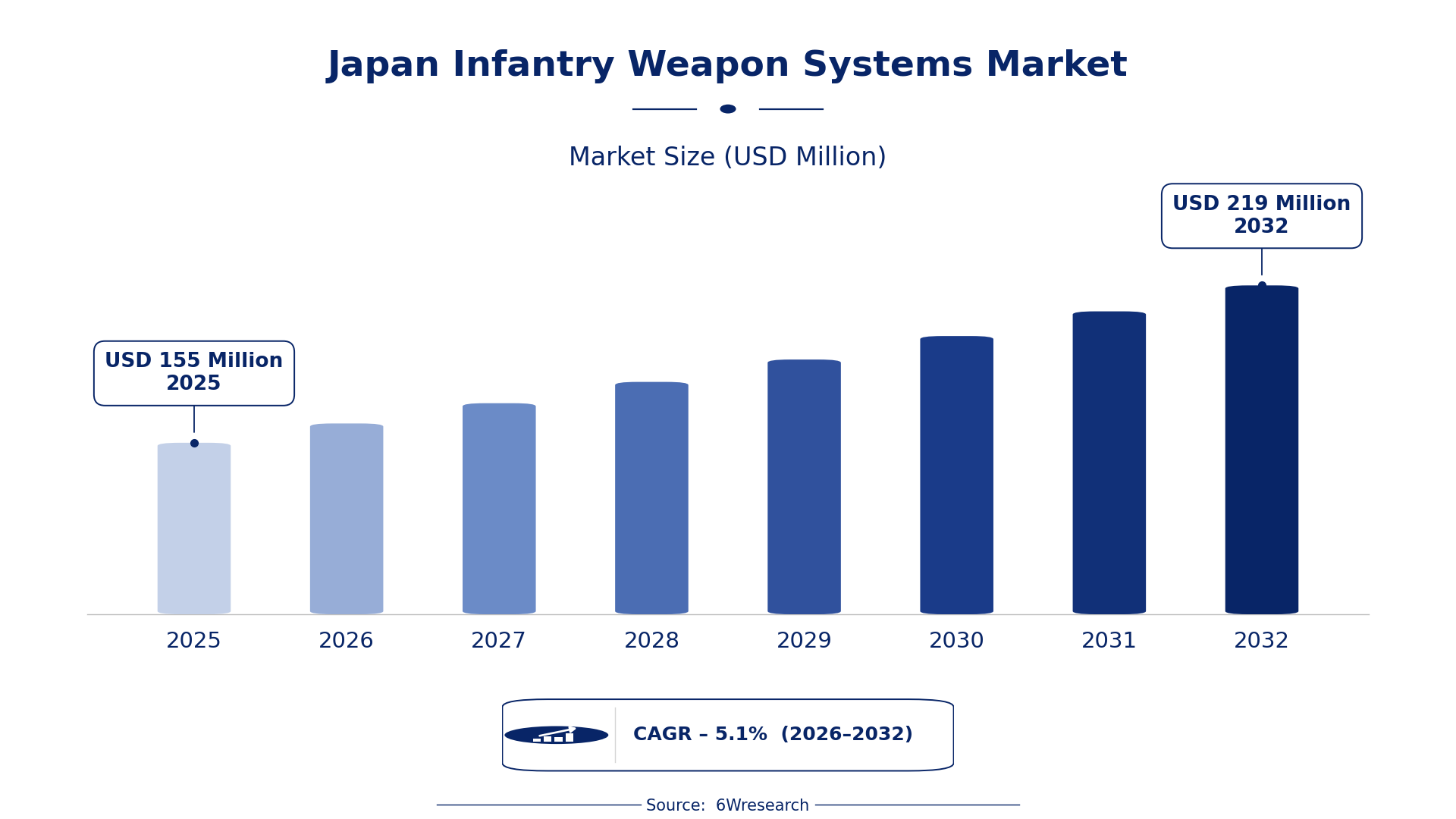
According to 6Wresearch internal database and industry insights, the Japan Infantry Weapon Systems Market was valued at USD 155 Million in 2025 and is projected to reach USD 219 Million by 2032, growing at a CAGR of approximately 5.1% during 2026–2032.
Japan Infantry Weapon Systems Market Highlights
| Report Metric | Details |
| Report Name | Japan Infantry Weapon Systems Market (2026-2032) |
| Market Size 2025 | USD 155 Million |
| Market Size 2032 | USD 219 Million |
| Absolute Growth 2025–2032 | USD 64 Million |
| CAGR 2026–2032 | 5.1% |
| Peak Annual Growth | 6.5% in 2026 |
| Forecast Period | 2026–2032 |
| Historical Data | 2022–2025 |
| Base Year | 2025 |
| Leading Infantry Weapon Systems, 2025 | Assault Rifles (39% share) |
| Leading Weapon Type, 2025 | Automatic/Semi-Auto (36% share) |
| Leading Operation Mode, 2025 | Gas-Operated (45% share) |
| Leading Component System, 2025 | Magazine (39% share) |
| Leading Application Area, 2025 | Ground Troops (50% share) |
| Fastest-Growing Infantry Weapon Systems | Rocket Launchers (6.9% CAGR) |
| Fastest-Growing Weapon Type | Shoulder-Fired (7.1% CAGR) |
| Fastest-Growing Operation Mode | Manual Trigger (6.3% CAGR) |
| Fastest-Growing Component System | Barrel (7.5% CAGR) |
| Fastest-Growing Application Area | Anti-Armor Missions (6.1% CAGR) |
| Growing Sector | military-grade firearms |
| Key End Users | military forces, defense contractors, government agencies |
Japan Infantry Weapon Systems Market Year-wise Growth Rate and Key Drivers (2022–2032)
This graph illustrates the annual growth rates of the market from 2022 to 2032, highlighting a steady upward trajectory and projected market expansion over the forecast period.
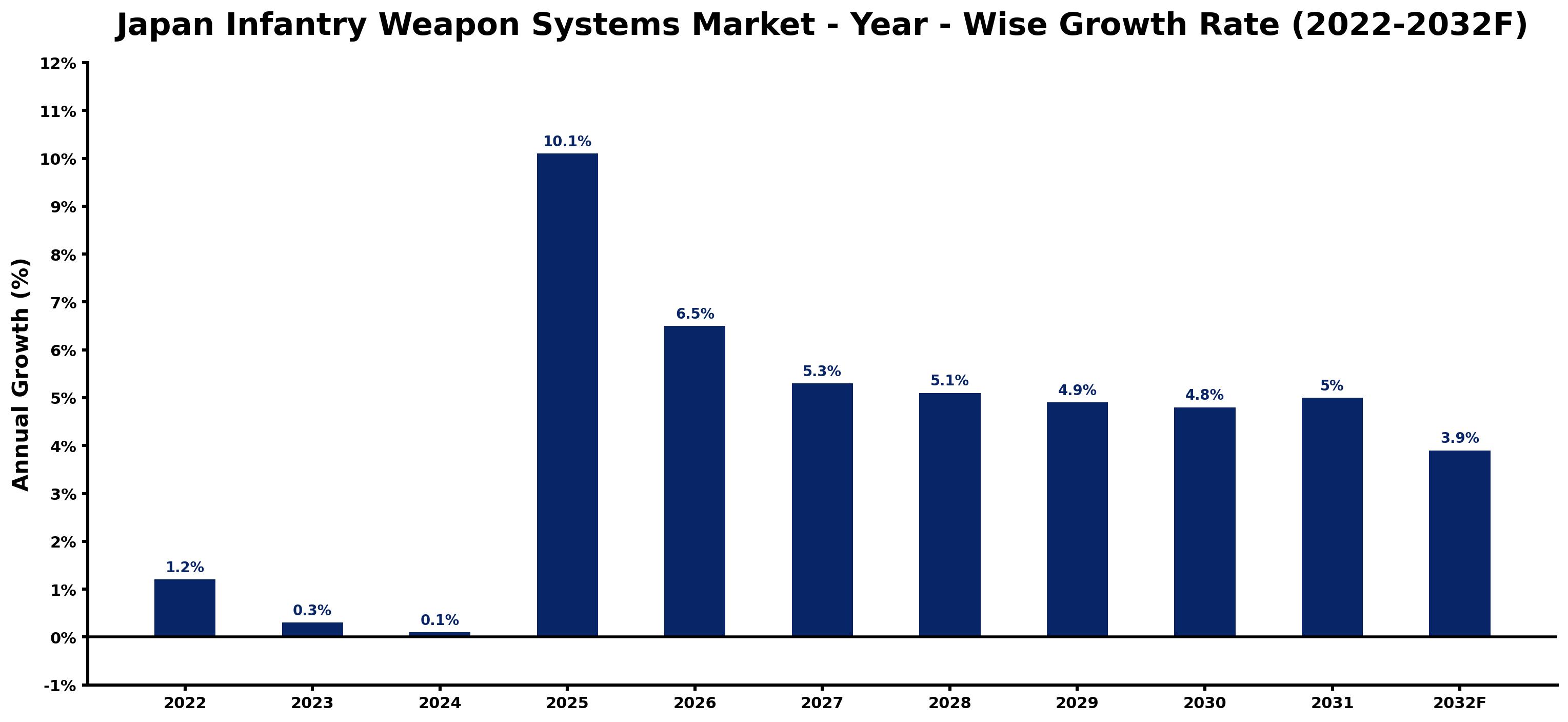
Each row of the following table gives one year's estimated growth and the event or demand shift that explains it.
| Year | Estimated Annual Growth (%) | Market Rationale |
| 2022 | 1.2 | The market exhibited stable growth, reflecting ongoing military modernization efforts. |
| 2023 | 0.3 | Growth slowed due to budgetary constraints and shifting military priorities. |
| 2024 | 0.1 | The market continued to grow slowly as focus remained on existing systems. |
| 2025 | 10.1 | Demand surged as the government increased defense spending significantly. |
| 2026 | 6.5 | Growth is expected to slow as the market adjusts to the peak demand from the previous year. |
| 2027 | 5.3 | A slight slowdown is projected as the market stabilises after rapid growth. |
| 2028 | 5.1 | Growth is projected to continue to slow as modernization efforts mature. |
| 2029 | 4.9 | The market is expected to maintain a steady pace as demand for existing systems persists. |
| 2030 | 4.8 | Growth is projected to remain stable as investments in modernization continue to yield results. |
| 2031 | 5.0 | An uptick in growth is expected as new procurement strategies are implemented. |
| 2032 | 3.9 | The market is projected to slow as growth normalises after previous peaks. |
Note: Market size estimations and growth projections presented in this report are based on 6Wresearch's proprietary forecasting methodology, utilizing the latest available industry data, government publications, and primary research inputs.
Japan Infantry Weapon Systems Market Synopsis
Infantry Weapon Systems include military-grade firearms and munitions designed for ground combat, utilising advanced materials for reliability and effectiveness. The Japan Infantry Weapon Systems Market is projected to grow due to increased defense spending, with ¥5 trillion allocated for 2023, alongside ongoing modernization efforts by the Self-Defense Forces. Demand arises from the need for effective combat capabilities and improved anti-armor systems, as well as joint exercises with allied nations.
Market Dynamics Impact Analysis (2026–2032)
| Factor | Type | Impact | Primary Segment Affected |
| Increased defense spending drives demand for modern infantry systems. | Driver | High | Assault Rifles |
| Ongoing modernization efforts enhance military capabilities. | Driver | High | Assault Rifles |
| Growing focus on anti-armor capabilities presents opportunities for suppliers. | Opportunity | High | Anti-Tank Missiles |
| Investment in advanced guided missile technology opens new markets. | Opportunity | High | Guided Missiles |
| Budget constraints may limit procurement of new systems. | Restraint | High | Assault Rifles |
| Slow adoption of emerging technologies can hinder growth. | Restraint | Medium | Assault Rifles |
| Technological integration challenges can delay system upgrades. | Challenge | High | Assault Rifles |
| Competition from international suppliers can pressure local manufacturers. | Challenge | Medium | Assault Rifles |
Evaluation of Drivers in Japan Infantry Weapon Systems Market (2026–2032)
The following drivers explain most of the expected growth.
| Drivers | Primary Segment Affected | Why It Matters (Evidence) |
| Increased defense budget allocation. | Assault Rifles | The Ministry of Defense allocated ¥5 trillion for 2023, prompting higher procurement of infantry systems. |
| Modernization of the Self-Defense Forces. | Assault Rifles | Ongoing military upgrades drive demand for advanced weapon systems, ensuring combat readiness. |
| Growing collaboration with allied nations. | Assault Rifles | Joint exercises with allied forces increase the need for modern infantry equipment, enhancing operational capabilities. |
| Rising focus on anti-armor capabilities. | Anti-Tank Missiles | Japan is investing in anti-armor systems to address evolving battlefield threats, increasing procurement. |
| Investment in precision strike technologies. | Guided Missiles | Japan's focus on remote targeting technology supports the demand for guided missile systems, enhancing strike accuracy. |
Several shifts outside the market lift sales. Ongoing modernization efforts drive demand for advanced weaponry, as seen in the emphasis on anti-armor capabilities. Military exercises with allied nations further increase the need for modern infantry equipment, leading to higher purchases. Japan's investment in remote targeting technology reflects a shift towards precision strikes in military operations, supporting the demand for advanced guided missile systems.
Evaluation of Restraints in Japan Infantry Weapon Systems Market
Several factors work against faster growth; the main ones are summarised below.
| Market Restraint | Primary Segment Affected | Why It Matters (Evidence) |
| Budget constraints limit procurement of new systems. | Assault Rifles | The Ministry of Defense's budgetary restrictions can hinder the acquisition of advanced infantry systems. |
| Slow adoption of emerging technologies. | Assault Rifles | Cautious integration of new technologies can delay modernization efforts, affecting operational readiness. |
| Technological integration challenges hinder upgrades. | Assault Rifles | Complexities in integrating advanced systems can slow down the upgrade process for existing weaponry. |
| Competition from international suppliers pressures local manufacturers. | Assault Rifles | Local manufacturers face challenges from international competitors offering advanced infantry systems. |
| Limited R&D funding affects innovation. | Assault Rifles | Insufficient funding for research and development can slow the introduction of new technologies. |
Japan Infantry Weapon Systems Market Challenges
A shortage of skilled technicians in Japan's defense manufacturing sector restricts production capabilities, as vocational training opportunities remain limited. This skills gap leads to delays for producers, extending lead times for infantry weapon systems required by the Self-Defense Forces. Rising material costs, driven by global supply chain issues, elevate production expenses by up to 15%, compelling manufacturers to raise prices for buyers. Increased competition from international suppliers poses a threat to local producers, potentially reducing their market share and jeopardising the supply of critical military equipment.
Trends in the Japan Infantry Weapon Systems Market
The trends below show where the Japan Infantry Weapon Systems Market is heading.
- Shift towards Improved Anti-Armor Capabilities: Since 2023, Japan has focused on improving its anti-armor capabilities, with significant investment in new systems. The allocation of ¥5 trillion for defense spending reflects this trend, resulting in increased demand for specialized weaponry.
- Transition from Traditional to Precision Strike Technologies: In 2024, Japan began investing in remote targeting technology for precision strikes, improving operational effectiveness. This shift is evident as the Self-Defense Forces adopt advanced guided missile systems, enhancing engagement accuracy.
- Emergence of Joint Military Exercises: Starting in 2025, joint exercises with allied nations have become more frequent, showcasing military innovations. These collaborations have led to a notable increase in demand for modern infantry systems among the Self-Defense Forces.
- Growing Emphasis on Cyber Warfare Capabilities: In 2026, Japan's focus on cyber warfare capabilities has intensified, impacting infantry operations. The Self-Defense Forces are increasing investments in technology to counter cyber threats, reflecting a strategic shift in defense priorities.
Investment Opportunities in the Japan Infantry Weapon Systems Market
The following areas offer the clearest openings for investors and suppliers in the Japan Infantry Weapon Systems Market.
- Rising Demand for Advanced Guided Missiles: With a projected increase in demand for advanced guided missiles, suppliers can capitalise on this opportunity. The Japan Defense Industry Association promotes collaboration among defense manufacturers, facilitating market entry.
- Critical Timing for Anti-Tank Missile Investments: As Japan enhances its anti-armor capabilities, the need for advanced anti-tank missiles is critical. Suppliers can partner with local manufacturers to meet this growing demand, especially in the Tokyo region.
- Entry into Remote Targeting Technology: The focus on remote targeting technology presents an opportunity for investment. Collaborating with the Defense Technology Agency can facilitate approvals for innovative systems in the military sector.
- Supply of Modern Assault Rifles: The demand for modern assault rifles is rising, driven by military modernization efforts. Suppliers should consider joint ventures with local firms to penetrate the market effectively.
Government Initiatives in the Japan Infantry Weapon Systems Market
The Hydrogen Society Promotion Act, enacted in 2024, supports low-carbon hydrogen supply chains, promoting sustainable practices within the defense sector. This act complements existing regulations by ensuring compliance with environmental standards, which benefits the manufacturing of military-grade equipment.
The Defense Technology Agency oversees the approval of defense-related projects, funding initiatives that improve military capabilities. With a budget increase of 1.1% in 2024, the agency supports modernization efforts, ensuring that the Self-Defense Forces remain equipped with advanced systems.
Future Insight of the Japan Infantry Weapon Systems Market
The government's focus on modernising military capabilities will drive suppliers to develop advanced infantry systems. By 2032, the emphasis on precision targeting technology will improve operational effectiveness for ground forces. Defence spending is projected to rise by 1.1% in 2024, providing essential funding for these initiatives. Increased collaboration with allied nations during joint exercises will further stimulate innovation and enhance the overall readiness of Japan's military forces.
Market Segmentation Analysis
Japan Infantry Weapon Systems Market report covers a detailed analysis of the following market segments:
By Infantry Weapon Systems – Assault Rifles Lead, Rocket Launchers Expected to Grow Fastest
According to Saurav Kr Singh, Senior Research Analyst at 6Wresearch, in 2025, Assault Rifles led the infantry weapon systems split with a 39% share. Assault rifles are essential for ground combat, with the Self-Defense Forces extensively using the Type 89 in various operations. This broad application establishes a strong installed base, reinforcing their leading position in the market. Rocket Launchers are projected to grow fastest, at a CAGR of 6.9% during 2026–2032. The focus on enhancing anti-armor capabilities is propelling demand for rocket launchers, as recent military strategies prioritise modernising these systems. This trend indicates a strategic shift to address contemporary battlefield requirements. Suppliers should prioritise advancements in rocket launcher technology to meet the evolving needs of military forces.
By Weapon Type – Automatic/Semi-Auto Leads, Shoulder-Fired Expected to Grow Fastest
Automatic/Semi-Auto accounted for 36% of the market by weapon type in 2025. Automatic and semi-automatic firearms are prevalent among ground troops, providing rapid-fire capabilities essential for combat effectiveness. Their operational efficiency ensures they dominate the market share in Japan's infantry weapon systems. Shoulder-Fired is set to record the highest CAGR in this split, 7.1% over 2026–2032. The rise of shoulder-fired weapons is attributed to their portability and ease of use, making them increasingly favoured in modern combat scenarios. This shift reflects the need for adaptable solutions on the battlefield. Manufacturers must focus on developing lightweight shoulder-fired systems to capitalise on this growing trend.
By Operation Mode – Gas-Operated Leads, Manual Trigger Expected to Grow Fastest
The largest operation mode category in 2025 was Gas-Operated, at 45% of revenue. Gas-operated systems are preferred for their reliability in diverse combat situations, making them a standard choice in military applications. This operational consistency solidifies their leading status in the market. Over 2026–2032, Manual Trigger is expected to post the fastest growth, at a CAGR of 6.3%. Manual trigger systems are gaining traction as they provide soldiers with better control during firing, which is crucial for traditional combat scenarios. This growing preference highlights the importance of precision in modern military operations. Manufacturers should consider integrating manual trigger options into their products to satisfy the demand for enhanced control and accuracy.
By Component System – Magazine Leads, Barrel Expected to Grow Fastest
Magazine held 39% of the Japan Infantry Weapon Systems Market by component system in 2025. Magazines are critical for storing and feeding ammunition, making them indispensable for the functionality of infantry weapon systems. Their role in ensuring operational readiness solidifies their dominance in the market. The quickest growth will come from Barrel, forecast to expand at a CAGR of 7.5% between 2026 and 2032. Barrels are experiencing increased demand due to advancements that improve weapon performance and accuracy, reflecting a shift towards high-efficiency components. This emphasis on precision is influencing component preferences in the market. Manufacturers should invest in improving barrel technology to enhance the overall effectiveness of infantry weapon systems.
By Application Area – Ground Troops Lead, Anti-Armor Missions Expected to Grow Fastest
Ground Troops took 50% of application area revenue in 2025, more than any other category. Ground troops are the primary users of infantry weapon systems, with their operational requirements significantly shaping market trends. The widespread adoption of these systems within military ranks reinforces their leading position in the market. Anti-Armor Missions are projected to grow fastest, at a CAGR of 6.1% during 2026–2032. Anti-armor missions are becoming increasingly important, necessitating specialised weaponry to effectively counter evolving threats. This shift underscores the need for enhanced operational capabilities in contemporary warfare. Suppliers must focus on developing specialised systems tailored for anti-armor missions to adapt to the changing demands of military operations.
Key Attractiveness of the Report
- 10 Years of Market Numbers
- Historical Data Starting from 2022 to 2025
- Base Year 2025
- Forecast Data until 2032
- Key Performance Indicators Impacting the Market
- Major Upcoming Developments and Projects
Key Highlights of the Report:
- Japan Infantry Weapon Systems Market Outlook
- Market Size of Japan Infantry Weapon Systems Market, 2025
- Forecast of Japan Infantry Weapon Systems Market, 2032
- Historical Data and Forecast of Japan Infantry Weapon Systems Revenues & Volume for the Period 2022-2032F
- Japan Infantry Weapon Systems Market Trend Evolution
- Japan Infantry Weapon Systems Market Drivers and Challenges
- Japan Infantry Weapon Systems Price Trends
- Japan Infantry Weapon Systems Porter's Five Forces
- Japan Infantry Weapon Systems Industry Life Cycle
- Historical Data and Forecast of Japan Infantry Weapon Systems Market Revenues & Volume By Infantry Weapon Systems for the Period 2022-2032F
- Historical Data and Forecast of Japan Infantry Weapon Systems Market Revenues & Volume By Assault Rifles for the Period 2022-2032F
- Historical Data and Forecast of Japan Infantry Weapon Systems Market Revenues & Volume By Rocket Launchers for the Period 2022-2032F
- Historical Data and Forecast of Japan Infantry Weapon Systems Market Revenues & Volume By Grenade Launchers for the Period 2022-2032F
- Historical Data and Forecast of Japan Infantry Weapon Systems Market Revenues & Volume By Anti-Tank Missiles for the Period 2022-2032F
- Historical Data and Forecast of Japan Infantry Weapon Systems Market Revenues & Volume By Weapon Type for the Period 2022-2032F
- Historical Data and Forecast of Japan Infantry Weapon Systems Market Revenues & Volume By Automatic/Semi-Auto for the Period 2022-2032F
- Historical Data and Forecast of Japan Infantry Weapon Systems Market Revenues & Volume By Shoulder-Fired for the Period 2022-2032F
- Historical Data and Forecast of Japan Infantry Weapon Systems Market Revenues & Volume By Single/Multiple Shot for the Period 2022-2032F
- Historical Data and Forecast of Japan Infantry Weapon Systems Market Revenues & Volume By Guided Missiles for the Period 2022-2032F
- Historical Data and Forecast of Japan Infantry Weapon Systems Market Revenues & Volume By Operation Mode for the Period 2022-2032F
- Historical Data and Forecast of Japan Infantry Weapon Systems Market Revenues & Volume By Gas-Operated for the Period 2022-2032F
- Historical Data and Forecast of Japan Infantry Weapon Systems Market Revenues & Volume By Manual Trigger for the Period 2022-2032F
- Historical Data and Forecast of Japan Infantry Weapon Systems Market Revenues & Volume By Trigger-Fired for the Period 2022-2032F
- Historical Data and Forecast of Japan Infantry Weapon Systems Market Revenues & Volume By Remote Targeting for the Period 2022-2032F
- Historical Data and Forecast of Japan Infantry Weapon Systems Market Revenues & Volume By Component System for the Period 2022-2032F
- Historical Data and Forecast of Japan Infantry Weapon Systems Market Revenues & Volume By Magazine, Barrel for the Period 2022-2032F
- Historical Data and Forecast of Japan Infantry Weapon Systems Market Revenues & Volume By Recoil Control for the Period 2022-2032F
- Historical Data and Forecast of Japan Infantry Weapon Systems Market Revenues & Volume By Blast Range System for the Period 2022-2032F
- Historical Data and Forecast of Japan Infantry Weapon Systems Market Revenues & Volume By Seeker & Launcher for the Period 2022-2032F
- Historical Data and Forecast of Japan Infantry Weapon Systems Market Revenues & Volume By Application Area for the Period 2022-2032F
- Historical Data and Forecast of Japan Infantry Weapon Systems Market Revenues & Volume By Ground Troops for the Period 2022-2032F
- Historical Data and Forecast of Japan Infantry Weapon Systems Market Revenues & Volume By Anti-Armor Missions for the Period 2022-2032F
- Historical Data and Forecast of Japan Infantry Weapon Systems Market Revenues & Volume By Tactical Infantry Units for the Period 2022-2032F
- Historical Data and Forecast of Japan Infantry Weapon Systems Market Revenues & Volume By Armored Vehicle Defense for the Period 2022-2032F
- Japan Infantry Weapon Systems Import Export Trade Statistics
- Market Opportunity Assessment By Infantry Weapon Systems
- Market Opportunity Assessment By Weapon Type
- Market Opportunity Assessment By Operation Mode
- Market Opportunity Assessment By Component System
- Market Opportunity Assessment By Application Area
- Japan Infantry Weapon Systems Top Companies Market Share
- Japan Infantry Weapon Systems Competitive Benchmarking By Technical and Operational Parameters
- Japan Infantry Weapon Systems Company Profiles
- Japan Infantry Weapon Systems Key Strategic Recommendations
Market Covered
This report examines the market across the segments below.
By Infantry Weapon Systems
- Assault Rifles
- Rocket Launchers
- Grenade Launchers
- Anti-Tank Missiles
By Weapon Type
- Automatic/Semi-Auto
- Shoulder-Fired
- Single/Multiple Shot
- Guided Missiles
By Operation Mode
- Gas-Operated
- Manual Trigger
- Trigger-Fired
- Remote Targeting
By Component System
- Magazine
- Barrel
- Recoil Control
- Blast Range System
- Seeker & Launcher
By Application Area
- Ground Troops
- Anti-Armor Missions
- Tactical Infantry Units
- Armored Vehicle Defense































