Japan Infection Control Textiles Market Size & Growth Rate
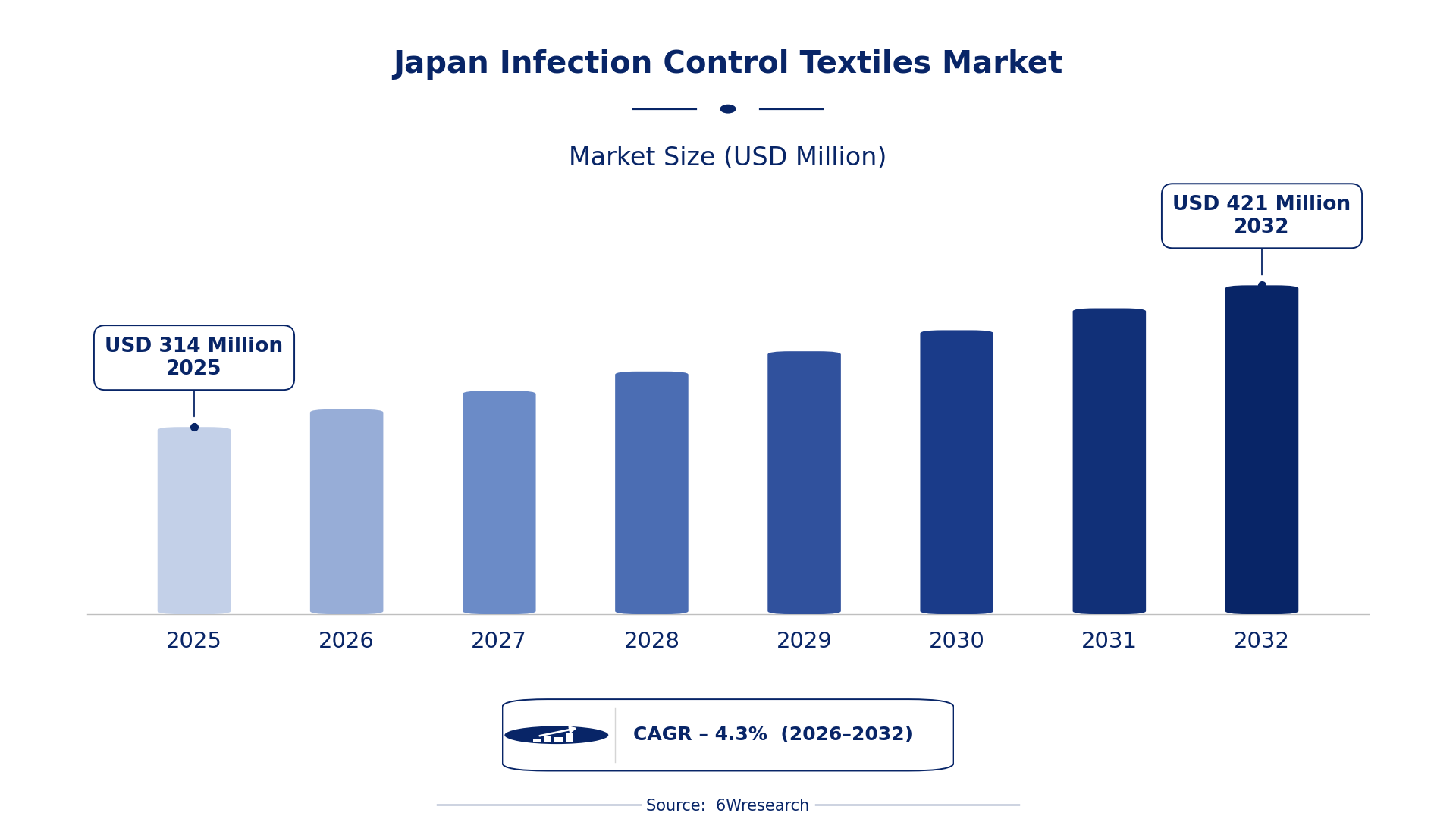
According to 6Wresearch internal database and industry insights, the Japan Infection Control Textiles Market was valued at USD 314 Million in 2025 and is projected to reach USD 421 Million by 2032, growing at a CAGR of approximately 4.3% during 2026–2032.
Japan Infection Control Textiles Market Highlights
| Report Metric | Details |
| Report Name | Japan Infection Control Textiles Market (2026-2032) |
| Market Size 2025 | USD 314 Million |
| Market Size 2032 | USD 421 Million |
| Absolute Growth 2025–2032 | USD 107 Million |
| CAGR 2026–2032 | 4.3% |
| Peak Annual Growth | 5.3% in 2032 |
| Forecast Period | 2026–2032 |
| Historical Data | 2022–2025 |
| Base Year | 2025 |
| Leading Textile Type, 2025 | Antimicrobial Curtains (33% share) |
| Leading Fiber Treatment, 2025 | Silver / Zinc Coatings (37% share) |
| Leading Usage Area, 2025 | Hospital Partitions (41% share) |
| Leading Distribution Channel, 2025 | Medical Textile Distributors (45% share) |
| Fastest-Growing Textile Type | Antibacterial Bedsheets (6.1% CAGR) |
| Fastest-Growing Fiber Treatment | Embedded Antiseptics (5.7% CAGR) |
| Fastest-Growing Usage Area | Patient Beds (5.3% CAGR) |
| Fastest-Growing Distribution Channel | Direct Sales (6.5% CAGR) |
| Growing Sector | healthcare textiles |
| Key End Users | hospitals, clinics, long-term care facilities, surgical centres |
Japan Infection Control Textiles Market Year-wise Growth Rate and Key Drivers (2022–2032)
This graph illustrates the annual growth rates of the market from 2022 to 2032, highlighting a steady upward trajectory and projected market expansion over the forecast period.
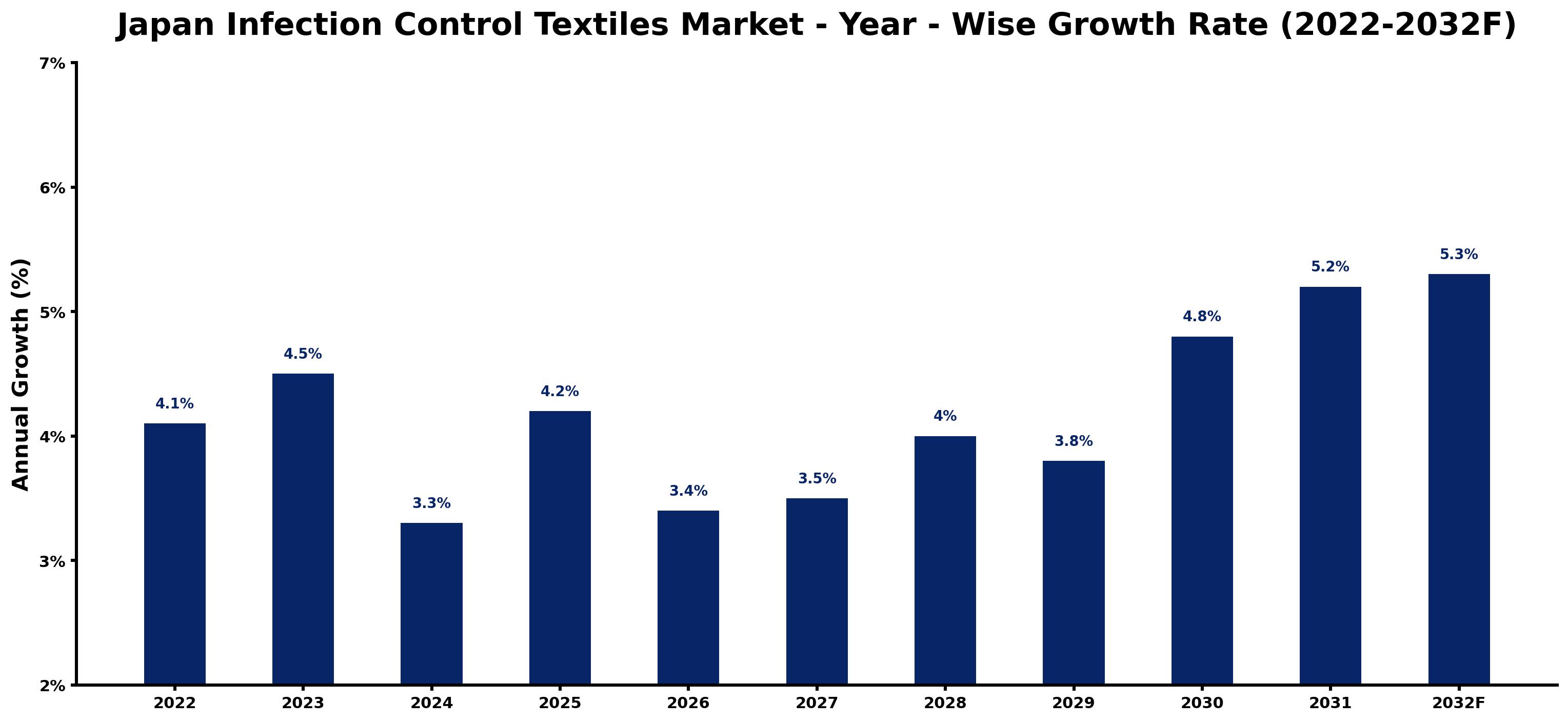
Each row of the following table gives one year's estimated growth and the event or demand shift that explains it.
| Year | Estimated Annual Growth (%) | Market Rationale |
| 2022 | 4.1 | The market showed steady growth, reflecting ongoing investments in healthcare infrastructure. |
| 2023 | 4.5 | Demand increased as hospitals adopted higher hygiene standards following recent health concerns. |
| 2024 | 3.3 | Growth slowed due to market saturation in certain textile applications and heightened competition. |
| 2025 | 4.2 | A resurgence in orders occurred as hospitals expanded their infection control measures. |
| 2026 | 3.4 | Growth is expected to decelerate as buyers adjust to previous investments and focus on cost management. |
| 2027 | 3.5 | Demand is projected to pick up again as healthcare facilities seek to improve patient safety protocols. |
| 2028 | 4.0 | Increased awareness of infection control is expected to spur further purchases across healthcare settings. |
| 2029 | 3.8 | Growth is projected to slow as market conditions stabilise and buyers reassess their procurement strategies. |
| 2030 | 4.8 | A renewed focus on infection prevention will lead to increased orders for specialized textiles. |
| 2031 | 5.2 | Demand is expected to surge as hospitals prepare for anticipated increases in patient volumes. |
| 2032 | 5.3 | The market is projected to peak as infection control textiles become standard in healthcare facilities. |
Note: Market size estimations and growth projections presented in this report are based on 6Wresearch's proprietary forecasting methodology, utilizing the latest available industry data, government publications, and primary research inputs.
Japan Infection Control Textiles Market Synopsis
Infection control textiles are specialised fabrics designed to inhibit the growth of microorganisms, primarily used in healthcare settings such as surgical drapes, patient bedding, and medical staff uniforms. The Japan Infection Control Textiles Market is growing due to rising healthcare demands and government initiatives aimed at improving hospital hygiene standards. With over 8,000 hospitals and clinics, the ageing population and increasing prevalence of hospital-acquired infections drive the need for these textiles. Ongoing investments in infection control technologies and practices support this expanding market, with the Tokyo region leading in demand.
Market Dynamics Impact Analysis (2026–2032)
| Factor | Type | Impact | Primary Segment Affected |
| Growing healthcare infrastructure investments | Driver | High | Antimicrobial Curtains |
| Increasing awareness of hospital-acquired infections | Driver | High | Disposable Drapes |
| Rising demand for infection-resistant uniforms | Opportunity | Medium | Infection-Resistant Uniforms |
| Expansion of long-term care facilities | Opportunity | Medium | Antibacterial Bedsheets |
| High competition among suppliers | Restraint | High | Medical Staff Apparel |
| Market saturation in certain textile applications | Restraint | Medium | Patient Beds |
| Rising costs of raw materials | Challenge | High | Surgical Use |
| Need for compliance with stringent regulations | Challenge | Medium | Hospital Partitions |
Evaluation of Drivers in Japan Infection Control Textiles Market (2026–2032)
These are the developments adding the most demand over the forecast period.
| Drivers | Primary Segment Affected | Why It Matters (Evidence) |
| Increased healthcare spending | Disposable Drapes | This trend is driven by the need for improved surgical hygiene, with disposable drapes used in over 90% of surgical procedures in Japan. |
| Growing elderly population | Infection-Resistant Uniforms | An aging demographic increases the demand for infection-resistant uniforms, critical for protecting medical staff in hospitals. |
| Heightened awareness of infection control | Antibacterial Bedsheets | The rising adoption of antibacterial bedsheets in long-term care facilities reflects growing awareness of hygiene standards. |
| Advancements in textile treatments | Embedded Antiseptics | Innovations in embedded antiseptics enhance product offerings, attracting more healthcare facilities to invest in these textiles. |
| Government initiatives for hygiene standards | Hospital Partitions | Government programs aimed at improving hospital hygiene have increased the demand for hospital partitions, which help create isolated areas. |
Behind the steady rise in orders sits increased healthcare spending, with a large portion of Japan's population relying on its extensive healthcare system. The growing elderly population contributes to a heightened demand for infection-resistant uniforms, further fuelling market growth. Awareness of infection control has led to the adoption of antibacterial bedsheets in long-term care facilities, while advancements in textile treatments, particularly embedded antiseptics, have enhanced product offerings, attracting more buyers from healthcare facilities.
Evaluation of Restraints in Japan Infection Control Textiles Market
The main factors holding the market back are set out below.
| Market Restraint | Primary Segment Affected | Why It Matters (Evidence) |
| High competition among suppliers | Medical Staff Apparel | Intense competition leads to price wars, affecting profitability for suppliers in the infection control textiles market. |
| Market saturation in certain textile applications | Patient Beds | As the market matures, growth slows due to limited new demand in established applications like patient beds. |
| Rising costs of raw materials | Surgical Use | Increased material costs impact suppliers' margins, potentially leading to higher prices for buyers. |
| Need for compliance with stringent regulations | Hospital Partitions | Compliance with regulations such as the JIS L 1902 standard increases operational costs for manufacturers. |
| Limited awareness among smaller healthcare facilities | Antimicrobial Curtains | Smaller facilities may lack knowledge of the benefits of antimicrobial curtains, hindering market expansion. |
Japan Infection Control Textiles Market Challenges
Over 90% of surgical procedures in Japan depend on disposable drapes, yet rising production costs from the national minimum wage increase to JPY 1,055 per hour compel producers to raise prices, straining hospital budgets. Urban hospitals face supply chain disruptions as demand for infection control textiles rises, resulting in delayed procurement for clinics. A shortage of skilled workers in textile treatment technologies limits producers' ability to meet the heightened standards set by the Ministry of Health, Labour and Welfare, creating compliance difficulties. Competition from nonwoven antiviral textiles intensifies, forcing established suppliers to adapt swiftly or risk losing market share to emerging players.
Trends in the Japan Infection Control Textiles Market
These developments are changing demand patterns in the Japan Infection Control Textiles Market.
- Shift towards Sustainable Textiles: Since 2023, a noticeable shift towards sustainable infection control textiles has emerged in Japan. The Tokyo Medical Association has advocated for eco-friendly materials, with over 30% of hospitals now opting for sustainable options.
- Emergence of Digital Procurement Platforms: In 2024, hospitals began adopting digital procurement platforms to streamline purchasing processes. This shift has improved efficiency, with an estimated 25% reduction in procurement time for medical textiles.
- Increased Demand for Disposable Medical Textiles: The demand for disposable medical textiles surged in 2025, as hospitals aimed to reduce cross-contamination risks. Over 90% of surgical procedures now utilise disposable drapes, reflecting this trend.
- Focus on Infection Prevention Training: In 2026, training programs for infection prevention became standard in healthcare facilities. This initiative, supported by the Ministry of Health, aims to reduce hospital-acquired infections by 30% by 2025.
Investment Opportunities in the Japan Infection Control Textiles Market
The opportunities below stand out in the Japan Infection Control Textiles Market for new entrants and existing suppliers.
- Invest in Antimicrobial Coatings: With a projected growth of 5.7% for embedded antiseptics, suppliers can invest in antimicrobial coatings to meet rising demand from hospitals focusing on infection control.
- Supply Disposable Drapes: The disposable drapes segment is essential in over 90% of surgical procedures. Suppliers can target hospitals in urban areas, where demand is highest, to fill this gap.
- Develop Nonwoven Antiviral Textiles: As nonwoven antiviral textiles gain traction, suppliers can focus on developing these products to meet rising health concerns, particularly in long-term care facilities.
- Partner with Medical Textile Distributors: By collaborating with medical textile distributors, suppliers can expand market reach and access a larger customer base, particularly in urban healthcare facilities.
Government Initiatives in the Japan Infection Control Textiles Market
The Electrical Appliance and Material Safety Act (1961) and the Medical Care Act (1948) set essential safety and quality standards for infection control textiles. Recent updates to these laws have incorporated modern requirements, ensuring that healthcare facilities adhere to stringent hygiene protocols and product safety measures, which improve overall patient safety.
Healthcare facilities effectively utilise government subsidies available for investing in infection control technologies. The Ministry of Health, Labour and Welfare provides financial support for hospitals that adopt advanced infection control textiles, enabling them to improve hygiene standards while managing costs.
Future Insight of the Japan Infection Control Textiles Market
By 2032, hospitals will increasingly adopt advanced infection control textiles due to new hygiene standards. Government incentives will drive healthcare facilities to invest in antimicrobial technologies, ensuring adherence to updated regulations. The Tokyo region will experience heightened demand for infection-resistant uniforms as hospitals implement revised protocols. As Japan's ageing population expands, the healthcare sector will grow, prompting suppliers to create tailored textile solutions that meet evolving healthcare needs.
Market Segmentation Analysis
Japan Infection Control Textiles Market report covers a detailed analysis of the following market segments:
By Textile Type – Antimicrobial Curtains Lead, Antibacterial Bedsheets Expected to Grow Fastest
According to Saurav Kr Singh, Senior Research Analyst at 6Wresearch, with 33% of textile type revenue in 2025, Antimicrobial Curtains was the largest category. Antimicrobial curtains dominate the market due to their extensive application in over 70% of urban hospitals, effectively minimising infection risks. This widespread adoption underscores the commitment of healthcare facilities to uphold stringent hygiene standards. Antibacterial Bedsheets are projected to grow fastest, at a CAGR of 6.1% during 2026–2032. Antibacterial bedsheets are rapidly gaining traction as they are vital for ensuring patient comfort and hygiene, particularly in long-term care settings. The increasing emphasis on reducing hospital-acquired infections is propelling this segment's growth. Suppliers should prioritise developing antibacterial bedsheets to align with the growing demand in healthcare.
By Fiber Treatment – Silver / Zinc Coatings Lead, Embedded Antiseptics Expected to Grow Fastest
Silver / Zinc Coatings took 37% of fiber treatment revenue in 2025, more than any other category. Silver and zinc coatings dominate the market as they are widely used for their antimicrobial properties across various textile applications. Their established presence in healthcare textiles underscores their importance in infection control. The quickest growth will come from Embedded Antiseptics, forecast to expand at a CAGR of 5.7% between 2026 and 2032. Embedded antiseptics are gaining traction due to their integral role in providing long-lasting infection control, particularly in high-demand environments. This trend is likely to accelerate as healthcare facilities seek more effective solutions. Manufacturers should invest in research and development for embedded antiseptics to capitalise on this growth opportunity.
By Usage Area – Hospital Partitions Lead, Patient Beds Expected to Grow Fastest
The largest usage area category in 2025 was Hospital Partitions, at 41% of revenue. Hospital partitions hold the largest share due to their vital role in creating isolated areas within hospitals, which is crucial for infection control. Their importance is underscored by the high adoption rates in numerous healthcare facilities across Japan. Over 2026–2032, Patient Beds are expected to post the fastest growth, at a CAGR of 5.3%. Patient beds are experiencing rapid growth as they are critical for infection control in patient care, particularly with the increasing number of elderly patients. This segment's growth will likely continue as healthcare facilities adapt to the rising demand for effective infection management solutions. Suppliers must focus on enhancing their offerings for patient beds to capitalise on the growing market demand.
By Distribution Channel – Medical Textile Distributors Lead, Direct Sales Expected to Grow Fastest
Medical Textile Distributors accounted for 45% of the market by distribution channel in 2025. Medical textile distributors dominate the market as they effectively supply infection control textiles to healthcare providers, ensuring that essential products reach hospitals. Their established networks facilitate timely delivery and support high hygiene standards across healthcare settings. Direct Sales is set to record the highest CAGR in this split, 6.5% over 2026–2032. Direct sales are growing quickly as manufacturers seek to strengthen relationships with healthcare providers, allowing for tailored solutions that meet specific needs. This approach is likely to drive further growth as responsiveness to market demands becomes increasingly important. Suppliers should refine their direct sales strategies to better connect with healthcare providers and boost market presence.
Key Attractiveness of the Report
- 10 Years of Market Numbers
- Historical Data Starting from 2022 to 2025
- Base Year 2025
- Forecast Data until 2032
- Key Performance Indicators Impacting the Market
- Major Upcoming Developments and Projects
Key Highlights of the Report:
- Japan Infection Control Textiles Market Outlook
- Market Size of Japan Infection Control Textiles Market, 2025
- Forecast of Japan Infection Control Textiles Market, 2032
- Historical Data and Forecast of Japan Infection Control Textiles Revenues & Volume for the Period 2022-2032F
- Japan Infection Control Textiles Market Trend Evolution
- Japan Infection Control Textiles Market Drivers and Challenges
- Japan Infection Control Textiles Price Trends
- Japan Infection Control Textiles Porter's Five Forces
- Japan Infection Control Textiles Industry Life Cycle
- Historical Data and Forecast of Japan Infection Control Textiles Market Revenues & Volume By Textile Type for the Period 2022-2032F
- Historical Data and Forecast of Japan Infection Control Textiles Market Revenues & Volume By Antimicrobial Curtains for the Period 2022-2032F
- Historical Data and Forecast of Japan Infection Control Textiles Market Revenues & Volume By Antibacterial Bedsheets for the Period 2022-2032F
- Historical Data and Forecast of Japan Infection Control Textiles Market Revenues & Volume By Infection-Resistant Uniforms for the Period 2022-2032F
- Historical Data and Forecast of Japan Infection Control Textiles Market Revenues & Volume By Disposable Drapes for the Period 2022-2032F
- Historical Data and Forecast of Japan Infection Control Textiles Market Revenues & Volume By Fiber Treatment for the Period 2022-2032F
- Historical Data and Forecast of Japan Infection Control Textiles Market Revenues & Volume By Silver / Zinc Coatings for the Period 2022-2032F
- Historical Data and Forecast of Japan Infection Control Textiles Market Revenues & Volume By Embedded Antiseptics for the Period 2022-2032F
- Historical Data and Forecast of Japan Infection Control Textiles Market Revenues & Volume By Coated Fabric for the Period 2022-2032F
- Historical Data and Forecast of Japan Infection Control Textiles Market Revenues & Volume By Nonwoven + Antiviral for the Period 2022-2032F
- Historical Data and Forecast of Japan Infection Control Textiles Market Revenues & Volume By Usage Area for the Period 2022-2032F
- Historical Data and Forecast of Japan Infection Control Textiles Market Revenues & Volume By Hospital Partitions for the Period 2022-2032F
- Historical Data and Forecast of Japan Infection Control Textiles Market Revenues & Volume By Patient Beds for the Period 2022-2032F
- Historical Data and Forecast of Japan Infection Control Textiles Market Revenues & Volume By Medical Staff Apparel for the Period 2022-2032F
- Historical Data and Forecast of Japan Infection Control Textiles Market Revenues & Volume By Surgical Use for the Period 2022-2032F
- Historical Data and Forecast of Japan Infection Control Textiles Market Revenues & Volume By Distribution Channel for the Period 2022-2032F
- Historical Data and Forecast of Japan Infection Control Textiles Market Revenues & Volume By Medical Textile Distributors for the Period 2022-2032F
- Historical Data and Forecast of Japan Infection Control Textiles Market Revenues & Volume By Direct Sales for the Period 2022-2032F
- Historical Data and Forecast of Japan Infection Control Textiles Market Revenues & Volume By Online Textile Suppliers for the Period 2022-2032F
- Historical Data and Forecast of Japan Infection Control Textiles Market Revenues & Volume By Hospital Linen Providers for the Period 2022-2032F
- Japan Infection Control Textiles Import Export Trade Statistics
- Market Opportunity Assessment By Textile Type
- Market Opportunity Assessment By Fiber Treatment
- Market Opportunity Assessment By Usage Area
- Market Opportunity Assessment By Distribution Channel
- Japan Infection Control Textiles Top Companies Market Share
- Japan Infection Control Textiles Competitive Benchmarking By Technical and Operational Parameters
- Japan Infection Control Textiles Company Profiles
- Japan Infection Control Textiles Key Strategic Recommendations
Market Covered
Segments analysed in this report are listed below.
By Textile Type
- Antimicrobial Curtains
- Antibacterial Bedsheets
- Infection-Resistant Uniforms
- Disposable Drapes
By Fiber Treatment
- Silver / Zinc Coatings
- Embedded Antiseptics
- Coated Fabric
- Nonwoven + Antiviral
By Usage Area
- Hospital Partitions
- Patient Beds
- Medical Staff Apparel
- Surgical Use
By Distribution Channel
- Medical Textile Distributors
- Direct Sales
- Online Textile Suppliers
- Hospital Linen Providers































