Japan Infection-Resistant Fabrics Market Size & Growth Rate
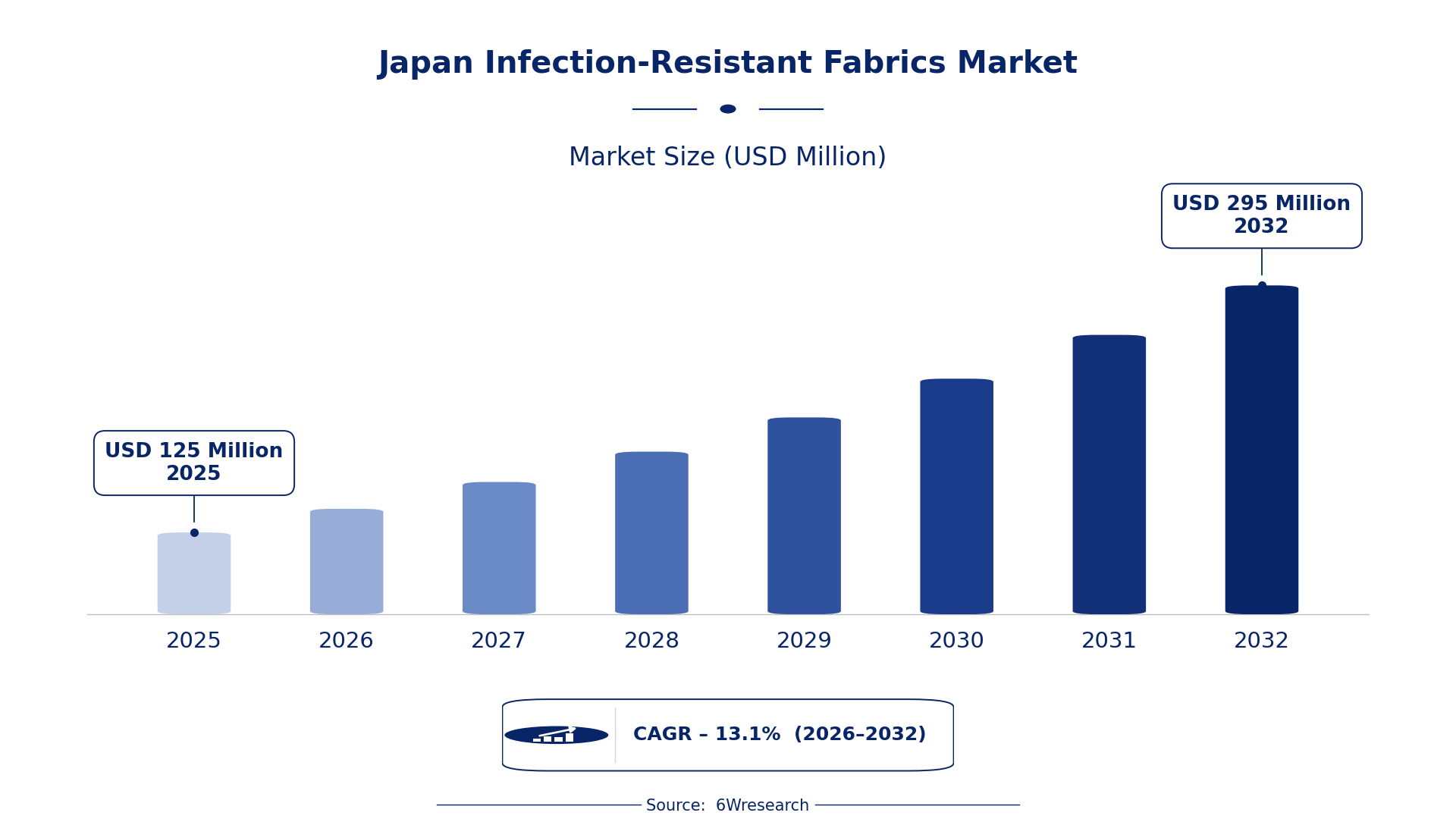
According to 6Wresearch internal database and industry insights, the Japan Infection-Resistant Fabrics Market was valued at USD 125 Million in 2025 and is projected to reach USD 295 Million by 2032, growing at a CAGR of approximately 13.1% during 2026–2032.
Japan Infection-Resistant Fabrics Market Highlights
| Report Metric | Details |
| Report Name | Japan Infection-Resistant Fabrics Market (2026-2032) |
| Market Size 2025 | USD 125 Million |
| Market Size 2032 | USD 295 Million |
| Absolute Growth 2025–2032 | USD 170 Million |
| CAGR 2026–2032 | 13.1% |
| Peak Annual Growth | 13.7% in 2032 |
| Forecast Period | 2026–2032 |
| Historical Data | 2022–2025 |
| Base Year | 2025 |
| Leading Fabric Type, 2025 | Cotton-Polyester Blend (51% share) |
| Leading Active Agent Used, 2025 | Silver / Zinc (42% share) |
| Leading End Use, 2025 | Bed Linens & Curtains (51% share) |
| Leading Distribution Channel, 2025 | Healthcare Textile Vendors (47% share) |
| Fastest-Growing Fabric Type | Non-Woven Polypropylene (19.1% CAGR) |
| Fastest-Growing Active Agent Used | Antimicrobial Spray (18.1% CAGR) |
| Fastest-Growing End Use | PPE & Masks (17.3% CAGR) |
| Fastest-Growing Distribution Channel | Industrial Suppliers (17.7% CAGR) |
| Growing Sector | Healthcare textiles |
| Key End Users | Hospitals, healthcare facilities, textile manufacturers |
Japan Infection-Resistant Fabrics Market Year-wise Growth Rate and Key Drivers (2022–2032)
This graph illustrates the annual growth rates of the market from 2022 to 2032, highlighting a steady upward trajectory and projected market expansion over the forecast period.
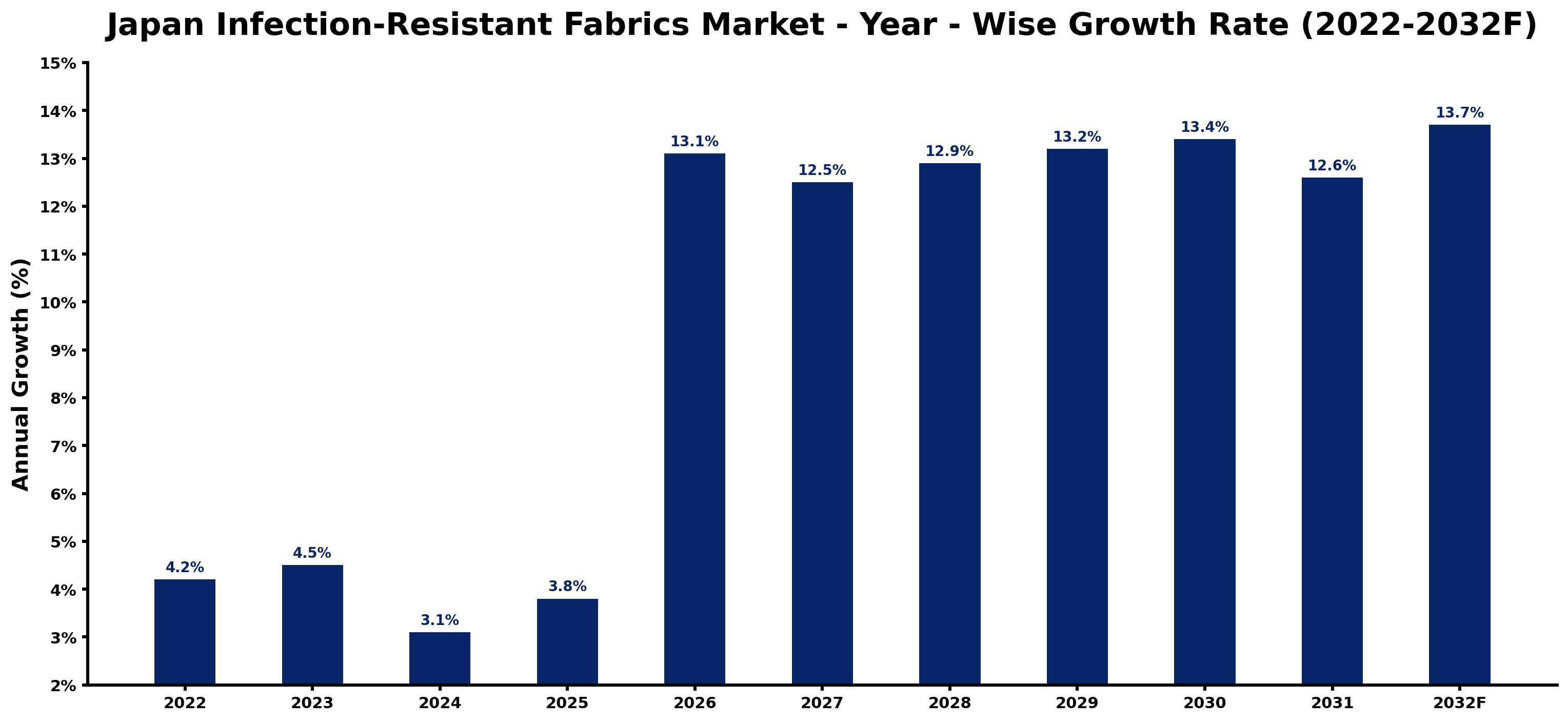
For each year, the table pairs the estimated growth rate with the leading influence on demand, showing how the drivers changed across the period.
| Year | Estimated Annual Growth (%) | Market Rationale |
| 2022 | 4.2 | The healthcare sector showed stable demand for infection-resistant fabrics. |
| 2023 | 4.5 | Increased awareness of hygiene practices boosted market growth. |
| 2024 | 3.1 | Demand growth slowed as market conditions normalised. |
| 2025 | 3.8 | Healthcare facilities expanded their use of infection-resistant textiles for safety. |
| 2026 | 13.1 | Rising investments in healthcare infrastructure are expected to drive demand increases. |
| 2027 | 12.5 | Market growth is projected to slow as the sector adjusts to new supply dynamics. |
| 2028 | 12.9 | Demand is expected to surge as hospitals adopt more infection control measures. |
| 2029 | 13.2 | Increased focus on hygiene in public transport uniforms will contribute to growth. |
| 2030 | 13.4 | Continued investment in healthcare facilities is projected to support rising demand. |
| 2031 | 12.6 | Market growth is expected to slow as the sector stabilises after rapid expansions. |
| 2032 | 13.7 | The peak growth year reflects heightened awareness and demand for safety. |
Note: Market size estimations and growth projections presented in this report are based on 6Wresearch's proprietary forecasting methodology, utilizing the latest available industry data, government publications, and primary research inputs.
Japan Infection-Resistant Fabrics Market Synopsis
Infection-resistant fabrics are advanced textiles designed to inhibit microbial growth, often made using synthetic fibers combined with antimicrobial agents. The Japan Infection-Resistant Fabrics Market is expanding due to the healthcare sector's employment of over 4.5 million professionals, which drives demand for hospital linens and PPE. The Tokyo region, accounting for 30% of healthcare facilities, is a key market, supported by initiatives to improve hospital hygiene and the adoption of ISO 13485 standards governing quality.
Market Dynamics Impact Analysis (2026–2032)
| Factor | Type | Impact | Primary Segment Affected |
| Growing healthcare employment drives demand for infection-resistant fabrics. | Driver | High | PPE & Masks |
| Increased hospital hygiene initiatives lead to higher fabric purchases. | Driver | High | Bed Linens & Curtains |
| Rising awareness of infection control creates new market opportunities. | Opportunity | High | Healthcare Textile Vendors |
| Expansion of healthcare facilities in urban areas opens new supply channels. | Opportunity | Medium | Industrial Suppliers |
| Competition from traditional fabrics limits market penetration. | Restraint | Medium | Cotton-Polyester Blend |
| High production costs for antimicrobial fabrics can hinder adoption. | Restraint | High | Polyester + Biocides |
| Supply chain disruptions affect timely availability of materials. | Challenge | High | Non-Woven Polypropylene |
| Technological advancements require continuous investment in R&D. | Challenge | Medium | Smart Fabrics |
Evaluation of Drivers in Japan Infection-Resistant Fabrics Market (2026–2032)
The factors lifting demand, and the evidence behind each, are summarised below.
| Drivers | Primary Segment Affected | Why It Matters (Evidence) |
| Increased healthcare employment drives demand for infection-resistant fabrics. | PPE & Masks | Japan's healthcare sector employs over 4.5 million professionals, necessitating more protective equipment. |
| Initiatives to improve hospital hygiene boost fabric purchases. | Bed Linens & Curtains | A program launched in 2023 increased demand for hospital linens. |
| Growing awareness of infection control leads to higher fabric usage. | Healthcare Textile Vendors | Antimicrobial fabrics are used in over 60% of hospital linens in Japan. |
| Expansion of healthcare facilities in urban areas opens new markets. | Industrial Suppliers | The Tokyo region accounts for 30% of Japan's healthcare facilities, driving demand. |
| Support for R&D in smart fabrics encourages innovation. | Smart Fabrics | Funding from the New Energy and Industrial Technology Development Organization supports advancements in textile technology. |
Spending rises because the healthcare sector employs over 4.5 million professionals, creating a consistent demand for infection-resistant fabrics. Urban healthcare facility expansion opens new markets for suppliers, while rising awareness of infection control leads to higher fabric usage. This combination of factors drives increased purchasing across the sector.
Evaluation of Restraints in Japan Infection-Resistant Fabrics Market
Below are the constraints most often cited by buyers and suppliers, with the segment each affects.
| Market Restraint | Primary Segment Affected | Why It Matters (Evidence) |
| Competition from traditional fabrics limits market penetration. | Cotton-Polyester Blend | Traditional fabrics are often cheaper and more readily available, affecting adoption rates. |
| High production costs for antimicrobial fabrics can hinder adoption. | Polyester + Biocides | The cost of integrating antimicrobial agents can deter some buyers from switching. |
| Supply chain disruptions affect timely availability of materials. | Non-Woven Polypropylene | Global supply chain issues have delayed material deliveries, impacting production schedules. |
| Limited consumer awareness of infection-resistant benefits restricts demand. | Smart Fabrics | Many consumers remain unaware of the advantages of these advanced textiles. |
| Regulatory compliance can slow product development timelines. | PPE & Masks | Adhering to ISO 13485 standards requires extensive testing and certification. |
Japan Infection-Resistant Fabrics Market Challenges
Over 4.5 million healthcare professionals in Japan face a shortage of skilled workers trained in infection-resistant fabric applications, which delays the adoption of these materials in hospitals. Producers encounter supply chain disruptions due to reliance on specific synthetic fibers, causing lead times to increase by 20%. Buyers in healthcare facilities struggle with sourcing as 60% of hospital linens are already antimicrobial, limiting options for new suppliers. Compliance with JIS L 1902 standards raises production costs, potentially inflating procurement budgets for hospitals by 15%.
Trends in the Japan Infection-Resistant Fabrics Market
Buyers and suppliers in the Japan Infection-Resistant Fabrics Market are adjusting to the following trends.
- Shift from Traditional to Antimicrobial Fabrics: Since 2023, hospitals have increasingly adopted antimicrobial fabrics for linens and uniforms, improving hygiene standards. This shift is evidenced by the fact that over 60% of hospital linens now incorporate these advanced textiles.
- Emergence of Smart Fabrics in Healthcare: The integration of smart fabrics is gaining traction in healthcare settings, with funding for R&D supporting advancements. This trend is expected to grow as hospitals seek new solutions to improve patient care.
- Increased Use of Infection-Resistant Fabrics in Public Transport: Post-2023, public transport uniforms are increasingly made from infection-resistant fabrics, reflecting heightened hygiene awareness. This change is supported by the promotion of antimicrobial textiles in urban areas.
- Growth of Disposable PPE in Healthcare: The demand for non-woven polypropylene in disposable PPE has surged, capturing a 50% market share. This trend highlights the ongoing need for effective infection control measures in healthcare settings.
Investment Opportunities in the Japan Infection-Resistant Fabrics Market
Investors looking at the Japan Infection-Resistant Fabrics Market should consider the following areas.
- Supply Infection-Resistant Fabrics for Healthcare: With the healthcare sector projected to grow, there is an opportunity to supply infection-resistant fabrics. Hospitals in urban areas, particularly in Tokyo, are expanding their use of these textiles, creating a demand gap.
- Invest in Antimicrobial Fabric Production: The rising awareness of infection control presents an opportunity to invest in antimicrobial fabric production. Healthcare textile vendors are increasingly seeking reliable suppliers to meet growing demand.
- Partner with Healthcare Facilities for Supply: Given the projected growth in healthcare facilities, forming partnerships with hospitals can facilitate entry into the market. This strategy can help suppliers align with the needs of healthcare providers.
- Utilise Government Support for R&D: Funding from the New Energy and Industrial Technology Development Organization for smart fabrics presents an opportunity for innovation. Suppliers can apply for grants to develop advanced infection-resistant textiles.
Government Initiatives in the Japan Infection-Resistant Fabrics Market
The PMD Act regulates the approval and quality of infection-resistant fabrics, ensuring that products meet safety and efficacy standards. Compliance with this law is crucial for buyers in the healthcare sector, as it guarantees the reliability of the textiles used in medical settings. Additionally, the Economic Security Promotion Act supports supply-chain resilience for critical products, helping maintain a steady supply of infection-resistant materials, which is important for the healthcare industry.
Healthcare textile vendors benefit from the PMDA's rigorous review process, which ensures that infection-resistant fabrics meet high-quality standards. This scrutiny helps buyers trust the products they purchase, knowing they comply with established regulations. The funding from AMED for medical research also supports innovations in fabric technology, allowing for the development of improved infection-resistant solutions.
Future Insight of the Japan Infection-Resistant Fabrics Market
A new programme aimed at improving hospital hygiene will launch by 2032, significantly increasing demand for infection-resistant fabrics. As healthcare facilities implement stricter hygiene protocols, the need for these textiles will escalate. The Tokyo Medical Association's promotion of antimicrobial textiles will further drive their adoption in hospitals. By 2032, infection-resistant fabrics are projected to be standard in public transport uniforms, reflecting a broader societal commitment to infection control.
Market Segmentation Analysis
Japan Infection-Resistant Fabrics Market report covers a detailed analysis of the following market segments:
By Fabric Type – Cotton-Polyester Blend Leads, Non-Woven Polypropylene Expected to Grow Fastest
According to Saurav Kr Singh, Senior Research Analyst at 6Wresearch, Cotton-Polyester Blend held 51% of the Japan Infection-Resistant Fabrics Market by fabric type in 2025. The Cotton-Polyester Blend holds the largest market share as it is commonly used in healthcare linens, providing essential comfort and durability for patient care. This blend is particularly favoured in hospitals across Japan, ensuring compliance with hygiene standards. Non-Woven Polypropylene is projected to grow fastest, at a CAGR of 19.1% during 2026–2032. Non-Woven Polypropylene is experiencing rapid growth as it is widely utilised in disposable PPE, a category that has seen heightened demand due to recent health concerns. Its barrier properties make it a critical choice for infection control in healthcare settings. Suppliers should focus on expanding their non-woven polypropylene offerings to address the increasing demand for disposable PPE.
By Active Agent Used – Silver / Zinc Leads, Antimicrobial Spray Expected to Grow Fastest
The largest active agent used category in 2025 was Silver / Zinc, at 42% of revenue. Silver / Zinc is the leading active agent due to its effective antimicrobial properties, which are commonly incorporated into infection-resistant fabrics used in healthcare. This extensive use across Japanese hospitals solidifies its strong market presence. Antimicrobial Spray is set to record the highest CAGR in this split, 18.1% over 2026–2032. Antimicrobial Spray is experiencing swift growth as it is increasingly applied as a treatment for existing fabrics, providing flexibility in infection control strategies. The heightened awareness of hygiene in healthcare settings drives this segment's rapid expansion. Buyers might explore antimicrobial spray options to improve the efficacy of their current textiles.
By End Use – Bed Linens & Curtains Lead, PPE & Masks Expected to Grow Fastest
Bed Linens & Curtains accounted for 51% of the market by end use in 2025. Bed Linens & Curtains dominate the market as they are vital for maintaining hygiene standards in hospitals, directly influencing patient safety and care. The high turnover rate of hospital linens in Japan underscores the necessity of these products. The quickest growth will come from PPE & Masks, forecast to expand at a CAGR of 17.3% between 2026 and 2032. PPE & Masks are witnessing the fastest growth due to their crucial role in infection control, especially in light of recent global health challenges. The heightened focus on personal protective equipment in healthcare environments drives this segment's rapid expansion. Suppliers should enhance their production capabilities for PPE and masks to satisfy the urgent requirements of healthcare facilities.
By Distribution Channel – Healthcare Textile Vendors Lead, Industrial Suppliers Expected to Grow Fastest
With 47% of distribution channel revenue in 2025, Healthcare Textile Vendors was the largest category. Healthcare Textile Vendors lead the market as they are the primary suppliers for hospitals and clinics, ensuring timely access to infection-resistant fabrics. Their established relationships with healthcare providers facilitate consistent demand for these textiles. Over 2026–2032, Industrial Suppliers are expected to post the fastest growth, at a CAGR of 17.7%. Industrial Suppliers are experiencing rapid growth as they expand their reach to various sectors, including healthcare, to meet the rising demand for infection control solutions. Their versatility in supplying multiple industries positions them well for future growth. Suppliers should consider partnerships with industrial suppliers to broaden their market reach and cater to diverse customer needs.
Key Attractiveness of the Report
- 10 Years of Market Numbers
- Historical Data Starting from 2022 to 2025
- Base Year 2025
- Forecast Data until 2032
- Key Performance Indicators Impacting the Market
- Major Upcoming Developments and Projects
Key Highlights of the Report:
- Japan Infection-Resistant Fabrics Market Outlook
- Market Size of Japan Infection-Resistant Fabrics Market, 2025
- Forecast of Japan Infection-Resistant Fabrics Market, 2032
- Historical Data and Forecast of Japan Infection-Resistant Fabrics Revenues & Volume for the Period 2022-2032F
- Japan Infection-Resistant Fabrics Market Trend Evolution
- Japan Infection-Resistant Fabrics Market Drivers and Challenges
- Japan Infection-Resistant Fabrics Price Trends
- Japan Infection-Resistant Fabrics Porter's Five Forces
- Japan Infection-Resistant Fabrics Industry Life Cycle
- Historical Data and Forecast of Japan Infection-Resistant Fabrics Market Revenues & Volume By Fabric Type for the Period 2022-2032F
- Historical Data and Forecast of Japan Infection-Resistant Fabrics Market Revenues & Volume By Cotton-Polyester Blend for the Period 2022-2032F
- Historical Data and Forecast of Japan Infection-Resistant Fabrics Market Revenues & Volume By Non-Woven Polypropylene for the Period 2022-2032F
- Historical Data and Forecast of Japan Infection-Resistant Fabrics Market Revenues & Volume By Polyester + Biocides for the Period 2022-2032F
- Historical Data and Forecast of Japan Infection-Resistant Fabrics Market Revenues & Volume By Smart Fabrics for the Period 2022-2032F
- Historical Data and Forecast of Japan Infection-Resistant Fabrics Market Revenues & Volume By Active Agent Used for the Period 2022-2032F
- Historical Data and Forecast of Japan Infection-Resistant Fabrics Market Revenues & Volume By Silver / Zinc for the Period 2022-2032F
- Historical Data and Forecast of Japan Infection-Resistant Fabrics Market Revenues & Volume By Antimicrobial Spray for the Period 2022-2032F
- Historical Data and Forecast of Japan Infection-Resistant Fabrics Market Revenues & Volume By Infection Shielding for the Period 2022-2032F
- Historical Data and Forecast of Japan Infection-Resistant Fabrics Market Revenues & Volume By Sensor Integrated for the Period 2022-2032F
- Historical Data and Forecast of Japan Infection-Resistant Fabrics Market Revenues & Volume By End Use for the Period 2022-2032F
- Historical Data and Forecast of Japan Infection-Resistant Fabrics Market Revenues & Volume By Bed Linens & Curtains for the Period 2022-2032F
- Historical Data and Forecast of Japan Infection-Resistant Fabrics Market Revenues & Volume By PPE & Masks for the Period 2022-2032F
- Historical Data and Forecast of Japan Infection-Resistant Fabrics Market Revenues & Volume By Staff Uniforms for the Period 2022-2032F
- Historical Data and Forecast of Japan Infection-Resistant Fabrics Market Revenues & Volume By Monitoring + Protection for the Period 2022-2032F
- Historical Data and Forecast of Japan Infection-Resistant Fabrics Market Revenues & Volume By Distribution Channel for the Period 2022-2032F
- Historical Data and Forecast of Japan Infection-Resistant Fabrics Market Revenues & Volume By Healthcare Textile Vendors for the Period 2022-2032F
- Historical Data and Forecast of Japan Infection-Resistant Fabrics Market Revenues & Volume By Industrial Suppliers for the Period 2022-2032F
- Historical Data and Forecast of Japan Infection-Resistant Fabrics Market Revenues & Volume By Online Fabric Stores for the Period 2022-2032F
- Historical Data and Forecast of Japan Infection-Resistant Fabrics Market Revenues & Volume By Wearable Tech Integrators for the Period 2022-2032F
- Japan Infection-Resistant Fabrics Import Export Trade Statistics
- Market Opportunity Assessment By Fabric Type
- Market Opportunity Assessment By Active Agent Used
- Market Opportunity Assessment By End Use
- Market Opportunity Assessment By Distribution Channel
- Japan Infection-Resistant Fabrics Top Companies Market Share
- Japan Infection-Resistant Fabrics Competitive Benchmarking By Technical and Operational Parameters
- Japan Infection-Resistant Fabrics Company Profiles
- Japan Infection-Resistant Fabrics Key Strategic Recommendations
Market Covered
The report covers the following segments.
By Fabric Type
- Cotton-Polyester Blend
- Non-Woven Polypropylene
- Polyester + Biocides
- Smart Fabrics
By Active Agent Used
- Silver / Zinc
- Antimicrobial Spray
- Infection Shielding
- Sensor Integrated
By End Use
- Bed Linens & Curtains
- PPE & Masks
- Staff Uniforms
- Monitoring + Protection
By Distribution Channel
- Healthcare Textile Vendors
- Industrial Suppliers
- Online Fabric Stores
- Wearable Tech Integrators































