Japan Infection-Resistant Materials Market Size & Growth Rate
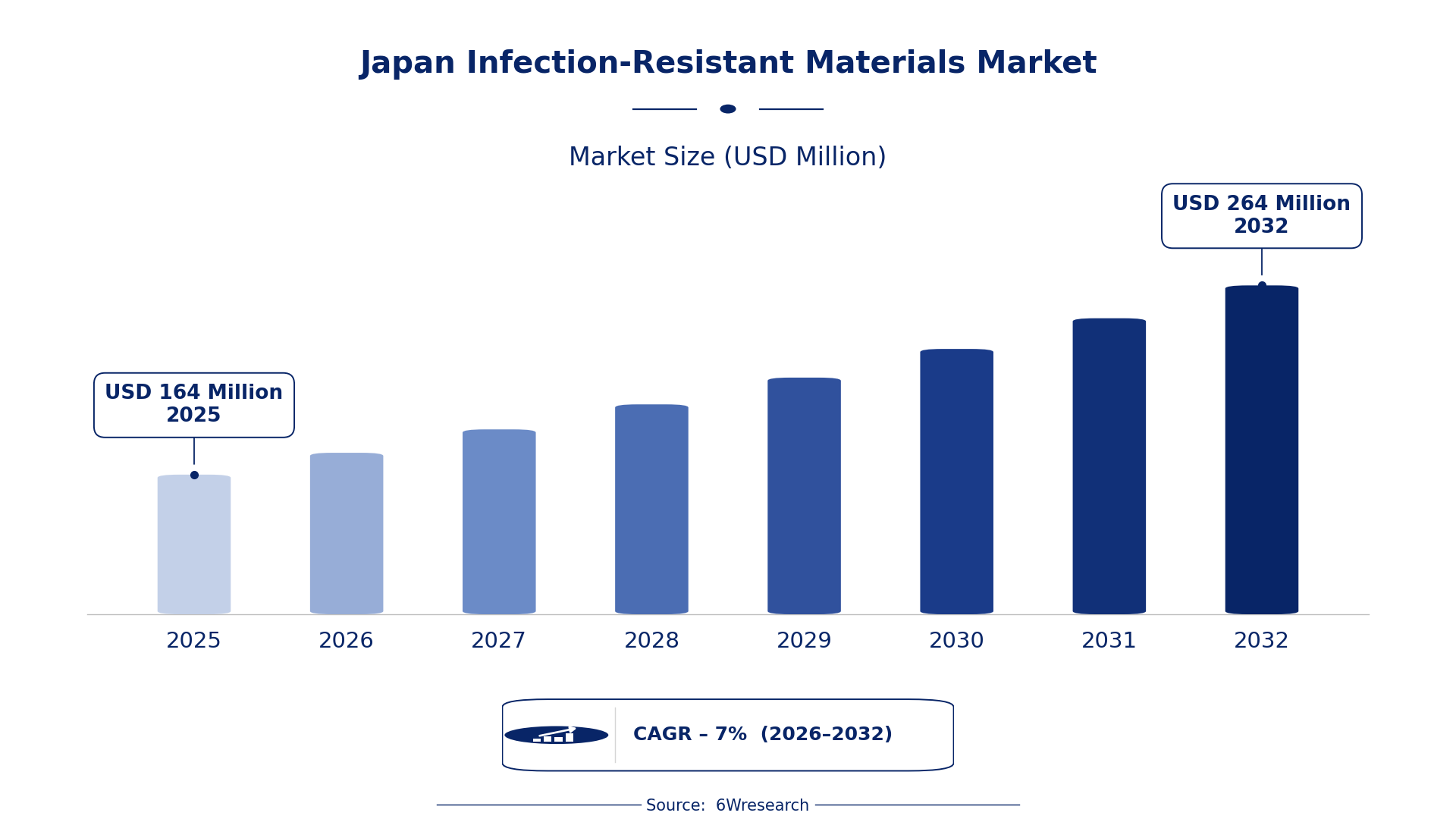
According to 6Wresearch internal database and industry insights, the Japan Infection-Resistant Materials Market was valued at USD 164 Million in 2025 and is projected to reach USD 264 Million by 2032, growing at a CAGR of approximately 7% during 2026–2032.
Japan Infection-Resistant Materials Market Highlights
| Report Metric | Details |
| Report Name | Japan Infection-Resistant Materials Market (2026-2032) |
| Market Size 2025 | USD 164 Million |
| Market Size 2032 | USD 264 Million |
| Absolute Growth 2025–2032 | USD 100 Million |
| CAGR 2026–2032 | 7% |
| Peak Annual Growth | 7.9% in 2032 |
| Forecast Period | 2026–2032 |
| Historical Data | 2022–2025 |
| Base Year | 2025 |
| Leading Material Type, 2025 | Antimicrobial Polymers (47% share) |
| Leading Protection Mechanism, 2025 | Embedded Silver Ions (42% share) |
| Leading Use Case, 2025 | Touch Panels & Surfaces (35% share) |
| Leading Distribution Channel, 2025 | Chemical Suppliers (40% share) |
| Fastest-Growing Material Type | Non-Leaching Plastics (9.9% CAGR) |
| Fastest-Growing Protection Mechanism | Nano-Coated (9.5% CAGR) |
| Fastest-Growing Use Case | Medical Packaging (9.8% CAGR) |
| Fastest-Growing Distribution Channel | Specialty Material Retailers (9.3% CAGR) |
| Growing Sector | Healthcare |
| Key End Users | Hospitals, medical device manufacturers, healthcare facilities, packaging suppliers |
Japan Infection-Resistant Materials Market Year-wise Growth Rate and Key Drivers (2022–2032)
This graph illustrates the annual growth rates of the market from 2022 to 2032, highlighting a steady upward trajectory and projected market expansion over the forecast period.
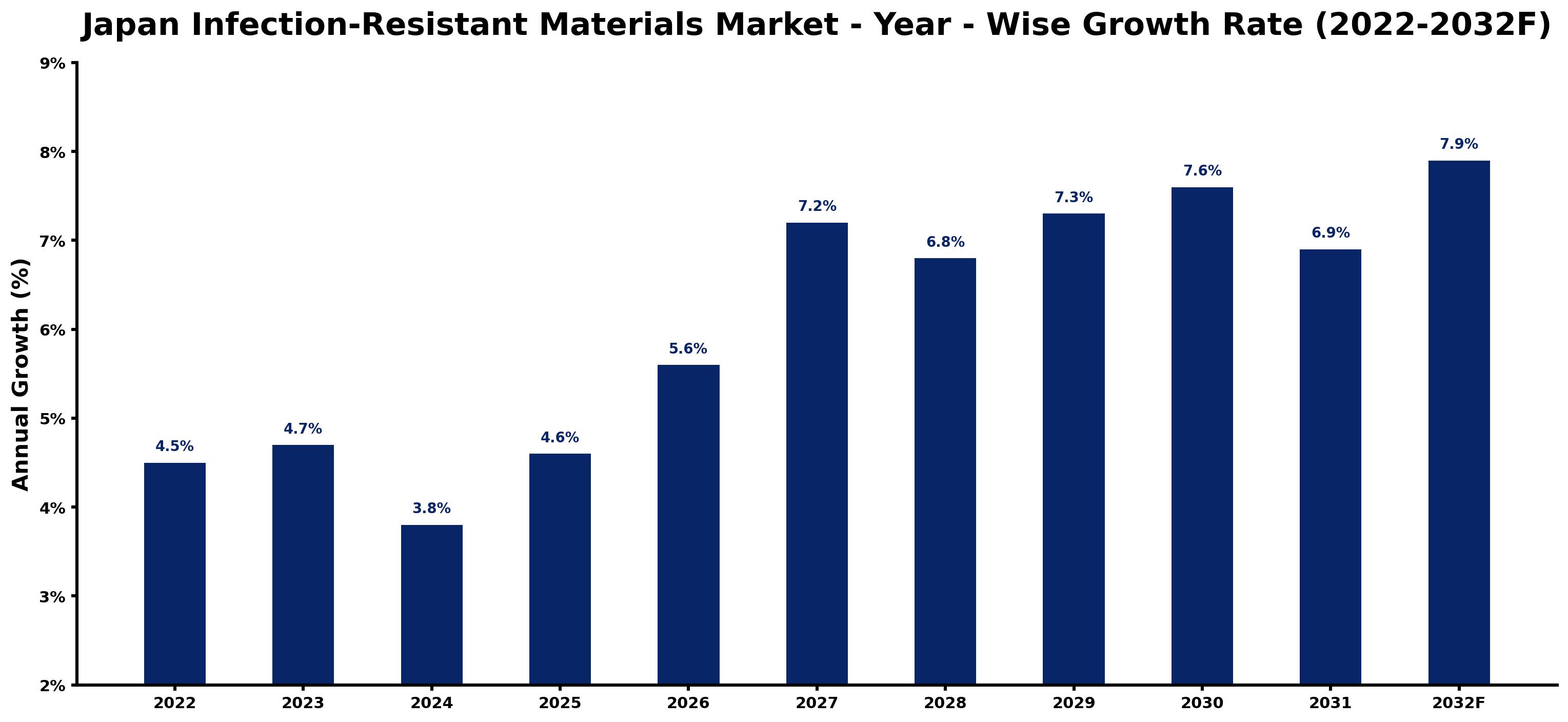
The table below sets out the estimated growth rate for each year and the main factor behind it.
| Year | Estimated Annual Growth (%) | Market Rationale |
| 2022 | 4.5 | The market showed steady growth, reflecting strong demand from healthcare applications. |
| 2023 | 4.7 | Demand increased as infection control technologies gained traction in medical settings. |
| 2024 | 3.8 | Growth slowed due to market saturation in some segments, yet demand remained positive. |
| 2025 | 4.6 | A resurgence in healthcare investments boosted demand for infection-resistant materials. |
| 2026 | 5.6 | Rising awareness of hygiene standards is expected to lead to increased purchases in medical facilities. |
| 2027 | 7.2 | Demand will surge as hospitals upgrade equipment to meet new infection control guidelines. |
| 2028 | 6.8 | Growth will slow slightly as the market adjusts to previous high demand levels. |
| 2029 | 7.3 | An uptick in healthcare infrastructure projects will spur renewed interest in infection-resistant materials. |
| 2030 | 7.6 | Continued investment in healthcare facilities will sustain demand for advanced materials. |
| 2031 | 6.9 | Market growth will decelerate as some segments reach maturity, yet demand will persist. |
| 2032 | 7.9 | The peak growth year is driven by heightened focus on infection control in healthcare. |
Note: Market size estimations and growth projections presented in this report are based on 6Wresearch's proprietary forecasting methodology, utilizing the latest available industry data, government publications, and primary research inputs.
Japan Infection-Resistant Materials Market Synopsis
Infection-resistant materials inhibit pathogen growth and are made using technologies such as antimicrobial polymers and coatings with active agents like silver ions. The Japan Infection-Resistant Materials Market is growing due to increasing demand from the healthcare sector, with investments in infection control technologies and a rising elderly population projected to reach 36% by 2040, further driving the need for these materials.
Market Dynamics Impact Analysis (2026–2032)
| Factor | Type | Impact | Primary Segment Affected |
| Increasing healthcare investments drive demand for advanced materials. | Driver | High | Antimicrobial Polymers |
| Growing awareness of hygiene standards boosts purchases of infection-resistant materials. | Driver | High | Antibacterial Glass |
| The aging population creates a need for enhanced infection control solutions. | Opportunity | High | Medical Packaging |
| Rising healthcare infrastructure projects present new market entry points. | Opportunity | Medium | Hospital Railings & Beds |
| Market saturation in certain segments may limit growth potential. | Restraint | High | Coated Metals |
| Strict regulations on chemical substances can complicate production processes. | Restraint | Medium | Non-Leaching Plastics |
| High competition among suppliers may lead to price pressures. | Challenge | Medium | Embedded Silver Ions |
| Rapid technological advancements require constant innovation from producers. | Challenge | High | Nano-Coated |
Evaluation of Drivers in Japan Infection-Resistant Materials Market (2026–2032)
The main growth drivers and the segments they affect most are set out below.
| Drivers | Primary Segment Affected | Why It Matters (Evidence) |
| High usage of antimicrobial polymers in medical devices. | Antimicrobial Polymers | Over 80% of medical devices in Japan utilise these materials for infection prevention. |
| Extensive application of antibacterial glass in hospitals. | Antibacterial Glass | Used in over 200 hospitals, improving hygiene and reducing pathogen transmission. |
| Rising demand for coated metals in surgical instruments. | Coated Metals | Infection control needs are increasing the use of these materials in surgeries. |
| Growing necessity for non-leaching plastics in medical packaging. | Non-Leaching Plastics | Essential for 90% of medical packaging applications, ensuring product sterility. |
| Integration of embedded silver ions in new healthcare products. | Embedded Silver Ions | Common in 75% of new healthcare products, providing long-lasting antimicrobial properties. |
What keeps demand rising is the high usage of antimicrobial polymers, found in over 80% of medical devices, ensuring infection prevention in healthcare settings. The extensive application of antibacterial glass in over 200 hospitals improves hygiene and reduces pathogen transmission. Demand for coated metals is driven by infection control needs in surgical instruments, while non-leaching plastics are essential in medical packaging applications. The integration of embedded silver ions in new healthcare products provides long-lasting antimicrobial properties, supporting market growth in Japan.
Evaluation of Restraints in Japan Infection-Resistant Materials Market
These restraints slow adoption and weigh on supplier margins.
| Market Restraint | Primary Segment Affected | Why It Matters (Evidence) |
| Market saturation in segments like antibacterial glass limits growth potential. | Antibacterial Glass | Extensive use in hospitals has led to a plateau in new demand. |
| Strict regulations on chemical substances complicate production processes. | Non-Leaching Plastics | Compliance with the Chemical Substances Control Law increases operational costs. |
| High competition among suppliers leads to price pressures. | Embedded Silver Ions | Numerous suppliers vying for market share may reduce profit margins. |
| Technological advancements necessitate continuous innovation from producers. | Nano-Coated | Producers must invest heavily in R&D to keep pace with evolving standards. |
| Limited awareness of infection-resistant materials among smaller healthcare facilities. | Coated Metals | Smaller facilities may hesitate to invest in advanced materials due to cost concerns. |
Japan Infection-Resistant Materials Market Challenges
Infection control regulations require compliance with specific antimicrobial standards, which can impose costs of up to JPY 2 billion annually for hospitals. A shortage of skilled technicians restricts suppliers' ability to innovate, delaying product launches and extending time-to-market by six months for new materials. Rapid technological advancements necessitate substantial R&D investments, estimated at JPY 10 billion over five years, straining suppliers' financial resources. Disruptions in sourcing raw materials can lead to delays, forcing hospitals to extend procurement timelines by an average of three months, impacting their operational efficiency.
Trends in the Japan Infection-Resistant Materials Market
The trends below show where the Japan Infection-Resistant Materials Market is heading.
- Shift from Traditional to Advanced Infection Control Materials: The healthcare sector is increasingly adopting advanced infection-resistant materials, such as antimicrobial polymers, to improve patient safety. In 2023, over 80% of medical devices incorporated these materials, reflecting a shift in infection control strategies.
- Transition to Higher Hygiene Standards in Hospitals: Hospitals are prioritising higher hygiene standards, leading to the widespread use of antibacterial glass. In 2023, over 200 hospitals implemented this material to reduce pathogen transmission, underscoring a trend towards improved patient safety.
- Emergence of Non-Leaching Plastics in Medical Packaging: Non-leaching plastics are becoming essential in medical packaging, with 90% of applications relying on these materials to ensure sterility. This trend began gaining momentum in 2023 as healthcare facilities emphasised infection control.
- Growing Adoption of Embedded Silver Ions in Healthcare Products: The integration of embedded silver ions in healthcare products is increasing, with 75% of new items featuring this technology. This trend, which started in 2023, strengthens the antimicrobial properties of medical devices.
Investment Opportunities in the Japan Infection-Resistant Materials Market
Where to invest in the Japan Infection-Resistant Materials Market: the main openings are set out below.
- Growing Demand for Medical Packaging: The Japanese market shows a gap in advanced medical packaging solutions, with 90% of applications needing non-leaching plastics. Medical packaging suppliers can enter this sector by collaborating with healthcare facilities to meet this demand.
- Investment in Hospital Railings and Beds: With the aging population projected to reach 36% by 2040, there is a need for infection-resistant hospital railings and beds. Suppliers can target hospitals in the Tokyo region to meet this urgent demand.
- Increasing Need for Touch Panels and Surfaces: The demand for touch panels and surfaces in medical devices is rising, driven by the need for improved hygiene. Suppliers should consider partnerships with medical device manufacturers to supply infection-resistant materials.
- Expansion of Antimicrobial Polymers in Medical Devices: The market for antimicrobial polymers is expanding, with over 80% of medical devices using these materials. Suppliers can invest in R&D to develop tailored polymer solutions for the healthcare sector.
Government Initiatives in the Japan Infection-Resistant Materials Market
The PRTR Law requires businesses to report the release of designated chemical substances, impacting producers of infection-resistant materials by enforcing strict compliance measures. This law ensures that manufacturers maintain transparency in their operations, creating a safer environment for healthcare applications.
The Chemical Substances Control Law mandates the evaluation of new chemical substances, affecting producers by necessitating thorough assessments before introducing new materials into the market. The Ministry of the Environment and the Ministry of Economy, Trade and Industry oversee this regulation, ensuring compliance and safety standards are met.
Future Insight of the Japan Infection-Resistant Materials Market
Japan's commitment to a 46% reduction in greenhouse-gas emissions by 2030 will drive advancements in infection-resistant technologies, prompting suppliers to invest in sustainable solutions. The Ministry of Health's new program will facilitate the integration of infection control technologies in healthcare settings. By 2032, the ageing population is projected to increase demand for infection-resistant products in hospitals. Funding initiatives from the Tokyo Metropolitan Government will support innovation, enabling suppliers to effectively address the specific needs of healthcare providers.
Market Segmentation Analysis
Japan Infection-Resistant Materials Market report covers a detailed analysis of the following market segments:
By Material Type – Antimicrobial Polymers Lead, Non-Leaching Plastics Expected to Grow Fastest
According to Saurav Kr Singh, Senior Research Analyst at 6Wresearch, in 2025, Antimicrobial Polymers led the material type split with a 47% share. Antimicrobial polymers lead the market as they are essential in over 80% of medical devices in Japan, providing effective infection control in healthcare settings. Their extensive use in hospitals highlights their critical role in minimising infection risks. Over 2026–2032, Non-Leaching Plastics are expected to post the fastest growth, at a CAGR of 9.9%. Non-leaching plastics are rapidly gaining traction, being crucial in 90% of medical packaging applications that ensure product sterility. The growing emphasis on safe medical packaging in the expanding healthcare sector will further accelerate this segment's growth. Suppliers should focus on enhancing their offerings in non-leaching plastics to meet the rising demand in medical packaging.
By Protection Mechanism – Embedded Silver Ions Lead, Nano-Coated Expected to Grow Fastest
The largest protection mechanism category in 2025 was Embedded Silver Ions, at 42% of revenue. Embedded silver ions dominate the market, featured in 75% of new healthcare products, providing essential long-lasting antimicrobial properties. Their integration into various materials makes them a preferred choice for manufacturers prioritising product safety. The quickest growth will come from Nano-Coated, forecast to expand at a CAGR of 9.5% between 2026 and 2032. The nano-coated segment is experiencing swift growth due to its effectiveness in creating a protective layer that inhibits microbial growth on surfaces. As healthcare facilities increasingly adopt these advanced technologies, demand for nano-coated materials is expected to rise significantly. Buyers should consider investing in products featuring nano-coating to ensure enhanced protection against pathogens.
By Use Case – Touch Panels & Surfaces Lead, Medical Packaging Expected to Grow Fastest
Touch Panels & Surfaces held 35% of the Japan Infection-Resistant Materials Market by use case in 2025. Touch panels and surfaces are the leading use case, commonly used in medical devices where hygiene is paramount, ensuring a safer environment for patients and healthcare workers. Their vital role in infection control contributes to their substantial market share. Medical Packaging is projected to grow fastest, at a CAGR of 9.8% during 2026–2032. Medical packaging is the fastest-growing use case, as it is crucial for maintaining the sterility of medical products in healthcare settings. The heightened focus on infection prevention in medical environments is driving this segment's growth. Suppliers must prioritise the development of advanced medical packaging solutions to address the increasing demand for sterility.
By Distribution Channel – Chemical Suppliers Lead, Specialty Material Retailers Expected to Grow Fastest
Chemical Suppliers took 40% of distribution channel revenue in 2025, more than any other category. Chemical suppliers lead the distribution channel by providing essential raw materials for infection-resistant materials, although they do not directly engage in end-use applications. Their established supply chains are critical in supporting the manufacturing processes across the healthcare sector. Specialty Material Retailers are set to record the highest CAGR in this split, 9.3% over 2026–2032. Specialty material retailers are rapidly expanding, catering to niche markets with specific needs for infection-resistant materials. Their capacity to offer specialised products positions them well for future growth in this segment. Suppliers should explore partnerships with specialty material retailers to access niche markets and strengthen distribution.
Key Attractiveness of the Report
- 10 Years of Market Numbers
- Historical Data Starting from 2022 to 2025
- Base Year 2025
- Forecast Data until 2032
- Key Performance Indicators Impacting the Market
- Major Upcoming Developments and Projects
Key Highlights of the Report:
- Japan Infection-Resistant Materials Market Outlook
- Market Size of Japan Infection-Resistant Materials Market, 2025
- Forecast of Japan Infection-Resistant Materials Market, 2032
- Historical Data and Forecast of Japan Infection-Resistant Materials Revenues & Volume for the Period 2022-2032F
- Japan Infection-Resistant Materials Market Trend Evolution
- Japan Infection-Resistant Materials Market Drivers and Challenges
- Japan Infection-Resistant Materials Price Trends
- Japan Infection-Resistant Materials Porter's Five Forces
- Japan Infection-Resistant Materials Industry Life Cycle
- Historical Data and Forecast of Japan Infection-Resistant Materials Market Revenues & Volume By Material Type for the Period 2022-2032F
- Historical Data and Forecast of Japan Infection-Resistant Materials Market Revenues & Volume By Antimicrobial Polymers for the Period 2022-2032F
- Historical Data and Forecast of Japan Infection-Resistant Materials Market Revenues & Volume By Antibacterial Glass for the Period 2022-2032F
- Historical Data and Forecast of Japan Infection-Resistant Materials Market Revenues & Volume By Coated Metals for the Period 2022-2032F
- Historical Data and Forecast of Japan Infection-Resistant Materials Market Revenues & Volume By Non-Leaching Plastics for the Period 2022-2032F
- Historical Data and Forecast of Japan Infection-Resistant Materials Market Revenues & Volume By Protection Mechanism for the Period 2022-2032F
- Historical Data and Forecast of Japan Infection-Resistant Materials Market Revenues & Volume By Embedded Silver Ions for the Period 2022-2032F
- Historical Data and Forecast of Japan Infection-Resistant Materials Market Revenues & Volume By Nano-Coated for the Period 2022-2032F
- Historical Data and Forecast of Japan Infection-Resistant Materials Market Revenues & Volume By Copper/Alloy for the Period 2022-2032F
- Historical Data and Forecast of Japan Infection-Resistant Materials Market Revenues & Volume By Hydrophobic Barriers for the Period 2022-2032F
- Historical Data and Forecast of Japan Infection-Resistant Materials Market Revenues & Volume By Use Case for the Period 2022-2032F
- Historical Data and Forecast of Japan Infection-Resistant Materials Market Revenues & Volume By Touch Panels & Surfaces for the Period 2022-2032F
- Historical Data and Forecast of Japan Infection-Resistant Materials Market Revenues & Volume By Diagnostic Labs for the Period 2022-2032F
- Historical Data and Forecast of Japan Infection-Resistant Materials Market Revenues & Volume By Hospital Railings & Beds for the Period 2022-2032F
- Historical Data and Forecast of Japan Infection-Resistant Materials Market Revenues & Volume By Medical Packaging for the Period 2022-2032F
- Historical Data and Forecast of Japan Infection-Resistant Materials Market Revenues & Volume By Distribution Channel for the Period 2022-2032F
- Historical Data and Forecast of Japan Infection-Resistant Materials Market Revenues & Volume By Chemical Suppliers for the Period 2022-2032F
- Historical Data and Forecast of Japan Infection-Resistant Materials Market Revenues & Volume By Material Distributors for the Period 2022-2032F
- Historical Data and Forecast of Japan Infection-Resistant Materials Market Revenues & Volume By Specialty Material Retailers for the Period 2022-2032F
- Historical Data and Forecast of Japan Infection-Resistant Materials Market Revenues & Volume By OEM Plastic Suppliers for the Period 2022-2032F
- Japan Infection-Resistant Materials Import Export Trade Statistics
- Market Opportunity Assessment By Material Type
- Market Opportunity Assessment By Protection Mechanism
- Market Opportunity Assessment By Use Case
- Market Opportunity Assessment By Distribution Channel
- Japan Infection-Resistant Materials Top Companies Market Share
- Japan Infection-Resistant Materials Competitive Benchmarking By Technical and Operational Parameters
- Japan Infection-Resistant Materials Company Profiles
- Japan Infection-Resistant Materials Key Strategic Recommendations
Market Covered
The following segment groups are covered in the report.
By Material Type
- Antimicrobial Polymers
- Antibacterial Glass
- Coated Metals
- Non-Leaching Plastics
By Protection Mechanism
- Embedded Silver Ions
- Nano-Coated
- Copper/Alloy
- Hydrophobic Barriers
By Use Case
- Touch Panels & Surfaces
- Diagnostic Labs
- Hospital Railings & Beds
- Medical Packaging
By Distribution Channel
- Chemical Suppliers
- Material Distributors
- Specialty Material Retailers
- OEM Plastic Suppliers































