Japan Infection Tracking Systems Market Size & Growth Rate
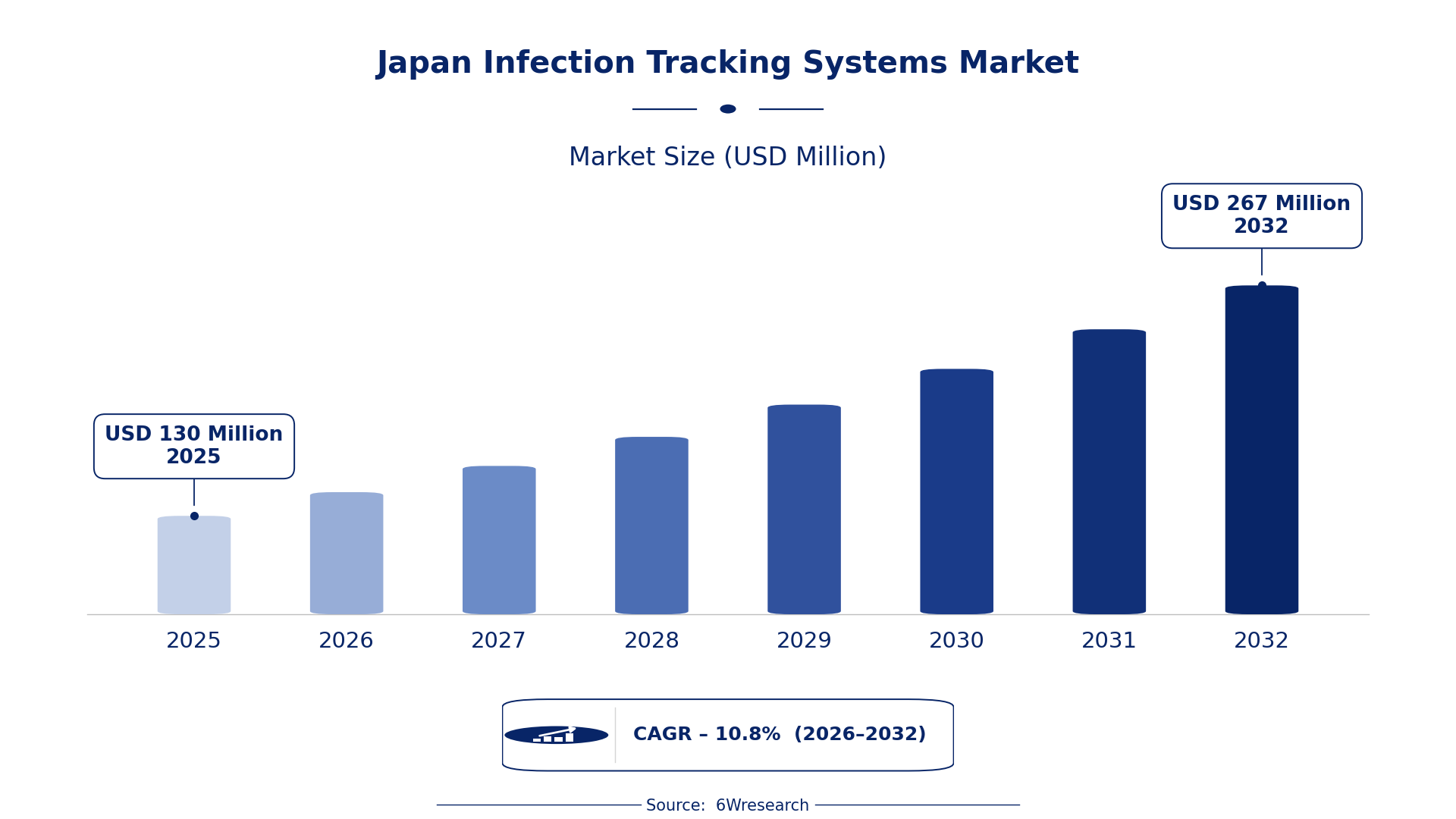
According to 6Wresearch internal database and industry insights, the Japan Infection Tracking Systems Market was valued at USD 130 Million in 2025 and is projected to reach USD 267 Million by 2032, growing at a CAGR of approximately 10.8% during 2026–2032.
Japan Infection Tracking Systems Market Highlights
| Report Metric | Details |
| Report Name | Japan Infection Tracking Systems Market (2026-2032) |
| Market Size 2025 | USD 130 Million |
| Market Size 2032 | USD 267 Million |
| Absolute Growth 2025–2032 | USD 137 Million |
| CAGR 2026–2032 | 10.8% |
| Peak Annual Growth | 12.2% in 2032 |
| Forecast Period | 2026–2032 |
| Historical Data | 2022–2025 |
| Base Year | 2025 |
| Leading System Type, 2025 | Hospital Tracking Systems (45% share) |
| Leading Tracking Method, 2025 | RFID + IoT (38% share) |
| Leading Deployment Site, 2025 | Inpatient Departments (43% share) |
| Leading Distribution Channel, 2025 | Software Integrators (40% share) |
| Fastest-Growing System Type | Public Health Portals (15.8% CAGR) |
| Fastest-Growing Tracking Method | Cloud-based Reporting (16.3% CAGR) |
| Fastest-Growing Deployment Site | National Databases (14.6% CAGR) |
| Fastest-Growing Distribution Channel | Direct Government Sales (14.7% CAGR) |
| Growing Sector | Healthcare |
| Key End Users | Hospitals, Public Health Organizations, Government Agencies, Healthcare Providers |
Japan Infection Tracking Systems Market Year-wise Growth Rate and Key Drivers (2022–2032)
This graph illustrates the annual growth rates of the market from 2022 to 2032, highlighting a steady upward trajectory and projected market expansion over the forecast period.
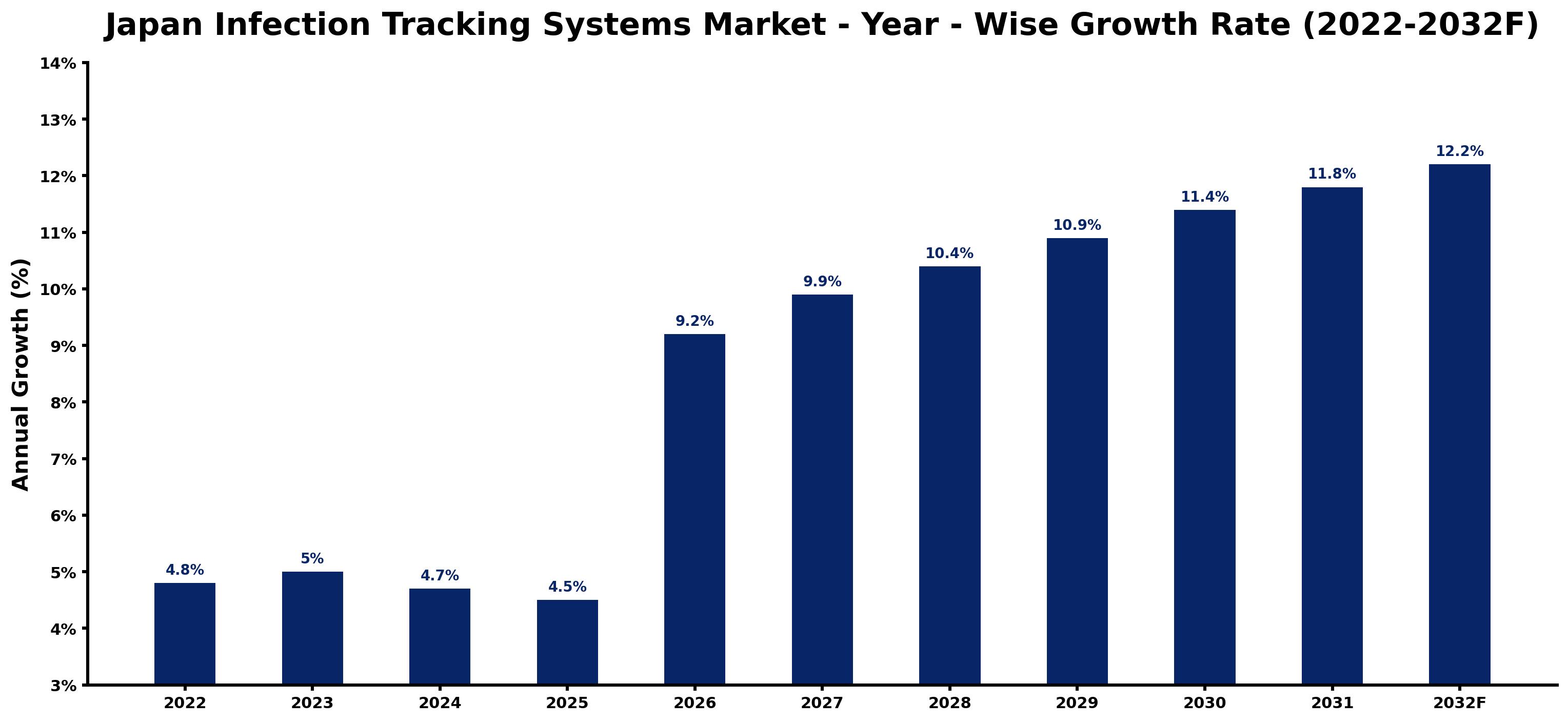
The yearly estimates that follow link every growth rate to its principal driver, so readers can see why the pace changed in each period.
| Year | Estimated Annual Growth (%) | Market Rationale |
| 2022 | 4.8 | The market showed steady growth with hospitals increasingly adopting tracking systems. |
| 2023 | 5.0 | Growth accelerated as 70% of hospitals reported using hospital tracking systems. |
| 2024 | 4.7 | Growth slowed slightly as hospitals faced budget constraints and prioritised other technologies. |
| 2025 | 4.5 | The market continued to grow, but at a slower pace due to market saturation in some areas. |
| 2026 | 9.2 | Demand surged as cloud-based reporting systems gained traction in healthcare facilities. |
| 2027 | 9.9 | Growth is expected to continue with increased investments in public health technology. |
| 2028 | 10.4 | The market is projected to expand further as AI-powered analytics become more widely adopted. |
| 2029 | 10.9 | Growth is anticipated to accelerate as community surveillance programs are implemented in more prefectures. |
| 2030 | 11.4 | Demand is expected to increase as hospitals upgrade their systems to improve data accuracy. |
| 2031 | 11.8 | The market will continue to grow with rising public health awareness and technology adoption. |
| 2032 | 12.2 | Growth is projected to peak as infection tracking systems become integral to healthcare operations. |
Note: Market size estimations and growth projections presented in this report are based on 6Wresearch's proprietary forecasting methodology, utilizing the latest available industry data, government publications, and primary research inputs.
Japan Infection Tracking Systems Market Synopsis
Infection Tracking Systems monitor and manage infectious disease outbreaks through technology solutions that integrate data from hospitals and public health agencies. The Japan Infection Tracking Systems Market is growing due to rising demand from over 8,000 hospitals and public health organizations. In 2023, the government allocated ¥1 billion for public health technology, stimulating market expansion and improving the capabilities of infection tracking systems.
Market Dynamics Impact Analysis (2026–2032)
| Factor | Type | Impact | Primary Segment Affected |
| Increasing adoption of hospital tracking systems | Driver | High | Hospital Tracking Systems |
| Growth in cloud-based reporting systems | Driver | High | Cloud-based Reporting |
| Rising need for enhanced public health monitoring | Opportunity | High | Public Health Portals |
| Expansion of community surveillance programs | Opportunity | Medium | Community Surveillance |
| Budget constraints faced by healthcare facilities | Restraint | High | Hospital Tracking Systems |
| Market saturation in certain regions | Restraint | Medium | Public Health Portals |
| High costs of implementing advanced systems | Challenge | High | Cloud-based Reporting |
| Integration challenges with existing systems | Challenge | Medium | Hospital Tracking Systems |
Evaluation of Drivers in Japan Infection Tracking Systems Market (2026–2032)
The table below links each growth driver to the segment it affects and the evidence for it.
| Drivers | Primary Segment Affected | Why It Matters (Evidence) |
| Increased hospital adoption of tracking systems | Hospital Tracking Systems | In 2023, 70% of hospitals reported using these systems to improve infection management. |
| Growing use of cloud-based reporting | Cloud-based Reporting | The adoption rate of cloud-based reporting systems is 60%, facilitating real-time data access. |
| Demand for public health portals | Public Health Portals | Public health initiatives focus on improving data accuracy and reporting, driving portal usage. |
| Implementation of community surveillance programs | Community Surveillance | Community surveillance programs are now active in 47 prefectures, enhancing public health monitoring. |
| Rising use of AI-powered analytics | AI-Powered Analytics | AI-powered analytics are increasingly used in hospitals for infection data, improving decision-making. |
Much of the new demand traces back to the rising adoption of hospital tracking systems, with 70% of hospitals using them to improve infection management. The current adoption rate of cloud-based reporting systems is 60%, enabling real-time data access and sharing among healthcare providers. AI-powered analytics are increasingly utilised in hospitals, allowing for better data analysis and informed decision-making.
Evaluation of Restraints in Japan Infection Tracking Systems Market
The table below lists the restraints and the evidence behind each.
| Market Restraint | Primary Segment Affected | Why It Matters (Evidence) |
| Budget constraints faced by healthcare facilities | Hospital Tracking Systems | Many hospitals are prioritising other technologies due to limited budgets, affecting system upgrades. |
| Market saturation in certain regions | Public Health Portals | In some areas, the market for public health portals has reached saturation, limiting growth. |
| High costs of implementing advanced systems | Cloud-based Reporting | The initial investment for cloud-based systems can be prohibitive for smaller healthcare facilities. |
| Integration challenges with existing systems | Hospital Tracking Systems | Healthcare facilities often struggle to integrate new systems with their existing infrastructure. |
| Limited awareness of mobile infection apps | Mobile Infection Apps | Despite downloads exceeding 5 million, many users remain unaware of their full capabilities. |
Japan Infection Tracking Systems Market Challenges
Producers face supply chain delays due to outdated technology, leading to inefficiencies that can cost hospitals up to ¥500 million annually. Buyers encounter rising operational costs as 70% of hospitals report using systems that lack real-time data integration, resulting in potential treatment delays for patients. Competition intensifies in regions like Tokyo and Osaka, where advanced infection tracking solutions are rapidly adopted, compelling other facilities to invest significantly to stay competitive. Compliance with ISO 9001 standards adds financial pressure, with hospitals incurring additional expenses of up to ¥100 million each year to meet these regulatory requirements.
Trends in the Japan Infection Tracking Systems Market
Below are the shifts with the largest effect on the Japan Infection Tracking Systems Market.
- Shift from Traditional to Cloud-based Reporting: The transition to cloud-based reporting systems began in 2023, driven by the need for real-time data access. Hospitals are increasingly adopting these systems, with a 60% adoption rate, improving their infection tracking capabilities.
- Rise of AI-Powered Analytics in Hospitals: AI-powered analytics have gained traction since 2023, as hospitals integrate these tools for better infection data management. This shift is reflected in the growing number of facilities adopting AI solutions, enhancing their decision-making processes.
- Expansion of Community Surveillance Programs: Community surveillance programs have expanded significantly since 2023, with implementation across 47 prefectures. This initiative strengthens public health monitoring, allowing for more effective outbreak management.
- Increased Use of Public Health Portals: Public health portals are becoming more prevalent, particularly since 2023, as they facilitate better data accuracy and reporting. This trend is supported by government initiatives promoting their use in healthcare.
Investment Opportunities in the Japan Infection Tracking Systems Market
Several openings in the Japan Infection Tracking Systems Market merit attention from investors.
- Gap in Advanced Infection Tracking Solutions: With the government allocating ¥1 billion for public health technology in 2023, there is an opportunity to supply advanced infection tracking solutions to hospitals, particularly in urban areas like Tokyo.
- Need for Enhanced Public Health Monitoring Tools: Public health organizations require improved monitoring tools, creating an opportunity to supply advanced infection tracking systems, especially in regions with high infection rates.
- Investment in Community Surveillance Technologies: The implementation of community surveillance programs across 47 prefectures highlights the need for advanced technologies, presenting an opportunity to partner with local health agencies for system development.
- Demand for Cloud-based Reporting Systems: As the adoption rate of cloud-based reporting systems reaches 60%, there is an opportunity to supply these solutions to healthcare facilities, particularly through local partnerships.
Government Initiatives in the Japan Infection Tracking Systems Market
The Medical Care Act of 1948 sets standards for hospitals and clinics, including requirements for infection tracking systems. The Next-Generation Medical Infrastructure Act of 2017 further supports the integration of advanced technologies in healthcare, allowing for anonymised medical data use.
In 2023, the government allocated ¥1 billion for public health technology, managed by the Ministry of Health, Labour and Welfare. This funding aims to improve the capabilities of infection tracking systems and public health monitoring.
Future Insight of the Japan Infection Tracking Systems Market
Public health organizations will undergo a transformation in infection tracking by 2032, as mobile infection apps are expected to surpass 10 million downloads, boosting user engagement. The integration of RFID technology will streamline patient management processes, making operations more efficient for healthcare providers. Government funding for public health technology is projected to rise to ¥2 billion, supporting further advancements in tracking systems. Adoption of cloud-based reporting systems will increase to 80%, improving data sharing and collaboration among healthcare entities.
Market Segmentation Analysis
Japan Infection Tracking Systems Market report covers a detailed analysis of the following market segments:
By System Type – Hospital Tracking Systems Lead, Public Health Portals Expected to Grow Fastest
According to Saurav Kr Singh, Senior Research Analyst at 6Wresearch, the largest system type category in 2025 was Hospital Tracking Systems, at 45% of revenue. Hospital Tracking Systems hold the largest share due to their essential role in monitoring infections within over 8,000 hospitals across Japan. These systems are vital for healthcare providers, ensuring effective management of infection rates and patient data. Over 2026–2032, Public Health Portals are expected to post the fastest growth, at a CAGR of 15.8%. Public Health Portals are rapidly growing as they are crucial for disseminating information to the public, particularly with the government allocating ¥1 billion for public health technology in 2023. This investment will likely accelerate their adoption and usage. Suppliers should focus on developing solutions tailored to public health agencies to leverage this growth opportunity.
By Tracking Method – RFID + IoT Leads, Cloud-based Reporting Expected to Grow Fastest
RFID + IoT accounted for 38% of the market by tracking method in 2025. RFID + IoT leads this segment as it significantly enhances tracking capabilities in healthcare settings, providing essential data for effective infection management. Its integration into hospitals supports operational efficiency necessary for successful infection tracking. The quickest growth will come from Cloud-based Reporting, forecast to expand at a CAGR of 16.3% between 2026 and 2032. Cloud-based Reporting is experiencing rapid growth because it allows for real-time data access and sharing, which is increasingly important for healthcare providers. With a 60% adoption rate in healthcare, this method is poised to become the preferred choice for infection tracking. Buyers should explore cloud-based solutions for enhanced data management and reporting functionalities.
By Deployment Site – Inpatient Departments Lead, National Databases Expected to Grow Fastest
Inpatient Departments held 43% of the Japan Infection Tracking Systems Market by deployment site in 2025. Inpatient Departments are the primary users of infection tracking systems, being directly involved in patient care and infection rate monitoring. This direct connection to patient management reinforces their position as the leading deployment site. National Databases are projected to grow fastest, at a CAGR of 14.6% during 2026–2032. National Databases are growing quickly as they are crucial for centralised data collection, enabling comprehensive tracking of infection trends nationwide. Their significance in public health initiatives is driving increased investment and focus. Suppliers must ensure compatibility with national databases to address the rising demand for centralised data solutions.
By Distribution Channel – Software Integrators Lead, Direct Government Sales Expected to Grow Fastest
In 2025, Software Integrators led the distribution channel split with a 40% share. Software Integrators command the largest share as they facilitate the implementation of infection tracking systems across various healthcare facilities. Their role in ensuring seamless integration is essential for the widespread adoption of these technologies. Direct Government Sales is set to record the highest CAGR in this split, 14.7% over 2026–2032. Direct Government Sales are on the rise as government agencies prioritise the acquisition of infection tracking systems to bolster public health responses. Recent government funding initiatives aimed at improving health technology support this trend. Vendors should strengthen partnerships with government entities to secure contracts and broaden their market presence.
Key Attractiveness of the Report
- 10 Years of Market Numbers
- Historical Data Starting from 2022 to 2025
- Base Year 2025
- Forecast Data until 2032
- Key Performance Indicators Impacting the Market
- Major Upcoming Developments and Projects
Key Highlights of the Report:
- Japan Infection Tracking Systems Market Outlook
- Market Size of Japan Infection Tracking Systems Market, 2025
- Forecast of Japan Infection Tracking Systems Market, 2032
- Historical Data and Forecast of Japan Infection Tracking Systems Revenues & Volume for the Period 2022-2032F
- Japan Infection Tracking Systems Market Trend Evolution
- Japan Infection Tracking Systems Market Drivers and Challenges
- Japan Infection Tracking Systems Price Trends
- Japan Infection Tracking Systems Porter's Five Forces
- Japan Infection Tracking Systems Industry Life Cycle
- Historical Data and Forecast of Japan Infection Tracking Systems Market Revenues & Volume By System Type for the Period 2022-2032F
- Historical Data and Forecast of Japan Infection Tracking Systems Market Revenues & Volume By Hospital Tracking Systems for the Period 2022-2032F
- Historical Data and Forecast of Japan Infection Tracking Systems Market Revenues & Volume By Public Health Portals for the Period 2022-2032F
- Historical Data and Forecast of Japan Infection Tracking Systems Market Revenues & Volume By Mobile Infection Apps for the Period 2022-2032F
- Historical Data and Forecast of Japan Infection Tracking Systems Market Revenues & Volume By Contact Tracing Tools for the Period 2022-2032F
- Historical Data and Forecast of Japan Infection Tracking Systems Market Revenues & Volume By Tracking Method for the Period 2022-2032F
- Historical Data and Forecast of Japan Infection Tracking Systems Market Revenues & Volume By RFID + IoT for the Period 2022-2032F
- Historical Data and Forecast of Japan Infection Tracking Systems Market Revenues & Volume By Cloud-based Reporting for the Period 2022-2032F
- Historical Data and Forecast of Japan Infection Tracking Systems Market Revenues & Volume By Bluetooth / GPS for the Period 2022-2032F
- Historical Data and Forecast of Japan Infection Tracking Systems Market Revenues & Volume By AI-Powered Analytics for the Period 2022-2032F
- Historical Data and Forecast of Japan Infection Tracking Systems Market Revenues & Volume By Deployment Site for the Period 2022-2032F
- Historical Data and Forecast of Japan Infection Tracking Systems Market Revenues & Volume By Inpatient Departments for the Period 2022-2032F
- Historical Data and Forecast of Japan Infection Tracking Systems Market Revenues & Volume By National Databases for the Period 2022-2032F
- Historical Data and Forecast of Japan Infection Tracking Systems Market Revenues & Volume By Community Surveillance for the Period 2022-2032F
- Historical Data and Forecast of Japan Infection Tracking Systems Market Revenues & Volume By Hospitals & Workplaces for the Period 2022-2032F
- Historical Data and Forecast of Japan Infection Tracking Systems Market Revenues & Volume By Distribution Channel for the Period 2022-2032F
- Historical Data and Forecast of Japan Infection Tracking Systems Market Revenues & Volume By Software Integrators for the Period 2022-2032F
- Historical Data and Forecast of Japan Infection Tracking Systems Market Revenues & Volume By Direct Government Sales for the Period 2022-2032F
- Historical Data and Forecast of Japan Infection Tracking Systems Market Revenues & Volume By App Stores / Licensing for the Period 2022-2032F
- Historical Data and Forecast of Japan Infection Tracking Systems Market Revenues & Volume By B2B SaaS Providers for the Period 2022-2032F
- Japan Infection Tracking Systems Import Export Trade Statistics
- Market Opportunity Assessment By System Type
- Market Opportunity Assessment By Tracking Method
- Market Opportunity Assessment By Deployment Site
- Market Opportunity Assessment By Distribution Channel
- Japan Infection Tracking Systems Top Companies Market Share
- Japan Infection Tracking Systems Competitive Benchmarking By Technical and Operational Parameters
- Japan Infection Tracking Systems Company Profiles
- Japan Infection Tracking Systems Key Strategic Recommendations
Market Covered
The study includes the following segmentation.
By System Type
- Hospital Tracking Systems
- Public Health Portals
- Mobile Infection Apps
- Contact Tracing Tools
By Tracking Method
- RFID + IoT
- Cloud-based Reporting
- Bluetooth / GPS
- AI-Powered Analytics
By Deployment Site
- Inpatient Departments
- National Databases
- Community Surveillance
- Hospitals & Workplaces
By Distribution Channel
- Software Integrators
- Direct Government Sales
- App Stores / Licensing
- B2B SaaS Providers































