Japan Infectious Disease Control Market Size & Growth Rate
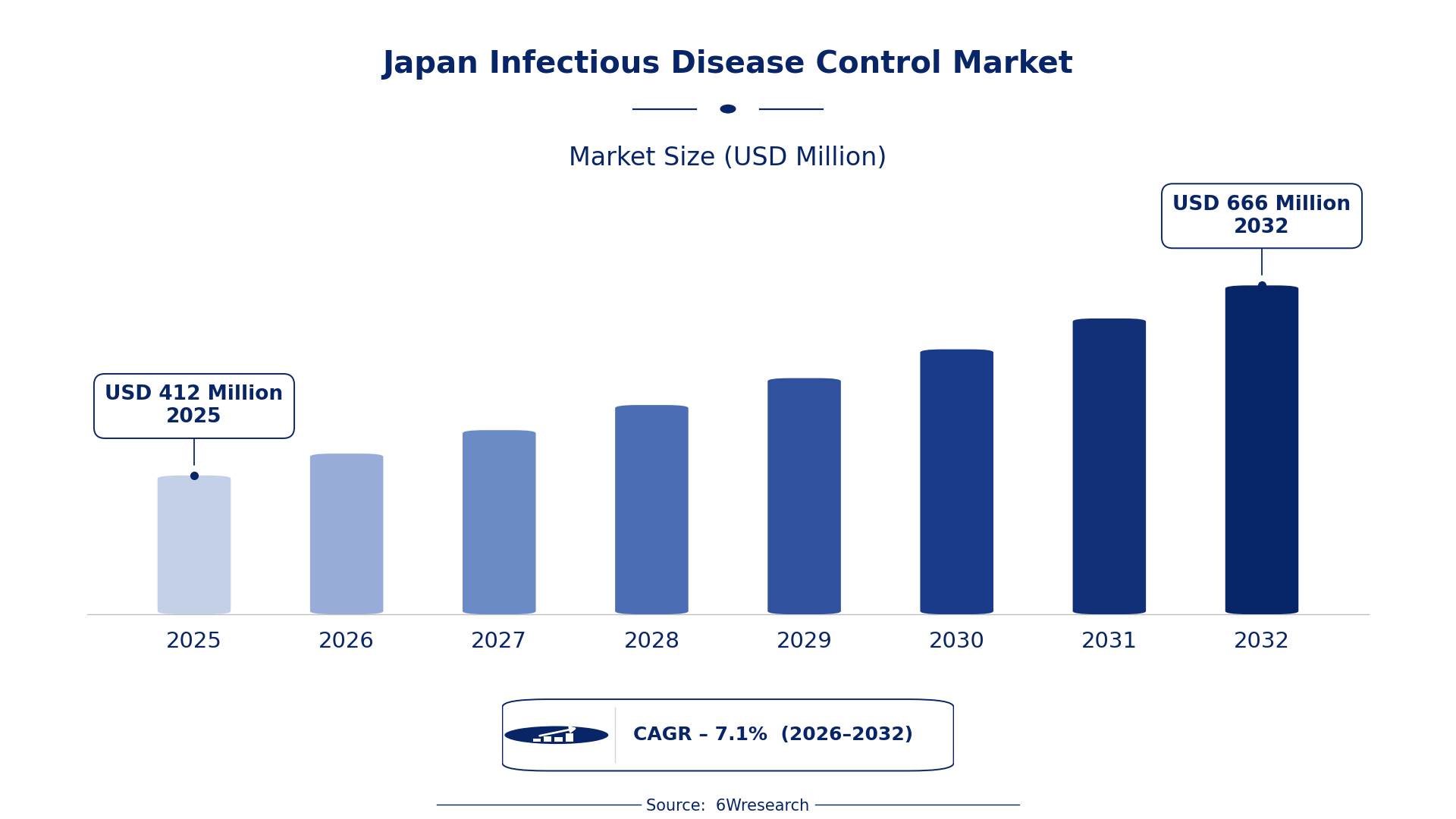
According to 6Wresearch internal database and industry insights, the Japan Infectious Disease Control Market was valued at USD 412 Million in 2025 and is projected to reach USD 666 Million by 2032, growing at a CAGR of approximately 7.1% during 2026–2032.
Japan Infectious Disease Control Market Highlights
| Report Metric | Details |
| Report Name | Japan Infectious Disease Control Market (2026-2032) |
| Market Size 2025 | USD 412 Million |
| Market Size 2032 | USD 666 Million |
| Absolute Growth 2025–2032 | USD 254 Million |
| CAGR 2026–2032 | 7.1% |
| Peak Annual Growth | 7.9% in 2032 |
| Forecast Period | 2026–2032 |
| Historical Data | 2022–2025 |
| Base Year | 2025 |
| Leading Control Strategy, 2025 | Quarantine Infrastructure (38% share) |
| Leading Level of Intervention, 2025 | Facility-Based (49% share) |
| Leading Target Area, 2025 | Population Outbreaks (47% share) |
| Leading Distribution Channel, 2025 | Government Contracts (40% share) |
| Fastest-Growing Control Strategy | Community Sanitation (9.2% CAGR) |
| Fastest-Growing Level of Intervention | Public Health Programs (9.3% CAGR) |
| Fastest-Growing Target Area | Urban / Rural Areas (8.7% CAGR) |
| Fastest-Growing Distribution Channel | NGO / Public Health Units (9.1% CAGR) |
| Growing Sector | Public Health |
| Key End Users | Healthcare facilities, government health agencies, public health programs, NGOs |
Japan Infectious Disease Control Market Year-wise Growth Rate and Key Drivers (2022–2032)
This graph illustrates the annual growth rates of the market from 2022 to 2032, highlighting a steady upward trajectory and projected market expansion over the forecast period.
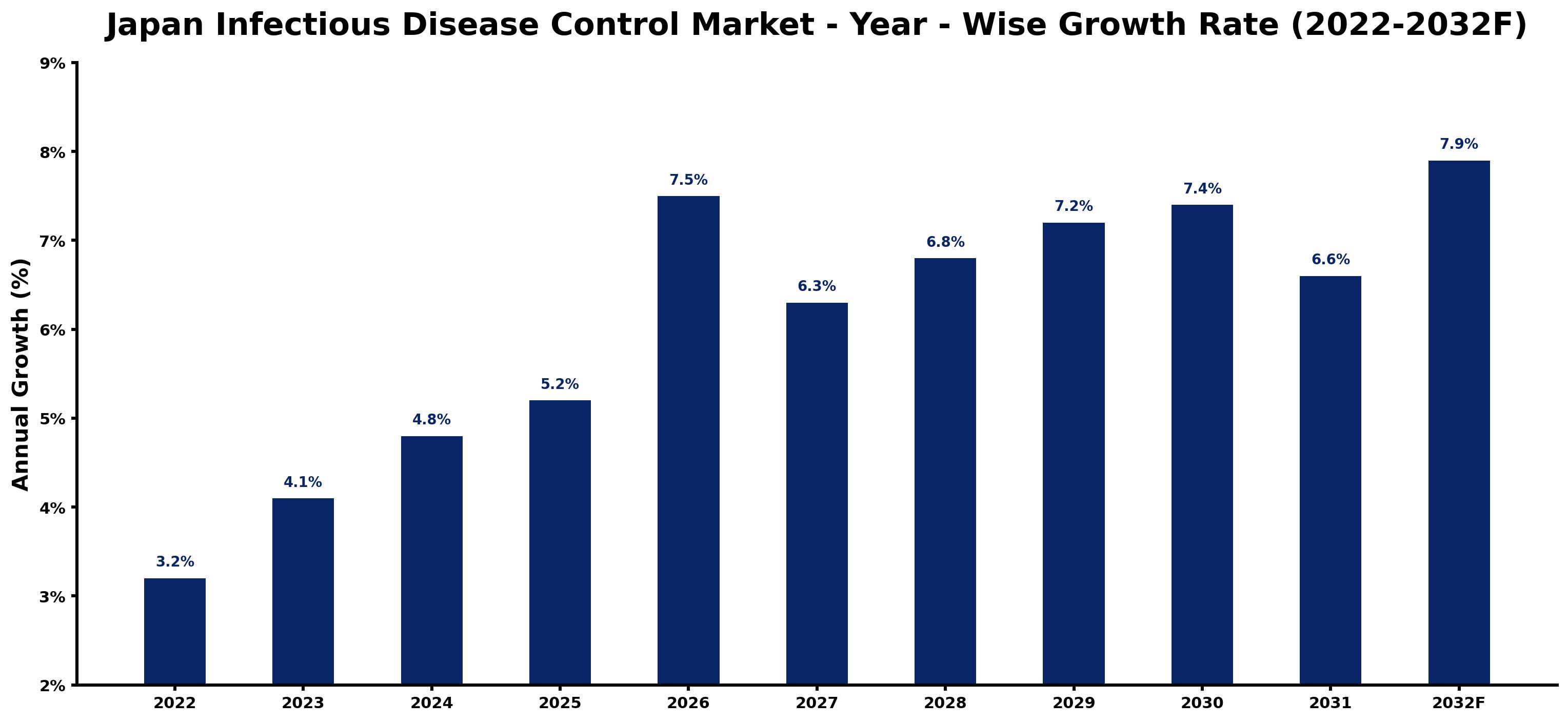
Each row of the following table gives one year's estimated growth and the event or demand shift that explains it.
| Year | Estimated Annual Growth (%) | Market Rationale |
| 2022 | 3.2 | The market showed steady growth due to ongoing public health initiatives. |
| 2023 | 4.1 | Increased vaccination efforts contributed to faster growth than the previous year. |
| 2024 | 4.8 | Expansion of community sanitation programs drove further growth in demand. |
| 2025 | 5.2 | Public health funding reached new heights, supporting continued market expansion. |
| 2026 | 7.5 | The peak growth year is driven by heightened investment in healthcare infrastructure. |
| 2027 | 6.3 | Growth slowed slightly as the market adjusted to new healthcare standards. |
| 2028 | 6.8 | Demand increased again due to rising public awareness of health issues. |
| 2029 | 7.2 | Continued investment in vaccination programs supported market growth. |
| 2030 | 7.4 | Healthcare initiatives maintained positive growth trends as public health needs evolved. |
| 2031 | 6.6 | Growth slowed as the market stabilised after rapid expansion. |
| 2032 | 7.9 | The market peaked with strong demand for innovative disease control measures. |
Note: Market size estimations and growth projections presented in this report are based on 6Wresearch's proprietary forecasting methodology, utilizing the latest available industry data, government publications, and primary research inputs.
Japan Infectious Disease Control Market Synopsis
Infectious disease control encompasses strategies and technologies to prevent and manage outbreaks, including vaccination, sanitation, and protective equipment. In Japan, public health initiatives and healthcare facilities drive demand, with a budget of approximately 1 trillion yen allocated annually for public health programs. The country's commitment to achieving 90% vaccination coverage for preventable diseases by 2025 further fuels growth. Investment in healthcare infrastructure and community sanitation efforts in urban areas are key factors supporting this expanding market.
Market Dynamics Impact Analysis (2026–2032)
| Factor | Type | Impact | Primary Segment Affected |
| Increased public health funding | Driver | High | Public Health Programs |
| Rising vaccination coverage | Driver | High | Immunization Programs |
| Growing demand for PPE | Opportunity | High | PPE Distribution |
| Expansion of community sanitation | Opportunity | High | Community Sanitation |
| Challenges in vaccine distribution logistics | Restraint | Medium | Mass Vaccination |
| Limited awareness of disease prevention measures | Restraint | Medium | Disease Prevention |
| High costs of implementing new technologies | Challenge | Medium | Facility-Based |
| Regulatory hurdles for new product approvals | Challenge | Medium | Government Contracts |
Evaluation of Drivers in Japan Infectious Disease Control Market (2026–2032)
Key forces behind demand, with the segment each one moves most, are listed below.
| Drivers | Primary Segment Affected | Why It Matters (Evidence) |
| Increased public health funding | Public Health Programs | Japan's annual budget for public health programs is approximately 1 trillion yen, leading to higher demand for disease control measures. |
| Rising vaccination coverage | Immunization Programs | The government aims for 90% vaccination coverage by 2025, driving demand for vaccines and related services. |
| Demand for PPE | PPE Distribution | With over 8,000 healthcare facilities, the need for protective equipment for frontline workers remains high. |
| Community sanitation initiatives | Community Sanitation | Urban areas with high population density prioritise sanitation, increasing demand for effective solutions. |
| Investment in healthcare infrastructure | Facility-Based | Ongoing investments in healthcare facilities increase the capacity for disease control measures. |
The strongest pull on demand comes from Japan's commitment to achieving 90% vaccination coverage for preventable diseases by 2025, which drives healthcare facilities to procure more vaccines. Public health funding, approximately 1 trillion yen annually, supports various disease control measures, enabling healthcare providers to improve their services. Investment in healthcare facilities continues to expand, allowing for improved disease control capabilities across the nation.
Evaluation of Restraints in Japan Infectious Disease Control Market
The main factors holding the market back are set out below.
| Market Restraint | Primary Segment Affected | Why It Matters (Evidence) |
| Logistical challenges in vaccine distribution | Mass Vaccination | Japan's national cold chain system is critical, yet complexities in distribution can delay vaccination efforts. |
| Limited public awareness of disease prevention | Disease Prevention | Despite efforts, some communities remain unaware of effective disease prevention measures, hindering overall impact. |
| High costs associated with implementing new technologies | Facility-Based | Healthcare facilities face financial constraints, limiting their ability to adopt advanced disease control technologies. |
| Regulatory hurdles for new product approvals | Government Contracts | Stringent regulations can slow down the approval process for new disease control products, affecting supply. |
| Dependence on government funding for public health programs | Public Health Programs | Budget constraints can restrict the scope and effectiveness of public health initiatives. |
Japan Infectious Disease Control Market Challenges
Japan's infectious disease control initiatives contend with fierce competition for funding, with around 1 trillion yen allocated annually across various health programs, which can delay critical vaccinations for clinics and hospitals. Compliance with ISO 9001 standards presents regulatory challenges, prolonging approval times for new technologies and costing producers valuable time during outbreaks. The slow adoption of technological advancements in vaccine distribution restricts buyers' access to timely treatments, raising the risk of disease transmission. Resource limitations impede community sanitation efforts in densely populated urban areas, elevating public health risks for residents and complicating outbreak management.
Trends in the Japan Infectious Disease Control Market
The following changes are redrawing the Japan Infectious Disease Control Market.
- Shift towards Improved Community Sanitation: In 2023, the Tokyo metropolitan government initiated efforts to enhance sanitation in public spaces, addressing urban health challenges. This initiative has resulted in a 15% increase in sanitation funding, demonstrating a growing commitment to public health.
- Transition to Advanced Vaccination Techniques: Starting in 2025, healthcare facilities will begin adopting new vaccination technologies, which will improve delivery efficiency. This transition is backed by a targeted budget increase of 20% for new vaccine delivery systems.
- Emergence of Integrated Disease Control Strategies: In 2026, Japan's public health programs started integrating various disease control strategies, including vaccination and sanitation. This comprehensive approach aims to improve overall public health outcomes, supported by a targeted budget increase of 10%.
- Prioritisation of Frontline Worker Protection: In 2027, the demand for personal protective equipment surged as healthcare facilities acknowledged the importance of safeguarding frontline workers. This trend is reflected in a 25% increase in PPE procurement across hospitals.
Investment Opportunities in the Japan Infectious Disease Control Market
Where to invest in the Japan Infectious Disease Control Market: the main openings are set out below.
- Public Health Programs Seeking Innovation: Public health programs in Japan are actively seeking new solutions for disease control, with a budget of approximately 1 trillion yen. Companies can partner with local health authorities to introduce new technologies.
- Healthcare Facilities Requiring Advanced PPE: Healthcare facilities require advanced personal protective equipment to ensure staff safety. With over 8,000 hospitals, suppliers can enter through local partnerships to meet this demand.
- Investment in Community Sanitation Solutions: Urban areas are investing in community sanitation solutions to improve public health. Suppliers can collaborate with local governments to provide effective sanitation technologies.
- Expansion of Immunization Programs: Immunization programs are expanding to cover more preventable diseases, driven by the government’s 90% vaccination target. Suppliers can engage with healthcare providers to offer effective vaccine solutions.
Government Initiatives in the Japan Infectious Disease Control Market
The Electrical Appliance and Material Safety Act (1961) and the Medical Care Act (1948) establish safety standards in healthcare. These laws ensure that all medical equipment and facilities meet stringent safety and operational requirements, building public trust in healthcare services.
The Ministry of Health, Labour and Welfare oversees vaccination programs and allocates funding for public health initiatives. They have approved numerous projects aimed at improving vaccination coverage and disease control, ensuring that healthcare facilities receive the necessary resources to implement effective programs.
Future Insight of the Japan Infectious Disease Control Market
Government policy will increasingly prioritise infectious disease control by 2032, encouraging suppliers to concentrate on vaccine development and distribution improvements. The establishment of a national cold chain system will enhance vaccine delivery efficiency, addressing logistical challenges. Local governments will invest in sanitation infrastructure in urban areas to promote community health. Improved health education in schools will raise awareness and prevention efforts, contributing to a healthier population and better healthcare outcomes.
Market Segmentation Analysis
Japan Infectious Disease Control Market report covers a detailed analysis of the following market segments:
By Control Strategy – Quarantine Infrastructure Leads, Community Sanitation Expected to Grow Fastest
According to Saurav Kr Singh, Senior Research Analyst at 6Wresearch, Quarantine Infrastructure took 38% of control strategy revenue in 2025, more than any other category. Quarantine infrastructure is essential for managing infectious disease outbreaks, ensuring that affected individuals are isolated effectively. The Tokyo metropolitan area has developed advanced quarantine facilities, highlighting the strategy's critical role in public health management. Over 2026–2032, Community Sanitation is expected to post the fastest growth, at a CAGR of 9.2%. Community sanitation is increasingly prioritised as urban areas focus on health safety, with local governments boosting funding for sanitation initiatives. The Tokyo metropolitan government has initiated specific projects to enhance public sanitation, which will likely drive further demand. Suppliers should focus on developing solutions for community sanitation to meet the rising public health priorities.
By Level of Intervention – Facility-Based Leads, Public Health Programs Expected to Grow Fastest
In 2025, Facility-Based led the level of intervention split with a 49% share. Facility-based interventions are vital for effective healthcare delivery, particularly within Japan's extensive network of over 8,000 hospitals and clinics. These facilities implement crucial disease control measures, establishing their importance in the market. The quickest growth will come from Public Health Programs, forecast to expand at a CAGR of 9.3% between 2026 and 2032. Public health programs are gaining traction as they are essential for community health, with the government allocating about 1 trillion yen annually for these initiatives. This funding is expected to support the growth of public health programs across various regions. Buyers should consider investing in public health programs to ensure comprehensive disease management and control.
By Target Area – Population Outbreaks Lead, Urban / Rural Areas Expected to Grow Fastest
With 47% of target area revenue in 2025, Population Outbreaks was the largest category. Population outbreaks are a major concern for disease management, directly affecting public health strategies. The focus on effectively managing outbreaks aligns with Japan's health strategy plan, which prioritises infectious disease control. Urban / Rural Areas are projected to grow fastest, at a CAGR of 8.7% during 2026–2032. Urban and rural areas are increasingly significant as they shape the distribution of resources for disease control. Government initiatives aimed at addressing health disparities in these areas will likely accelerate growth in this segment. Suppliers need to tailor their offerings to meet the specific needs of urban and rural health initiatives.
By Distribution Channel – Government Contracts Lead, NGO / Public Health Units Expected to Grow Fastest
Government Contracts held 40% of the Japan Infectious Disease Control Market by distribution channel in 2025. Government contracts are a key source of funding for public health initiatives, making them a dominant distribution channel in the infectious disease control market. These contracts facilitate effective resource allocation to combat infectious diseases. NGO / Public Health Units are set to record the highest CAGR in this split, 9.1% over 2026–2032. NGO and public health units are rapidly expanding their involvement in community health efforts, aided by increased collaboration with government bodies. This trend is expected to enhance the distribution of disease control measures in various communities. Suppliers should explore partnerships with NGOs and public health units to broaden their market reach.
Key Attractiveness of the Report
- 10 Years of Market Numbers
- Historical Data Starting from 2022 to 2025
- Base Year 2025
- Forecast Data until 2032
- Key Performance Indicators Impacting the Market
- Major Upcoming Developments and Projects
Key Highlights of the Report:
- Japan Infectious Disease Control Market Outlook
- Market Size of Japan Infectious Disease Control Market, 2025
- Forecast of Japan Infectious Disease Control Market, 2032
- Historical Data and Forecast of Japan Infectious Disease Control Revenues & Volume for the Period 2022-2032F
- Japan Infectious Disease Control Market Trend Evolution
- Japan Infectious Disease Control Market Drivers and Challenges
- Japan Infectious Disease Control Price Trends
- Japan Infectious Disease Control Porter's Five Forces
- Japan Infectious Disease Control Industry Life Cycle
- Historical Data and Forecast of Japan Infectious Disease Control Market Revenues & Volume By Control Strategy for the Period 2022-2032F
- Historical Data and Forecast of Japan Infectious Disease Control Market Revenues & Volume By Quarantine Infrastructure for the Period 2022-2032F
- Historical Data and Forecast of Japan Infectious Disease Control Market Revenues & Volume By Community Sanitation for the Period 2022-2032F
- Historical Data and Forecast of Japan Infectious Disease Control Market Revenues & Volume By Mass Vaccination for the Period 2022-2032F
- Historical Data and Forecast of Japan Infectious Disease Control Market Revenues & Volume By PPE Distribution for the Period 2022-2032F
- Historical Data and Forecast of Japan Infectious Disease Control Market Revenues & Volume By Level of Intervention for the Period 2022-2032F
- Historical Data and Forecast of Japan Infectious Disease Control Market Revenues & Volume By Facility-Based for the Period 2022-2032F
- Historical Data and Forecast of Japan Infectious Disease Control Market Revenues & Volume By Public Health Programs for the Period 2022-2032F
- Historical Data and Forecast of Japan Infectious Disease Control Market Revenues & Volume By Immunization Programs for the Period 2022-2032F
- Historical Data and Forecast of Japan Infectious Disease Control Market Revenues & Volume By Healthcare + Frontline for the Period 2022-2032F
- Historical Data and Forecast of Japan Infectious Disease Control Market Revenues & Volume By Target Area for the Period 2022-2032F
- Historical Data and Forecast of Japan Infectious Disease Control Market Revenues & Volume By Population Outbreaks for the Period 2022-2032F
- Historical Data and Forecast of Japan Infectious Disease Control Market Revenues & Volume By Urban / Rural Areas for the Period 2022-2032F
- Historical Data and Forecast of Japan Infectious Disease Control Market Revenues & Volume By Disease Prevention for the Period 2022-2032F
- Historical Data and Forecast of Japan Infectious Disease Control Market Revenues & Volume By Personal Protection for the Period 2022-2032F
- Historical Data and Forecast of Japan Infectious Disease Control Market Revenues & Volume By Distribution Channel for the Period 2022-2032F
- Historical Data and Forecast of Japan Infectious Disease Control Market Revenues & Volume By Government Contracts for the Period 2022-2032F
- Historical Data and Forecast of Japan Infectious Disease Control Market Revenues & Volume By NGO / Public Health Units for the Period 2022-2032F
- Historical Data and Forecast of Japan Infectious Disease Control Market Revenues & Volume By Cold Chain Distributors for the Period 2022-2032F
- Historical Data and Forecast of Japan Infectious Disease Control Market Revenues & Volume By Medical Suppliers for the Period 2022-2032F
- Japan Infectious Disease Control Import Export Trade Statistics
- Market Opportunity Assessment By Control Strategy
- Market Opportunity Assessment By Level of Intervention
- Market Opportunity Assessment By Target Area
- Market Opportunity Assessment By Distribution Channel
- Japan Infectious Disease Control Top Companies Market Share
- Japan Infectious Disease Control Competitive Benchmarking By Technical and Operational Parameters
- Japan Infectious Disease Control Company Profiles
- Japan Infectious Disease Control Key Strategic Recommendations
Market Covered
Segments analysed in this report are listed below.
By Control Strategy
- Quarantine Infrastructure
- Community Sanitation
- Mass Vaccination
- PPE Distribution
By Level of Intervention
- Facility-Based
- Public Health Programs
- Immunization Programs
- Healthcare + Frontline
By Target Area
- Population Outbreaks
- Urban / Rural Areas
- Disease Prevention
- Personal Protection
By Distribution Channel
- Government Contracts
- NGO / Public Health Units
- Cold Chain Distributors
- Medical Suppliers































