Japan Infectious Disease Market Size & Growth Rate
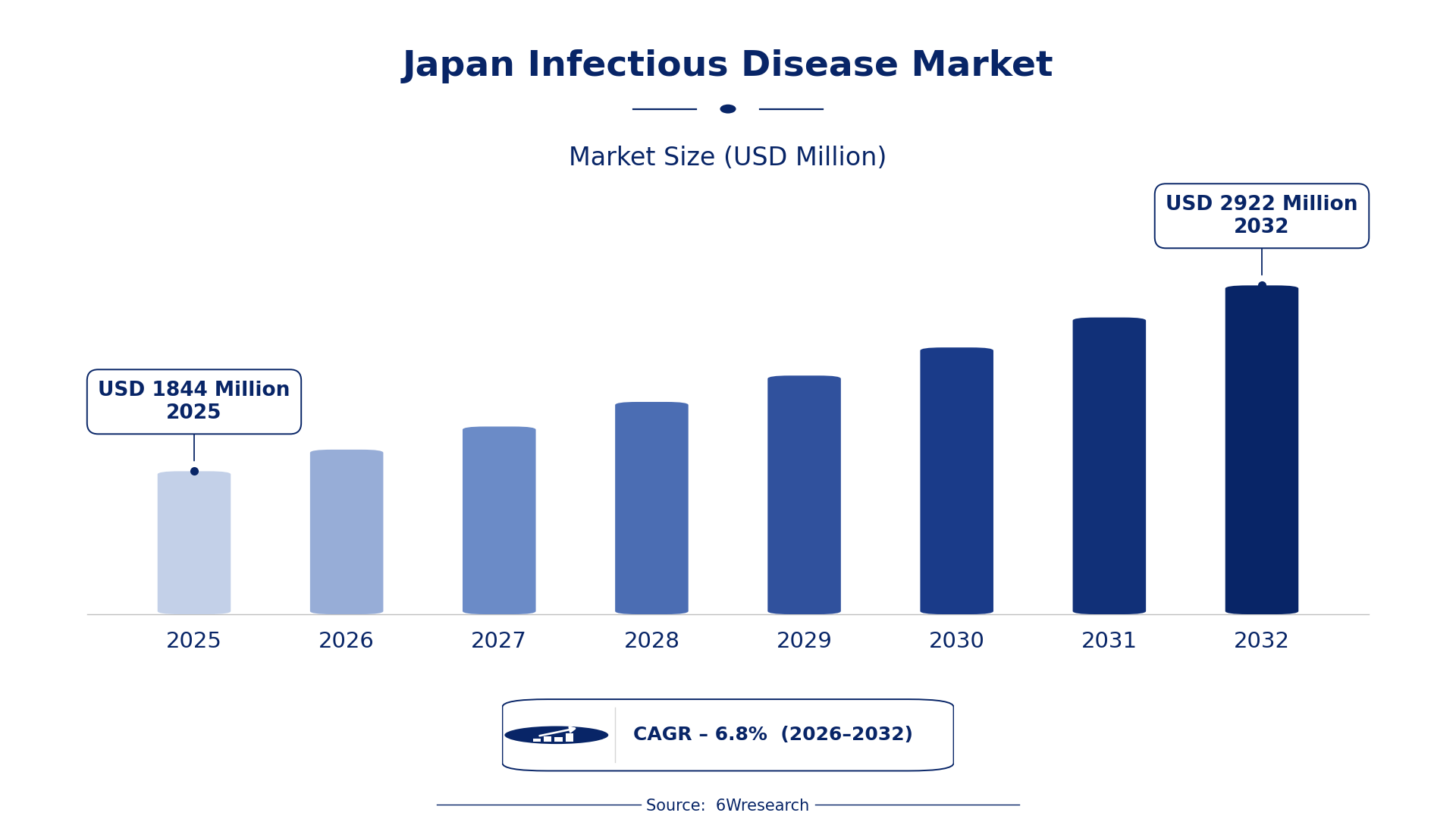
According to 6Wresearch internal database and industry insights, the Japan Infectious Disease Market was valued at USD 1,844 Million in 2025 and is projected to reach USD 2,922 Million by 2032, growing at a CAGR of approximately 6.8% during 2026–2032.
Japan Infectious Disease Market Highlights
| Report Metric | Details |
| Report Name | Japan Infectious Disease Market (2026-2032) |
| Market Size 2025 | USD 1,844 Million |
| Market Size 2032 | USD 2,922 Million |
| Absolute Growth 2025–2032 | USD 1,078 Million |
| CAGR 2026–2032 | 6.8% |
| Peak Annual Growth | 7.4% in 2030 |
| Forecast Period | 2026–2032 |
| Historical Data | 2022–2025 |
| Base Year | 2025 |
| Leading Disease Type, 2025 | Viral Infections (46% share) |
| Leading Transmission Mode, 2025 | Airborne / Bloodborne (39% share) |
| Leading Healthcare Impact, 2025 | Epidemics / Pandemics (48% share) |
| Leading Distribution Channel, 2025 | Hospital Drug Suppliers (43% share) |
| Fastest-Growing Disease Type | Bacterial Infections (9.3% CAGR) |
| Fastest-Growing Transmission Mode | Vector-Borne (8.9% CAGR) |
| Fastest-Growing Healthcare Impact | Community Acquired (9.1% CAGR) |
| Fastest-Growing Distribution Channel | Pharmacy Chains (8.7% CAGR) |
| Growing Sector | Healthcare |
| Key End Users | Hospitals, Government Health Agencies, Pharmaceutical Suppliers, Diagnostic Laboratories |
Japan Infectious Disease Market Year-wise Growth Rate and Key Drivers (2022–2032)
This graph illustrates the annual growth rates of the market from 2022 to 2032, highlighting a steady upward trajectory and projected market expansion over the forecast period.
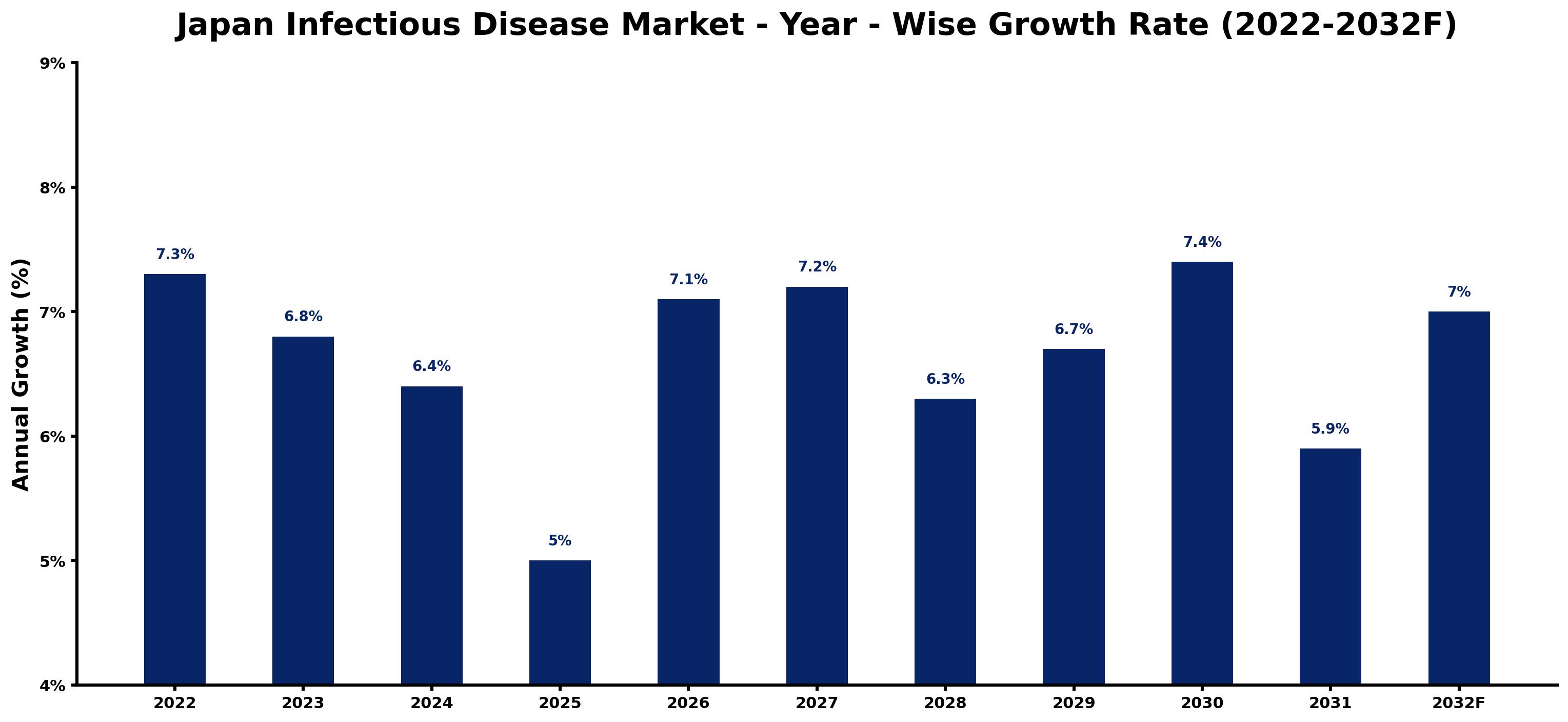
Below, each year's estimated growth is shown next to the factor that most influenced it.
| Year | Estimated Annual Growth (%) | Market Rationale |
| 2022 | 7.3 | The market experienced strong demand due to rising viral infections. |
| 2023 | 6.8 | Growth slowed as the healthcare sector adjusted to evolving healthcare needs. |
| 2024 | 6.4 | Continued adjustments in healthcare spending led to further moderation in growth. |
| 2025 | 5.0 | Demand stabilised as healthcare providers focused on essential services. |
| 2026 | 7.1 | Growth is expected to accelerate with increased investments in diagnostic technologies. |
| 2027 | 7.2 | The rise in community-acquired infections is projected to spur further demand for treatments. |
| 2028 | 6.3 | Growth is anticipated to slow as market saturation begins to impact new product introductions. |
| 2029 | 6.7 | Demand is expected to increase again due to heightened awareness of infectious diseases. |
| 2030 | 7.4 | The peak growth is projected to be driven by public health initiatives. |
| 2031 | 5.9 | Growth is expected to slow as the market adjusts to new regulatory standards. |
| 2032 | 7.0 | Demand is projected to rise with advancements in vaccine technologies. |
Note: Market size estimations and growth projections presented in this report are based on 6Wresearch's proprietary forecasting methodology, utilizing the latest available industry data, government publications, and primary research inputs.
Japan Infectious Disease Market Synopsis
Infectious disease products encompass a range of diagnostics, therapeutics, and vaccines aimed at preventing and treating infections caused by pathogens. The market is growing due to heightened awareness of infectious diseases, with Japan reporting over 1 million cases of viral infections in 2023. Major drivers include ongoing public health campaigns and a government allocation of ¥10 billion for infectious disease research, which supports the healthcare sector's response to emerging pathogens. This increasing focus on infectious disease management attracts both domestic and international buyers, further expanding market opportunities.
Market Dynamics Impact Analysis (2026–2032)
| Factor | Type | Impact | Primary Segment Affected |
| Rising healthcare expenditure | Driver | High | Viral Infections |
| Increased public health awareness campaigns | Driver | High | Epidemics / Pandemics |
| Growing demand for diagnostic testing | Opportunity | Medium | Bacterial Infections |
| Investment in vaccine development | Opportunity | High | Immunocompromised Patients |
| Market saturation in diagnostic equipment | Restraint | Medium | Airborne / Bloodborne |
| Regulatory compliance costs for new products | Restraint | High | Hospital Drug Suppliers |
| High costs of advanced therapeutics | Challenge | High | Community Acquired |
| Capacity limitations in healthcare facilities | Challenge | Medium | Government Supply Chains |
Evaluation of Drivers in Japan Infectious Disease Market (2026–2032)
Demand rests on the following drivers, each shown with the segment it touches most.
| Drivers | Primary Segment Affected | Why It Matters (Evidence) |
| Increased healthcare expenditure | Viral Infections | Healthcare expenditure in Japan is approximately ¥42 trillion annually, driving demand for diagnostics and treatments. |
| Public health campaigns | Epidemics / Pandemics | Annual public health awareness campaigns improve understanding of infectious diseases, leading to higher product demand. |
| Technological advancements in diagnostics | Bacterial Infections | The installed base of diagnostic equipment exceeds 50,000 units, improving testing capabilities and increasing purchases. |
| Vaccination programs | Immunocompromised Patients | Japan's vaccination initiatives for influenza lead to higher demand for related therapeutic products. |
| Rising incidence of viral infections | Airborne / Bloodborne | In 2023, Japan reported over 1 million cases of viral infections, prompting increased demand for relevant products. |
Most of the extra volume comes from increased healthcare expenditure, which is approximately ¥42 trillion annually, driving demand for diagnostics and treatments. Annual public health awareness campaigns enhance understanding of infectious diseases, prompting higher product uptake. The installed base of diagnostic equipment in hospitals exceeds 50,000 units, improving testing capabilities and driving purchases. In 2023, the country reported over 1 million cases of viral infections, creating urgent needs for relevant products.
Evaluation of Restraints in Japan Infectious Disease Market
Several factors work against faster growth; the main ones are summarised below.
| Market Restraint | Primary Segment Affected | Why It Matters (Evidence) |
| Market saturation in diagnostic equipment | Airborne / Bloodborne | The installed base of diagnostic equipment exceeds 50,000 units, limiting growth opportunities for new entrants. |
| Regulatory compliance costs for new products | Hospital Drug Suppliers | Compliance with the NHI drug price standard increases costs for suppliers, impacting pricing strategies. |
| High costs of advanced therapeutics | Community Acquired | Advanced therapeutics can be prohibitively expensive, limiting access for many patients. |
| Capacity limitations in healthcare facilities | Government Supply Chains | Healthcare facilities face capacity constraints, affecting their ability to respond to increased demand. |
| Limited market for fungal treatments | Fungal Infections | Fungal treatments are less common, restricting overall market growth potential. |
Japan Infectious Disease Market Challenges
Producers face rising costs as the demand for infectious disease products increases, with over 1 million viral infection cases reported in 2023, straining their budgets for manufacturing. Importers encounter supply chain disruptions due to limited availability of raw materials, causing delays in the delivery of essential diagnostics and therapeutics. Buyers experience longer wait times for critical diagnostic tools, as the installed base of PCR testing machines exceeds 20,000 units, impacting timely patient care in hospitals. Competition intensifies among suppliers, driven by the government's ¥10 billion investment in infectious disease research, which attracts new entrants and pressures existing pricing strategies.
Trends in the Japan Infectious Disease Market
Several trends are reshaping the Japan Infectious Disease Market; the most important are set out below.
- Shift in Public Health Focus: Healthcare providers are increasingly prioritising infectious disease management, as seen in Tokyo's public health campaigns, which have led to a 10% increase in vaccination rates.
- Emergence of Rapid Diagnostic Tests: The introduction of rapid diagnostic tests has transformed patient care, with over 20,000 PCR testing machines installed across Japan, improving response times for infectious disease outbreaks.
- Increased Collaboration in Research: Collaboration between research institutions and healthcare providers is growing, evidenced by the ¥10 billion allocated for infectious disease research in 2023, enhancing innovation.
- Expansion of Telemedicine Services: Telemedicine is becoming more prevalent in infectious disease management, particularly in Osaka, where healthcare providers report a 30% increase in remote consultations.
Investment Opportunities in the Japan Infectious Disease Market
Several openings in the Japan Infectious Disease Market merit attention from investors.
- Timing for Investment in Diagnostics: With over 1 million viral infection cases reported in 2023, there is a pressing need for advanced diagnostic tools, especially in urban areas like Tokyo.
- Gap in Vaccination Coverage: The government allocated ¥10 billion for infectious disease research, indicating a strong investment opportunity for vaccine developers to fill existing gaps.
- Growing Demand from Hospitals: Hospital Drug Suppliers are increasingly seeking effective treatments, particularly for community-acquired infections, as demand continues to rise.
- Expansion of Public Health Initiatives: Increased funding for community health programs presents opportunities for suppliers to engage with local health authorities and improve awareness.
Government Initiatives in the Japan Infectious Disease Market
The Infectious Disease Control Law, enacted in 1999, mandates rigorous standards for infectious disease management, ensuring that healthcare providers adhere to strict protocols for diagnosis and treatment. This law supports the development and distribution of essential products, improving public health outcomes. The government allocated ¥10 billion for infectious disease research in 2023, enhancing the capacity for effective response to outbreaks.
The Ministry of Health, Labour and Welfare oversees the approval of new drugs and treatments under the NHI drug price standard, ensuring that healthcare providers have access to effective therapies while managing costs. This agency also funds public health initiatives aimed at improving awareness and prevention of infectious diseases.
Future Insight of the Japan Infectious Disease Market
The rollout of advanced diagnostic facilities will enhance the detection of infectious diseases, improving response times for healthcare providers. By 2032, the adoption of JIS Z 2801 standards will elevate the effectiveness of antimicrobial products, benefiting both hospitals and patients. Increased government funding for infectious disease research will drive breakthroughs in therapeutics and diagnostics. The installed base of diagnostic equipment in hospitals is projected to grow, ensuring better access to essential infectious disease products and ultimately improving patient outcomes.
Market Segmentation Analysis
Japan Infectious Disease Market report covers a detailed analysis of the following market segments:
By Disease Type – Viral Infections Lead, Bacterial Infections Expected to Grow Fastest
According to Saurav Kr Singh, Senior Research Analyst at 6Wresearch, in 2025, Viral Infections led the disease type split with a 46% share. Viral infections hold the largest share due to over 1 million reported cases in 2023, necessitating extensive diagnostic tests and antiviral treatments. The robust vaccination programme for influenza demonstrates the focus on effectively managing viral outbreaks in Japan. Bacterial Infections are set to record the highest CAGR in this split, 9.3% over 2026–2032. Bacterial infections are experiencing rapid growth as the demand for antibiotics and diagnostics rises, particularly due to the prevalence of community-acquired infections. The average hospital stay for infectious diseases being about 10 days highlights the urgent need for effective bacterial treatment options. Suppliers must prioritise the development of targeted products for bacterial infections to meet the growing healthcare demands.
By Transmission Mode – Airborne / Bloodborne Leads, Vector-Borne Expected to Grow Fastest
Airborne / Bloodborne held 39% of the Japan Infectious Disease Market by transmission mode in 2025. Airborne and bloodborne transmission modes dominate the market as products targeting these pathways are vital for public health in densely populated regions like Tokyo and Osaka. The extensive use of diagnostics and treatments for airborne viruses underscores their importance in infection control efforts. Over 2026–2032, Vector-Borne is expected to post the fastest growth, at a CAGR of 8.9%. Vector-borne diseases are witnessing the fastest growth due to rising awareness and control efforts against illnesses like dengue and malaria. The government's allocation of ¥10 billion for infectious disease research highlights the urgency in addressing vector-borne threats. Suppliers should focus on innovative vector control solutions to capitalise on the increasing demand for effective management of these diseases.
By Healthcare Impact – Epidemics / Pandemics Lead, Community Acquired Expected to Grow Fastest
With 48% of healthcare impact revenue in 2025, Epidemics / Pandemics was the largest category. Epidemics and pandemics represent the largest share as preparedness products are essential for responding to the over 1 million viral infection cases reported in 2023. The ongoing commitment from the Ministry of Health, Labour and Welfare to infectious disease control programmes reinforces the focus on epidemic response. Community Acquired is projected to grow fastest, at a CAGR of 9.1% during 2026–2032. Community-acquired infections are growing rapidly, driving demand for diagnostics and treatments as healthcare providers seek to manage these prevalent conditions effectively. The National Health Insurance covering many treatments further accelerates this segment's growth. Suppliers must enhance their offerings in community-acquired infection diagnostics to align with the rising healthcare needs.
By Distribution Channel – Hospital Drug Suppliers Lead, Pharmacy Chains Expected to Grow Fastest
Hospital Drug Suppliers took 43% of distribution channel revenue in 2025, more than any other category. Hospital drug suppliers lead the market as they are key distributors of infectious disease products, catering to the extensive installed base of over 50,000 diagnostic equipment units in hospitals. Their role in ensuring timely access to necessary treatments is critical for effective healthcare delivery. The quickest growth will come from Pharmacy Chains, forecast to expand at a CAGR of 8.7% between 2026 and 2032. Pharmacy chains are experiencing the fastest growth as they play a significant role in dispensing treatments, particularly in urban areas where access to healthcare is paramount. Their increasing involvement in public health campaigns further drives their relevance in the market. Suppliers should strengthen partnerships with pharmacy chains to improve distribution and accessibility of infectious disease treatments.
Key Attractiveness of the Report
- 10 Years of Market Numbers
- Historical Data Starting from 2022 to 2025
- Base Year 2025
- Forecast Data until 2032
- Key Performance Indicators Impacting the Market
- Major Upcoming Developments and Projects
Key Highlights of the Report:
- Japan Infectious Disease Market Outlook
- Market Size of Japan Infectious Disease Market, 2025
- Forecast of Japan Infectious Disease Market, 2032
- Historical Data and Forecast of Japan Infectious Disease Revenues & Volume for the Period 2022-2032F
- Japan Infectious Disease Market Trend Evolution
- Japan Infectious Disease Market Drivers and Challenges
- Japan Infectious Disease Price Trends
- Japan Infectious Disease Porter's Five Forces
- Japan Infectious Disease Industry Life Cycle
- Historical Data and Forecast of Japan Infectious Disease Market Revenues & Volume By Disease Type for the Period 2022-2032F
- Historical Data and Forecast of Japan Infectious Disease Market Revenues & Volume By Viral Infections for the Period 2022-2032F
- Historical Data and Forecast of Japan Infectious Disease Market Revenues & Volume By Bacterial Infections for the Period 2022-2032F
- Historical Data and Forecast of Japan Infectious Disease Market Revenues & Volume By Fungal Infections for the Period 2022-2032F
- Historical Data and Forecast of Japan Infectious Disease Market Revenues & Volume By Parasitic Infections for the Period 2022-2032F
- Historical Data and Forecast of Japan Infectious Disease Market Revenues & Volume By Transmission Mode for the Period 2022-2032F
- Historical Data and Forecast of Japan Infectious Disease Market Revenues & Volume By Airborne / Bloodborne for the Period 2022-2032F
- Historical Data and Forecast of Japan Infectious Disease Market Revenues & Volume By Contact / Waterborne for the Period 2022-2032F
- Historical Data and Forecast of Japan Infectious Disease Market Revenues & Volume By Environmental for the Period 2022-2032F
- Historical Data and Forecast of Japan Infectious Disease Market Revenues & Volume By Vector-Borne for the Period 2022-2032F
- Historical Data and Forecast of Japan Infectious Disease Market Revenues & Volume By Healthcare Impact for the Period 2022-2032F
- Historical Data and Forecast of Japan Infectious Disease Market Revenues & Volume By Epidemics / Pandemics for the Period 2022-2032F
- Historical Data and Forecast of Japan Infectious Disease Market Revenues & Volume By Community Acquired for the Period 2022-2032F
- Historical Data and Forecast of Japan Infectious Disease Market Revenues & Volume By Immunocompromised Patients for the Period 2022-2032F
- Historical Data and Forecast of Japan Infectious Disease Market Revenues & Volume By Developing Nations for the Period 2022-2032F
- Historical Data and Forecast of Japan Infectious Disease Market Revenues & Volume By Distribution Channel for the Period 2022-2032F
- Historical Data and Forecast of Japan Infectious Disease Market Revenues & Volume By Hospital Drug Suppliers for the Period 2022-2032F
- Historical Data and Forecast of Japan Infectious Disease Market Revenues & Volume By Pharmacy Chains for the Period 2022-2032F
- Historical Data and Forecast of Japan Infectious Disease Market Revenues & Volume By Online Prescription Stores for the Period 2022-2032F
- Historical Data and Forecast of Japan Infectious Disease Market Revenues & Volume By Government Supply Chains for the Period 2022-2032F
- Japan Infectious Disease Import Export Trade Statistics
- Market Opportunity Assessment By Disease Type
- Market Opportunity Assessment By Transmission Mode
- Market Opportunity Assessment By Healthcare Impact
- Market Opportunity Assessment By Distribution Channel
- Japan Infectious Disease Top Companies Market Share
- Japan Infectious Disease Competitive Benchmarking By Technical and Operational Parameters
- Japan Infectious Disease Company Profiles
- Japan Infectious Disease Key Strategic Recommendations
Market Covered
The report covers the following segments.
By Disease Type
- Viral Infections
- Bacterial Infections
- Fungal Infections
- Parasitic Infections
By Transmission Mode
- Airborne / Bloodborne
- Contact / Waterborne
- Environmental
- Vector-Borne
By Healthcare Impact
- Epidemics / Pandemics
- Community Acquired
- Immunocompromised Patients
- Developing Nations
By Distribution Channel
- Hospital Drug Suppliers
- Pharmacy Chains
- Online Prescription Stores
- Government Supply Chains































