Japan Infectious Disease Treatment Market Size & Growth Rate
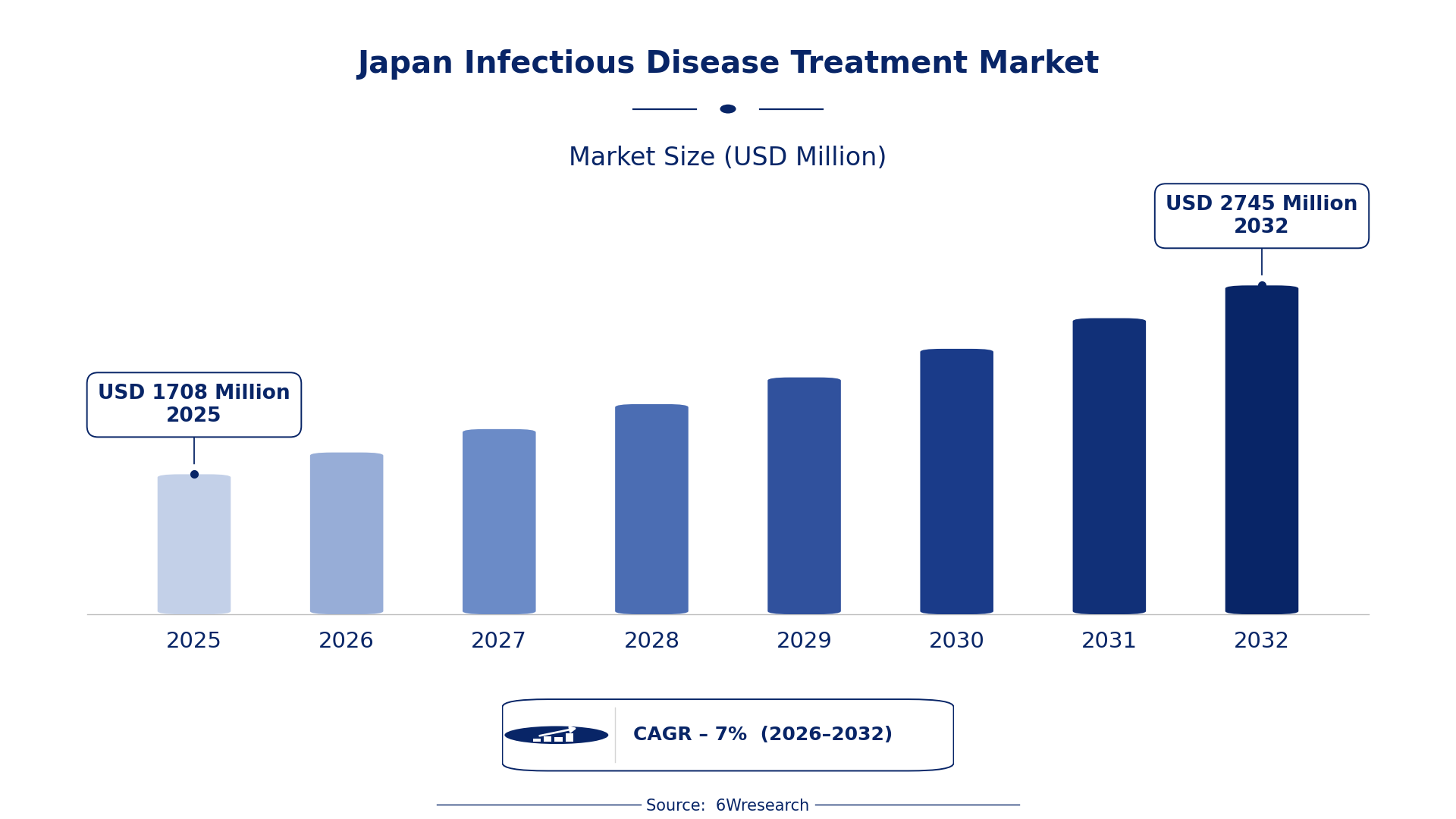
According to 6Wresearch internal database and industry insights, the Japan Infectious Disease Treatment Market was valued at USD 1,708 Million in 2025 and is projected to reach USD 2,745 Million by 2032, growing at a CAGR of approximately 7% during 2026–2032.
Japan Infectious Disease Treatment Market Highlights
| Report Metric | Details |
| Report Name | Japan Infectious Disease Treatment Market (2026-2032) |
| Market Size 2025 | USD 1,708 Million |
| Market Size 2032 | USD 2,745 Million |
| Absolute Growth 2025–2032 | USD 1,037 Million |
| CAGR 2026–2032 | 7% |
| Peak Annual Growth | 7.5% in 2032 |
| Forecast Period | 2026–2032 |
| Historical Data | 2022–2025 |
| Base Year | 2025 |
| Leading Treatment Type, 2025 | Antiviral Treatments (45% share) |
| Leading Disease Type, 2025 | Viral Infections (37% share) |
| Leading Drug Class, 2025 | Protease Inhibitors (41% share) |
| Leading Distribution Channel, 2025 | Hospital Pharmacies (47% share) |
| Fastest-Growing Treatment Type | Antibiotic Treatments (10.0% CAGR) |
| Fastest-Growing Disease Type | Bacterial Infections (9.8% CAGR) |
| Fastest-Growing Drug Class | Beta-Lactams (9.2% CAGR) |
| Fastest-Growing Distribution Channel | Retail Pharmacies (9.3% CAGR) |
| Growing Sector | pharmaceuticals |
| Key End Users | hospitals, specialty clinics, healthcare providers |
Japan Infectious Disease Treatment Market Year-wise Growth Rate and Key Drivers (2022–2032)
This graph illustrates the annual growth rates of the market from 2022 to 2032, highlighting a steady upward trajectory and projected market expansion over the forecast period.
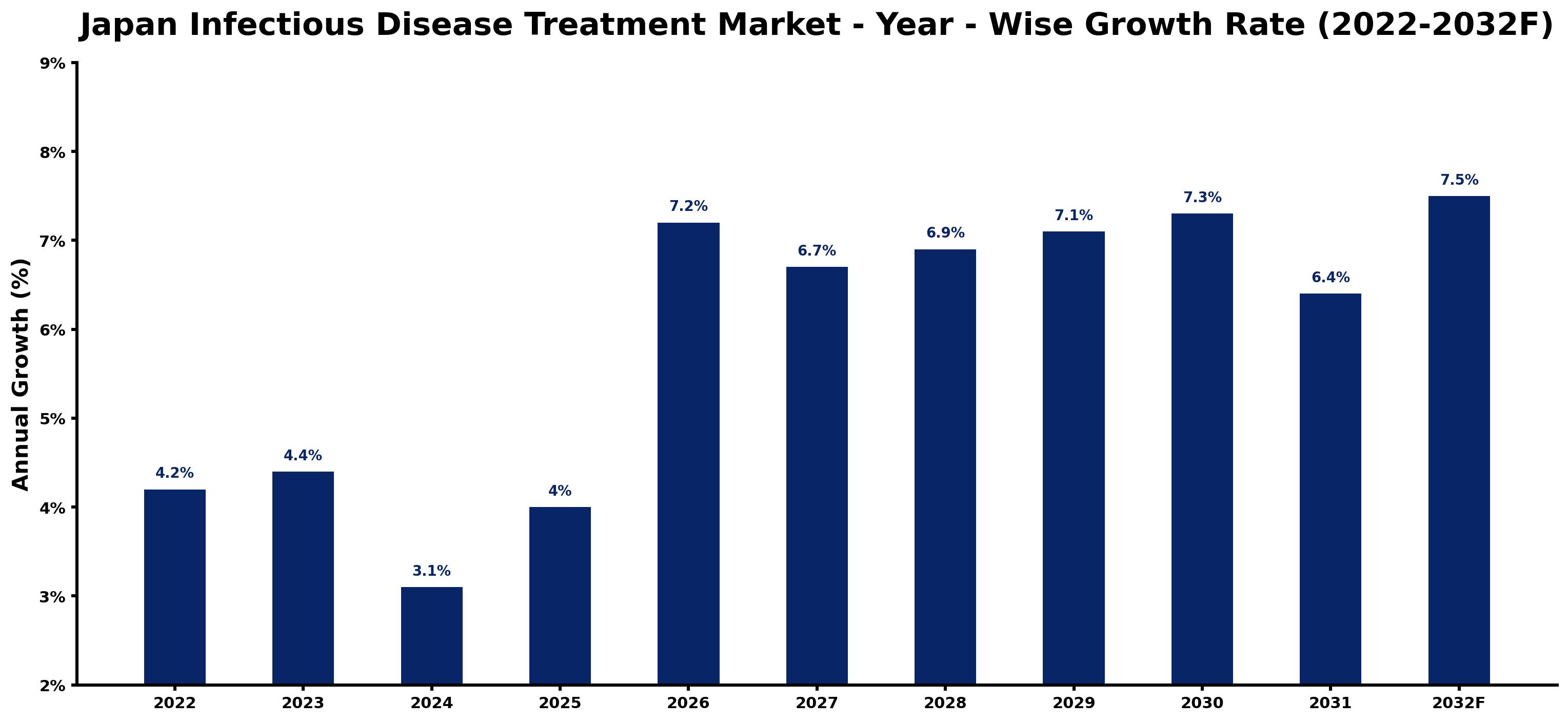
The table below sets out the estimated growth rate for each year and the main factor behind it.
| Year | Estimated Annual Growth (%) | Market Rationale |
| 2022 | 4.2 | The market experienced steady growth due to increased healthcare spending. |
| 2023 | 4.4 | Growth accelerated as hospitals expanded their infectious disease treatment capabilities. |
| 2024 | 3.1 | A slowdown occurred as demand stabilised after the previous year's surge. |
| 2025 | 4.0 | Growth resumed as healthcare providers increased their procurement of treatments. |
| 2026 | 7.2 | An upturn is expected as new antiviral treatments gain market approval. |
| 2027 | 6.7 | The growth rate is projected to slow as market saturation begins. |
| 2028 | 6.9 | Demand is likely to rise again with the introduction of new therapies. |
| 2029 | 7.1 | Healthcare infrastructure investment will support ongoing growth. |
| 2030 | 7.3 | The market is set to grow further as public health initiatives expand. |
| 2031 | 6.4 | A slowdown is anticipated as the market approaches maturity. |
| 2032 | 7.5 | Growth will peak as advanced treatments become widely available. |
Note: Market size estimations and growth projections presented in this report are based on 6Wresearch's proprietary forecasting methodology, utilizing the latest available industry data, government publications, and primary research inputs.
Japan Infectious Disease Treatment Market Synopsis
Infectious disease treatments encompass pharmaceuticals aimed at combating infections from various pathogens, produced through chemical synthesis and fermentation. These treatments play a crucial role in managing infections within healthcare facilities, curbing disease transmission, and addressing chronic conditions. The Japan Infectious Disease Treatment Market is growing due to increased healthcare expenditure, with over 8,000 hospitals offering treatment and antibiotics representing about 30% of pharmaceutical sales. Continuous research and development efforts are driving demand, especially for antiviral treatments that are vital for managing seasonal influenza, with more than 1 million cases reported each year.
Market Dynamics Impact Analysis (2026–2032)
| Factor | Type | Impact | Primary Segment Affected |
| Increasing healthcare expenditure drives demand for infectious disease treatments. | Driver | High | Antiviral Treatments |
| Growing incidence of viral infections creates a need for effective therapies. | Driver | High | Viral Infections |
| Rising antibiotic resistance presents opportunities for innovative treatment solutions. | Opportunity | High | Antibiotic Treatments |
| Expansion of hospital pharmacies enhances distribution capabilities for treatments. | Opportunity | Medium | Hospital Pharmacies |
| Regulatory hurdles can delay the approval of new treatments. | Restraint | High | Antiviral Treatments |
| Limited awareness of certain treatments may restrict market growth. | Restraint | Medium | Antibiotic Treatments |
| Supply chain disruptions can impact the availability of essential drugs. | Challenge | High | Antifungal Therapies |
| Competition from generic drugs can reduce market share for branded treatments. | Challenge | Medium | Antiparasitic Agents |
Evaluation of Drivers in Japan Infectious Disease Treatment Market (2026–2032)
Key forces behind demand, with the segment each one moves most, are listed below.
| Drivers | Primary Segment Affected | Why It Matters (Evidence) |
| Rising healthcare expenditure increases demand for infectious disease treatments. | Antiviral Treatments | In 2023, Japan's healthcare spending reached approximately USD 450 billion, prompting higher procurement of antiviral medications. |
| Growing incidence of viral infections necessitates effective treatment options. | Viral Infections | Japan reported over 1 million cases of viral infections annually, driving demand for antiviral therapies. |
| Ongoing research and development in pharmaceuticals drives innovation. | Antibiotic Treatments | Research initiatives promote the development of new antibiotics, enhancing treatment options. |
| Expansion of hospital pharmacies improves access to treatments. | Hospital Pharmacies | With over 8,000 hospitals in Japan, hospital pharmacies are essential for distributing infectious disease treatments. |
| Increased public awareness of infectious diseases boosts treatment demand. | Antifungal Therapies | Public health campaigns on fungal infections have raised awareness, leading to higher treatment rates. |
What keeps demand rising is the increasing healthcare expenditure in Japan, which reached approximately USD 450 billion in 2023, prompting hospitals to procure more antiviral treatments. The rising incidence of viral infections, with over 1 million cases reported annually, necessitates effective therapies. The expansion of hospital pharmacies improves access to essential treatments, while public awareness campaigns on infectious diseases have also contributed to increased treatment rates, particularly for antifungal therapies.
Evaluation of Restraints in Japan Infectious Disease Treatment Market
The key brakes on demand, and where they bite hardest, are shown below.
| Market Restraint | Primary Segment Affected | Why It Matters (Evidence) |
| Regulatory hurdles can delay the approval of new treatments. | Antiviral Treatments | The Ministry of Health, Labour and Welfare oversees drug approvals, which can extend timelines for new therapies. |
| Limited awareness of certain treatments may restrict market growth. | Antibiotic Treatments | Many patients remain unaware of available antibiotic options, limiting their usage. |
| Supply chain disruptions can impact the availability of essential drugs. | Antifungal Therapies | Recent global supply chain issues have affected the distribution of antifungal medications. |
| Competition from generic drugs can reduce market share for branded treatments. | Antiparasitic Agents | As generics become more prevalent, branded antiparasitic agents face declining sales. |
| High production costs can limit the availability of new treatments. | Antiviral Treatments | The complex synthesis processes for antiviral drugs lead to elevated production expenses. |
Japan Infectious Disease Treatment Market Challenges
Producers encounter a shortage of skilled professionals in infectious disease treatment, which delays the development of new therapies and affects patient care across over 8,000 hospitals. Regulatory complexities hinder the timely approval of drugs, as the Ministry of Health, Labour and Welfare's stringent guidelines can extend approval timelines by up to six months, impacting hospitals' ability to access necessary therapies. Supply chain disruptions lead to shortages of essential raw materials, causing production delays that prevent clinics from adequately addressing patient needs. Buyers face rising costs, with antibiotics accounting for around 30% of total pharmaceutical sales, forcing healthcare providers to allocate larger budgets for essential therapies.
Trends in the Japan Infectious Disease Treatment Market
Buyers and suppliers in the Japan Infectious Disease Treatment Market are adjusting to the following trends.
- Shift towards Digital Health Solutions: The Digital Agency, established in 2021, is promoting digital health solutions in Japan's healthcare sector. This shift aims to improve patient access to infectious disease treatments, with a target of increasing telehealth services by 30% by 2025.
- Growing Focus on Preventive Care: In 2023, Japan's healthcare system began prioritising preventive care, especially for infectious diseases. This shift is reflected in increased funding for vaccination programmes, with an allocation of USD 100 million to enhance public health initiatives.
- Rise of Home Healthcare Services: Home healthcare services have gained traction since 2022, allowing patients to receive infectious disease treatments at home. This trend is supported by a 20% increase in home healthcare providers in urban areas.
- Expansion of Specialty Clinics: Specialty clinics focusing on infectious diseases have emerged, particularly in metropolitan regions. In 2023, the number of specialty clinics increased by 15%, catering to specific treatment needs.
Investment Opportunities in the Japan Infectious Disease Treatment Market
Investors looking at the Japan Infectious Disease Treatment Market should consider the following areas.
- Growing Demand for Antiviral Treatments: With over 1 million annual viral infection cases, the demand for antiviral treatments is substantial. Investing in antiviral drug development can benefit healthcare providers in urban areas, where infection rates are highest.
- Investment in Antibiotic Research: The rising antibiotic resistance presents a critical opportunity for investment. Focusing on innovative antibiotic development can attract funding from healthcare providers in Japan, particularly in research institutions.
- Expansion of Hospital Pharmacies: The growing number of hospitals provides an opportunity to enhance distribution channels. Investing in hospital pharmacy infrastructure can improve access to infectious disease treatments, especially in rural areas.
- Increasing Role of Online Platforms: The rise of online platforms for pharmaceutical sales presents a gap in the market. Supplying treatments through these channels can reach a broader audience, particularly younger demographics.
Government Initiatives in the Japan Infectious Disease Treatment Market
The Medical Care Act, enacted in 1948, sets standards for hospitals and clinics, including facilities and staffing, which directly impacts the quality of infectious disease treatments. The Water Supply Act, enacted in 1957, sets standards for drinking-water quality and supply, which indirectly supports the health of populations by preventing waterborne diseases. The Sewerage Act, established in 1958, governs sewerage systems and wastewater treatment, ensuring sanitary conditions that reduce the spread of infectious diseases. Additionally, the National Health Insurance drug price standard, revised regularly, sets reimbursement prices for treatments, promoting accessibility for patients and incentivising providers to offer effective therapies.
Healthcare providers utilise the National Health Insurance scheme to cover various infectious disease treatments. The Ministry of Health, Labour and Welfare oversees this scheme, which ensures that patients have access to necessary medications without significant out-of-pocket costs. In 2023, approximately 80% of infectious disease treatments were covered under this scheme, enhancing patient compliance and treatment outcomes.
Future Insight of the Japan Infectious Disease Treatment Market
Investment in the infectious disease treatment sector will grow by 2032, driven by increased funding for research and development initiatives, resulting in a projected increase of 15% in available treatments. This growth will create heightened demand for new options, particularly as healthcare providers respond to the ongoing challenges of managing infections. Collaborations between research institutions and pharmaceutical manufacturers will lead to more effective treatment protocols. The implementation of advanced quality management standards will ensure that suppliers can consistently meet the rigorous demands of the healthcare system.
Market Segmentation Analysis
Japan Infectious Disease Treatment Market report covers a detailed analysis of the following market segments:
By Treatment Type – Antiviral Treatments Lead, Antibiotic Treatments Expected to Grow Fastest
According to Saurav Kr Singh, Senior Research Analyst at 6Wresearch, Antiviral Treatments held 45% of the Japan Infectious Disease Treatment Market by treatment type in 2025. Antiviral treatments command the largest share as they are essential for managing seasonal influenza and other viral infections prevalent in Japan. The high incidence of over 1 million reported cases of viral infections annually underscores the reliance on these therapies by healthcare providers. Antibiotic Treatments are set to record the highest CAGR in this split, 10.0% over 2026–2032. The antibiotic treatments segment is growing rapidly due to rising concerns over antibiotic-resistant strains, which necessitate effective management of bacterial infections. This urgency is reflected in antibiotics accounting for around 30% of total pharmaceutical sales in Japan, indicating a strong market demand. Suppliers should prioritise their antiviral and antibiotic product lines to align with the increasing healthcare demands.
By Disease Type – Viral Infections Lead, Bacterial Infections Expected to Grow Fastest
The largest disease type category in 2025 was Viral Infections, at 37% of revenue. Viral infections dominate the market as they are the major focus of treatment efforts, particularly during peak flu seasons. The annual reporting of over 1 million viral infection cases underscores the critical need for effective treatment options, reinforcing this segment's leading position. Over 2026–2032, Bacterial Infections are expected to post the fastest growth, at a CAGR of 9.8%. Bacterial infections are experiencing rapid growth due to the rising incidence of antibiotic-resistant bacteria, necessitating the development of new treatment solutions. This trend encourages healthcare providers to focus on enhancing antibiotic therapies, further driving the segment's expansion. Suppliers must prioritise the development of effective treatments for both viral and bacterial infections to meet growing healthcare demands.
By Drug Class – Protease Inhibitors Lead, Beta-Lactams Expected to Grow Fastest
In 2025, Protease Inhibitors led the drug class split with a 41% share. Protease inhibitors are the leading drug class as they are essential for the effective treatment of various viral infections, particularly in the context of antiviral therapies. Their critical role in managing these infections has established a strong demand within the healthcare system. Beta-Lactams are projected to grow fastest, at a CAGR of 9.2% during 2026–2032. Beta-lactams are rapidly growing in popularity due to their widespread use as a primary antibiotic class for bacterial infections, which are increasingly being targeted for treatment. The urgency to combat bacterial infections is propelling this segment's growth. Suppliers should invest in the development of protease inhibitors and beta-lactams to align with market needs.
By Distribution Channel – Hospital Pharmacies Lead, Retail Pharmacies Expected to Grow Fastest
Hospital Pharmacies took 47% of distribution channel revenue in 2025, more than any other category. Hospital pharmacies are the primary distribution point for infectious disease treatments, ensuring direct access to necessary medications for healthcare providers and patients. With over 8,000 hospitals in Japan, this channel plays a crucial role in delivering timely treatments. The quickest growth will come from Retail Pharmacies, forecast to expand at a CAGR of 9.3% between 2026 and 2032. Retail pharmacies are growing rapidly as patients increasingly seek convenient access to treatments outside hospital settings, reflecting a shift in consumer preferences. This trend indicates a need for suppliers to adapt their distribution strategies to meet changing patient behaviours. Suppliers should consider expanding their partnerships with retail pharmacies to enhance accessibility for patients.
Key Attractiveness of the Report
- 10 Years of Market Numbers
- Historical Data Starting from 2022 to 2025
- Base Year 2025
- Forecast Data until 2032
- Key Performance Indicators Impacting the Market
- Major Upcoming Developments and Projects
Key Highlights of the Report:
- Japan Infectious Disease Treatment Market Outlook
- Market Size of Japan Infectious Disease Treatment Market, 2025
- Forecast of Japan Infectious Disease Treatment Market, 2032
- Historical Data and Forecast of Japan Infectious Disease Treatment Revenues & Volume for the Period 2022-2032F
- Japan Infectious Disease Treatment Market Trend Evolution
- Japan Infectious Disease Treatment Market Drivers and Challenges
- Japan Infectious Disease Treatment Price Trends
- Japan Infectious Disease Treatment Porter's Five Forces
- Japan Infectious Disease Treatment Industry Life Cycle
- Historical Data and Forecast of Japan Infectious Disease Treatment Market Revenues & Volume By Treatment Type for the Period 2022-2032F
- Historical Data and Forecast of Japan Infectious Disease Treatment Market Revenues & Volume By Antiviral Treatments for the Period 2022-2032F
- Historical Data and Forecast of Japan Infectious Disease Treatment Market Revenues & Volume By Antibiotic Treatments for the Period 2022-2032F
- Historical Data and Forecast of Japan Infectious Disease Treatment Market Revenues & Volume By Antifungal Therapies for the Period 2022-2032F
- Historical Data and Forecast of Japan Infectious Disease Treatment Market Revenues & Volume By Antiparasitic Agents for the Period 2022-2032F
- Historical Data and Forecast of Japan Infectious Disease Treatment Market Revenues & Volume By Disease Type for the Period 2022-2032F
- Historical Data and Forecast of Japan Infectious Disease Treatment Market Revenues & Volume By Viral Infections for the Period 2022-2032F
- Historical Data and Forecast of Japan Infectious Disease Treatment Market Revenues & Volume By Bacterial Infections for the Period 2022-2032F
- Historical Data and Forecast of Japan Infectious Disease Treatment Market Revenues & Volume By Fungal Infections for the Period 2022-2032F
- Historical Data and Forecast of Japan Infectious Disease Treatment Market Revenues & Volume By Parasitic Infections for the Period 2022-2032F
- Historical Data and Forecast of Japan Infectious Disease Treatment Market Revenues & Volume By Treatment Type for the Period 2022-2032F
- Historical Data and Forecast of Japan Infectious Disease Treatment Market Revenues & Volume By Oral Antiviral for the Period 2022-2032F
- Historical Data and Forecast of Japan Infectious Disease Treatment Market Revenues & Volume By IV/IM Antibiotic for the Period 2022-2032F
- Historical Data and Forecast of Japan Infectious Disease Treatment Market Revenues & Volume By Topical/Oral for the Period 2022-2032F
- Historical Data and Forecast of Japan Infectious Disease Treatment Market Revenues & Volume By Combination Therapy for the Period 2022-2032F
- Historical Data and Forecast of Japan Infectious Disease Treatment Market Revenues & Volume By Drug Class for the Period 2022-2032F
- Historical Data and Forecast of Japan Infectious Disease Treatment Market Revenues & Volume By Protease Inhibitors for the Period 2022-2032F
- Historical Data and Forecast of Japan Infectious Disease Treatment Market Revenues & Volume By Beta-Lactams for the Period 2022-2032F
- Historical Data and Forecast of Japan Infectious Disease Treatment Market Revenues & Volume By Azoles/Polyenes for the Period 2022-2032F
- Historical Data and Forecast of Japan Infectious Disease Treatment Market Revenues & Volume By Artemisinins for the Period 2022-2032F
- Historical Data and Forecast of Japan Infectious Disease Treatment Market Revenues & Volume By Distribution Channel for the Period 2022-2032F
- Historical Data and Forecast of Japan Infectious Disease Treatment Market Revenues & Volume By Hospital Pharmacies for the Period 2022-2032F
- Historical Data and Forecast of Japan Infectious Disease Treatment Market Revenues & Volume By Retail Pharmacies for the Period 2022-2032F
- Historical Data and Forecast of Japan Infectious Disease Treatment Market Revenues & Volume By Specialty Clinics for the Period 2022-2032F
- Historical Data and Forecast of Japan Infectious Disease Treatment Market Revenues & Volume By Online Platforms for the Period 2022-2032F
- Japan Infectious Disease Treatment Import Export Trade Statistics
- Market Opportunity Assessment By Treatment Type
- Market Opportunity Assessment By Disease Type
- Market Opportunity Assessment By Treatment Type
- Market Opportunity Assessment By Drug Class
- Market Opportunity Assessment By Distribution Channel
- Japan Infectious Disease Treatment Top Companies Market Share
- Japan Infectious Disease Treatment Competitive Benchmarking By Technical and Operational Parameters
- Japan Infectious Disease Treatment Company Profiles
- Japan Infectious Disease Treatment Key Strategic Recommendations
Market Covered
This report examines the market across the segments below.
By Treatment Type
- Antiviral Treatments
- Antibiotic Treatments
- Antifungal Therapies
- Antiparasitic Agents
By Disease Type
- Viral Infections
- Bacterial Infections
- Fungal Infections
- Parasitic Infections
By Drug Class
- Protease Inhibitors
- Beta-Lactams
- Azoles/Polyenes
- Artemisinins
By Distribution Channel
- Hospital Pharmacies
- Retail Pharmacies
- Specialty Clinics
- Online Platforms































